Business Report: Comparing Golden Harvest Agro & DASCOH Bangladesh
VerifiedAdded on 2021/11/16
|32
|8385
|55
Report
AI Summary
This report, submitted by a student, compares and contrasts two distinct business organizations: Golden Harvest Agro Industries Ltd. (GHAIL), a public limited company manufacturing frozen food, and DASCOH Bangladesh, a non-profit organization focused on rural development. The report defines key business concepts such as product vs. service, private vs. public vs. non-profit organizational structures, liabilities, and scope and size of business. It then provides detailed information on GHAIL and DASCOH, including their purposes, sizes, sectors, and liabilities. The report further explores the concept of stakeholders, categorizing them as internal and external, and analyzes the roles and influences of various stakeholders for both organizations, including directors, investors, employees, government, customers, local communities, suppliers, media, and consumers. The analysis includes the impact of stakeholder groups on the business operations and strategic decisions of both GHAIL and DASCOH.
Submitted by:
SHAHRIAR SHAMIR HASAN
ID: 2021126004
ND in Business
SHAHRIAR SHAMIR HASAN
ID: 2021126004
ND in Business

Paraphrase This Document
Need a fresh take? Get an instant paraphrase of this document with our AI Paraphraser
As a Research Assistant at SGRB , I have made the following report on two contrasting business
organization. They are; Golden Harvest Agro Industries Ltd. (GHAIL), DASCOH Bangladesh (non-
profit organization). GHAIL is a manufacturing company which makes frozen ready to cook food in
Bangladesh and DASCOH is a nonprofit organization that provides training and helps improve
infrastructure to rural communities for improving their lifestyle. Both organizations have numbers of
stakeholders both internal and external. These stakeholder helps the organization in maintaining
themselves and providing goods and services to the targeted people. Both organizations have aims
and objectives that defines them. The report contains information on various factors that influences a
business and also information that is collected using various tools for analysis such as; SWOT,
pestle.
organization. They are; Golden Harvest Agro Industries Ltd. (GHAIL), DASCOH Bangladesh (non-
profit organization). GHAIL is a manufacturing company which makes frozen ready to cook food in
Bangladesh and DASCOH is a nonprofit organization that provides training and helps improve
infrastructure to rural communities for improving their lifestyle. Both organizations have numbers of
stakeholders both internal and external. These stakeholder helps the organization in maintaining
themselves and providing goods and services to the targeted people. Both organizations have aims
and objectives that defines them. The report contains information on various factors that influences a
business and also information that is collected using various tools for analysis such as; SWOT,
pestle.
P1
Business: It is an organized economic activity of individuals which involves the process of making a
profit by fulfilling the demands of customers by manufacturing goods, or reselling certain products
or services. The primary goal of a business is to gain the targeted profit. To gain profit a business
sells two kinds of items, they are;
Product: It is a form of item that is offered to the general civilians or individuals for solving
or satisfying their needs, demands for any specific reason. A product usually comes with a
price that depends on the market, quality, and other vital segments.
Service: It is an intangible item that is produced by an individual or an entity that involves an
action or a procedure that will help solve a particular problem of another entity or individual.
(Phillips et al., 2016)
There are three kinds of ways an organization can run itself, they are; Private, Public and
Not-for profit, we have explained below the three categories and their sub categories;
PRIVATE
o Sole Trader: A sole trader is also known as a sole proprietorship, is a form of
business that is owned by an individual, it is a typical business that is simple and easy
to establish. The owner is responsible for all aspects of the business; therefore, the
debts and losses can’t be held for anyone other than the owner. The owner also does
not need to share the profit with anyone. The owner may employ other workers to
help the business grow.
o Partnership: It is also a form of business where an agreement is held between two or
more individuals, these individuals are stated as business partners, and the agreement
dictates terms and conditions by which the business will run, and how the shares of
profit and liabilities will be divided among the partners.
o Limited company: A limited company is a separate legal entity, is operated by
several owners. Limited company owners are not personally liable for the company’s
debts; therefore, it offers financial protection to the owners and its shareholders.
o Public limited company: A public limited company is a limited liability company
that has legal permission for selling its share to the public. A PLC (public limited
company) needs a minimum of seven members to a maximum of having unlimited
Business: It is an organized economic activity of individuals which involves the process of making a
profit by fulfilling the demands of customers by manufacturing goods, or reselling certain products
or services. The primary goal of a business is to gain the targeted profit. To gain profit a business
sells two kinds of items, they are;
Product: It is a form of item that is offered to the general civilians or individuals for solving
or satisfying their needs, demands for any specific reason. A product usually comes with a
price that depends on the market, quality, and other vital segments.
Service: It is an intangible item that is produced by an individual or an entity that involves an
action or a procedure that will help solve a particular problem of another entity or individual.
(Phillips et al., 2016)
There are three kinds of ways an organization can run itself, they are; Private, Public and
Not-for profit, we have explained below the three categories and their sub categories;
PRIVATE
o Sole Trader: A sole trader is also known as a sole proprietorship, is a form of
business that is owned by an individual, it is a typical business that is simple and easy
to establish. The owner is responsible for all aspects of the business; therefore, the
debts and losses can’t be held for anyone other than the owner. The owner also does
not need to share the profit with anyone. The owner may employ other workers to
help the business grow.
o Partnership: It is also a form of business where an agreement is held between two or
more individuals, these individuals are stated as business partners, and the agreement
dictates terms and conditions by which the business will run, and how the shares of
profit and liabilities will be divided among the partners.
o Limited company: A limited company is a separate legal entity, is operated by
several owners. Limited company owners are not personally liable for the company’s
debts; therefore, it offers financial protection to the owners and its shareholders.
o Public limited company: A public limited company is a limited liability company
that has legal permission for selling its share to the public. A PLC (public limited
company) needs a minimum of seven members to a maximum of having unlimited
⊘ This is a preview!⊘
Do you want full access?
Subscribe today to unlock all pages.

Trusted by 1+ million students worldwide
members. A PLC is great for raising capital by selling shares to the public, and the
share of a public limited company is available for the general public to buy from a
stock exchange. Also, since legally it is a limited liability company, the owners and
management have limited responsibilities. A public limited company is required to
publish its annual report and financial information, maintaining a high level of
transparency of its accounting and auditing information.
o Private limited company: A private limited company or LTD. is a privately owned
business entity that is maintained by a small group of individuals. A private limited
company does not share detailed information with the public or the government. This
type of company does not sell the share on the stock exchange, the owner holds all the
shares and only sells shares to anyone specific if all the shareholders agree on it. Since
it is a limited liability company, the owners are not responsible personally for the
debts but rather the company is responsible.
o Cooperative: A cooperative is a type of business that is owned and operated for the
necessity of their members, this necessity might include social, economic and cultural
needs in a cooperative business model all members hold equal rights in the decision
making, events of the business.
(Bentley et al., 2013)
PUBLIC:
o Government owned: A government owned business is a type of business that is
controlled by government, either fully or partially government owned enterprises have
a distinctive legal structure and they are established to operate in Commercial Affairs
and activities.
Not-for-Profit
o Charitable organization: It is a type of nonprofit organization that is established for
charitable purposes a charitable organization helps society or a particular group of
people in a society. It has many definitive perfect purposes, but goes beyond the relief
for poor and homeless, such as the betterment of society.
o Voluntary organization: It is a type of nonprofit organization which emphasizes on
something else rather than earning profit for its owner. The term voluntary is used
share of a public limited company is available for the general public to buy from a
stock exchange. Also, since legally it is a limited liability company, the owners and
management have limited responsibilities. A public limited company is required to
publish its annual report and financial information, maintaining a high level of
transparency of its accounting and auditing information.
o Private limited company: A private limited company or LTD. is a privately owned
business entity that is maintained by a small group of individuals. A private limited
company does not share detailed information with the public or the government. This
type of company does not sell the share on the stock exchange, the owner holds all the
shares and only sells shares to anyone specific if all the shareholders agree on it. Since
it is a limited liability company, the owners are not responsible personally for the
debts but rather the company is responsible.
o Cooperative: A cooperative is a type of business that is owned and operated for the
necessity of their members, this necessity might include social, economic and cultural
needs in a cooperative business model all members hold equal rights in the decision
making, events of the business.
(Bentley et al., 2013)
PUBLIC:
o Government owned: A government owned business is a type of business that is
controlled by government, either fully or partially government owned enterprises have
a distinctive legal structure and they are established to operate in Commercial Affairs
and activities.
Not-for-Profit
o Charitable organization: It is a type of nonprofit organization that is established for
charitable purposes a charitable organization helps society or a particular group of
people in a society. It has many definitive perfect purposes, but goes beyond the relief
for poor and homeless, such as the betterment of society.
o Voluntary organization: It is a type of nonprofit organization which emphasizes on
something else rather than earning profit for its owner. The term voluntary is used
Paraphrase This Document
Need a fresh take? Get an instant paraphrase of this document with our AI Paraphraser
because individuals that joins the organization have common interests that merges
with the organizations interests.
(Phillips et al., 2016)
Liability
It is the legal obligation of a company or owner which they have to pay to other person, entity or
organization. Liability can be of two forms;
Limited liability: It is a concept that dictates the business owner or owner’s liability is
limited to the amount invested in the business.
Unlimited liability: This concept dictates the owners and shareholders takes full
responsibility of the all the business debts, which means the debts can be paid by seizing or
selling owner’s personal assets.
Scope of Business
Scope of a business defines the coverage of business in terms of geography, and can be categorized
into three forms;
o Local: Means the business sells its products to the local market in its own city or
town
o National: This scope defines that the organizations sell it products to consumers all
the over the country.
o International: This scope refers to the organization when it sells it product to
consumers around the globe.
Size of Business: A size of business can be of four types, which are stated below:
Micro: Consist of 1 to 9 members as their staff or employees.
Small: Consist of 10 to 49 members as their staff or employees.
Medium: Consist of 50 to 249 working as for the organization
Large: Consist of 250 or more employees.
Below we have selected two contrasting organizations, for which we will explain their features,
goals, size, scopes and liabilities:
with the organizations interests.
(Phillips et al., 2016)
Liability
It is the legal obligation of a company or owner which they have to pay to other person, entity or
organization. Liability can be of two forms;
Limited liability: It is a concept that dictates the business owner or owner’s liability is
limited to the amount invested in the business.
Unlimited liability: This concept dictates the owners and shareholders takes full
responsibility of the all the business debts, which means the debts can be paid by seizing or
selling owner’s personal assets.
Scope of Business
Scope of a business defines the coverage of business in terms of geography, and can be categorized
into three forms;
o Local: Means the business sells its products to the local market in its own city or
town
o National: This scope defines that the organizations sell it products to consumers all
the over the country.
o International: This scope refers to the organization when it sells it product to
consumers around the globe.
Size of Business: A size of business can be of four types, which are stated below:
Micro: Consist of 1 to 9 members as their staff or employees.
Small: Consist of 10 to 49 members as their staff or employees.
Medium: Consist of 50 to 249 working as for the organization
Large: Consist of 250 or more employees.
Below we have selected two contrasting organizations, for which we will explain their features,
goals, size, scopes and liabilities:
Non-profit organization
1. DASCOH (Development association for self-reliance, Communication, and health)
DASCOH is a non-government and non-profit organization that is a voluntary organization in
accordance with the SWISS Civil code of conduct. Though it is registered as a Swiss
international NGO and its HQ is in Berne, in 1995 it started in operations in Bangladesh
registering under NGO Affairs Bureau under ‘The Foreign Donations (Voluntary Activities)
Regulation Ordinance, 1978. Currently in Bangladesh DASCOH HQ is situated in
RAJSHAHI. (DASCOH Bangladesh, 2021.)
PURPOSES OF THE ORGANIZATION
DASCOH vision is to create and maintain an enabling environment that ensures equal access
to state and non-state resources to reduce poverty, and its mission is to empower the poor and
marginalized communities by complementing and complementing development objectives
and by helping local governments to build straightforward, adaptable and viable processes
and systems to provide assistance, and to further develop and strengthen alliances with
foreign, national and community-based organizations. DASCOH Bangladesh is able to
empower rural poor and neglected populations through the creation and delivery of nationally
oriented services, supporting local authorities in the development of transparent, sensitive and
sustainable service delivery systems and processes and continuing to innovate and strengthen
international, national and community-based or community partnership.
(DASCOH Bangladesh, 2021.)
SIZE
DASCOH can be classified as a large non-profit organization, the company size is around
201- 500 employees working for them. DASCOH can be classified as an international non-
profit organization.
SECTOR
DASCOH can be classified under tertiary sector as they are involved skills development
program, provides training to local rural people and also helps provide support to local
government employees.
LIABILITIES
1. DASCOH (Development association for self-reliance, Communication, and health)
DASCOH is a non-government and non-profit organization that is a voluntary organization in
accordance with the SWISS Civil code of conduct. Though it is registered as a Swiss
international NGO and its HQ is in Berne, in 1995 it started in operations in Bangladesh
registering under NGO Affairs Bureau under ‘The Foreign Donations (Voluntary Activities)
Regulation Ordinance, 1978. Currently in Bangladesh DASCOH HQ is situated in
RAJSHAHI. (DASCOH Bangladesh, 2021.)
PURPOSES OF THE ORGANIZATION
DASCOH vision is to create and maintain an enabling environment that ensures equal access
to state and non-state resources to reduce poverty, and its mission is to empower the poor and
marginalized communities by complementing and complementing development objectives
and by helping local governments to build straightforward, adaptable and viable processes
and systems to provide assistance, and to further develop and strengthen alliances with
foreign, national and community-based organizations. DASCOH Bangladesh is able to
empower rural poor and neglected populations through the creation and delivery of nationally
oriented services, supporting local authorities in the development of transparent, sensitive and
sustainable service delivery systems and processes and continuing to innovate and strengthen
international, national and community-based or community partnership.
(DASCOH Bangladesh, 2021.)
SIZE
DASCOH can be classified as a large non-profit organization, the company size is around
201- 500 employees working for them. DASCOH can be classified as an international non-
profit organization.
SECTOR
DASCOH can be classified under tertiary sector as they are involved skills development
program, provides training to local rural people and also helps provide support to local
government employees.
LIABILITIES
⊘ This is a preview!⊘
Do you want full access?
Subscribe today to unlock all pages.
Trusted by 1+ million students worldwide
The governing body of DASCOH is legally liable for all kinds of liabilities.
Public limited company
2. GOLDEN HARVEST AGRO INDUSTRIES LTD.
Golden harvest AGRO industries Ltd is official publicly listed company that sells ready to eat
frozen food. According to the supply chain of the firm, more than 100,000 agricultural
partners in Bangladesh make up 95% of the raw materials. A team of industry professionals
equipped and maintained at the Gazipur food processing facility with the newest technology
and state-of-the-art gear. (GHAIL, 2020)
SCOPE OF ORGANIZATION
The company is involved in the distribution of their product for both national and
international markets, they export to countries like; USA, Canada, Australia, Middle East,
and few selected European countries.
PURPOSE OF THE ORGANIZATION
The company's mission is to provide the nation with a pioneering innovative product that can
satisfy consumer demands. The vision of the organization is to provide safe and affordable
food for everyone. To be the purest and safest frozen food and beverage produced in the
world by a socially responsible Bangladeshi company.
SIZE
The organization is classified as a large organization as it has a total number of over 500
employees.
SECTOR
GOLDEN harvest AGRO can classified in the secondary sector as they are involved in
processing raw materials into finished goods.
LIABILITIES
Since it is a public limited company, the shareholders are liable for nominal value of shares,
also, shareholders are limited to the specific amount they have contributed.
Public limited company
2. GOLDEN HARVEST AGRO INDUSTRIES LTD.
Golden harvest AGRO industries Ltd is official publicly listed company that sells ready to eat
frozen food. According to the supply chain of the firm, more than 100,000 agricultural
partners in Bangladesh make up 95% of the raw materials. A team of industry professionals
equipped and maintained at the Gazipur food processing facility with the newest technology
and state-of-the-art gear. (GHAIL, 2020)
SCOPE OF ORGANIZATION
The company is involved in the distribution of their product for both national and
international markets, they export to countries like; USA, Canada, Australia, Middle East,
and few selected European countries.
PURPOSE OF THE ORGANIZATION
The company's mission is to provide the nation with a pioneering innovative product that can
satisfy consumer demands. The vision of the organization is to provide safe and affordable
food for everyone. To be the purest and safest frozen food and beverage produced in the
world by a socially responsible Bangladeshi company.
SIZE
The organization is classified as a large organization as it has a total number of over 500
employees.
SECTOR
GOLDEN harvest AGRO can classified in the secondary sector as they are involved in
processing raw materials into finished goods.
LIABILITIES
Since it is a public limited company, the shareholders are liable for nominal value of shares,
also, shareholders are limited to the specific amount they have contributed.
Paraphrase This Document
Need a fresh take? Get an instant paraphrase of this document with our AI Paraphraser
P2
Definition of Stakeholder
Stakeholder can be a person, a social group or an organization that has effect or be affected by the
business. Thus, a stakeholder will have interest in the organization and outcomes that comes from
certain actions and decision.
Classification of Stakeholder
Stakeholder can be divided into two categories, below is the following categories;
Internal: Internal stakeholders are individuals who have direct concern in a business, or have
a direct relationship with the business or organization.
External: External stakeholder is an entity that does not work for the particular business or
organization but affected by its activities or has an effect on the business or organization.
(Bentley et al., 2013)
Now we will show the stakeholder and their roles for our two-contrasting organization;
1. GOLDEN HARVEST AGRO INDUSTRIES LTD.
GOLDEN HARVEST AGRO INDUSTRIES LTD is an organization that manufactures frozen snack
type foods like; Singara, Samosa, Tehari, Fish ball, Nuggets, Sausages and many other varieties of
delicious foods. They mostly collect raw materials and process them into finished frozen product for
the mass population. Below is a list consisting of stakeholders of GOLDEN HARVEST AGRO
INDUSTRIES LTD. (Annual Report 2020 GHAIL, 2020). Below we have separated the
following stakeholders into two categories;
Definition of Stakeholder
Stakeholder can be a person, a social group or an organization that has effect or be affected by the
business. Thus, a stakeholder will have interest in the organization and outcomes that comes from
certain actions and decision.
Classification of Stakeholder
Stakeholder can be divided into two categories, below is the following categories;
Internal: Internal stakeholders are individuals who have direct concern in a business, or have
a direct relationship with the business or organization.
External: External stakeholder is an entity that does not work for the particular business or
organization but affected by its activities or has an effect on the business or organization.
(Bentley et al., 2013)
Now we will show the stakeholder and their roles for our two-contrasting organization;
1. GOLDEN HARVEST AGRO INDUSTRIES LTD.
GOLDEN HARVEST AGRO INDUSTRIES LTD is an organization that manufactures frozen snack
type foods like; Singara, Samosa, Tehari, Fish ball, Nuggets, Sausages and many other varieties of
delicious foods. They mostly collect raw materials and process them into finished frozen product for
the mass population. Below is a list consisting of stakeholders of GOLDEN HARVEST AGRO
INDUSTRIES LTD. (Annual Report 2020 GHAIL, 2020). Below we have separated the
following stakeholders into two categories;
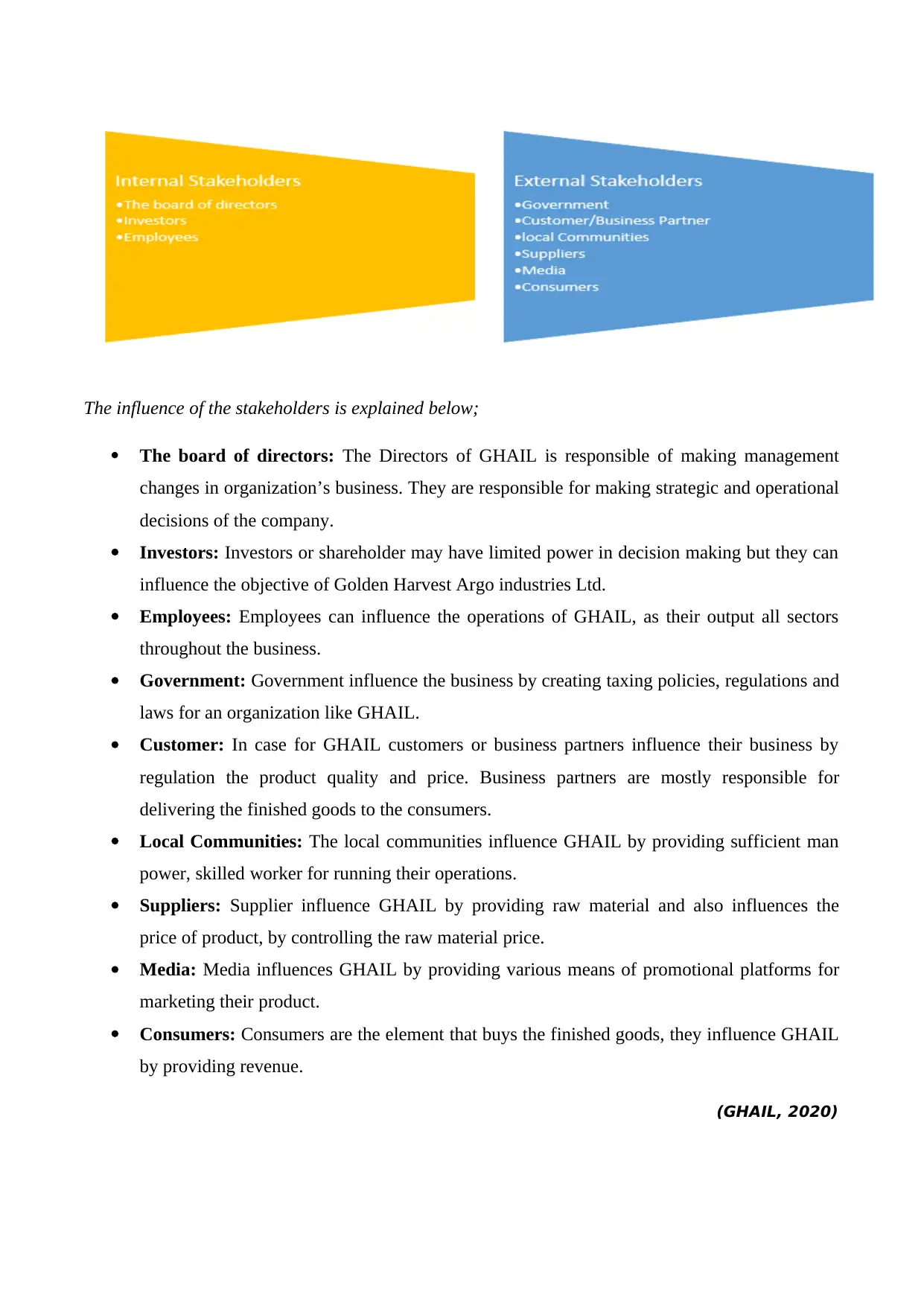
The influence of the stakeholders is explained below;
The board of directors: The Directors of GHAIL is responsible of making management
changes in organization’s business. They are responsible for making strategic and operational
decisions of the company.
Investors: Investors or shareholder may have limited power in decision making but they can
influence the objective of Golden Harvest Argo industries Ltd.
Employees: Employees can influence the operations of GHAIL, as their output all sectors
throughout the business.
Government: Government influence the business by creating taxing policies, regulations and
laws for an organization like GHAIL.
Customer: In case for GHAIL customers or business partners influence their business by
regulation the product quality and price. Business partners are mostly responsible for
delivering the finished goods to the consumers.
Local Communities: The local communities influence GHAIL by providing sufficient man
power, skilled worker for running their operations.
Suppliers: Supplier influence GHAIL by providing raw material and also influences the
price of product, by controlling the raw material price.
Media: Media influences GHAIL by providing various means of promotional platforms for
marketing their product.
Consumers: Consumers are the element that buys the finished goods, they influence GHAIL
by providing revenue.
(GHAIL, 2020)
The board of directors: The Directors of GHAIL is responsible of making management
changes in organization’s business. They are responsible for making strategic and operational
decisions of the company.
Investors: Investors or shareholder may have limited power in decision making but they can
influence the objective of Golden Harvest Argo industries Ltd.
Employees: Employees can influence the operations of GHAIL, as their output all sectors
throughout the business.
Government: Government influence the business by creating taxing policies, regulations and
laws for an organization like GHAIL.
Customer: In case for GHAIL customers or business partners influence their business by
regulation the product quality and price. Business partners are mostly responsible for
delivering the finished goods to the consumers.
Local Communities: The local communities influence GHAIL by providing sufficient man
power, skilled worker for running their operations.
Suppliers: Supplier influence GHAIL by providing raw material and also influences the
price of product, by controlling the raw material price.
Media: Media influences GHAIL by providing various means of promotional platforms for
marketing their product.
Consumers: Consumers are the element that buys the finished goods, they influence GHAIL
by providing revenue.
(GHAIL, 2020)
⊘ This is a preview!⊘
Do you want full access?
Subscribe today to unlock all pages.
Trusted by 1+ million students worldwide
2. DASCOH (Development association for self-reliance, Communication, and health)
DASCOH is a non-government and non-profit organization that provides training, infrastructure
upgrade and support to village people in Bangladesh. They also provide various kinds of training to
local government employees that will help the betterment of the society. Though it is Swiss
international NGO, it has registered to operate in Bangladesh legally with its HQ situated in
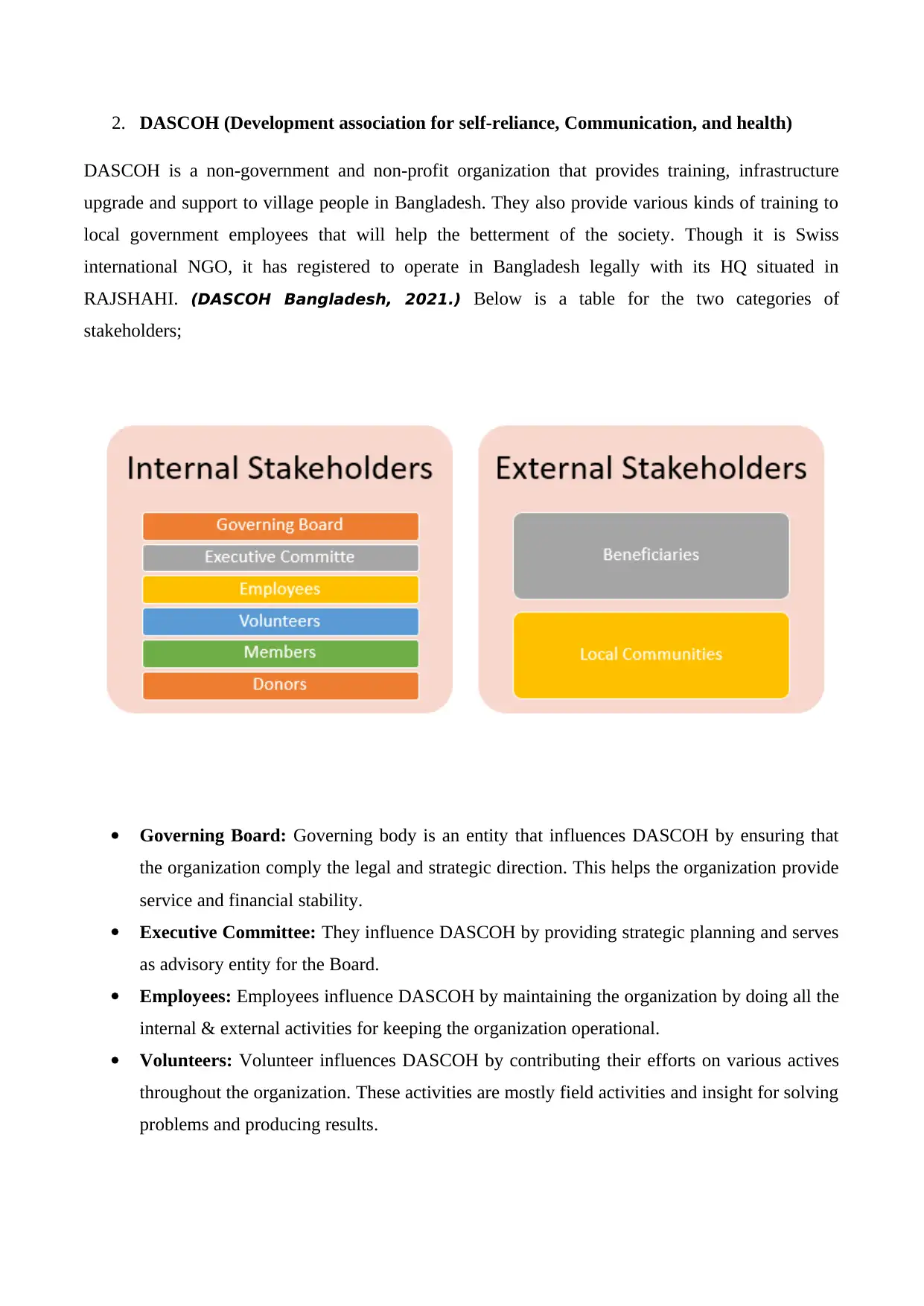
RAJSHAHI. (DASCOH Bangladesh, 2021.) Below is a table for the two categories of
stakeholders;
Governing Board: Governing body is an entity that influences DASCOH by ensuring that
the organization comply the legal and strategic direction. This helps the organization provide
service and financial stability.
Executive Committee: They influence DASCOH by providing strategic planning and serves
as advisory entity for the Board.
Employees: Employees influence DASCOH by maintaining the organization by doing all the
internal & external activities for keeping the organization operational.
Volunteers: Volunteer influences DASCOH by contributing their efforts on various actives
throughout the organization. These activities are mostly field activities and insight for solving
problems and producing results.
DASCOH is a non-government and non-profit organization that provides training, infrastructure
upgrade and support to village people in Bangladesh. They also provide various kinds of training to
local government employees that will help the betterment of the society. Though it is Swiss
international NGO, it has registered to operate in Bangladesh legally with its HQ situated in
RAJSHAHI. (DASCOH Bangladesh, 2021.) Below is a table for the two categories of
stakeholders;
Governing Board: Governing body is an entity that influences DASCOH by ensuring that
the organization comply the legal and strategic direction. This helps the organization provide
service and financial stability.
Executive Committee: They influence DASCOH by providing strategic planning and serves
as advisory entity for the Board.
Employees: Employees influence DASCOH by maintaining the organization by doing all the
internal & external activities for keeping the organization operational.
Volunteers: Volunteer influences DASCOH by contributing their efforts on various actives
throughout the organization. These activities are mostly field activities and insight for solving
problems and producing results.
Paraphrase This Document
Need a fresh take? Get an instant paraphrase of this document with our AI Paraphraser
Members: They influence the organization by providing various kinds of supports as well,
members consist of individual located in various location for maintaining activities for an
organization.
Donors: They influence DASCOH by providing various supports and resources which is
vital for the organization’s survival.
Beneficiaries: They influence DASCOH directly as they control the services that are needed
to be provided by DASCOH.
Local Communities: They influence DASCOH by participating in various projects which
helps them improve their lives, furthermore local communities help the organization by
staying with projects.
members consist of individual located in various location for maintaining activities for an
organization.
Donors: They influence DASCOH by providing various supports and resources which is
vital for the organization’s survival.
Beneficiaries: They influence DASCOH directly as they control the services that are needed
to be provided by DASCOH.
Local Communities: They influence DASCOH by participating in various projects which
helps them improve their lives, furthermore local communities help the organization by
staying with projects.
P3
Definition of organizational structure
An organizational structure explains how various tasks are distributed in order to achieve a
company's aim. It describes an employee's job duties and obligations in a corporation. Employees
with more authority will be promoted further up the organizational ladder. Furthermore, the more
well-organized a structure is, the more efficiently a business may work. (Bentley et al., 2013)
Different kinds of organizational structure
There various kinds of organizational structure but we will talk about four different kinds of
organizational structure they are:
Hierarchical: It is a structure where all entities expect the topmost are subordinate to another
entity. It is still prevalent in governments, major organizations, religious groups, and
corporations, and is considered one of the most conventional and popular systems in
existence. In a hierarchy, there is a vertical chain of command with multiple levels of
authority, such as between a company's superior and subordinate levels. The person at the top
wields the most authority, and power gradually diminishes as one descends from the top to
the bottom.
Flat: Flat organizational structure is defined as an entity in which top management has direct
communication with front-line salespeople, floor-level staff, and customers The goal of a flat
organizational structure is for there to be little hierarchy so that everyone can handle
whatever work is assigned to them.
Matrix: A matrix organizational structure is one in which the reporting links are organized in
a grid, or matrix, rather than a typical hierarchy. Employees, in other words, have dual
reporting relationships, reporting to both a functional manager and a product manager in most
cases.
Holacracy: Holacracy is a decentralized organizational structure, in which a business
consists of units or staff working independently towards the achievement of company-wide
aims. Their work is continually monitored and adapted. Holacracy guarantees that the process
of self-organization is efficient, productive and unambiguous.
(Bentley et al., 2013)
Now we will discuss about our two-contrasting organization, their organizational structure and
functionality of different departments.
Definition of organizational structure
An organizational structure explains how various tasks are distributed in order to achieve a
company's aim. It describes an employee's job duties and obligations in a corporation. Employees
with more authority will be promoted further up the organizational ladder. Furthermore, the more
well-organized a structure is, the more efficiently a business may work. (Bentley et al., 2013)
Different kinds of organizational structure
There various kinds of organizational structure but we will talk about four different kinds of
organizational structure they are:
Hierarchical: It is a structure where all entities expect the topmost are subordinate to another
entity. It is still prevalent in governments, major organizations, religious groups, and
corporations, and is considered one of the most conventional and popular systems in
existence. In a hierarchy, there is a vertical chain of command with multiple levels of
authority, such as between a company's superior and subordinate levels. The person at the top
wields the most authority, and power gradually diminishes as one descends from the top to
the bottom.
Flat: Flat organizational structure is defined as an entity in which top management has direct
communication with front-line salespeople, floor-level staff, and customers The goal of a flat
organizational structure is for there to be little hierarchy so that everyone can handle
whatever work is assigned to them.
Matrix: A matrix organizational structure is one in which the reporting links are organized in
a grid, or matrix, rather than a typical hierarchy. Employees, in other words, have dual
reporting relationships, reporting to both a functional manager and a product manager in most
cases.
Holacracy: Holacracy is a decentralized organizational structure, in which a business
consists of units or staff working independently towards the achievement of company-wide
aims. Their work is continually monitored and adapted. Holacracy guarantees that the process
of self-organization is efficient, productive and unambiguous.
(Bentley et al., 2013)
Now we will discuss about our two-contrasting organization, their organizational structure and
functionality of different departments.
⊘ This is a preview!⊘
Do you want full access?
Subscribe today to unlock all pages.
Trusted by 1+ million students worldwide

1 out of 32


Related Documents


Your All-in-One AI-Powered Toolkit for Academic Success.
+13062052269
info@desklib.com
Available 24*7 on WhatsApp / Email
![[object Object]](/_next/static/media/star-bottom.7253800d.svg)
Unlock your academic potential
Copyright © 2020–2026 A2Z Services. All Rights Reserved. Developed and managed by ZUCOL.