MS60057E Business Research Project: COVID-19 and UK SMEs Response
VerifiedAdded on 2022/12/28
|34
|7960
|88
Project
AI Summary
This business research project investigates the responses of small and medium-sized enterprises (SMEs) in the United Kingdom to the disruptions caused by the COVID-19 pandemic. The study explores the background of the research topic, the role of SMEs in the UK economy, and the challenges they faced during the pandemic. It examines the research rationale, question, aims, and objectives, including analyzing the impact of COVID-19, evaluating different types of SMEs, and assessing their benefits to economic growth. The project includes a comprehensive literature review covering themes such as the impact of COVID-19 on SMEs, the different types of SMEs in the UK, and the benefits they provide to economic growth. The research methodology outlines the research philosophy, approach, sampling, data collection methods, and ethical considerations. The findings and analysis, along with conclusions and recommendations, are presented to provide insights into SME resilience and strategies for business continuity. The study focuses on identifying positive responses, highlighting current business decision-making, analyzing market threats and opportunities, and evaluating the effectiveness of national schemes and policy interventions. The research aims to provide a detailed understanding of how SMEs adapted and survived during the pandemic, including a case analysis of MOMA foods, and offers recommendations for future support and growth.
BUSSINES
RESEARCH
PROJECT
RESEARCH
PROJECT

Paraphrase This Document
Need a fresh take? Get an instant paraphrase of this document with our AI Paraphraser
Table of Contents
TITLE: To investigate the response of small and medium sized enterprises to COVID-19
disruption: implications for the United Kingdom (UK)..................................................................4
Chapter 1: INTRODUCTION .........................................................................................................4
1.1 Background to research topic................................................................................................4
1.2 Background to research organisation....................................................................................4
1.3 Research Rationale................................................................................................................4
1.4 Research Question.................................................................................................................5
1.5 Research aims and objectives................................................................................................5
MAIN BODY...................................................................................................................................6
Chapter 2: LITERATURE REVIEW ..............................................................................................6
2.1 Introduction of literature review...........................................................................................6
2.2 Themes of Literature review.................................................................................................6
2.3 Conclusion of Literature review............................................................................................8
Chapter 3: RESEARCH METHODOLOGY ..................................................................................8
Research Philosophy:..................................................................................................................8
Research Approach:....................................................................................................................8
Sampling:....................................................................................................................................9
Data Collection:..........................................................................................................................9
Research instruments, strategies or techniques:..........................................................................9
Secondary Research:.................................................................................................................11
Research Ethics.........................................................................................................................11
Research Limitations.................................................................................................................11
Research reliability and validity................................................................................................12
Chapter 4: FINDINGS AND ANALYSIS.....................................................................................12
Chapter 5: CONCLUSION AND RECOMMENDATIONS ........................................................19
5.1 Conclusion...........................................................................................................................19
5.2 Recommendation.................................................................................................................19
REFERNCES:................................................................................................................................21
Books and Journals:..................................................................................................................21
TITLE: To investigate the response of small and medium sized enterprises to COVID-19
disruption: implications for the United Kingdom (UK)..................................................................4
Chapter 1: INTRODUCTION .........................................................................................................4
1.1 Background to research topic................................................................................................4
1.2 Background to research organisation....................................................................................4
1.3 Research Rationale................................................................................................................4
1.4 Research Question.................................................................................................................5
1.5 Research aims and objectives................................................................................................5
MAIN BODY...................................................................................................................................6
Chapter 2: LITERATURE REVIEW ..............................................................................................6
2.1 Introduction of literature review...........................................................................................6
2.2 Themes of Literature review.................................................................................................6
2.3 Conclusion of Literature review............................................................................................8
Chapter 3: RESEARCH METHODOLOGY ..................................................................................8
Research Philosophy:..................................................................................................................8
Research Approach:....................................................................................................................8
Sampling:....................................................................................................................................9
Data Collection:..........................................................................................................................9
Research instruments, strategies or techniques:..........................................................................9
Secondary Research:.................................................................................................................11
Research Ethics.........................................................................................................................11
Research Limitations.................................................................................................................11
Research reliability and validity................................................................................................12
Chapter 4: FINDINGS AND ANALYSIS.....................................................................................12
Chapter 5: CONCLUSION AND RECOMMENDATIONS ........................................................19
5.1 Conclusion...........................................................................................................................19
5.2 Recommendation.................................................................................................................19
REFERNCES:................................................................................................................................21
Books and Journals:..................................................................................................................21
TITLE: To investigate the response of small and medium sized enterprises to
COVID-19 disruption: implications for the United Kingdom (UK).
Chapter 1: INTRODUCTION
1.1 Background to research topic
In today's era it can be seen that every organisation plays a vital role in uprising the
country's economy. But the SME's play a significant role than that of large organisations as these
are operated by the core individuals without much technology and funds. The local individuals
who are working here faced a lot of crisis with emergence of COVID-19 as whole market was
shut down and work force was forced to shift back to their native places. There were many
challenges which were faced by the SME's which are discussed under (Chronopoulos, Lukas and
Wilson 2020). Along with this it is also seen how they are coping up with the change in such a
manner that they are again moving towards the growth. This in return is making the economic
growth also rise many folds. To examine this scenario, a research is proceeded by selecting the
SME MOMA foods which is a food outlet with an approximate of 50 employees. Along with this
different kinds of SME's in UK is also studied.
1.2 Background to research organisation
MOMA foods is a SME which is delivering oats and porridge in wide variety. The
organisation is serving varied variety of oats and porridge which is very healthy food item. It is
located in UK, with a staff of approximate 50 employees. The organisation specialises in giving
morning a better start. MOMA foods or Make Oats More Awesome is serving delicious oats. In
times of COVID-19 the organisation suffered a lot as there was complete shutdown which forced
them to do the same. But slowly and gradually as and when restrictions were uplifted, MOMA
foods was restarted following the proper guidelines of safety and security as given by the
governance bodies (Brown Rocha and Cowling 2020). In order to sustain COVID -19, the
organisation is using the appropriate measures which is helping in removing the ill effects. The
research is completed by adapting both qualitative and quantitative data approaches.
1.3 Research Rationale
In today's era COVID- 19 has affected organisations very adversely, more than that it has
majorly affected the small and medium scale enterprises as they are not having a greater
financial support which can help them regain themselves and start working like before. There are
COVID-19 disruption: implications for the United Kingdom (UK).
Chapter 1: INTRODUCTION
1.1 Background to research topic
In today's era it can be seen that every organisation plays a vital role in uprising the
country's economy. But the SME's play a significant role than that of large organisations as these
are operated by the core individuals without much technology and funds. The local individuals
who are working here faced a lot of crisis with emergence of COVID-19 as whole market was
shut down and work force was forced to shift back to their native places. There were many
challenges which were faced by the SME's which are discussed under (Chronopoulos, Lukas and
Wilson 2020). Along with this it is also seen how they are coping up with the change in such a
manner that they are again moving towards the growth. This in return is making the economic
growth also rise many folds. To examine this scenario, a research is proceeded by selecting the
SME MOMA foods which is a food outlet with an approximate of 50 employees. Along with this
different kinds of SME's in UK is also studied.
1.2 Background to research organisation
MOMA foods is a SME which is delivering oats and porridge in wide variety. The
organisation is serving varied variety of oats and porridge which is very healthy food item. It is
located in UK, with a staff of approximate 50 employees. The organisation specialises in giving
morning a better start. MOMA foods or Make Oats More Awesome is serving delicious oats. In
times of COVID-19 the organisation suffered a lot as there was complete shutdown which forced
them to do the same. But slowly and gradually as and when restrictions were uplifted, MOMA
foods was restarted following the proper guidelines of safety and security as given by the
governance bodies (Brown Rocha and Cowling 2020). In order to sustain COVID -19, the
organisation is using the appropriate measures which is helping in removing the ill effects. The
research is completed by adapting both qualitative and quantitative data approaches.
1.3 Research Rationale
In today's era COVID- 19 has affected organisations very adversely, more than that it has
majorly affected the small and medium scale enterprises as they are not having a greater
financial support which can help them regain themselves and start working like before. There are
⊘ This is a preview!⊘
Do you want full access?
Subscribe today to unlock all pages.

Trusted by 1+ million students worldwide
various kinds of SME's in UK. As SME's contribute a lot to GDP they are required to be
analysed in an appropriate manner (Ozili 2020). Thus conducting this research will be supporting
in widening the learning about SME's and how it is affecting the growth of a nation. While
performing this research, several competencies were developed namely, research skills, team
spirit, understanding ability, improving knowledge, communication skills and much more. It will
also be helping professionally in future terms as when any other project on the same topic will
come, the research will be proceeded in a better manner which will enhance the scope. Along
with this it will help the research worker to use their knowledge in respective field and move in
same direction for employment purposes which will aid financial support also.
1.4 Research Question
To perform a research, it is needed for research worker to gain learning about issues and
challenges whichever they are required to mention, by a systematic case study. In order to
complete this research, respective questions are required to be addressed:
How can the impacts of COVID- 19 be studied on SME's be analysed?
What are the various kinds of SME's that are existing in UK?
How can SME's benefits the economic growth of an economy?
1.5 Research aims and objectives
To complete a research on any subject matter, appropriate aims and objectives are needed
to be made. These give true support and direction to the research worker as to what is needed to
be procured (Sigala 2020). Framing research objectives and aims will be increasing the chances
of acquiring correct and true results out of the project in a systematic manner. In this regard,
aims and objectives of present research topic are described as below –
Research Aim:
“To identify the positive immediate responses for SME's in UK after COVID 19. A case analysis
on MOMA foods.”
Research Objectives:
To analyse the impact on SME after COVID 19
To evaluate different types of SME's in UK
To assess benefits of SME to the economic growth
analysed in an appropriate manner (Ozili 2020). Thus conducting this research will be supporting
in widening the learning about SME's and how it is affecting the growth of a nation. While
performing this research, several competencies were developed namely, research skills, team
spirit, understanding ability, improving knowledge, communication skills and much more. It will
also be helping professionally in future terms as when any other project on the same topic will
come, the research will be proceeded in a better manner which will enhance the scope. Along
with this it will help the research worker to use their knowledge in respective field and move in
same direction for employment purposes which will aid financial support also.
1.4 Research Question
To perform a research, it is needed for research worker to gain learning about issues and
challenges whichever they are required to mention, by a systematic case study. In order to
complete this research, respective questions are required to be addressed:
How can the impacts of COVID- 19 be studied on SME's be analysed?
What are the various kinds of SME's that are existing in UK?
How can SME's benefits the economic growth of an economy?
1.5 Research aims and objectives
To complete a research on any subject matter, appropriate aims and objectives are needed
to be made. These give true support and direction to the research worker as to what is needed to
be procured (Sigala 2020). Framing research objectives and aims will be increasing the chances
of acquiring correct and true results out of the project in a systematic manner. In this regard,
aims and objectives of present research topic are described as below –
Research Aim:
“To identify the positive immediate responses for SME's in UK after COVID 19. A case analysis
on MOMA foods.”
Research Objectives:
To analyse the impact on SME after COVID 19
To evaluate different types of SME's in UK
To assess benefits of SME to the economic growth
Paraphrase This Document
Need a fresh take? Get an instant paraphrase of this document with our AI Paraphraser
MAIN BODY
Chapter 2: LITERATURE REVIEW
2.1 Introduction of literature review
The literature review is known as academic sources which is brought from books,
journals, articles, thesis and other sources also. It has been proceeded on a particular topic on
which the research project is executed along with the existing knowledge which researcher is
having from past. The literature review is mentioned under research paper, dissertation and
others which have a complete knowledge about a particular topic. The knowledge which is given
by literature review is an extended form of knowledge more than what is existing to a research
worker. It can be further used for research and findings as it gives a summarised form about the
subject matter. It is being proceeded as theoretical knowledge and contributes to a specific topic.
This puts light on the content and diversifies the knowledge and learning competencies of
research worker on a respective topic (Akrofi and Antwi 2020). The literature review explains
the point of view of different authors on the basis of objectives which ever is prepared.
2.2 Themes of Literature review
Theme 1: Analysing the impact on SME's after COVID-19 outbreak.
As per the view point of author, Omar, Ishak and Jusoh (2020), it can be said that the
outbreak of Corona Virus has adversely affected the world. In UK, it became hard for the small
and medium sector enterprises to operate and results were such that they bound to discontinue
their operations. At the time of COVID- 19 everything was shut and after a long period of time
when situations were in control and looking to the safety of population trade was started. At that
time when owners of SME's suffered financial loss and were unable to restart businesses because
of lack of funds many organisations were forced to discontinue their existence.
As per the view point of author, Sarkodie and Owusu (2020), it can be said that many
owners of small and medium sector enterprises developed new and innovative techniques which
can be used in industry so that innovativeness and uniqueness is brought. After COVID- 19
many new techniques helped several SME's to gain interest of buyers in the market by bringing
in new strategies which facilitated survival. When market is having shortage of funds at time
several entrepreneurs took firm decisions which catered interest of consumers as they started
home delivery or moved towards online platform also which facilitated the process.
Chapter 2: LITERATURE REVIEW
2.1 Introduction of literature review
The literature review is known as academic sources which is brought from books,
journals, articles, thesis and other sources also. It has been proceeded on a particular topic on
which the research project is executed along with the existing knowledge which researcher is
having from past. The literature review is mentioned under research paper, dissertation and
others which have a complete knowledge about a particular topic. The knowledge which is given
by literature review is an extended form of knowledge more than what is existing to a research
worker. It can be further used for research and findings as it gives a summarised form about the
subject matter. It is being proceeded as theoretical knowledge and contributes to a specific topic.
This puts light on the content and diversifies the knowledge and learning competencies of
research worker on a respective topic (Akrofi and Antwi 2020). The literature review explains
the point of view of different authors on the basis of objectives which ever is prepared.
2.2 Themes of Literature review
Theme 1: Analysing the impact on SME's after COVID-19 outbreak.
As per the view point of author, Omar, Ishak and Jusoh (2020), it can be said that the
outbreak of Corona Virus has adversely affected the world. In UK, it became hard for the small
and medium sector enterprises to operate and results were such that they bound to discontinue
their operations. At the time of COVID- 19 everything was shut and after a long period of time
when situations were in control and looking to the safety of population trade was started. At that
time when owners of SME's suffered financial loss and were unable to restart businesses because
of lack of funds many organisations were forced to discontinue their existence.
As per the view point of author, Sarkodie and Owusu (2020), it can be said that many
owners of small and medium sector enterprises developed new and innovative techniques which
can be used in industry so that innovativeness and uniqueness is brought. After COVID- 19
many new techniques helped several SME's to gain interest of buyers in the market by bringing
in new strategies which facilitated survival. When market is having shortage of funds at time
several entrepreneurs took firm decisions which catered interest of consumers as they started
home delivery or moved towards online platform also which facilitated the process.
Theme 2: Varied kinds of SME's in UK.
As per the view point of author, Gledson and Phoenix (2017), it can be said that there
are many kinds of Small and Medium Sector Enterprises in a market which result in providing
economic growth to a country. There are a lot of SME's in UK, as per the record of 2020, there
are an approximate of 6 million SME's of varied kinds. SME's are also divided on the basis of
turnover which they incur in a financial year. In UK there are three different kinds of SME's
functioning which can be namely seen as medium scale enterprises, small scale enterprises and
micro scale enterprises. They are categorised on the basis of number of employees employed in
an organisation. In medium scale enterprises there are minimum 50 to 249 employees, in small
scale enterprises a minimum of 10 to 49 employees are employed and in micro scale enterprises
maximum of 9 employees are employed to work for proper management. The SME's are small
and medium scaled organisation with not more than 250 employees otherwise it would be
refereed to as large organisations.
Theme 3: Assessing benefits that SME's serve for economic growth.
As per the view point of author, Ndikubwimana (2016), it can be said that SME's support
growth of an economy as it involves the middle class local residents who are in majority in a
country. They help in eradicating poverty by providing employment to unemployed ones. The
creation of employment is on high scale as it is mainly human oriented as they lack funds which
makes them operate every function on their own rather than using high intensity machinery. As
many and many people are moving towards SME's it is resulting in efficiency so that
organisation can grow which will be increasing the standard of living of people in an economy.
As per the view point of author, GARANDI and HASSAN (2020), it can be said that
SME's contribute highly to the GDP and per capita income of a country. It provides job to a lot
of people which will result in improved living standards thus reducing the ill effects which are
prevalent in an economy like illiteracy, unemployment, theft, robbery and much more. They
mainly produce goods which depict the culture and heritage of the country and when they are
exported it will enhance foreign trade which will maintain the balance of trade. This will help in
overcoming the unforeseen events which might occur, as when good trade relations are made
they will help at times of need.
As per the view point of author, Gledson and Phoenix (2017), it can be said that there
are many kinds of Small and Medium Sector Enterprises in a market which result in providing
economic growth to a country. There are a lot of SME's in UK, as per the record of 2020, there
are an approximate of 6 million SME's of varied kinds. SME's are also divided on the basis of
turnover which they incur in a financial year. In UK there are three different kinds of SME's
functioning which can be namely seen as medium scale enterprises, small scale enterprises and
micro scale enterprises. They are categorised on the basis of number of employees employed in
an organisation. In medium scale enterprises there are minimum 50 to 249 employees, in small
scale enterprises a minimum of 10 to 49 employees are employed and in micro scale enterprises
maximum of 9 employees are employed to work for proper management. The SME's are small
and medium scaled organisation with not more than 250 employees otherwise it would be
refereed to as large organisations.
Theme 3: Assessing benefits that SME's serve for economic growth.
As per the view point of author, Ndikubwimana (2016), it can be said that SME's support
growth of an economy as it involves the middle class local residents who are in majority in a
country. They help in eradicating poverty by providing employment to unemployed ones. The
creation of employment is on high scale as it is mainly human oriented as they lack funds which
makes them operate every function on their own rather than using high intensity machinery. As
many and many people are moving towards SME's it is resulting in efficiency so that
organisation can grow which will be increasing the standard of living of people in an economy.
As per the view point of author, GARANDI and HASSAN (2020), it can be said that
SME's contribute highly to the GDP and per capita income of a country. It provides job to a lot
of people which will result in improved living standards thus reducing the ill effects which are
prevalent in an economy like illiteracy, unemployment, theft, robbery and much more. They
mainly produce goods which depict the culture and heritage of the country and when they are
exported it will enhance foreign trade which will maintain the balance of trade. This will help in
overcoming the unforeseen events which might occur, as when good trade relations are made
they will help at times of need.
⊘ This is a preview!⊘
Do you want full access?
Subscribe today to unlock all pages.
Trusted by 1+ million students worldwide
2.3 Conclusion of Literature review
From the above discussed literature review it can be concluded that SME's are vital
source of earning in UK as they give a lot of income to respective country. There are kinds of
SME's which are categorised on the basis of turnover and employees. After the outbreak of
COVID- 19 there was a complete shutdown and when everything started back again, several
organisations due to lack of funds were forced to shut down while several SME's due to
innovativeness and uniqueness, flourished and are gaining good revenues. The SME's serve with
significance and results in providing a good support which will upraise the growth in an
economy. As SME's are focused in labour intensive techniques they provide employment to a lot
of people which reduces the negative factors in an economy.
Chapter 3: RESEARCH METHODOLOGY
An appropriate research model acts as a framework to research worker to collect data
which is required for executing the research. The research methodology helps researcher to
collect true and relevant facts about the existing conditions and competitors. It is a collective part
of methods, techniques, activities which are desired to be used in a research. Underneath are
some of the relevant methods for carrying out research:
Research Philosophy:
There are two kinds of research which is used by the research worker. They can be seen
as Positivism and Interpretivisim. In the below mentioned project, research methodology used is
interpretivisim, as this philosophy aids in evaluating the thoughts of people which further helps
in making the process transparent and getting diversified knowledge of the subject matter.
Positivism is not used as it is time consuming and will not be able to result in effectiveness.
Using interpretivisim will make the research work completed on time.
Research Approach:
There are two types of research approach namely deductive and inductive approaches.
Inductive approach is considered by the research worker as it helps in gaining broad knowledge
about the content. It gives positive results and when research is conducted globally it will give
authentic data. On the other side deductive approach is rarely used as the information derived by
this approach is not that much reliable and can affect the authenticity of project.
From the above discussed literature review it can be concluded that SME's are vital
source of earning in UK as they give a lot of income to respective country. There are kinds of
SME's which are categorised on the basis of turnover and employees. After the outbreak of
COVID- 19 there was a complete shutdown and when everything started back again, several
organisations due to lack of funds were forced to shut down while several SME's due to
innovativeness and uniqueness, flourished and are gaining good revenues. The SME's serve with
significance and results in providing a good support which will upraise the growth in an
economy. As SME's are focused in labour intensive techniques they provide employment to a lot
of people which reduces the negative factors in an economy.
Chapter 3: RESEARCH METHODOLOGY
An appropriate research model acts as a framework to research worker to collect data
which is required for executing the research. The research methodology helps researcher to
collect true and relevant facts about the existing conditions and competitors. It is a collective part
of methods, techniques, activities which are desired to be used in a research. Underneath are
some of the relevant methods for carrying out research:
Research Philosophy:
There are two kinds of research which is used by the research worker. They can be seen
as Positivism and Interpretivisim. In the below mentioned project, research methodology used is
interpretivisim, as this philosophy aids in evaluating the thoughts of people which further helps
in making the process transparent and getting diversified knowledge of the subject matter.
Positivism is not used as it is time consuming and will not be able to result in effectiveness.
Using interpretivisim will make the research work completed on time.
Research Approach:
There are two types of research approach namely deductive and inductive approaches.
Inductive approach is considered by the research worker as it helps in gaining broad knowledge
about the content. It gives positive results and when research is conducted globally it will give
authentic data. On the other side deductive approach is rarely used as the information derived by
this approach is not that much reliable and can affect the authenticity of project.
Paraphrase This Document
Need a fresh take? Get an instant paraphrase of this document with our AI Paraphraser
Sampling:
There are two kinds of sampling methods through which data can be sampled, these can
be refereed to as probability and non probability sampling techniques. Along with this there are
other sampling methods which can be called as stratified, systematic, judgemental and random
sampling. To attain desired aims and objectives of the research stratified and judgemental
technique is used as it accurate sample which is required for the research. For following research
20 people are taken into consideration who are related to the MOMA foods and are consuming
services provided by the SME.
Data Collection:
In a research project, data is required to be collected to proceed the project and express
views on the subject matter. Data can be collected by various ways. There are two ways of
collecting data, primary as well as secondary data (Snyder 2019). In this both primary and
secondary data is used and this will help in securing the best and productive outcome. Primary
data collection involves first hand data by questionnaire, interviews etc. and gives authentic
information. It takes a lot of to me but this is a reliable source. On the other hand, secondary data
is procured using books, journals, newspapers, articles etc. These data are less authentic as that
of primary data. It saves time as well as cost.
Research instruments, strategies or techniques:
To execute a research there are various tools and techniques that can be used which
create an effective and authentic research. In a research project there are a number of
instruments, strategies or techniques which can be used to complete a project. In the
continued project, questionnaire is used to fulfil the purpose (Kumar 2018). A number of
respondents are used who makes data collection easy for the researcher.
Questionnaire
1. How do you think SME's are affected after COVID-19?
a) Growth of SME's have been improved
b) SME's are adversely affected
c) No impactful affect
2. Do SME's have more than 250 employees?
a) Yes
There are two kinds of sampling methods through which data can be sampled, these can
be refereed to as probability and non probability sampling techniques. Along with this there are
other sampling methods which can be called as stratified, systematic, judgemental and random
sampling. To attain desired aims and objectives of the research stratified and judgemental
technique is used as it accurate sample which is required for the research. For following research
20 people are taken into consideration who are related to the MOMA foods and are consuming
services provided by the SME.
Data Collection:
In a research project, data is required to be collected to proceed the project and express
views on the subject matter. Data can be collected by various ways. There are two ways of
collecting data, primary as well as secondary data (Snyder 2019). In this both primary and
secondary data is used and this will help in securing the best and productive outcome. Primary
data collection involves first hand data by questionnaire, interviews etc. and gives authentic
information. It takes a lot of to me but this is a reliable source. On the other hand, secondary data
is procured using books, journals, newspapers, articles etc. These data are less authentic as that
of primary data. It saves time as well as cost.
Research instruments, strategies or techniques:
To execute a research there are various tools and techniques that can be used which
create an effective and authentic research. In a research project there are a number of
instruments, strategies or techniques which can be used to complete a project. In the
continued project, questionnaire is used to fulfil the purpose (Kumar 2018). A number of
respondents are used who makes data collection easy for the researcher.
Questionnaire
1. How do you think SME's are affected after COVID-19?
a) Growth of SME's have been improved
b) SME's are adversely affected
c) No impactful affect
2. Do SME's have more than 250 employees?
a) Yes
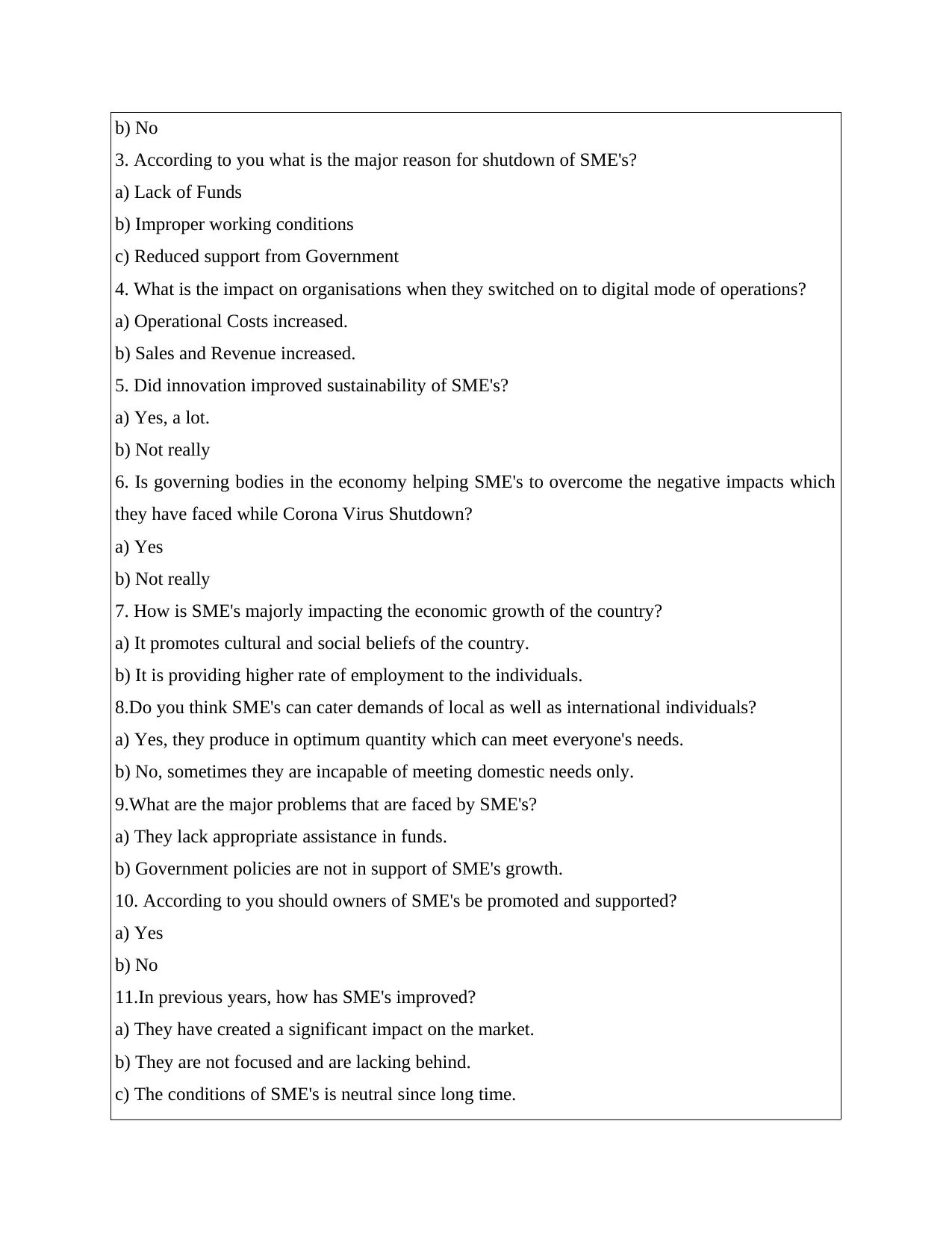
b) No
3. According to you what is the major reason for shutdown of SME's?
a) Lack of Funds
b) Improper working conditions
c) Reduced support from Government
4. What is the impact on organisations when they switched on to digital mode of operations?
a) Operational Costs increased.
b) Sales and Revenue increased.
5. Did innovation improved sustainability of SME's?
a) Yes, a lot.
b) Not really
6. Is governing bodies in the economy helping SME's to overcome the negative impacts which
they have faced while Corona Virus Shutdown?
a) Yes
b) Not really
7. How is SME's majorly impacting the economic growth of the country?
a) It promotes cultural and social beliefs of the country.
b) It is providing higher rate of employment to the individuals.
8.Do you think SME's can cater demands of local as well as international individuals?
a) Yes, they produce in optimum quantity which can meet everyone's needs.
b) No, sometimes they are incapable of meeting domestic needs only.
9.What are the major problems that are faced by SME's?
a) They lack appropriate assistance in funds.
b) Government policies are not in support of SME's growth.
10. According to you should owners of SME's be promoted and supported?
a) Yes
b) No
11.In previous years, how has SME's improved?
a) They have created a significant impact on the market.
b) They are not focused and are lacking behind.
c) The conditions of SME's is neutral since long time.
3. According to you what is the major reason for shutdown of SME's?
a) Lack of Funds
b) Improper working conditions
c) Reduced support from Government
4. What is the impact on organisations when they switched on to digital mode of operations?
a) Operational Costs increased.
b) Sales and Revenue increased.
5. Did innovation improved sustainability of SME's?
a) Yes, a lot.
b) Not really
6. Is governing bodies in the economy helping SME's to overcome the negative impacts which
they have faced while Corona Virus Shutdown?
a) Yes
b) Not really
7. How is SME's majorly impacting the economic growth of the country?
a) It promotes cultural and social beliefs of the country.
b) It is providing higher rate of employment to the individuals.
8.Do you think SME's can cater demands of local as well as international individuals?
a) Yes, they produce in optimum quantity which can meet everyone's needs.
b) No, sometimes they are incapable of meeting domestic needs only.
9.What are the major problems that are faced by SME's?
a) They lack appropriate assistance in funds.
b) Government policies are not in support of SME's growth.
10. According to you should owners of SME's be promoted and supported?
a) Yes
b) No
11.In previous years, how has SME's improved?
a) They have created a significant impact on the market.
b) They are not focused and are lacking behind.
c) The conditions of SME's is neutral since long time.
⊘ This is a preview!⊘
Do you want full access?
Subscribe today to unlock all pages.
Trusted by 1+ million students worldwide
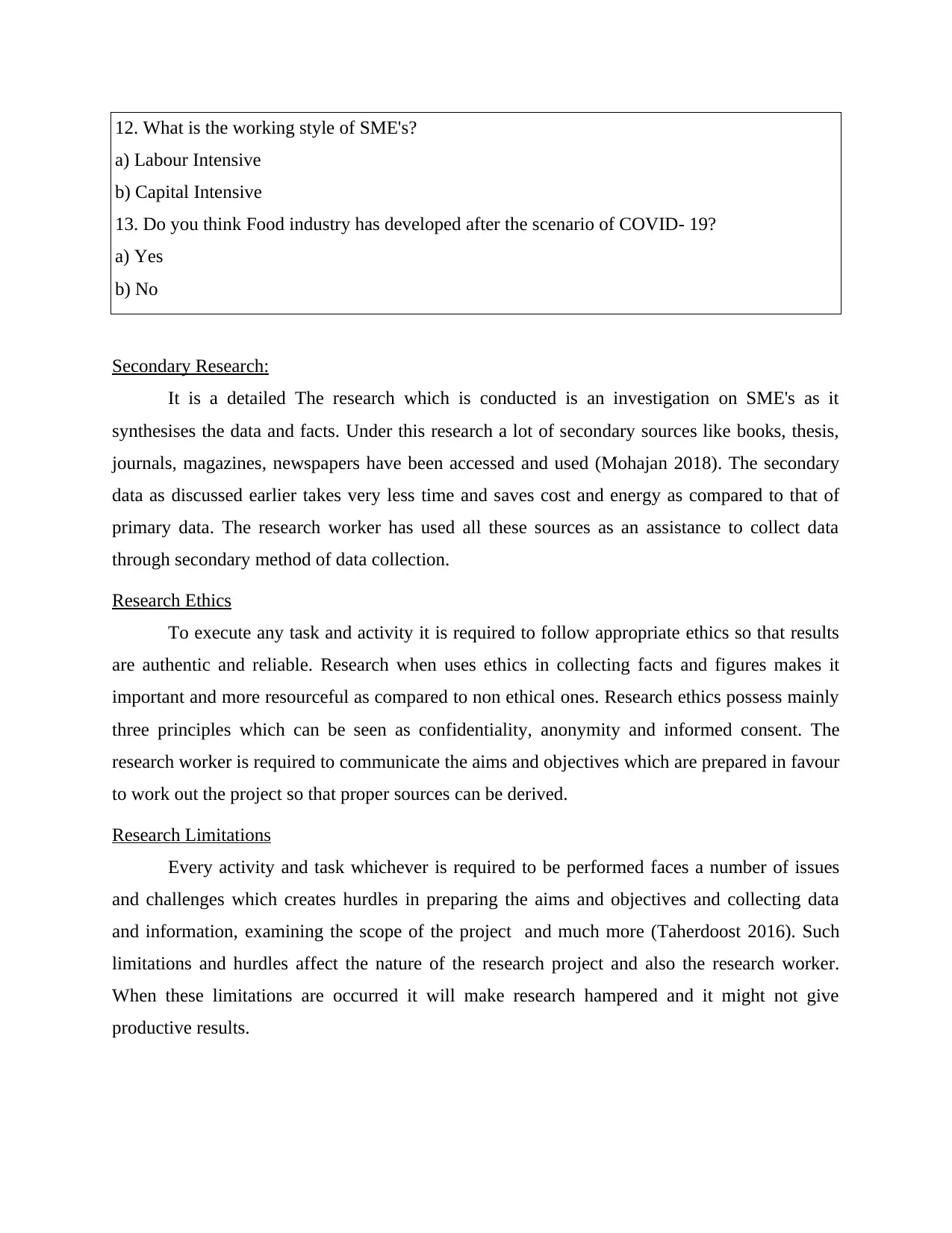
12. What is the working style of SME's?
a) Labour Intensive
b) Capital Intensive
13. Do you think Food industry has developed after the scenario of COVID- 19?
a) Yes
b) No
Secondary Research:
It is a detailed The research which is conducted is an investigation on SME's as it
synthesises the data and facts. Under this research a lot of secondary sources like books, thesis,
journals, magazines, newspapers have been accessed and used (Mohajan 2018). The secondary
data as discussed earlier takes very less time and saves cost and energy as compared to that of
primary data. The research worker has used all these sources as an assistance to collect data
through secondary method of data collection.
Research Ethics
To execute any task and activity it is required to follow appropriate ethics so that results
are authentic and reliable. Research when uses ethics in collecting facts and figures makes it
important and more resourceful as compared to non ethical ones. Research ethics possess mainly
three principles which can be seen as confidentiality, anonymity and informed consent. The
research worker is required to communicate the aims and objectives which are prepared in favour
to work out the project so that proper sources can be derived.
Research Limitations
Every activity and task whichever is required to be performed faces a number of issues
and challenges which creates hurdles in preparing the aims and objectives and collecting data
and information, examining the scope of the project and much more (Taherdoost 2016). Such
limitations and hurdles affect the nature of the research project and also the research worker.
When these limitations are occurred it will make research hampered and it might not give
productive results.
a) Labour Intensive
b) Capital Intensive
13. Do you think Food industry has developed after the scenario of COVID- 19?
a) Yes
b) No
Secondary Research:
It is a detailed The research which is conducted is an investigation on SME's as it
synthesises the data and facts. Under this research a lot of secondary sources like books, thesis,
journals, magazines, newspapers have been accessed and used (Mohajan 2018). The secondary
data as discussed earlier takes very less time and saves cost and energy as compared to that of
primary data. The research worker has used all these sources as an assistance to collect data
through secondary method of data collection.
Research Ethics
To execute any task and activity it is required to follow appropriate ethics so that results
are authentic and reliable. Research when uses ethics in collecting facts and figures makes it
important and more resourceful as compared to non ethical ones. Research ethics possess mainly
three principles which can be seen as confidentiality, anonymity and informed consent. The
research worker is required to communicate the aims and objectives which are prepared in favour
to work out the project so that proper sources can be derived.
Research Limitations
Every activity and task whichever is required to be performed faces a number of issues
and challenges which creates hurdles in preparing the aims and objectives and collecting data
and information, examining the scope of the project and much more (Taherdoost 2016). Such
limitations and hurdles affect the nature of the research project and also the research worker.
When these limitations are occurred it will make research hampered and it might not give
productive results.
Paraphrase This Document
Need a fresh take? Get an instant paraphrase of this document with our AI Paraphraser
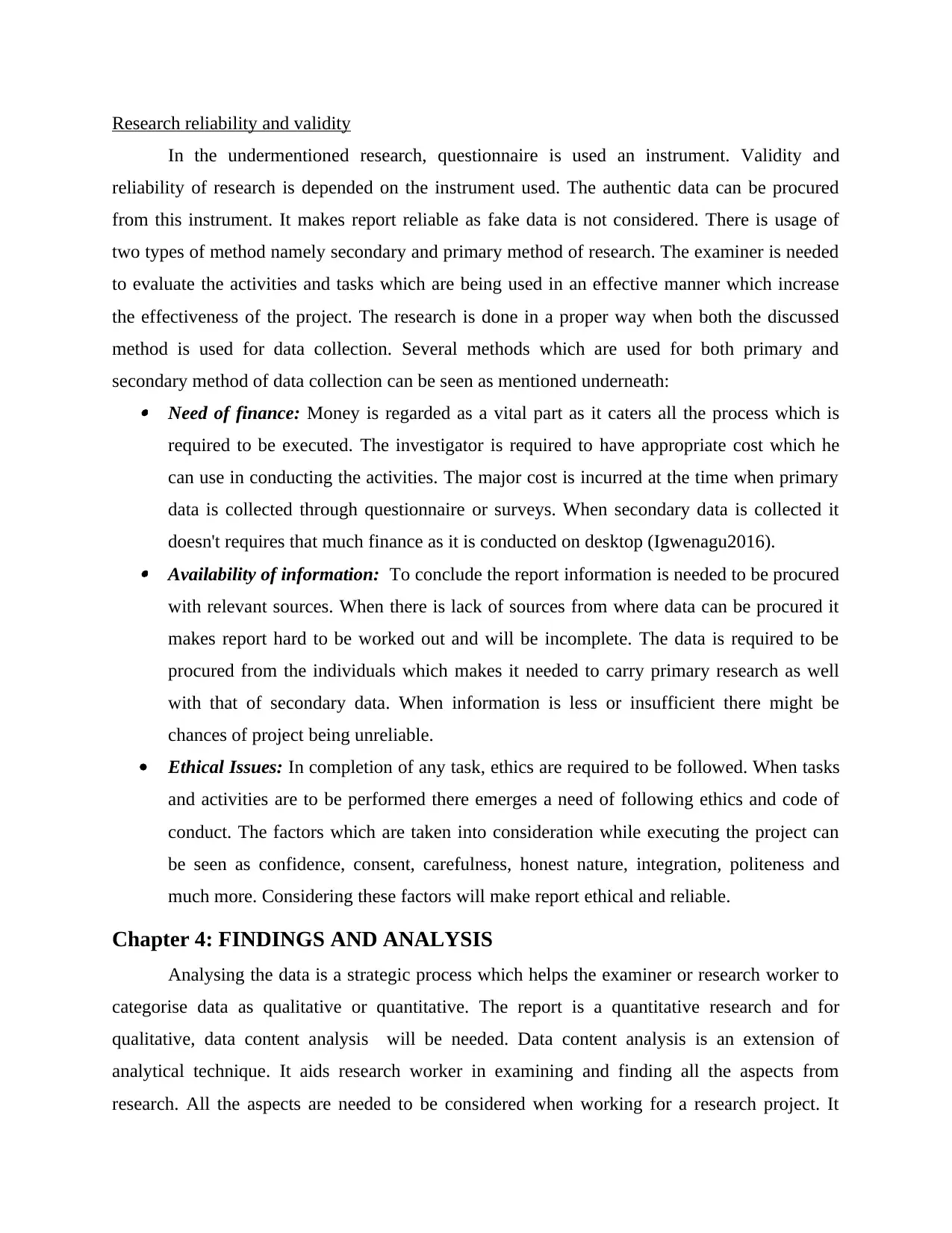
Research reliability and validity
In the undermentioned research, questionnaire is used an instrument. Validity and
reliability of research is depended on the instrument used. The authentic data can be procured
from this instrument. It makes report reliable as fake data is not considered. There is usage of
two types of method namely secondary and primary method of research. The examiner is needed
to evaluate the activities and tasks which are being used in an effective manner which increase
the effectiveness of the project. The research is done in a proper way when both the discussed
method is used for data collection. Several methods which are used for both primary and
secondary method of data collection can be seen as mentioned underneath: Need of finance: Money is regarded as a vital part as it caters all the process which is
required to be executed. The investigator is required to have appropriate cost which he
can use in conducting the activities. The major cost is incurred at the time when primary
data is collected through questionnaire or surveys. When secondary data is collected it
doesn't requires that much finance as it is conducted on desktop (Igwenagu2016). Availability of information: To conclude the report information is needed to be procured
with relevant sources. When there is lack of sources from where data can be procured it
makes report hard to be worked out and will be incomplete. The data is required to be
procured from the individuals which makes it needed to carry primary research as well
with that of secondary data. When information is less or insufficient there might be
chances of project being unreliable.
Ethical Issues: In completion of any task, ethics are required to be followed. When tasks
and activities are to be performed there emerges a need of following ethics and code of
conduct. The factors which are taken into consideration while executing the project can
be seen as confidence, consent, carefulness, honest nature, integration, politeness and
much more. Considering these factors will make report ethical and reliable.
Chapter 4: FINDINGS AND ANALYSIS
Analysing the data is a strategic process which helps the examiner or research worker to
categorise data as qualitative or quantitative. The report is a quantitative research and for
qualitative, data content analysis will be needed. Data content analysis is an extension of
analytical technique. It aids research worker in examining and finding all the aspects from
research. All the aspects are needed to be considered when working for a research project. It
In the undermentioned research, questionnaire is used an instrument. Validity and
reliability of research is depended on the instrument used. The authentic data can be procured
from this instrument. It makes report reliable as fake data is not considered. There is usage of
two types of method namely secondary and primary method of research. The examiner is needed
to evaluate the activities and tasks which are being used in an effective manner which increase
the effectiveness of the project. The research is done in a proper way when both the discussed
method is used for data collection. Several methods which are used for both primary and
secondary method of data collection can be seen as mentioned underneath: Need of finance: Money is regarded as a vital part as it caters all the process which is
required to be executed. The investigator is required to have appropriate cost which he
can use in conducting the activities. The major cost is incurred at the time when primary
data is collected through questionnaire or surveys. When secondary data is collected it
doesn't requires that much finance as it is conducted on desktop (Igwenagu2016). Availability of information: To conclude the report information is needed to be procured
with relevant sources. When there is lack of sources from where data can be procured it
makes report hard to be worked out and will be incomplete. The data is required to be
procured from the individuals which makes it needed to carry primary research as well
with that of secondary data. When information is less or insufficient there might be
chances of project being unreliable.
Ethical Issues: In completion of any task, ethics are required to be followed. When tasks
and activities are to be performed there emerges a need of following ethics and code of
conduct. The factors which are taken into consideration while executing the project can
be seen as confidence, consent, carefulness, honest nature, integration, politeness and
much more. Considering these factors will make report ethical and reliable.
Chapter 4: FINDINGS AND ANALYSIS
Analysing the data is a strategic process which helps the examiner or research worker to
categorise data as qualitative or quantitative. The report is a quantitative research and for
qualitative, data content analysis will be needed. Data content analysis is an extension of
analytical technique. It aids research worker in examining and finding all the aspects from
research. All the aspects are needed to be considered when working for a research project. It

involves varied important aspects which can be seen as visual, textual materials which help
strategic and set record for categorising the data and facts which are needed to be analysed. For
evaluating research findings and data, an extended frequency table is needed to be performed
which can be seen as under:
strategic and set record for categorising the data and facts which are needed to be analysed. For
evaluating research findings and data, an extended frequency table is needed to be performed
which can be seen as under:
⊘ This is a preview!⊘
Do you want full access?
Subscribe today to unlock all pages.
Trusted by 1+ million students worldwide

1 out of 34


Related Documents


Your All-in-One AI-Powered Toolkit for Academic Success.
+13062052269
info@desklib.com
Available 24*7 on WhatsApp / Email
![[object Object]](/_next/static/media/star-bottom.7253800d.svg)
Unlock your academic potential
Copyright © 2020–2026 A2Z Services. All Rights Reserved. Developed and managed by ZUCOL.