Business Research Project: Workplace Discrimination Impact on Primark
VerifiedAdded on 2023/01/13
|26
|5361
|69
Project
AI Summary
This business research project investigates the impact of workplace discrimination on employee performance, focusing on Primark as a case study. The project begins with a research proposal outlining the aim to identify this impact, along with specific objectives, and a rationale for the chosen topic. A literature review explores the concept of workplace discrimination, its positive and negative impacts, and methods to improve employee performance. The methodology section details a quantitative research approach, employing questionnaires to collect primary data from Primark managers, and secondary data from various sources. Data analysis involves content analysis and frequency tables to interpret the findings. The project concludes with findings, recommendations, and a personal reflective statement discussing the research methods used and areas for further investigation. The research examines the various types of discrimination, its effects on business performance, and methods for improvement within the organization.

Business
Research Project
(Equality and diversity in the workplace)
1
Research Project
(Equality and diversity in the workplace)
1

Paraphrase This Document
Need a fresh take? Get an instant paraphrase of this document with our AI Paraphraser
Contents
Chapter 1 Introduction.....................................................................................................................3
1.1 Research Proposal..................................................................................................................3
(I) Research project description...............................................................................................3
(II) Research aim and objectives.............................................................................................3
(III) Reasons for choosing this research project......................................................................4
(IV) Activities and timescales.................................................................................................4
Chapter 2: Literature review............................................................................................................6
2.1 Introduction............................................................................................................................6
2.2 Literature review....................................................................................................................6
Chapter 3: Methodology..................................................................................................................8
3.1 Research Approach................................................................................................................8
3.2 Methodologies:......................................................................................................................8
(I) Sampling –..........................................................................................................................8
(II) Data analysis......................................................................................................................9
(III) Cost, access and ethical considerations............................................................................9
Chapter 4 Data Collection and Analysis........................................................................................10
4.1 Data collection.....................................................................................................................10
4.2 Data analysis, presentation and discussion..........................................................................12
Chapter 5: Conclusions and Recommendations............................................................................23
5.1 Conclusions..........................................................................................................................23
5.2 Recommendations................................................................................................................24
Chapter 6: Personal Reflective Statement......................................................................................24
6.1 Reflect on the research methods used in your project.........................................................24
6.2 Consider research methods that could have been used........................................................24
6.3 Areas for further research or consideration.........................................................................25
REFERENCES..............................................................................................................................26
2
Chapter 1 Introduction.....................................................................................................................3
1.1 Research Proposal..................................................................................................................3
(I) Research project description...............................................................................................3
(II) Research aim and objectives.............................................................................................3
(III) Reasons for choosing this research project......................................................................4
(IV) Activities and timescales.................................................................................................4
Chapter 2: Literature review............................................................................................................6
2.1 Introduction............................................................................................................................6
2.2 Literature review....................................................................................................................6
Chapter 3: Methodology..................................................................................................................8
3.1 Research Approach................................................................................................................8
3.2 Methodologies:......................................................................................................................8
(I) Sampling –..........................................................................................................................8
(II) Data analysis......................................................................................................................9
(III) Cost, access and ethical considerations............................................................................9
Chapter 4 Data Collection and Analysis........................................................................................10
4.1 Data collection.....................................................................................................................10
4.2 Data analysis, presentation and discussion..........................................................................12
Chapter 5: Conclusions and Recommendations............................................................................23
5.1 Conclusions..........................................................................................................................23
5.2 Recommendations................................................................................................................24
Chapter 6: Personal Reflective Statement......................................................................................24
6.1 Reflect on the research methods used in your project.........................................................24
6.2 Consider research methods that could have been used........................................................24
6.3 Areas for further research or consideration.........................................................................25
REFERENCES..............................................................................................................................26
2
Chapter 1 Introduction
1.1 Research Proposal
(I) Research project description
Discrimination at workplace means is treating and proposing to treat, an individual
employees unfavourably or differentially because of their characteristic protected by law.
Discrimination at workplace has negative impact over performance of employees (Sapada and et.
al., 2018). For this report Primark is a chosen retailer that specialise in selling of clothes,
cosmetics and house wares to the customers. Within an organisation, discrimination is major
issue that have impact on employees as well as business performance in negative manner. Impact
of discrimination over employees reduced their performance, productivity, motivation and
satisfaction level. These will turn to impact on business by increase high employee turnover,
reducing brand reputation etc. Therefore, these are main issues of discrimination at workplace.
(II) Research aim and objectives
Research aim:
Main aim of this report is “To identify the impact of workplace discrimination on
employee’s performance at workplace.” A case study on Primark.
Research Objectives
To know the meaning and concept of workplace discrimination.
To understand the positive & negative impact of workplace discrimination on the
performance of staff members working in Primark.
To examine various types of methods which help the workers of Primark in improving
their performance?
Research questions
What is the positive & negative impact of workplace discrimination on the performance
of staff members working in Primark?
What are the various types of methods which help the workers of Primark in improving
their performance?
3
1.1 Research Proposal
(I) Research project description
Discrimination at workplace means is treating and proposing to treat, an individual
employees unfavourably or differentially because of their characteristic protected by law.
Discrimination at workplace has negative impact over performance of employees (Sapada and et.
al., 2018). For this report Primark is a chosen retailer that specialise in selling of clothes,
cosmetics and house wares to the customers. Within an organisation, discrimination is major
issue that have impact on employees as well as business performance in negative manner. Impact
of discrimination over employees reduced their performance, productivity, motivation and
satisfaction level. These will turn to impact on business by increase high employee turnover,
reducing brand reputation etc. Therefore, these are main issues of discrimination at workplace.
(II) Research aim and objectives
Research aim:
Main aim of this report is “To identify the impact of workplace discrimination on
employee’s performance at workplace.” A case study on Primark.
Research Objectives
To know the meaning and concept of workplace discrimination.
To understand the positive & negative impact of workplace discrimination on the
performance of staff members working in Primark.
To examine various types of methods which help the workers of Primark in improving
their performance?
Research questions
What is the positive & negative impact of workplace discrimination on the performance
of staff members working in Primark?
What are the various types of methods which help the workers of Primark in improving
their performance?
3
⊘ This is a preview!⊘
Do you want full access?
Subscribe today to unlock all pages.

Trusted by 1+ million students worldwide
(III) Reasons for choosing this research project
Main reason behind selecting this topic is to increase knowledge about the discrimination
and its impact at workplace and on employee’s performance. By doing this research, researcher
can easily understand about the negative effect of workplace discrimination on performance of
employees. By performing this study, they can also identify certain ways for improving
employee’s performance at workplace (Webster and et. al., 2018).
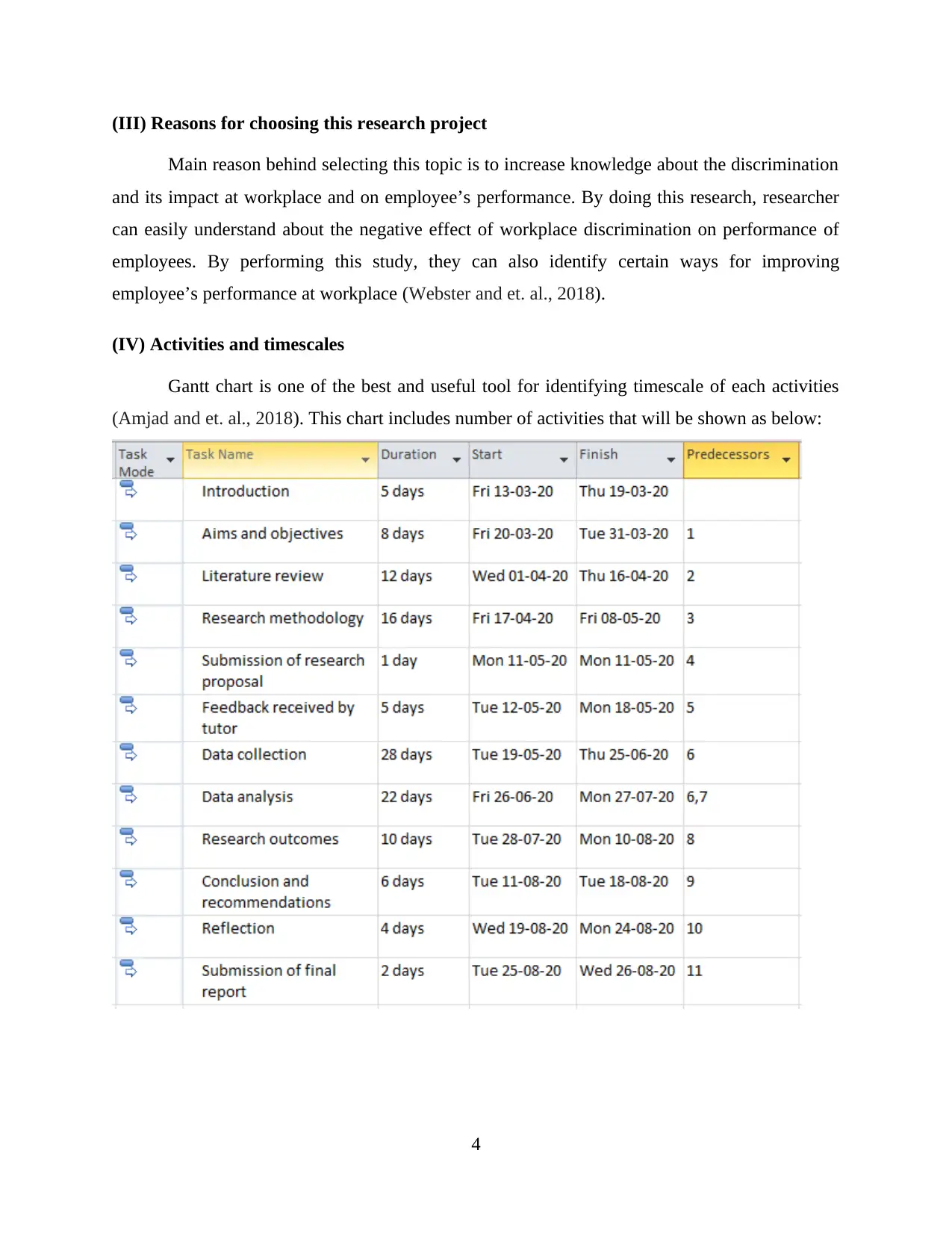
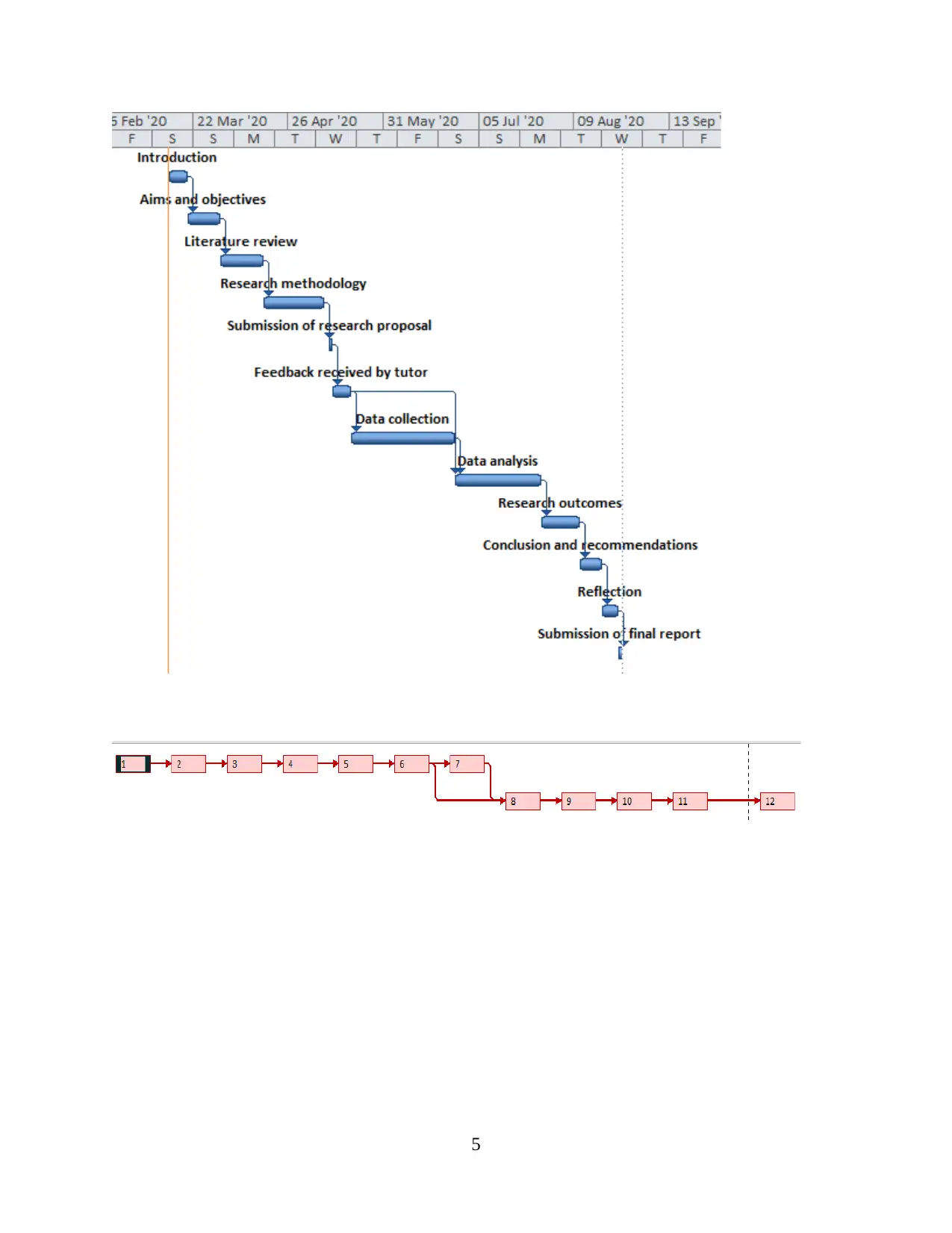
(IV) Activities and timescales
Gantt chart is one of the best and useful tool for identifying timescale of each activities
(Amjad and et. al., 2018). This chart includes number of activities that will be shown as below:
4
Main reason behind selecting this topic is to increase knowledge about the discrimination
and its impact at workplace and on employee’s performance. By doing this research, researcher
can easily understand about the negative effect of workplace discrimination on performance of
employees. By performing this study, they can also identify certain ways for improving
employee’s performance at workplace (Webster and et. al., 2018).
(IV) Activities and timescales
Gantt chart is one of the best and useful tool for identifying timescale of each activities
(Amjad and et. al., 2018). This chart includes number of activities that will be shown as below:
4
Paraphrase This Document
Need a fresh take? Get an instant paraphrase of this document with our AI Paraphraser
5
Chapter 2: Literature review
2.1 Introduction
It is systematic identification and location of document concerning information related to
the research program. It is a body of text that aims to review the critical points of current
knowledge on a particular topic. It is use as database report of primary or original scholarship
and does not report new primary scholarship itself
2.2 Literature review
Meaning and concept of workplace discrimination.
As per the view presented by Benstead (2018), workplace discrimination is a condition
when employs of an organization are treated unfairly due to some reason. Workplace
discrimination will be depended on equal pay of compensation, national origin, pregnancy,
gender discrimination, religion, caste, disability, physical appearance; all are the main causes of
the issue aeries of discrimination within the workplace. The concept of discrimination takes into
consideration after globalization of economy. Companies hire workforce from different
countries, religion, places for enhancing their efficiency of organization. But employee and most
of time labours are affected and conflicts aeries among labours and employers related to
discrimination. This concept is used for study to give essential information to mangers regarding
workplace discrimination and strategies and polices are develop which are use for solving issue
regarding unfair justice within the organization
Positive & negative impact of workplace discrimination on the performance of staff members
working in Primark.
According to the Harness (2019), workplace discrimination will be positively as well as
negatively impacted on business organization which is described below:
Positive impact:
Diversification will help in increasing motivation among employee and labors to increase
their performance as mangers give incentive and bonus on the basis of performance.
Diversification also help in team coordination as manger of Primark divided group of employers
and give accommodation in the basis of their performance it will help in increasing performance
and management abilities among all the group members.
Negative impact:
6
2.1 Introduction
It is systematic identification and location of document concerning information related to
the research program. It is a body of text that aims to review the critical points of current
knowledge on a particular topic. It is use as database report of primary or original scholarship
and does not report new primary scholarship itself
2.2 Literature review
Meaning and concept of workplace discrimination.
As per the view presented by Benstead (2018), workplace discrimination is a condition
when employs of an organization are treated unfairly due to some reason. Workplace
discrimination will be depended on equal pay of compensation, national origin, pregnancy,
gender discrimination, religion, caste, disability, physical appearance; all are the main causes of
the issue aeries of discrimination within the workplace. The concept of discrimination takes into
consideration after globalization of economy. Companies hire workforce from different
countries, religion, places for enhancing their efficiency of organization. But employee and most
of time labours are affected and conflicts aeries among labours and employers related to
discrimination. This concept is used for study to give essential information to mangers regarding
workplace discrimination and strategies and polices are develop which are use for solving issue
regarding unfair justice within the organization
Positive & negative impact of workplace discrimination on the performance of staff members
working in Primark.
According to the Harness (2019), workplace discrimination will be positively as well as
negatively impacted on business organization which is described below:
Positive impact:
Diversification will help in increasing motivation among employee and labors to increase
their performance as mangers give incentive and bonus on the basis of performance.
Diversification also help in team coordination as manger of Primark divided group of employers
and give accommodation in the basis of their performance it will help in increasing performance
and management abilities among all the group members.
Negative impact:
6
⊘ This is a preview!⊘
Do you want full access?
Subscribe today to unlock all pages.
Trusted by 1+ million students worldwide
Issue related to caste, and religion of employs will directly impact on their morale and
ethics, they get de motivated due to these issues. It will result in higher rate of labor turnover, as
labor get dissatisfied and resign the organization, this will reduce rate of performance of the
company.
Types of methods which help the workers of Primark in improving their performance.
According to the Ciner (2019), there are various methods that will be requiring to follow by
Primark for enhancing performance of their employees. Some effective ways will be determined
as below:
Training: By using training manger of Primark can enhance performance of their
underperform employers and labor.
Communication: Manager of Primark can improve performance of their employers by using
effective communication tools, with their communication skills they motivate and enhance
capabilities of their employs to work toward achievement of goal of the organization.
Workforce management: For managing all the employers’ mangers play games, as study
which will help in increasing their knowledge and it also useful for increasing coordination and
team work of the employs.
7
ethics, they get de motivated due to these issues. It will result in higher rate of labor turnover, as
labor get dissatisfied and resign the organization, this will reduce rate of performance of the
company.
Types of methods which help the workers of Primark in improving their performance.
According to the Ciner (2019), there are various methods that will be requiring to follow by
Primark for enhancing performance of their employees. Some effective ways will be determined
as below:
Training: By using training manger of Primark can enhance performance of their
underperform employers and labor.
Communication: Manager of Primark can improve performance of their employers by using
effective communication tools, with their communication skills they motivate and enhance
capabilities of their employs to work toward achievement of goal of the organization.
Workforce management: For managing all the employers’ mangers play games, as study
which will help in increasing their knowledge and it also useful for increasing coordination and
team work of the employs.
7
Paraphrase This Document
Need a fresh take? Get an instant paraphrase of this document with our AI Paraphraser
Chapter 3: Methodology
Methodology is a vital tool use for research program, it is a process of systematically
analysis the methods use and applied for research study (Aoyama, Hoshika and Honda, 2018).
This tool is also help investigator for collecting essential data from various respondents. There
will be several methods which are use for the current research, all are mention below:
3.1 Research Approach
It is a systematic framework of research section. Research approaches considered those
plans and policies which are used for collection of essential data, analysis and interpretation of
the information collected from theses data. Investigator uses research approaches on the basis of
problem of the study. It is divided into two parts, quantitative approach and qualitative approach.
For this research quantitative study has been decided as it will help in finding conclusion in
effective way. On the other side for data analysis purpose inductive and deductive sort also uses.
For this project deductive approach has been applied with quantitative information (Gaur and
Kumar, 2018).
3.2 Methodologies:
Investigators use primary and secondary sources for collection of their research data.
Primary data are those information which are first time uses and collected directly from
investigators to the main source of research questionnaire are prepared for collection of
information by using primary sources. Secondary data are those data which are collected by
other. For collecting information from secondary data, magazine, newspaper, books journals are
use. In this study both primary and secondary sources are uses by investigator to collect
information for this research (Gjesfjeld and et. al., 2020).
(I) Sampling –
It is a systematic technique which is used for deciding sample size from the total
population. There will be 2 types of sample technique which can apply by investigators,
probability and non probability. For this research study probability technique is use for sampling,
by using probability technique investigator recruit or selects 20 managers of Primark on random
basis. This technique is help investigators for effective use the time and minimize cost of the
research program as compare to non probability technique of sampling (Güven, 2018).
8
Methodology is a vital tool use for research program, it is a process of systematically
analysis the methods use and applied for research study (Aoyama, Hoshika and Honda, 2018).
This tool is also help investigator for collecting essential data from various respondents. There
will be several methods which are use for the current research, all are mention below:
3.1 Research Approach
It is a systematic framework of research section. Research approaches considered those
plans and policies which are used for collection of essential data, analysis and interpretation of
the information collected from theses data. Investigator uses research approaches on the basis of
problem of the study. It is divided into two parts, quantitative approach and qualitative approach.
For this research quantitative study has been decided as it will help in finding conclusion in
effective way. On the other side for data analysis purpose inductive and deductive sort also uses.
For this project deductive approach has been applied with quantitative information (Gaur and
Kumar, 2018).
3.2 Methodologies:
Investigators use primary and secondary sources for collection of their research data.
Primary data are those information which are first time uses and collected directly from
investigators to the main source of research questionnaire are prepared for collection of
information by using primary sources. Secondary data are those data which are collected by
other. For collecting information from secondary data, magazine, newspaper, books journals are
use. In this study both primary and secondary sources are uses by investigator to collect
information for this research (Gjesfjeld and et. al., 2020).
(I) Sampling –
It is a systematic technique which is used for deciding sample size from the total
population. There will be 2 types of sample technique which can apply by investigators,
probability and non probability. For this research study probability technique is use for sampling,
by using probability technique investigator recruit or selects 20 managers of Primark on random
basis. This technique is help investigators for effective use the time and minimize cost of the
research program as compare to non probability technique of sampling (Güven, 2018).
8
(II) Data analysis
In this section of the research methodology investigator analysis all the data collecting by
sampling process. It is essential part of the research process as it is the responsibility of the
investigator to provide reliable and valid information related to the data. Investigator use content
analysis this tool has been used for analysis data in minimal time and it also useful for making
questions related to the data. Investigator will be used graphs, tables, for analysing their
quantitative data and table and graphs also use for representing information in an effective
manner (Kelly and et. al., 2018).
(III) Cost, access and ethical considerations
This is necessary part of each methodology step use during research program. For doing a
research program it is essential for every researcher to follow their ethical rules and work in a
system way which helps in saving their cost. For collection of primary data large amount of
monetary resource require thus investigators needs to used those tools and method which help in
reducing their cost of program, after that they need to access all the relevant information from
employees of Primark for collection of data investigator are need to follow ethical principle, of
confidentiality, beneficence, antonym etc. It is necessary for investigators to complete their
research in systematic way (Page and et. al., 2019).
9
In this section of the research methodology investigator analysis all the data collecting by
sampling process. It is essential part of the research process as it is the responsibility of the
investigator to provide reliable and valid information related to the data. Investigator use content
analysis this tool has been used for analysis data in minimal time and it also useful for making
questions related to the data. Investigator will be used graphs, tables, for analysing their
quantitative data and table and graphs also use for representing information in an effective
manner (Kelly and et. al., 2018).
(III) Cost, access and ethical considerations
This is necessary part of each methodology step use during research program. For doing a
research program it is essential for every researcher to follow their ethical rules and work in a
system way which helps in saving their cost. For collection of primary data large amount of
monetary resource require thus investigators needs to used those tools and method which help in
reducing their cost of program, after that they need to access all the relevant information from
employees of Primark for collection of data investigator are need to follow ethical principle, of
confidentiality, beneficence, antonym etc. It is necessary for investigators to complete their
research in systematic way (Page and et. al., 2019).
9
⊘ This is a preview!⊘
Do you want full access?
Subscribe today to unlock all pages.
Trusted by 1+ million students worldwide
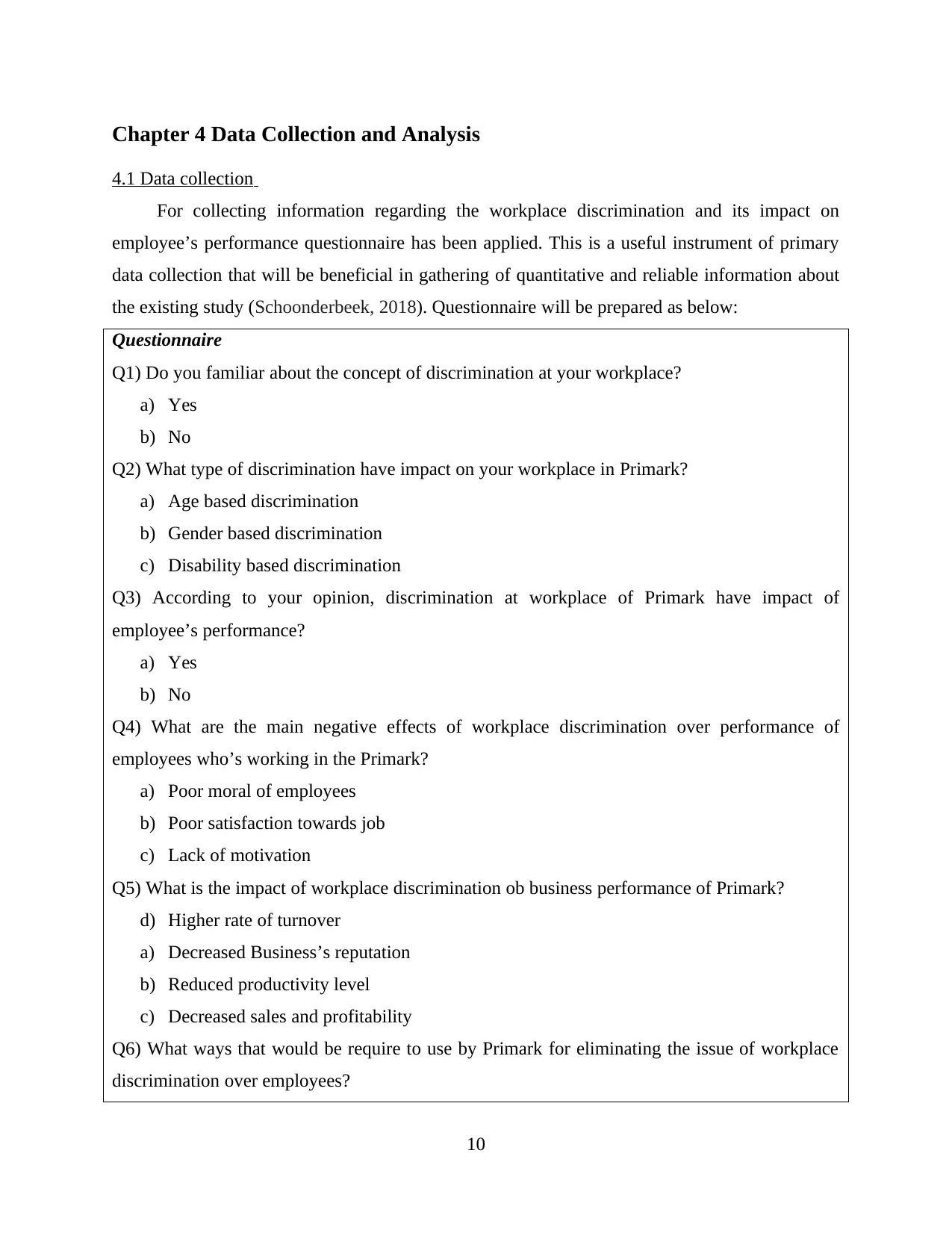
Chapter 4 Data Collection and Analysis
4.1 Data collection
For collecting information regarding the workplace discrimination and its impact on
employee’s performance questionnaire has been applied. This is a useful instrument of primary
data collection that will be beneficial in gathering of quantitative and reliable information about
the existing study (Schoonderbeek, 2018). Questionnaire will be prepared as below:
Questionnaire
Q1) Do you familiar about the concept of discrimination at your workplace?
a) Yes
b) No
Q2) What type of discrimination have impact on your workplace in Primark?
a) Age based discrimination
b) Gender based discrimination
c) Disability based discrimination
Q3) According to your opinion, discrimination at workplace of Primark have impact of
employee’s performance?
a) Yes
b) No
Q4) What are the main negative effects of workplace discrimination over performance of
employees who’s working in the Primark?
a) Poor moral of employees
b) Poor satisfaction towards job
c) Lack of motivation
Q5) What is the impact of workplace discrimination ob business performance of Primark?
d) Higher rate of turnover
a) Decreased Business’s reputation
b) Reduced productivity level
c) Decreased sales and profitability
Q6) What ways that would be require to use by Primark for eliminating the issue of workplace
discrimination over employees?
10
4.1 Data collection
For collecting information regarding the workplace discrimination and its impact on
employee’s performance questionnaire has been applied. This is a useful instrument of primary
data collection that will be beneficial in gathering of quantitative and reliable information about
the existing study (Schoonderbeek, 2018). Questionnaire will be prepared as below:
Questionnaire
Q1) Do you familiar about the concept of discrimination at your workplace?
a) Yes
b) No
Q2) What type of discrimination have impact on your workplace in Primark?
a) Age based discrimination
b) Gender based discrimination
c) Disability based discrimination
Q3) According to your opinion, discrimination at workplace of Primark have impact of
employee’s performance?
a) Yes
b) No
Q4) What are the main negative effects of workplace discrimination over performance of
employees who’s working in the Primark?
a) Poor moral of employees
b) Poor satisfaction towards job
c) Lack of motivation
Q5) What is the impact of workplace discrimination ob business performance of Primark?
d) Higher rate of turnover
a) Decreased Business’s reputation
b) Reduced productivity level
c) Decreased sales and profitability
Q6) What ways that would be require to use by Primark for eliminating the issue of workplace
discrimination over employees?
10
Paraphrase This Document
Need a fresh take? Get an instant paraphrase of this document with our AI Paraphraser
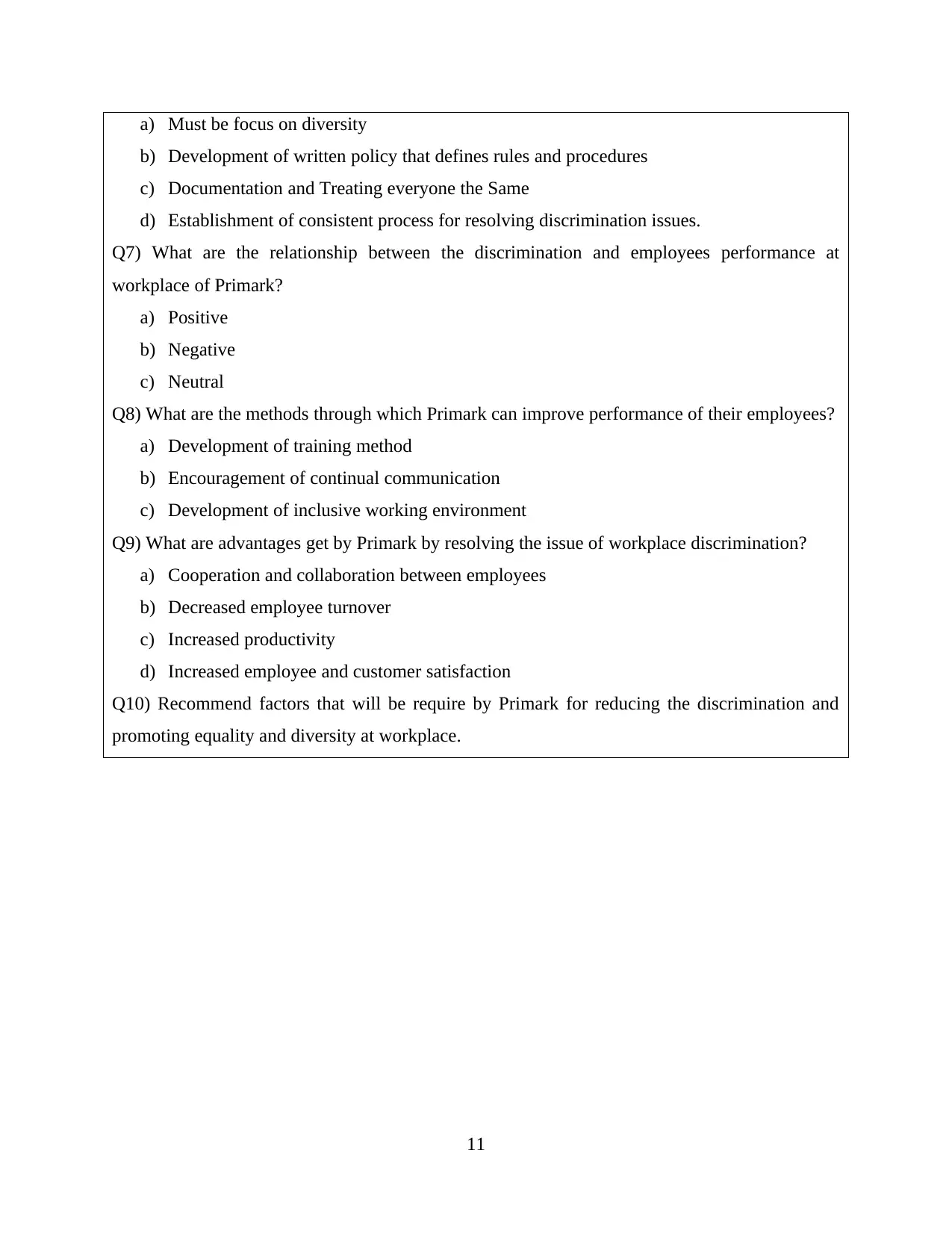
a) Must be focus on diversity
b) Development of written policy that defines rules and procedures
c) Documentation and Treating everyone the Same
d) Establishment of consistent process for resolving discrimination issues.
Q7) What are the relationship between the discrimination and employees performance at
workplace of Primark?
a) Positive
b) Negative
c) Neutral
Q8) What are the methods through which Primark can improve performance of their employees?
a) Development of training method
b) Encouragement of continual communication
c) Development of inclusive working environment
Q9) What are advantages get by Primark by resolving the issue of workplace discrimination?
a) Cooperation and collaboration between employees
b) Decreased employee turnover
c) Increased productivity
d) Increased employee and customer satisfaction
Q10) Recommend factors that will be require by Primark for reducing the discrimination and
promoting equality and diversity at workplace.
11
b) Development of written policy that defines rules and procedures
c) Documentation and Treating everyone the Same
d) Establishment of consistent process for resolving discrimination issues.
Q7) What are the relationship between the discrimination and employees performance at
workplace of Primark?
a) Positive
b) Negative
c) Neutral
Q8) What are the methods through which Primark can improve performance of their employees?
a) Development of training method
b) Encouragement of continual communication
c) Development of inclusive working environment
Q9) What are advantages get by Primark by resolving the issue of workplace discrimination?
a) Cooperation and collaboration between employees
b) Decreased employee turnover
c) Increased productivity
d) Increased employee and customer satisfaction
Q10) Recommend factors that will be require by Primark for reducing the discrimination and
promoting equality and diversity at workplace.
11
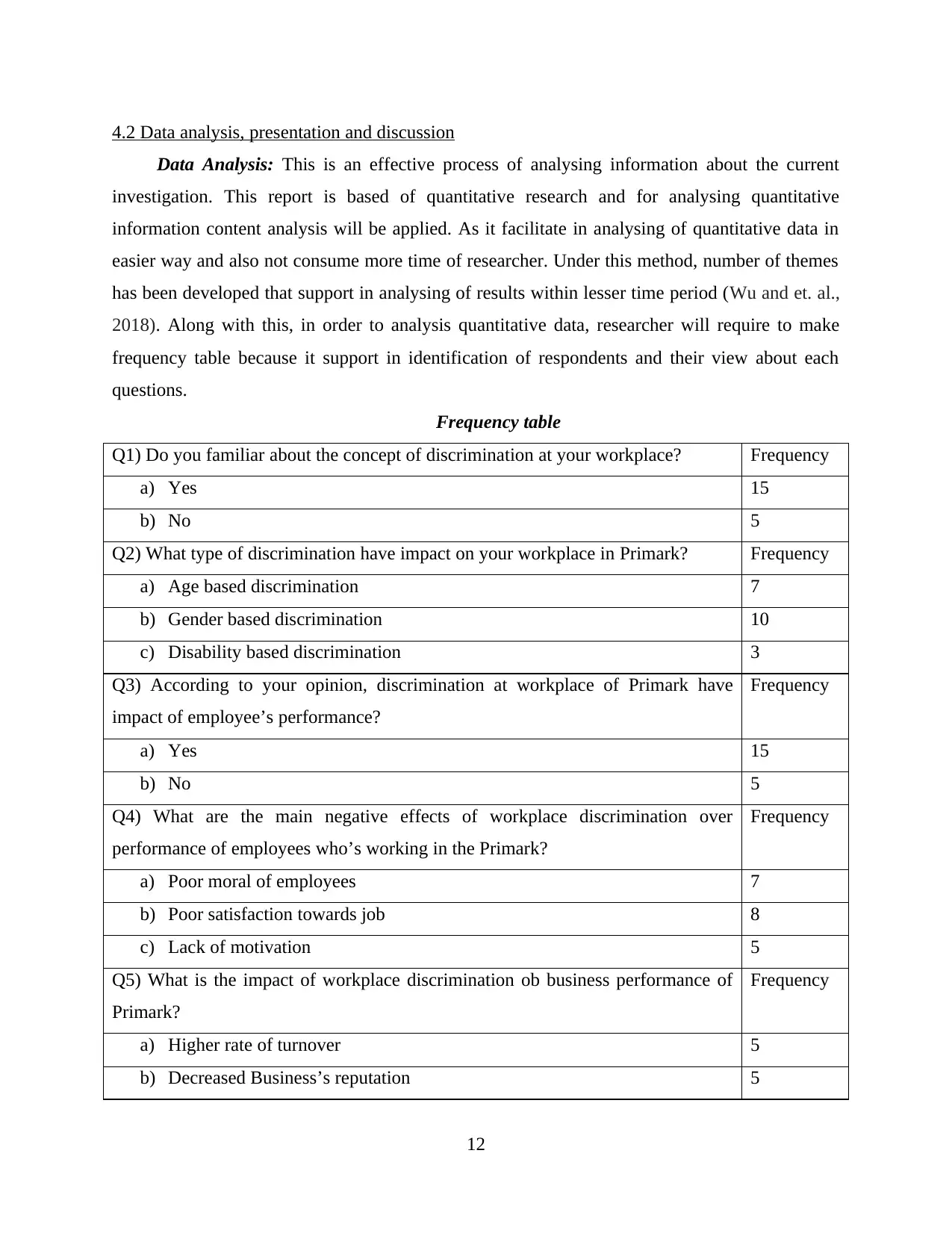
4.2 Data analysis, presentation and discussion
Data Analysis: This is an effective process of analysing information about the current
investigation. This report is based of quantitative research and for analysing quantitative
information content analysis will be applied. As it facilitate in analysing of quantitative data in
easier way and also not consume more time of researcher. Under this method, number of themes
has been developed that support in analysing of results within lesser time period (Wu and et. al.,
2018). Along with this, in order to analysis quantitative data, researcher will require to make
frequency table because it support in identification of respondents and their view about each
questions.
Frequency table
Q1) Do you familiar about the concept of discrimination at your workplace? Frequency
a) Yes 15
b) No 5
Q2) What type of discrimination have impact on your workplace in Primark? Frequency
a) Age based discrimination 7
b) Gender based discrimination 10
c) Disability based discrimination 3
Q3) According to your opinion, discrimination at workplace of Primark have
impact of employee’s performance?
Frequency
a) Yes 15
b) No 5
Q4) What are the main negative effects of workplace discrimination over
performance of employees who’s working in the Primark?
Frequency
a) Poor moral of employees 7
b) Poor satisfaction towards job 8
c) Lack of motivation 5
Q5) What is the impact of workplace discrimination ob business performance of
Primark?
Frequency
a) Higher rate of turnover 5
b) Decreased Business’s reputation 5
12
Data Analysis: This is an effective process of analysing information about the current
investigation. This report is based of quantitative research and for analysing quantitative
information content analysis will be applied. As it facilitate in analysing of quantitative data in
easier way and also not consume more time of researcher. Under this method, number of themes
has been developed that support in analysing of results within lesser time period (Wu and et. al.,
2018). Along with this, in order to analysis quantitative data, researcher will require to make
frequency table because it support in identification of respondents and their view about each
questions.
Frequency table
Q1) Do you familiar about the concept of discrimination at your workplace? Frequency
a) Yes 15
b) No 5
Q2) What type of discrimination have impact on your workplace in Primark? Frequency
a) Age based discrimination 7
b) Gender based discrimination 10
c) Disability based discrimination 3
Q3) According to your opinion, discrimination at workplace of Primark have
impact of employee’s performance?
Frequency
a) Yes 15
b) No 5
Q4) What are the main negative effects of workplace discrimination over
performance of employees who’s working in the Primark?
Frequency
a) Poor moral of employees 7
b) Poor satisfaction towards job 8
c) Lack of motivation 5
Q5) What is the impact of workplace discrimination ob business performance of
Primark?
Frequency
a) Higher rate of turnover 5
b) Decreased Business’s reputation 5
12
⊘ This is a preview!⊘
Do you want full access?
Subscribe today to unlock all pages.
Trusted by 1+ million students worldwide

1 out of 26


Related Documents


Your All-in-One AI-Powered Toolkit for Academic Success.
+13062052269
info@desklib.com
Available 24*7 on WhatsApp / Email
![[object Object]](/_next/static/media/star-bottom.7253800d.svg)
Unlock your academic potential
Copyright © 2020–2026 A2Z Services. All Rights Reserved. Developed and managed by ZUCOL.