Effective Apps Case Study: Performance and Business Research Methods

Verified

Added on  2023/06/11

|6
|1426
|211
Case Study
AI Summary
This case study examines the performance management policies and procedures at Effective Apps, an Australian software company. The analysis identifies key problems such as the lack of formal appraisal procedures, inadequate personal development plans, biased team leadership, and high employee turnover due to low profit-related bonuses. The most critical issue is the high turnover rate among software developers, which can lead to a loss of valuable skills to competitors. A strategy involving rewards and recognition interventions, including deferred and performance-based bonuses, is proposed to address this issue. The case study concludes by emphasizing the importance of addressing these critical issues to improve employee retention and overall organizational performance. Desklib provides similar solved assignments for students.
Document Page
Running head: BUSINESS RESEARCH METHODOLOGY 1
Business research methodology
Name:
Institution Affiliation:
tabler-icon-diamond-filled.svg

Paraphrase This Document

Need a fresh take? Get an instant paraphrase of this document with our AI Paraphraser
Document Page
BUSINESS RESEARCH METHODOLOGY 2
Case study
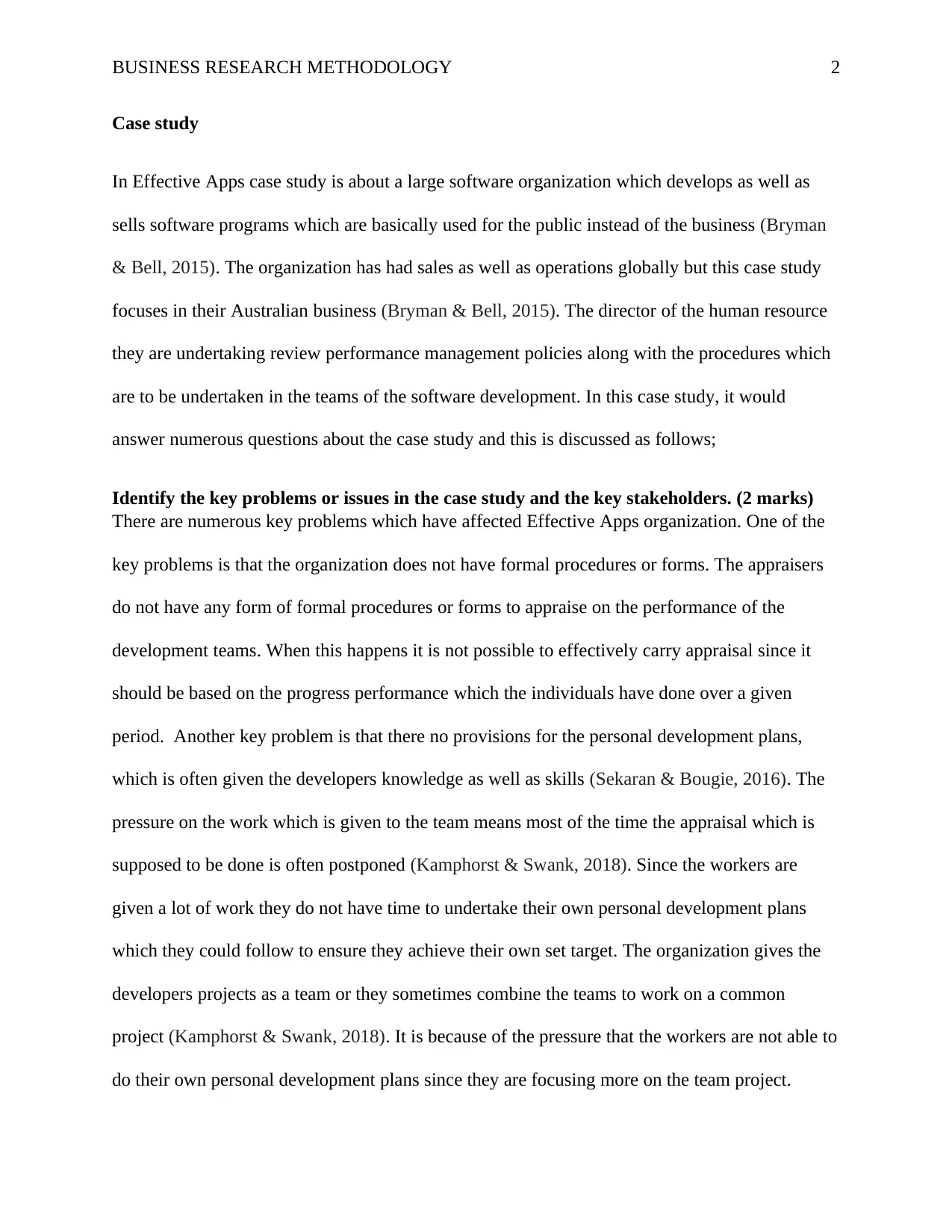
In Effective Apps case study is about a large software organization which develops as well as
sells software programs which are basically used for the public instead of the business (Bryman
& Bell, 2015). The organization has had sales as well as operations globally but this case study
focuses in their Australian business (Bryman & Bell, 2015). The director of the human resource
they are undertaking review performance management policies along with the procedures which
are to be undertaken in the teams of the software development. In this case study, it would
answer numerous questions about the case study and this is discussed as follows;
Identify the key problems or issues in the case study and the key stakeholders. (2 marks)
There are numerous key problems which have affected Effective Apps organization. One of the
key problems is that the organization does not have formal procedures or forms. The appraisers
do not have any form of formal procedures or forms to appraise on the performance of the
development teams. When this happens it is not possible to effectively carry appraisal since it
should be based on the progress performance which the individuals have done over a given
period. Another key problem is that there no provisions for the personal development plans,
which is often given the developers knowledge as well as skills (Sekaran & Bougie, 2016). The
pressure on the work which is given to the team means most of the time the appraisal which is
supposed to be done is often postponed (Kamphorst & Swank, 2018). Since the workers are
given a lot of work they do not have time to undertake their own personal development plans
which they could follow to ensure they achieve their own set target. The organization gives the
developers projects as a team or they sometimes combine the teams to work on a common
project (Kamphorst & Swank, 2018). It is because of the pressure that the workers are not able to
do their own personal development plans since they are focusing more on the team project.
Document Page
BUSINESS RESEARCH METHODOLOGY 3
Another key problem is that there are team leaders who favor some team members than the
others. There are team leaders who are softer appraisers than others. When this happens there is
no equality in the work since some seems to be favored than others (Kamphorst & Swank, 2018).
In any business all the workers need to be treated equally, there should neither softer appraisers
nor strict appraisers (Kamphorst & Swank, 2018). This is an issue since performance of some
workers would be better than others and all are doing the same project as a team (Landy, Zedeck
& Cleveland, 2017). The last problem is the increase in the rate of the turnover amongst the
software developers. This has been associated with the low pay since the software developers
benefits have been based on the profit related bonuses and over the past few years the
organization profits have been low (Landy, Zedeck & Cleveland, 2017). This means that there is
issue in the structure of the salaries and bonus which need to be appraised well.
Key stakeholders
The key stakeholders for this particular organization are the customers and the employees. The
organization is making applications which are aimed for the general public consumers. This
means that they tend to target the customers rather than the business (Kamphorst & Swank,
2018). The employees are also the stakeholders since they are concerned with the development
of the software and they are the ones are concerned in making all the software would make a
difference to the general public.
Comparing all the identified problems/issues, which one do you consider most critical,
justifying your choice. (3 marks)
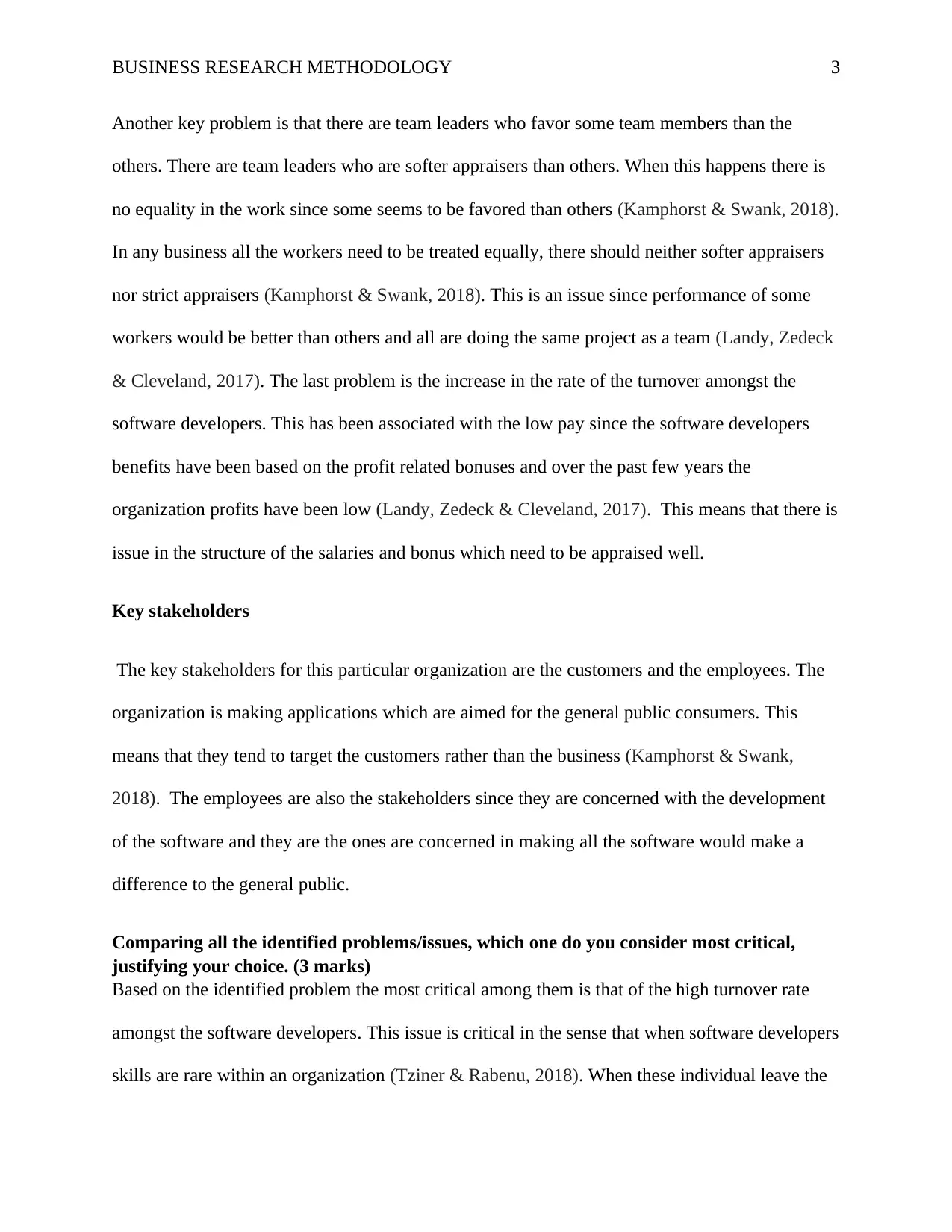
Based on the identified problem the most critical among them is that of the high turnover rate
amongst the software developers. This issue is critical in the sense that when software developers
skills are rare within an organization (Tziner & Rabenu, 2018). When these individual leave the
Document Page
BUSINESS RESEARCH METHODOLOGY 4
organization they would end up to the competitors of that organization. With them they have all
the knowledge applications for all the design the previous employer have aligned to implement.
Moreover, software developers have scarce skills, and it might be hard to replace them when
they reassign from your organization (Landy, Zedeck & Cleveland, 2017). It is thus, important to
retain all of them but make their salaries and bonuses worthwhile than the competitors because if
they get a better offer they would leave the organization. Considering Effective Apps
organization is not doing well and there profit they have not been good many are reassigning.
Propose a strategy to address the most critical problem/issue and justify your approach,
drawing on relevant course concepts. (5 marks)
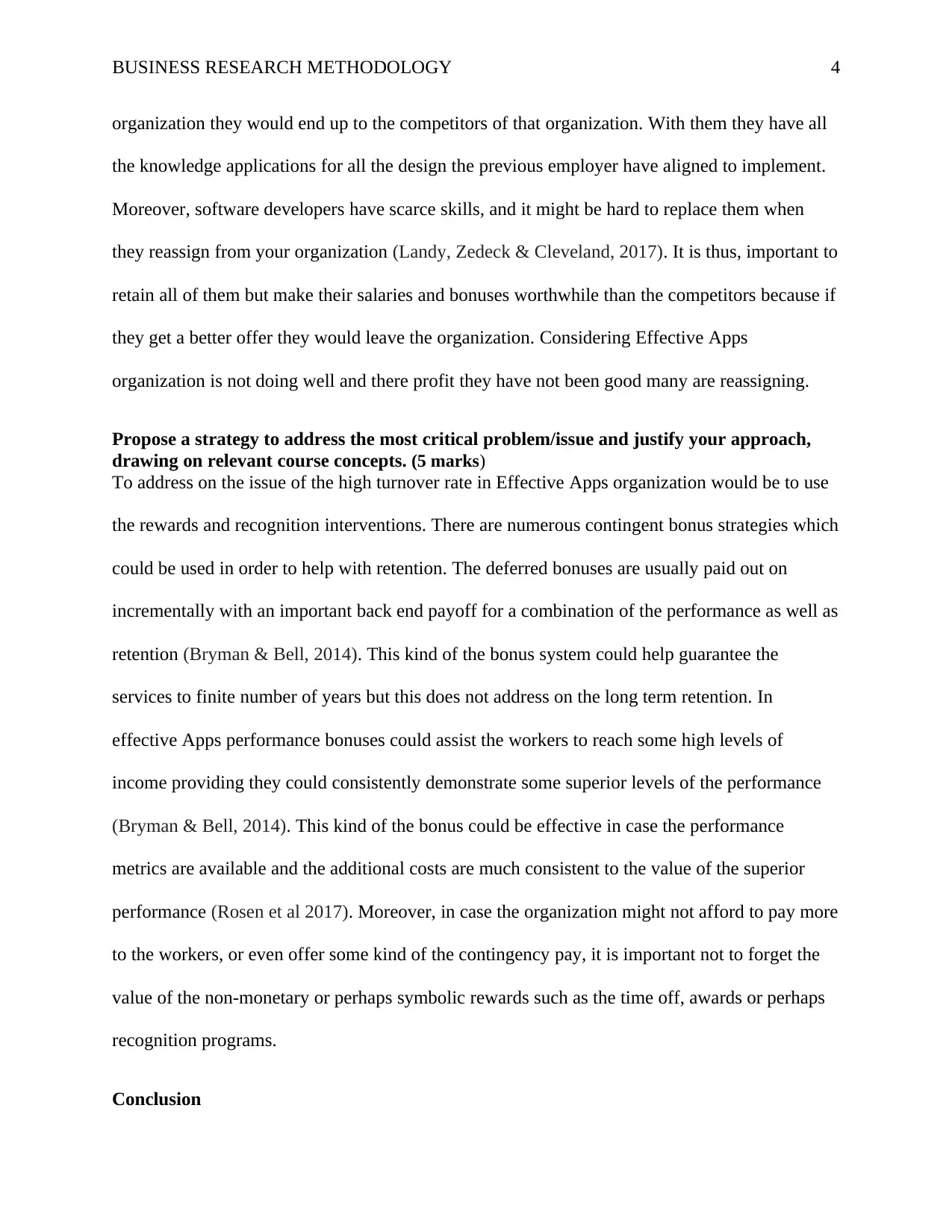
To address on the issue of the high turnover rate in Effective Apps organization would be to use
the rewards and recognition interventions. There are numerous contingent bonus strategies which
could be used in order to help with retention. The deferred bonuses are usually paid out on
incrementally with an important back end payoff for a combination of the performance as well as
retention (Bryman & Bell, 2014). This kind of the bonus system could help guarantee the
services to finite number of years but this does not address on the long term retention. In
effective Apps performance bonuses could assist the workers to reach some high levels of
income providing they could consistently demonstrate some superior levels of the performance
(Bryman & Bell, 2014). This kind of the bonus could be effective in case the performance
metrics are available and the additional costs are much consistent to the value of the superior
performance (Rosen et al 2017). Moreover, in case the organization might not afford to pay more
to the workers, or even offer some kind of the contingency pay, it is important not to forget the
value of the non-monetary or perhaps symbolic rewards such as the time off, awards or perhaps
recognition programs.
Conclusion
tabler-icon-diamond-filled.svg

Paraphrase This Document

Need a fresh take? Get an instant paraphrase of this document with our AI Paraphraser
Document Page
BUSINESS RESEARCH METHODOLOGY 5
In this Effective Apps organization case study the software company has encountered some key
problems which have been discussed as above. These issues are critical and they need to be
addressed by this organization to ensure they address all the issues affecting the workers.
Document Page
BUSINESS RESEARCH METHODOLOGY 6
References
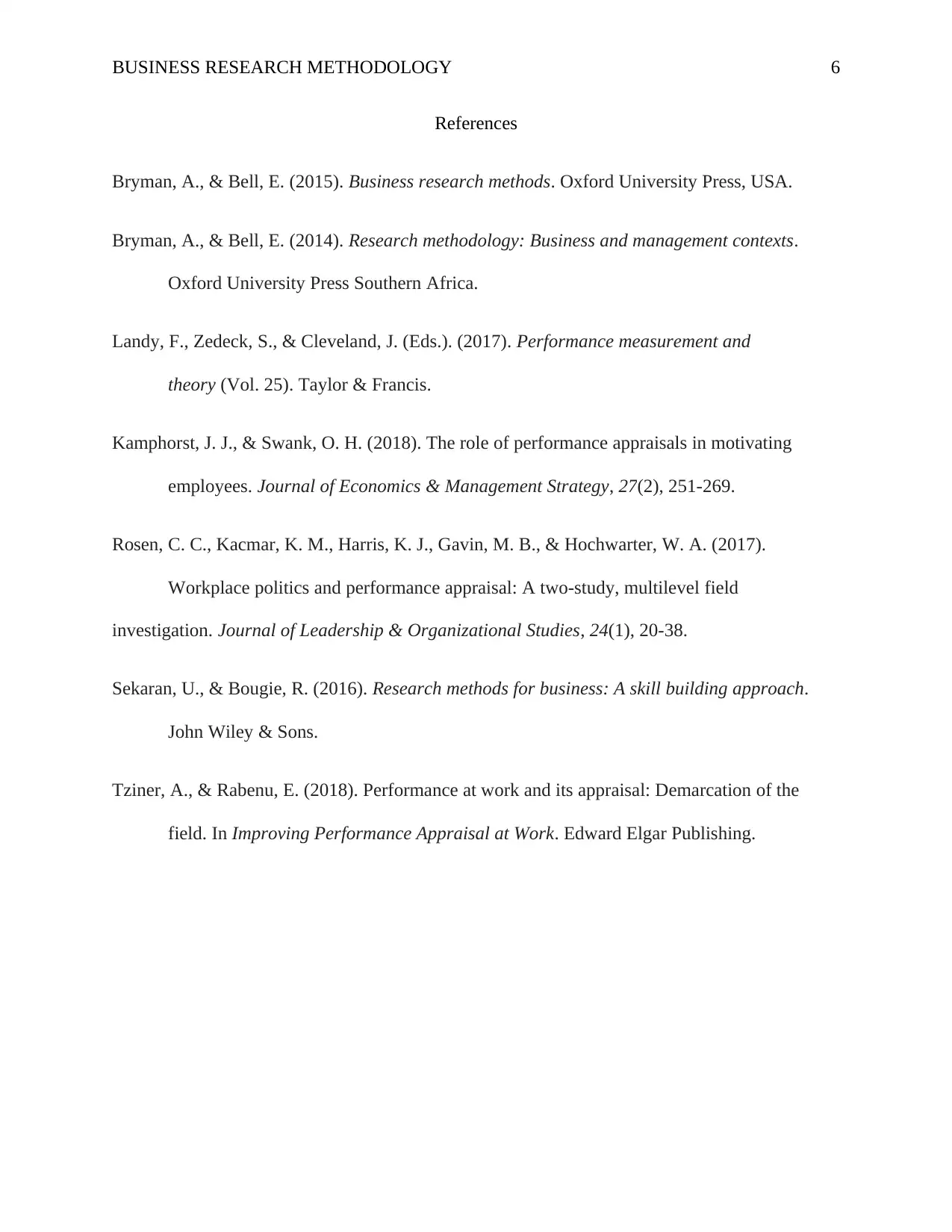
Bryman, A., & Bell, E. (2015). Business research methods. Oxford University Press, USA.
Bryman, A., & Bell, E. (2014). Research methodology: Business and management contexts.
Oxford University Press Southern Africa.
Landy, F., Zedeck, S., & Cleveland, J. (Eds.). (2017). Performance measurement and
theory (Vol. 25). Taylor & Francis.
Kamphorst, J. J., & Swank, O. H. (2018). The role of performance appraisals in motivating
employees. Journal of Economics & Management Strategy, 27(2), 251-269.
Rosen, C. C., Kacmar, K. M., Harris, K. J., Gavin, M. B., & Hochwarter, W. A. (2017).
Workplace politics and performance appraisal: A two-study, multilevel field
investigation. Journal of Leadership & Organizational Studies, 24(1), 20-38.
Sekaran, U., & Bougie, R. (2016). Research methods for business: A skill building approach.
John Wiley & Sons.
Tziner, A., & Rabenu, E. (2018). Performance at work and its appraisal: Demarcation of the
field. In Improving Performance Appraisal at Work. Edward Elgar Publishing.
chevron_up_icon
1 out of 6
circle_padding
hide_on_mobile
zoom_out_icon
[object Object]