Business Research Methodology Report: Ethical Intention and CSR
VerifiedAdded on 2020/04/07
|11
|2738
|138
Report
AI Summary
This report provides a comprehensive analysis of business research methodology, encompassing both theoretical frameworks and practical applications. Part 1 of the report critically analyzes an article exploring the impact of individual and organizational ethics on ethical intention within international business decision-making, discussing the roles of corporate governance and stakeholder theory. It also includes a detailed examination of the research model, hypotheses, and findings, along with the limitations of the study. Part 2 delves into a learning log, focusing on stakeholder theory within the context of Corporate Social Responsibility (CSR), summarizing a literature search and review of scholarly articles. Unit 3 explores the evolution and importance of stakeholder theory, while Unit 8 addresses statistical concepts, including hypothesis testing, p-values, and their implications for business profitability analysis. The report provides insights into ethical decision-making, corporate governance, and statistical analysis within a business context.
Running head: BUSINESS RESEARCH METHODOLOGY
Business Research Methodology
Name of the Student:
Name of the University:
Author note:
Business Research Methodology
Name of the Student:
Name of the University:
Author note:

Paraphrase This Document
Need a fresh take? Get an instant paraphrase of this document with our AI Paraphraser
1BUSINESS RESEARCH METHODOLOGY
Part 1: Essay
Thesis statement-In this essay, the article related to organizational ethics, individual ethics and
ethical intention in international decision making is critically analyzed.
Introduction
The article explores how Ethical Intention (EI) is affected by individual ethics (IE) and
organizational ethics (OE). The ethical intention (EI) in the decision making process of
international business is studied and results of the study has demonstrated that EI is influenced
by both IE and OE. The findings of the study suggests that governance mechanism should be
created in an organization to increase ethical congruence and thus managers of the organization
will be more likely to make choices which are more ethical during the decision making process
of the organization. Also the study shows that organizational ethics influence younger managers
more than older managers (Elango et al 2010).
Discussion
The importance of corporate governance is of paramount importance for an organization.
The organizations are directed and controlled by corporate governance and there is collaboration
among the ethical norms of the organization and the responsibility of the organization towards
stakeholders which helps in managerial decisions which are in alignment with ethics of the
organization. The corporate governance of an organization helps in maintaining a positive ethical
climate and organizational ethics and Individual ethics are studied simultaneously in the article.
The study will demonstrate how ethical intention (EI) is affected by organizational and
individual ethics and the findings of the research can be used to develop practices of business
ethics in an organization to make the process of corporate governance (Dale and Latham 2015).
Part 1: Essay
Thesis statement-In this essay, the article related to organizational ethics, individual ethics and
ethical intention in international decision making is critically analyzed.
Introduction
The article explores how Ethical Intention (EI) is affected by individual ethics (IE) and
organizational ethics (OE). The ethical intention (EI) in the decision making process of
international business is studied and results of the study has demonstrated that EI is influenced
by both IE and OE. The findings of the study suggests that governance mechanism should be
created in an organization to increase ethical congruence and thus managers of the organization
will be more likely to make choices which are more ethical during the decision making process
of the organization. Also the study shows that organizational ethics influence younger managers
more than older managers (Elango et al 2010).
Discussion
The importance of corporate governance is of paramount importance for an organization.
The organizations are directed and controlled by corporate governance and there is collaboration
among the ethical norms of the organization and the responsibility of the organization towards
stakeholders which helps in managerial decisions which are in alignment with ethics of the
organization. The corporate governance of an organization helps in maintaining a positive ethical
climate and organizational ethics and Individual ethics are studied simultaneously in the article.
The study will demonstrate how ethical intention (EI) is affected by organizational and
individual ethics and the findings of the research can be used to develop practices of business
ethics in an organization to make the process of corporate governance (Dale and Latham 2015).
2BUSINESS RESEARCH METHODOLOGY
The theoretical overview of the article suggests that there should be an alignment and
congruence between the value of an individual and organizational values which is called person-
organizational fit. According to Casmir (2013), the values of an organization are of prime
importance for the practice of ethical behavior within an organization. Business is a part of
society and thus every organization owe to all its stakeholders by following an ethical work
culture and by practicing corporate governance. There is congruence between the ethical
decision making and values within an organization. The cultural and organizational setting might
influence individuals with similar values to make different choices of ethics while making
decisions for an organization. The article suggests that organization culture, ethical practices and
values are complex. According to Ciulla (2014), there are several factors that can affect ethical
decision making in an organization like work climate, organizational climate, accountability
practices of an organization. However, studying the ethical practices of an organization in terms
of international context can be quite complex. The system of bribery is highly prevalent in the
international market and thus managers often end up working unethically. Also the standards of
ethical behavior in the host and home country do not match which lead to unethical behavior
from managers. However, according to Crane and Matten (2016), the managers who stay abroad
may not be able to resolve ethical issues because they feel distanced from the resources of the
organization. The article suggest that managers who work in an international setting are vested
with autonomous rights and the corporate governance, law and regulation are not strict enough in
a distant location or within the cultural boundary of a different country(Trevino and Nelson
2016). The managers are also not scrutinized well by various stakeholders like the journalists;
customers and investors and thus managers might deviate from ethical decision making.
However, it can be argued that managers working in a distant location do not require constant
The theoretical overview of the article suggests that there should be an alignment and
congruence between the value of an individual and organizational values which is called person-
organizational fit. According to Casmir (2013), the values of an organization are of prime
importance for the practice of ethical behavior within an organization. Business is a part of
society and thus every organization owe to all its stakeholders by following an ethical work
culture and by practicing corporate governance. There is congruence between the ethical
decision making and values within an organization. The cultural and organizational setting might
influence individuals with similar values to make different choices of ethics while making
decisions for an organization. The article suggests that organization culture, ethical practices and
values are complex. According to Ciulla (2014), there are several factors that can affect ethical
decision making in an organization like work climate, organizational climate, accountability
practices of an organization. However, studying the ethical practices of an organization in terms
of international context can be quite complex. The system of bribery is highly prevalent in the
international market and thus managers often end up working unethically. Also the standards of
ethical behavior in the host and home country do not match which lead to unethical behavior
from managers. However, according to Crane and Matten (2016), the managers who stay abroad
may not be able to resolve ethical issues because they feel distanced from the resources of the
organization. The article suggest that managers who work in an international setting are vested
with autonomous rights and the corporate governance, law and regulation are not strict enough in
a distant location or within the cultural boundary of a different country(Trevino and Nelson
2016). The managers are also not scrutinized well by various stakeholders like the journalists;
customers and investors and thus managers might deviate from ethical decision making.
However, it can be argued that managers working in a distant location do not require constant
⊘ This is a preview!⊘
Do you want full access?
Subscribe today to unlock all pages.

Trusted by 1+ million students worldwide
3BUSINESS RESEARCH METHODOLOGY
monitoring for making decisions based on ethics. Individual ethics have a huge role to play here
and if the internal values of the organization are in alignment with the values and culture of the
organization, then managers do not need strict monitoring to make ethical decisions (Giacalone
and Rosenfeld 2013).
Research model and Hypothesis-
The relationship between Individual Ethics (IE) and Organizational Ethics and how they
affect the ethical behavior of respondents are studied in the article. The design of Valentine and
Rittenburg is used as the research model of the article. The organizational ethics (OE) and the
respondent’s own Individual Ethics (IE) are hypothesized to have an impact on the dependant
variable of Ethical Intention EI). The controlled variables that are used in the article are gender,
level of management experience and age. Three hypothesis are tested in the article which are
Hypothesis 1- Ethical Intentional (EI) and Individual ethics are related positively. Hypothesis 2
states that ethical intention (EI) will be related positively to the perception of employee of high
level of OE. The Hypothesis 3 suggests that age of the employee moderates the relationship
between employee’s perception of OE and ethical intention (EI). There are several findings that
are demonstrated in the article like younger managers are subjected to higher risk-taking and
manipulation which can lead to deviation from ethical behavior, but this is not often true. Age
may not be a determining factor in ethical behavior as older managers may also practice
unethical behavior. The sample subjects of the article are MBA graduate students of two major
state Universities of the United States with 2 years of full time work experience. Stepwise
hierarchical regression model are used to analyze the article (Michaelson et al 2014).
monitoring for making decisions based on ethics. Individual ethics have a huge role to play here
and if the internal values of the organization are in alignment with the values and culture of the
organization, then managers do not need strict monitoring to make ethical decisions (Giacalone
and Rosenfeld 2013).
Research model and Hypothesis-
The relationship between Individual Ethics (IE) and Organizational Ethics and how they
affect the ethical behavior of respondents are studied in the article. The design of Valentine and
Rittenburg is used as the research model of the article. The organizational ethics (OE) and the
respondent’s own Individual Ethics (IE) are hypothesized to have an impact on the dependant
variable of Ethical Intention EI). The controlled variables that are used in the article are gender,
level of management experience and age. Three hypothesis are tested in the article which are
Hypothesis 1- Ethical Intentional (EI) and Individual ethics are related positively. Hypothesis 2
states that ethical intention (EI) will be related positively to the perception of employee of high
level of OE. The Hypothesis 3 suggests that age of the employee moderates the relationship
between employee’s perception of OE and ethical intention (EI). There are several findings that
are demonstrated in the article like younger managers are subjected to higher risk-taking and
manipulation which can lead to deviation from ethical behavior, but this is not often true. Age
may not be a determining factor in ethical behavior as older managers may also practice
unethical behavior. The sample subjects of the article are MBA graduate students of two major
state Universities of the United States with 2 years of full time work experience. Stepwise
hierarchical regression model are used to analyze the article (Michaelson et al 2014).
Paraphrase This Document
Need a fresh take? Get an instant paraphrase of this document with our AI Paraphraser
4BUSINESS RESEARCH METHODOLOGY
Conclusion
The limitation of the research article is related to the nature of the design. The decision
making of managers in practice can’t be surrogated by the executive MBA students with
experience of work and international exposure. The classroom setting of the respondents is very
different from the actual foreign setting and culture of an organization. There can be social
response bias which is demonstrated by students. There are other variables like size of an
organization, type of industry and degree of internationalization which are not considered in the
article because the sample size of the article is very small. It can be concluded that ethical
choices are made by an individual based on their individual values and values of the
organization. Organizational practices and policies and norms set by leaders also influence the
ethical choices made by an individual.
Conclusion
The limitation of the research article is related to the nature of the design. The decision
making of managers in practice can’t be surrogated by the executive MBA students with
experience of work and international exposure. The classroom setting of the respondents is very
different from the actual foreign setting and culture of an organization. There can be social
response bias which is demonstrated by students. There are other variables like size of an
organization, type of industry and degree of internationalization which are not considered in the
article because the sample size of the article is very small. It can be concluded that ethical
choices are made by an individual based on their individual values and values of the
organization. Organizational practices and policies and norms set by leaders also influence the
ethical choices made by an individual.
5BUSINESS RESEARCH METHODOLOGY
Part 2: Learning Log
Unit 3
The topic for the literature search is the stakeholder theory under the broad topic of
Corporate Social Responsibility (CSR). Few articles and books will be explored to find out the
details of stakeholder theory. The stakeholder theory was introduced by freeman in the 1980s.
This theory laid the foundation of the CSR, which is a very important activity of almost all the
organizations.
To find out more about this theory and CSR, many scholarly articles must be reviewed.
To get the scholarly articles most easily, Google Scholar is the best source. All the authentic
articles along with their citations are available in Google Scholar. The student has reviewed
some scholarly articles. He has chosen the journals, which are ranked 4*, 4 and 3 in the ABS
Academic Journal Guide. These articles have focused mainly on the stakeholder theory and
corporate social responsibility. The articles were searched by using the key word ‘Stakeholder
Theory’, ‘Corporate Social Responsibility’, ‘Stakeholder values’ and ‘Corporate Governance’
along with some journal names. It helps in more precise searching. Many articles have come up
in the search list, but only those articles were considered for review, which were published in the
ABS listed, ranked 4*, 4 and 3. This indicates the acceptability and high quality of the articles.
This also adds more authenticity in the literature review. The year of publication has been taken
from 2012 to 2017. This is so due to the more recent and upgraded research papers can elaborate
the topic more precisely and can also provide new dimensions to the study. Once the article
comes up in the search list, it is checked if the article is open to all. All the articles mentioned in
Part 2: Learning Log
Unit 3
The topic for the literature search is the stakeholder theory under the broad topic of
Corporate Social Responsibility (CSR). Few articles and books will be explored to find out the
details of stakeholder theory. The stakeholder theory was introduced by freeman in the 1980s.
This theory laid the foundation of the CSR, which is a very important activity of almost all the
organizations.
To find out more about this theory and CSR, many scholarly articles must be reviewed.
To get the scholarly articles most easily, Google Scholar is the best source. All the authentic
articles along with their citations are available in Google Scholar. The student has reviewed
some scholarly articles. He has chosen the journals, which are ranked 4*, 4 and 3 in the ABS
Academic Journal Guide. These articles have focused mainly on the stakeholder theory and
corporate social responsibility. The articles were searched by using the key word ‘Stakeholder
Theory’, ‘Corporate Social Responsibility’, ‘Stakeholder values’ and ‘Corporate Governance’
along with some journal names. It helps in more precise searching. Many articles have come up
in the search list, but only those articles were considered for review, which were published in the
ABS listed, ranked 4*, 4 and 3. This indicates the acceptability and high quality of the articles.
This also adds more authenticity in the literature review. The year of publication has been taken
from 2012 to 2017. This is so due to the more recent and upgraded research papers can elaborate
the topic more precisely and can also provide new dimensions to the study. Once the article
comes up in the search list, it is checked if the article is open to all. All the articles mentioned in
⊘ This is a preview!⊘
Do you want full access?
Subscribe today to unlock all pages.
Trusted by 1+ million students worldwide
6BUSINESS RESEARCH METHODOLOGY
this paper are very recently published journal articles, which are available through various online
and university libraries.
The first article, ‘Stakeholder Theory, Value and Firm Performance’, was written by
Jeffrey S. Harrison and Andrew C. Wicks and published in Business Ethics Quarterly, in the year
2013. The journal is rated 4 in the ABS list. The authors addressed the complexity of stakeholder
values and new methods of measuring it. Another article has been taken from the Journal of
Management, ranked 4* in the ABS list. In this article, the authors, Herman Aguinis and Ante
Glavas (2012), have explored 102 books and book chapters and 588 journal articles to
demonstrate the multidisciplinary and multilevel theoretical framework for integrating the CSR
actions and connection with stakeholder values. The other major articles are from the Journal of
Business Ethics, Journal of Management Studies and International Journal of Management
Reviews, ranked, 3, 4, and 3 respectively in the ABS list. The third article by Brown and Forster
(2013) focuses on the moral prioritization of CSR and stakeholder theory. The other two articles
also focused on different aspects of these theories. Siebels and zu Knyphausen‐Aufseß (2012)
mentioned in their article about the role and place of the stakeholder theory and corporate
governance in case of family business. This is a valuable concept in the business. George,
McGahan and Prabhu (2012) have addressed the issue of inclusive growth through the above
mentioned theories.
Through the literature search and reviews, many aspects of the stakeholder theory were
highlighted and its relation with the CSR has been explored. Different authors had different
views on these topics, and those were reviewed by the student. It has been found that, these two
are ethically related. However, if CSR needs to be maintained, the stakeholders value is reduced
to some extent.
this paper are very recently published journal articles, which are available through various online
and university libraries.
The first article, ‘Stakeholder Theory, Value and Firm Performance’, was written by
Jeffrey S. Harrison and Andrew C. Wicks and published in Business Ethics Quarterly, in the year
2013. The journal is rated 4 in the ABS list. The authors addressed the complexity of stakeholder
values and new methods of measuring it. Another article has been taken from the Journal of
Management, ranked 4* in the ABS list. In this article, the authors, Herman Aguinis and Ante
Glavas (2012), have explored 102 books and book chapters and 588 journal articles to
demonstrate the multidisciplinary and multilevel theoretical framework for integrating the CSR
actions and connection with stakeholder values. The other major articles are from the Journal of
Business Ethics, Journal of Management Studies and International Journal of Management
Reviews, ranked, 3, 4, and 3 respectively in the ABS list. The third article by Brown and Forster
(2013) focuses on the moral prioritization of CSR and stakeholder theory. The other two articles
also focused on different aspects of these theories. Siebels and zu Knyphausen‐Aufseß (2012)
mentioned in their article about the role and place of the stakeholder theory and corporate
governance in case of family business. This is a valuable concept in the business. George,
McGahan and Prabhu (2012) have addressed the issue of inclusive growth through the above
mentioned theories.
Through the literature search and reviews, many aspects of the stakeholder theory were
highlighted and its relation with the CSR has been explored. Different authors had different
views on these topics, and those were reviewed by the student. It has been found that, these two
are ethically related. However, if CSR needs to be maintained, the stakeholders value is reduced
to some extent.
Paraphrase This Document
Need a fresh take? Get an instant paraphrase of this document with our AI Paraphraser
7BUSINESS RESEARCH METHODOLOGY
Unit 8
Answer 1
H0: The organization is not profitable as the average profit per employee is less than the industry
average profit.
H1: The organization is profitable as the average profit per employee is more than the industry
standard.
Answer 2
P-value is the probability value of a statistical model, indicating the significance of the statistical
model. This is calculated and interpreted to see if the null hypothesis is to be accepted or
rejected. The critical p-value is held at 0.05 (say α). If the obtained p-value is greater than the
critical value of 0.05, the model is statistically significant and null hypothesis is accepted. The
opposite happens in case of p-value being less than the critical value.
In this example, p-value under normal distribution is 0.405, which is greater than the critical p-
value of 0.05. Thus, the statistical model is significant. It indicates to accept the null hypothesis.
Answer 3
It is mentioned that there is no statistically significant difference between profit per employee (x)
of the company and average industry profit (mean of x). But the problem of testing was based
upon the assumption of the difference between the company average and industry average.
H0: x < mean(x) [The organization is not profitable as the average profit per employee is less
than the industry average profit]
Unit 8
Answer 1
H0: The organization is not profitable as the average profit per employee is less than the industry
average profit.
H1: The organization is profitable as the average profit per employee is more than the industry
standard.
Answer 2
P-value is the probability value of a statistical model, indicating the significance of the statistical
model. This is calculated and interpreted to see if the null hypothesis is to be accepted or
rejected. The critical p-value is held at 0.05 (say α). If the obtained p-value is greater than the
critical value of 0.05, the model is statistically significant and null hypothesis is accepted. The
opposite happens in case of p-value being less than the critical value.
In this example, p-value under normal distribution is 0.405, which is greater than the critical p-
value of 0.05. Thus, the statistical model is significant. It indicates to accept the null hypothesis.
Answer 3
It is mentioned that there is no statistically significant difference between profit per employee (x)
of the company and average industry profit (mean of x). But the problem of testing was based
upon the assumption of the difference between the company average and industry average.
H0: x < mean(x) [The organization is not profitable as the average profit per employee is less
than the industry average profit]
8BUSINESS RESEARCH METHODOLOGY
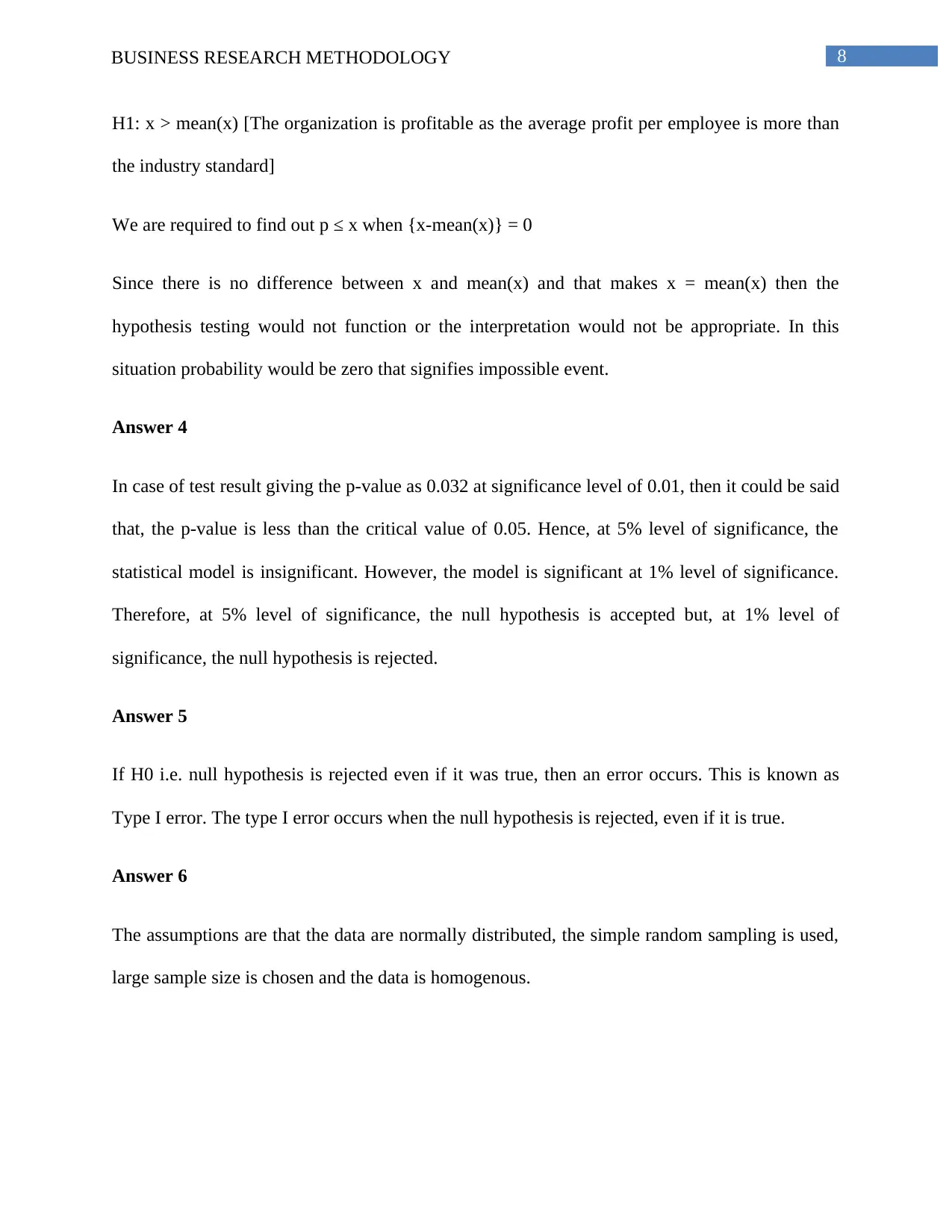
H1: x > mean(x) [The organization is profitable as the average profit per employee is more than
the industry standard]
We are required to find out p ≤ x when {x-mean(x)} = 0
Since there is no difference between x and mean(x) and that makes x = mean(x) then the
hypothesis testing would not function or the interpretation would not be appropriate. In this
situation probability would be zero that signifies impossible event.
Answer 4
In case of test result giving the p-value as 0.032 at significance level of 0.01, then it could be said
that, the p-value is less than the critical value of 0.05. Hence, at 5% level of significance, the
statistical model is insignificant. However, the model is significant at 1% level of significance.
Therefore, at 5% level of significance, the null hypothesis is accepted but, at 1% level of
significance, the null hypothesis is rejected.
Answer 5
If H0 i.e. null hypothesis is rejected even if it was true, then an error occurs. This is known as
Type I error. The type I error occurs when the null hypothesis is rejected, even if it is true.
Answer 6
The assumptions are that the data are normally distributed, the simple random sampling is used,
large sample size is chosen and the data is homogenous.
H1: x > mean(x) [The organization is profitable as the average profit per employee is more than
the industry standard]
We are required to find out p ≤ x when {x-mean(x)} = 0
Since there is no difference between x and mean(x) and that makes x = mean(x) then the
hypothesis testing would not function or the interpretation would not be appropriate. In this
situation probability would be zero that signifies impossible event.
Answer 4
In case of test result giving the p-value as 0.032 at significance level of 0.01, then it could be said
that, the p-value is less than the critical value of 0.05. Hence, at 5% level of significance, the
statistical model is insignificant. However, the model is significant at 1% level of significance.
Therefore, at 5% level of significance, the null hypothesis is accepted but, at 1% level of
significance, the null hypothesis is rejected.
Answer 5
If H0 i.e. null hypothesis is rejected even if it was true, then an error occurs. This is known as
Type I error. The type I error occurs when the null hypothesis is rejected, even if it is true.
Answer 6
The assumptions are that the data are normally distributed, the simple random sampling is used,
large sample size is chosen and the data is homogenous.
⊘ This is a preview!⊘
Do you want full access?
Subscribe today to unlock all pages.
Trusted by 1+ million students worldwide
9BUSINESS RESEARCH METHODOLOGY
References
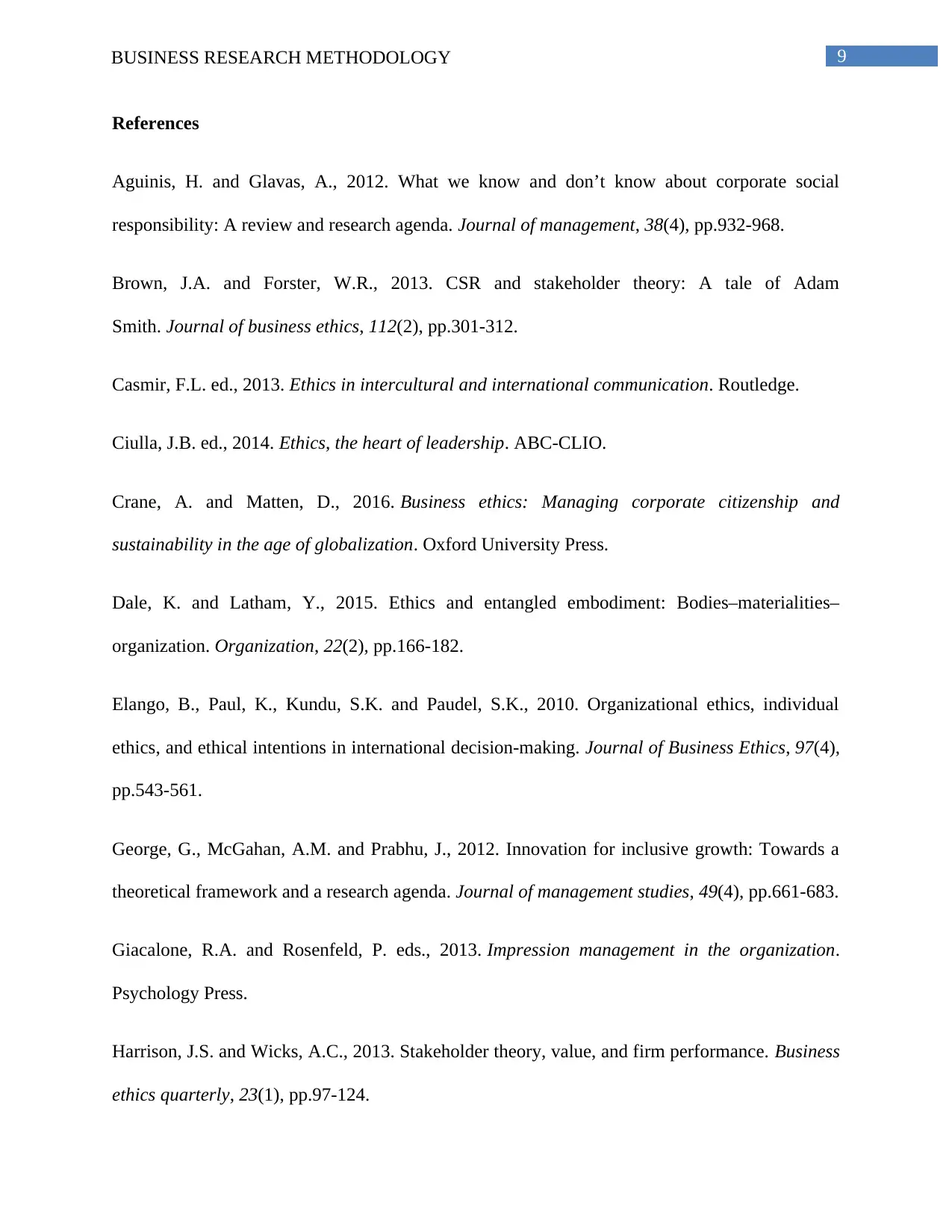
Aguinis, H. and Glavas, A., 2012. What we know and don’t know about corporate social
responsibility: A review and research agenda. Journal of management, 38(4), pp.932-968.
Brown, J.A. and Forster, W.R., 2013. CSR and stakeholder theory: A tale of Adam
Smith. Journal of business ethics, 112(2), pp.301-312.
Casmir, F.L. ed., 2013. Ethics in intercultural and international communication. Routledge.
Ciulla, J.B. ed., 2014. Ethics, the heart of leadership. ABC-CLIO.
Crane, A. and Matten, D., 2016. Business ethics: Managing corporate citizenship and
sustainability in the age of globalization. Oxford University Press.
Dale, K. and Latham, Y., 2015. Ethics and entangled embodiment: Bodies–materialities–
organization. Organization, 22(2), pp.166-182.
Elango, B., Paul, K., Kundu, S.K. and Paudel, S.K., 2010. Organizational ethics, individual
ethics, and ethical intentions in international decision-making. Journal of Business Ethics, 97(4),
pp.543-561.
George, G., McGahan, A.M. and Prabhu, J., 2012. Innovation for inclusive growth: Towards a
theoretical framework and a research agenda. Journal of management studies, 49(4), pp.661-683.
Giacalone, R.A. and Rosenfeld, P. eds., 2013. Impression management in the organization.
Psychology Press.
Harrison, J.S. and Wicks, A.C., 2013. Stakeholder theory, value, and firm performance. Business
ethics quarterly, 23(1), pp.97-124.
References
Aguinis, H. and Glavas, A., 2012. What we know and don’t know about corporate social
responsibility: A review and research agenda. Journal of management, 38(4), pp.932-968.
Brown, J.A. and Forster, W.R., 2013. CSR and stakeholder theory: A tale of Adam
Smith. Journal of business ethics, 112(2), pp.301-312.
Casmir, F.L. ed., 2013. Ethics in intercultural and international communication. Routledge.
Ciulla, J.B. ed., 2014. Ethics, the heart of leadership. ABC-CLIO.
Crane, A. and Matten, D., 2016. Business ethics: Managing corporate citizenship and
sustainability in the age of globalization. Oxford University Press.
Dale, K. and Latham, Y., 2015. Ethics and entangled embodiment: Bodies–materialities–
organization. Organization, 22(2), pp.166-182.
Elango, B., Paul, K., Kundu, S.K. and Paudel, S.K., 2010. Organizational ethics, individual
ethics, and ethical intentions in international decision-making. Journal of Business Ethics, 97(4),
pp.543-561.
George, G., McGahan, A.M. and Prabhu, J., 2012. Innovation for inclusive growth: Towards a
theoretical framework and a research agenda. Journal of management studies, 49(4), pp.661-683.
Giacalone, R.A. and Rosenfeld, P. eds., 2013. Impression management in the organization.
Psychology Press.
Harrison, J.S. and Wicks, A.C., 2013. Stakeholder theory, value, and firm performance. Business
ethics quarterly, 23(1), pp.97-124.
Paraphrase This Document
Need a fresh take? Get an instant paraphrase of this document with our AI Paraphraser
10BUSINESS RESEARCH METHODOLOGY
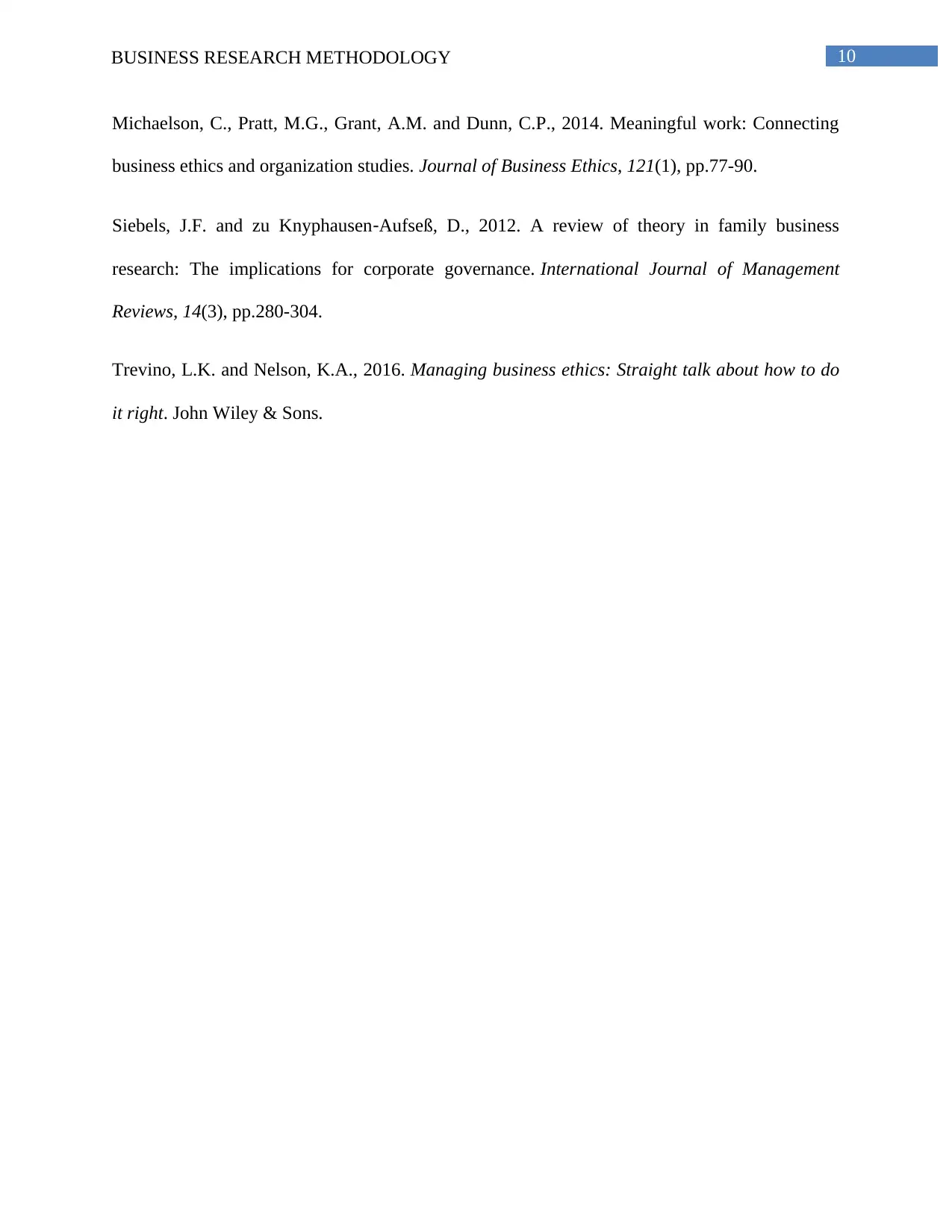
Michaelson, C., Pratt, M.G., Grant, A.M. and Dunn, C.P., 2014. Meaningful work: Connecting
business ethics and organization studies. Journal of Business Ethics, 121(1), pp.77-90.
Siebels, J.F. and zu Knyphausen‐Aufseß, D., 2012. A review of theory in family business
research: The implications for corporate governance. International Journal of Management
Reviews, 14(3), pp.280-304.
Trevino, L.K. and Nelson, K.A., 2016. Managing business ethics: Straight talk about how to do
it right. John Wiley & Sons.
Michaelson, C., Pratt, M.G., Grant, A.M. and Dunn, C.P., 2014. Meaningful work: Connecting
business ethics and organization studies. Journal of Business Ethics, 121(1), pp.77-90.
Siebels, J.F. and zu Knyphausen‐Aufseß, D., 2012. A review of theory in family business
research: The implications for corporate governance. International Journal of Management
Reviews, 14(3), pp.280-304.
Trevino, L.K. and Nelson, K.A., 2016. Managing business ethics: Straight talk about how to do
it right. John Wiley & Sons.

1 out of 11


Related Documents


Your All-in-One AI-Powered Toolkit for Academic Success.
+13062052269
info@desklib.com
Available 24*7 on WhatsApp / Email
![[object Object]](/_next/static/media/star-bottom.7253800d.svg)
Unlock your academic potential
Copyright © 2020–2026 A2Z Services. All Rights Reserved. Developed and managed by ZUCOL.