Research and Statistical Methods in Business Development Assignment

Verified

Added on  2021/05/31

|8
|2295
|85
Homework Assignment
AI Summary
This document presents a detailed analysis of a research and statistical methods assignment. The assignment addresses critical aspects of research design, including the determination of appropriate sample size, considering factors like population heterogeneity and the trade-off between accuracy and resource utilization. It delves into sampling techniques, specifically simple random sampling, outlining its advantages and disadvantages in the context of a study involving bank employees. The analysis further examines the concepts of reliability and validity concerning measurement variables such as quantitative and qualitative job insecurity and psychological distress, evaluating their suitability for the research. Additionally, the assignment explores the use of control variables like age, gender, and education level, justifying their inclusion based on their potential impact on the variables of interest. Finally, the assignment identifies and discusses the correlational research design employed, highlighting its strengths and weaknesses in capturing the association between different measures related to job insecurity.

Document Page
RESEARCH AND STATISTICAL METHOD
STUDENT ID:
[Pick the date]
tabler-icon-diamond-filled.svg

Paraphrase This Document

Need a fresh take? Get an instant paraphrase of this document with our AI Paraphraser
Document Page
Question 1
A key dilemma which every researcher typically has to address while conducting research it
with regards to the appropriate same size. For reliable results from the research, it is pivotal
that the sample obtained should be a faithful illustration of the population of interest that the
researcher intends to replicate. It is known that there is an inverse relationship between
standard error and sample size. Thus, it is clear that by increasing the sample size, the
researcher can enhance the overall accuracy of the research. However, a flip side is the use of
higher resources (both financial and non-financial). On the contrary, if a smaller sample size
is selected, then the cost and resource use would be lowered but so would the accuracy
(Eriksson & Kovalainen, 2015).
Hence, amidst this trade off, the researcher needs to decide on the requisite priorities of
different factors so that decision on appropriate sample size can be made. In this context, it is
noteworthy that another parameter which is of immense consideration is the underlying
heterogeneity that is present in the population. A population that is diverse in terms of key
attributes would typically require a larger sample size so as to ensure that all these diverse
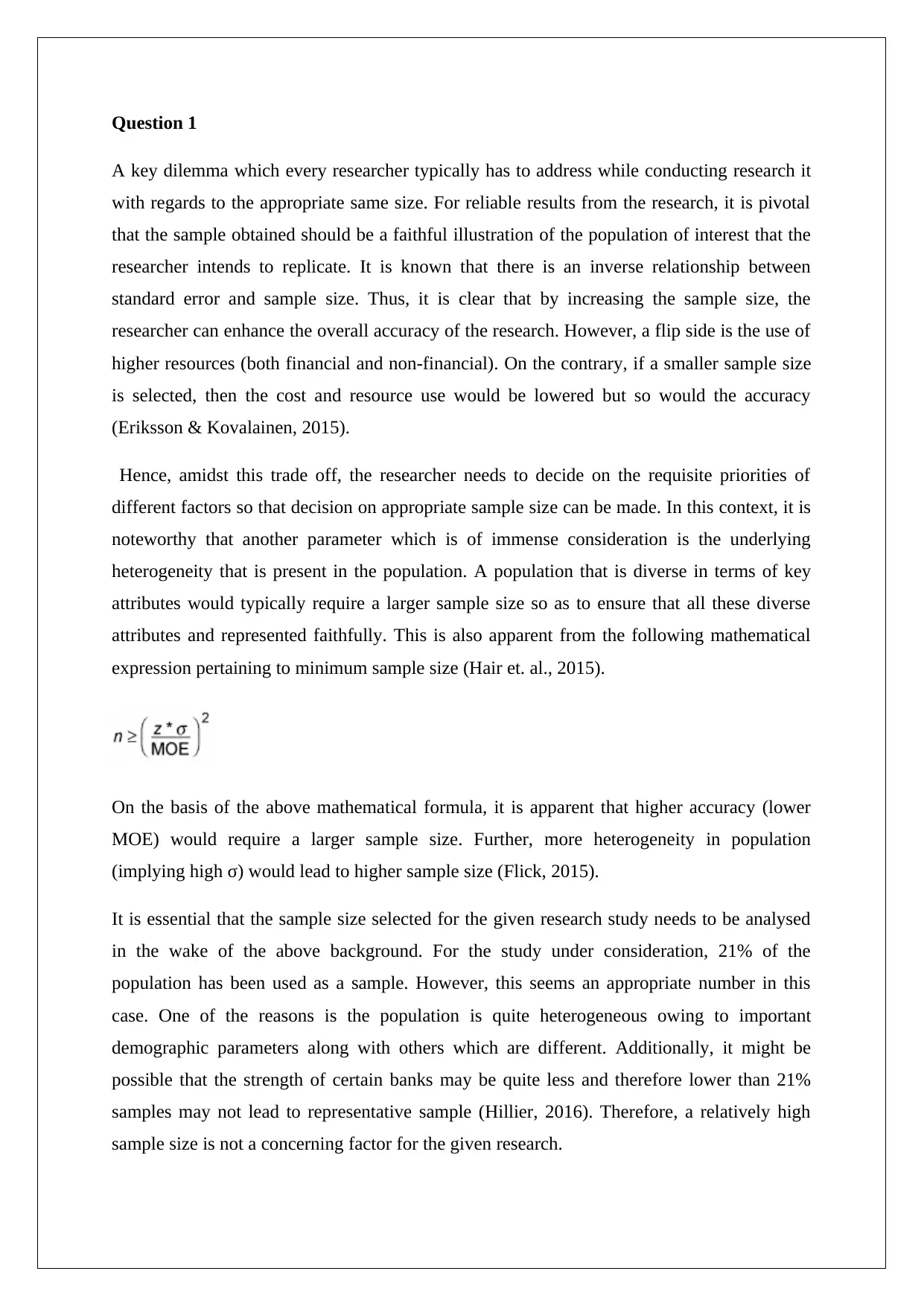
attributes and represented faithfully. This is also apparent from the following mathematical
expression pertaining to minimum sample size (Hair et. al., 2015).
On the basis of the above mathematical formula, it is apparent that higher accuracy (lower
MOE) would require a larger sample size. Further, more heterogeneity in population
(implying high σ) would lead to higher sample size (Flick, 2015).
It is essential that the sample size selected for the given research study needs to be analysed
in the wake of the above background. For the study under consideration, 21% of the
population has been used as a sample. However, this seems an appropriate number in this
case. One of the reasons is the population is quite heterogeneous owing to important
demographic parameters along with others which are different. Additionally, it might be
possible that the strength of certain banks may be quite less and therefore lower than 21%
samples may not lead to representative sample (Hillier, 2016). Therefore, a relatively high
sample size is not a concerning factor for the given research.
Document Page
Question 2
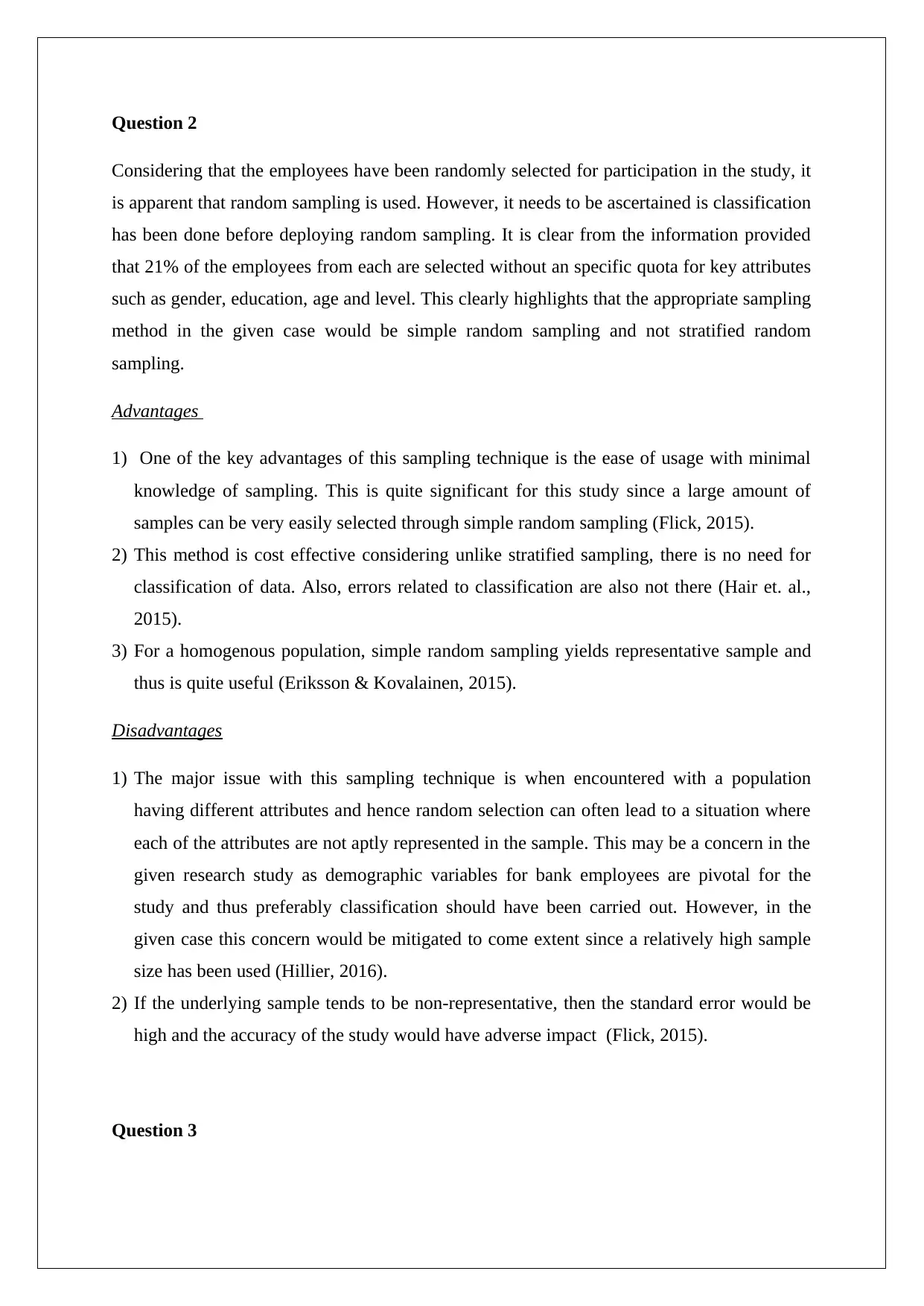
Considering that the employees have been randomly selected for participation in the study, it
is apparent that random sampling is used. However, it needs to be ascertained is classification
has been done before deploying random sampling. It is clear from the information provided
that 21% of the employees from each are selected without an specific quota for key attributes
such as gender, education, age and level. This clearly highlights that the appropriate sampling
method in the given case would be simple random sampling and not stratified random
sampling.
Advantages
1) One of the key advantages of this sampling technique is the ease of usage with minimal
knowledge of sampling. This is quite significant for this study since a large amount of
samples can be very easily selected through simple random sampling (Flick, 2015).
2) This method is cost effective considering unlike stratified sampling, there is no need for
classification of data. Also, errors related to classification are also not there (Hair et. al.,
2015).
3) For a homogenous population, simple random sampling yields representative sample and
thus is quite useful (Eriksson & Kovalainen, 2015).
Disadvantages
1) The major issue with this sampling technique is when encountered with a population
having different attributes and hence random selection can often lead to a situation where
each of the attributes are not aptly represented in the sample. This may be a concern in the
given research study as demographic variables for bank employees are pivotal for the
study and thus preferably classification should have been carried out. However, in the
given case this concern would be mitigated to come extent since a relatively high sample
size has been used (Hillier, 2016).
2) If the underlying sample tends to be non-representative, then the standard error would be
high and the accuracy of the study would have adverse impact (Flick, 2015).
Question 3
Document Page
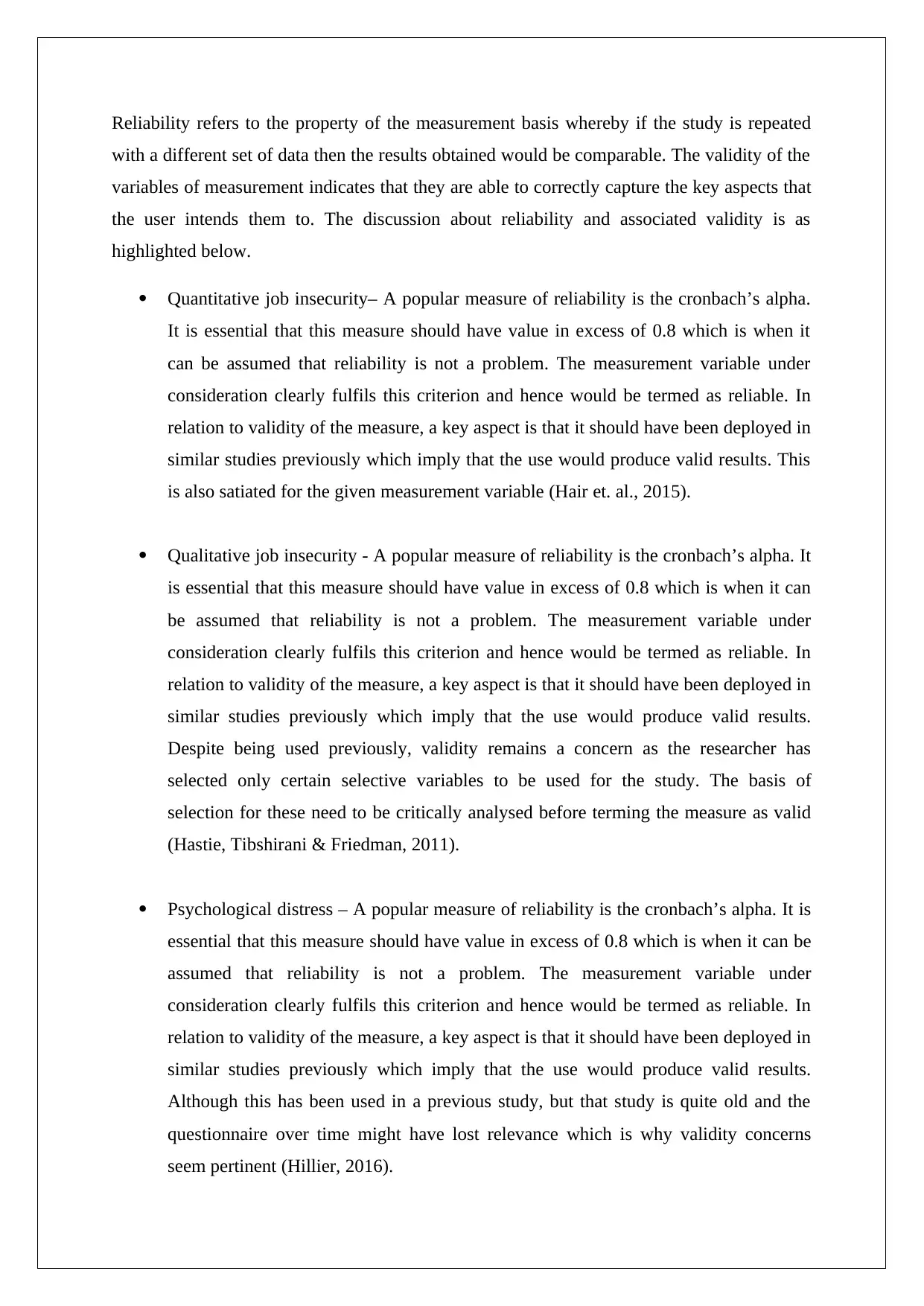
Reliability refers to the property of the measurement basis whereby if the study is repeated
with a different set of data then the results obtained would be comparable. The validity of the
variables of measurement indicates that they are able to correctly capture the key aspects that
the user intends them to. The discussion about reliability and associated validity is as
highlighted below.
 Quantitative job insecurity– A popular measure of reliability is the cronbach’s alpha.
It is essential that this measure should have value in excess of 0.8 which is when it
can be assumed that reliability is not a problem. The measurement variable under
consideration clearly fulfils this criterion and hence would be termed as reliable. In
relation to validity of the measure, a key aspect is that it should have been deployed in
similar studies previously which imply that the use would produce valid results. This
is also satiated for the given measurement variable (Hair et. al., 2015).
 Qualitative job insecurity - A popular measure of reliability is the cronbach’s alpha. It
is essential that this measure should have value in excess of 0.8 which is when it can
be assumed that reliability is not a problem. The measurement variable under
consideration clearly fulfils this criterion and hence would be termed as reliable. In
relation to validity of the measure, a key aspect is that it should have been deployed in
similar studies previously which imply that the use would produce valid results.
Despite being used previously, validity remains a concern as the researcher has
selected only certain selective variables to be used for the study. The basis of
selection for these need to be critically analysed before terming the measure as valid
(Hastie, Tibshirani & Friedman, 2011).
 Psychological distress – A popular measure of reliability is the cronbach’s alpha. It is
essential that this measure should have value in excess of 0.8 which is when it can be
assumed that reliability is not a problem. The measurement variable under
consideration clearly fulfils this criterion and hence would be termed as reliable. In
relation to validity of the measure, a key aspect is that it should have been deployed in
similar studies previously which imply that the use would produce valid results.
Although this has been used in a previous study, but that study is quite old and the
questionnaire over time might have lost relevance which is why validity concerns
seem pertinent (Hillier, 2016).
tabler-icon-diamond-filled.svg

Paraphrase This Document

Need a fresh take? Get an instant paraphrase of this document with our AI Paraphraser
Document Page
Thus, the overall conclusion which seems to be emerging from the critical analysis of the
measurement variables is that reliability does not pose any challenge but the same cannot be
said about the validity of the measurement variables in use.
Question 4
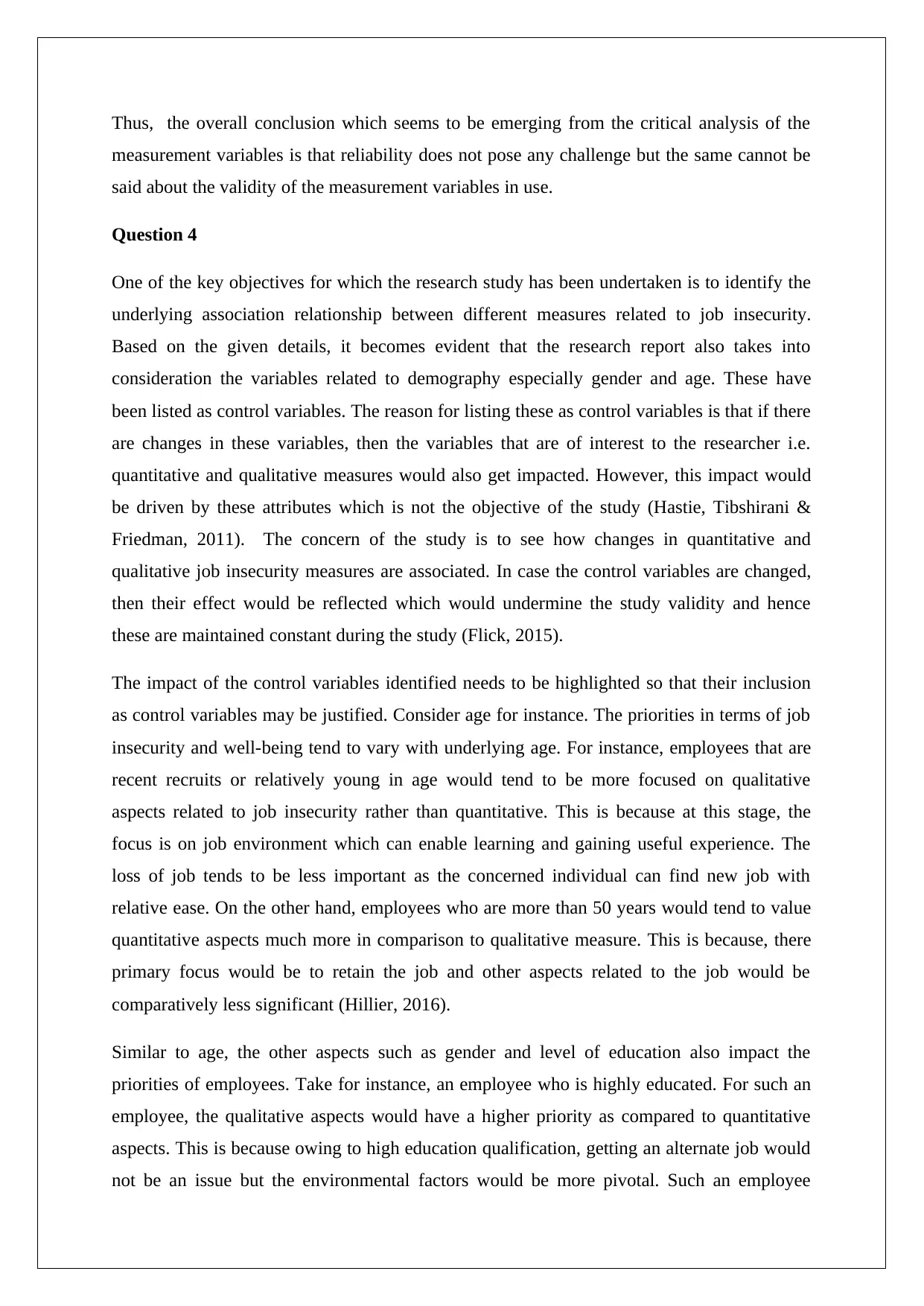
One of the key objectives for which the research study has been undertaken is to identify the
underlying association relationship between different measures related to job insecurity.
Based on the given details, it becomes evident that the research report also takes into
consideration the variables related to demography especially gender and age. These have
been listed as control variables. The reason for listing these as control variables is that if there
are changes in these variables, then the variables that are of interest to the researcher i.e.
quantitative and qualitative measures would also get impacted. However, this impact would
be driven by these attributes which is not the objective of the study (Hastie, Tibshirani &
Friedman, 2011). The concern of the study is to see how changes in quantitative and
qualitative job insecurity measures are associated. In case the control variables are changed,
then their effect would be reflected which would undermine the study validity and hence
these are maintained constant during the study (Flick, 2015).
The impact of the control variables identified needs to be highlighted so that their inclusion
as control variables may be justified. Consider age for instance. The priorities in terms of job
insecurity and well-being tend to vary with underlying age. For instance, employees that are
recent recruits or relatively young in age would tend to be more focused on qualitative
aspects related to job insecurity rather than quantitative. This is because at this stage, the
focus is on job environment which can enable learning and gaining useful experience. The
loss of job tends to be less important as the concerned individual can find new job with
relative ease. On the other hand, employees who are more than 50 years would tend to value
quantitative aspects much more in comparison to qualitative measure. This is because, there
primary focus would be to retain the job and other aspects related to the job would be
comparatively less significant (Hillier, 2016).
Similar to age, the other aspects such as gender and level of education also impact the
priorities of employees. Take for instance, an employee who is highly educated. For such an
employee, the qualitative aspects would have a higher priority as compared to quantitative
aspects. This is because owing to high education qualification, getting an alternate job would
not be an issue but the environmental factors would be more pivotal. Such an employee
Document Page
would not stick in an organisation where qualitative parameters of job insecurity are
significant. In comparison, now consider another employee who has limited education
qualification. For such an individual, finding a new job would be a significant challenge and
hence for this employee, the quantitative measures of job insecurity and well-being would
matter more when compared to qualitative aspects. The on job experience would not be that
important since this employee would be willing to comprise on most of the aspects just to
maintain the current job (Hair et. al., 2015). Similar inclinations of priorities and preferences
can also be observed in case of different genders, justifying the inclusion in the list of control
variables.
Question 5
The relevant research design which has been deployed for the given research is correlational
design which focuses on highlighting the nature and extent of association between the
variables of interest. The various positives (advantages) and limitations (disadvantages) have
been briefly summarised below.
Advantages
1) The amount of data that is collected during this research design tends to exceed the
other research designs. This may be on account of the objective of the study which
rather than focusing on a narrow aspect tends to broad in nature (Hastie, Tibshirani &
Friedman, 2011)
2) This research design aids in the process of theory building since the initial trends may
be captured by this research design. The other researchers can then carry the
association relation forward to develop the same into a causal relation and conduct
indepth study through hypothesis testing (Hillier, 2016).
3) For various researchers, this research design provides better opportunity to understand
the relationship between variables, This can then help immensely in hypothesis
forming and further research using other designs such as experimental (Flick, 2015).
Disadvantages
1) It is imperative to note that association relationship does not imply a causal
relationship. This is a key shortcoming of correlation design since it stops at
highlighting the trend only between selected variables but does not provide the precise
cause on why such a relationship is observed (Hastie, Tibshirani & Friedman, 2011)
Document Page
2) At any given time, this research design can focus on relationship between two
variables thus limiting its use to where a broad relationship between two variables
needs to be ascertained (Hair et. al., 2015).
tabler-icon-diamond-filled.svg

Paraphrase This Document

Need a fresh take? Get an instant paraphrase of this document with our AI Paraphraser
Document Page
References
Eriksson, P. & Kovalainen, A. (2015) Quantitative methods in business research (3rd ed.).
London: Sage Publications.
Flick, U. (2015) Introducing research methodology: A beginner's guide to doing a research
project (4th ed.). New York: Sage Publications.
Hair, J. F., Wolfinbarger, M., Money, A. H., Samouel, P., & Page, M. J. (2015) Essentials of
business research methods (2nd ed.). New York: Routledge.
Hastie, T., Tibshirani, R. & Friedman, J. (2011) The Elements of Statistical Learning (4th
ed.). New York: Springer Publications.
Hillier, F. (2016) Introduction to Operations Research (6th ed.). New York: McGraw Hill
Publications.
chevron_up_icon
1 out of 8
circle_padding
hide_on_mobile
zoom_out_icon
[object Object]