Unit 29: A Comprehensive Report on Business Resources and Financials
VerifiedAdded on 2023/06/17
|13
|3341
|206
Report
AI Summary
This report provides a detailed analysis of various aspects crucial for business development. It begins by examining the factors to consider when selecting resources, including legislations, risk factors, budget considerations, suitability, alignment with business objectives, and sustainability. The report then delves into Customer Relationship Management (CRM), exploring the role of technology, employee training, strategic alignment, and effective processes in understanding and interacting with customers. Furthermore, it discusses transactional development and different approaches to internationalization, such as exporting, franchising, and joint ventures. A break-even analysis is presented as a financial tool for assessing profitability and setting revenue targets. Finally, the report explains the importance of financial statements, including the balance sheet, income statement, and cash flow statement, and their interpretation in making informed business decisions, along with a brief discussion on relevant business legislations. Desklib provides more resources like this to aid students in their studies.

Unit 29- Questions
1
1

Paraphrase This Document
Need a fresh take? Get an instant paraphrase of this document with our AI Paraphraser
TABLE OF CONTENTS
Table of Contents.............................................................................................................................1
1. Factors to be taken into account while choosing resources.....................................................1
2. Customer relationship management (CRM)............................................................................2
3. Transactional development and approaches of internationalisation........................................4
4. Break even analysis.................................................................................................................5
5. Financial statements and their interpretation in business........................................................7
6. Legislations and their impact on small business....................................................................10
REFERNCES.................................................................................................................................11
2
Table of Contents.............................................................................................................................1
1. Factors to be taken into account while choosing resources.....................................................1
2. Customer relationship management (CRM)............................................................................2
3. Transactional development and approaches of internationalisation........................................4
4. Break even analysis.................................................................................................................5
5. Financial statements and their interpretation in business........................................................7
6. Legislations and their impact on small business....................................................................10
REFERNCES.................................................................................................................................11
2
1. Factors to be taken into account while choosing resources
Selection and application of appropriate resources is vital to achieve business objectives.
However while considering any resource for organisational growth small businesses must
consider several factors. Some of these factors are as follows:
Legislations: Every resource must meet the legal compliance associated with its acquirement or
utilisation. If small business does not research or comply with legal aspects then it can result in
legal challenges and resource may not deliver expected outcomes (Watson IV and et.al., 2018).
For example if small business is adopting any technology then it must research all its data
privacy and user regulation so that it can prevent legal and operational consequences.
Risk factors: Resources are chosen to achieve growth objectives thus it is also equally important
to consider the risk factors associated with it. The risk related to particular resources can
influence the cost of maintenance or their usability in business. Thus companies must identify
the possible risk factors, their impact on organisational objectives and associated mitigation
strategies which can be chosen by firms if resource is used or selected for functional purpose.
Budget consideration: Finance can be one of the reasons which can affect the selection of
particular resource. Thus while selecting resources small organisations must ensure that it meets
their financial or budge criteria (Stallkamp and Schotter, 2021). Certain resources may require
additional costs in the form of maintenance, updates or training over period of time. These must
also be consider so that resources can be fully optimised for meeting objectives else even if
initial costs meet budget of organisation but in long run organisation may find difficulty to
maintain such resources.
Suitability and alignment of resource with business objective: When considering any resource it
must be ensured that resource is capable of meeting business objectives and strategies for long
term. Small business must choose the resources in a way such that their diversified objectives
can be fulfilled with minimum modification or requirements in resource and it can overcome the
difficulties in operating business environment. For instance as today online retaining is one of
the latest trends companies must choose a technology platform which not only support online
payment and digital interaction but is also capable to withstand the threats of cyber security or
data privacy concerns.
Sustainability: This is one of the most important considerations when organisation chooses any
resource (Bashir and et.al., 2018). It must be ensure that resource is easy to integrate and use
3
Selection and application of appropriate resources is vital to achieve business objectives.
However while considering any resource for organisational growth small businesses must
consider several factors. Some of these factors are as follows:
Legislations: Every resource must meet the legal compliance associated with its acquirement or
utilisation. If small business does not research or comply with legal aspects then it can result in
legal challenges and resource may not deliver expected outcomes (Watson IV and et.al., 2018).
For example if small business is adopting any technology then it must research all its data
privacy and user regulation so that it can prevent legal and operational consequences.
Risk factors: Resources are chosen to achieve growth objectives thus it is also equally important
to consider the risk factors associated with it. The risk related to particular resources can
influence the cost of maintenance or their usability in business. Thus companies must identify
the possible risk factors, their impact on organisational objectives and associated mitigation
strategies which can be chosen by firms if resource is used or selected for functional purpose.
Budget consideration: Finance can be one of the reasons which can affect the selection of
particular resource. Thus while selecting resources small organisations must ensure that it meets
their financial or budge criteria (Stallkamp and Schotter, 2021). Certain resources may require
additional costs in the form of maintenance, updates or training over period of time. These must
also be consider so that resources can be fully optimised for meeting objectives else even if
initial costs meet budget of organisation but in long run organisation may find difficulty to
maintain such resources.
Suitability and alignment of resource with business objective: When considering any resource it
must be ensured that resource is capable of meeting business objectives and strategies for long
term. Small business must choose the resources in a way such that their diversified objectives
can be fulfilled with minimum modification or requirements in resource and it can overcome the
difficulties in operating business environment. For instance as today online retaining is one of
the latest trends companies must choose a technology platform which not only support online
payment and digital interaction but is also capable to withstand the threats of cyber security or
data privacy concerns.
Sustainability: This is one of the most important considerations when organisation chooses any
resource (Bashir and et.al., 2018). It must be ensure that resource is easy to integrate and use
3
⊘ This is a preview!⊘
Do you want full access?
Subscribe today to unlock all pages.

Trusted by 1+ million students worldwide
with other business processes so that in long term it can deliver expected profits. Resources such
as technology or human may also need training. However in certain cases it can be not feasible
with existing business needs. Thus while choosing particular resources along with future
sustainability organisations must also ensure that resource needs minimum training and meet the
time requirements as well. For example if organisation is choosing any technology then it must
satisfy with the time frame aspect of business objective.
2. Customer relationship management (CRM)
CRM is defined as the incorporation of various strategies of practices for analysing or
implementing the data and practices related to existing as well as potential customers. For
success and customer retention it is important to effectively apply CRM in operations (Surdu,
Mellahi and Glaister, 2018). Along with this CRM also helps organisations to improve their
services by streamlining the business activities and functions in alignment with customer
expectations and business objectives. Customer research management consist of following key
areas which needs priority to understand and interact with the customers and to gather relevant
research about consumer preferences. These areas are as follows:
Technology: In competitive business environment it is vital that organisations must stay ahead of
their competitors. Thus it has become mandatory for companies to keep a track of needs and
choices of customers and social trends. For this purpose effective technology based CRM
software is used which can keep records of every customer interaction. It helps organisation to
personalise and organise their marketing and operational approaches.
Pros: Use of technology in customer research helps companies to accurately predict customer
needs and buying pattern so that a better communication and service delivery can be achieved.
Cons: In addition to vast number of benefits technology based solutions are vulnerable to data
security concerns (Sartor and Beamish, 2018). In some instances the obtained information also
lacks reliability and validity like social media platforms can easily be used by customers to
negative aspects of service.
Process:
Employee training: CRM objectives cannot be achieved without employee engagement. Thus it
is important that employees are well aware with the purpose and approaches of customer
research. For this purpose they may also require training and additional resources.
4
as technology or human may also need training. However in certain cases it can be not feasible
with existing business needs. Thus while choosing particular resources along with future
sustainability organisations must also ensure that resource needs minimum training and meet the
time requirements as well. For example if organisation is choosing any technology then it must
satisfy with the time frame aspect of business objective.
2. Customer relationship management (CRM)
CRM is defined as the incorporation of various strategies of practices for analysing or
implementing the data and practices related to existing as well as potential customers. For
success and customer retention it is important to effectively apply CRM in operations (Surdu,
Mellahi and Glaister, 2018). Along with this CRM also helps organisations to improve their
services by streamlining the business activities and functions in alignment with customer
expectations and business objectives. Customer research management consist of following key
areas which needs priority to understand and interact with the customers and to gather relevant
research about consumer preferences. These areas are as follows:
Technology: In competitive business environment it is vital that organisations must stay ahead of
their competitors. Thus it has become mandatory for companies to keep a track of needs and
choices of customers and social trends. For this purpose effective technology based CRM
software is used which can keep records of every customer interaction. It helps organisation to
personalise and organise their marketing and operational approaches.
Pros: Use of technology in customer research helps companies to accurately predict customer
needs and buying pattern so that a better communication and service delivery can be achieved.
Cons: In addition to vast number of benefits technology based solutions are vulnerable to data
security concerns (Sartor and Beamish, 2018). In some instances the obtained information also
lacks reliability and validity like social media platforms can easily be used by customers to
negative aspects of service.
Process:
Employee training: CRM objectives cannot be achieved without employee engagement. Thus it
is important that employees are well aware with the purpose and approaches of customer
research. For this purpose they may also require training and additional resources.
4
Paraphrase This Document
Need a fresh take? Get an instant paraphrase of this document with our AI Paraphraser
Advantages: Employee engagement along with the technology helps organisation to achieve
customer loyalty as employee represent brands and their engagement can directly affect
profitability.
Disadvantages: Employee training may add on to cost and resource burden particularly for small
size organisations.
Strategy: The use of CRM strategy and software tools must be in alignment with the marketing
and business objectives of firm (Piszcz, Jasser and Warszawski, 2019). They must be clearly
defined and must consider customer interaction and experience into account.
Advantage: When customer research is incorporated with strategic direction of company it
becomes easier for the firms to formulate marketing tactics which can attract and retain
customers so that companies can achieve their growth objectives.
Disadvantage: The use of interactive strategy can deprive small business to emphasis on other
crucial business aspects such as failure risks or operational efficiency.
Process: One of the most important aspects in CRM is process used by organisation to
understand their customer. The organisation must use suitable platforms and technology
solutions to approach customers. If communication process is not informative or easy then it can
complicate the outcomes and customers may avoid it.
Advantages: Use of right process can help organisation to identify its customers and to
understand their expectations (LeBaron and Rühmkorf, 2019). It is helpful and beneficial in
improving customer experience which is good for organisational growth.
Disadvantages: The process used for customer research may lack innovation and thus to
maintain its integrity and productivity organisations needs to regularly update and monitor their
process. The lack of efficiency in this aspect can be harmful for organisational growth. It may
demand for great transparency and capital requirements which is challenging for small
organisations.
3. Transactional development and approaches of internationalisation
Transactional development is defined as business approaches which emphasis on
enhancing sales instead of long term consumer relations. Such business model is particularly
chosen by small firms so that by using appropriate marketing tactics they can make potential
customers to pay for services and then efforts are made to increase sales (Osadchy and et.al.,
5
customer loyalty as employee represent brands and their engagement can directly affect
profitability.
Disadvantages: Employee training may add on to cost and resource burden particularly for small
size organisations.
Strategy: The use of CRM strategy and software tools must be in alignment with the marketing
and business objectives of firm (Piszcz, Jasser and Warszawski, 2019). They must be clearly
defined and must consider customer interaction and experience into account.
Advantage: When customer research is incorporated with strategic direction of company it
becomes easier for the firms to formulate marketing tactics which can attract and retain
customers so that companies can achieve their growth objectives.
Disadvantage: The use of interactive strategy can deprive small business to emphasis on other
crucial business aspects such as failure risks or operational efficiency.
Process: One of the most important aspects in CRM is process used by organisation to
understand their customer. The organisation must use suitable platforms and technology
solutions to approach customers. If communication process is not informative or easy then it can
complicate the outcomes and customers may avoid it.
Advantages: Use of right process can help organisation to identify its customers and to
understand their expectations (LeBaron and Rühmkorf, 2019). It is helpful and beneficial in
improving customer experience which is good for organisational growth.
Disadvantages: The process used for customer research may lack innovation and thus to
maintain its integrity and productivity organisations needs to regularly update and monitor their
process. The lack of efficiency in this aspect can be harmful for organisational growth. It may
demand for great transparency and capital requirements which is challenging for small
organisations.
3. Transactional development and approaches of internationalisation
Transactional development is defined as business approaches which emphasis on
enhancing sales instead of long term consumer relations. Such business model is particularly
chosen by small firms so that by using appropriate marketing tactics they can make potential
customers to pay for services and then efforts are made to increase sales (Osadchy and et.al.,
5
2018). While entering into interactional market small business can use various ways to enter the
market and to accomplish their transactional development.
Internet (export): In this approach organisation can directly sell its products in international
market without any investment or establishment. Use of internet, good logistics and payment
methods has made this approach very popular for small businesses. Exporting has following pros
and cons:
Pros:
Low investment requirements
Low risk factors and fast entry method
No expenses to establish operations in foreign country
Cons:
Transportation or environmental impact can have greater impact
Limited control
Limited knowledge of local changes and needs which can affect growth
Franchising: In this method firm can permit the other company in foreign market the right to
use its products under its brand name. Thus franchisee is responsible for all operations and
decisions.
Pros:
Low risk
Extensive franchising support strengthen the customer base and buying power
Easy brand recognition due to local support
Cons:
High initial investment is required
Limited creativity
Risk of sharing financial information with corporate thus strong contract are required for
avoiding future conflicts
6
market and to accomplish their transactional development.
Internet (export): In this approach organisation can directly sell its products in international
market without any investment or establishment. Use of internet, good logistics and payment
methods has made this approach very popular for small businesses. Exporting has following pros
and cons:
Pros:
Low investment requirements
Low risk factors and fast entry method
No expenses to establish operations in foreign country
Cons:
Transportation or environmental impact can have greater impact
Limited control
Limited knowledge of local changes and needs which can affect growth
Franchising: In this method firm can permit the other company in foreign market the right to
use its products under its brand name. Thus franchisee is responsible for all operations and
decisions.
Pros:
Low risk
Extensive franchising support strengthen the customer base and buying power
Easy brand recognition due to local support
Cons:
High initial investment is required
Limited creativity
Risk of sharing financial information with corporate thus strong contract are required for
avoiding future conflicts
6
⊘ This is a preview!⊘
Do you want full access?
Subscribe today to unlock all pages.
Trusted by 1+ million students worldwide
Joint ventures: Firms can also enter international market by means of strategic alliance with
local organisation in foreign country through a contractual agreement with specific terms and
conditions and time period.
Pros:
Low investment as cost is shared
Minimum risk
Greater flexibility to organisation
Cons:
Higher cost as compare to export method or franchising
Difficulty in integrating two different corporate cultures
Lack of direct control and higher possibilities of conflict if goals are not common for
both partners.
4. Break even analysis
Break even analysis is known to be one of the effective financial tool which assist
organisations to assess the stage or level at which particular product or organisation will have
profit. It gives the number of products organisation must sell to recover its fixed costs. Break
even is a situation in which organisation neither makes neither profit nor has any losses but its
costs are covered (Harymawan and Nurillah, 2017). It provides relationship between revenue,
fixed cost and variable cost.
Figure 1: Breakeven analysis
7
local organisation in foreign country through a contractual agreement with specific terms and
conditions and time period.
Pros:
Low investment as cost is shared
Minimum risk
Greater flexibility to organisation
Cons:
Higher cost as compare to export method or franchising
Difficulty in integrating two different corporate cultures
Lack of direct control and higher possibilities of conflict if goals are not common for
both partners.
4. Break even analysis
Break even analysis is known to be one of the effective financial tool which assist
organisations to assess the stage or level at which particular product or organisation will have
profit. It gives the number of products organisation must sell to recover its fixed costs. Break
even is a situation in which organisation neither makes neither profit nor has any losses but its
costs are covered (Harymawan and Nurillah, 2017). It provides relationship between revenue,
fixed cost and variable cost.
Figure 1: Breakeven analysis
7
Paraphrase This Document
Need a fresh take? Get an instant paraphrase of this document with our AI Paraphraser
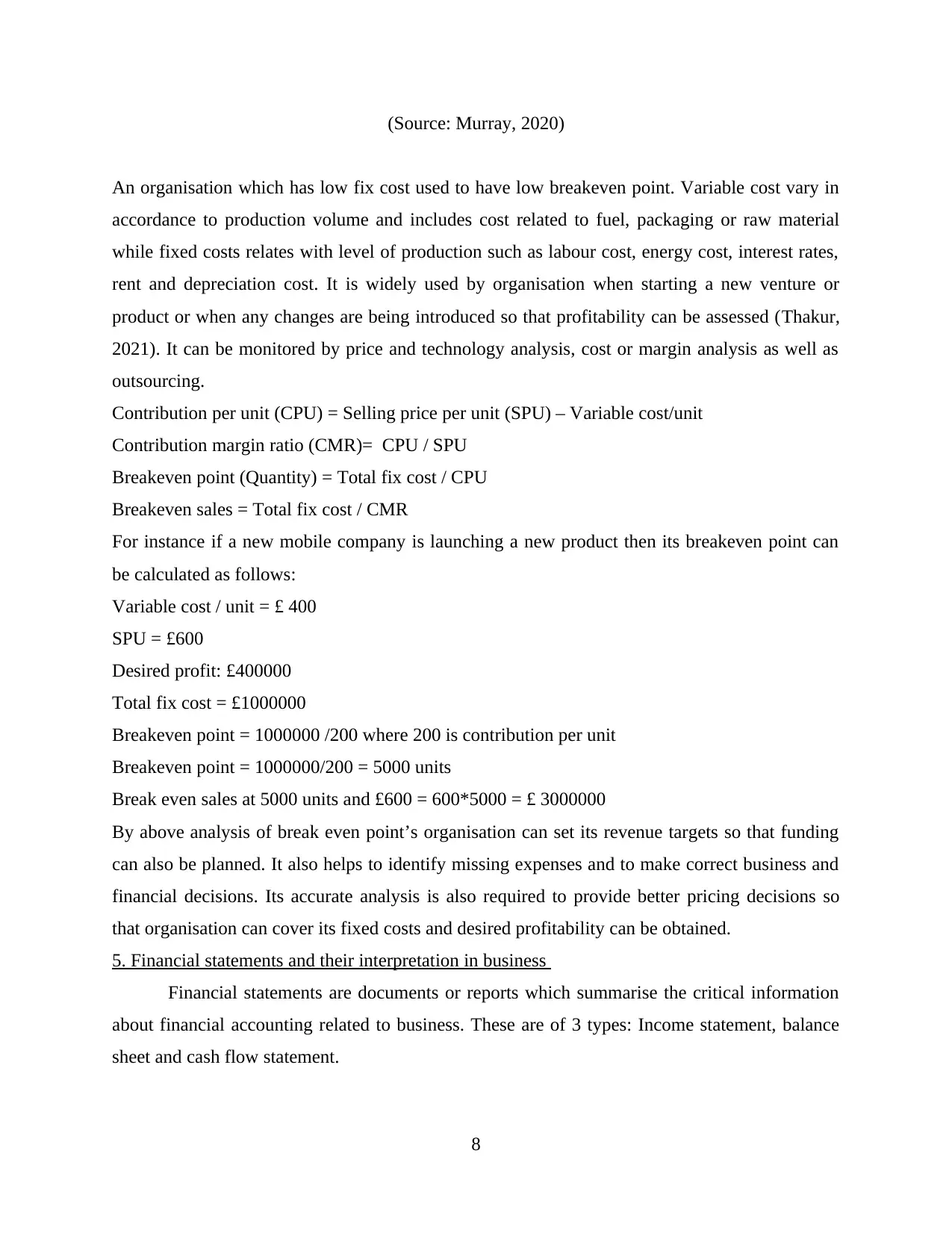
(Source: Murray, 2020)
An organisation which has low fix cost used to have low breakeven point. Variable cost vary in
accordance to production volume and includes cost related to fuel, packaging or raw material
while fixed costs relates with level of production such as labour cost, energy cost, interest rates,
rent and depreciation cost. It is widely used by organisation when starting a new venture or
product or when any changes are being introduced so that profitability can be assessed (Thakur,
2021). It can be monitored by price and technology analysis, cost or margin analysis as well as
outsourcing.
Contribution per unit (CPU) = Selling price per unit (SPU) – Variable cost/unit
Contribution margin ratio (CMR)= CPU / SPU
Breakeven point (Quantity) = Total fix cost / CPU
Breakeven sales = Total fix cost / CMR
For instance if a new mobile company is launching a new product then its breakeven point can
be calculated as follows:
Variable cost / unit = £ 400
SPU = £600
Desired profit: £400000
Total fix cost = £1000000
Breakeven point = 1000000 /200 where 200 is contribution per unit
Breakeven point = 1000000/200 = 5000 units
Break even sales at 5000 units and £600 = 600*5000 = £ 3000000
By above analysis of break even point’s organisation can set its revenue targets so that funding
can also be planned. It also helps to identify missing expenses and to make correct business and
financial decisions. Its accurate analysis is also required to provide better pricing decisions so
that organisation can cover its fixed costs and desired profitability can be obtained.
5. Financial statements and their interpretation in business
Financial statements are documents or reports which summarise the critical information
about financial accounting related to business. These are of 3 types: Income statement, balance
sheet and cash flow statement.
8
An organisation which has low fix cost used to have low breakeven point. Variable cost vary in
accordance to production volume and includes cost related to fuel, packaging or raw material
while fixed costs relates with level of production such as labour cost, energy cost, interest rates,
rent and depreciation cost. It is widely used by organisation when starting a new venture or
product or when any changes are being introduced so that profitability can be assessed (Thakur,
2021). It can be monitored by price and technology analysis, cost or margin analysis as well as
outsourcing.
Contribution per unit (CPU) = Selling price per unit (SPU) – Variable cost/unit
Contribution margin ratio (CMR)= CPU / SPU
Breakeven point (Quantity) = Total fix cost / CPU
Breakeven sales = Total fix cost / CMR
For instance if a new mobile company is launching a new product then its breakeven point can
be calculated as follows:
Variable cost / unit = £ 400
SPU = £600
Desired profit: £400000
Total fix cost = £1000000
Breakeven point = 1000000 /200 where 200 is contribution per unit
Breakeven point = 1000000/200 = 5000 units
Break even sales at 5000 units and £600 = 600*5000 = £ 3000000
By above analysis of break even point’s organisation can set its revenue targets so that funding
can also be planned. It also helps to identify missing expenses and to make correct business and
financial decisions. Its accurate analysis is also required to provide better pricing decisions so
that organisation can cover its fixed costs and desired profitability can be obtained.
5. Financial statements and their interpretation in business
Financial statements are documents or reports which summarise the critical information
about financial accounting related to business. These are of 3 types: Income statement, balance
sheet and cash flow statement.
8
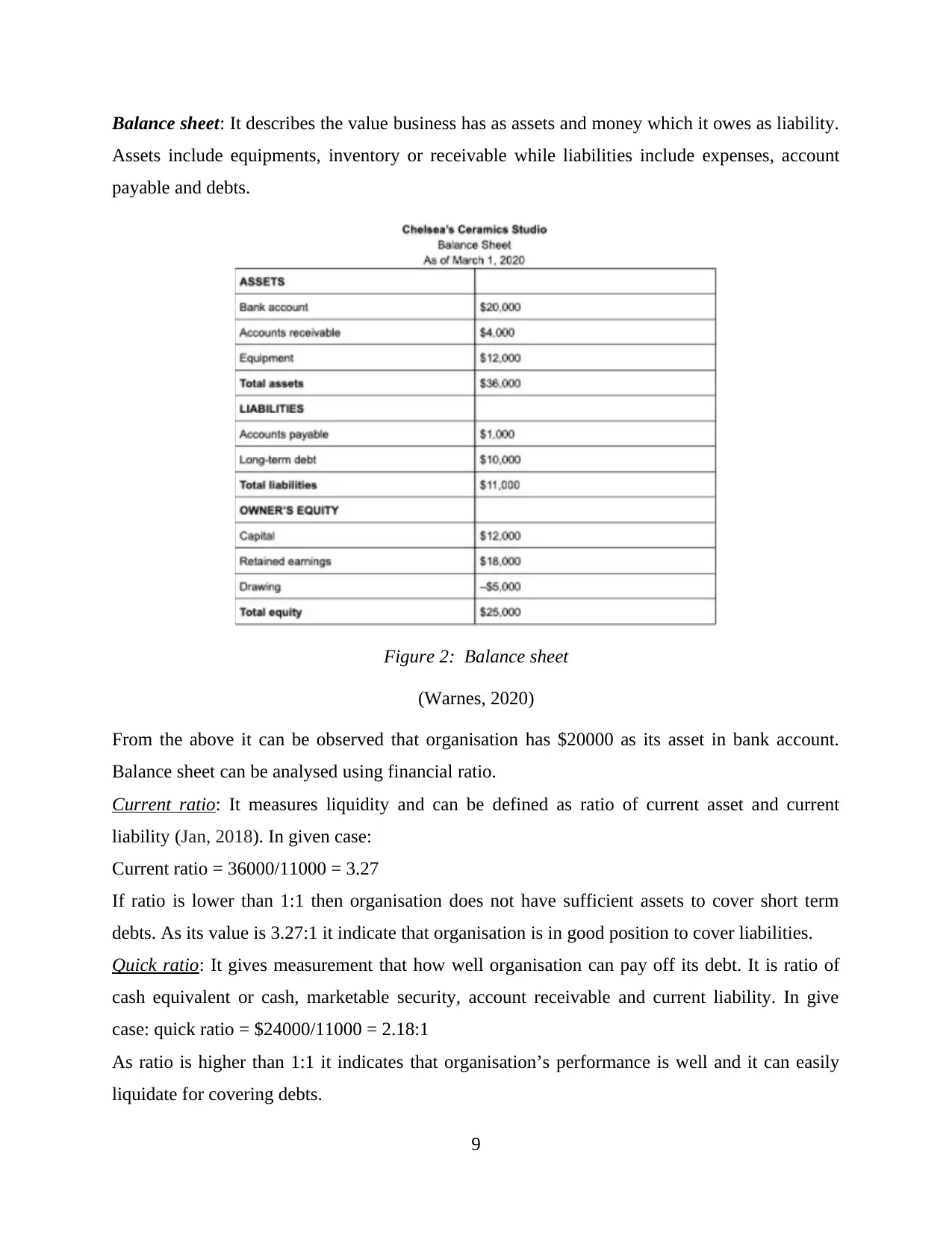
Balance sheet: It describes the value business has as assets and money which it owes as liability.
Assets include equipments, inventory or receivable while liabilities include expenses, account
payable and debts.
Figure 2: Balance sheet
(Warnes, 2020)
From the above it can be observed that organisation has $20000 as its asset in bank account.
Balance sheet can be analysed using financial ratio.
Current ratio: It measures liquidity and can be defined as ratio of current asset and current
liability (Jan, 2018). In given case:
Current ratio = 36000/11000 = 3.27
If ratio is lower than 1:1 then organisation does not have sufficient assets to cover short term
debts. As its value is 3.27:1 it indicate that organisation is in good position to cover liabilities.
Quick ratio: It gives measurement that how well organisation can pay off its debt. It is ratio of
cash equivalent or cash, marketable security, account receivable and current liability. In give
case: quick ratio = $24000/11000 = 2.18:1
As ratio is higher than 1:1 it indicates that organisation’s performance is well and it can easily
liquidate for covering debts.
9
Assets include equipments, inventory or receivable while liabilities include expenses, account
payable and debts.
Figure 2: Balance sheet
(Warnes, 2020)
From the above it can be observed that organisation has $20000 as its asset in bank account.
Balance sheet can be analysed using financial ratio.
Current ratio: It measures liquidity and can be defined as ratio of current asset and current
liability (Jan, 2018). In given case:
Current ratio = 36000/11000 = 3.27
If ratio is lower than 1:1 then organisation does not have sufficient assets to cover short term
debts. As its value is 3.27:1 it indicate that organisation is in good position to cover liabilities.
Quick ratio: It gives measurement that how well organisation can pay off its debt. It is ratio of
cash equivalent or cash, marketable security, account receivable and current liability. In give
case: quick ratio = $24000/11000 = 2.18:1
As ratio is higher than 1:1 it indicates that organisation’s performance is well and it can easily
liquidate for covering debts.
9
⊘ This is a preview!⊘
Do you want full access?
Subscribe today to unlock all pages.
Trusted by 1+ million students worldwide
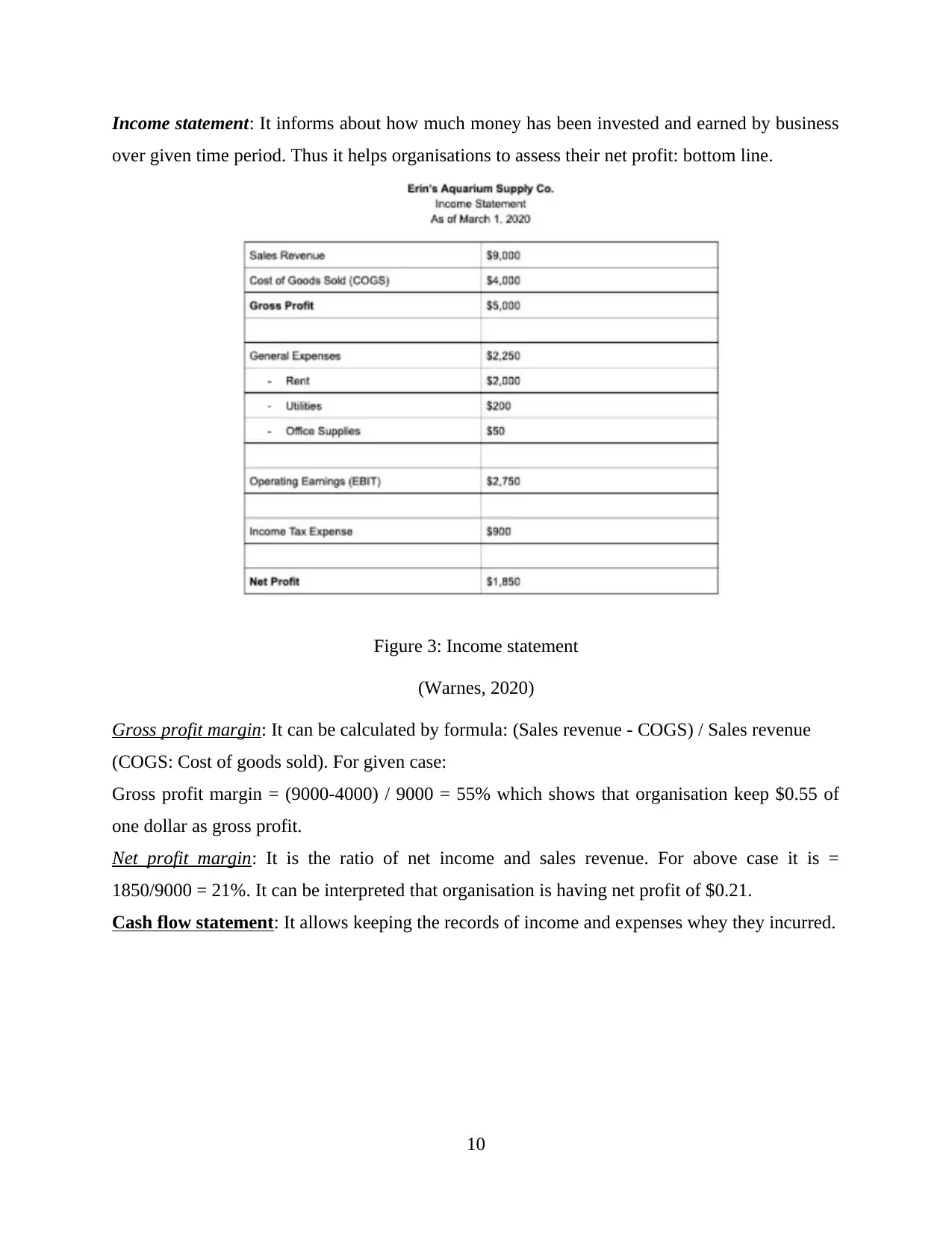
Income statement: It informs about how much money has been invested and earned by business
over given time period. Thus it helps organisations to assess their net profit: bottom line.
Figure 3: Income statement
(Warnes, 2020)
Gross profit margin: It can be calculated by formula: (Sales revenue - COGS) / Sales revenue
(COGS: Cost of goods sold). For given case:
Gross profit margin = (9000-4000) / 9000 = 55% which shows that organisation keep $0.55 of
one dollar as gross profit.
Net profit margin: It is the ratio of net income and sales revenue. For above case it is =
1850/9000 = 21%. It can be interpreted that organisation is having net profit of $0.21.
Cash flow statement: It allows keeping the records of income and expenses whey they incurred.
10
over given time period. Thus it helps organisations to assess their net profit: bottom line.
Figure 3: Income statement
(Warnes, 2020)
Gross profit margin: It can be calculated by formula: (Sales revenue - COGS) / Sales revenue
(COGS: Cost of goods sold). For given case:
Gross profit margin = (9000-4000) / 9000 = 55% which shows that organisation keep $0.55 of
one dollar as gross profit.
Net profit margin: It is the ratio of net income and sales revenue. For above case it is =
1850/9000 = 21%. It can be interpreted that organisation is having net profit of $0.21.
Cash flow statement: It allows keeping the records of income and expenses whey they incurred.
10
Paraphrase This Document
Need a fresh take? Get an instant paraphrase of this document with our AI Paraphraser
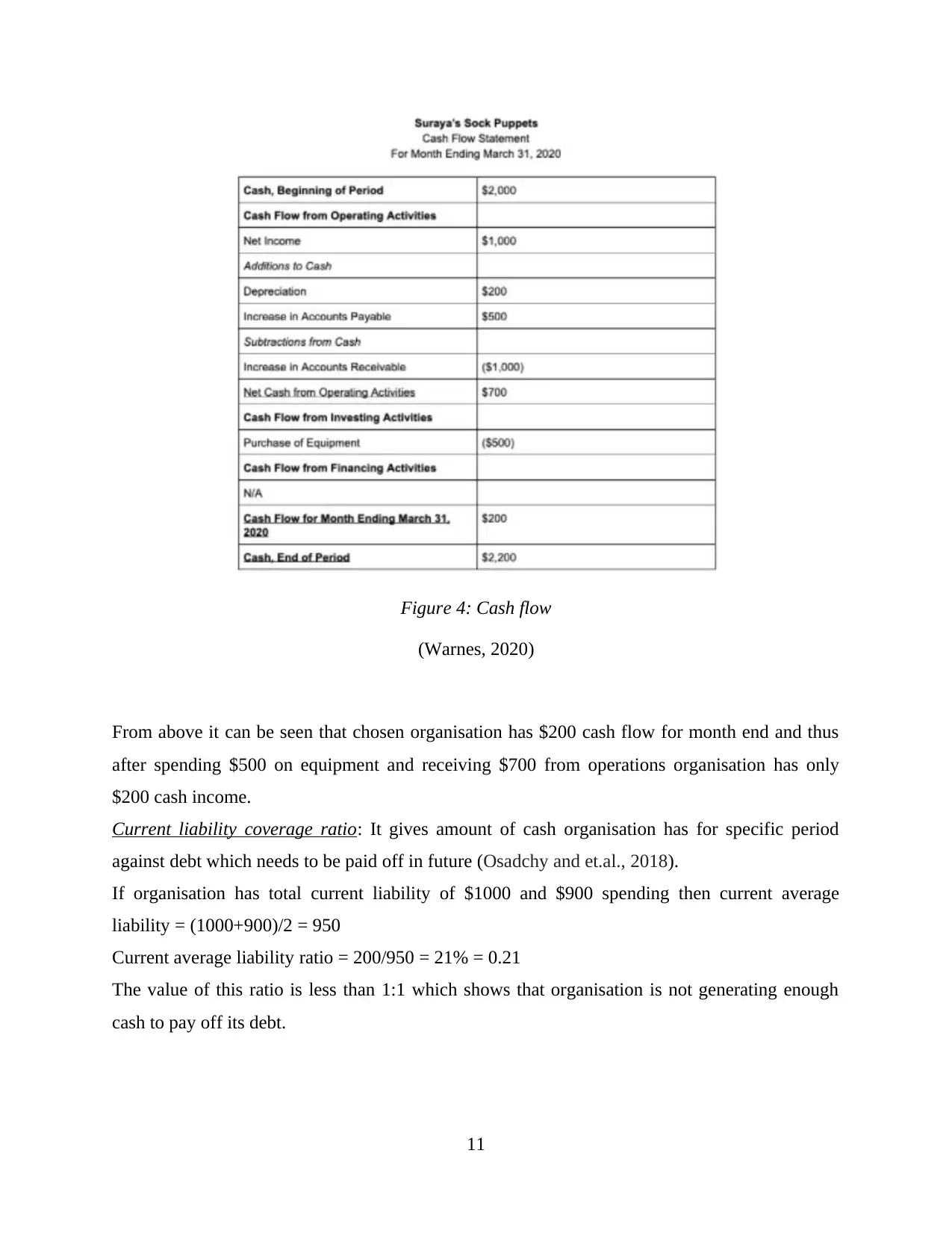
Figure 4: Cash flow
(Warnes, 2020)
From above it can be seen that chosen organisation has $200 cash flow for month end and thus
after spending $500 on equipment and receiving $700 from operations organisation has only
$200 cash income.
Current liability coverage ratio: It gives amount of cash organisation has for specific period
against debt which needs to be paid off in future (Osadchy and et.al., 2018).
If organisation has total current liability of $1000 and $900 spending then current average
liability = (1000+900)/2 = 950
Current average liability ratio = 200/950 = 21% = 0.21
The value of this ratio is less than 1:1 which shows that organisation is not generating enough
cash to pay off its debt.
11
(Warnes, 2020)
From above it can be seen that chosen organisation has $200 cash flow for month end and thus
after spending $500 on equipment and receiving $700 from operations organisation has only
$200 cash income.
Current liability coverage ratio: It gives amount of cash organisation has for specific period
against debt which needs to be paid off in future (Osadchy and et.al., 2018).
If organisation has total current liability of $1000 and $900 spending then current average
liability = (1000+900)/2 = 950
Current average liability ratio = 200/950 = 21% = 0.21
The value of this ratio is less than 1:1 which shows that organisation is not generating enough
cash to pay off its debt.
11
6. Legislations and their impact on small business
Legislations are helpful in regulating that business processes follow quality and standard
procedures. Failure to comply with these regulations can cause financial penalties or operational
restrictions on firm. It can also cause negative brand perception due to compromise in service
quality. Some of the most important legislations which must be followed by small organisations
are as follows:
Employment act 1996: Employment act consist of consolidated enactments to regulate that
employment practices such as recruitment, dismissal or working culture are fair to individuals
and does not have unfair practices. The purpose of this act is to ensure that employees are given
fair and non-discriminatory treatment in all aspects of employment including employment safety,
protection of wages, unfair dismissal, work suspension and zero hour contract.
Company law 2006: This act modernise the company law so that shareholders rights can be
protected and administrative burden can be eased (LeBaron and Rühmkorf, 2019). Company law
states several practices such as codification of director’s duties and rights of stakeholders so that
business can run smooth without conflicts.
Data protection act 1998: This act permits an individual to have right to access their personal
data which is held by organisations. It also ensures that organisation use personal information of
their employees in lawful, informed and specific purpose only which does not violate the privacy
of individuals. In compliance with this act organisations must store, access and process the data
in secure and informed manner which does not violate privacy or does not cause any harm to
individual.
Health and safety regulation: This regulation states that employer must provide a safe and
healthy working condition to all of its employees. If there are any possible risks or harm then
employer must ensure that safety of employee is not compromised.
Compliance to these regulations is mandatory for organisations from legal as well as operational
perspective as they also set standards for quality operations.
12
Legislations are helpful in regulating that business processes follow quality and standard
procedures. Failure to comply with these regulations can cause financial penalties or operational
restrictions on firm. It can also cause negative brand perception due to compromise in service
quality. Some of the most important legislations which must be followed by small organisations
are as follows:
Employment act 1996: Employment act consist of consolidated enactments to regulate that
employment practices such as recruitment, dismissal or working culture are fair to individuals
and does not have unfair practices. The purpose of this act is to ensure that employees are given
fair and non-discriminatory treatment in all aspects of employment including employment safety,
protection of wages, unfair dismissal, work suspension and zero hour contract.
Company law 2006: This act modernise the company law so that shareholders rights can be
protected and administrative burden can be eased (LeBaron and Rühmkorf, 2019). Company law
states several practices such as codification of director’s duties and rights of stakeholders so that
business can run smooth without conflicts.
Data protection act 1998: This act permits an individual to have right to access their personal
data which is held by organisations. It also ensures that organisation use personal information of
their employees in lawful, informed and specific purpose only which does not violate the privacy
of individuals. In compliance with this act organisations must store, access and process the data
in secure and informed manner which does not violate privacy or does not cause any harm to
individual.
Health and safety regulation: This regulation states that employer must provide a safe and
healthy working condition to all of its employees. If there are any possible risks or harm then
employer must ensure that safety of employee is not compromised.
Compliance to these regulations is mandatory for organisations from legal as well as operational
perspective as they also set standards for quality operations.
12
⊘ This is a preview!⊘
Do you want full access?
Subscribe today to unlock all pages.
Trusted by 1+ million students worldwide

1 out of 13


Related Documents


Your All-in-One AI-Powered Toolkit for Academic Success.
+13062052269
info@desklib.com
Available 24*7 on WhatsApp / Email
![[object Object]](/_next/static/media/star-bottom.7253800d.svg)
Unlock your academic potential
Copyright © 2020–2026 A2Z Services. All Rights Reserved. Developed and managed by ZUCOL.