Business Resources Report: McDonald's Financial Analysis and Resources
VerifiedAdded on 2020/09/03
|10
|3059
|97
Report
AI Summary
This report provides a comprehensive analysis of McDonald's business resources. It begins with an introduction to business resources and selects McDonald's as the case study. The report covers recruitment documentation, outlining job descriptions and the hiring process. It then describes the employability, personal, and communication skills required for specific job roles within the company. The analysis continues with an examination of the physical and technological resources essential for McDonald's operations. Sources of internal and external finance are discussed, followed by an interpretation of trading, profit and loss accounts, and balance sheets. The report illustrates the use of budgets for break-even analysis and financial performance. The report concludes with a summary of findings and references.
Business Resource

Paraphrase This Document
Need a fresh take? Get an instant paraphrase of this document with our AI Paraphraser
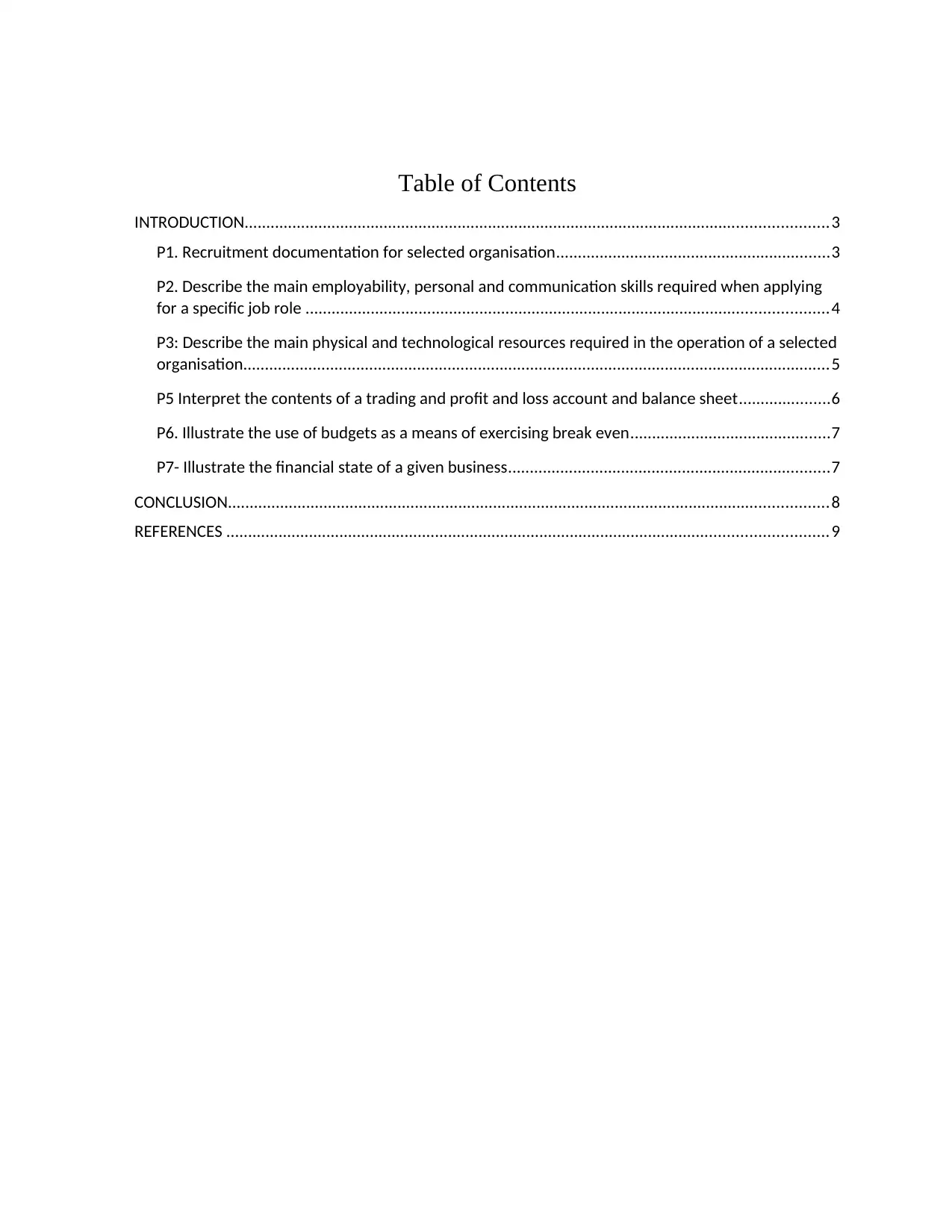
Table of Contents
INTRODUCTION......................................................................................................................................3
P1. Recruitment documentation for selected organisation...............................................................3
P2. Describe the main employability, personal and communication skills required when applying
for a specific job role ........................................................................................................................4
P3: Describe the main physical and technological resources required in the operation of a selected
organisation.......................................................................................................................................5
P5 Interpret the contents of a trading and profit and loss account and balance sheet.....................6
P6. Illustrate the use of budgets as a means of exercising break even..............................................7
P7- Illustrate the financial state of a given business..........................................................................7
CONCLUSION..........................................................................................................................................8
REFERENCES ..........................................................................................................................................9
INTRODUCTION......................................................................................................................................3
P1. Recruitment documentation for selected organisation...............................................................3
P2. Describe the main employability, personal and communication skills required when applying
for a specific job role ........................................................................................................................4
P3: Describe the main physical and technological resources required in the operation of a selected
organisation.......................................................................................................................................5
P5 Interpret the contents of a trading and profit and loss account and balance sheet.....................6
P6. Illustrate the use of budgets as a means of exercising break even..............................................7
P7- Illustrate the financial state of a given business..........................................................................7
CONCLUSION..........................................................................................................................................8
REFERENCES ..........................................................................................................................................9
INTRODUCTION
Business resources are the different resources that organization need to fulfill their all
the different activities and operations which includes human, natural and tangible resources
such as machinery spare parts for production, intangible resources such as brand image and
knowledge, financial resources such as capital, cash at bank etc and anything else a which is
used by the organization to earn the profit. McDonald’s has been selected for this project. It is
one of the world’s most well known and valuable brand-sand commands a leading market
share in the world’s supermarket business. McDonald’s produces food and general household
products and it also has a cafeteria which produces hot drinks, sweet-sand snacks.
P1. Recruitment documentation for selected organisation
A job description sets out the purpose of a job, where the job fits into the organisation
structure, the main responsibilities of the job and the key tasks to be performed. A job
description will set out how a particular employee will fit into the organization. Diverse
factors are there which need to be referred effectively such as job title, responsibilities, role
and duties. A job description could be used as a job indicator for applicants for a job.
Alternatively, it could be used as a guideline for an employee and/or his or her line manager
as to his or her role and responsibility within the organization (Barkemeyer and et.al, 2014).
If McDonald’s decides on hiring employees for their many departmental stores
situated across various branches. There can be a number of ways to advertise this vacancy out of
the many a few may be classified as newspaper, posters, website adverts. Advertisement
should state the job description and should specify the duties the position holds. It should also
state the educational qualification which is essential for the applicant. After the vacancy has
been advertised, interested applicants will send their CV to the given address which will state
their name, educational qualification, work experience, career objective and expectation. On
the basis of approval the further requirements are being taken into account. Before the
interviews take place the interviewees will have to decide what questions they will ask, these
will be found by HR from looking at previous interview questions for similar roles or the line
manager will produce specific questions (Brooks and Henderson, 2014). All questions will be
agreed on before the interview in order to prevent similar questions being repeatedly asked.
The same questions will be asked to all candidates internal or external; this helps to keep it
Business resources are the different resources that organization need to fulfill their all
the different activities and operations which includes human, natural and tangible resources
such as machinery spare parts for production, intangible resources such as brand image and
knowledge, financial resources such as capital, cash at bank etc and anything else a which is
used by the organization to earn the profit. McDonald’s has been selected for this project. It is
one of the world’s most well known and valuable brand-sand commands a leading market
share in the world’s supermarket business. McDonald’s produces food and general household
products and it also has a cafeteria which produces hot drinks, sweet-sand snacks.
P1. Recruitment documentation for selected organisation
A job description sets out the purpose of a job, where the job fits into the organisation
structure, the main responsibilities of the job and the key tasks to be performed. A job
description will set out how a particular employee will fit into the organization. Diverse
factors are there which need to be referred effectively such as job title, responsibilities, role
and duties. A job description could be used as a job indicator for applicants for a job.
Alternatively, it could be used as a guideline for an employee and/or his or her line manager
as to his or her role and responsibility within the organization (Barkemeyer and et.al, 2014).
If McDonald’s decides on hiring employees for their many departmental stores
situated across various branches. There can be a number of ways to advertise this vacancy out of
the many a few may be classified as newspaper, posters, website adverts. Advertisement
should state the job description and should specify the duties the position holds. It should also
state the educational qualification which is essential for the applicant. After the vacancy has
been advertised, interested applicants will send their CV to the given address which will state
their name, educational qualification, work experience, career objective and expectation. On
the basis of approval the further requirements are being taken into account. Before the
interviews take place the interviewees will have to decide what questions they will ask, these
will be found by HR from looking at previous interview questions for similar roles or the line
manager will produce specific questions (Brooks and Henderson, 2014). All questions will be
agreed on before the interview in order to prevent similar questions being repeatedly asked.
The same questions will be asked to all candidates internal or external; this helps to keep it
⊘ This is a preview!⊘
Do you want full access?
Subscribe today to unlock all pages.

Trusted by 1+ million students worldwide
fair and will make it easier to find the best candidate for the job. The responses to the
questions are recorded and scored from 1-4 by each interviewee and then added up and
compared for all candidates. Once the interviews have been completed the chairperson from
the interview panel summarises the scores of the candidates on the candidate grading forms
and a decision is then made based on the scores. After the offer letter has been accepted by the
new employee, a contract of employment will be drawn up by McDonald’s, describing what
is expected of the new recruit. The contract of employment shall be a legally binding
agreement between google and the new employee (Chuang and Huang, 2015).
P2. Describe the main employability, personal and communication skills
required when applying for a specific job role
Employ-ability- Employers are often looking for skills that go beyond qualifications
and experience. While your education may make you eligible to apply for a job, to be
successful in the role you will need to exhibit a mix of skills: ‘employability skills.
Employability can be defined as “doing value creating work, getting paid for it and
learning at the same time, enhancing the ability to get work in the future. It refers to
drawing on a range of skills, abilities and attributes that are developed in a whole
range of settings and that vary from individual to individual (Eriksson and Kovalainen,
2015).
Personal skills: Personal skills are not hard traits that you can quantify and measure,
like computer programming skills or legal knowledge. Instead, they are soft skills –
qualities or attitudes that a person demonstrates. Personal skills are those that allow
you to interact with others, express yourself, and manage yourself. Your personal
skills shape not only the way you work, but also the way you live your daily life
(Kaspina and Zakirov, 2014).
Communication skill-The ability to communicate information accurately, clearly and
as intended, is a vital life skill and something that should not be overlooked. It is
regarded as act of conveying intended meanings from one entity or group to another
through the use of mutually understood signs and semiotic rules. It describes the
processes of conveying a type of information in the form of non-linguistic
representations. Examples of non-verbal these include hepatic and chronemic
conversation, gestures, body language, facial expressions, eye contact, and how one
questions are recorded and scored from 1-4 by each interviewee and then added up and
compared for all candidates. Once the interviews have been completed the chairperson from
the interview panel summarises the scores of the candidates on the candidate grading forms
and a decision is then made based on the scores. After the offer letter has been accepted by the
new employee, a contract of employment will be drawn up by McDonald’s, describing what
is expected of the new recruit. The contract of employment shall be a legally binding
agreement between google and the new employee (Chuang and Huang, 2015).
P2. Describe the main employability, personal and communication skills
required when applying for a specific job role
Employ-ability- Employers are often looking for skills that go beyond qualifications
and experience. While your education may make you eligible to apply for a job, to be
successful in the role you will need to exhibit a mix of skills: ‘employability skills.
Employability can be defined as “doing value creating work, getting paid for it and
learning at the same time, enhancing the ability to get work in the future. It refers to
drawing on a range of skills, abilities and attributes that are developed in a whole
range of settings and that vary from individual to individual (Eriksson and Kovalainen,
2015).
Personal skills: Personal skills are not hard traits that you can quantify and measure,
like computer programming skills or legal knowledge. Instead, they are soft skills –
qualities or attitudes that a person demonstrates. Personal skills are those that allow
you to interact with others, express yourself, and manage yourself. Your personal
skills shape not only the way you work, but also the way you live your daily life
(Kaspina and Zakirov, 2014).
Communication skill-The ability to communicate information accurately, clearly and
as intended, is a vital life skill and something that should not be overlooked. It is
regarded as act of conveying intended meanings from one entity or group to another
through the use of mutually understood signs and semiotic rules. It describes the
processes of conveying a type of information in the form of non-linguistic
representations. Examples of non-verbal these include hepatic and chronemic
conversation, gestures, body language, facial expressions, eye contact, and how one
Paraphrase This Document
Need a fresh take? Get an instant paraphrase of this document with our AI Paraphraser
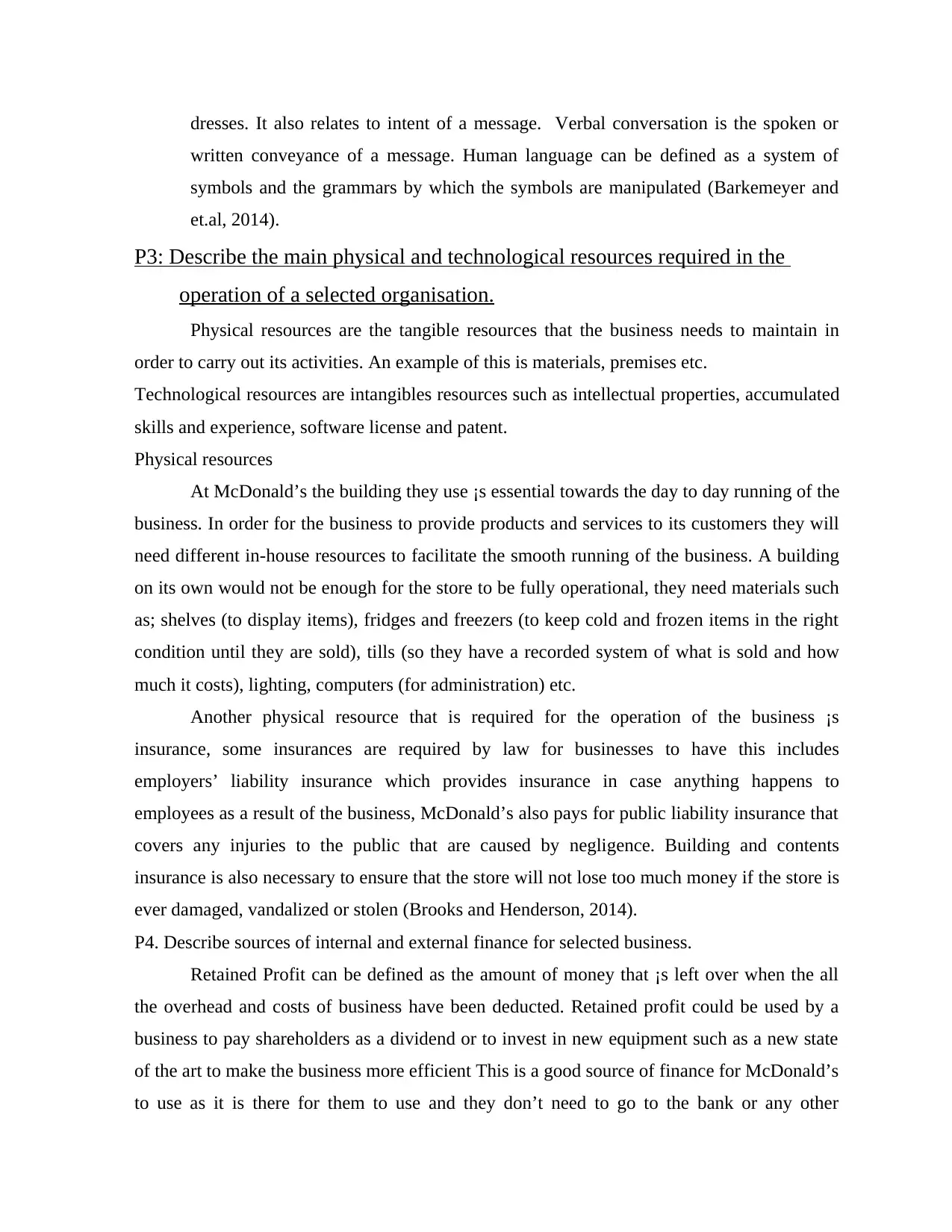
dresses. It also relates to intent of a message. Verbal conversation is the spoken or
written conveyance of a message. Human language can be defined as a system of
symbols and the grammars by which the symbols are manipulated (Barkemeyer and
et.al, 2014).
P3: Describe the main physical and technological resources required in the
operation of a selected organisation.
Physical resources are the tangible resources that the business needs to maintain in
order to carry out its activities. An example of this is materials, premises etc.
Technological resources are intangibles resources such as intellectual properties, accumulated
skills and experience, software license and patent.
Physical resources
At McDonald’s the building they use ¡s essential towards the day to day running of the
business. In order for the business to provide products and services to its customers they will
need different in-house resources to facilitate the smooth running of the business. A building
on its own would not be enough for the store to be fully operational, they need materials such
as; shelves (to display items), fridges and freezers (to keep cold and frozen items in the right
condition until they are sold), tills (so they have a recorded system of what is sold and how
much it costs), lighting, computers (for administration) etc.
Another physical resource that is required for the operation of the business ¡s
insurance, some insurances are required by law for businesses to have this includes
employers’ liability insurance which provides insurance in case anything happens to
employees as a result of the business, McDonald’s also pays for public liability insurance that
covers any injuries to the public that are caused by negligence. Building and contents
insurance is also necessary to ensure that the store will not lose too much money if the store is
ever damaged, vandalized or stolen (Brooks and Henderson, 2014).
P4. Describe sources of internal and external finance for selected business.
Retained Profit can be defined as the amount of money that ¡s left over when the all
the overhead and costs of business have been deducted. Retained profit could be used by a
business to pay shareholders as a dividend or to invest in new equipment such as a new state
of the art to make the business more efficient This is a good source of finance for McDonald’s
to use as it is there for them to use and they don’t need to go to the bank or any other
written conveyance of a message. Human language can be defined as a system of
symbols and the grammars by which the symbols are manipulated (Barkemeyer and
et.al, 2014).
P3: Describe the main physical and technological resources required in the
operation of a selected organisation.
Physical resources are the tangible resources that the business needs to maintain in
order to carry out its activities. An example of this is materials, premises etc.
Technological resources are intangibles resources such as intellectual properties, accumulated
skills and experience, software license and patent.
Physical resources
At McDonald’s the building they use ¡s essential towards the day to day running of the
business. In order for the business to provide products and services to its customers they will
need different in-house resources to facilitate the smooth running of the business. A building
on its own would not be enough for the store to be fully operational, they need materials such
as; shelves (to display items), fridges and freezers (to keep cold and frozen items in the right
condition until they are sold), tills (so they have a recorded system of what is sold and how
much it costs), lighting, computers (for administration) etc.
Another physical resource that is required for the operation of the business ¡s
insurance, some insurances are required by law for businesses to have this includes
employers’ liability insurance which provides insurance in case anything happens to
employees as a result of the business, McDonald’s also pays for public liability insurance that
covers any injuries to the public that are caused by negligence. Building and contents
insurance is also necessary to ensure that the store will not lose too much money if the store is
ever damaged, vandalized or stolen (Brooks and Henderson, 2014).
P4. Describe sources of internal and external finance for selected business.
Retained Profit can be defined as the amount of money that ¡s left over when the all
the overhead and costs of business have been deducted. Retained profit could be used by a
business to pay shareholders as a dividend or to invest in new equipment such as a new state
of the art to make the business more efficient This is a good source of finance for McDonald’s
to use as it is there for them to use and they don’t need to go to the bank or any other
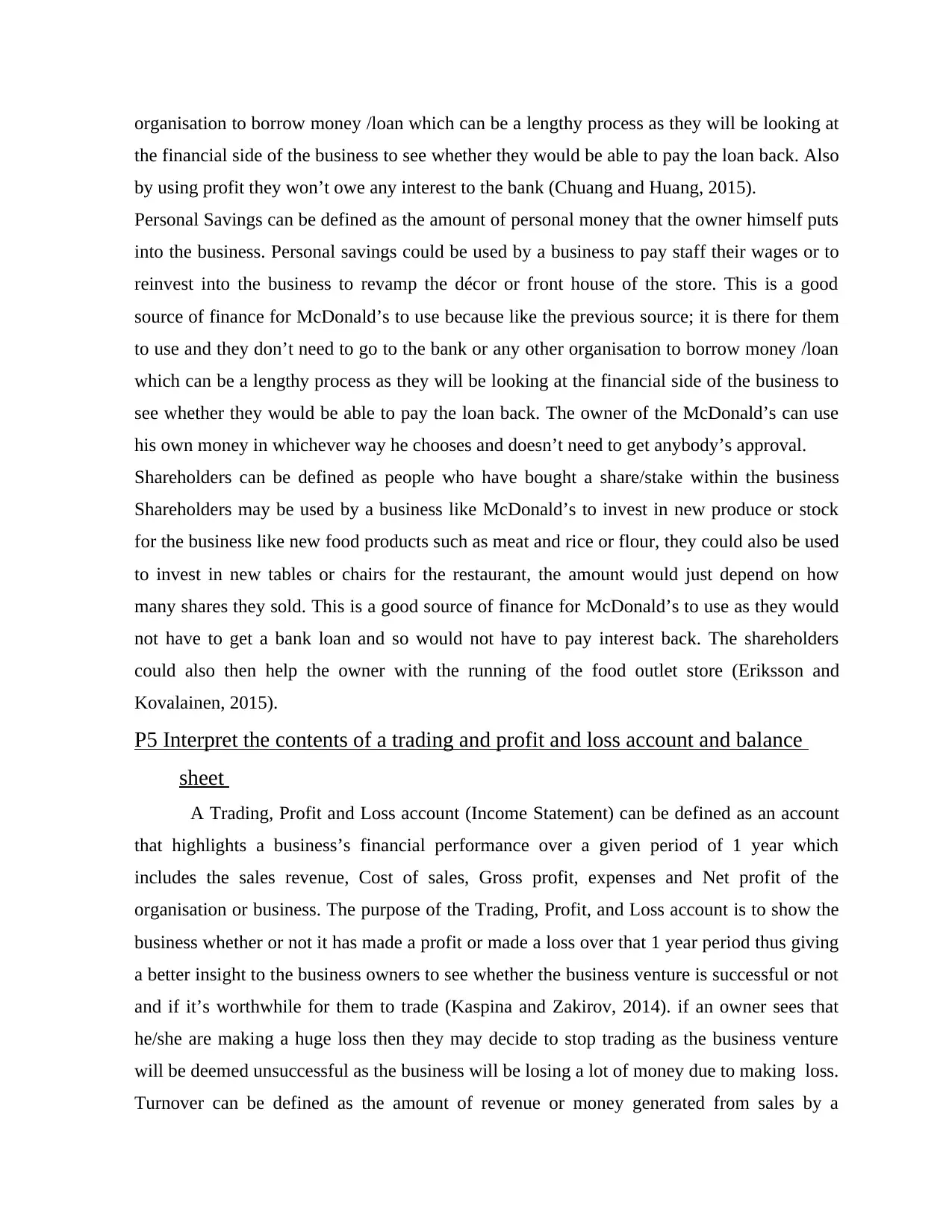
organisation to borrow money /loan which can be a lengthy process as they will be looking at
the financial side of the business to see whether they would be able to pay the loan back. Also
by using profit they won’t owe any interest to the bank (Chuang and Huang, 2015).
Personal Savings can be defined as the amount of personal money that the owner himself puts
into the business. Personal savings could be used by a business to pay staff their wages or to
reinvest into the business to revamp the décor or front house of the store. This is a good
source of finance for McDonald’s to use because like the previous source; it is there for them
to use and they don’t need to go to the bank or any other organisation to borrow money /loan
which can be a lengthy process as they will be looking at the financial side of the business to
see whether they would be able to pay the loan back. The owner of the McDonald’s can use
his own money in whichever way he chooses and doesn’t need to get anybody’s approval.
Shareholders can be defined as people who have bought a share/stake within the business
Shareholders may be used by a business like McDonald’s to invest in new produce or stock
for the business like new food products such as meat and rice or flour, they could also be used
to invest in new tables or chairs for the restaurant, the amount would just depend on how
many shares they sold. This is a good source of finance for McDonald’s to use as they would
not have to get a bank loan and so would not have to pay interest back. The shareholders
could also then help the owner with the running of the food outlet store (Eriksson and
Kovalainen, 2015).
P5 Interpret the contents of a trading and profit and loss account and balance
sheet
A Trading, Profit and Loss account (Income Statement) can be defined as an account
that highlights a business’s financial performance over a given period of 1 year which
includes the sales revenue, Cost of sales, Gross profit, expenses and Net profit of the
organisation or business. The purpose of the Trading, Profit, and Loss account is to show the
business whether or not it has made a profit or made a loss over that 1 year period thus giving
a better insight to the business owners to see whether the business venture is successful or not
and if it’s worthwhile for them to trade (Kaspina and Zakirov, 2014). if an owner sees that
he/she are making a huge loss then they may decide to stop trading as the business venture
will be deemed unsuccessful as the business will be losing a lot of money due to making loss.
Turnover can be defined as the amount of revenue or money generated from sales by a
the financial side of the business to see whether they would be able to pay the loan back. Also
by using profit they won’t owe any interest to the bank (Chuang and Huang, 2015).
Personal Savings can be defined as the amount of personal money that the owner himself puts
into the business. Personal savings could be used by a business to pay staff their wages or to
reinvest into the business to revamp the décor or front house of the store. This is a good
source of finance for McDonald’s to use because like the previous source; it is there for them
to use and they don’t need to go to the bank or any other organisation to borrow money /loan
which can be a lengthy process as they will be looking at the financial side of the business to
see whether they would be able to pay the loan back. The owner of the McDonald’s can use
his own money in whichever way he chooses and doesn’t need to get anybody’s approval.
Shareholders can be defined as people who have bought a share/stake within the business
Shareholders may be used by a business like McDonald’s to invest in new produce or stock
for the business like new food products such as meat and rice or flour, they could also be used
to invest in new tables or chairs for the restaurant, the amount would just depend on how
many shares they sold. This is a good source of finance for McDonald’s to use as they would
not have to get a bank loan and so would not have to pay interest back. The shareholders
could also then help the owner with the running of the food outlet store (Eriksson and
Kovalainen, 2015).
P5 Interpret the contents of a trading and profit and loss account and balance
sheet
A Trading, Profit and Loss account (Income Statement) can be defined as an account
that highlights a business’s financial performance over a given period of 1 year which
includes the sales revenue, Cost of sales, Gross profit, expenses and Net profit of the
organisation or business. The purpose of the Trading, Profit, and Loss account is to show the
business whether or not it has made a profit or made a loss over that 1 year period thus giving
a better insight to the business owners to see whether the business venture is successful or not
and if it’s worthwhile for them to trade (Kaspina and Zakirov, 2014). if an owner sees that
he/she are making a huge loss then they may decide to stop trading as the business venture
will be deemed unsuccessful as the business will be losing a lot of money due to making loss.
Turnover can be defined as the amount of revenue or money generated from sales by a
⊘ This is a preview!⊘
Do you want full access?
Subscribe today to unlock all pages.
Trusted by 1+ million students worldwide
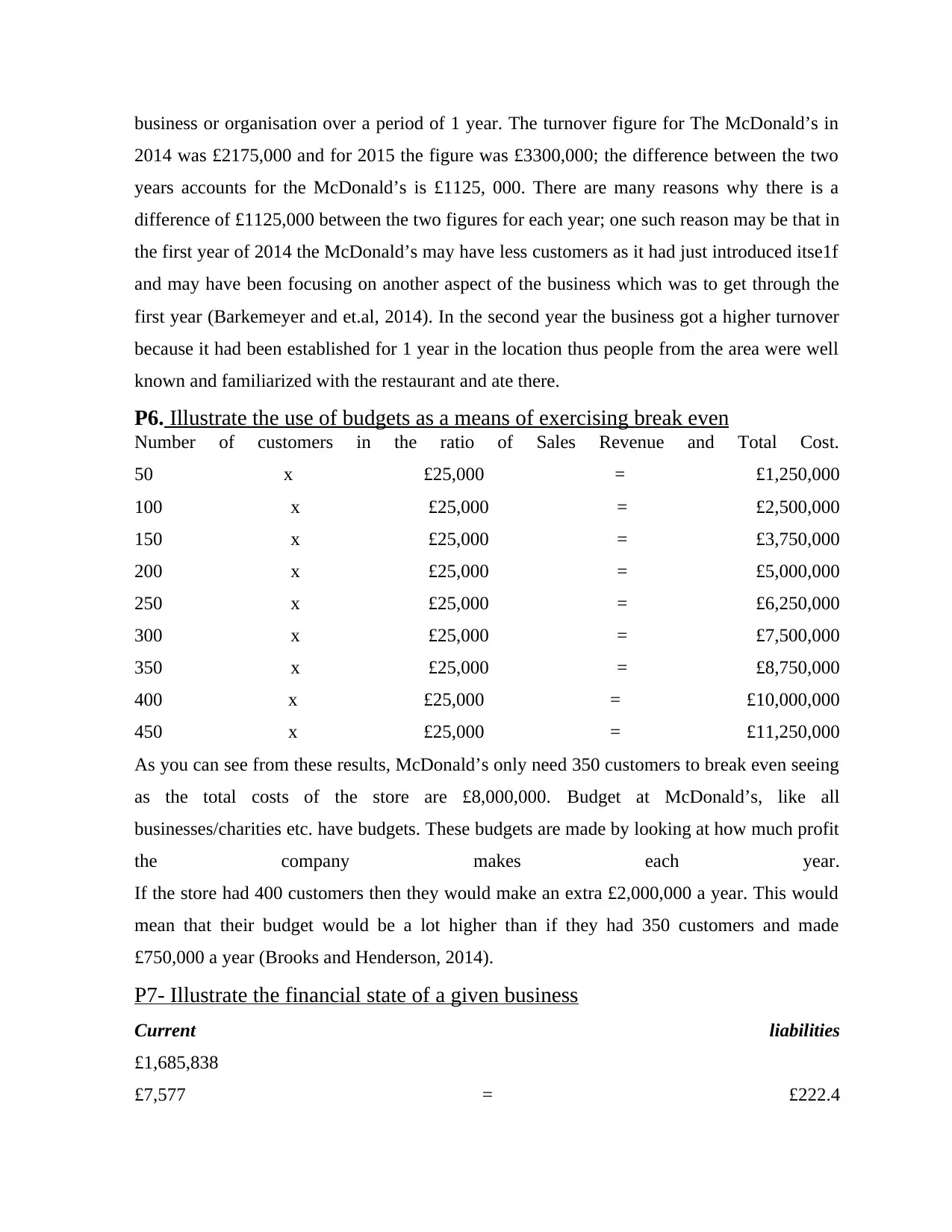
business or organisation over a period of 1 year. The turnover figure for The McDonald’s in
2014 was £2175,000 and for 2015 the figure was £3300,000; the difference between the two
years accounts for the McDonald’s is £1125, 000. There are many reasons why there is a
difference of £1125,000 between the two figures for each year; one such reason may be that in
the first year of 2014 the McDonald’s may have less customers as it had just introduced itse1f
and may have been focusing on another aspect of the business which was to get through the
first year (Barkemeyer and et.al, 2014). In the second year the business got a higher turnover
because it had been established for 1 year in the location thus people from the area were well
known and familiarized with the restaurant and ate there.
P6. Illustrate the use of budgets as a means of exercising break even
Number of customers in the ratio of Sales Revenue and Total Cost.
50 x £25,000 = £1,250,000
100 x £25,000 = £2,500,000
150 x £25,000 = £3,750,000
200 x £25,000 = £5,000,000
250 x £25,000 = £6,250,000
300 x £25,000 = £7,500,000
350 x £25,000 = £8,750,000
400 x £25,000 = £10,000,000
450 x £25,000 = £11,250,000
As you can see from these results, McDonald’s only need 350 customers to break even seeing
as the total costs of the store are £8,000,000. Budget at McDonald’s, like all
businesses/charities etc. have budgets. These budgets are made by looking at how much profit
the company makes each year.
If the store had 400 customers then they would make an extra £2,000,000 a year. This would
mean that their budget would be a lot higher than if they had 350 customers and made
£750,000 a year (Brooks and Henderson, 2014).
P7- Illustrate the financial state of a given business
Current liabilities
£1,685,838
£7,577 = £222.4
2014 was £2175,000 and for 2015 the figure was £3300,000; the difference between the two
years accounts for the McDonald’s is £1125, 000. There are many reasons why there is a
difference of £1125,000 between the two figures for each year; one such reason may be that in
the first year of 2014 the McDonald’s may have less customers as it had just introduced itse1f
and may have been focusing on another aspect of the business which was to get through the
first year (Barkemeyer and et.al, 2014). In the second year the business got a higher turnover
because it had been established for 1 year in the location thus people from the area were well
known and familiarized with the restaurant and ate there.
P6. Illustrate the use of budgets as a means of exercising break even
Number of customers in the ratio of Sales Revenue and Total Cost.
50 x £25,000 = £1,250,000
100 x £25,000 = £2,500,000
150 x £25,000 = £3,750,000
200 x £25,000 = £5,000,000
250 x £25,000 = £6,250,000
300 x £25,000 = £7,500,000
350 x £25,000 = £8,750,000
400 x £25,000 = £10,000,000
450 x £25,000 = £11,250,000
As you can see from these results, McDonald’s only need 350 customers to break even seeing
as the total costs of the store are £8,000,000. Budget at McDonald’s, like all
businesses/charities etc. have budgets. These budgets are made by looking at how much profit
the company makes each year.
If the store had 400 customers then they would make an extra £2,000,000 a year. This would
mean that their budget would be a lot higher than if they had 350 customers and made
£750,000 a year (Brooks and Henderson, 2014).
P7- Illustrate the financial state of a given business
Current liabilities
£1,685,838
£7,577 = £222.4
Paraphrase This Document
Need a fresh take? Get an instant paraphrase of this document with our AI Paraphraser
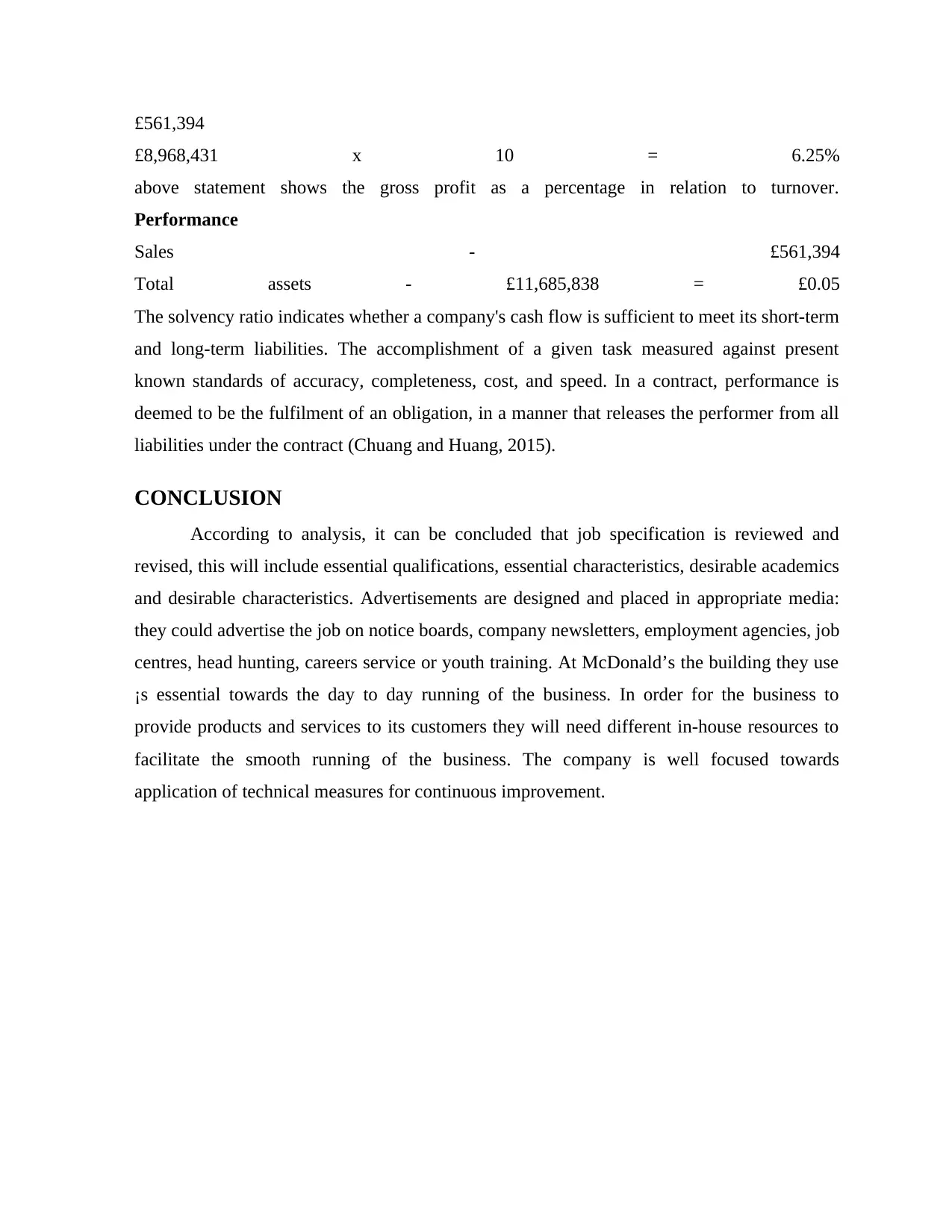
£561,394
£8,968,431 x 10 = 6.25%
above statement shows the gross profit as a percentage in relation to turnover.
Performance
Sales - £561,394
Total assets - £11,685,838 = £0.05
The solvency ratio indicates whether a company's cash flow is sufficient to meet its short-term
and long-term liabilities. The accomplishment of a given task measured against present
known standards of accuracy, completeness, cost, and speed. In a contract, performance is
deemed to be the fulfilment of an obligation, in a manner that releases the performer from all
liabilities under the contract (Chuang and Huang, 2015).
CONCLUSION
According to analysis, it can be concluded that job specification is reviewed and
revised, this will include essential qualifications, essential characteristics, desirable academics
and desirable characteristics. Advertisements are designed and placed in appropriate media:
they could advertise the job on notice boards, company newsletters, employment agencies, job
centres, head hunting, careers service or youth training. At McDonald’s the building they use
¡s essential towards the day to day running of the business. In order for the business to
provide products and services to its customers they will need different in-house resources to
facilitate the smooth running of the business. The company is well focused towards
application of technical measures for continuous improvement.
£8,968,431 x 10 = 6.25%
above statement shows the gross profit as a percentage in relation to turnover.
Performance
Sales - £561,394
Total assets - £11,685,838 = £0.05
The solvency ratio indicates whether a company's cash flow is sufficient to meet its short-term
and long-term liabilities. The accomplishment of a given task measured against present
known standards of accuracy, completeness, cost, and speed. In a contract, performance is
deemed to be the fulfilment of an obligation, in a manner that releases the performer from all
liabilities under the contract (Chuang and Huang, 2015).
CONCLUSION
According to analysis, it can be concluded that job specification is reviewed and
revised, this will include essential qualifications, essential characteristics, desirable academics
and desirable characteristics. Advertisements are designed and placed in appropriate media:
they could advertise the job on notice boards, company newsletters, employment agencies, job
centres, head hunting, careers service or youth training. At McDonald’s the building they use
¡s essential towards the day to day running of the business. In order for the business to
provide products and services to its customers they will need different in-house resources to
facilitate the smooth running of the business. The company is well focused towards
application of technical measures for continuous improvement.
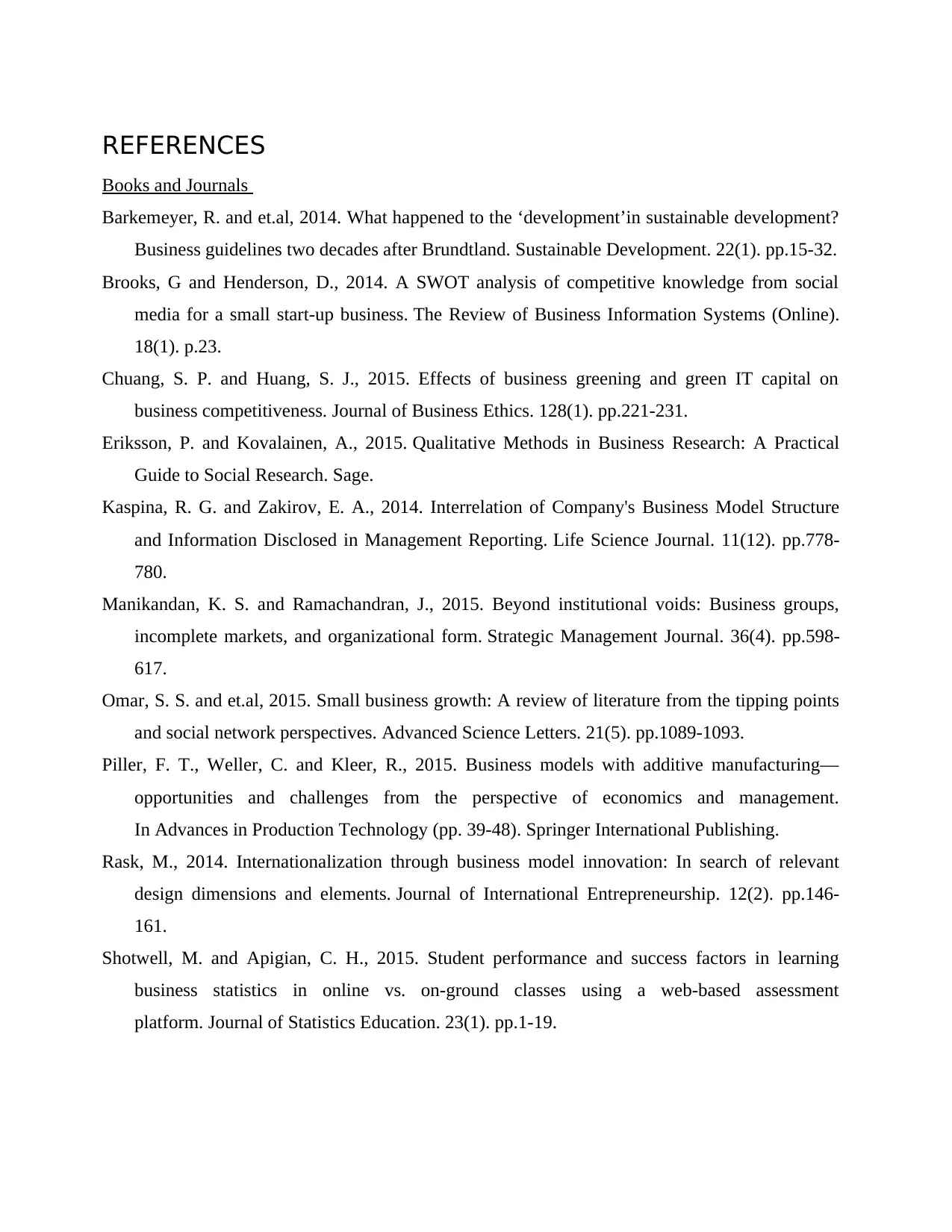
REFERENCES
Books and Journals
Barkemeyer, R. and et.al, 2014. What happened to the ‘development’in sustainable development?
Business guidelines two decades after Brundtland. Sustainable Development. 22(1). pp.15-32.
Brooks, G and Henderson, D., 2014. A SWOT analysis of competitive knowledge from social
media for a small start-up business. The Review of Business Information Systems (Online).
18(1). p.23.
Chuang, S. P. and Huang, S. J., 2015. Effects of business greening and green IT capital on
business competitiveness. Journal of Business Ethics. 128(1). pp.221-231.
Eriksson, P. and Kovalainen, A., 2015. Qualitative Methods in Business Research: A Practical
Guide to Social Research. Sage.
Kaspina, R. G. and Zakirov, E. A., 2014. Interrelation of Company's Business Model Structure
and Information Disclosed in Management Reporting. Life Science Journal. 11(12). pp.778-
780.
Manikandan, K. S. and Ramachandran, J., 2015. Beyond institutional voids: Business groups,
incomplete markets, and organizational form. Strategic Management Journal. 36(4). pp.598-
617.
Omar, S. S. and et.al, 2015. Small business growth: A review of literature from the tipping points
and social network perspectives. Advanced Science Letters. 21(5). pp.1089-1093.
Piller, F. T., Weller, C. and Kleer, R., 2015. Business models with additive manufacturing—
opportunities and challenges from the perspective of economics and management.
In Advances in Production Technology (pp. 39-48). Springer International Publishing.
Rask, M., 2014. Internationalization through business model innovation: In search of relevant
design dimensions and elements. Journal of International Entrepreneurship. 12(2). pp.146-
161.
Shotwell, M. and Apigian, C. H., 2015. Student performance and success factors in learning
business statistics in online vs. on-ground classes using a web-based assessment
platform. Journal of Statistics Education. 23(1). pp.1-19.
Books and Journals
Barkemeyer, R. and et.al, 2014. What happened to the ‘development’in sustainable development?
Business guidelines two decades after Brundtland. Sustainable Development. 22(1). pp.15-32.
Brooks, G and Henderson, D., 2014. A SWOT analysis of competitive knowledge from social
media for a small start-up business. The Review of Business Information Systems (Online).
18(1). p.23.
Chuang, S. P. and Huang, S. J., 2015. Effects of business greening and green IT capital on
business competitiveness. Journal of Business Ethics. 128(1). pp.221-231.
Eriksson, P. and Kovalainen, A., 2015. Qualitative Methods in Business Research: A Practical
Guide to Social Research. Sage.
Kaspina, R. G. and Zakirov, E. A., 2014. Interrelation of Company's Business Model Structure
and Information Disclosed in Management Reporting. Life Science Journal. 11(12). pp.778-
780.
Manikandan, K. S. and Ramachandran, J., 2015. Beyond institutional voids: Business groups,
incomplete markets, and organizational form. Strategic Management Journal. 36(4). pp.598-
617.
Omar, S. S. and et.al, 2015. Small business growth: A review of literature from the tipping points
and social network perspectives. Advanced Science Letters. 21(5). pp.1089-1093.
Piller, F. T., Weller, C. and Kleer, R., 2015. Business models with additive manufacturing—
opportunities and challenges from the perspective of economics and management.
In Advances in Production Technology (pp. 39-48). Springer International Publishing.
Rask, M., 2014. Internationalization through business model innovation: In search of relevant
design dimensions and elements. Journal of International Entrepreneurship. 12(2). pp.146-
161.
Shotwell, M. and Apigian, C. H., 2015. Student performance and success factors in learning
business statistics in online vs. on-ground classes using a web-based assessment
platform. Journal of Statistics Education. 23(1). pp.1-19.
⊘ This is a preview!⊘
Do you want full access?
Subscribe today to unlock all pages.
Trusted by 1+ million students worldwide
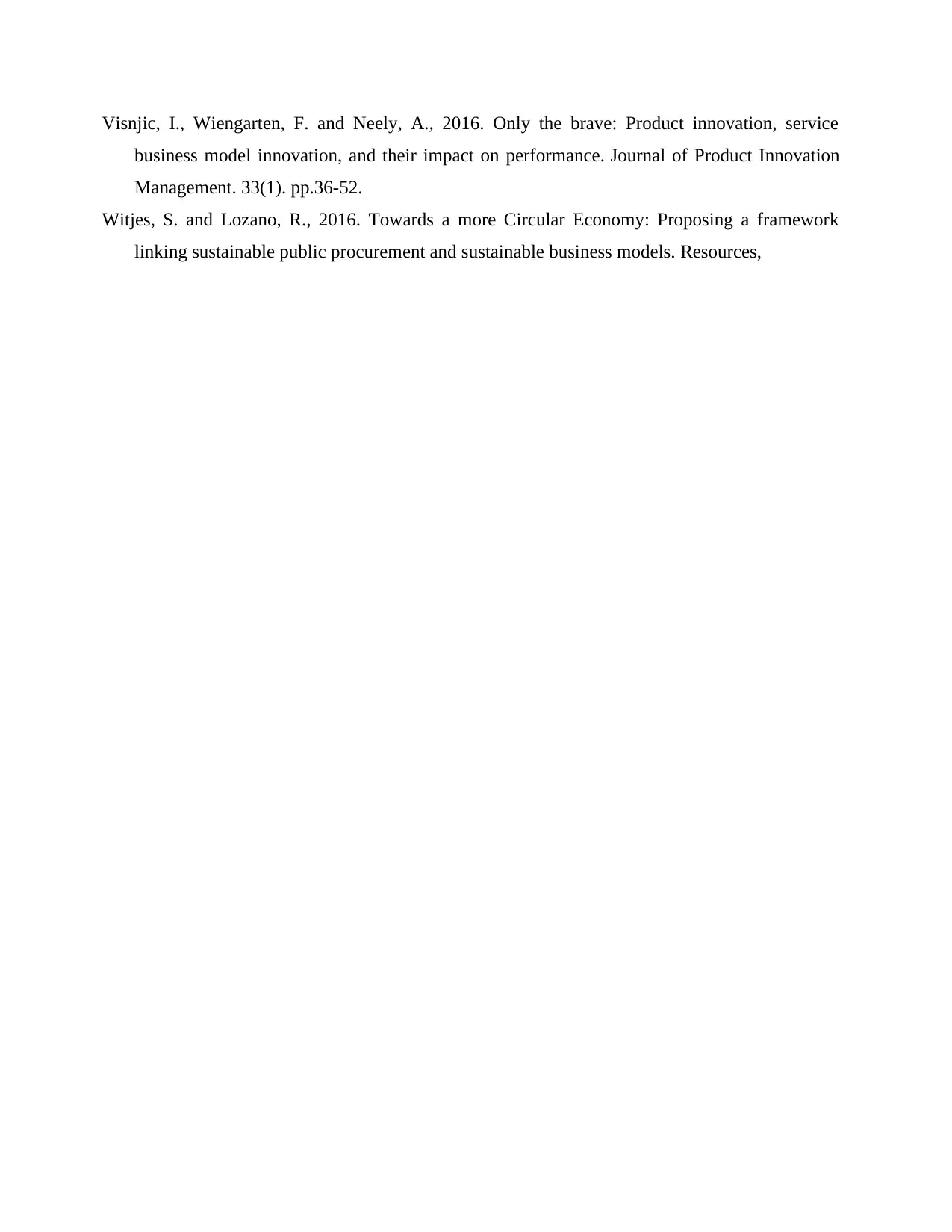
Visnjic, I., Wiengarten, F. and Neely, A., 2016. Only the brave: Product innovation, service
business model innovation, and their impact on performance. Journal of Product Innovation
Management. 33(1). pp.36-52.
Witjes, S. and Lozano, R., 2016. Towards a more Circular Economy: Proposing a framework
linking sustainable public procurement and sustainable business models. Resources,
business model innovation, and their impact on performance. Journal of Product Innovation
Management. 33(1). pp.36-52.
Witjes, S. and Lozano, R., 2016. Towards a more Circular Economy: Proposing a framework
linking sustainable public procurement and sustainable business models. Resources,

1 out of 10


Related Documents


Your All-in-One AI-Powered Toolkit for Academic Success.
+13062052269
info@desklib.com
Available 24*7 on WhatsApp / Email
![[object Object]](/_next/static/media/star-bottom.7253800d.svg)
Unlock your academic potential
Copyright © 2020–2026 A2Z Services. All Rights Reserved. Developed and managed by ZUCOL.