Strategic Management: Individual Quantitative Literacy Case Study
VerifiedAdded on 2022/10/17
|8
|1936
|406
Case Study
AI Summary
This case study analyzes the application of quantitative literacy in business scenarios using Fermi questions. It presents a detailed analysis of two businesses: a car wash and a kebab van, along with a competitor's coffee shop. The study calculates the maximum gross revenue for the car wash under different operational conditions, considering employee breaks and varying bay utilization. Similarly, it calculates the maximum gross revenue for the kebab van, also accounting for employee breaks and efficiency. The case study further explores the potential revenue of a coffee shop dependent on the car wash's customer volume. The analysis includes the creation of numeric datasets, interpretation of the data, development of a synthetic model with calculations, and extrapolation of outcomes. The study highlights the importance of quantitative skills in making informed business decisions and estimating financial performance under different conditions. It also reflects on the challenges of providing accurate answers to business-related questions, emphasizing the value of estimations.
Running Head: INDIVIDUAL QUANTITATIVE LITERACY
1
Individual Quantitative Literacy Case Study
Name
Institution
Date
1
Individual Quantitative Literacy Case Study
Name
Institution
Date
Paraphrase This Document
Need a fresh take? Get an instant paraphrase of this document with our AI Paraphraser

INDIVIDUAL QUANTITATIVE LITERACY 2
Individual Quantitative Literacy Case Study
There are many questions in physics and engineering that require a fast and rough
estimate of the answer. This is because they are either impossible to measure or difficulty to give
an exact answer. Such questions are known as Fermi questions (Cheuk et al., 2016, p.1267).
They include estimates such as the volume of water in a certain ocean, the number of people in a
given country or the number of cars in a given city (Niss, 2018, p.357-369). Answers to such
questions would be estimates which are hopefully accurate and given within a certain margin
(Akgül et al., 2017, p.1438). Such questions enhance critical thinking and students are able to
demonstrate their numeracy skills on analysis, inference and interpretation. They also
demonstrate their skill in explaining and evaluating their ideas as well as reflecting on their
process of reasoning (Parand et al., 2017, p.77). These questions can best be explained by an
example like in the following case study.
Business 1
Data Set
Working hours 8 hours
Number of employees 12
Charges $40 for hand washing $10 for
vacuumed washing
Time 20 minutes for hand washing
10 minutes for vacuumed washing
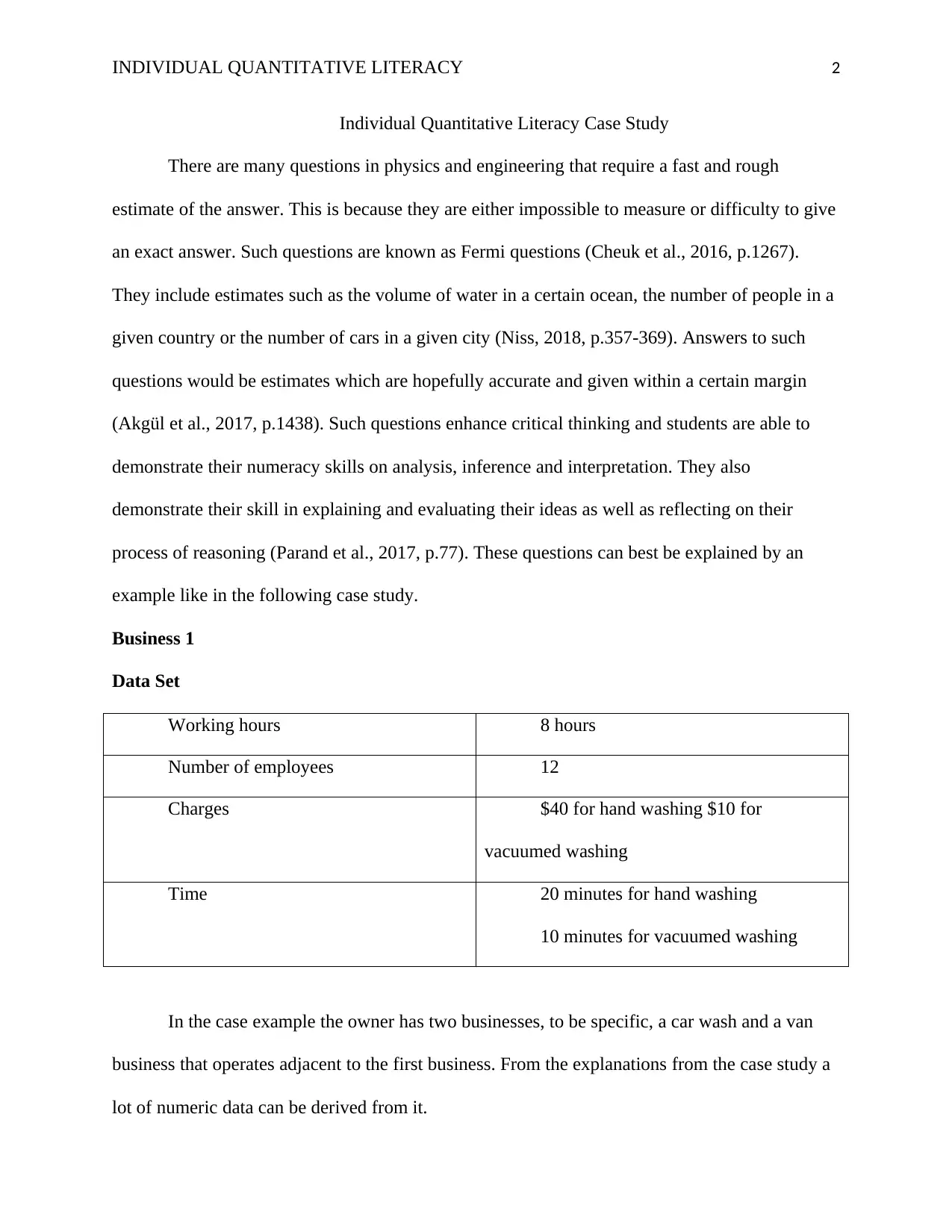
In the case example the owner has two businesses, to be specific, a car wash and a van
business that operates adjacent to the first business. From the explanations from the case study a
lot of numeric data can be derived from it.
Individual Quantitative Literacy Case Study
There are many questions in physics and engineering that require a fast and rough
estimate of the answer. This is because they are either impossible to measure or difficulty to give
an exact answer. Such questions are known as Fermi questions (Cheuk et al., 2016, p.1267).
They include estimates such as the volume of water in a certain ocean, the number of people in a
given country or the number of cars in a given city (Niss, 2018, p.357-369). Answers to such
questions would be estimates which are hopefully accurate and given within a certain margin
(Akgül et al., 2017, p.1438). Such questions enhance critical thinking and students are able to
demonstrate their numeracy skills on analysis, inference and interpretation. They also
demonstrate their skill in explaining and evaluating their ideas as well as reflecting on their
process of reasoning (Parand et al., 2017, p.77). These questions can best be explained by an
example like in the following case study.
Business 1
Data Set
Working hours 8 hours
Number of employees 12
Charges $40 for hand washing $10 for
vacuumed washing
Time 20 minutes for hand washing
10 minutes for vacuumed washing
In the case example the owner has two businesses, to be specific, a car wash and a van
business that operates adjacent to the first business. From the explanations from the case study a
lot of numeric data can be derived from it.

INDIVIDUAL QUANTITATIVE LITERACY 3
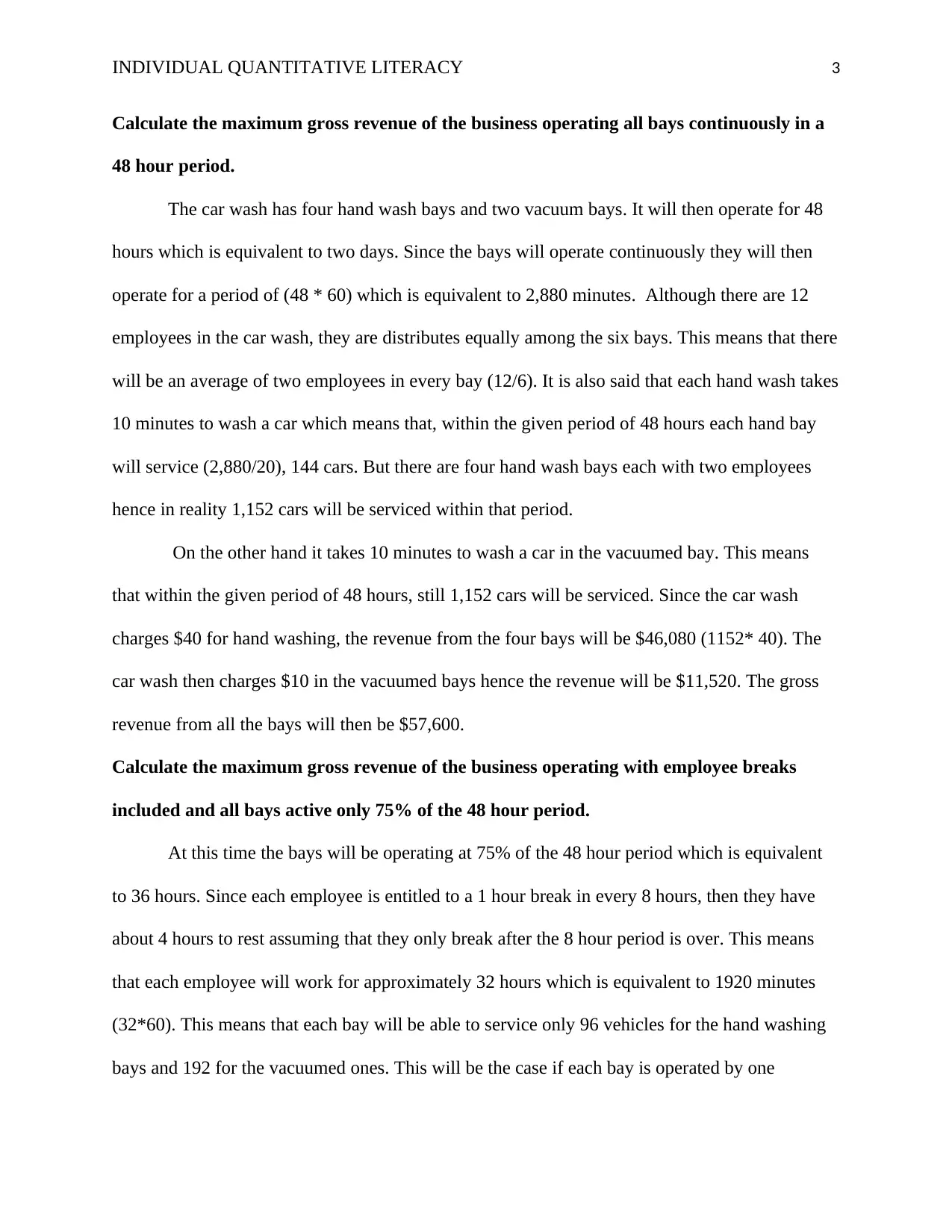
Calculate the maximum gross revenue of the business operating all bays continuously in a
48 hour period.
The car wash has four hand wash bays and two vacuum bays. It will then operate for 48
hours which is equivalent to two days. Since the bays will operate continuously they will then
operate for a period of (48 * 60) which is equivalent to 2,880 minutes. Although there are 12
employees in the car wash, they are distributes equally among the six bays. This means that there
will be an average of two employees in every bay (12/6). It is also said that each hand wash takes
10 minutes to wash a car which means that, within the given period of 48 hours each hand bay
will service (2,880/20), 144 cars. But there are four hand wash bays each with two employees
hence in reality 1,152 cars will be serviced within that period.
On the other hand it takes 10 minutes to wash a car in the vacuumed bay. This means
that within the given period of 48 hours, still 1,152 cars will be serviced. Since the car wash
charges $40 for hand washing, the revenue from the four bays will be $46,080 (1152* 40). The
car wash then charges $10 in the vacuumed bays hence the revenue will be $11,520. The gross
revenue from all the bays will then be $57,600.
Calculate the maximum gross revenue of the business operating with employee breaks
included and all bays active only 75% of the 48 hour period.
At this time the bays will be operating at 75% of the 48 hour period which is equivalent
to 36 hours. Since each employee is entitled to a 1 hour break in every 8 hours, then they have
about 4 hours to rest assuming that they only break after the 8 hour period is over. This means
that each employee will work for approximately 32 hours which is equivalent to 1920 minutes
(32*60). This means that each bay will be able to service only 96 vehicles for the hand washing
bays and 192 for the vacuumed ones. This will be the case if each bay is operated by one
Calculate the maximum gross revenue of the business operating all bays continuously in a
48 hour period.
The car wash has four hand wash bays and two vacuum bays. It will then operate for 48
hours which is equivalent to two days. Since the bays will operate continuously they will then
operate for a period of (48 * 60) which is equivalent to 2,880 minutes. Although there are 12
employees in the car wash, they are distributes equally among the six bays. This means that there
will be an average of two employees in every bay (12/6). It is also said that each hand wash takes
10 minutes to wash a car which means that, within the given period of 48 hours each hand bay
will service (2,880/20), 144 cars. But there are four hand wash bays each with two employees
hence in reality 1,152 cars will be serviced within that period.
On the other hand it takes 10 minutes to wash a car in the vacuumed bay. This means
that within the given period of 48 hours, still 1,152 cars will be serviced. Since the car wash
charges $40 for hand washing, the revenue from the four bays will be $46,080 (1152* 40). The
car wash then charges $10 in the vacuumed bays hence the revenue will be $11,520. The gross
revenue from all the bays will then be $57,600.
Calculate the maximum gross revenue of the business operating with employee breaks
included and all bays active only 75% of the 48 hour period.
At this time the bays will be operating at 75% of the 48 hour period which is equivalent
to 36 hours. Since each employee is entitled to a 1 hour break in every 8 hours, then they have
about 4 hours to rest assuming that they only break after the 8 hour period is over. This means
that each employee will work for approximately 32 hours which is equivalent to 1920 minutes
(32*60). This means that each bay will be able to service only 96 vehicles for the hand washing
bays and 192 for the vacuumed ones. This will be the case if each bay is operated by one
⊘ This is a preview!⊘
Do you want full access?
Subscribe today to unlock all pages.

Trusted by 1+ million students worldwide

INDIVIDUAL QUANTITATIVE LITERACY 4
employee, but since we have 12 employees, two of them will be working in each bay. Owing to
this fact, each hand washing bay will then be able to service 192 cars (96*2). On the other hand
the vacuumed bays will be able to service 384 cars (192*2). From this information, revenue from
the hand washing bays will be $7,680 while that from the vacuumed bays will be $3,840, hence
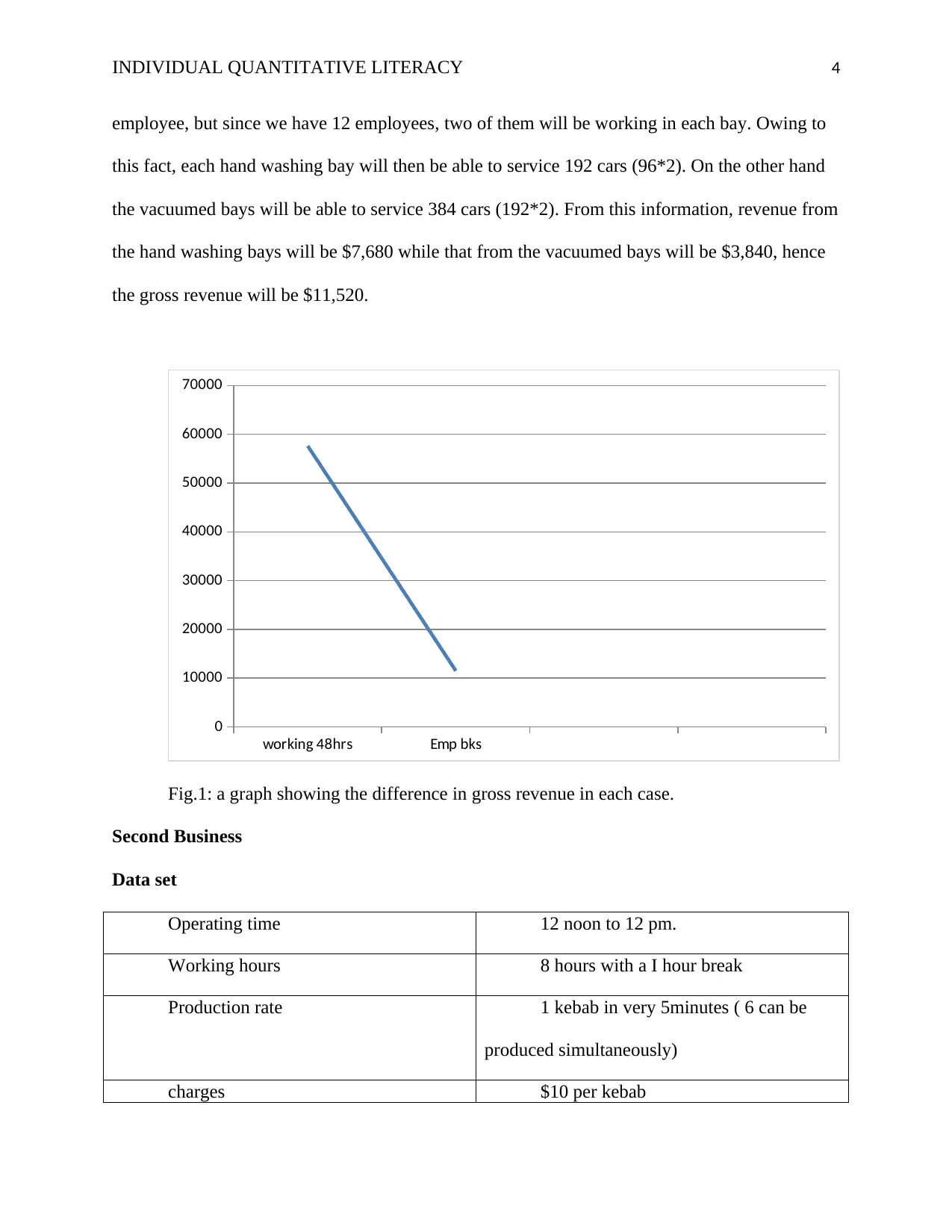
the gross revenue will be $11,520.
working 48hrs Emp bks
0
10000
20000
30000
40000
50000
60000
70000
Fig.1: a graph showing the difference in gross revenue in each case.
Second Business
Data set
Operating time 12 noon to 12 pm.
Working hours 8 hours with a I hour break
Production rate 1 kebab in very 5minutes ( 6 can be
produced simultaneously)
charges $10 per kebab
employee, but since we have 12 employees, two of them will be working in each bay. Owing to
this fact, each hand washing bay will then be able to service 192 cars (96*2). On the other hand
the vacuumed bays will be able to service 384 cars (192*2). From this information, revenue from
the hand washing bays will be $7,680 while that from the vacuumed bays will be $3,840, hence
the gross revenue will be $11,520.
working 48hrs Emp bks
0
10000
20000
30000
40000
50000
60000
70000
Fig.1: a graph showing the difference in gross revenue in each case.
Second Business
Data set
Operating time 12 noon to 12 pm.
Working hours 8 hours with a I hour break
Production rate 1 kebab in very 5minutes ( 6 can be
produced simultaneously)
charges $10 per kebab
Paraphrase This Document
Need a fresh take? Get an instant paraphrase of this document with our AI Paraphraser

INDIVIDUAL QUANTITATIVE LITERACY 5
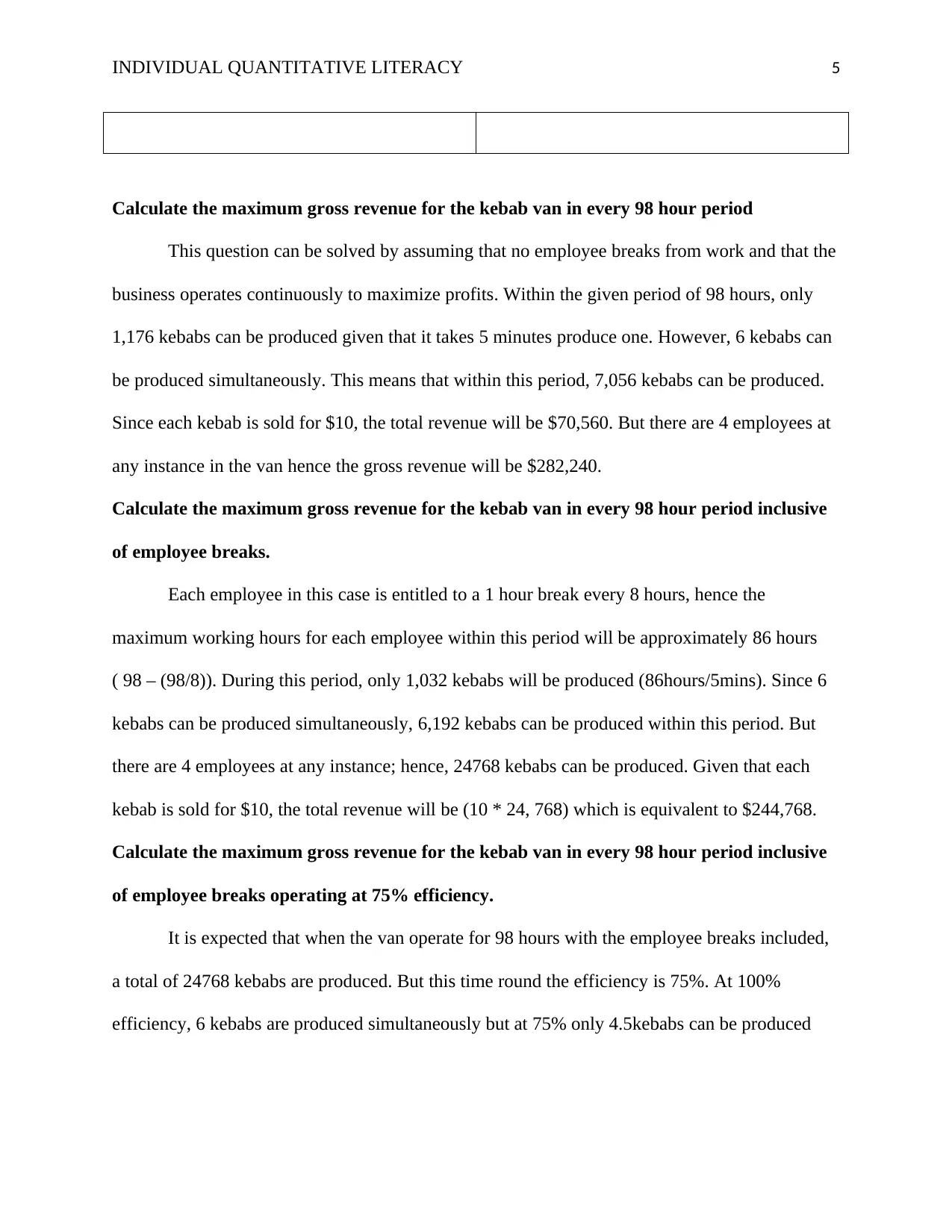
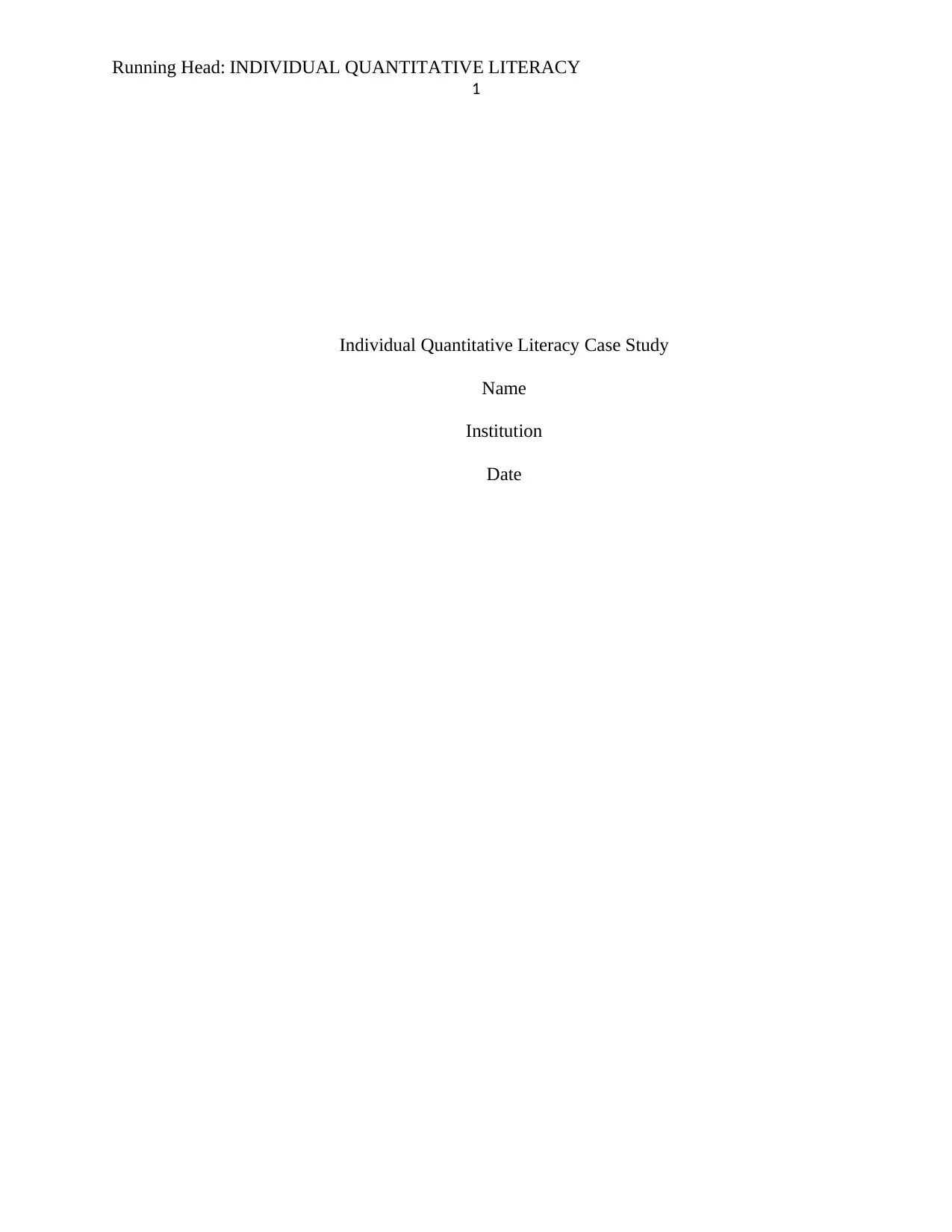
Calculate the maximum gross revenue for the kebab van in every 98 hour period
This question can be solved by assuming that no employee breaks from work and that the
business operates continuously to maximize profits. Within the given period of 98 hours, only
1,176 kebabs can be produced given that it takes 5 minutes produce one. However, 6 kebabs can
be produced simultaneously. This means that within this period, 7,056 kebabs can be produced.
Since each kebab is sold for $10, the total revenue will be $70,560. But there are 4 employees at
any instance in the van hence the gross revenue will be $282,240.
Calculate the maximum gross revenue for the kebab van in every 98 hour period inclusive
of employee breaks.
Each employee in this case is entitled to a 1 hour break every 8 hours, hence the
maximum working hours for each employee within this period will be approximately 86 hours
( 98 – (98/8)). During this period, only 1,032 kebabs will be produced (86hours/5mins). Since 6
kebabs can be produced simultaneously, 6,192 kebabs can be produced within this period. But
there are 4 employees at any instance; hence, 24768 kebabs can be produced. Given that each
kebab is sold for $10, the total revenue will be (10 * 24, 768) which is equivalent to $244,768.
Calculate the maximum gross revenue for the kebab van in every 98 hour period inclusive
of employee breaks operating at 75% efficiency.
It is expected that when the van operate for 98 hours with the employee breaks included,
a total of 24768 kebabs are produced. But this time round the efficiency is 75%. At 100%
efficiency, 6 kebabs are produced simultaneously but at 75% only 4.5kebabs can be produced
Calculate the maximum gross revenue for the kebab van in every 98 hour period
This question can be solved by assuming that no employee breaks from work and that the
business operates continuously to maximize profits. Within the given period of 98 hours, only
1,176 kebabs can be produced given that it takes 5 minutes produce one. However, 6 kebabs can
be produced simultaneously. This means that within this period, 7,056 kebabs can be produced.
Since each kebab is sold for $10, the total revenue will be $70,560. But there are 4 employees at
any instance in the van hence the gross revenue will be $282,240.
Calculate the maximum gross revenue for the kebab van in every 98 hour period inclusive
of employee breaks.
Each employee in this case is entitled to a 1 hour break every 8 hours, hence the
maximum working hours for each employee within this period will be approximately 86 hours
( 98 – (98/8)). During this period, only 1,032 kebabs will be produced (86hours/5mins). Since 6
kebabs can be produced simultaneously, 6,192 kebabs can be produced within this period. But
there are 4 employees at any instance; hence, 24768 kebabs can be produced. Given that each
kebab is sold for $10, the total revenue will be (10 * 24, 768) which is equivalent to $244,768.
Calculate the maximum gross revenue for the kebab van in every 98 hour period inclusive
of employee breaks operating at 75% efficiency.
It is expected that when the van operate for 98 hours with the employee breaks included,
a total of 24768 kebabs are produced. But this time round the efficiency is 75%. At 100%
efficiency, 6 kebabs are produced simultaneously but at 75% only 4.5kebabs can be produced

INDIVIDUAL QUANTITATIVE LITERACY 6
(75*6/100). This means that only 18,576 kebabs can be produced. Since each one is sold at $10,
then the gross revenue will be $185,760.
98hrs without break 98 hours with break working at 75%
eficiency Category 4
0
50000
100000
150000
200000
250000
300000
Fig.2: a graph showing the difference in gross revenue in each case.
Competitor's Business
Data set
Sitting capacity 16
Number of customers 60% of the car wash customers
charges $4.50
Cost 30 cents
Working time 8 hours with a 1 hour break
Since the coffee shop depends on the number of customers who get their cars services in
the car wash, the profit can be estimated. I have found that the maximum number of customers
that the car wash can serve in a period of 48 hours is 2,300 from both the hand washing and the
(75*6/100). This means that only 18,576 kebabs can be produced. Since each one is sold at $10,
then the gross revenue will be $185,760.
98hrs without break 98 hours with break working at 75%
eficiency Category 4
0
50000
100000
150000
200000
250000
300000
Fig.2: a graph showing the difference in gross revenue in each case.
Competitor's Business
Data set
Sitting capacity 16
Number of customers 60% of the car wash customers
charges $4.50
Cost 30 cents
Working time 8 hours with a 1 hour break
Since the coffee shop depends on the number of customers who get their cars services in
the car wash, the profit can be estimated. I have found that the maximum number of customers
that the car wash can serve in a period of 48 hours is 2,300 from both the hand washing and the
⊘ This is a preview!⊘
Do you want full access?
Subscribe today to unlock all pages.

Trusted by 1+ million students worldwide

INDIVIDUAL QUANTITATIVE LITERACY 7
vacuuming bays (1, 152 from each type of bay). From the case study, 60% visits the coffee shop;
hence approximately 1,382 people will visits the coffee shop. Coffee is charged at $4.50 which
means that within this period, the shop earns $6,219. However, there is a production cost of
30cents which means that in reality the coffee is sold at $4.2, (5.5-0.3). From these calculations,
the gross profit is (4.2*2, 300) which approximately $5,804.
The best case would be opening my own coffee shop. This is because, although, there are
many customers (60%) who visit the coffee shop, its space is very limited and its impossible to
tell for how long each customer stays in the shop.
Conclusion
From the case study, each business choice has its own gross profit. In such scenarios it’s
upon the business owner to choose on which business to start (Saadatmandi & Sanatkar, 2018,
p.200). It is also evident that the same business can produce different gross income. This relies
on several conditions that can change at certain periods (Ardila & Giorgini, 2016, p.063640).
This means that it’s very difficult to give an accurate answer when asked to tell the exact amount
of profit that a certain business will produce, hence can only be given as an estimate (Parand et
al., 2016, p.1606). Therefore, as far as Fermi questions people have different answers based on
their own reasoning ((Yong, 2014, p.1050).
References
Akgül, A., Hashemi, M.S. and Raheem, S.A., 2017. Constructing two powerful methods to solve
the Thomas–Fermi equation. Nonlinear Dynamics, 87(2), pp.1435-1444.
vacuuming bays (1, 152 from each type of bay). From the case study, 60% visits the coffee shop;
hence approximately 1,382 people will visits the coffee shop. Coffee is charged at $4.50 which
means that within this period, the shop earns $6,219. However, there is a production cost of
30cents which means that in reality the coffee is sold at $4.2, (5.5-0.3). From these calculations,
the gross profit is (4.2*2, 300) which approximately $5,804.
The best case would be opening my own coffee shop. This is because, although, there are
many customers (60%) who visit the coffee shop, its space is very limited and its impossible to
tell for how long each customer stays in the shop.
Conclusion
From the case study, each business choice has its own gross profit. In such scenarios it’s
upon the business owner to choose on which business to start (Saadatmandi & Sanatkar, 2018,
p.200). It is also evident that the same business can produce different gross income. This relies
on several conditions that can change at certain periods (Ardila & Giorgini, 2016, p.063640).
This means that it’s very difficult to give an accurate answer when asked to tell the exact amount
of profit that a certain business will produce, hence can only be given as an estimate (Parand et
al., 2016, p.1606). Therefore, as far as Fermi questions people have different answers based on
their own reasoning ((Yong, 2014, p.1050).
References
Akgül, A., Hashemi, M.S. and Raheem, S.A., 2017. Constructing two powerful methods to solve
the Thomas–Fermi equation. Nonlinear Dynamics, 87(2), pp.1435-1444.
Paraphrase This Document
Need a fresh take? Get an instant paraphrase of this document with our AI Paraphraser

INDIVIDUAL QUANTITATIVE LITERACY 8
Ardila, L.P. and Giorgini, S., 2016. Bose polaron problem: Effect of mass imbalance on binding
energy. Physical Review A, 94(6), p.063640.
Cheuk, L.W., Nichols, M.A., Lawrence, K.R., Okan, M., Zhang, H., Khatami, E., Trivedi, N.,
Paiva, T., Rigol, M. and Zwierlein, M.W., 2016. Observation of spatial charge and spin
correlations in the 2D Fermi-Hubbard model. Science, 353(6305), pp.1260-1264.
Niss, M., 2018. What Is Physics Problem-Solving Competency? The Views of Arnold
Sommerfeld and Enrico Fermi. Science & Education, 27(3-4), pp.357-369.
Parand, K., Ghaderi, A., Delkhosh, M. and Yousefi, H., 2016. A new approach for solving
nonlinear Thomas-Fermi equation based on fractional order of rational Bessel functions. arXiv
preprint arXiv:1606.07615.
Parand, K., Mazaheri, P., Yousefi, H. and Delkhosh, M., 2017. Fractional order of rational Jacobi
functions for solving the non-linear singular Thomas-Fermi equation. The European Physical
Journal Plus, 132(2), p.77.
Saadatmandi, A. and Sanatkar, Z., 2018. Collocation method based on rational Legendre
functions for solving the magneto-hydrodynamic flow over a nonlinear stretching sheet. Applied
Mathematics and Computation, 323, pp.193-203.
Yong, A., 2014. Critique of Hirsch’s citation index: A combinatorial Fermi problem. Notices of
the AMS, 61(9), pp.1040-1050.
Ardila, L.P. and Giorgini, S., 2016. Bose polaron problem: Effect of mass imbalance on binding
energy. Physical Review A, 94(6), p.063640.
Cheuk, L.W., Nichols, M.A., Lawrence, K.R., Okan, M., Zhang, H., Khatami, E., Trivedi, N.,
Paiva, T., Rigol, M. and Zwierlein, M.W., 2016. Observation of spatial charge and spin
correlations in the 2D Fermi-Hubbard model. Science, 353(6305), pp.1260-1264.
Niss, M., 2018. What Is Physics Problem-Solving Competency? The Views of Arnold
Sommerfeld and Enrico Fermi. Science & Education, 27(3-4), pp.357-369.
Parand, K., Ghaderi, A., Delkhosh, M. and Yousefi, H., 2016. A new approach for solving
nonlinear Thomas-Fermi equation based on fractional order of rational Bessel functions. arXiv
preprint arXiv:1606.07615.
Parand, K., Mazaheri, P., Yousefi, H. and Delkhosh, M., 2017. Fractional order of rational Jacobi
functions for solving the non-linear singular Thomas-Fermi equation. The European Physical
Journal Plus, 132(2), p.77.
Saadatmandi, A. and Sanatkar, Z., 2018. Collocation method based on rational Legendre
functions for solving the magneto-hydrodynamic flow over a nonlinear stretching sheet. Applied
Mathematics and Computation, 323, pp.193-203.
Yong, A., 2014. Critique of Hirsch’s citation index: A combinatorial Fermi problem. Notices of
the AMS, 61(9), pp.1040-1050.
1 out of 8
Related Documents
Your All-in-One AI-Powered Toolkit for Academic Success.
+13062052269
info@desklib.com
Available 24*7 on WhatsApp / Email
Unlock your academic potential
Copyright © 2020–2026 A2Z Services. All Rights Reserved. Developed and managed by ZUCOL.