Business Risk Assessment and Management Assignment - [University]
VerifiedAdded on 2023/06/10
|26
|5200
|63
Homework Assignment
AI Summary
This assignment comprehensively addresses business risk management. It begins by defining business risk and explores risk management frameworks, legislative and regulatory contexts, and organizational policies, procedures, and processes. The assignment identifies various risk management documents and storage procedures, followed by an in-depth examination of different types of business risks, including strategic, compliance, operational, and reputational risks. It then outlines options for treating risks, details the risk management process (identification, analysis, evaluation, treatment, and monitoring), and highlights the purpose and key elements of current risk management standards. Finally, the assignment identifies and describes tools and techniques for risk identification, such as documentation reviews, information gathering, root cause analysis, and SWOT analysis, providing a complete overview of the topic. The case study analyzes the factors influencing an organization's performance, while the project section likely involves practical application of risk management principles.
Manage business risk

Paraphrase This Document
Need a fresh take? Get an instant paraphrase of this document with our AI Paraphraser
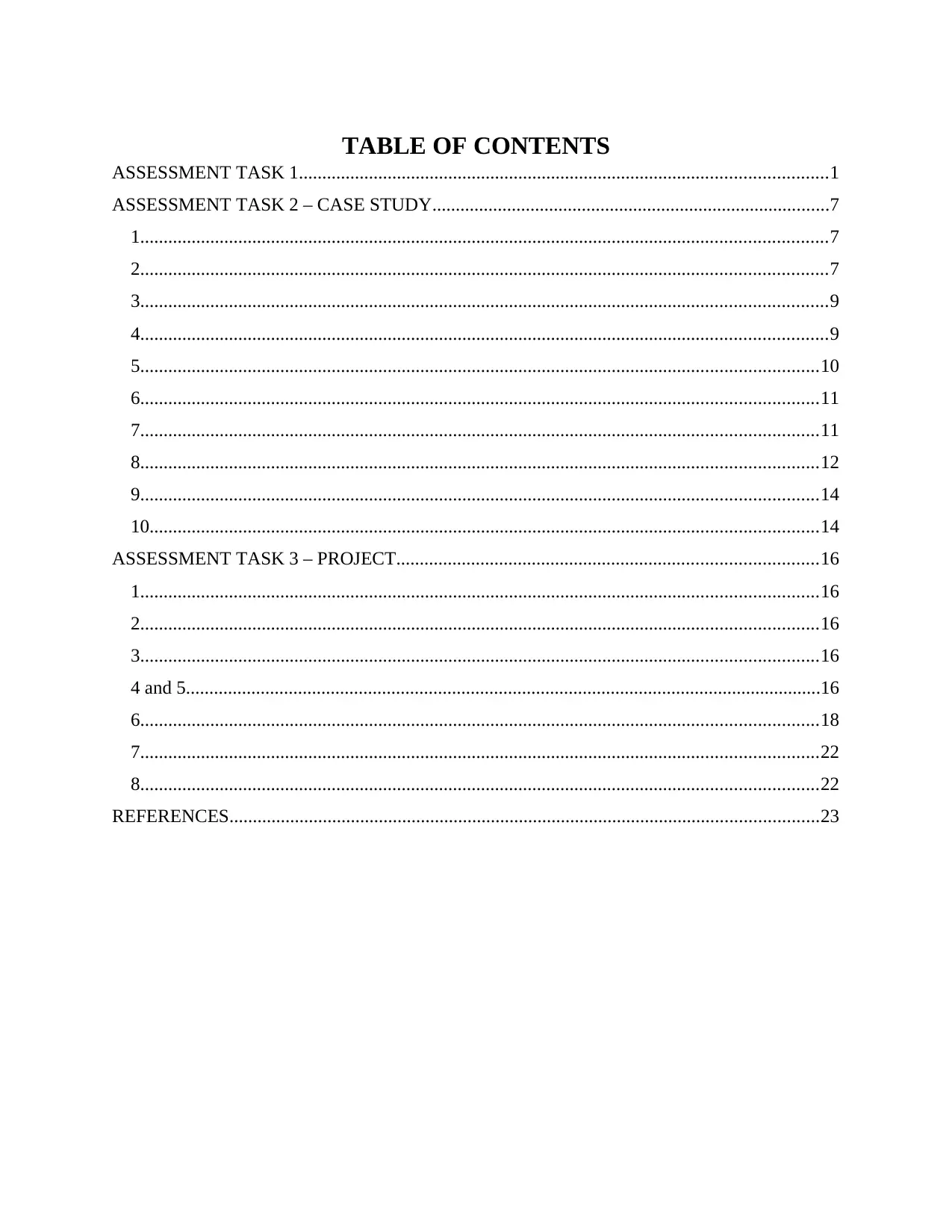
TABLE OF CONTENTS
ASSESSMENT TASK 1.................................................................................................................1
ASSESSMENT TASK 2 – CASE STUDY.....................................................................................7
1...................................................................................................................................................7
2...................................................................................................................................................7
3...................................................................................................................................................9
4...................................................................................................................................................9
5.................................................................................................................................................10
6.................................................................................................................................................11
7.................................................................................................................................................11
8.................................................................................................................................................12
9.................................................................................................................................................14
10...............................................................................................................................................14
ASSESSMENT TASK 3 – PROJECT..........................................................................................16
1.................................................................................................................................................16
2.................................................................................................................................................16
3.................................................................................................................................................16
4 and 5........................................................................................................................................16
6.................................................................................................................................................18
7.................................................................................................................................................22
8.................................................................................................................................................22
REFERENCES..............................................................................................................................23
ASSESSMENT TASK 1.................................................................................................................1
ASSESSMENT TASK 2 – CASE STUDY.....................................................................................7
1...................................................................................................................................................7
2...................................................................................................................................................7
3...................................................................................................................................................9
4...................................................................................................................................................9
5.................................................................................................................................................10
6.................................................................................................................................................11
7.................................................................................................................................................11
8.................................................................................................................................................12
9.................................................................................................................................................14
10...............................................................................................................................................14
ASSESSMENT TASK 3 – PROJECT..........................................................................................16
1.................................................................................................................................................16
2.................................................................................................................................................16
3.................................................................................................................................................16
4 and 5........................................................................................................................................16
6.................................................................................................................................................18
7.................................................................................................................................................22
8.................................................................................................................................................22
REFERENCES..............................................................................................................................23
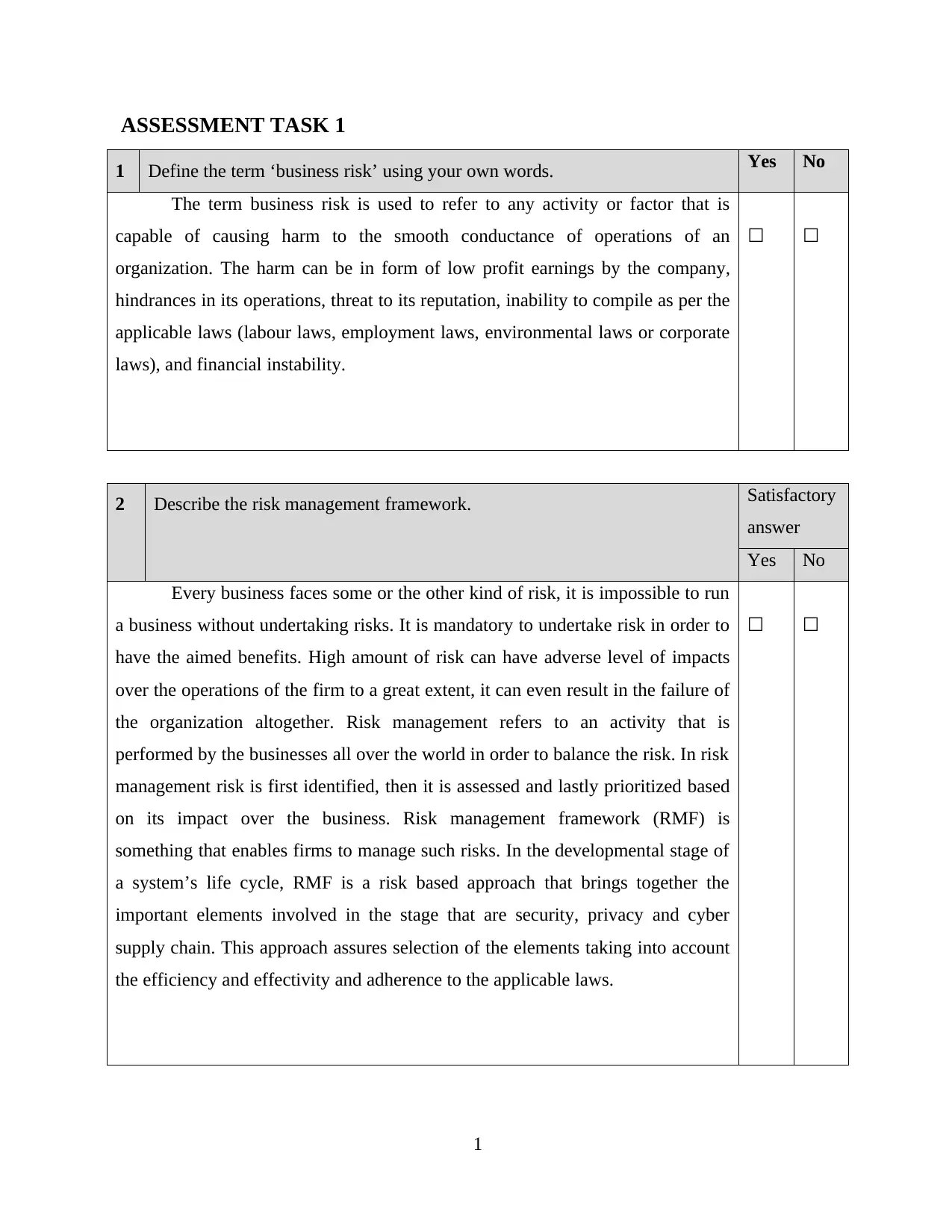
ASSESSMENT TASK 1
1 Define the term ‘business risk’ using your own words. Yes No
The term business risk is used to refer to any activity or factor that is
capable of causing harm to the smooth conductance of operations of an
organization. The harm can be in form of low profit earnings by the company,
hindrances in its operations, threat to its reputation, inability to compile as per the
applicable laws (labour laws, employment laws, environmental laws or corporate
laws), and financial instability.
☐ ☐
2 Describe the risk management framework. Satisfactory
answer
Yes No
Every business faces some or the other kind of risk, it is impossible to run
a business without undertaking risks. It is mandatory to undertake risk in order to
have the aimed benefits. High amount of risk can have adverse level of impacts
over the operations of the firm to a great extent, it can even result in the failure of
the organization altogether. Risk management refers to an activity that is
performed by the businesses all over the world in order to balance the risk. In risk
management risk is first identified, then it is assessed and lastly prioritized based
on its impact over the business. Risk management framework (RMF) is
something that enables firms to manage such risks. In the developmental stage of
a system’s life cycle, RMF is a risk based approach that brings together the
important elements involved in the stage that are security, privacy and cyber
supply chain. This approach assures selection of the elements taking into account
the efficiency and effectivity and adherence to the applicable laws.
☐ ☐
1
1 Define the term ‘business risk’ using your own words. Yes No
The term business risk is used to refer to any activity or factor that is
capable of causing harm to the smooth conductance of operations of an
organization. The harm can be in form of low profit earnings by the company,
hindrances in its operations, threat to its reputation, inability to compile as per the
applicable laws (labour laws, employment laws, environmental laws or corporate
laws), and financial instability.
☐ ☐
2 Describe the risk management framework. Satisfactory
answer
Yes No
Every business faces some or the other kind of risk, it is impossible to run
a business without undertaking risks. It is mandatory to undertake risk in order to
have the aimed benefits. High amount of risk can have adverse level of impacts
over the operations of the firm to a great extent, it can even result in the failure of
the organization altogether. Risk management refers to an activity that is
performed by the businesses all over the world in order to balance the risk. In risk
management risk is first identified, then it is assessed and lastly prioritized based
on its impact over the business. Risk management framework (RMF) is
something that enables firms to manage such risks. In the developmental stage of
a system’s life cycle, RMF is a risk based approach that brings together the
important elements involved in the stage that are security, privacy and cyber
supply chain. This approach assures selection of the elements taking into account
the efficiency and effectivity and adherence to the applicable laws.
☐ ☐
1
⊘ This is a preview!⊘
Do you want full access?
Subscribe today to unlock all pages.

Trusted by 1+ million students worldwide
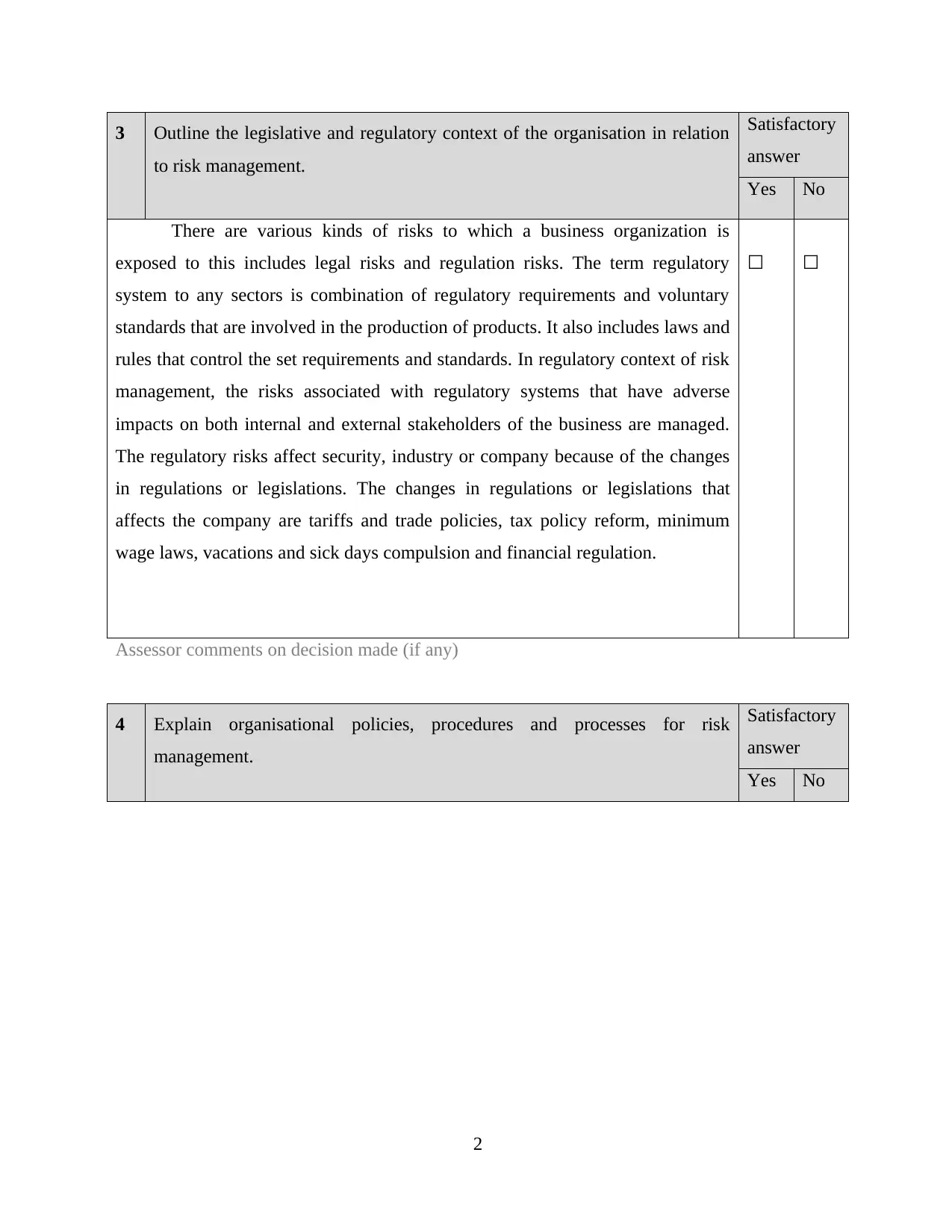
3 Outline the legislative and regulatory context of the organisation in relation
to risk management.
Satisfactory
answer
Yes No
There are various kinds of risks to which a business organization is
exposed to this includes legal risks and regulation risks. The term regulatory
system to any sectors is combination of regulatory requirements and voluntary
standards that are involved in the production of products. It also includes laws and
rules that control the set requirements and standards. In regulatory context of risk
management, the risks associated with regulatory systems that have adverse
impacts on both internal and external stakeholders of the business are managed.
The regulatory risks affect security, industry or company because of the changes
in regulations or legislations. The changes in regulations or legislations that
affects the company are tariffs and trade policies, tax policy reform, minimum
wage laws, vacations and sick days compulsion and financial regulation.
☐ ☐
Assessor comments on decision made (if any)
4 Explain organisational policies, procedures and processes for risk
management.
Satisfactory
answer
Yes No
2
to risk management.
Satisfactory
answer
Yes No
There are various kinds of risks to which a business organization is
exposed to this includes legal risks and regulation risks. The term regulatory
system to any sectors is combination of regulatory requirements and voluntary
standards that are involved in the production of products. It also includes laws and
rules that control the set requirements and standards. In regulatory context of risk
management, the risks associated with regulatory systems that have adverse
impacts on both internal and external stakeholders of the business are managed.
The regulatory risks affect security, industry or company because of the changes
in regulations or legislations. The changes in regulations or legislations that
affects the company are tariffs and trade policies, tax policy reform, minimum
wage laws, vacations and sick days compulsion and financial regulation.
☐ ☐
Assessor comments on decision made (if any)
4 Explain organisational policies, procedures and processes for risk
management.
Satisfactory
answer
Yes No
2
Paraphrase This Document
Need a fresh take? Get an instant paraphrase of this document with our AI Paraphraser
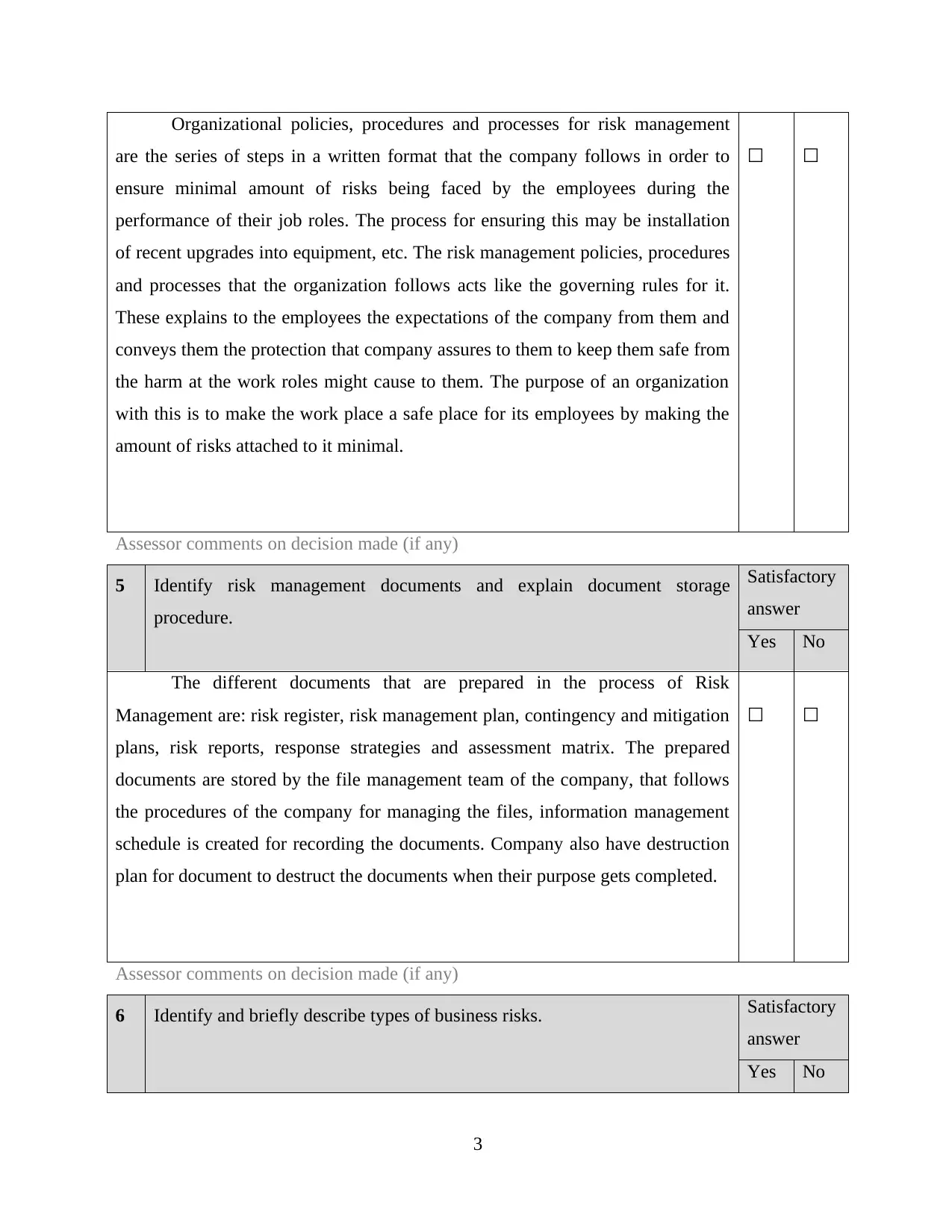
Organizational policies, procedures and processes for risk management
are the series of steps in a written format that the company follows in order to
ensure minimal amount of risks being faced by the employees during the
performance of their job roles. The process for ensuring this may be installation
of recent upgrades into equipment, etc. The risk management policies, procedures
and processes that the organization follows acts like the governing rules for it.
These explains to the employees the expectations of the company from them and
conveys them the protection that company assures to them to keep them safe from
the harm at the work roles might cause to them. The purpose of an organization
with this is to make the work place a safe place for its employees by making the
amount of risks attached to it minimal.
☐ ☐
Assessor comments on decision made (if any)
5 Identify risk management documents and explain document storage
procedure.
Satisfactory
answer
Yes No
The different documents that are prepared in the process of Risk
Management are: risk register, risk management plan, contingency and mitigation
plans, risk reports, response strategies and assessment matrix. The prepared
documents are stored by the file management team of the company, that follows
the procedures of the company for managing the files, information management
schedule is created for recording the documents. Company also have destruction
plan for document to destruct the documents when their purpose gets completed.
☐ ☐
Assessor comments on decision made (if any)
6 Identify and briefly describe types of business risks. Satisfactory
answer
Yes No
3
are the series of steps in a written format that the company follows in order to
ensure minimal amount of risks being faced by the employees during the
performance of their job roles. The process for ensuring this may be installation
of recent upgrades into equipment, etc. The risk management policies, procedures
and processes that the organization follows acts like the governing rules for it.
These explains to the employees the expectations of the company from them and
conveys them the protection that company assures to them to keep them safe from
the harm at the work roles might cause to them. The purpose of an organization
with this is to make the work place a safe place for its employees by making the
amount of risks attached to it minimal.
☐ ☐
Assessor comments on decision made (if any)
5 Identify risk management documents and explain document storage
procedure.
Satisfactory
answer
Yes No
The different documents that are prepared in the process of Risk
Management are: risk register, risk management plan, contingency and mitigation
plans, risk reports, response strategies and assessment matrix. The prepared
documents are stored by the file management team of the company, that follows
the procedures of the company for managing the files, information management
schedule is created for recording the documents. Company also have destruction
plan for document to destruct the documents when their purpose gets completed.
☐ ☐
Assessor comments on decision made (if any)
6 Identify and briefly describe types of business risks. Satisfactory
answer
Yes No
3
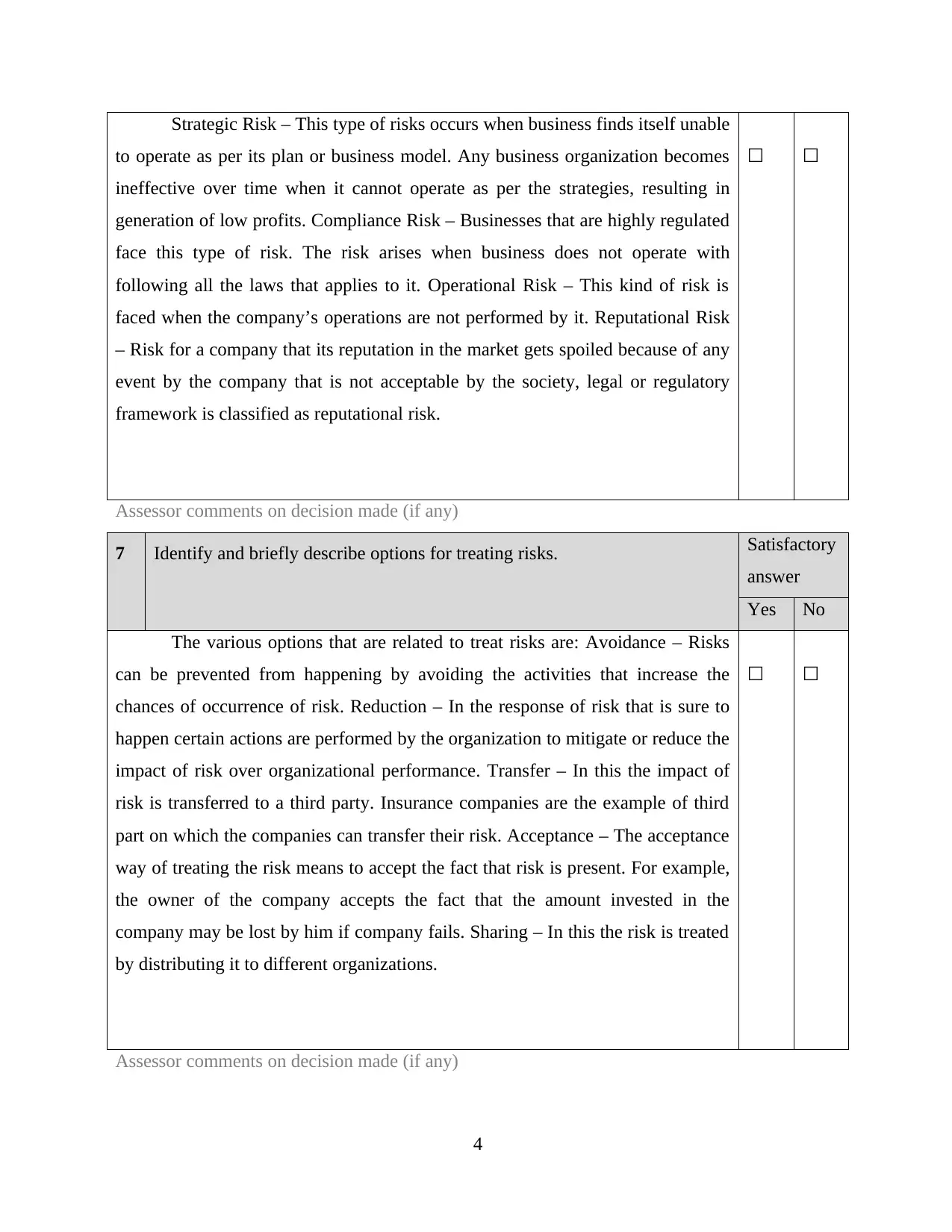
Strategic Risk – This type of risks occurs when business finds itself unable
to operate as per its plan or business model. Any business organization becomes
ineffective over time when it cannot operate as per the strategies, resulting in
generation of low profits. Compliance Risk – Businesses that are highly regulated
face this type of risk. The risk arises when business does not operate with
following all the laws that applies to it. Operational Risk – This kind of risk is
faced when the company’s operations are not performed by it. Reputational Risk
– Risk for a company that its reputation in the market gets spoiled because of any
event by the company that is not acceptable by the society, legal or regulatory
framework is classified as reputational risk.
☐ ☐
Assessor comments on decision made (if any)
7 Identify and briefly describe options for treating risks. Satisfactory
answer
Yes No
The various options that are related to treat risks are: Avoidance – Risks
can be prevented from happening by avoiding the activities that increase the
chances of occurrence of risk. Reduction – In the response of risk that is sure to
happen certain actions are performed by the organization to mitigate or reduce the
impact of risk over organizational performance. Transfer – In this the impact of
risk is transferred to a third party. Insurance companies are the example of third
part on which the companies can transfer their risk. Acceptance – The acceptance
way of treating the risk means to accept the fact that risk is present. For example,
the owner of the company accepts the fact that the amount invested in the
company may be lost by him if company fails. Sharing – In this the risk is treated
by distributing it to different organizations.
☐ ☐
Assessor comments on decision made (if any)
4
to operate as per its plan or business model. Any business organization becomes
ineffective over time when it cannot operate as per the strategies, resulting in
generation of low profits. Compliance Risk – Businesses that are highly regulated
face this type of risk. The risk arises when business does not operate with
following all the laws that applies to it. Operational Risk – This kind of risk is
faced when the company’s operations are not performed by it. Reputational Risk
– Risk for a company that its reputation in the market gets spoiled because of any
event by the company that is not acceptable by the society, legal or regulatory
framework is classified as reputational risk.
☐ ☐
Assessor comments on decision made (if any)
7 Identify and briefly describe options for treating risks. Satisfactory
answer
Yes No
The various options that are related to treat risks are: Avoidance – Risks
can be prevented from happening by avoiding the activities that increase the
chances of occurrence of risk. Reduction – In the response of risk that is sure to
happen certain actions are performed by the organization to mitigate or reduce the
impact of risk over organizational performance. Transfer – In this the impact of
risk is transferred to a third party. Insurance companies are the example of third
part on which the companies can transfer their risk. Acceptance – The acceptance
way of treating the risk means to accept the fact that risk is present. For example,
the owner of the company accepts the fact that the amount invested in the
company may be lost by him if company fails. Sharing – In this the risk is treated
by distributing it to different organizations.
☐ ☐
Assessor comments on decision made (if any)
4
⊘ This is a preview!⊘
Do you want full access?
Subscribe today to unlock all pages.
Trusted by 1+ million students worldwide
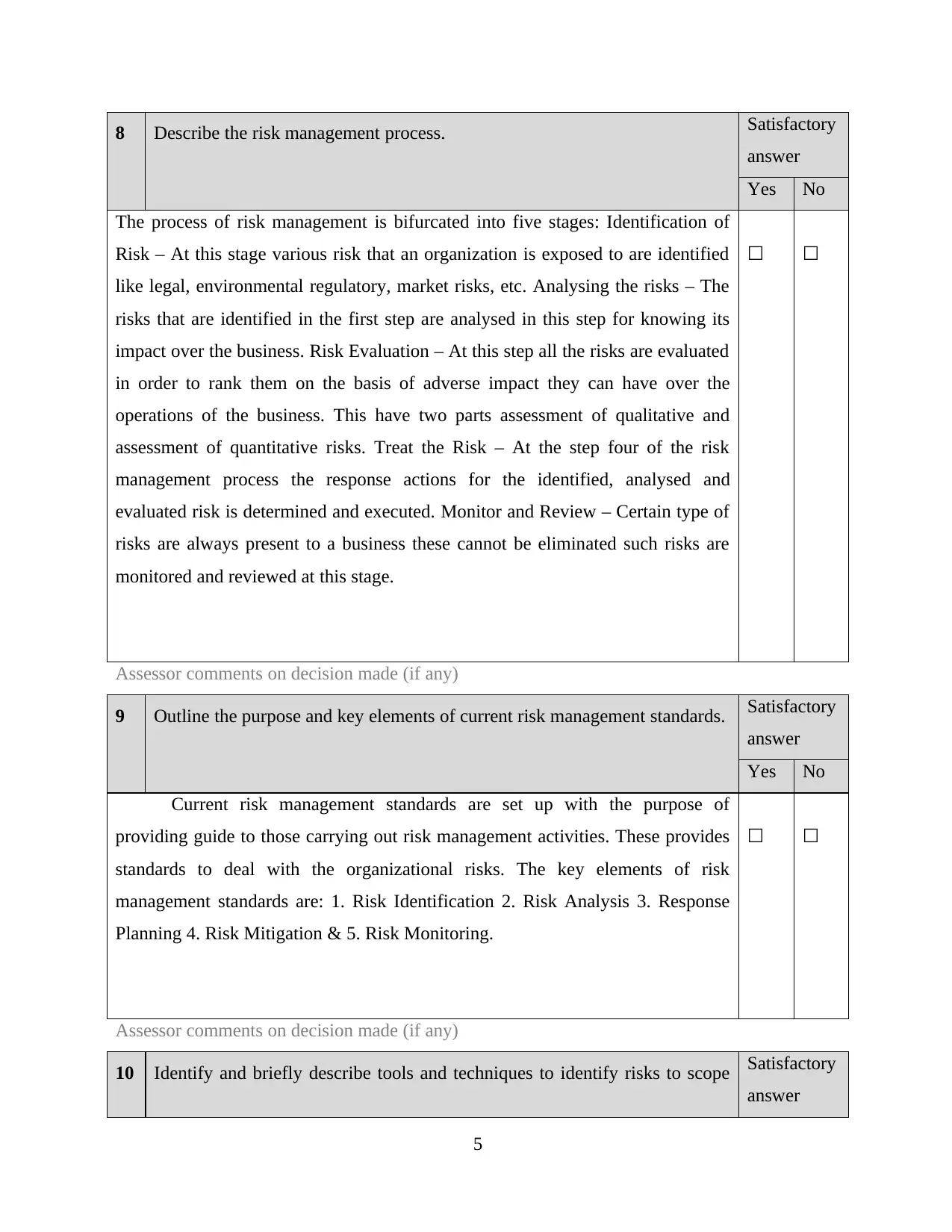
8 Describe the risk management process. Satisfactory
answer
Yes No
The process of risk management is bifurcated into five stages: Identification of
Risk – At this stage various risk that an organization is exposed to are identified
like legal, environmental regulatory, market risks, etc. Analysing the risks – The
risks that are identified in the first step are analysed in this step for knowing its
impact over the business. Risk Evaluation – At this step all the risks are evaluated
in order to rank them on the basis of adverse impact they can have over the
operations of the business. This have two parts assessment of qualitative and
assessment of quantitative risks. Treat the Risk – At the step four of the risk
management process the response actions for the identified, analysed and
evaluated risk is determined and executed. Monitor and Review – Certain type of
risks are always present to a business these cannot be eliminated such risks are
monitored and reviewed at this stage.
☐ ☐
Assessor comments on decision made (if any)
9 Outline the purpose and key elements of current risk management standards. Satisfactory
answer
Yes No
Current risk management standards are set up with the purpose of
providing guide to those carrying out risk management activities. These provides
standards to deal with the organizational risks. The key elements of risk
management standards are: 1. Risk Identification 2. Risk Analysis 3. Response
Planning 4. Risk Mitigation & 5. Risk Monitoring.
☐ ☐
Assessor comments on decision made (if any)
10 Identify and briefly describe tools and techniques to identify risks to scope Satisfactory
answer
5
answer
Yes No
The process of risk management is bifurcated into five stages: Identification of
Risk – At this stage various risk that an organization is exposed to are identified
like legal, environmental regulatory, market risks, etc. Analysing the risks – The
risks that are identified in the first step are analysed in this step for knowing its
impact over the business. Risk Evaluation – At this step all the risks are evaluated
in order to rank them on the basis of adverse impact they can have over the
operations of the business. This have two parts assessment of qualitative and
assessment of quantitative risks. Treat the Risk – At the step four of the risk
management process the response actions for the identified, analysed and
evaluated risk is determined and executed. Monitor and Review – Certain type of
risks are always present to a business these cannot be eliminated such risks are
monitored and reviewed at this stage.
☐ ☐
Assessor comments on decision made (if any)
9 Outline the purpose and key elements of current risk management standards. Satisfactory
answer
Yes No
Current risk management standards are set up with the purpose of
providing guide to those carrying out risk management activities. These provides
standards to deal with the organizational risks. The key elements of risk
management standards are: 1. Risk Identification 2. Risk Analysis 3. Response
Planning 4. Risk Mitigation & 5. Risk Monitoring.
☐ ☐
Assessor comments on decision made (if any)
10 Identify and briefly describe tools and techniques to identify risks to scope Satisfactory
answer
5
Paraphrase This Document
Need a fresh take? Get an instant paraphrase of this document with our AI Paraphraser
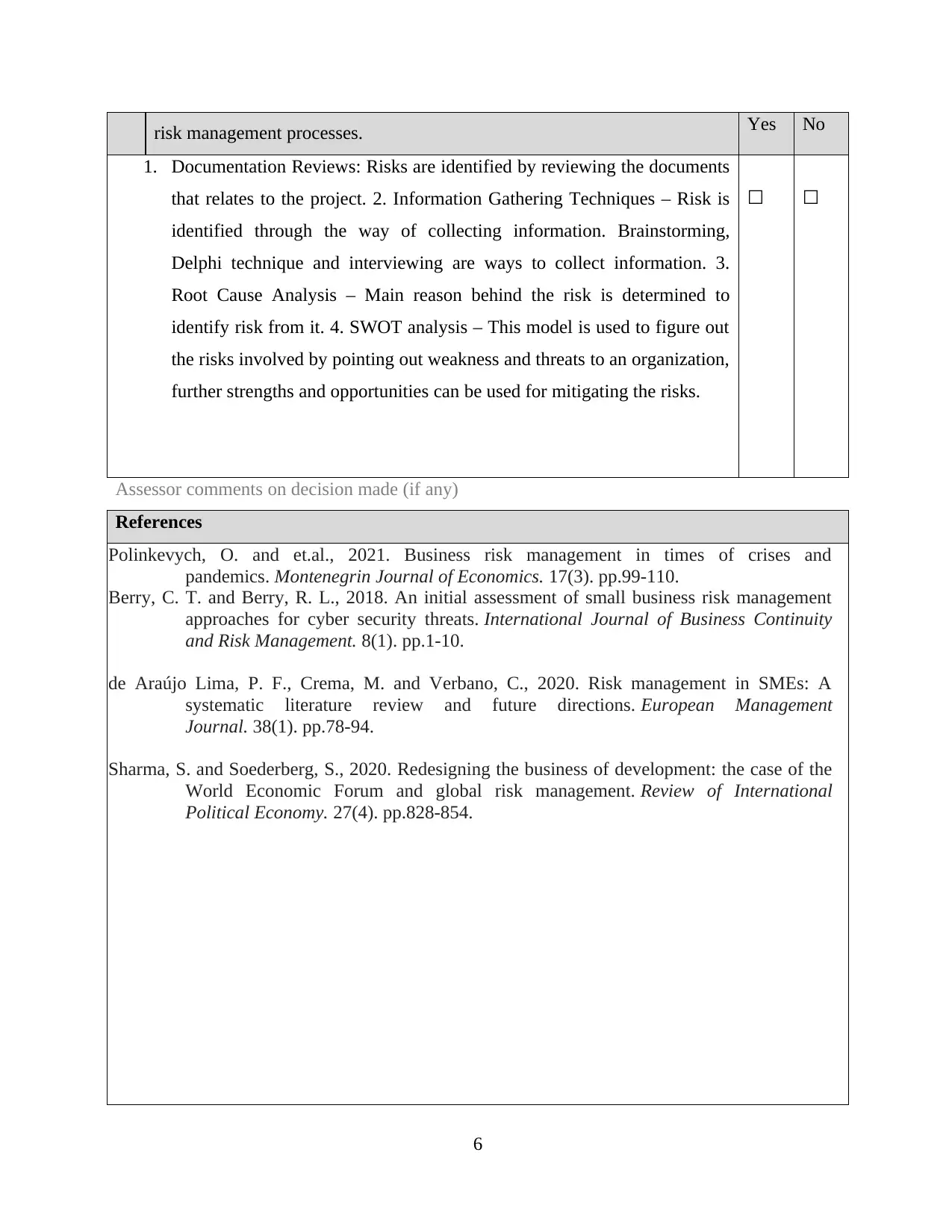
risk management processes. Yes No
1. Documentation Reviews: Risks are identified by reviewing the documents
that relates to the project. 2. Information Gathering Techniques – Risk is
identified through the way of collecting information. Brainstorming,
Delphi technique and interviewing are ways to collect information. 3.
Root Cause Analysis – Main reason behind the risk is determined to
identify risk from it. 4. SWOT analysis – This model is used to figure out
the risks involved by pointing out weakness and threats to an organization,
further strengths and opportunities can be used for mitigating the risks.
☐ ☐
Assessor comments on decision made (if any)
References
Polinkevych, O. and et.al., 2021. Business risk management in times of crises and
pandemics. Montenegrin Journal of Economics. 17(3). pp.99-110.
Berry, C. T. and Berry, R. L., 2018. An initial assessment of small business risk management
approaches for cyber security threats. International Journal of Business Continuity
and Risk Management. 8(1). pp.1-10.
de Araújo Lima, P. F., Crema, M. and Verbano, C., 2020. Risk management in SMEs: A
systematic literature review and future directions. European Management
Journal. 38(1). pp.78-94.
Sharma, S. and Soederberg, S., 2020. Redesigning the business of development: the case of the
World Economic Forum and global risk management. Review of International
Political Economy. 27(4). pp.828-854.
6
1. Documentation Reviews: Risks are identified by reviewing the documents
that relates to the project. 2. Information Gathering Techniques – Risk is
identified through the way of collecting information. Brainstorming,
Delphi technique and interviewing are ways to collect information. 3.
Root Cause Analysis – Main reason behind the risk is determined to
identify risk from it. 4. SWOT analysis – This model is used to figure out
the risks involved by pointing out weakness and threats to an organization,
further strengths and opportunities can be used for mitigating the risks.
☐ ☐
Assessor comments on decision made (if any)
References
Polinkevych, O. and et.al., 2021. Business risk management in times of crises and
pandemics. Montenegrin Journal of Economics. 17(3). pp.99-110.
Berry, C. T. and Berry, R. L., 2018. An initial assessment of small business risk management
approaches for cyber security threats. International Journal of Business Continuity
and Risk Management. 8(1). pp.1-10.
de Araújo Lima, P. F., Crema, M. and Verbano, C., 2020. Risk management in SMEs: A
systematic literature review and future directions. European Management
Journal. 38(1). pp.78-94.
Sharma, S. and Soederberg, S., 2020. Redesigning the business of development: the case of the
World Economic Forum and global risk management. Review of International
Political Economy. 27(4). pp.828-854.
6
Assessor comments on decision made (if any)
ASSESSMENT TASK 2 – CASE STUDY
1
From the evaluation of the overall performance of the organization it can be mentioned
that there are different types of the factors that influences the overall practices of the
organization. This includes political, political, economic, social, legal, technological and policy
related which hamper or boost the overall performance of the organization (Ullah and et.al.,
2021).
There is different form of the political factors which hampers the functioning of the
organization that involves the political stability, government rule s& regulations
regarding work health safety, non-compliance with the water utilization policy,
The economic factors which is highly required to focused for gaining the depth
understanding about it is that it is related with possessing that customers are having good
disposal income which shows that good level of sales can be made. The particular area
is having good trend of obtaining tourism that can boost the overall functioning of the
organization.
Social trend is prevailing among the customers to have the good type of the foods such as
pizza, etc. which is offered by the cafe 65. There is as well attention is paid by the firm to
offer coffee, tea, etc. that is used for possessing significant pattern in area of socialization
practice.
Technological aspects in the particular sector is required to be adopted for the purpose of
gaining higher profitability & sustainability so that greater efficient services can be
offered to the customers. It is not successfully cooperating with the industrial
requirement which is need to be overcome so that appropriate action of growth can be
obtained.
On the basis of this it can be articulated that policy is taken into the procedure by the
organization so that competitive actions are exerted for deriving compliance with consumer
protection, industrial requirement, effective work health requirement, etc. so that good
reputation in market can be maintained.
7
ASSESSMENT TASK 2 – CASE STUDY
1
From the evaluation of the overall performance of the organization it can be mentioned
that there are different types of the factors that influences the overall practices of the
organization. This includes political, political, economic, social, legal, technological and policy
related which hamper or boost the overall performance of the organization (Ullah and et.al.,
2021).
There is different form of the political factors which hampers the functioning of the
organization that involves the political stability, government rule s& regulations
regarding work health safety, non-compliance with the water utilization policy,
The economic factors which is highly required to focused for gaining the depth
understanding about it is that it is related with possessing that customers are having good
disposal income which shows that good level of sales can be made. The particular area
is having good trend of obtaining tourism that can boost the overall functioning of the
organization.
Social trend is prevailing among the customers to have the good type of the foods such as
pizza, etc. which is offered by the cafe 65. There is as well attention is paid by the firm to
offer coffee, tea, etc. that is used for possessing significant pattern in area of socialization
practice.
Technological aspects in the particular sector is required to be adopted for the purpose of
gaining higher profitability & sustainability so that greater efficient services can be
offered to the customers. It is not successfully cooperating with the industrial
requirement which is need to be overcome so that appropriate action of growth can be
obtained.
On the basis of this it can be articulated that policy is taken into the procedure by the
organization so that competitive actions are exerted for deriving compliance with consumer
protection, industrial requirement, effective work health requirement, etc. so that good
reputation in market can be maintained.
7
⊘ This is a preview!⊘
Do you want full access?
Subscribe today to unlock all pages.
Trusted by 1+ million students worldwide
2
a)
There is distinct form of requirements which is need to accomplished by the firm in turn
attaining goal of eliminating irrelevant practices to uplift overall functioning can become
possible. The one of the significant role of risk identification is to possess knowledge regarding
the prevailing threats which can hamper its ability to coordinate with the changing business
environment. It aids in identifying the prevailing lacking areas so that particular execution of
reliable improvement techniques can be executed (Alabdullah, 2022). It helps in receiving
productivity via assuring that significant capability for eliminating negative impact leading to
losses. Improvement in the overall process can be achieved to have higher profitable situation.
b)
Stakeholder analysis is one of the significant technique that is helpful in identifying the
project risk so that accomplishing the goal of higher ability to coordinate with prevailing
circumstances can become possible. It comprises the four aspects such as keep satisfied,
manage closely, keep informed and monitor. From the assessment of the given case study the
stakeholders can be identified as below:
8
a)
There is distinct form of requirements which is need to accomplished by the firm in turn
attaining goal of eliminating irrelevant practices to uplift overall functioning can become
possible. The one of the significant role of risk identification is to possess knowledge regarding
the prevailing threats which can hamper its ability to coordinate with the changing business
environment. It aids in identifying the prevailing lacking areas so that particular execution of
reliable improvement techniques can be executed (Alabdullah, 2022). It helps in receiving
productivity via assuring that significant capability for eliminating negative impact leading to
losses. Improvement in the overall process can be achieved to have higher profitable situation.
b)
Stakeholder analysis is one of the significant technique that is helpful in identifying the
project risk so that accomplishing the goal of higher ability to coordinate with prevailing
circumstances can become possible. It comprises the four aspects such as keep satisfied,
manage closely, keep informed and monitor. From the assessment of the given case study the
stakeholders can be identified as below:
8
Paraphrase This Document
Need a fresh take? Get an instant paraphrase of this document with our AI Paraphraser
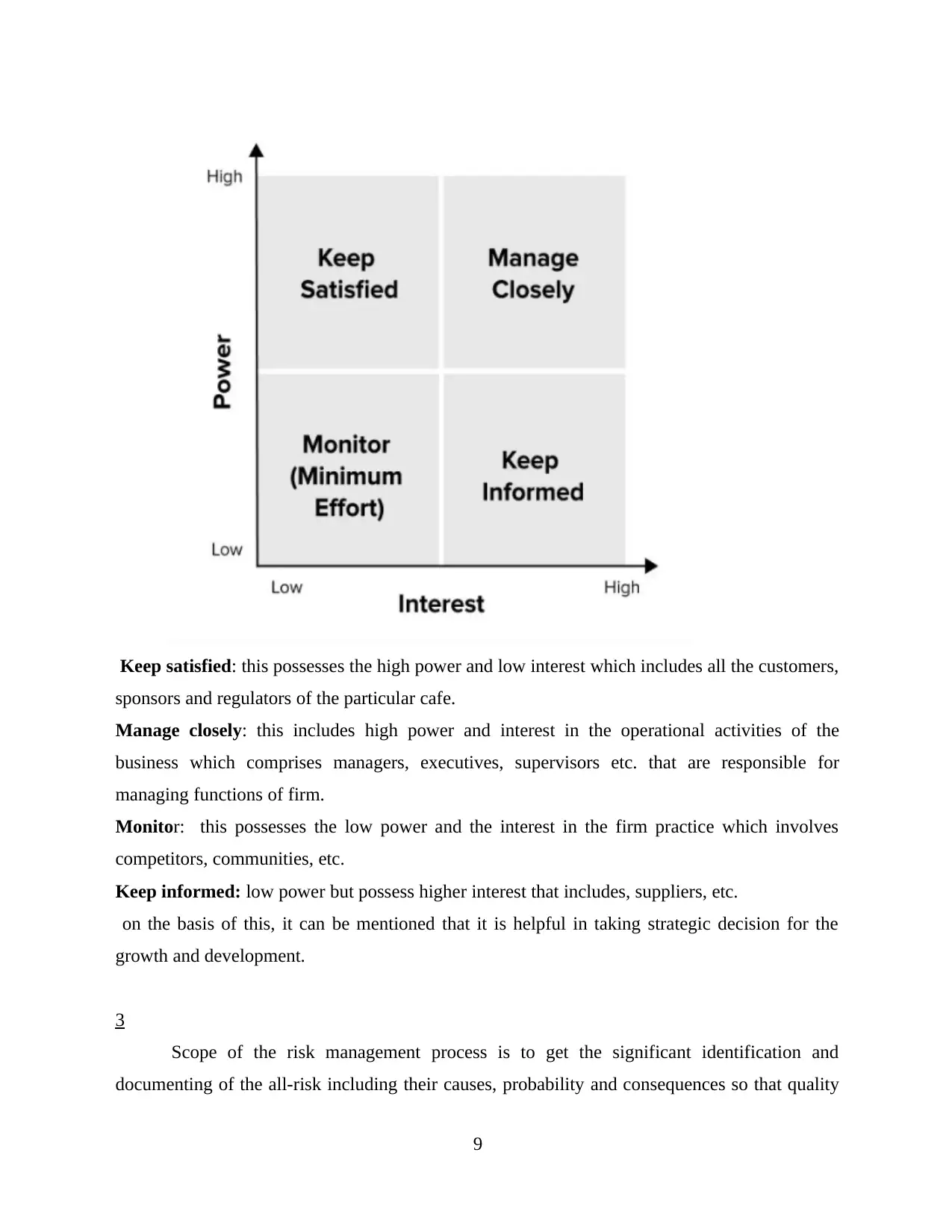
Keep satisfied: this possesses the high power and low interest which includes all the customers,
sponsors and regulators of the particular cafe.
Manage closely: this includes high power and interest in the operational activities of the
business which comprises managers, executives, supervisors etc. that are responsible for
managing functions of firm.
Monitor: this possesses the low power and the interest in the firm practice which involves
competitors, communities, etc.
Keep informed: low power but possess higher interest that includes, suppliers, etc.
on the basis of this, it can be mentioned that it is helpful in taking strategic decision for the
growth and development.
3
Scope of the risk management process is to get the significant identification and
documenting of the all-risk including their causes, probability and consequences so that quality
9
sponsors and regulators of the particular cafe.
Manage closely: this includes high power and interest in the operational activities of the
business which comprises managers, executives, supervisors etc. that are responsible for
managing functions of firm.
Monitor: this possesses the low power and the interest in the firm practice which involves
competitors, communities, etc.
Keep informed: low power but possess higher interest that includes, suppliers, etc.
on the basis of this, it can be mentioned that it is helpful in taking strategic decision for the
growth and development.
3
Scope of the risk management process is to get the significant identification and
documenting of the all-risk including their causes, probability and consequences so that quality
9
action for the improvement can be taken (Kim, Lee and Kang, 2021). This particularly helpful in
having the basic assumptions for the international and external environment that aids in
achieving the objectives of risk management process. It is concerned with having the particular
information regarding the controlling measures as well in turn getting assurance for eliminating
of risks can be done. The processes have the certain steps which can permit specific business to
achieve benefits of understanding the crucial requirements such as identification & controlling
of threats so that productive results can be offered. In addition to this, the focus is provided on
achieving the reliable monitoring action in turn good practices to uplift position of firm to
decline irrelevant aspects hindering organizational performance. The risk context in the specified
organization is found to be non-effective as there is no absence of formulating register, no
documentation for the monitored practices. On the basis of this it can be identified that there is
inappropriate level of action is implemented to meet goal of eliminating risks which is depicting
higher scope for having implementation of action for improving performance.
4
There are different types of the risk which is basically prevailing in the particular cafe and
required to be eliminated in turn significant level of quality work can be developed/
Risk Context Risk Stakeholder inputs/or methods
used to identify risk
Ability to eliminate the
unattractive aspects of
firm
Strategic risk Case analysis
Objective is to have
effective functioning of
operational actions
Financial risk Document analysis for cash
balancing
To avoid delay delivery
of goods
Reputation risk Case analysis
To obtain the
competitiveness via
optimum utilization of
resources
operational Case analysis
For avoiding incidents Security and fraud risk Case analysis
10
having the basic assumptions for the international and external environment that aids in
achieving the objectives of risk management process. It is concerned with having the particular
information regarding the controlling measures as well in turn getting assurance for eliminating
of risks can be done. The processes have the certain steps which can permit specific business to
achieve benefits of understanding the crucial requirements such as identification & controlling
of threats so that productive results can be offered. In addition to this, the focus is provided on
achieving the reliable monitoring action in turn good practices to uplift position of firm to
decline irrelevant aspects hindering organizational performance. The risk context in the specified
organization is found to be non-effective as there is no absence of formulating register, no
documentation for the monitored practices. On the basis of this it can be identified that there is
inappropriate level of action is implemented to meet goal of eliminating risks which is depicting
higher scope for having implementation of action for improving performance.
4
There are different types of the risk which is basically prevailing in the particular cafe and
required to be eliminated in turn significant level of quality work can be developed/
Risk Context Risk Stakeholder inputs/or methods
used to identify risk
Ability to eliminate the
unattractive aspects of
firm
Strategic risk Case analysis
Objective is to have
effective functioning of
operational actions
Financial risk Document analysis for cash
balancing
To avoid delay delivery
of goods
Reputation risk Case analysis
To obtain the
competitiveness via
optimum utilization of
resources
operational Case analysis
For avoiding incidents Security and fraud risk Case analysis
10
⊘ This is a preview!⊘
Do you want full access?
Subscribe today to unlock all pages.
Trusted by 1+ million students worldwide

1 out of 26


Related Documents


Your All-in-One AI-Powered Toolkit for Academic Success.
+13062052269
info@desklib.com
Available 24*7 on WhatsApp / Email
![[object Object]](/_next/static/media/star-bottom.7253800d.svg)
Unlock your academic potential
Copyright © 2020–2026 A2Z Services. All Rights Reserved. Developed and managed by ZUCOL.