Cambridge College: Business Stakeholders and Ethical Considerations
VerifiedAdded on 2021/08/03
|20
|1160
|92
Presentation
AI Summary
This presentation, delivered by Mahesh Senanayake, a visiting lecturer at Cambridge College of Business Management, explores the critical role of stakeholders in a business environment. The presentation covers key areas such as the business environment, environmental dimensions affecting industries, the difference between stockholders and stakeholders, various types of stakeholders, and the application of stakeholder theory. It delves into stakeholder management, analysis using Mendelow's Matrix, stakeholder dispute resolution, and the application of business ethics. The presentation emphasizes the importance of ethical principles and the creation of win-win scenarios for all stakeholders, highlighting the significance of stakeholder relationships for achieving competitive advantage and the common good. The content provides a comprehensive overview of stakeholder theory and its practical implications in business operations.
BY MAHESH SENANAYAKE
VISITING LECTURER
CAMBRIDGE COLLEGE OF BUSINESS MANAGEMENT
VISITING LECTURER
CAMBRIDGE COLLEGE OF BUSINESS MANAGEMENT
Paraphrase This Document
Need a fresh take? Get an instant paraphrase of this document with our AI Paraphraser

MAHESH SENANAYAKE 2
Lesson 02
Stakeholders in a business & How
Business Ethics relates to
Stakeholders
Lesson 02
Stakeholders in a business & How
Business Ethics relates to
Stakeholders

Key Areas to Learn
Business Environment
Environmental Dimensions Affecting Industries, Organizations,
and Jobs
Difference between Stockholder and Stakeholders
Types of Stakeholders
Stakeholder theory
Stakeholder Management
Stakeholder Analysis
Mendelow’s Matrix
Typology of Stakeholders
Stakeholder Dispute Resolution
Applied Business Ethics and Stakeholders
MAHESH SENANAYAKE 3
Business Environment
Environmental Dimensions Affecting Industries, Organizations,
and Jobs
Difference between Stockholder and Stakeholders
Types of Stakeholders
Stakeholder theory
Stakeholder Management
Stakeholder Analysis
Mendelow’s Matrix
Typology of Stakeholders
Stakeholder Dispute Resolution
Applied Business Ethics and Stakeholders
MAHESH SENANAYAKE 3
⊘ This is a preview!⊘
Do you want full access?
Subscribe today to unlock all pages.

Trusted by 1+ million students worldwide

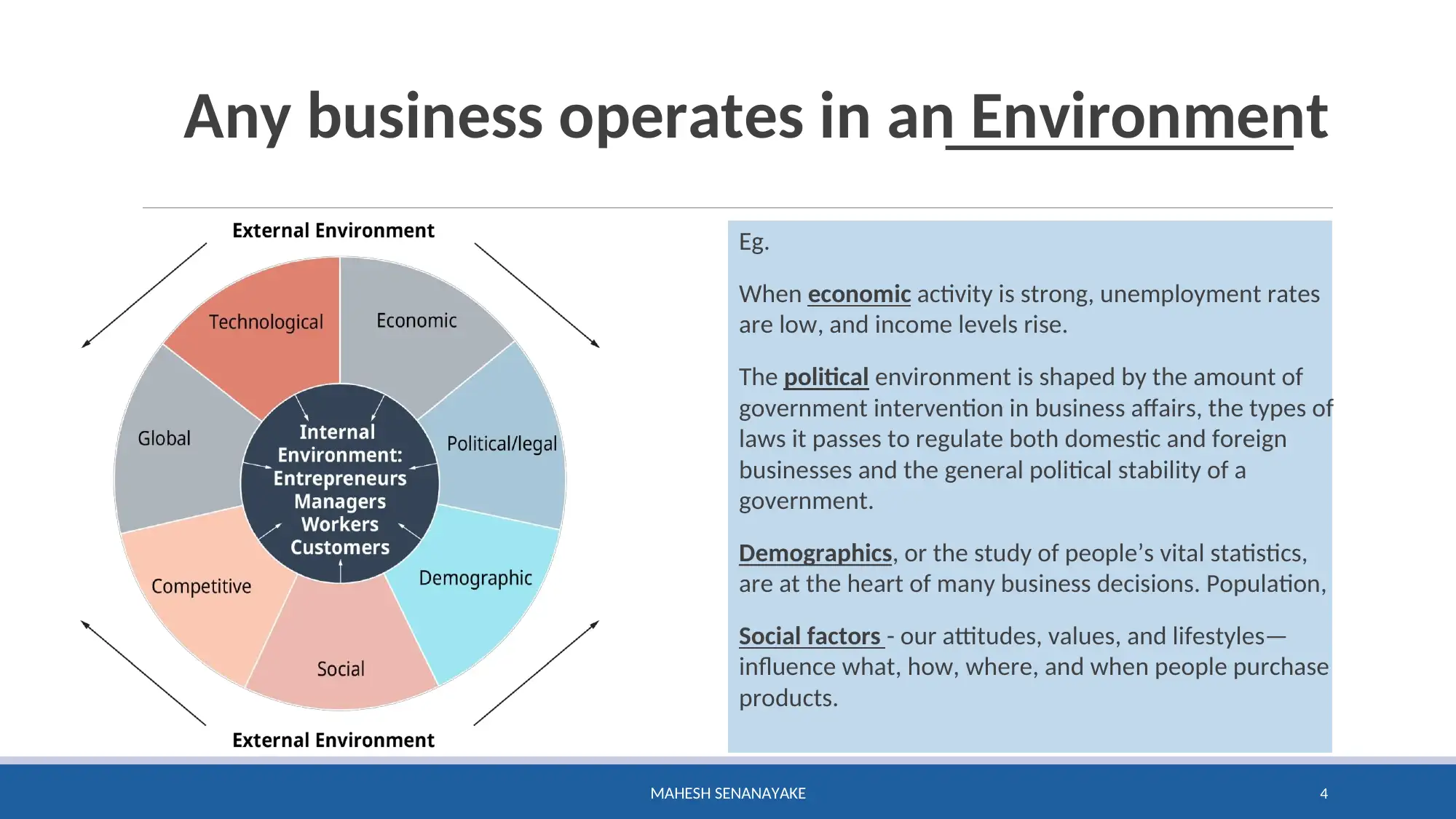
Any business operates in an Environment
MAHESH SENANAYAKE 4
Eg.
When economic activity is strong, unemployment rates
are low, and income levels rise.
The political environment is shaped by the amount of
government intervention in business affairs, the types of
laws it passes to regulate both domestic and foreign
businesses and the general political stability of a
government.
Demographics, or the study of people’s vital statistics,
are at the heart of many business decisions. Population,
Social factors - our attitudes, values, and lifestyles—
influence what, how, where, and when people purchase
products.
MAHESH SENANAYAKE 4
Eg.
When economic activity is strong, unemployment rates
are low, and income levels rise.
The political environment is shaped by the amount of
government intervention in business affairs, the types of
laws it passes to regulate both domestic and foreign
businesses and the general political stability of a
government.
Demographics, or the study of people’s vital statistics,
are at the heart of many business decisions. Population,
Social factors - our attitudes, values, and lifestyles—
influence what, how, where, and when people purchase
products.
Paraphrase This Document
Need a fresh take? Get an instant paraphrase of this document with our AI Paraphraser

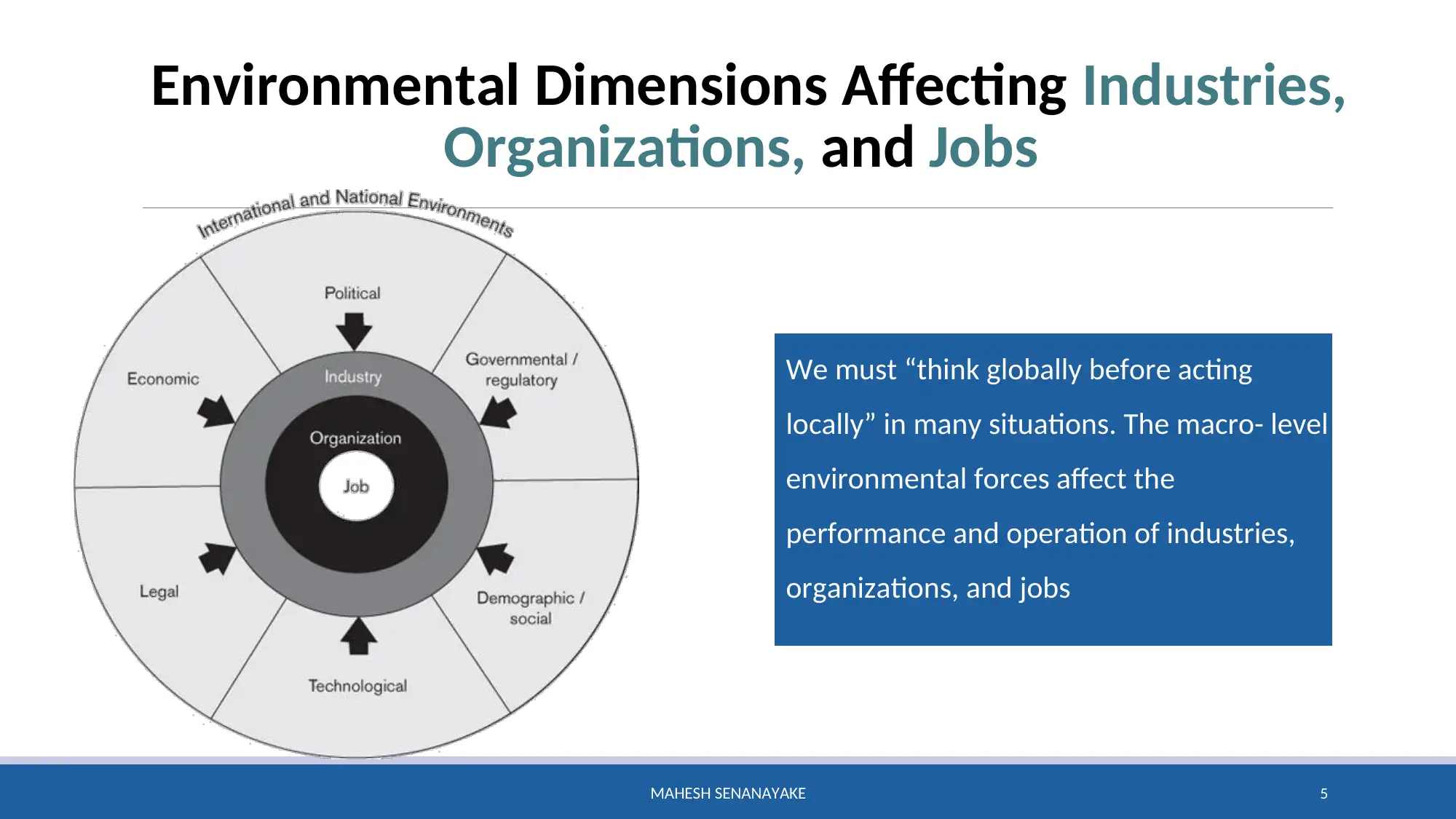
Environmental Dimensions Affecting Industries,
Organizations, and Jobs
MAHESH SENANAYAKE 5
We must “think globally before acting
locally” in many situations. The macro- level
environmental forces affect the
performance and operation of industries,
organizations, and jobs
Organizations, and Jobs
MAHESH SENANAYAKE 5
We must “think globally before acting
locally” in many situations. The macro- level
environmental forces affect the
performance and operation of industries,
organizations, and jobs

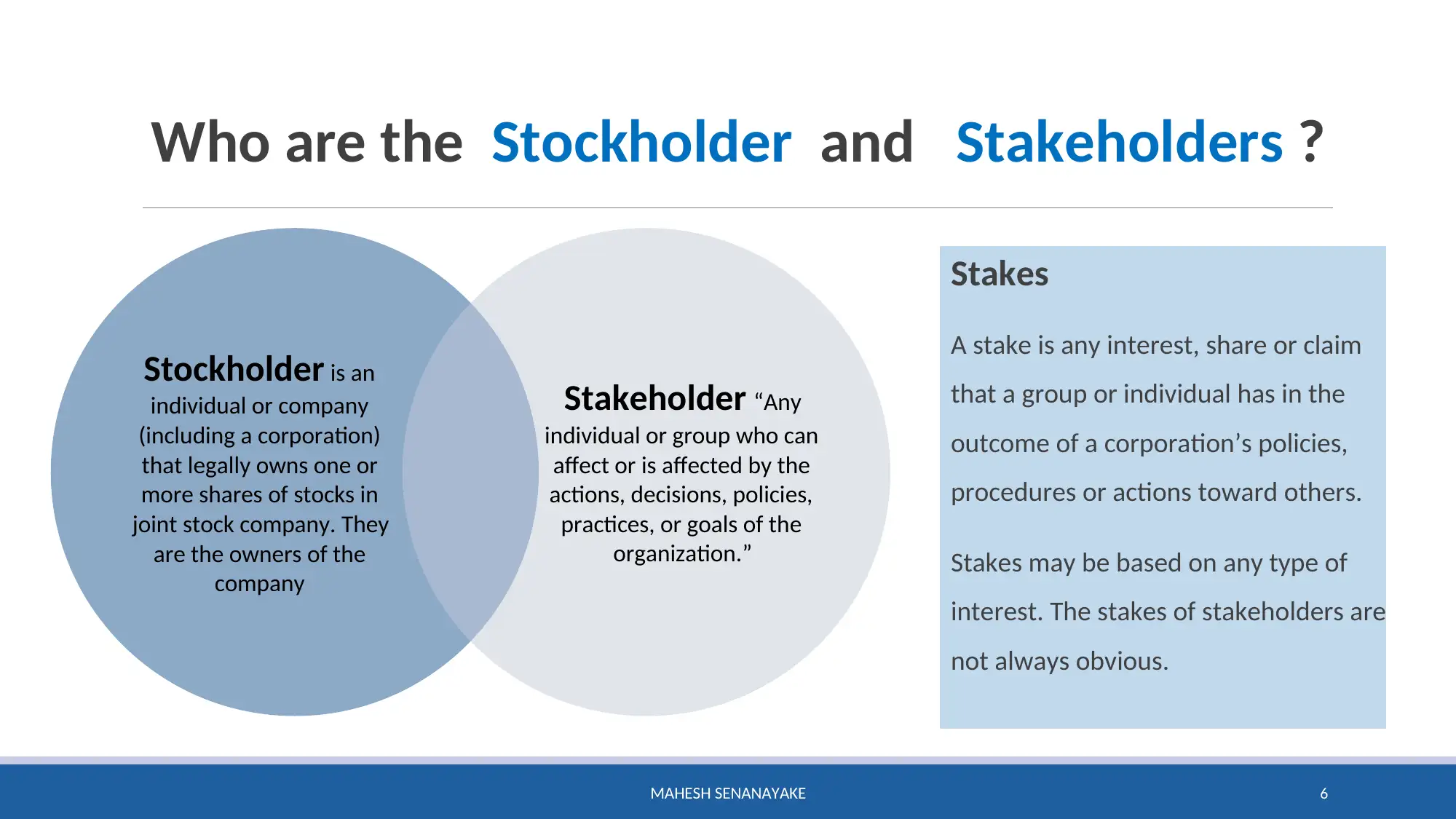
Who are the Stockholder and Stakeholders ?
Stakes
A stake is any interest, share or claim
that a group or individual has in the
outcome of a corporation’s policies,
procedures or actions toward others.
Stakes may be based on any type of
interest. The stakes of stakeholders are
not always obvious.
MAHESH SENANAYAKE 6
Stockholder is an
individual or company
(including a corporation)
that legally owns one or
more shares of stocks in
joint stock company. They
are the owners of the
company
Stakeholder “Any
individual or group who can
affect or is affected by the
actions, decisions, policies,
practices, or goals of the
organization.”
Stakes
A stake is any interest, share or claim
that a group or individual has in the
outcome of a corporation’s policies,
procedures or actions toward others.
Stakes may be based on any type of
interest. The stakes of stakeholders are
not always obvious.
MAHESH SENANAYAKE 6
Stockholder is an
individual or company
(including a corporation)
that legally owns one or
more shares of stocks in
joint stock company. They
are the owners of the
company
Stakeholder “Any
individual or group who can
affect or is affected by the
actions, decisions, policies,
practices, or goals of the
organization.”
⊘ This is a preview!⊘
Do you want full access?
Subscribe today to unlock all pages.

Trusted by 1+ million students worldwide

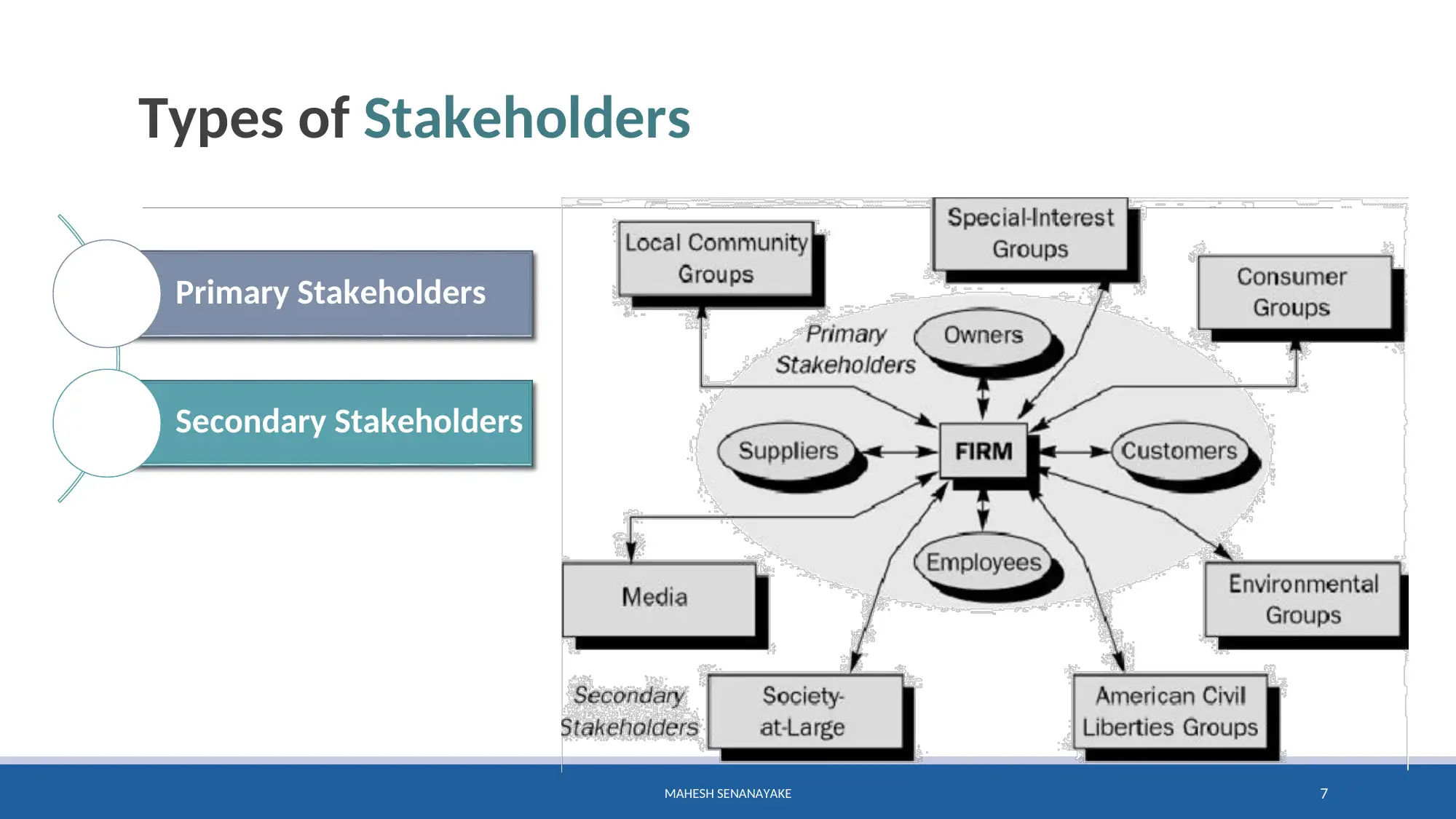
Types of Stakeholders
MAHESH SENANAYAKE 7
Primary Stakeholders
Secondary Stakeholders
MAHESH SENANAYAKE 7
Primary Stakeholders
Secondary Stakeholders
Paraphrase This Document
Need a fresh take? Get an instant paraphrase of this document with our AI Paraphraser

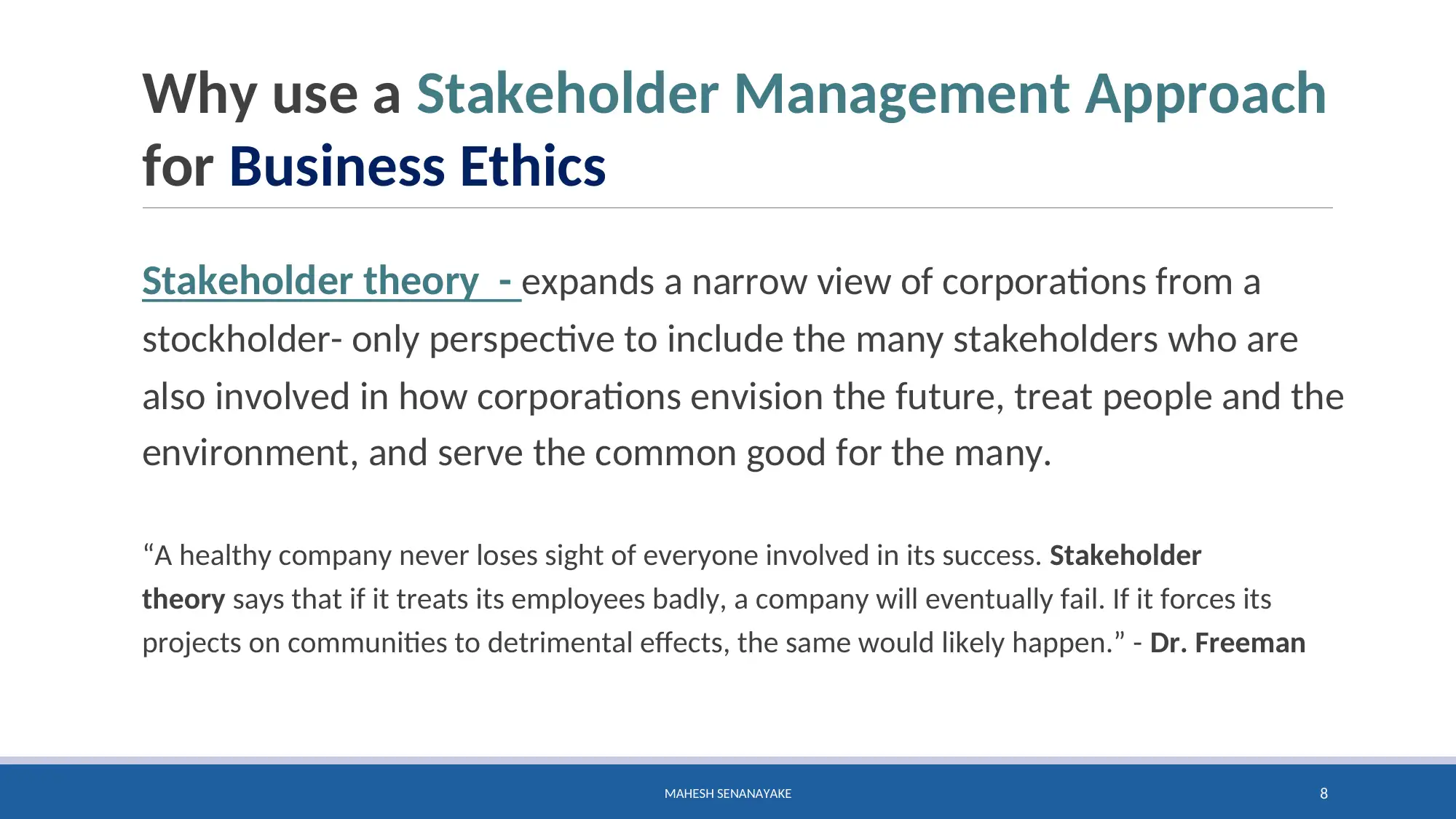
Why use a Stakeholder Management Approach
for Business Ethics
Stakeholder theory - expands a narrow view of corporations from a
stockholder- only perspective to include the many stakeholders who are
also involved in how corporations envision the future, treat people and the
environment, and serve the common good for the many.
“A healthy company never loses sight of everyone involved in its success. Stakeholder
theory says that if it treats its employees badly, a company will eventually fail. If it forces its
projects on communities to detrimental effects, the same would likely happen.” - Dr. Freeman
MAHESH SENANAYAKE 8
for Business Ethics
Stakeholder theory - expands a narrow view of corporations from a
stockholder- only perspective to include the many stakeholders who are
also involved in how corporations envision the future, treat people and the
environment, and serve the common good for the many.
“A healthy company never loses sight of everyone involved in its success. Stakeholder
theory says that if it treats its employees badly, a company will eventually fail. If it forces its
projects on communities to detrimental effects, the same would likely happen.” - Dr. Freeman
MAHESH SENANAYAKE 8

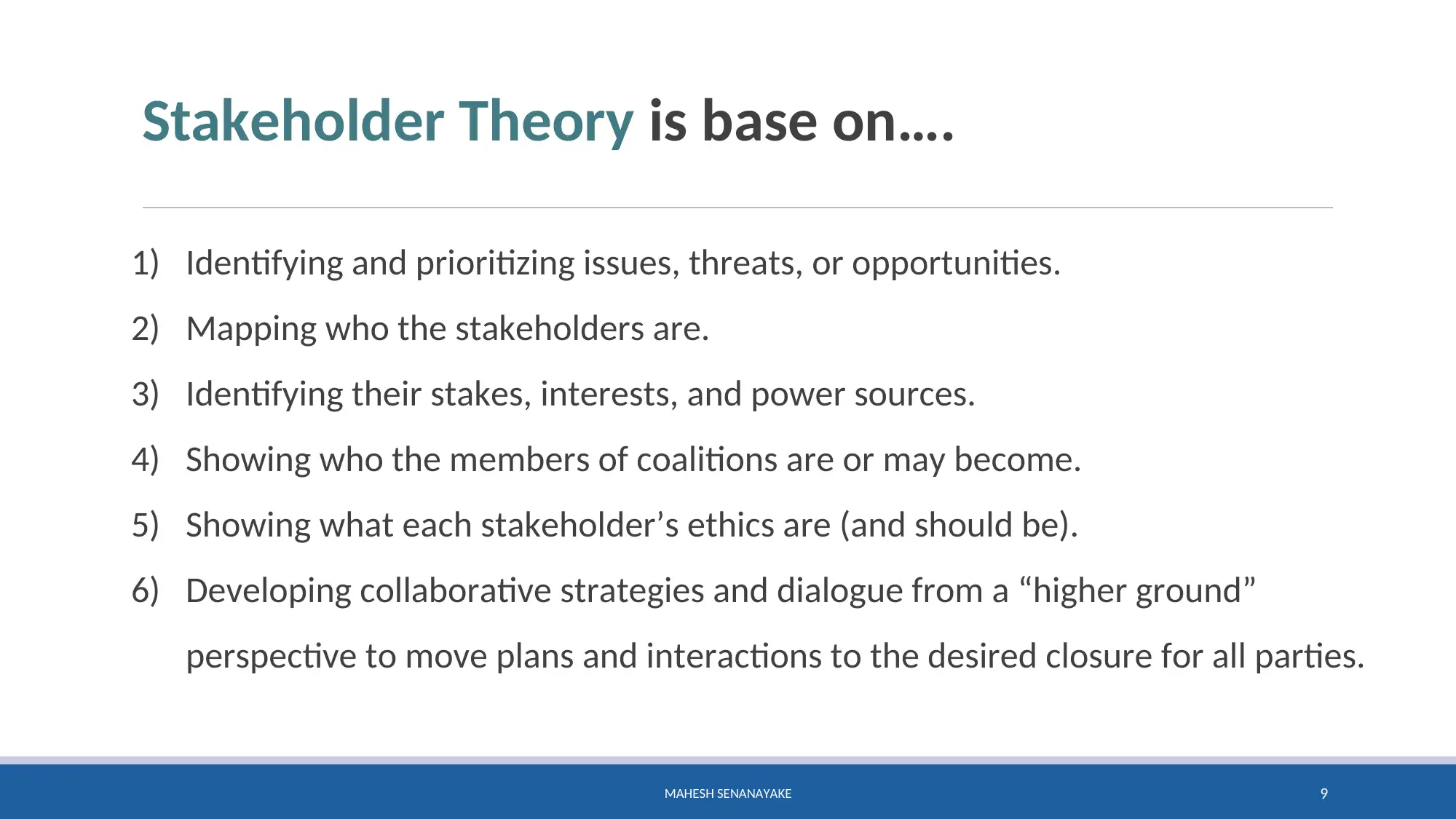
Stakeholder Theory is base on….
1) Identifying and prioritizing issues, threats, or opportunities.
2) Mapping who the stakeholders are.
3) Identifying their stakes, interests, and power sources.
4) Showing who the members of coalitions are or may become.
5) Showing what each stakeholder’s ethics are (and should be).
6) Developing collaborative strategies and dialogue from a “higher ground”
perspective to move plans and interactions to the desired closure for all parties.
MAHESH SENANAYAKE 9
1) Identifying and prioritizing issues, threats, or opportunities.
2) Mapping who the stakeholders are.
3) Identifying their stakes, interests, and power sources.
4) Showing who the members of coalitions are or may become.
5) Showing what each stakeholder’s ethics are (and should be).
6) Developing collaborative strategies and dialogue from a “higher ground”
perspective to move plans and interactions to the desired closure for all parties.
MAHESH SENANAYAKE 9
⊘ This is a preview!⊘
Do you want full access?
Subscribe today to unlock all pages.

Trusted by 1+ million students worldwide

Stake holders theory replaces…..
Concept of ;
Mangers have a “duty” towards to Stockholders with Mangers have
a “fiduciary” relationship to Stakeholders.
Does This happen in Sri Lanka ?
DO Mangers have a say in how business are run ?
MAHESH SENANAYAKE 10
Concept of ;
Mangers have a “duty” towards to Stockholders with Mangers have
a “fiduciary” relationship to Stakeholders.
Does This happen in Sri Lanka ?
DO Mangers have a say in how business are run ?
MAHESH SENANAYAKE 10
Paraphrase This Document
Need a fresh take? Get an instant paraphrase of this document with our AI Paraphraser

Stakeholder Management
Stakeholder Management is based on
“ Ethical principles (trust, trustworthiness, and cooperativeness) that can result
in significant competitive advantage through stakeholder relationship
management.”
The stakeholder management approach takes into account…..
Nonmarket forces that affect organizations and individuals, such as moral,
political, legal and technological interests, as well as economic factors.
a) It maintain the relationship with stakeholders
b) Create positive relationships
c) Should be based on moral and ethical grounds
MAHESH SENANAYAKE 11
Stakeholder Management is based on
“ Ethical principles (trust, trustworthiness, and cooperativeness) that can result
in significant competitive advantage through stakeholder relationship
management.”
The stakeholder management approach takes into account…..
Nonmarket forces that affect organizations and individuals, such as moral,
political, legal and technological interests, as well as economic factors.
a) It maintain the relationship with stakeholders
b) Create positive relationships
c) Should be based on moral and ethical grounds
MAHESH SENANAYAKE 11

Stakeholder Analysis
MAHESH SENANAYAKE 12
Stake holder management enables researchers and practitioners to use analytical
concepts and methods for identifying, mapping, and evaluating corporate strategy
with stakeholders.
We refer to the use of this ‘instrumental approach’ in stakeholder theory as
“stakeholder analysis.”
THIS IS AIMED AT CREATING WIN WIN SCENARIOS FOR ALL STAKEHOLDERS
“win– win” means making moral decisions that benefit the common good of all
constituencies within the constraints of justice, fairness and economic interests.
Unfortunately, this does not always happen.
MAHESH SENANAYAKE 12
Stake holder management enables researchers and practitioners to use analytical
concepts and methods for identifying, mapping, and evaluating corporate strategy
with stakeholders.
We refer to the use of this ‘instrumental approach’ in stakeholder theory as
“stakeholder analysis.”
THIS IS AIMED AT CREATING WIN WIN SCENARIOS FOR ALL STAKEHOLDERS
“win– win” means making moral decisions that benefit the common good of all
constituencies within the constraints of justice, fairness and economic interests.
Unfortunately, this does not always happen.
⊘ This is a preview!⊘
Do you want full access?
Subscribe today to unlock all pages.

Trusted by 1+ million students worldwide
1 out of 20
Related Documents
Your All-in-One AI-Powered Toolkit for Academic Success.
+13062052269
info@desklib.com
Available 24*7 on WhatsApp / Email
Unlock your academic potential
Copyright © 2020–2026 A2Z Services. All Rights Reserved. Developed and managed by ZUCOL.