Business Statistics Report on Student Motivation at Sun Way University

Verified

Added on  2023/06/10

|7
|946
|438
Report
AI Summary
This report presents a business statistics analysis of student motivation in the context of Sun Way University. The study employs close-ended questionnaires to gather data from 30 respondents, focusing on demographics, studying habits, and the Academic Motivation Scale (AMS). The methodology includes various statistical techniques like histograms, pie charts, and bar charts to analyze the collected data. The report investigates the relationship between motivation and academic performance, addressing whether intelligence or motivation is more crucial for learning, referencing the Self-Determination Theory and AMS. Findings include interpretations of age distribution, gender, race, nationality, faculty/centre, and course distributions. Statistical tests like one-sample t-tests are used to determine if the average age of undergraduate students differs significantly from 21 years old. The report aims to provide insights into the motivation trends among Sun Way University students, relevant to Psychometrics and educators. The report also includes the questionnaire used for the study and relevant references.
Document Page
Business Statistics
Student Name
Institution
Date of Submission
tabler-icon-diamond-filled.svg

Paraphrase This Document

Need a fresh take? Get an instant paraphrase of this document with our AI Paraphraser
Document Page
INTRODUCTION
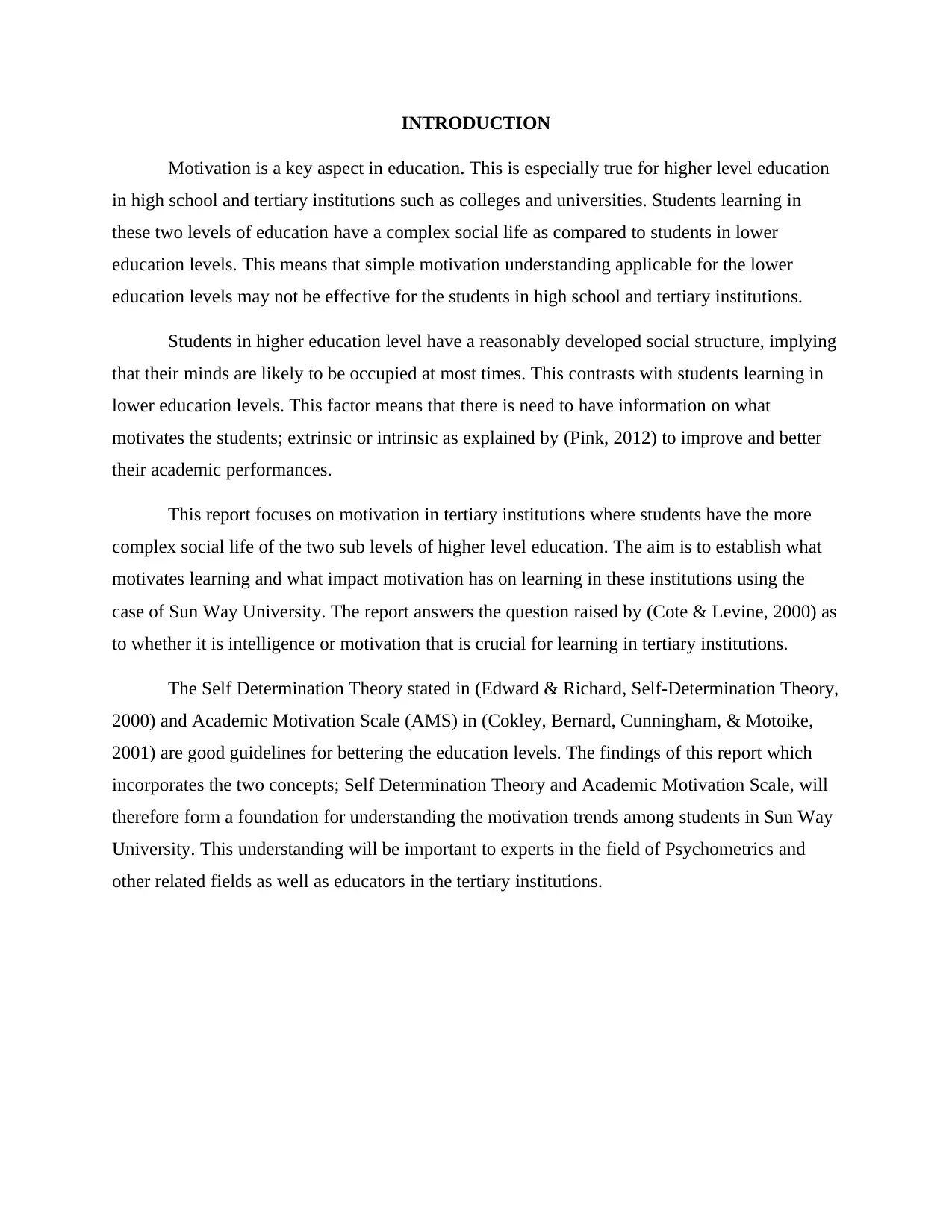
Motivation is a key aspect in education. This is especially true for higher level education
in high school and tertiary institutions such as colleges and universities. Students learning in
these two levels of education have a complex social life as compared to students in lower
education levels. This means that simple motivation understanding applicable for the lower
education levels may not be effective for the students in high school and tertiary institutions.
Students in higher education level have a reasonably developed social structure, implying
that their minds are likely to be occupied at most times. This contrasts with students learning in
lower education levels. This factor means that there is need to have information on what
motivates the students; extrinsic or intrinsic as explained by (Pink, 2012) to improve and better
their academic performances.
This report focuses on motivation in tertiary institutions where students have the more
complex social life of the two sub levels of higher level education. The aim is to establish what
motivates learning and what impact motivation has on learning in these institutions using the
case of Sun Way University. The report answers the question raised by (Cote & Levine, 2000) as
to whether it is intelligence or motivation that is crucial for learning in tertiary institutions.
The Self Determination Theory stated in (Edward & Richard, Self-Determination Theory,
2000) and Academic Motivation Scale (AMS) in (Cokley, Bernard, Cunningham, & Motoike,
2001) are good guidelines for bettering the education levels. The findings of this report which
incorporates the two concepts; Self Determination Theory and Academic Motivation Scale, will
therefore form a foundation for understanding the motivation trends among students in Sun Way
University. This understanding will be important to experts in the field of Psychometrics and
other related fields as well as educators in the tertiary institutions.
Document Page
METHODOLOGY
The data used for analysis in this report was collected using close ended questionnaires. The
close ended questionnaire types made the data collection period shorter and the collection
process more comfortable for the respondents. Data was recorded from a total of 30 respondents
on the variables below:
Race
Gender
Age
Nationality
School/Faculty/Centre
Course
Studying Hours
Academic Motivation Scale
The first six variables were captured in part A (Demography) of the questionnaire with the
final two variables being captured in part B (Survey Questions).
The variables in part A will help in contextualizing the motivation among students based on
aspects represented by the eight variables. This is an added advantage to finding the motivation
trend for Sun Way University plus the various population subsets available.
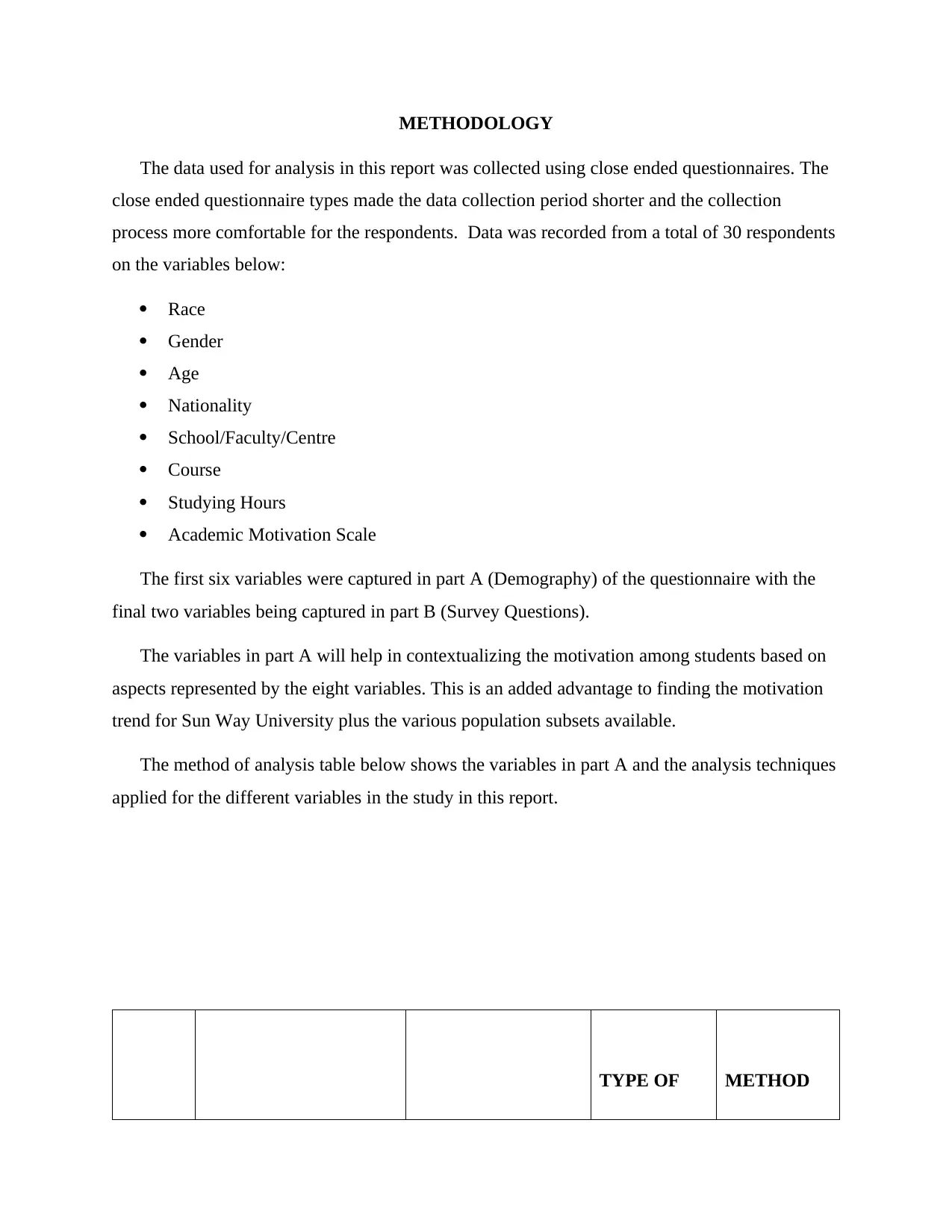
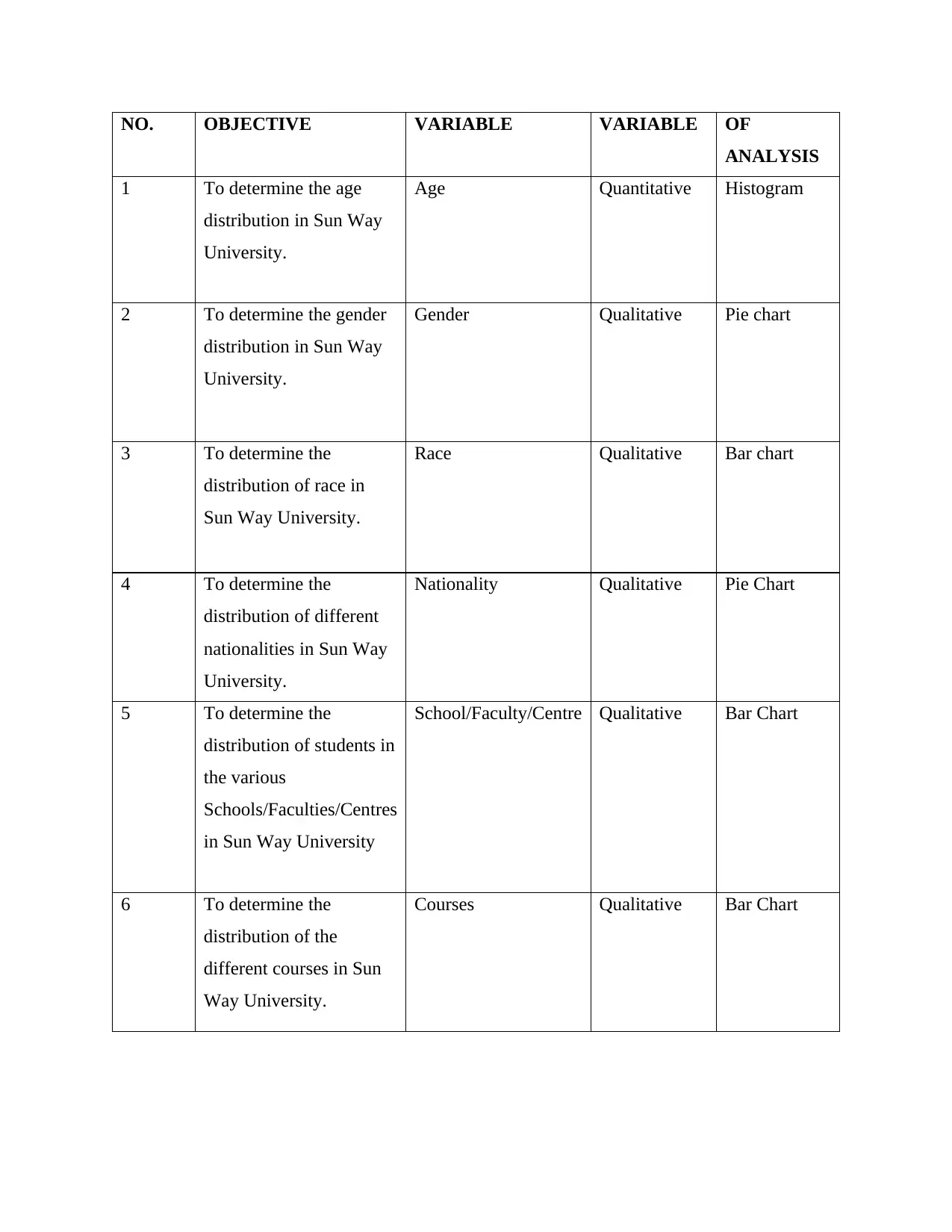
The method of analysis table below shows the variables in part A and the analysis techniques
applied for the different variables in the study in this report.
TYPE OF METHOD
Document Page
NO. OBJECTIVE VARIABLE VARIABLE OF
ANALYSIS
1 To determine the age
distribution in Sun Way
University.
Age Quantitative Histogram
2 To determine the gender
distribution in Sun Way
University.
Gender Qualitative Pie chart
3 To determine the
distribution of race in
Sun Way University.
Race Qualitative Bar chart
4 To determine the
distribution of different
nationalities in Sun Way
University.
Nationality Qualitative Pie Chart
5 To determine the
distribution of students in
the various
Schools/Faculties/Centres
in Sun Way University
School/Faculty/Centre Qualitative Bar Chart
6 To determine the
distribution of the
different courses in Sun
Way University.
Courses Qualitative Bar Chart
tabler-icon-diamond-filled.svg

Paraphrase This Document

Need a fresh take? Get an instant paraphrase of this document with our AI Paraphraser
Document Page
The studying hours variables was recorded in two ways;
Average number of hours spent studying daily.
Average number of hours spent studying weekly.
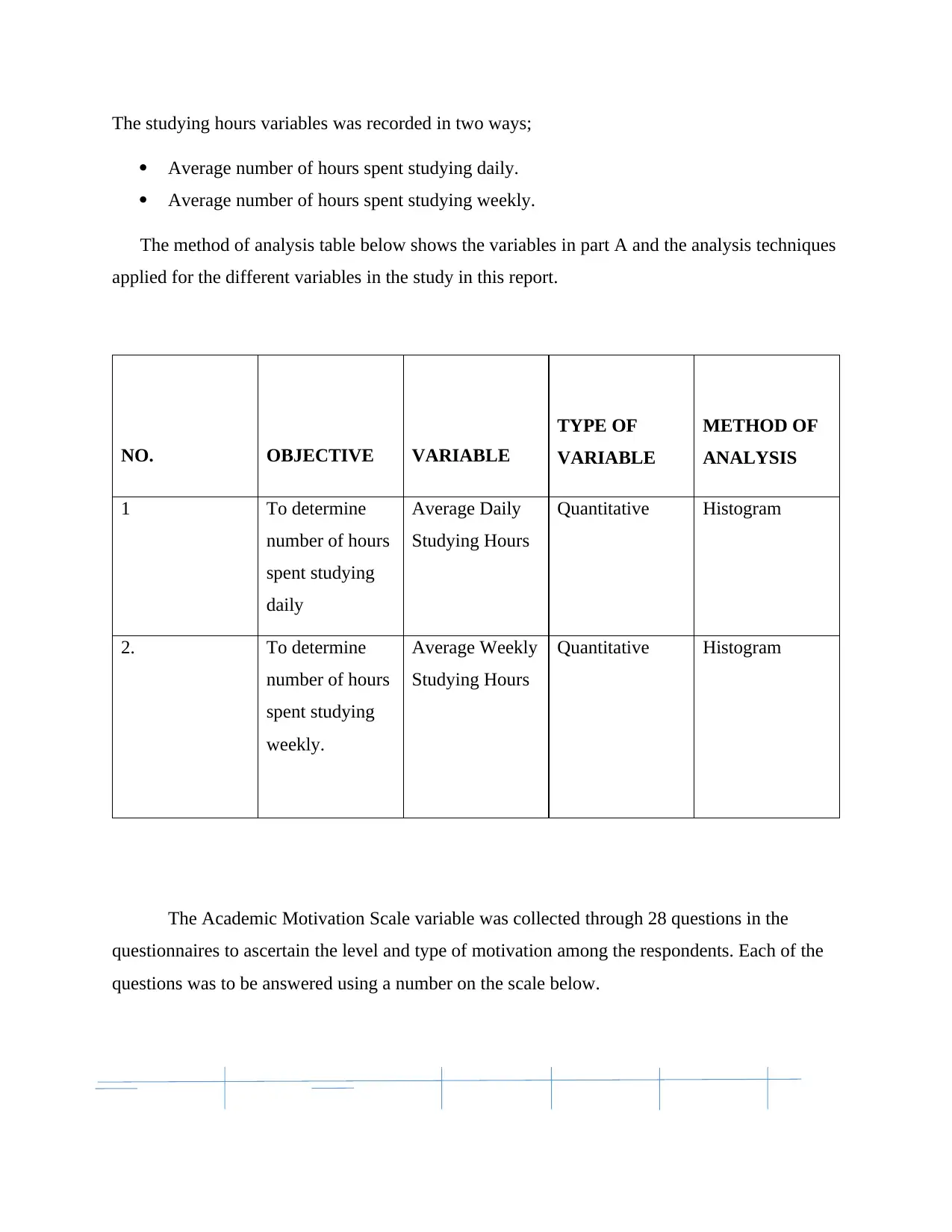
The method of analysis table below shows the variables in part A and the analysis techniques
applied for the different variables in the study in this report.
NO. OBJECTIVE VARIABLE
TYPE OF
VARIABLE
METHOD OF
ANALYSIS
1 To determine
number of hours
spent studying
daily
Average Daily
Studying Hours
Quantitative Histogram
2. To determine
number of hours
spent studying
weekly.
Average Weekly
Studying Hours
Quantitative Histogram
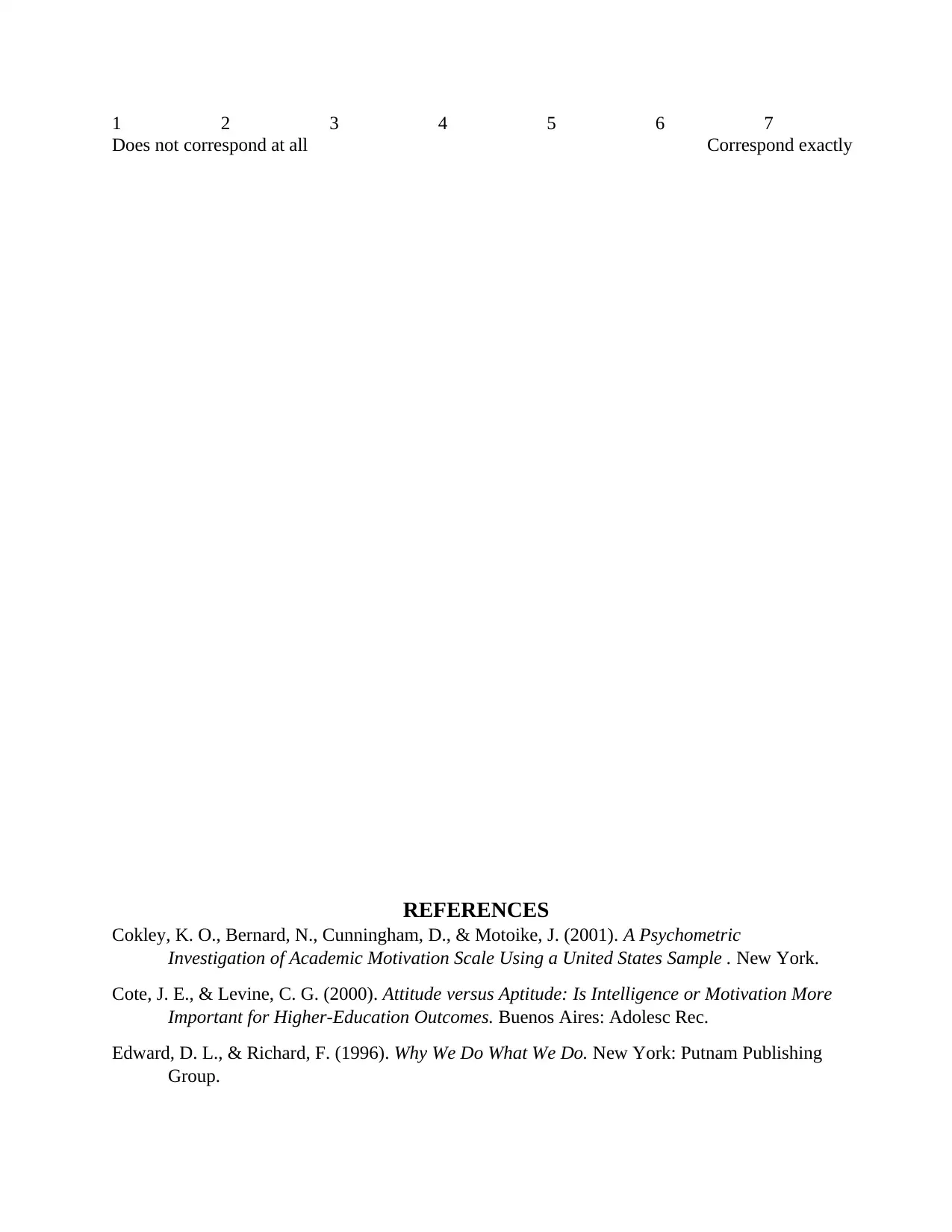
The Academic Motivation Scale variable was collected through 28 questions in the
questionnaires to ascertain the level and type of motivation among the respondents. Each of the
questions was to be answered using a number on the scale below.
Document Page
1 2 3 4 5 6 7
Does not correspond at all Correspond exactly
REFERENCES
Cokley, K. O., Bernard, N., Cunningham, D., & Motoike, J. (2001). A Psychometric
Investigation of Academic Motivation Scale Using a United States Sample . New York.
Cote, J. E., & Levine, C. G. (2000). Attitude versus Aptitude: Is Intelligence or Motivation More
Important for Higher-Education Outcomes. Buenos Aires: Adolesc Rec.
Edward, D. L., & Richard, F. (1996). Why We Do What We Do. New York: Putnam Publishing
Group.
Document Page
Edward, D. L., & Richard, R. M. (2000). Self-Determination Theory. New York.
Gagne, M. (2014). Oxford Handbook of Work Engagement, Motivation & Determination
Theory. Oxford: Oxford Library of Psycology.
Pink, D. (2012). Drive: The Suprising Truth About What Motivates Us. New York: New York
Times.
chevron_up_icon
1 out of 7
circle_padding
hide_on_mobile
zoom_out_icon
[object Object]