Business Strategies Assignment: Chapters 7 & 8 Analysis

Verified

Added on  2022/11/28

|9
|1607
|103
Homework Assignment
AI Summary
This assignment solution analyzes key business strategies, including standardization and format wars, and explores the global environment and market entry. It defines standardization and format wars, detailing how standardization can lead to format wars and who benefits. The solution also examines the advantages of first and second movers in a market. Furthermore, it delves into why companies globalize, various entry modes like exporting, franchising, and joint ventures, and the role of economies of scale in global expansion. The assignment also outlines different global strategies, such as global standardization and localization, and discusses the resources and competencies required for specific entry modes, offering a detailed overview of strategic business principles and their practical applications in a global context.
Document Page
Running head: BUSINESS STRATEGIES
Business Strategies & Management Principles
Name:
Institution:
Date:
.
tabler-icon-diamond-filled.svg

Paraphrase This Document

Need a fresh take? Get an instant paraphrase of this document with our AI Paraphraser
Document Page
BUSINESS STRATEGIES
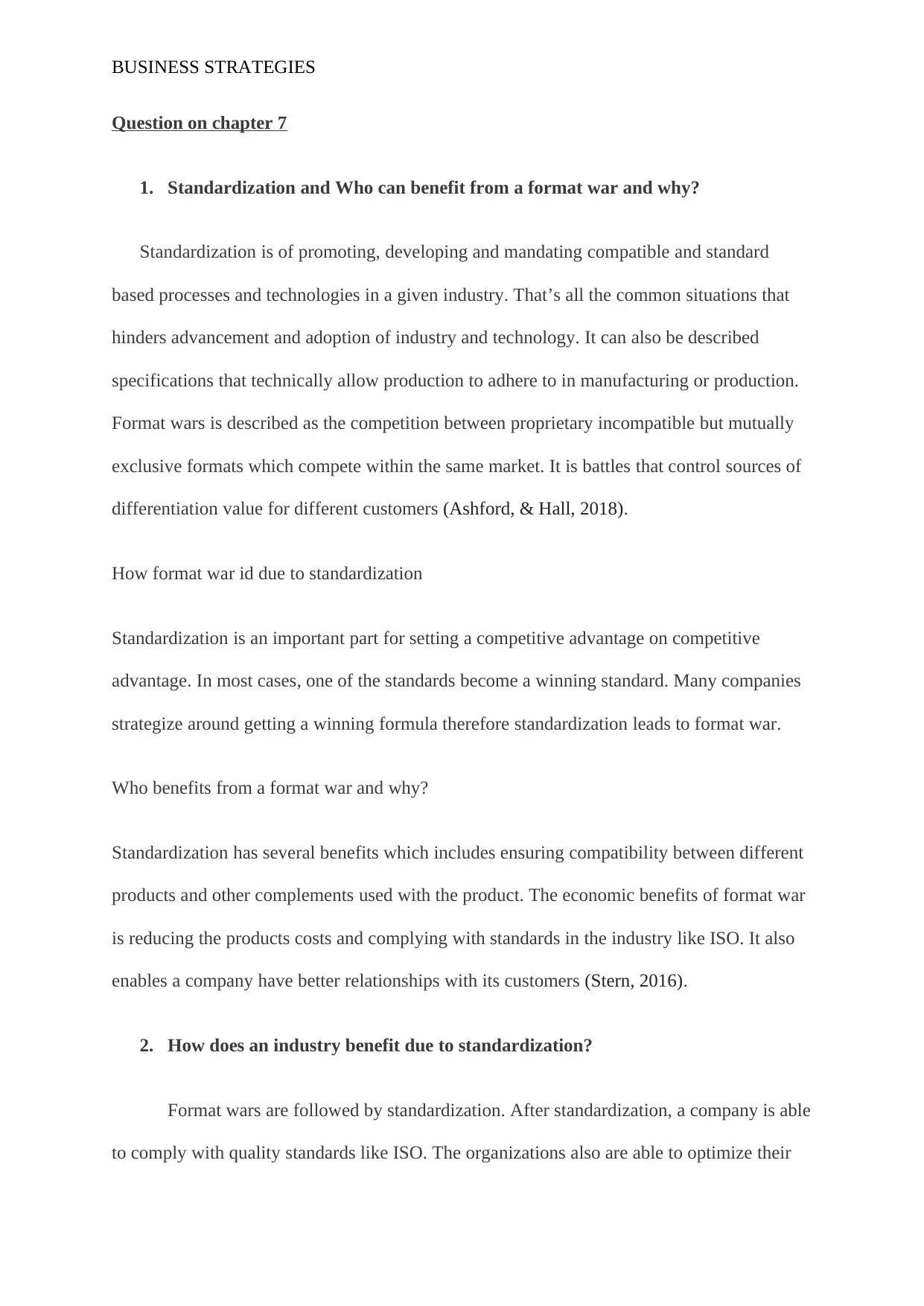
Question on chapter 7
1. Standardization and Who can benefit from a format war and why?
Standardization is of promoting, developing and mandating compatible and standard
based processes and technologies in a given industry. That’s all the common situations that
hinders advancement and adoption of industry and technology. It can also be described
specifications that technically allow production to adhere to in manufacturing or production.
Format wars is described as the competition between proprietary incompatible but mutually
exclusive formats which compete within the same market. It is battles that control sources of
differentiation value for different customers (Ashford, & Hall, 2018).
How format war id due to standardization
Standardization is an important part for setting a competitive advantage on competitive
advantage. In most cases, one of the standards become a winning standard. Many companies
strategize around getting a winning formula therefore standardization leads to format war.
Who benefits from a format war and why?
Standardization has several benefits which includes ensuring compatibility between different
products and other complements used with the product. The economic benefits of format war
is reducing the products costs and complying with standards in the industry like ISO. It also
enables a company have better relationships with its customers (Stern, 2016).
2. How does an industry benefit due to standardization?
Format wars are followed by standardization. After standardization, a company is able
to comply with quality standards like ISO. The organizations also are able to optimize their
Document Page
BUSINESS STRATEGIES
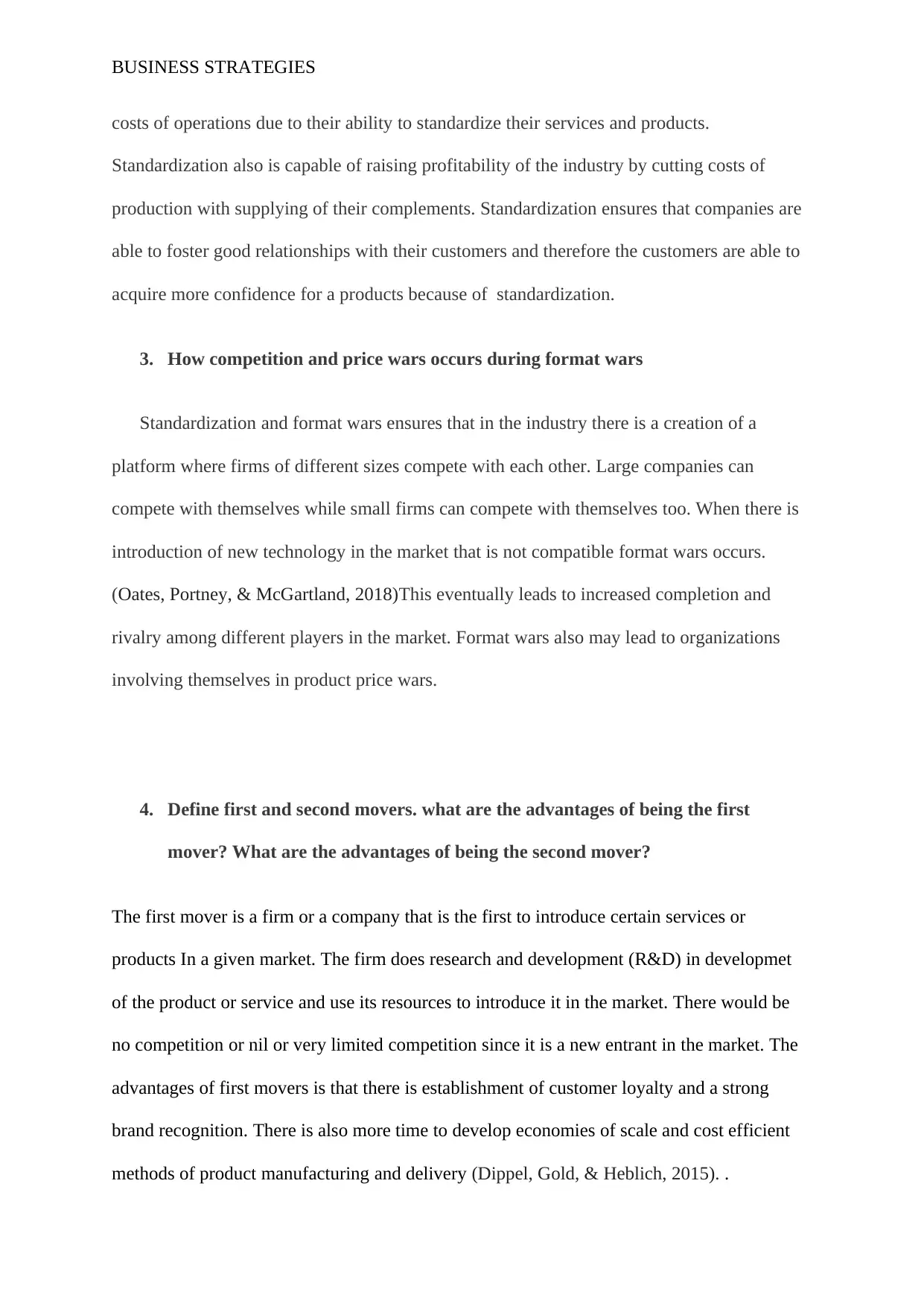
costs of operations due to their ability to standardize their services and products.
Standardization also is capable of raising profitability of the industry by cutting costs of
production with supplying of their complements. Standardization ensures that companies are
able to foster good relationships with their customers and therefore the customers are able to
acquire more confidence for a products because of standardization.
3. How competition and price wars occurs during format wars
Standardization and format wars ensures that in the industry there is a creation of a
platform where firms of different sizes compete with each other. Large companies can
compete with themselves while small firms can compete with themselves too. When there is
introduction of new technology in the market that is not compatible format wars occurs.
(Oates, Portney, & McGartland, 2018)This eventually leads to increased completion and
rivalry among different players in the market. Format wars also may lead to organizations
involving themselves in product price wars.
4. Define first and second movers. what are the advantages of being the first
mover? What are the advantages of being the second mover?
The first mover is a firm or a company that is the first to introduce certain services or
products In a given market. The firm does research and development (R&D) in developmet
of the product or service and use its resources to introduce it in the market. There would be
no competition or nil or very limited competition since it is a new entrant in the market. The
advantages of first movers is that there is establishment of customer loyalty and a strong
brand recognition. There is also more time to develop economies of scale and cost efficient
methods of product manufacturing and delivery (Dippel, Gold, & Heblich, 2015). .
Document Page
BUSINESS STRATEGIES
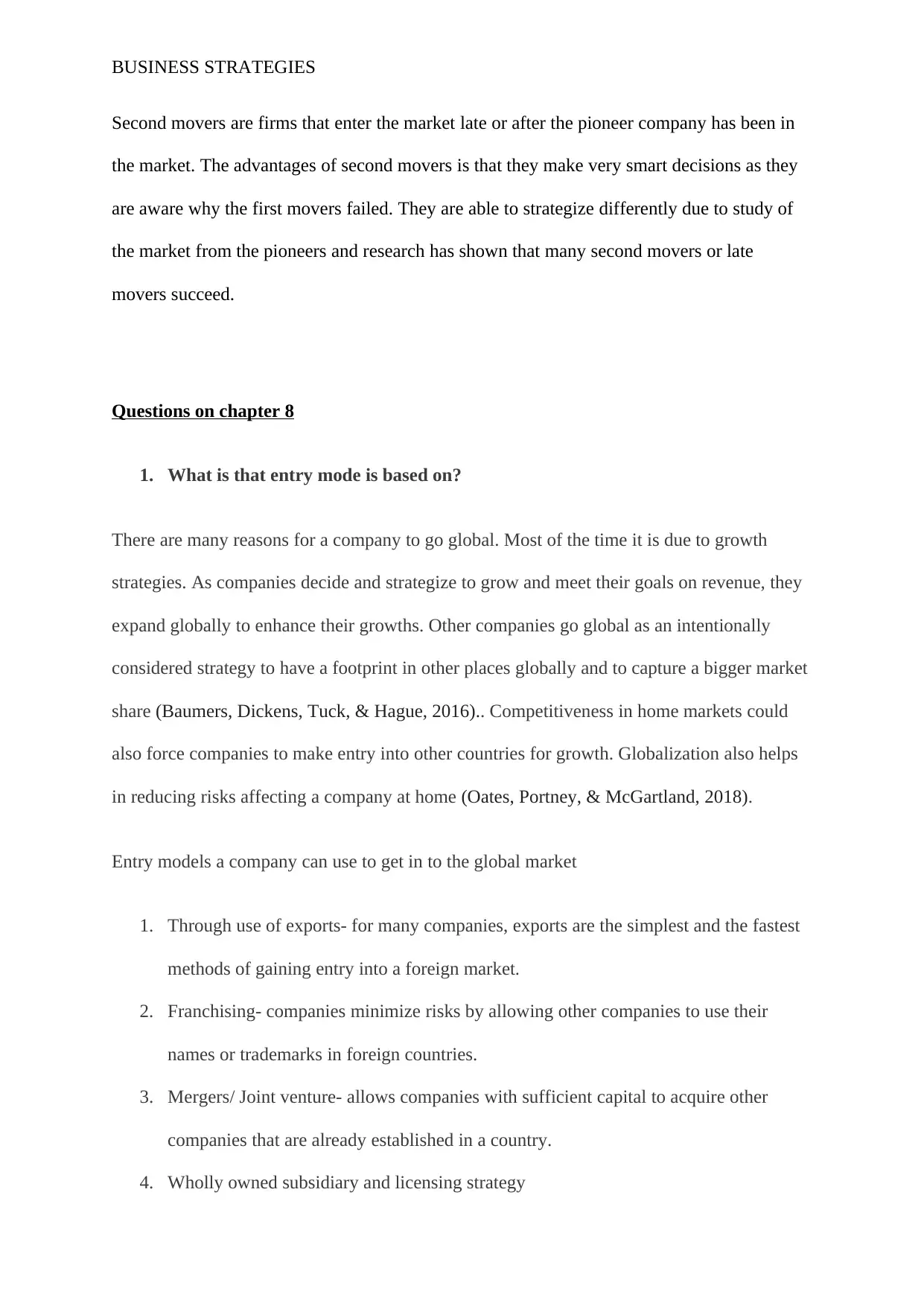
Second movers are firms that enter the market late or after the pioneer company has been in
the market. The advantages of second movers is that they make very smart decisions as they
are aware why the first movers failed. They are able to strategize differently due to study of
the market from the pioneers and research has shown that many second movers or late
movers succeed.
Questions on chapter 8
1. What is that entry mode is based on?
There are many reasons for a company to go global. Most of the time it is due to growth
strategies. As companies decide and strategize to grow and meet their goals on revenue, they
expand globally to enhance their growths. Other companies go global as an intentionally
considered strategy to have a footprint in other places globally and to capture a bigger market
share (Baumers, Dickens, Tuck, & Hague, 2016).. Competitiveness in home markets could
also force companies to make entry into other countries for growth. Globalization also helps
in reducing risks affecting a company at home (Oates, Portney, & McGartland, 2018).
Entry models a company can use to get in to the global market
1. Through use of exports- for many companies, exports are the simplest and the fastest
methods of gaining entry into a foreign market.
2. Franchising- companies minimize risks by allowing other companies to use their
names or trademarks in foreign countries.
3. Mergers/ Joint venture- allows companies with sufficient capital to acquire other
companies that are already established in a country.
4. Wholly owned subsidiary and licensing strategy
tabler-icon-diamond-filled.svg

Paraphrase This Document

Need a fresh take? Get an instant paraphrase of this document with our AI Paraphraser
Document Page
BUSINESS STRATEGIES
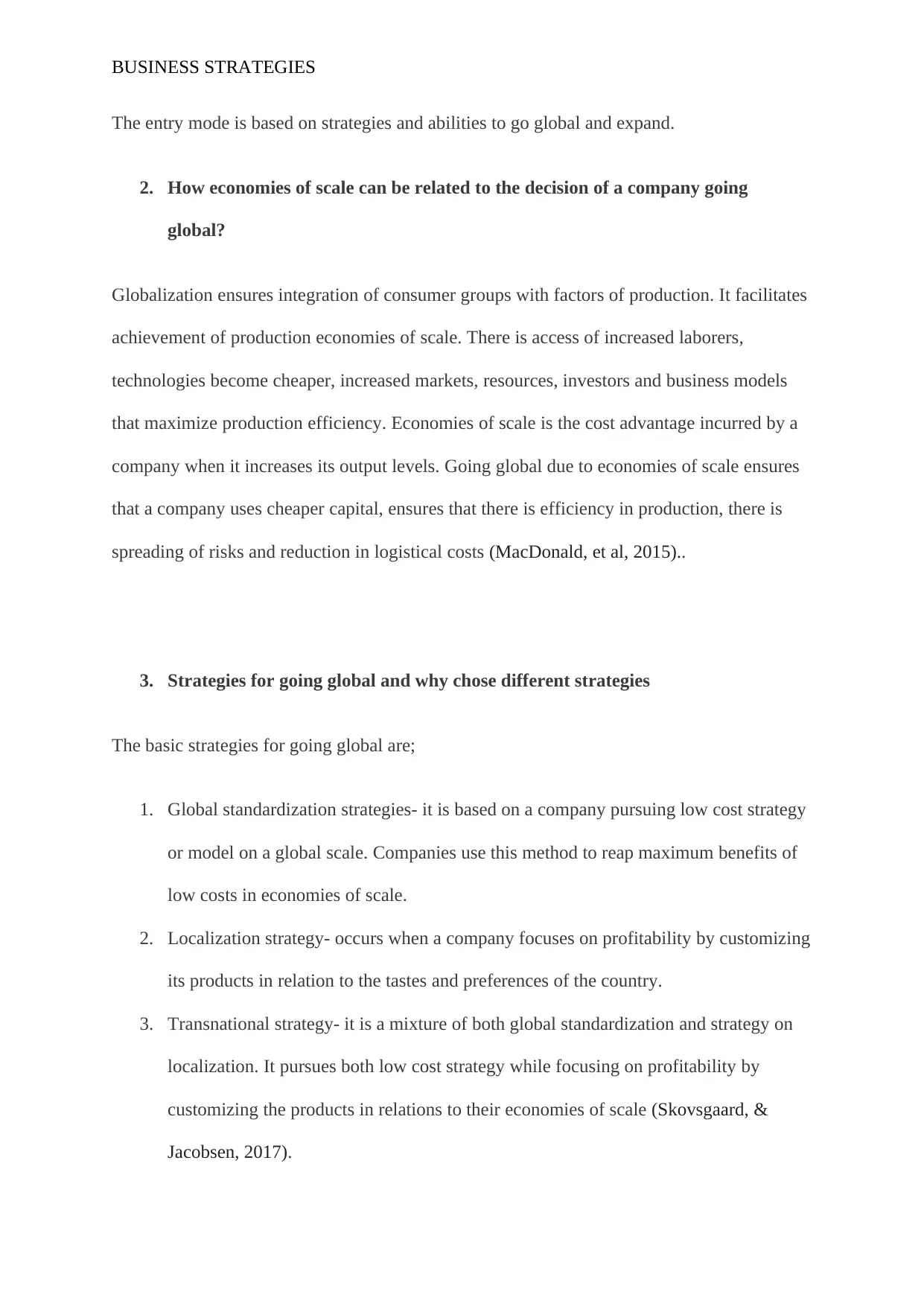
The entry mode is based on strategies and abilities to go global and expand.
2. How economies of scale can be related to the decision of a company going
global?
Globalization ensures integration of consumer groups with factors of production. It facilitates
achievement of production economies of scale. There is access of increased laborers,
technologies become cheaper, increased markets, resources, investors and business models
that maximize production efficiency. Economies of scale is the cost advantage incurred by a
company when it increases its output levels. Going global due to economies of scale ensures
that a company uses cheaper capital, ensures that there is efficiency in production, there is
spreading of risks and reduction in logistical costs (MacDonald, et al, 2015)..
3. Strategies for going global and why chose different strategies
The basic strategies for going global are;
1. Global standardization strategies- it is based on a company pursuing low cost strategy
or model on a global scale. Companies use this method to reap maximum benefits of
low costs in economies of scale.
2. Localization strategy- occurs when a company focuses on profitability by customizing
its products in relation to the tastes and preferences of the country.
3. Transnational strategy- it is a mixture of both global standardization and strategy on
localization. It pursues both low cost strategy while focusing on profitability by
customizing the products in relations to their economies of scale (Skovsgaard, &
Jacobsen, 2017).
Document Page
BUSINESS STRATEGIES
4. International strategy- it occurs when a company establishes a marketing and
manufacturing function in each country they have entered to.
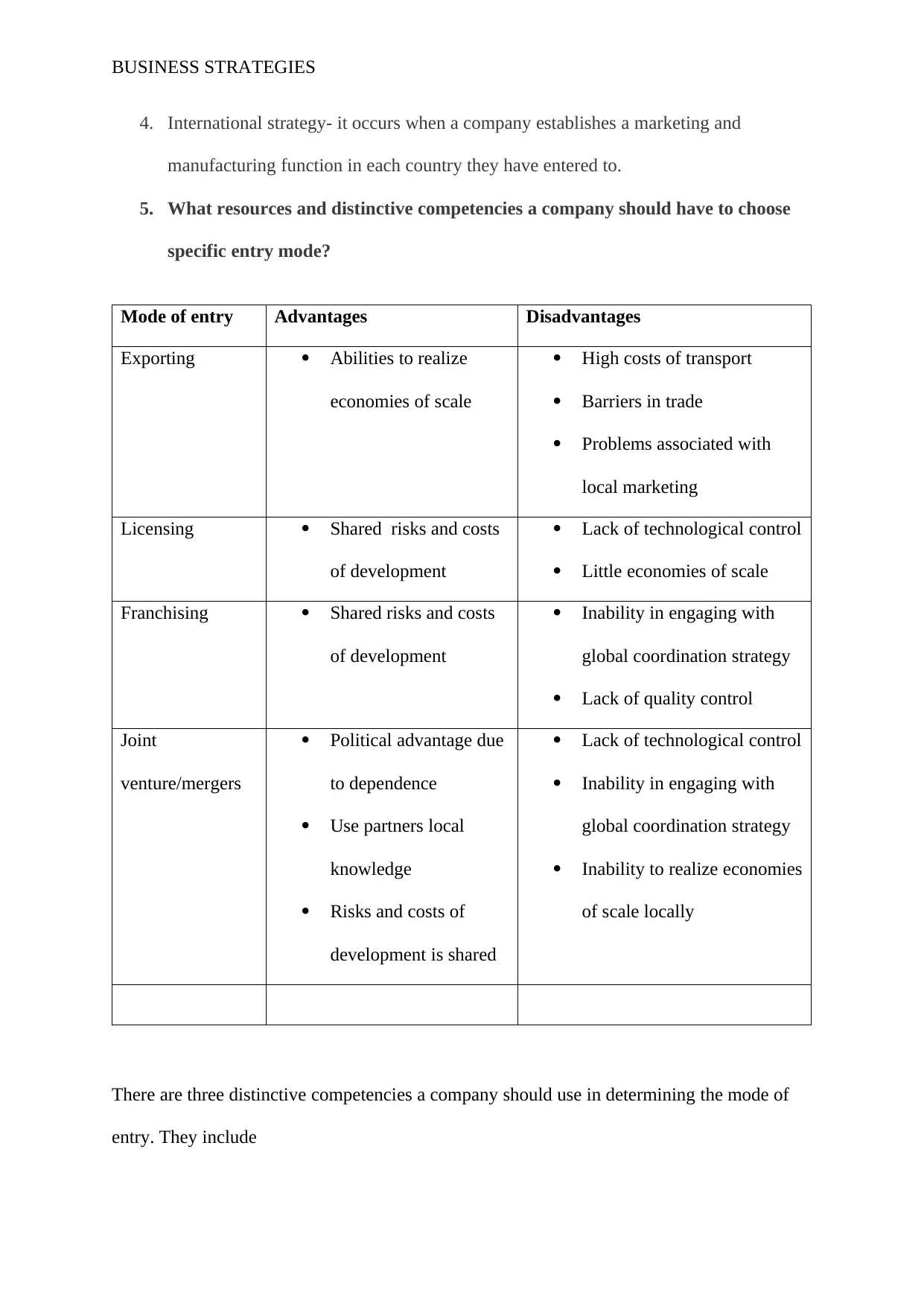
5. What resources and distinctive competencies a company should have to choose
specific entry mode?
Mode of entry Advantages Disadvantages
Exporting Abilities to realize
economies of scale
High costs of transport
Barriers in trade
Problems associated with
local marketing
Licensing Shared risks and costs
of development
Lack of technological control
Little economies of scale
Franchising Shared risks and costs
of development
Inability in engaging with
global coordination strategy
Lack of quality control
Joint
venture/mergers
Political advantage due
to dependence
Use partners local
knowledge
Risks and costs of
development is shared
Lack of technological control
Inability in engaging with
global coordination strategy
Inability to realize economies
of scale locally
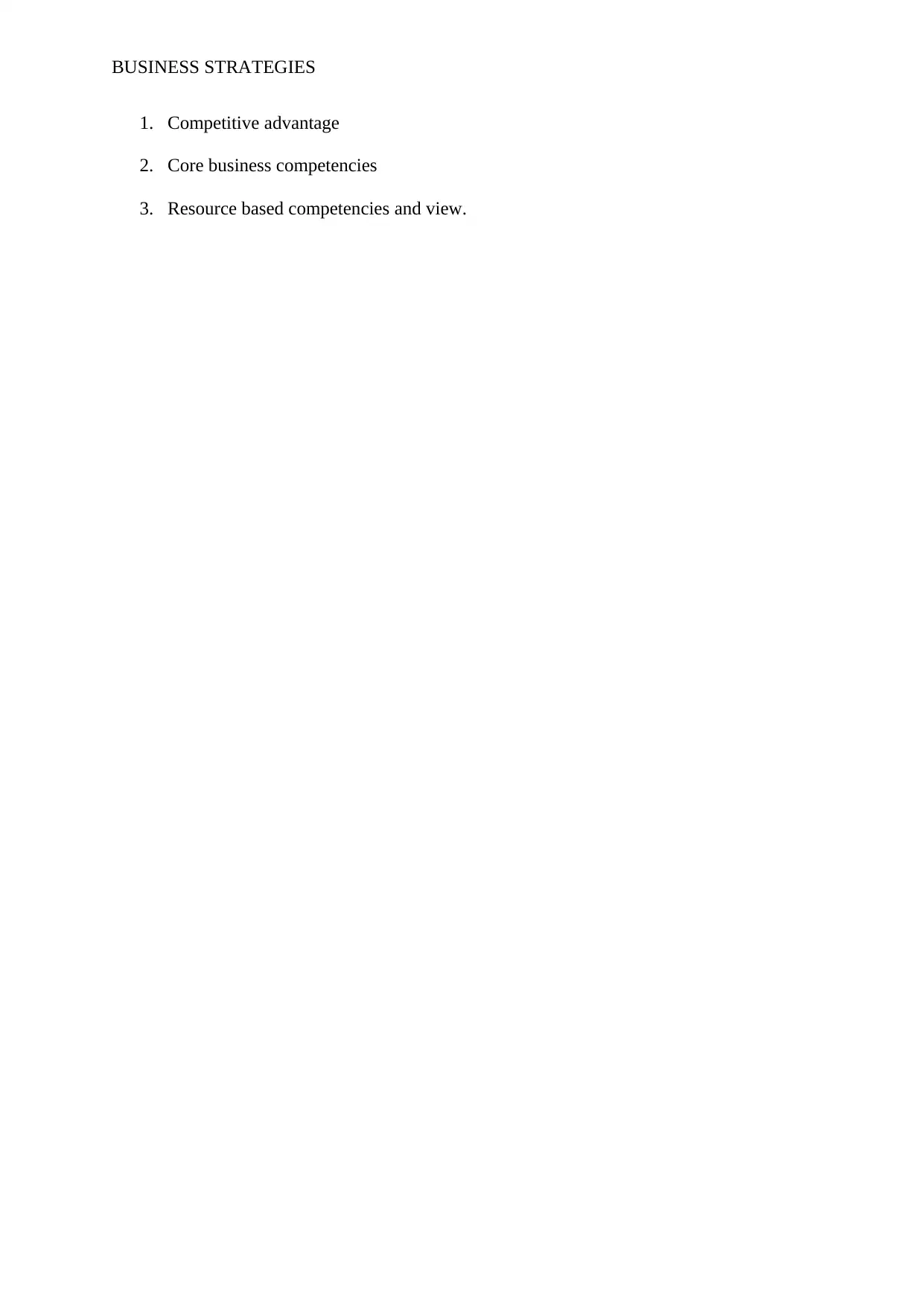
There are three distinctive competencies a company should use in determining the mode of
entry. They include
Document Page
BUSINESS STRATEGIES
1. Competitive advantage
2. Core business competencies
3. Resource based competencies and view.
tabler-icon-diamond-filled.svg

Paraphrase This Document

Need a fresh take? Get an instant paraphrase of this document with our AI Paraphraser
Document Page
BUSINESS STRATEGIES
References
Ashford, N. A., & Hall, R. P. (2018). Globalization: Technology, trade regimes, capital
flows, and the global financial system. In Technology, Globalization, and Sustainable
Development(pp. 264-333). Routledge.
Baumers, M., Dickens, P., Tuck, C., & Hague, R. (2016). The cost of additive manufacturing:
machine productivity, economies of scale and technology-push. Technological
forecasting and social change, 102, 193-201.
Dippel, C., Gold, R., & Heblich, S. (2015). Globalization and its (dis-) content: Trade shocks
and voting behavior (No. w21812). National Bureau of Economic Research.
MacDonald, G. K., Brauman, K. A., Sun, S., Carlson, K. M., Cassidy, E. S., Gerber, J. S., &
West, P. C. (2015). Rethinking agricultural trade relationships in an era of
globalization. BioScience, 65(3), 275-289.
Oates, W. E., Portney, P. R., & McGartland, A. M. (2018). The net benefits of incentive-
based regulation: a case study of environmental standard setting. The Theory and
Practice of Command and Control in Environmental Policy, 273-282.
Skovsgaard, L., & Jacobsen, H. K. (2017). Economies of scale in biogas production and the
significance of flexible regulation. Energy Policy, 101, 77-89.
Stern, N. (2016). Economics: current climate models are grossly misleading. Nature
News, 530(7591), 407.
Document Page
BUSINESS STRATEGIES
chevron_up_icon
1 out of 9
circle_padding
hide_on_mobile
zoom_out_icon
[object Object]