Business Strategy Report: Analysis and Recommendations for Sony
VerifiedAdded on 2020/01/28
|9
|2657
|56
Report
AI Summary
This report provides a comprehensive analysis of Sony's business strategy, focusing on market penetration and product development. It explores various strategic options, including substantive, limited, and retrenchment strategies, and recommends a combination of market penetration and product development for Sony. The report details the roles and responsibilities of different departments (finance, operations, and HR) in strategy implementation, along with resource requirements such as financial and human capital. It also outlines proposed targets for Sony, emphasizing the importance of specific, measurable, achievable, realistic, and time-bound (SMART) objectives. The conclusion highlights the need for continuous monitoring of the business environment and the effective utilization of resources for successful strategy implementation. The report is based on research, analysis and provides valuable insights into Sony's strategic approach.
BUSINESS STRATEGY

Paraphrase This Document
Need a fresh take? Get an instant paraphrase of this document with our AI Paraphraser
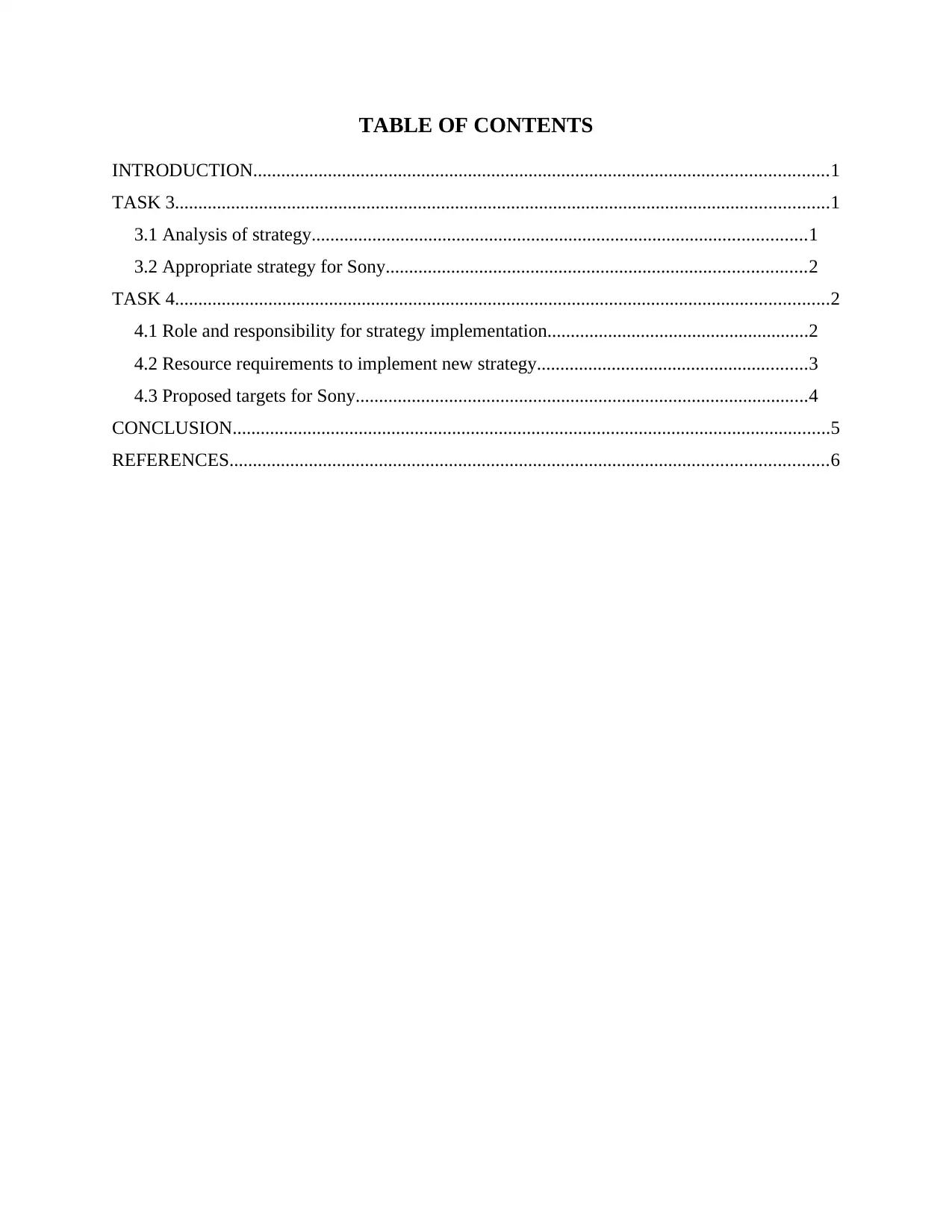
TABLE OF CONTENTS
INTRODUCTION...........................................................................................................................1
TASK 3............................................................................................................................................1
3.1 Analysis of strategy..........................................................................................................1
3.2 Appropriate strategy for Sony..........................................................................................2
TASK 4............................................................................................................................................2
4.1 Role and responsibility for strategy implementation........................................................2
4.2 Resource requirements to implement new strategy..........................................................3
4.3 Proposed targets for Sony.................................................................................................4
CONCLUSION................................................................................................................................5
REFERENCES................................................................................................................................6
INTRODUCTION...........................................................................................................................1
TASK 3............................................................................................................................................1
3.1 Analysis of strategy..........................................................................................................1
3.2 Appropriate strategy for Sony..........................................................................................2
TASK 4............................................................................................................................................2
4.1 Role and responsibility for strategy implementation........................................................2
4.2 Resource requirements to implement new strategy..........................................................3
4.3 Proposed targets for Sony.................................................................................................4
CONCLUSION................................................................................................................................5
REFERENCES................................................................................................................................6
INTRODUCTION
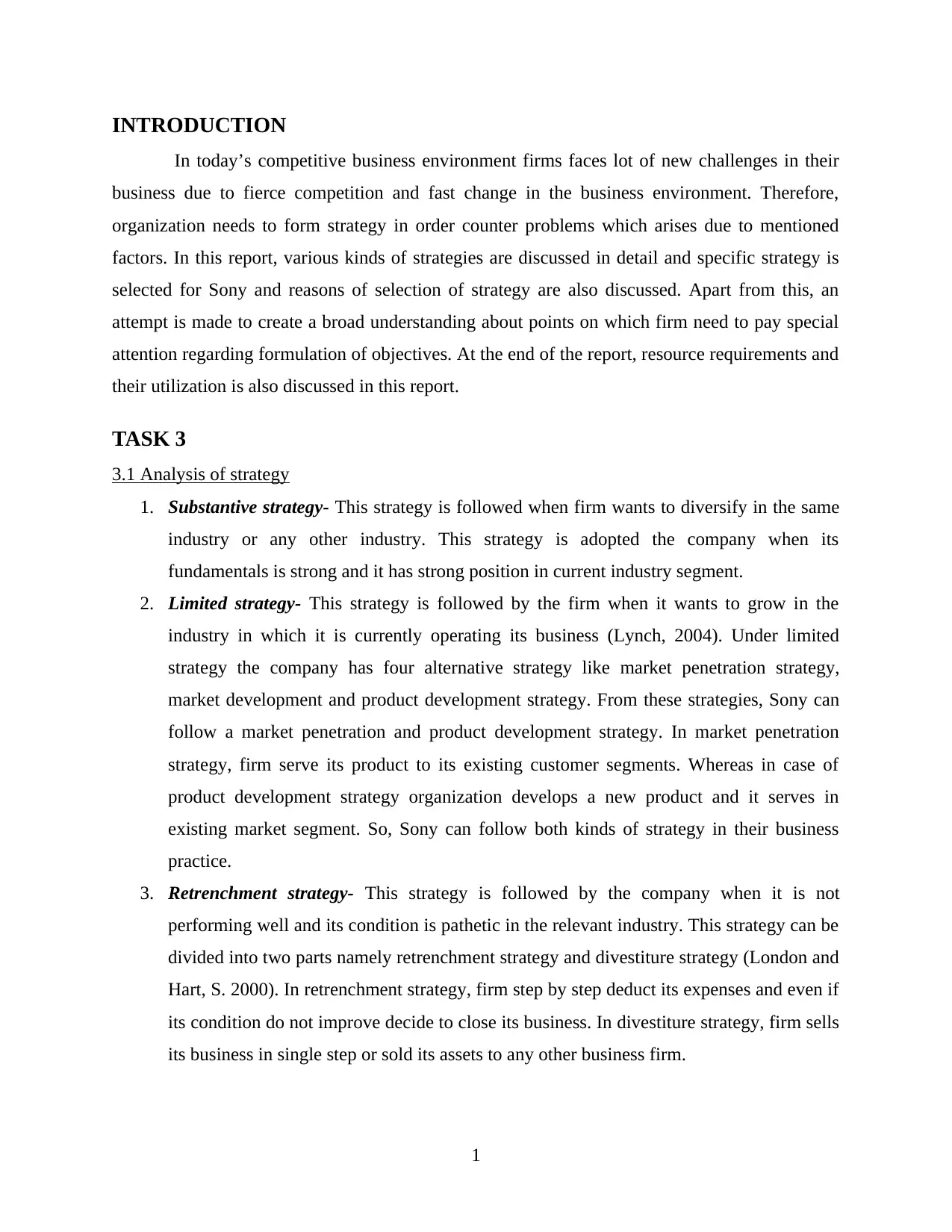
In today’s competitive business environment firms faces lot of new challenges in their
business due to fierce competition and fast change in the business environment. Therefore,
organization needs to form strategy in order counter problems which arises due to mentioned
factors. In this report, various kinds of strategies are discussed in detail and specific strategy is
selected for Sony and reasons of selection of strategy are also discussed. Apart from this, an
attempt is made to create a broad understanding about points on which firm need to pay special
attention regarding formulation of objectives. At the end of the report, resource requirements and
their utilization is also discussed in this report.
TASK 3
3.1 Analysis of strategy
1. Substantive strategy- This strategy is followed when firm wants to diversify in the same
industry or any other industry. This strategy is adopted the company when its
fundamentals is strong and it has strong position in current industry segment.
2. Limited strategy- This strategy is followed by the firm when it wants to grow in the
industry in which it is currently operating its business (Lynch, 2004). Under limited
strategy the company has four alternative strategy like market penetration strategy,
market development and product development strategy. From these strategies, Sony can
follow a market penetration and product development strategy. In market penetration
strategy, firm serve its product to its existing customer segments. Whereas in case of
product development strategy organization develops a new product and it serves in
existing market segment. So, Sony can follow both kinds of strategy in their business
practice.
3. Retrenchment strategy- This strategy is followed by the company when it is not
performing well and its condition is pathetic in the relevant industry. This strategy can be
divided into two parts namely retrenchment strategy and divestiture strategy (London and
Hart, S. 2000). In retrenchment strategy, firm step by step deduct its expenses and even if
its condition do not improve decide to close its business. In divestiture strategy, firm sells
its business in single step or sold its assets to any other business firm.
1
In today’s competitive business environment firms faces lot of new challenges in their
business due to fierce competition and fast change in the business environment. Therefore,
organization needs to form strategy in order counter problems which arises due to mentioned
factors. In this report, various kinds of strategies are discussed in detail and specific strategy is
selected for Sony and reasons of selection of strategy are also discussed. Apart from this, an
attempt is made to create a broad understanding about points on which firm need to pay special
attention regarding formulation of objectives. At the end of the report, resource requirements and
their utilization is also discussed in this report.
TASK 3
3.1 Analysis of strategy
1. Substantive strategy- This strategy is followed when firm wants to diversify in the same
industry or any other industry. This strategy is adopted the company when its
fundamentals is strong and it has strong position in current industry segment.
2. Limited strategy- This strategy is followed by the firm when it wants to grow in the
industry in which it is currently operating its business (Lynch, 2004). Under limited
strategy the company has four alternative strategy like market penetration strategy,
market development and product development strategy. From these strategies, Sony can
follow a market penetration and product development strategy. In market penetration
strategy, firm serve its product to its existing customer segments. Whereas in case of
product development strategy organization develops a new product and it serves in
existing market segment. So, Sony can follow both kinds of strategy in their business
practice.
3. Retrenchment strategy- This strategy is followed by the company when it is not
performing well and its condition is pathetic in the relevant industry. This strategy can be
divided into two parts namely retrenchment strategy and divestiture strategy (London and
Hart, S. 2000). In retrenchment strategy, firm step by step deduct its expenses and even if
its condition do not improve decide to close its business. In divestiture strategy, firm sells
its business in single step or sold its assets to any other business firm.
1
⊘ This is a preview!⊘
Do you want full access?
Subscribe today to unlock all pages.

Trusted by 1+ million students worldwide
3.2 Appropriate strategy for Sony
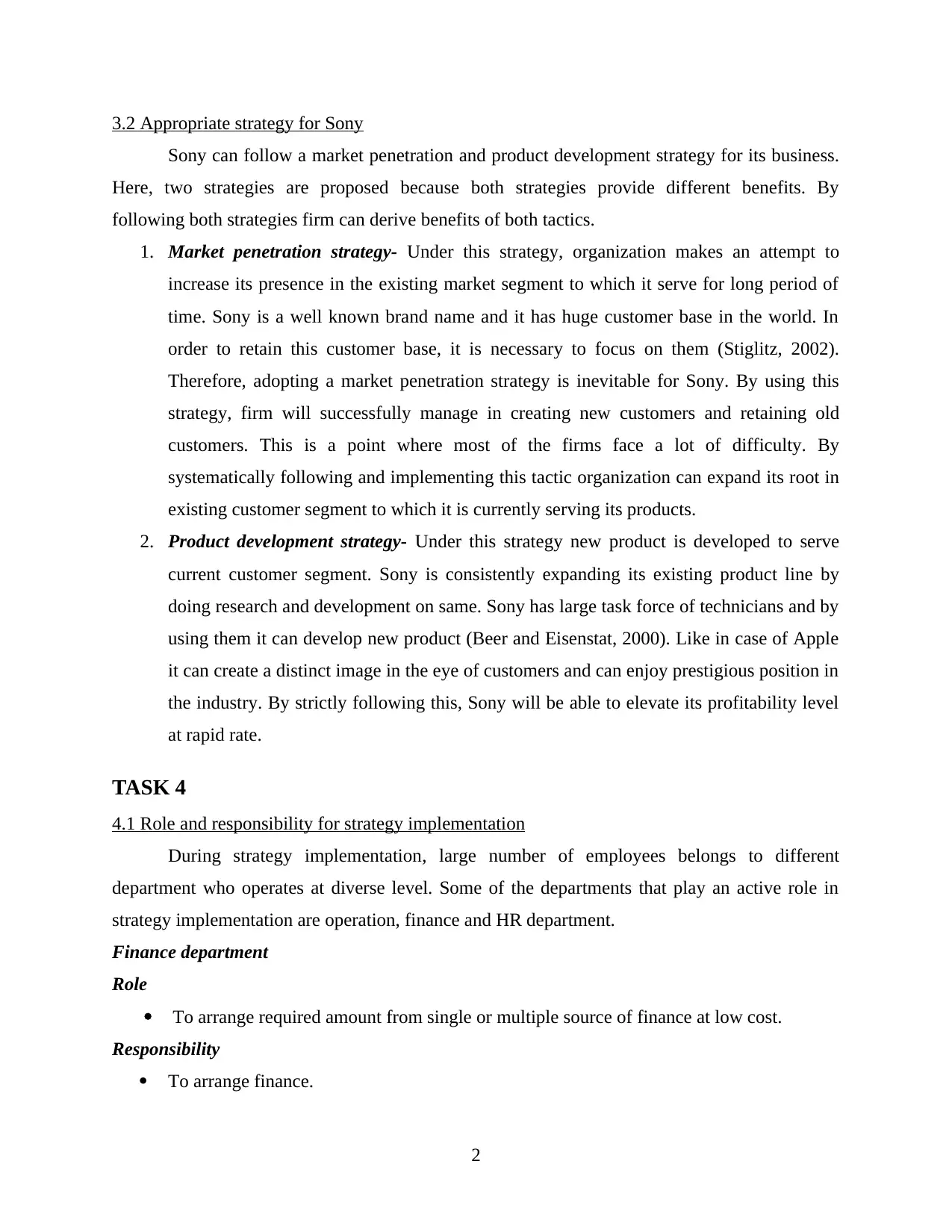
Sony can follow a market penetration and product development strategy for its business.
Here, two strategies are proposed because both strategies provide different benefits. By
following both strategies firm can derive benefits of both tactics.
1. Market penetration strategy- Under this strategy, organization makes an attempt to
increase its presence in the existing market segment to which it serve for long period of
time. Sony is a well known brand name and it has huge customer base in the world. In
order to retain this customer base, it is necessary to focus on them (Stiglitz, 2002).
Therefore, adopting a market penetration strategy is inevitable for Sony. By using this
strategy, firm will successfully manage in creating new customers and retaining old
customers. This is a point where most of the firms face a lot of difficulty. By
systematically following and implementing this tactic organization can expand its root in
existing customer segment to which it is currently serving its products.
2. Product development strategy- Under this strategy new product is developed to serve
current customer segment. Sony is consistently expanding its existing product line by
doing research and development on same. Sony has large task force of technicians and by
using them it can develop new product (Beer and Eisenstat, 2000). Like in case of Apple
it can create a distinct image in the eye of customers and can enjoy prestigious position in
the industry. By strictly following this, Sony will be able to elevate its profitability level
at rapid rate.
TASK 4
4.1 Role and responsibility for strategy implementation
During strategy implementation, large number of employees belongs to different
department who operates at diverse level. Some of the departments that play an active role in
strategy implementation are operation, finance and HR department.
Finance department
Role
To arrange required amount from single or multiple source of finance at low cost.
Responsibility
To arrange finance.
2
Sony can follow a market penetration and product development strategy for its business.
Here, two strategies are proposed because both strategies provide different benefits. By
following both strategies firm can derive benefits of both tactics.
1. Market penetration strategy- Under this strategy, organization makes an attempt to
increase its presence in the existing market segment to which it serve for long period of
time. Sony is a well known brand name and it has huge customer base in the world. In
order to retain this customer base, it is necessary to focus on them (Stiglitz, 2002).
Therefore, adopting a market penetration strategy is inevitable for Sony. By using this
strategy, firm will successfully manage in creating new customers and retaining old
customers. This is a point where most of the firms face a lot of difficulty. By
systematically following and implementing this tactic organization can expand its root in
existing customer segment to which it is currently serving its products.
2. Product development strategy- Under this strategy new product is developed to serve
current customer segment. Sony is consistently expanding its existing product line by
doing research and development on same. Sony has large task force of technicians and by
using them it can develop new product (Beer and Eisenstat, 2000). Like in case of Apple
it can create a distinct image in the eye of customers and can enjoy prestigious position in
the industry. By strictly following this, Sony will be able to elevate its profitability level
at rapid rate.
TASK 4
4.1 Role and responsibility for strategy implementation
During strategy implementation, large number of employees belongs to different
department who operates at diverse level. Some of the departments that play an active role in
strategy implementation are operation, finance and HR department.
Finance department
Role
To arrange required amount from single or multiple source of finance at low cost.
Responsibility
To arrange finance.
2
Paraphrase This Document
Need a fresh take? Get an instant paraphrase of this document with our AI Paraphraser
To allocate amount of finance among various activities by taking guidance from
employees of operations department (Kaplan and Norton, 2005).
To prepare sound cash management strategy to reduce firm dependence on external
source of finance.
Operation department
Role
Monitoring implementation of strategy at the ground level
Responsibility
Implementation of strategy on field.
Organizing all employee’s in a team to whom a task to implement the strategy is given by
the top management.
Providing necessary guidelines to employees for effective implementation of the strategy
on time (Goffin and Mitchell, 2005).
Human resource department
Role
Selecting a right candidates for strategy implementation
Responsibility
Providing training to the employees under supervision and guidance of operation and
human resource manager.
Drafting a list of topics on which training need to be given for effective implementation
of the strategy.
Preparing an outline for performing training for each and every individual topic.
4.2 Resource requirements to implement new strategy.
At the time of implementing strategy, Sony has to use many resources like financial and
human resource. In order to successfully implement the strategy, organization needs to make best
use of these resources. Finance is a basic problem for every organization as well as its
acquisition and utilization are challenging task for an organization. Economic environment is
unstable and reduced amount of loan in balance sheet will proves good for the firm when
economic condition become further respite. Therefore, firm must reduce its dependency on
external source of finance. In other words it can also be said that, by retaining more money and
3
employees of operations department (Kaplan and Norton, 2005).
To prepare sound cash management strategy to reduce firm dependence on external
source of finance.
Operation department
Role
Monitoring implementation of strategy at the ground level
Responsibility
Implementation of strategy on field.
Organizing all employee’s in a team to whom a task to implement the strategy is given by
the top management.
Providing necessary guidelines to employees for effective implementation of the strategy
on time (Goffin and Mitchell, 2005).
Human resource department
Role
Selecting a right candidates for strategy implementation
Responsibility
Providing training to the employees under supervision and guidance of operation and
human resource manager.
Drafting a list of topics on which training need to be given for effective implementation
of the strategy.
Preparing an outline for performing training for each and every individual topic.
4.2 Resource requirements to implement new strategy.
At the time of implementing strategy, Sony has to use many resources like financial and
human resource. In order to successfully implement the strategy, organization needs to make best
use of these resources. Finance is a basic problem for every organization as well as its
acquisition and utilization are challenging task for an organization. Economic environment is
unstable and reduced amount of loan in balance sheet will proves good for the firm when
economic condition become further respite. Therefore, firm must reduce its dependency on
external source of finance. In other words it can also be said that, by retaining more money and
3
unlocking cash amount, firm can arrange finance at its own level. In this regard, company needs
to formulate cash management strategy under which Sony will make all payment in cheque and
will centralise its payment system. As a result, firm will get an extra time to retain cash in its
bank account (Manuj and Mentzer, 2008). Apart from this, Sony must recover its debt amount
from the debtors as soon as possible. If it is unable to recover same amount from debtors then it
can use factoring service to get its debt amount from the debtors as soon as possible. In this way,
Sony to some extent can reduce its dependency on loan from banks or NBFC'S. Along with this,
organization is required to prepare proper plan regarding utilisation of cash in various activities
that will be performed at the ground level. In this regard, finance manager need to allocate
budgeted amount in all activities that will be performed for strategy implementation. Apart from
this, firm need human resources to implement its strategy at the ground level. In order to
implement strategy in proper manner, top management of Sony is required to select right
candidates for strategy implementation team (Goffin and Mitchell, 2005.). Many times firm
implement new and unique strategy and employees do not have any past experience in this
regard. Therefore, in such cases company needs to provide adequate training to the employees.
So as to ensure that, employees will not commit any mistake in implementation of the strategy at
the field level.
4.3 Proposed targets for Sony
Objectives of Sony are as follows.
Specific- Objective determined must be specific in nature. In other words it can also be
said that, objective must indicate a particular direction in which firm wants to move.
Objective of Sony is to increase its market share in India and China. This indicates that,
the company is targeting Asia and it selects its two major economies for business
expansion.
Measurable- Objective which is determined must be measurable in nature. Means that
determined objective must be quantified in terms of figures or percentages. Sony wants to
increase its market share by 5% at the end of this fiscal year in India and China
individually. This objective is measurable in terms of value and it also indicates
expectation of top management from regional heads of Sony branch in India and China
(Haugey, 2015).
4
to formulate cash management strategy under which Sony will make all payment in cheque and
will centralise its payment system. As a result, firm will get an extra time to retain cash in its
bank account (Manuj and Mentzer, 2008). Apart from this, Sony must recover its debt amount
from the debtors as soon as possible. If it is unable to recover same amount from debtors then it
can use factoring service to get its debt amount from the debtors as soon as possible. In this way,
Sony to some extent can reduce its dependency on loan from banks or NBFC'S. Along with this,
organization is required to prepare proper plan regarding utilisation of cash in various activities
that will be performed at the ground level. In this regard, finance manager need to allocate
budgeted amount in all activities that will be performed for strategy implementation. Apart from
this, firm need human resources to implement its strategy at the ground level. In order to
implement strategy in proper manner, top management of Sony is required to select right
candidates for strategy implementation team (Goffin and Mitchell, 2005.). Many times firm
implement new and unique strategy and employees do not have any past experience in this
regard. Therefore, in such cases company needs to provide adequate training to the employees.
So as to ensure that, employees will not commit any mistake in implementation of the strategy at
the field level.
4.3 Proposed targets for Sony
Objectives of Sony are as follows.
Specific- Objective determined must be specific in nature. In other words it can also be
said that, objective must indicate a particular direction in which firm wants to move.
Objective of Sony is to increase its market share in India and China. This indicates that,
the company is targeting Asia and it selects its two major economies for business
expansion.
Measurable- Objective which is determined must be measurable in nature. Means that
determined objective must be quantified in terms of figures or percentages. Sony wants to
increase its market share by 5% at the end of this fiscal year in India and China
individually. This objective is measurable in terms of value and it also indicates
expectation of top management from regional heads of Sony branch in India and China
(Haugey, 2015).
4
⊘ This is a preview!⊘
Do you want full access?
Subscribe today to unlock all pages.
Trusted by 1+ million students worldwide
Achievable- Objective must be achievable. Many times due to wrong prediction about
future or ignorance of movement in current market, firms make objectives which are very
difficult to achieve. In case of non-achievement of objectives, top management can take
action against managers which is wrong. Therefore, after evaluating entire situation,
company must determine objective which are challenging but are possible to achieve in
determined deadline.
Realistic- Firm must determine objective that are realistic. Suppose management of Sony
set a target to grow their business by 10% in India and China individually. This objective
is unrealistic because China economy is not performing well and its manufacturing sector
is contracting consistently (SMART, 2015). In such kind of situation, expecting growth of
10% from China division is unrealistic. Therefore, goals must be realistic and must be
reviewed time to time in order to make changes in determined goals.
Time frame- Time must be determined within which goal must be achieved by the firm.
Time frame must be determined in such a way that achievement of goal becomes possible
in determined time period.
CONCLUSION
On the basis of above discussion it is concluded that, firms must consider several factors
before preparing its strategic plan. Organization must review business environment time to time.
In this regard, company must review economic environment very frequently because economic
conditions at national and international level is changing very rapidly. For understanding overall
situation, firm may use several kinds of matrix and analysis methods like BCS matrix and
PESTEL analysis. In order to run business smoothly, economic environment is unfavourable and
it is imperative to monitor business environment time to time. Lot of strategies are available with
the firm and company must select right strategy so that, it elevates its profitability. In order to
implement strategy, firm must access resource requirements and must make their excellent
utilization in business. Goals which are determined by the must be SMART in nature. By
following all these things, company can prepare and implement strategies at ground level in the
proper manner.
5
future or ignorance of movement in current market, firms make objectives which are very
difficult to achieve. In case of non-achievement of objectives, top management can take
action against managers which is wrong. Therefore, after evaluating entire situation,
company must determine objective which are challenging but are possible to achieve in
determined deadline.
Realistic- Firm must determine objective that are realistic. Suppose management of Sony
set a target to grow their business by 10% in India and China individually. This objective
is unrealistic because China economy is not performing well and its manufacturing sector
is contracting consistently (SMART, 2015). In such kind of situation, expecting growth of
10% from China division is unrealistic. Therefore, goals must be realistic and must be
reviewed time to time in order to make changes in determined goals.
Time frame- Time must be determined within which goal must be achieved by the firm.
Time frame must be determined in such a way that achievement of goal becomes possible
in determined time period.
CONCLUSION
On the basis of above discussion it is concluded that, firms must consider several factors
before preparing its strategic plan. Organization must review business environment time to time.
In this regard, company must review economic environment very frequently because economic
conditions at national and international level is changing very rapidly. For understanding overall
situation, firm may use several kinds of matrix and analysis methods like BCS matrix and
PESTEL analysis. In order to run business smoothly, economic environment is unfavourable and
it is imperative to monitor business environment time to time. Lot of strategies are available with
the firm and company must select right strategy so that, it elevates its profitability. In order to
implement strategy, firm must access resource requirements and must make their excellent
utilization in business. Goals which are determined by the must be SMART in nature. By
following all these things, company can prepare and implement strategies at ground level in the
proper manner.
5
Paraphrase This Document
Need a fresh take? Get an instant paraphrase of this document with our AI Paraphraser
REFERENCES
Books and Journals
Beer, M. and Eisenstat, R. A., 2000. The silent killers of strategy implementation and learning.
Sloan Management Review. 41(4). pp. 29-40.
Brugha, R. and Varvasovszky, Z., 2000. Stakeholder analysis: a review. Health policy and
planning. 15(3). pp. 239-246.
Figge, F., Hahn, T., Schaltegger, S. and Wagner, M., 2002. The sustainability balanced
scorecard–linking sustainability management to business strategy. Business strategy and
the Environment. 11(5). pp. 269-284.
Goffin, K. and Mitchell, R., 2005. Innovation management: Strategy and implementation using
the pentathlon framework. Houndmills, Basingstoke: Palgrave Macmillan.
Hall, P. A., 2001. Varieties of capitalism. John Wiley & Sons, Inc.
Jackson, S. E., Joshi, A. and Erhardt, N. L., 2003. Recent research on team and organizational
diversity: SWOT analysis and implications. Journal of management. 29(6). pp. 801-830.
Kaplan, R. S. and Norton, D. P., 2005. Creating the office of strategy management. Division of
Research, Harvard Business School.
London, T. and Hart, S. L., 2004. Reinventing strategies for emerging markets: beyond the
transnational model. Journal of international business studies. 35(5). pp. 350-370.
Lynch, R. G., 2004. Rethinking growth strategies: How state and local taxes and services affect
economic development. In Economic Policy Institute.
Manuj, I. and Mentzer, J. T., 2008. Global supply chain risk management strategies.
International Journal of Physical Distribution & Logistics Management. 38(3). pp. 192-
223.
Matsuno, K. and Mentzer, J. T., 2000. The effects of strategy type on the market orientation-
performance relationship. Journal of marketing. 64(4). pp. 1-16.
Olson, E. M., Slater, S. F. and Hult, G. T., 2005. The performance implications of fit among
business strategy, marketing organization structure, and strategic behavior. Journal of
marketing. 69(3). pp. 49-65.
Prell, C., Hubacek, K. and Reed, M., 2009. Stakeholder analysis and social network analysis in
natural resource management. Society and Natural Resources. 22(6). pp. 501-518.
Richard, O. C., 2000. Racial diversity, business strategy, and firm performance: A resource-
based view. Academy of management journal. 43(2). pp. 164-177.
6
Books and Journals
Beer, M. and Eisenstat, R. A., 2000. The silent killers of strategy implementation and learning.
Sloan Management Review. 41(4). pp. 29-40.
Brugha, R. and Varvasovszky, Z., 2000. Stakeholder analysis: a review. Health policy and
planning. 15(3). pp. 239-246.
Figge, F., Hahn, T., Schaltegger, S. and Wagner, M., 2002. The sustainability balanced
scorecard–linking sustainability management to business strategy. Business strategy and
the Environment. 11(5). pp. 269-284.
Goffin, K. and Mitchell, R., 2005. Innovation management: Strategy and implementation using
the pentathlon framework. Houndmills, Basingstoke: Palgrave Macmillan.
Hall, P. A., 2001. Varieties of capitalism. John Wiley & Sons, Inc.
Jackson, S. E., Joshi, A. and Erhardt, N. L., 2003. Recent research on team and organizational
diversity: SWOT analysis and implications. Journal of management. 29(6). pp. 801-830.
Kaplan, R. S. and Norton, D. P., 2005. Creating the office of strategy management. Division of
Research, Harvard Business School.
London, T. and Hart, S. L., 2004. Reinventing strategies for emerging markets: beyond the
transnational model. Journal of international business studies. 35(5). pp. 350-370.
Lynch, R. G., 2004. Rethinking growth strategies: How state and local taxes and services affect
economic development. In Economic Policy Institute.
Manuj, I. and Mentzer, J. T., 2008. Global supply chain risk management strategies.
International Journal of Physical Distribution & Logistics Management. 38(3). pp. 192-
223.
Matsuno, K. and Mentzer, J. T., 2000. The effects of strategy type on the market orientation-
performance relationship. Journal of marketing. 64(4). pp. 1-16.
Olson, E. M., Slater, S. F. and Hult, G. T., 2005. The performance implications of fit among
business strategy, marketing organization structure, and strategic behavior. Journal of
marketing. 69(3). pp. 49-65.
Prell, C., Hubacek, K. and Reed, M., 2009. Stakeholder analysis and social network analysis in
natural resource management. Society and Natural Resources. 22(6). pp. 501-518.
Richard, O. C., 2000. Racial diversity, business strategy, and firm performance: A resource-
based view. Academy of management journal. 43(2). pp. 164-177.
6
Stiglitz, J. E., 2002. Towards a new paradigm for development: strategies, policies and
processes. Applied Econometrics and International Development. 2(1). pp. 116-122.
Teece, D. J., 2010. Business models, business strategy and innovation. Long range
planning. .43(2). pp. 172-194.
Vorhies, D. W. and Morgan, N. A., 2003. A configuration theory assessment of marketing
organization fit with business strategy and its relationship with marketing performance.
Journal of marketing. 67(1). pp. 100-115.
Yüksel, I. and Dagdeviren, M., 2007. Using the analytic network process (ANP) in a SWOT
analysis–A case study for a textile firm. Information Sciences. 177(16). pp. 3364-3382.
Yüksel, I., 2012. Developing a multi-criteria decision making model for PESTEL analysis.
International Journal of Business and Management. 7(24). pp. 52-53.
Zimmermann, O., 2005. Analysis and Design Techniques for Service-Oriented Development and
Integration. In GI Jahrestagung. 1(2). pp. 606-611.
Online
Haugey, D., 2015. SMART goals. [Online]. Available through: <
https://www.projectsmart.co.uk/smart-goals.php>. [Accessed on 2nd September 2015].
SMART. 2015. [Online]. Available through: < http://www.learnmarketing.net/smart.htm>.
[Accessed on 2nd September 2015].
7
processes. Applied Econometrics and International Development. 2(1). pp. 116-122.
Teece, D. J., 2010. Business models, business strategy and innovation. Long range
planning. .43(2). pp. 172-194.
Vorhies, D. W. and Morgan, N. A., 2003. A configuration theory assessment of marketing
organization fit with business strategy and its relationship with marketing performance.
Journal of marketing. 67(1). pp. 100-115.
Yüksel, I. and Dagdeviren, M., 2007. Using the analytic network process (ANP) in a SWOT
analysis–A case study for a textile firm. Information Sciences. 177(16). pp. 3364-3382.
Yüksel, I., 2012. Developing a multi-criteria decision making model for PESTEL analysis.
International Journal of Business and Management. 7(24). pp. 52-53.
Zimmermann, O., 2005. Analysis and Design Techniques for Service-Oriented Development and
Integration. In GI Jahrestagung. 1(2). pp. 606-611.
Online
Haugey, D., 2015. SMART goals. [Online]. Available through: <
https://www.projectsmart.co.uk/smart-goals.php>. [Accessed on 2nd September 2015].
SMART. 2015. [Online]. Available through: < http://www.learnmarketing.net/smart.htm>.
[Accessed on 2nd September 2015].
7
⊘ This is a preview!⊘
Do you want full access?
Subscribe today to unlock all pages.
Trusted by 1+ million students worldwide

1 out of 9


Related Documents


Your All-in-One AI-Powered Toolkit for Academic Success.
+13062052269
info@desklib.com
Available 24*7 on WhatsApp / Email
![[object Object]](/_next/static/media/star-bottom.7253800d.svg)
Unlock your academic potential
Copyright © 2020–2026 A2Z Services. All Rights Reserved. Developed and managed by ZUCOL.