6EC513 Global Business and Strategy Coursework 1 Test Assignment
VerifiedAdded on 2021/02/19
|9
|1787
|329
Homework Assignment
AI Summary
This assignment covers a wide range of topics in global business and strategy. The assignment begins with questions on cultural literacy, mercantilism, foreign investment, and international franchising. It also examines non-tariff barriers and the product life cycle theory. The assignment delves into international trade theories such as absolute and comparative advantage, and the Heckscher-Ohlin model. The assignment also explores Porter's diamond model, tariffs, quotas, and economic integration. Additionally, the assignment analyzes market entry strategies, including exporting, and the investment development path of internationalization, using examples of Greek firms. The assignment provides detailed answers and calculations to illustrate key concepts.
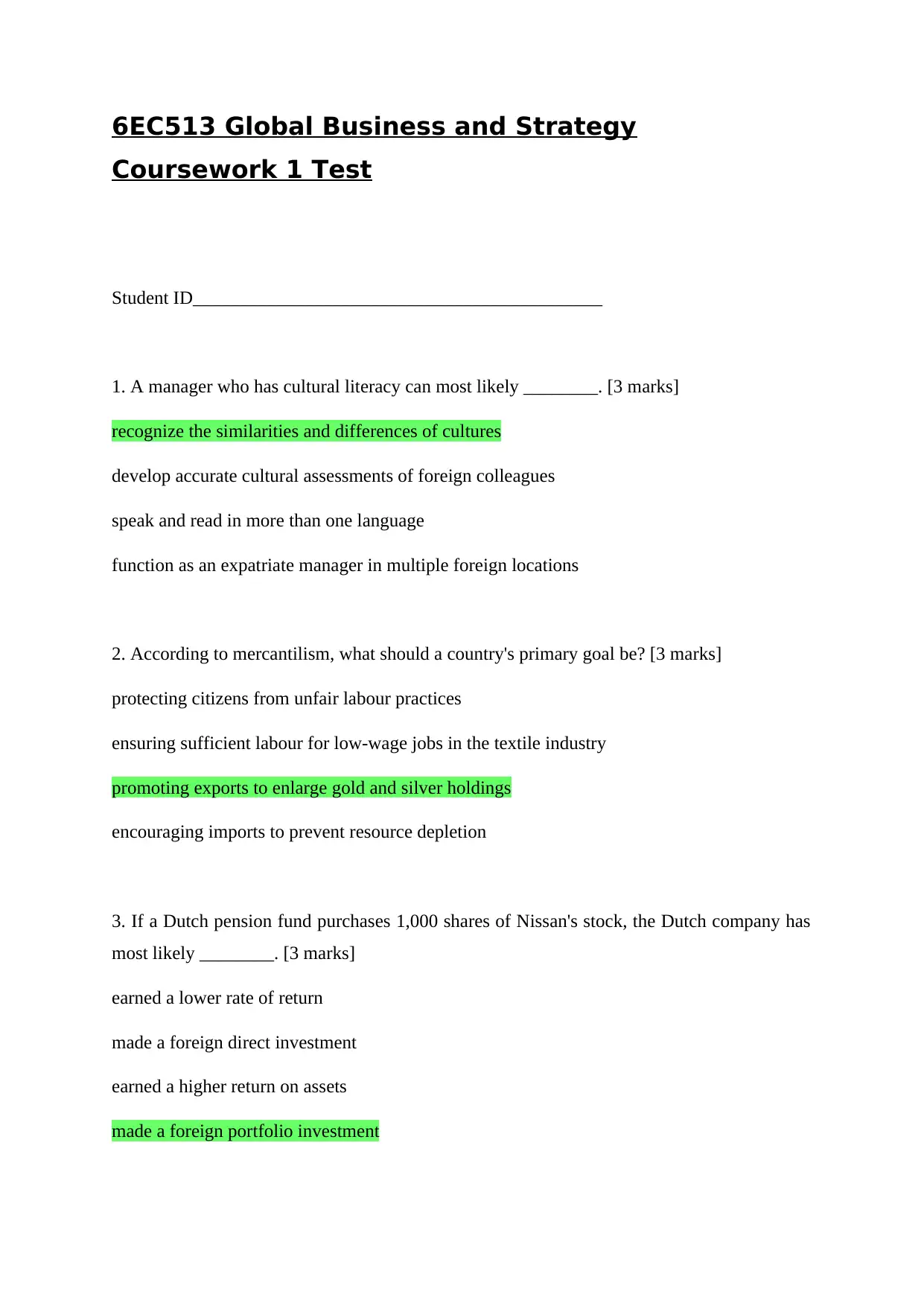
6EC513 Global Business and Strategy
Coursework 1 Test
Student ID____________________________________________
1. A manager who has cultural literacy can most likely ________. [3 marks]
recognize the similarities and differences of cultures
develop accurate cultural assessments of foreign colleagues
speak and read in more than one language
function as an expatriate manager in multiple foreign locations
2. According to mercantilism, what should a country's primary goal be? [3 marks]
protecting citizens from unfair labour practices
ensuring sufficient labour for low-wage jobs in the textile industry
promoting exports to enlarge gold and silver holdings
encouraging imports to prevent resource depletion
3. If a Dutch pension fund purchases 1,000 shares of Nissan's stock, the Dutch company has
most likely ________. [3 marks]
earned a lower rate of return
made a foreign direct investment
earned a higher return on assets
made a foreign portfolio investment
Coursework 1 Test
Student ID____________________________________________
1. A manager who has cultural literacy can most likely ________. [3 marks]
recognize the similarities and differences of cultures
develop accurate cultural assessments of foreign colleagues
speak and read in more than one language
function as an expatriate manager in multiple foreign locations
2. According to mercantilism, what should a country's primary goal be? [3 marks]
protecting citizens from unfair labour practices
ensuring sufficient labour for low-wage jobs in the textile industry
promoting exports to enlarge gold and silver holdings
encouraging imports to prevent resource depletion
3. If a Dutch pension fund purchases 1,000 shares of Nissan's stock, the Dutch company has
most likely ________. [3 marks]
earned a lower rate of return
made a foreign direct investment
earned a higher return on assets
made a foreign portfolio investment

Paraphrase This Document
Need a fresh take? Get an instant paraphrase of this document with our AI Paraphraser
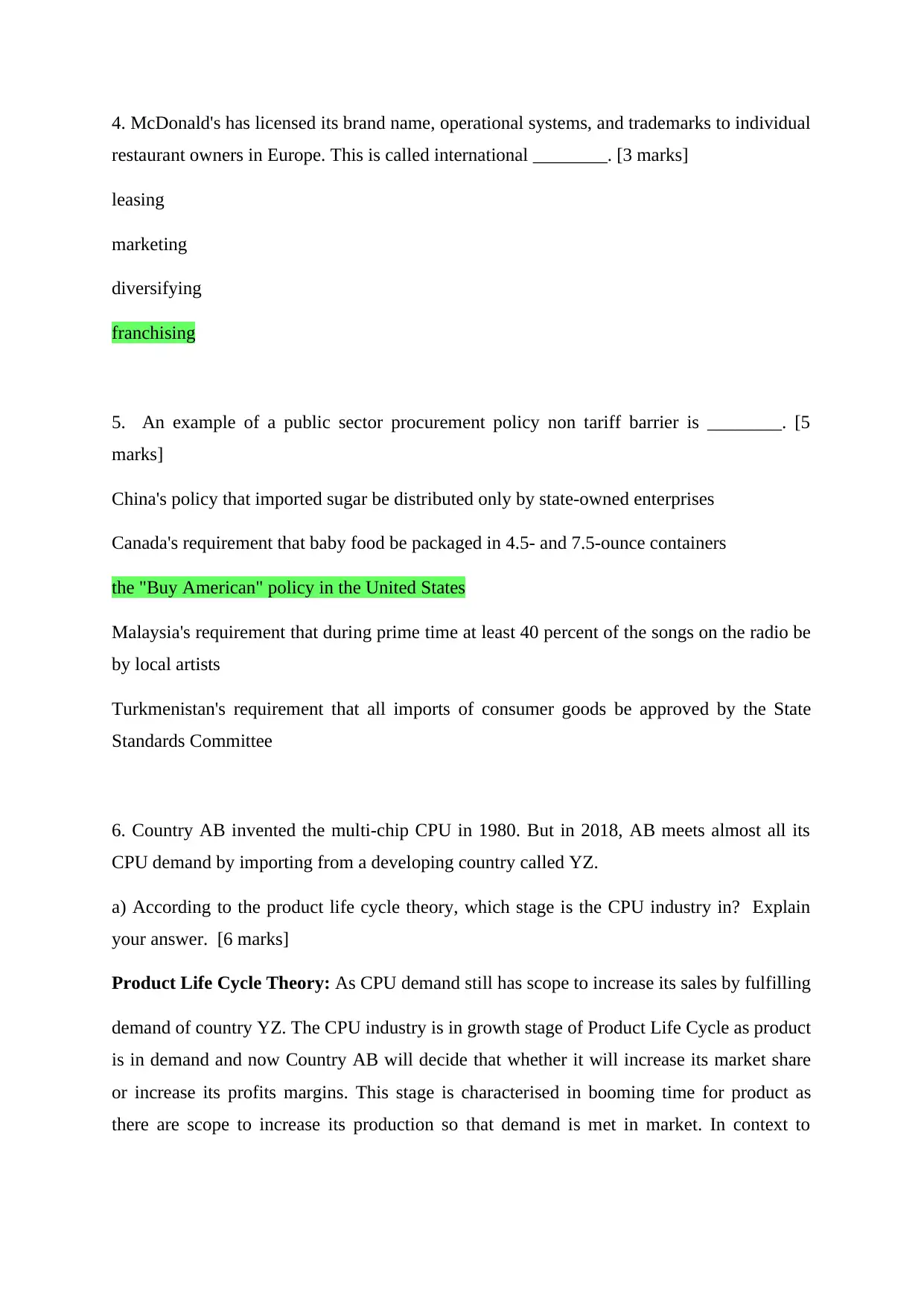
4. McDonald's has licensed its brand name, operational systems, and trademarks to individual
restaurant owners in Europe. This is called international ________. [3 marks]
leasing
marketing
diversifying
franchising
5. An example of a public sector procurement policy non tariff barrier is ________. [5
marks]
China's policy that imported sugar be distributed only by state-owned enterprises
Canada's requirement that baby food be packaged in 4.5- and 7.5-ounce containers
the "Buy American" policy in the United States
Malaysia's requirement that during prime time at least 40 percent of the songs on the radio be
by local artists
Turkmenistan's requirement that all imports of consumer goods be approved by the State
Standards Committee
6. Country AB invented the multi-chip CPU in 1980. But in 2018, AB meets almost all its
CPU demand by importing from a developing country called YZ.
a) According to the product life cycle theory, which stage is the CPU industry in? Explain
your answer. [6 marks]
Product Life Cycle Theory: As CPU demand still has scope to increase its sales by fulfilling
demand of country YZ. The CPU industry is in growth stage of Product Life Cycle as product
is in demand and now Country AB will decide that whether it will increase its market share
or increase its profits margins. This stage is characterised in booming time for product as
there are scope to increase its production so that demand is met in market. In context to
restaurant owners in Europe. This is called international ________. [3 marks]
leasing
marketing
diversifying
franchising
5. An example of a public sector procurement policy non tariff barrier is ________. [5
marks]
China's policy that imported sugar be distributed only by state-owned enterprises
Canada's requirement that baby food be packaged in 4.5- and 7.5-ounce containers
the "Buy American" policy in the United States
Malaysia's requirement that during prime time at least 40 percent of the songs on the radio be
by local artists
Turkmenistan's requirement that all imports of consumer goods be approved by the State
Standards Committee
6. Country AB invented the multi-chip CPU in 1980. But in 2018, AB meets almost all its
CPU demand by importing from a developing country called YZ.
a) According to the product life cycle theory, which stage is the CPU industry in? Explain
your answer. [6 marks]
Product Life Cycle Theory: As CPU demand still has scope to increase its sales by fulfilling
demand of country YZ. The CPU industry is in growth stage of Product Life Cycle as product
is in demand and now Country AB will decide that whether it will increase its market share
or increase its profits margins. This stage is characterised in booming time for product as
there are scope to increase its production so that demand is met in market. In context to
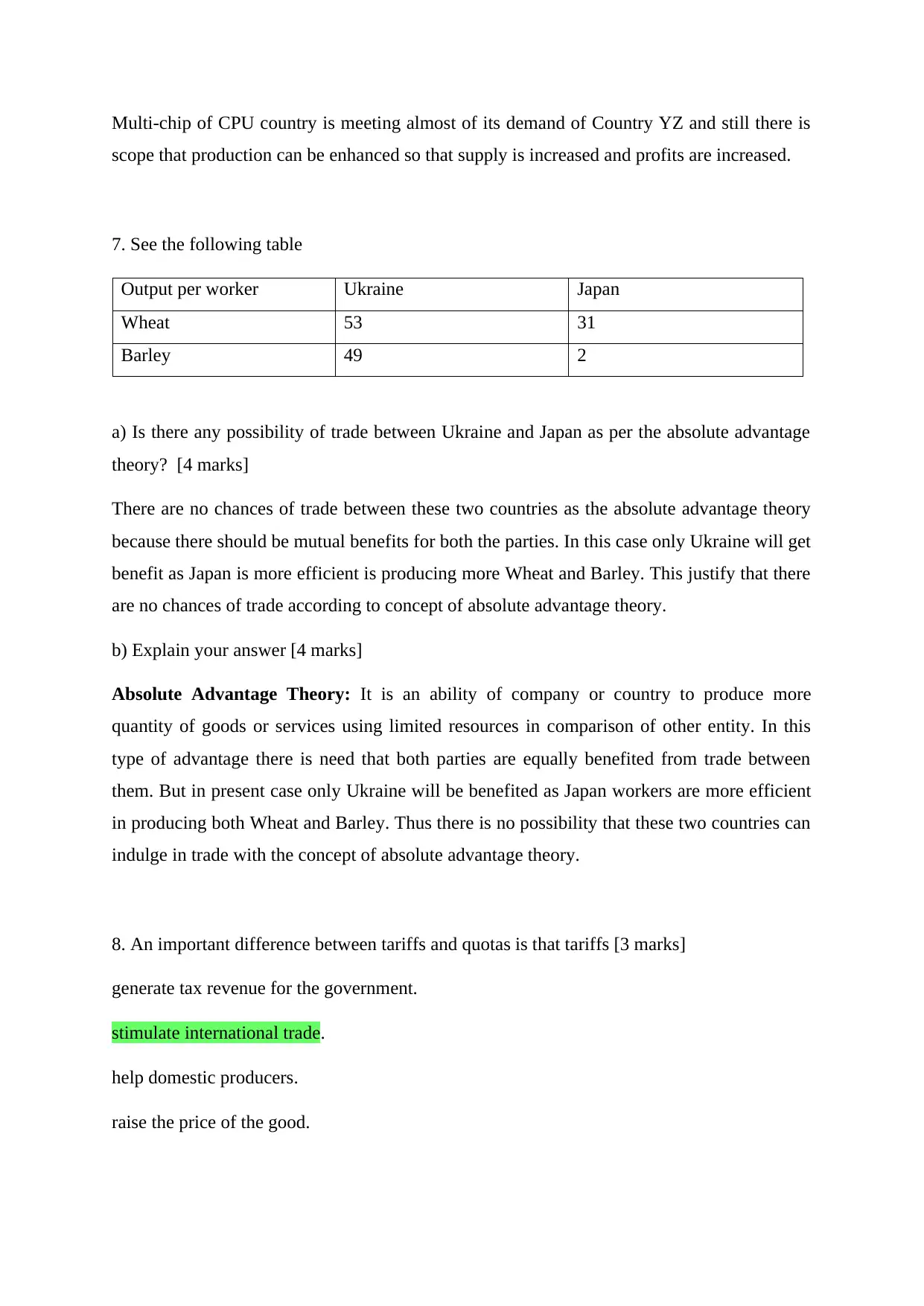
Multi-chip of CPU country is meeting almost of its demand of Country YZ and still there is
scope that production can be enhanced so that supply is increased and profits are increased.
7. See the following table
Output per worker Ukraine Japan
Wheat 53 31
Barley 49 2
a) Is there any possibility of trade between Ukraine and Japan as per the absolute advantage
theory? [4 marks]
There are no chances of trade between these two countries as the absolute advantage theory
because there should be mutual benefits for both the parties. In this case only Ukraine will get
benefit as Japan is more efficient is producing more Wheat and Barley. This justify that there
are no chances of trade according to concept of absolute advantage theory.
b) Explain your answer [4 marks]
Absolute Advantage Theory: It is an ability of company or country to produce more
quantity of goods or services using limited resources in comparison of other entity. In this
type of advantage there is need that both parties are equally benefited from trade between
them. But in present case only Ukraine will be benefited as Japan workers are more efficient
in producing both Wheat and Barley. Thus there is no possibility that these two countries can
indulge in trade with the concept of absolute advantage theory.
8. An important difference between tariffs and quotas is that tariffs [3 marks]
generate tax revenue for the government.
stimulate international trade.
help domestic producers.
raise the price of the good.
scope that production can be enhanced so that supply is increased and profits are increased.
7. See the following table
Output per worker Ukraine Japan
Wheat 53 31
Barley 49 2
a) Is there any possibility of trade between Ukraine and Japan as per the absolute advantage
theory? [4 marks]
There are no chances of trade between these two countries as the absolute advantage theory
because there should be mutual benefits for both the parties. In this case only Ukraine will get
benefit as Japan is more efficient is producing more Wheat and Barley. This justify that there
are no chances of trade according to concept of absolute advantage theory.
b) Explain your answer [4 marks]
Absolute Advantage Theory: It is an ability of company or country to produce more
quantity of goods or services using limited resources in comparison of other entity. In this
type of advantage there is need that both parties are equally benefited from trade between
them. But in present case only Ukraine will be benefited as Japan workers are more efficient
in producing both Wheat and Barley. Thus there is no possibility that these two countries can
indulge in trade with the concept of absolute advantage theory.
8. An important difference between tariffs and quotas is that tariffs [3 marks]
generate tax revenue for the government.
stimulate international trade.
help domestic producers.
raise the price of the good.
⊘ This is a preview!⊘
Do you want full access?
Subscribe today to unlock all pages.

Trusted by 1+ million students worldwide
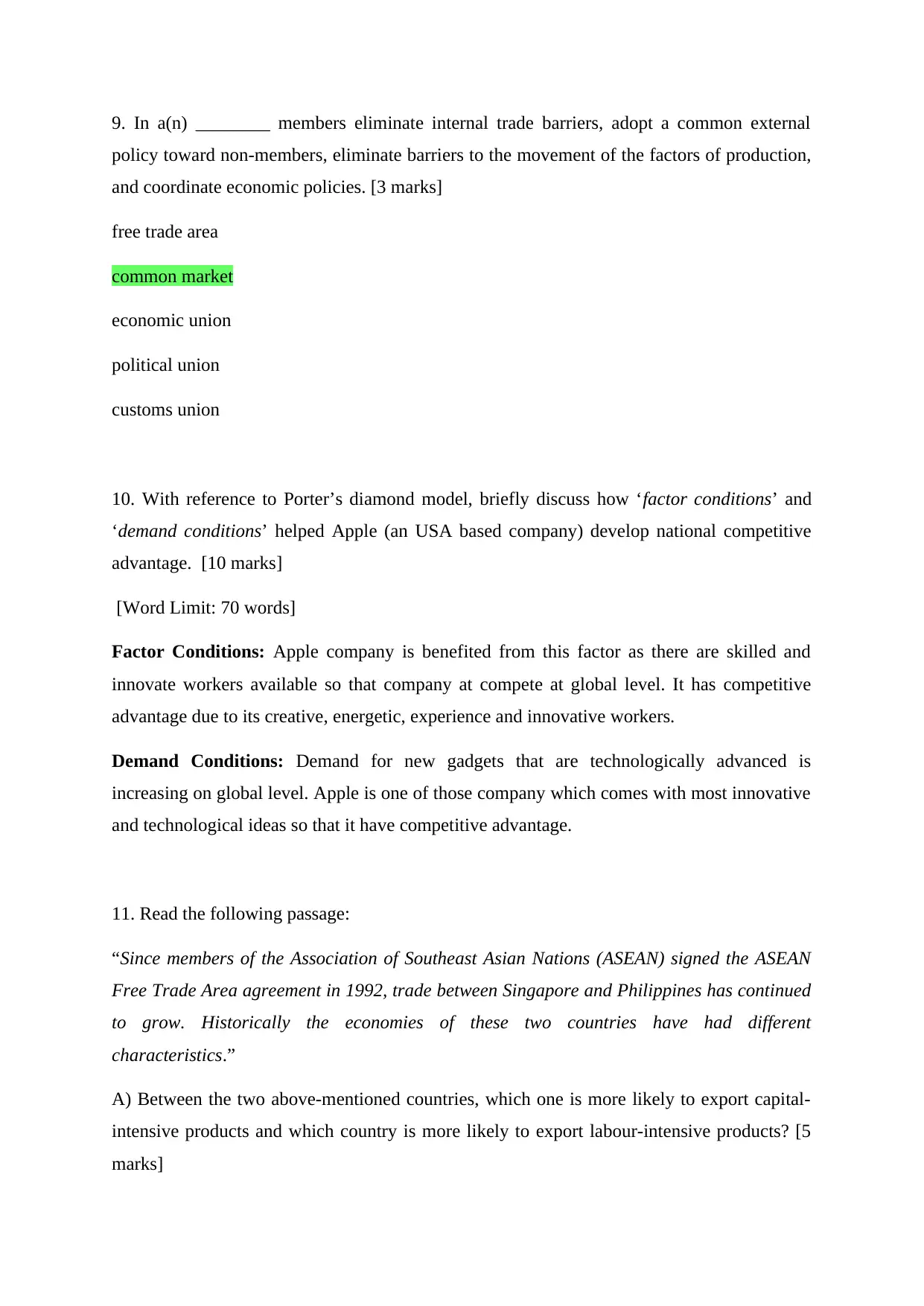
9. In a(n) ________ members eliminate internal trade barriers, adopt a common external
policy toward non-members, eliminate barriers to the movement of the factors of production,
and coordinate economic policies. [3 marks]
free trade area
common market
economic union
political union
customs union
10. With reference to Porter’s diamond model, briefly discuss how ‘factor conditions’ and
‘demand conditions’ helped Apple (an USA based company) develop national competitive
advantage. [10 marks]
[Word Limit: 70 words]
Factor Conditions: Apple company is benefited from this factor as there are skilled and
innovate workers available so that company at compete at global level. It has competitive
advantage due to its creative, energetic, experience and innovative workers.
Demand Conditions: Demand for new gadgets that are technologically advanced is
increasing on global level. Apple is one of those company which comes with most innovative
and technological ideas so that it have competitive advantage.
11. Read the following passage:
“Since members of the Association of Southeast Asian Nations (ASEAN) signed the ASEAN
Free Trade Area agreement in 1992, trade between Singapore and Philippines has continued
to grow. Historically the economies of these two countries have had different
characteristics.”
A) Between the two above-mentioned countries, which one is more likely to export capital-
intensive products and which country is more likely to export labour-intensive products? [5
marks]
policy toward non-members, eliminate barriers to the movement of the factors of production,
and coordinate economic policies. [3 marks]
free trade area
common market
economic union
political union
customs union
10. With reference to Porter’s diamond model, briefly discuss how ‘factor conditions’ and
‘demand conditions’ helped Apple (an USA based company) develop national competitive
advantage. [10 marks]
[Word Limit: 70 words]
Factor Conditions: Apple company is benefited from this factor as there are skilled and
innovate workers available so that company at compete at global level. It has competitive
advantage due to its creative, energetic, experience and innovative workers.
Demand Conditions: Demand for new gadgets that are technologically advanced is
increasing on global level. Apple is one of those company which comes with most innovative
and technological ideas so that it have competitive advantage.
11. Read the following passage:
“Since members of the Association of Southeast Asian Nations (ASEAN) signed the ASEAN
Free Trade Area agreement in 1992, trade between Singapore and Philippines has continued
to grow. Historically the economies of these two countries have had different
characteristics.”
A) Between the two above-mentioned countries, which one is more likely to export capital-
intensive products and which country is more likely to export labour-intensive products? [5
marks]
Paraphrase This Document
Need a fresh take? Get an instant paraphrase of this document with our AI Paraphraser
Singapore is highly developed economy which exports electronics and other capital intensive
products on the other hand Philippines exports semi-conductors and other labour intensive
product.
B) Which theory did you apply to answer Question A? [5 marks]
The Heckscher-Ohlin Model of factor proportions in which factor of production are different
while trading between countries.
12. A(n) ________ is an agreement wherein a firm in one country agrees to operate facilities
or provide other management services to a firm in another country for an agreed-upon fee. [3
marks]
portfolio investment
franchising agreement
licensing agreement
management contract
indirect investment
13. A firm might choose to forgo exporting to a foreign market when ________. [3 marks]
many other firms are already exporting
there are high trade barriers
the firm's existing foreign operations are geographically distant
the company wants to use the market as a platform to other markets
14. A greenfield strategy can be beneficial because of all of the following except ________.
[3 marks]
it allows the firm to select the site that meets its needs
the firm must comply with local and national regulations
the firm can acclimate itself with the new culture at its own pace
products on the other hand Philippines exports semi-conductors and other labour intensive
product.
B) Which theory did you apply to answer Question A? [5 marks]
The Heckscher-Ohlin Model of factor proportions in which factor of production are different
while trading between countries.
12. A(n) ________ is an agreement wherein a firm in one country agrees to operate facilities
or provide other management services to a firm in another country for an agreed-upon fee. [3
marks]
portfolio investment
franchising agreement
licensing agreement
management contract
indirect investment
13. A firm might choose to forgo exporting to a foreign market when ________. [3 marks]
many other firms are already exporting
there are high trade barriers
the firm's existing foreign operations are geographically distant
the company wants to use the market as a platform to other markets
14. A greenfield strategy can be beneficial because of all of the following except ________.
[3 marks]
it allows the firm to select the site that meets its needs
the firm must comply with local and national regulations
the firm can acclimate itself with the new culture at its own pace
the firm can construct modern facilities
the firm starts with a clean slate
15. Local purchase requirements, investment controls, and product and testing standards are
all forms of ________. [3 marks]
numerical export controls
embargoes
voluntary export restraints
nontariff barriers
16. Australia and Brazil have the outputs per worker in producing sleds and clarinets shown
in the table below.
a) By showing relevant calculations, demonstrate who has a comparative advantage in
clarinets production? [7 marks]
Goods
Output per
Worker Sleds Clarinets
Country Australia 300 2
Brazil 200 1
the firm starts with a clean slate
15. Local purchase requirements, investment controls, and product and testing standards are
all forms of ________. [3 marks]
numerical export controls
embargoes
voluntary export restraints
nontariff barriers
16. Australia and Brazil have the outputs per worker in producing sleds and clarinets shown
in the table below.
a) By showing relevant calculations, demonstrate who has a comparative advantage in
clarinets production? [7 marks]
Goods
Output per
Worker Sleds Clarinets
Country Australia 300 2
Brazil 200 1
⊘ This is a preview!⊘
Do you want full access?
Subscribe today to unlock all pages.
Trusted by 1+ million students worldwide
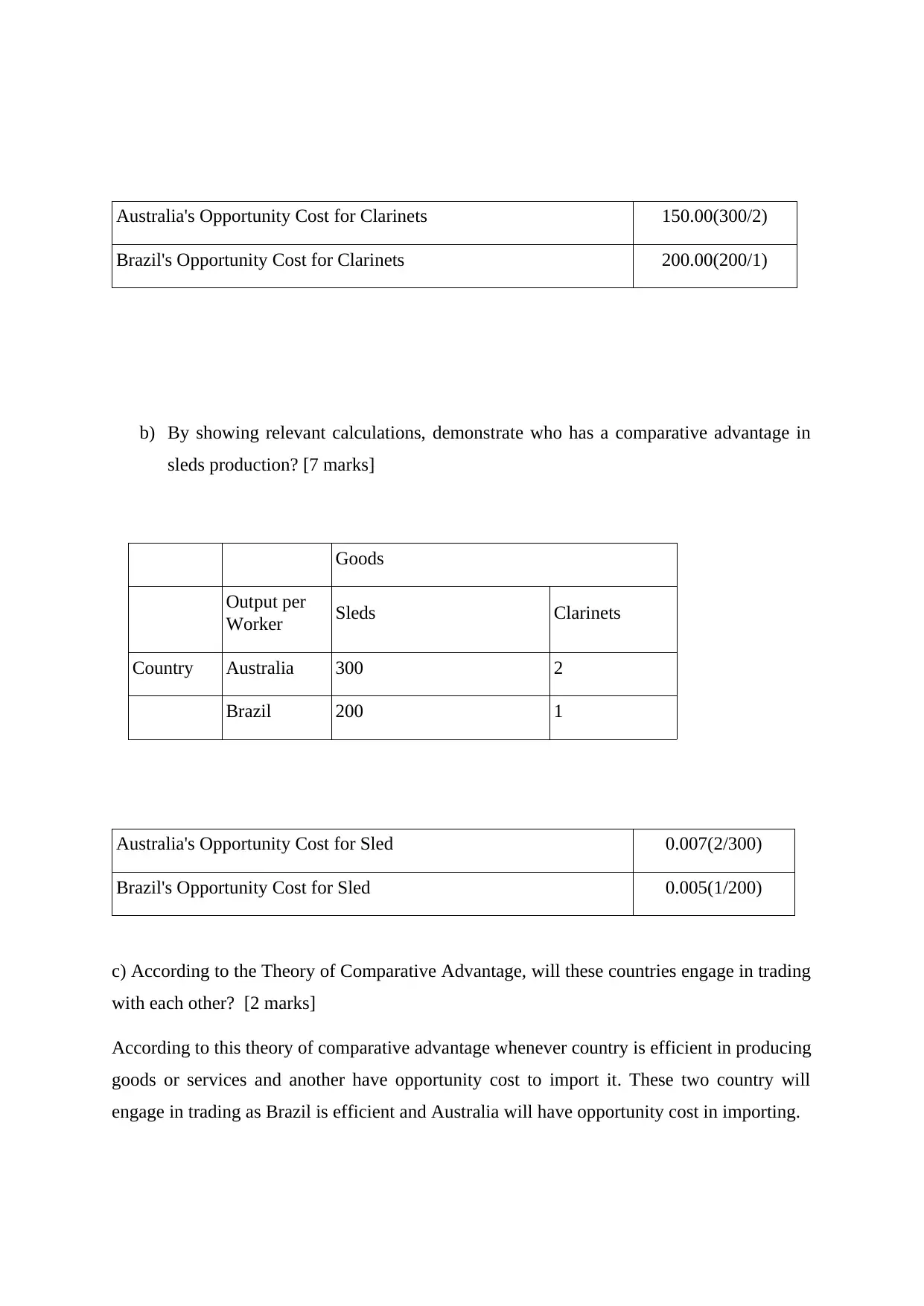
Australia's Opportunity Cost for Clarinets 150.00(300/2)
Brazil's Opportunity Cost for Clarinets 200.00(200/1)
b) By showing relevant calculations, demonstrate who has a comparative advantage in
sleds production? [7 marks]
Goods
Output per
Worker Sleds Clarinets
Country Australia 300 2
Brazil 200 1
Australia's Opportunity Cost for Sled 0.007(2/300)
Brazil's Opportunity Cost for Sled 0.005(1/200)
c) According to the Theory of Comparative Advantage, will these countries engage in trading
with each other? [2 marks]
According to this theory of comparative advantage whenever country is efficient in producing
goods or services and another have opportunity cost to import it. These two country will
engage in trading as Brazil is efficient and Australia will have opportunity cost in importing.
Brazil's Opportunity Cost for Clarinets 200.00(200/1)
b) By showing relevant calculations, demonstrate who has a comparative advantage in
sleds production? [7 marks]
Goods
Output per
Worker Sleds Clarinets
Country Australia 300 2
Brazil 200 1
Australia's Opportunity Cost for Sled 0.007(2/300)
Brazil's Opportunity Cost for Sled 0.005(1/200)
c) According to the Theory of Comparative Advantage, will these countries engage in trading
with each other? [2 marks]
According to this theory of comparative advantage whenever country is efficient in producing
goods or services and another have opportunity cost to import it. These two country will
engage in trading as Brazil is efficient and Australia will have opportunity cost in importing.
Paraphrase This Document
Need a fresh take? Get an instant paraphrase of this document with our AI Paraphraser
17. Read the following paragraph:
“During the last two decades Greece has emerged as a key regional player and one of the
largest investors in the Central and Eastern and South Eastern European Countries
(CESEE). Firms like Delta, a partner of Danone; 3E, a Coca- Cola soft drinks subsidiary;
Chipita, a PepsiCo food subsidiary and Intracom, a partner of Siemens, working in
telecommunications, were amongst the pioneer investors. Initially, as part of the ‘Greek-
Balkan Reconstruction Plan’, the firms invested in the Balkan countries. In the later stages of
internationalisation of Greek firms we also observe investments into developing, but distant
countries, such as India and China, which have recently become popular investment
destinations or even into developed countries with which Greece has had historical,
economic and cultural ties, such as the UK or the US.”
a) What is the model of internationalisation that can explain the strategy of Greek firms? [5
marks]
The Investment Development Path (IDP) approach of internationalisation in which countries
passes five stages so that positions of net outward investment can be developed.
c) Justify your answer (word limit:100) [10 marks]
The investment development path of internationalisation and Greek shows example of
how peripheral and small economy by increasing its economy role with the help of IDP in its
neighbouring countries. As India and china are increasingly generating foreign direct
investment from wider international countries. This approach shows by testing location and
ownership advantage is important factor for country to internationalise and have advantages
in assessing internationalisation. Country uses five stages, first to train local personnel, then
linking with domestic firms after that it expand in different countries to exploit new markets,
it then start investing in developing countries and then to developed countries.
“During the last two decades Greece has emerged as a key regional player and one of the
largest investors in the Central and Eastern and South Eastern European Countries
(CESEE). Firms like Delta, a partner of Danone; 3E, a Coca- Cola soft drinks subsidiary;
Chipita, a PepsiCo food subsidiary and Intracom, a partner of Siemens, working in
telecommunications, were amongst the pioneer investors. Initially, as part of the ‘Greek-
Balkan Reconstruction Plan’, the firms invested in the Balkan countries. In the later stages of
internationalisation of Greek firms we also observe investments into developing, but distant
countries, such as India and China, which have recently become popular investment
destinations or even into developed countries with which Greece has had historical,
economic and cultural ties, such as the UK or the US.”
a) What is the model of internationalisation that can explain the strategy of Greek firms? [5
marks]
The Investment Development Path (IDP) approach of internationalisation in which countries
passes five stages so that positions of net outward investment can be developed.
c) Justify your answer (word limit:100) [10 marks]
The investment development path of internationalisation and Greek shows example of
how peripheral and small economy by increasing its economy role with the help of IDP in its
neighbouring countries. As India and china are increasingly generating foreign direct
investment from wider international countries. This approach shows by testing location and
ownership advantage is important factor for country to internationalise and have advantages
in assessing internationalisation. Country uses five stages, first to train local personnel, then
linking with domestic firms after that it expand in different countries to exploit new markets,
it then start investing in developing countries and then to developed countries.

⊘ This is a preview!⊘
Do you want full access?
Subscribe today to unlock all pages.
Trusted by 1+ million students worldwide

1 out of 9


Your All-in-One AI-Powered Toolkit for Academic Success.
+13062052269
info@desklib.com
Available 24*7 on WhatsApp / Email
![[object Object]](/_next/static/media/star-bottom.7253800d.svg)
Unlock your academic potential
Copyright © 2020–2026 A2Z Services. All Rights Reserved. Developed and managed by ZUCOL.