Hilton Hotel: Strategic Analysis and Business Strategy Report
VerifiedAdded on 2020/07/22
|9
|2833
|292
Report
AI Summary
This report offers a comprehensive analysis of Hilton Hotel's business strategy, focusing on its strategic position, choices, and actions within the UK market. The report begins with an introduction to strategic management and its importance, followed by an in-depth examination of Hilton's external environment using PESTEL analysis, considering political, economic, social, technological, environmental, and legal factors. An internal analysis utilizing SWOT analysis assesses the company's strengths, weaknesses, opportunities, and threats. The report then delves into strategic choices, including business-level strategies like service differentiation and corporate-level strategies, incorporating the Ansoff matrix to explore market penetration, product development, market development, and diversification. Finally, the report outlines the strategic action process, including goal setting, analysis, strategy formulation, and implementation, providing a holistic view of Hilton's strategic approach. This analysis is valuable for understanding the complexities of strategic management and the application of various frameworks in the hospitality industry.
BUSINESS STRATEGY

Paraphrase This Document
Need a fresh take? Get an instant paraphrase of this document with our AI Paraphraser
Table of Contents
Introduction ..........................................................................................................................................3
Strategic position ..................................................................................................................................3
Strategic choice.....................................................................................................................................5
Strategic action .....................................................................................................................................7
References ............................................................................................................................................9
Introduction ..........................................................................................................................................3
Strategic position ..................................................................................................................................3
Strategic choice.....................................................................................................................................5
Strategic action .....................................................................................................................................7
References ............................................................................................................................................9
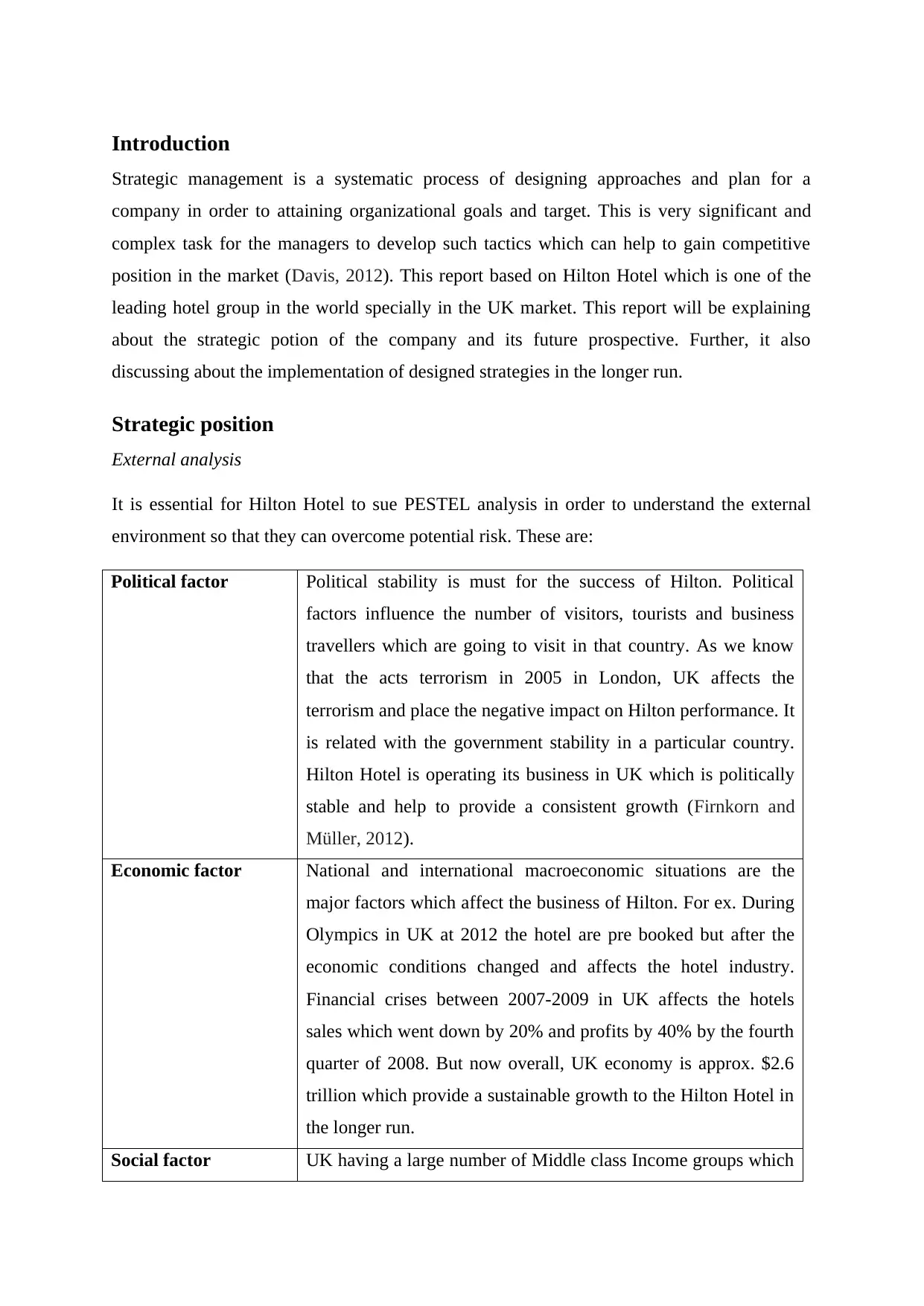
Introduction
Strategic management is a systematic process of designing approaches and plan for a
company in order to attaining organizational goals and target. This is very significant and
complex task for the managers to develop such tactics which can help to gain competitive
position in the market (Davis, 2012). This report based on Hilton Hotel which is one of the
leading hotel group in the world specially in the UK market. This report will be explaining
about the strategic potion of the company and its future prospective. Further, it also
discussing about the implementation of designed strategies in the longer run.
Strategic position
External analysis
It is essential for Hilton Hotel to sue PESTEL analysis in order to understand the external
environment so that they can overcome potential risk. These are:
Political factor Political stability is must for the success of Hilton. Political
factors influence the number of visitors, tourists and business
travellers which are going to visit in that country. As we know
that the acts terrorism in 2005 in London, UK affects the
terrorism and place the negative impact on Hilton performance. It
is related with the government stability in a particular country.
Hilton Hotel is operating its business in UK which is politically
stable and help to provide a consistent growth (Firnkorn and
Müller, 2012).
Economic factor National and international macroeconomic situations are the
major factors which affect the business of Hilton. For ex. During
Olympics in UK at 2012 the hotel are pre booked but after the
economic conditions changed and affects the hotel industry.
Financial crises between 2007-2009 in UK affects the hotels
sales which went down by 20% and profits by 40% by the fourth
quarter of 2008. But now overall, UK economy is approx. $2.6
trillion which provide a sustainable growth to the Hilton Hotel in
the longer run.
Social factor UK having a large number of Middle class Income groups which
Strategic management is a systematic process of designing approaches and plan for a
company in order to attaining organizational goals and target. This is very significant and
complex task for the managers to develop such tactics which can help to gain competitive
position in the market (Davis, 2012). This report based on Hilton Hotel which is one of the
leading hotel group in the world specially in the UK market. This report will be explaining
about the strategic potion of the company and its future prospective. Further, it also
discussing about the implementation of designed strategies in the longer run.
Strategic position
External analysis
It is essential for Hilton Hotel to sue PESTEL analysis in order to understand the external
environment so that they can overcome potential risk. These are:
Political factor Political stability is must for the success of Hilton. Political
factors influence the number of visitors, tourists and business
travellers which are going to visit in that country. As we know
that the acts terrorism in 2005 in London, UK affects the
terrorism and place the negative impact on Hilton performance. It
is related with the government stability in a particular country.
Hilton Hotel is operating its business in UK which is politically
stable and help to provide a consistent growth (Firnkorn and
Müller, 2012).
Economic factor National and international macroeconomic situations are the
major factors which affect the business of Hilton. For ex. During
Olympics in UK at 2012 the hotel are pre booked but after the
economic conditions changed and affects the hotel industry.
Financial crises between 2007-2009 in UK affects the hotels
sales which went down by 20% and profits by 40% by the fourth
quarter of 2008. But now overall, UK economy is approx. $2.6
trillion which provide a sustainable growth to the Hilton Hotel in
the longer run.
Social factor UK having a large number of Middle class Income groups which
⊘ This is a preview!⊘
Do you want full access?
Subscribe today to unlock all pages.

Trusted by 1+ million students worldwide
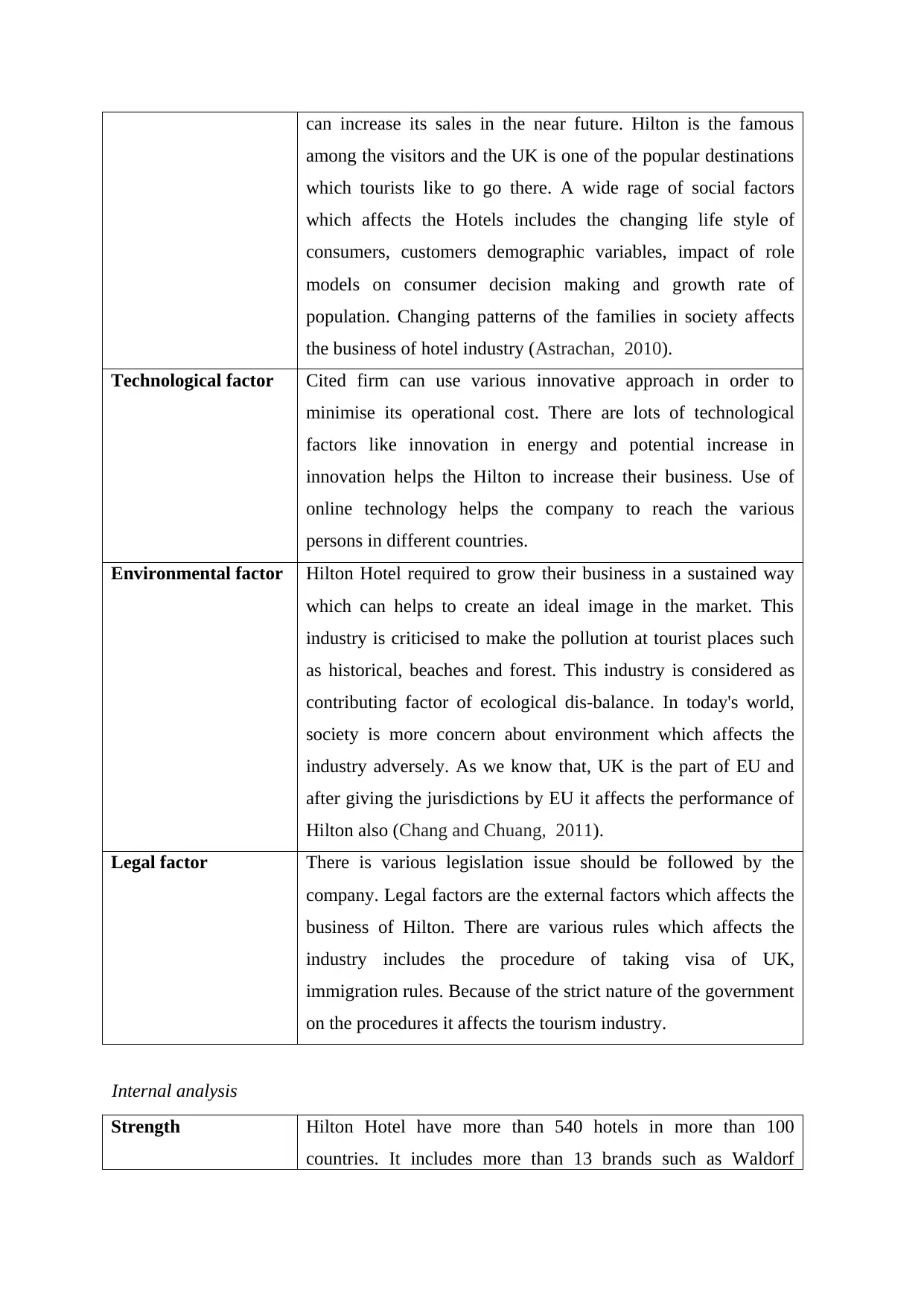
can increase its sales in the near future. Hilton is the famous
among the visitors and the UK is one of the popular destinations
which tourists like to go there. A wide rage of social factors
which affects the Hotels includes the changing life style of
consumers, customers demographic variables, impact of role
models on consumer decision making and growth rate of
population. Changing patterns of the families in society affects
the business of hotel industry (Astrachan, 2010).
Technological factor Cited firm can use various innovative approach in order to
minimise its operational cost. There are lots of technological
factors like innovation in energy and potential increase in
innovation helps the Hilton to increase their business. Use of
online technology helps the company to reach the various
persons in different countries.
Environmental factor Hilton Hotel required to grow their business in a sustained way
which can helps to create an ideal image in the market. This
industry is criticised to make the pollution at tourist places such
as historical, beaches and forest. This industry is considered as
contributing factor of ecological dis-balance. In today's world,
society is more concern about environment which affects the
industry adversely. As we know that, UK is the part of EU and
after giving the jurisdictions by EU it affects the performance of
Hilton also (Chang and Chuang, 2011).
Legal factor There is various legislation issue should be followed by the
company. Legal factors are the external factors which affects the
business of Hilton. There are various rules which affects the
industry includes the procedure of taking visa of UK,
immigration rules. Because of the strict nature of the government
on the procedures it affects the tourism industry.
Internal analysis
Strength Hilton Hotel have more than 540 hotels in more than 100
countries. It includes more than 13 brands such as Waldorf
among the visitors and the UK is one of the popular destinations
which tourists like to go there. A wide rage of social factors
which affects the Hotels includes the changing life style of
consumers, customers demographic variables, impact of role
models on consumer decision making and growth rate of
population. Changing patterns of the families in society affects
the business of hotel industry (Astrachan, 2010).
Technological factor Cited firm can use various innovative approach in order to
minimise its operational cost. There are lots of technological
factors like innovation in energy and potential increase in
innovation helps the Hilton to increase their business. Use of
online technology helps the company to reach the various
persons in different countries.
Environmental factor Hilton Hotel required to grow their business in a sustained way
which can helps to create an ideal image in the market. This
industry is criticised to make the pollution at tourist places such
as historical, beaches and forest. This industry is considered as
contributing factor of ecological dis-balance. In today's world,
society is more concern about environment which affects the
industry adversely. As we know that, UK is the part of EU and
after giving the jurisdictions by EU it affects the performance of
Hilton also (Chang and Chuang, 2011).
Legal factor There is various legislation issue should be followed by the
company. Legal factors are the external factors which affects the
business of Hilton. There are various rules which affects the
industry includes the procedure of taking visa of UK,
immigration rules. Because of the strict nature of the government
on the procedures it affects the tourism industry.
Internal analysis
Strength Hilton Hotel have more than 540 hotels in more than 100
countries. It includes more than 13 brands such as Waldorf
Paraphrase This Document
Need a fresh take? Get an instant paraphrase of this document with our AI Paraphraser
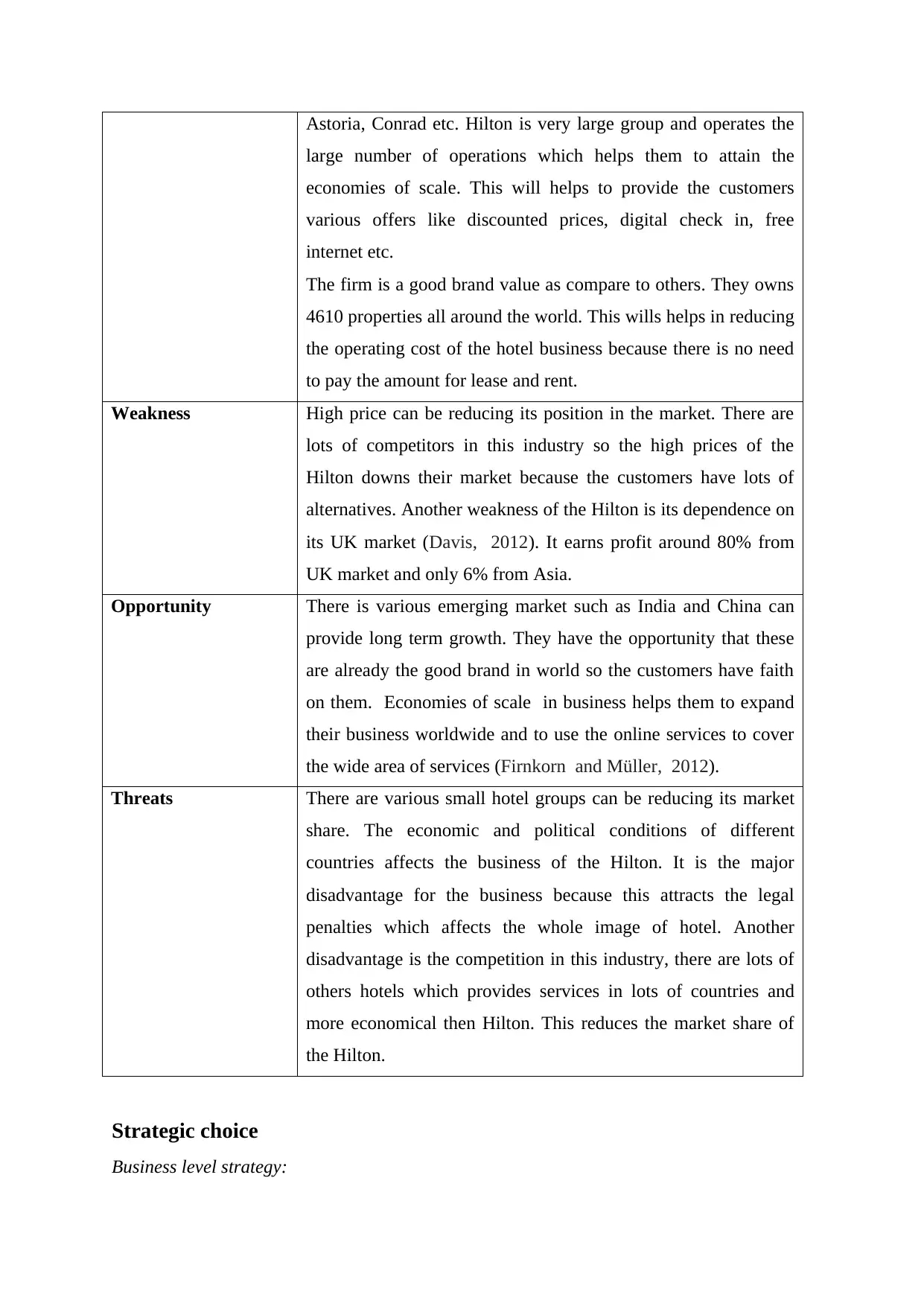
Astoria, Conrad etc. Hilton is very large group and operates the
large number of operations which helps them to attain the
economies of scale. This will helps to provide the customers
various offers like discounted prices, digital check in, free
internet etc.
The firm is a good brand value as compare to others. They owns
4610 properties all around the world. This wills helps in reducing
the operating cost of the hotel business because there is no need
to pay the amount for lease and rent.
Weakness High price can be reducing its position in the market. There are
lots of competitors in this industry so the high prices of the
Hilton downs their market because the customers have lots of
alternatives. Another weakness of the Hilton is its dependence on
its UK market (Davis, 2012). It earns profit around 80% from
UK market and only 6% from Asia.
Opportunity There is various emerging market such as India and China can
provide long term growth. They have the opportunity that these
are already the good brand in world so the customers have faith
on them. Economies of scale in business helps them to expand
their business worldwide and to use the online services to cover
the wide area of services (Firnkorn and Müller, 2012).
Threats There are various small hotel groups can be reducing its market
share. The economic and political conditions of different
countries affects the business of the Hilton. It is the major
disadvantage for the business because this attracts the legal
penalties which affects the whole image of hotel. Another
disadvantage is the competition in this industry, there are lots of
others hotels which provides services in lots of countries and
more economical then Hilton. This reduces the market share of
the Hilton.
Strategic choice
Business level strategy:
large number of operations which helps them to attain the
economies of scale. This will helps to provide the customers
various offers like discounted prices, digital check in, free
internet etc.
The firm is a good brand value as compare to others. They owns
4610 properties all around the world. This wills helps in reducing
the operating cost of the hotel business because there is no need
to pay the amount for lease and rent.
Weakness High price can be reducing its position in the market. There are
lots of competitors in this industry so the high prices of the
Hilton downs their market because the customers have lots of
alternatives. Another weakness of the Hilton is its dependence on
its UK market (Davis, 2012). It earns profit around 80% from
UK market and only 6% from Asia.
Opportunity There is various emerging market such as India and China can
provide long term growth. They have the opportunity that these
are already the good brand in world so the customers have faith
on them. Economies of scale in business helps them to expand
their business worldwide and to use the online services to cover
the wide area of services (Firnkorn and Müller, 2012).
Threats There are various small hotel groups can be reducing its market
share. The economic and political conditions of different
countries affects the business of the Hilton. It is the major
disadvantage for the business because this attracts the legal
penalties which affects the whole image of hotel. Another
disadvantage is the competition in this industry, there are lots of
others hotels which provides services in lots of countries and
more economical then Hilton. This reduces the market share of
the Hilton.
Strategic choice
Business level strategy:
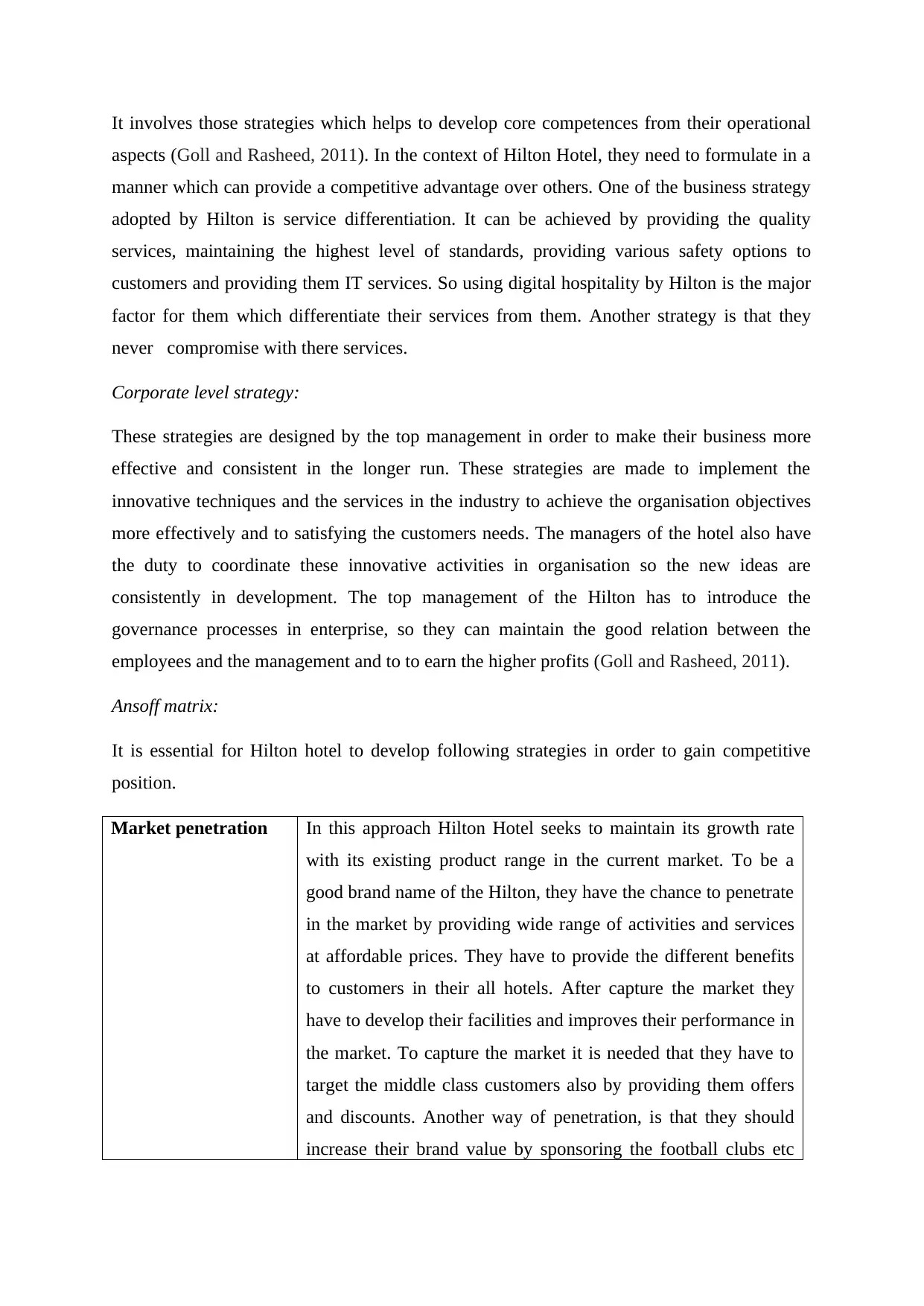
It involves those strategies which helps to develop core competences from their operational
aspects (Goll and Rasheed, 2011). In the context of Hilton Hotel, they need to formulate in a
manner which can provide a competitive advantage over others. One of the business strategy
adopted by Hilton is service differentiation. It can be achieved by providing the quality
services, maintaining the highest level of standards, providing various safety options to
customers and providing them IT services. So using digital hospitality by Hilton is the major
factor for them which differentiate their services from them. Another strategy is that they
never compromise with there services.
Corporate level strategy:
These strategies are designed by the top management in order to make their business more
effective and consistent in the longer run. These strategies are made to implement the
innovative techniques and the services in the industry to achieve the organisation objectives
more effectively and to satisfying the customers needs. The managers of the hotel also have
the duty to coordinate these innovative activities in organisation so the new ideas are
consistently in development. The top management of the Hilton has to introduce the
governance processes in enterprise, so they can maintain the good relation between the
employees and the management and to to earn the higher profits (Goll and Rasheed, 2011).
Ansoff matrix:
It is essential for Hilton hotel to develop following strategies in order to gain competitive
position.
Market penetration In this approach Hilton Hotel seeks to maintain its growth rate
with its existing product range in the current market. To be a
good brand name of the Hilton, they have the chance to penetrate
in the market by providing wide range of activities and services
at affordable prices. They have to provide the different benefits
to customers in their all hotels. After capture the market they
have to develop their facilities and improves their performance in
the market. To capture the market it is needed that they have to
target the middle class customers also by providing them offers
and discounts. Another way of penetration, is that they should
increase their brand value by sponsoring the football clubs etc
aspects (Goll and Rasheed, 2011). In the context of Hilton Hotel, they need to formulate in a
manner which can provide a competitive advantage over others. One of the business strategy
adopted by Hilton is service differentiation. It can be achieved by providing the quality
services, maintaining the highest level of standards, providing various safety options to
customers and providing them IT services. So using digital hospitality by Hilton is the major
factor for them which differentiate their services from them. Another strategy is that they
never compromise with there services.
Corporate level strategy:
These strategies are designed by the top management in order to make their business more
effective and consistent in the longer run. These strategies are made to implement the
innovative techniques and the services in the industry to achieve the organisation objectives
more effectively and to satisfying the customers needs. The managers of the hotel also have
the duty to coordinate these innovative activities in organisation so the new ideas are
consistently in development. The top management of the Hilton has to introduce the
governance processes in enterprise, so they can maintain the good relation between the
employees and the management and to to earn the higher profits (Goll and Rasheed, 2011).
Ansoff matrix:
It is essential for Hilton hotel to develop following strategies in order to gain competitive
position.
Market penetration In this approach Hilton Hotel seeks to maintain its growth rate
with its existing product range in the current market. To be a
good brand name of the Hilton, they have the chance to penetrate
in the market by providing wide range of activities and services
at affordable prices. They have to provide the different benefits
to customers in their all hotels. After capture the market they
have to develop their facilities and improves their performance in
the market. To capture the market it is needed that they have to
target the middle class customers also by providing them offers
and discounts. Another way of penetration, is that they should
increase their brand value by sponsoring the football clubs etc
⊘ This is a preview!⊘
Do you want full access?
Subscribe today to unlock all pages.
Trusted by 1+ million students worldwide
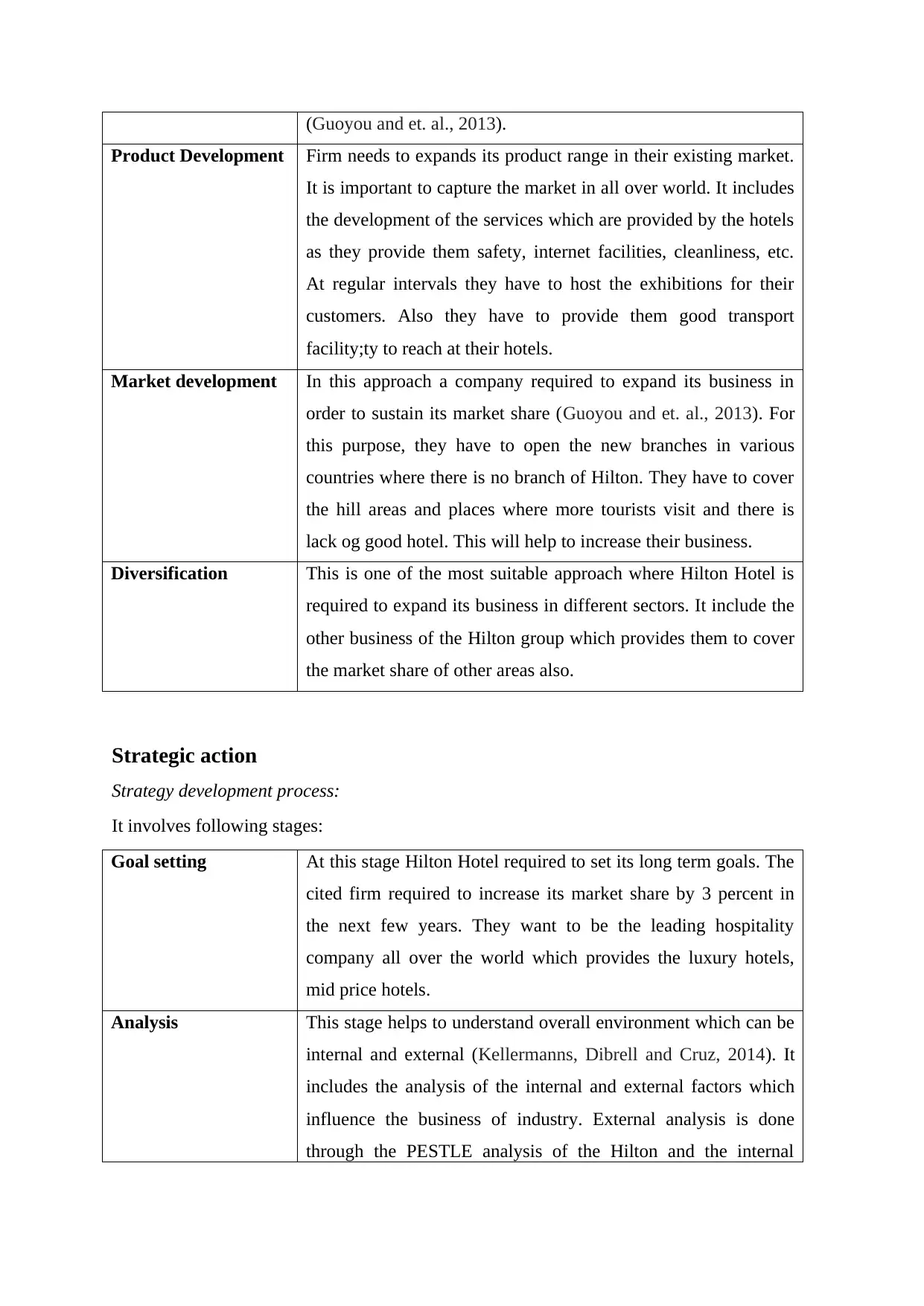
(Guoyou and et. al., 2013).
Product Development Firm needs to expands its product range in their existing market.
It is important to capture the market in all over world. It includes
the development of the services which are provided by the hotels
as they provide them safety, internet facilities, cleanliness, etc.
At regular intervals they have to host the exhibitions for their
customers. Also they have to provide them good transport
facility;ty to reach at their hotels.
Market development In this approach a company required to expand its business in
order to sustain its market share (Guoyou and et. al., 2013). For
this purpose, they have to open the new branches in various
countries where there is no branch of Hilton. They have to cover
the hill areas and places where more tourists visit and there is
lack og good hotel. This will help to increase their business.
Diversification This is one of the most suitable approach where Hilton Hotel is
required to expand its business in different sectors. It include the
other business of the Hilton group which provides them to cover
the market share of other areas also.
Strategic action
Strategy development process:
It involves following stages:
Goal setting At this stage Hilton Hotel required to set its long term goals. The
cited firm required to increase its market share by 3 percent in
the next few years. They want to be the leading hospitality
company all over the world which provides the luxury hotels,
mid price hotels.
Analysis This stage helps to understand overall environment which can be
internal and external (Kellermanns, Dibrell and Cruz, 2014). It
includes the analysis of the internal and external factors which
influence the business of industry. External analysis is done
through the PESTLE analysis of the Hilton and the internal
Product Development Firm needs to expands its product range in their existing market.
It is important to capture the market in all over world. It includes
the development of the services which are provided by the hotels
as they provide them safety, internet facilities, cleanliness, etc.
At regular intervals they have to host the exhibitions for their
customers. Also they have to provide them good transport
facility;ty to reach at their hotels.
Market development In this approach a company required to expand its business in
order to sustain its market share (Guoyou and et. al., 2013). For
this purpose, they have to open the new branches in various
countries where there is no branch of Hilton. They have to cover
the hill areas and places where more tourists visit and there is
lack og good hotel. This will help to increase their business.
Diversification This is one of the most suitable approach where Hilton Hotel is
required to expand its business in different sectors. It include the
other business of the Hilton group which provides them to cover
the market share of other areas also.
Strategic action
Strategy development process:
It involves following stages:
Goal setting At this stage Hilton Hotel required to set its long term goals. The
cited firm required to increase its market share by 3 percent in
the next few years. They want to be the leading hospitality
company all over the world which provides the luxury hotels,
mid price hotels.
Analysis This stage helps to understand overall environment which can be
internal and external (Kellermanns, Dibrell and Cruz, 2014). It
includes the analysis of the internal and external factors which
influence the business of industry. External analysis is done
through the PESTLE analysis of the Hilton and the internal
Paraphrase This Document
Need a fresh take? Get an instant paraphrase of this document with our AI Paraphraser
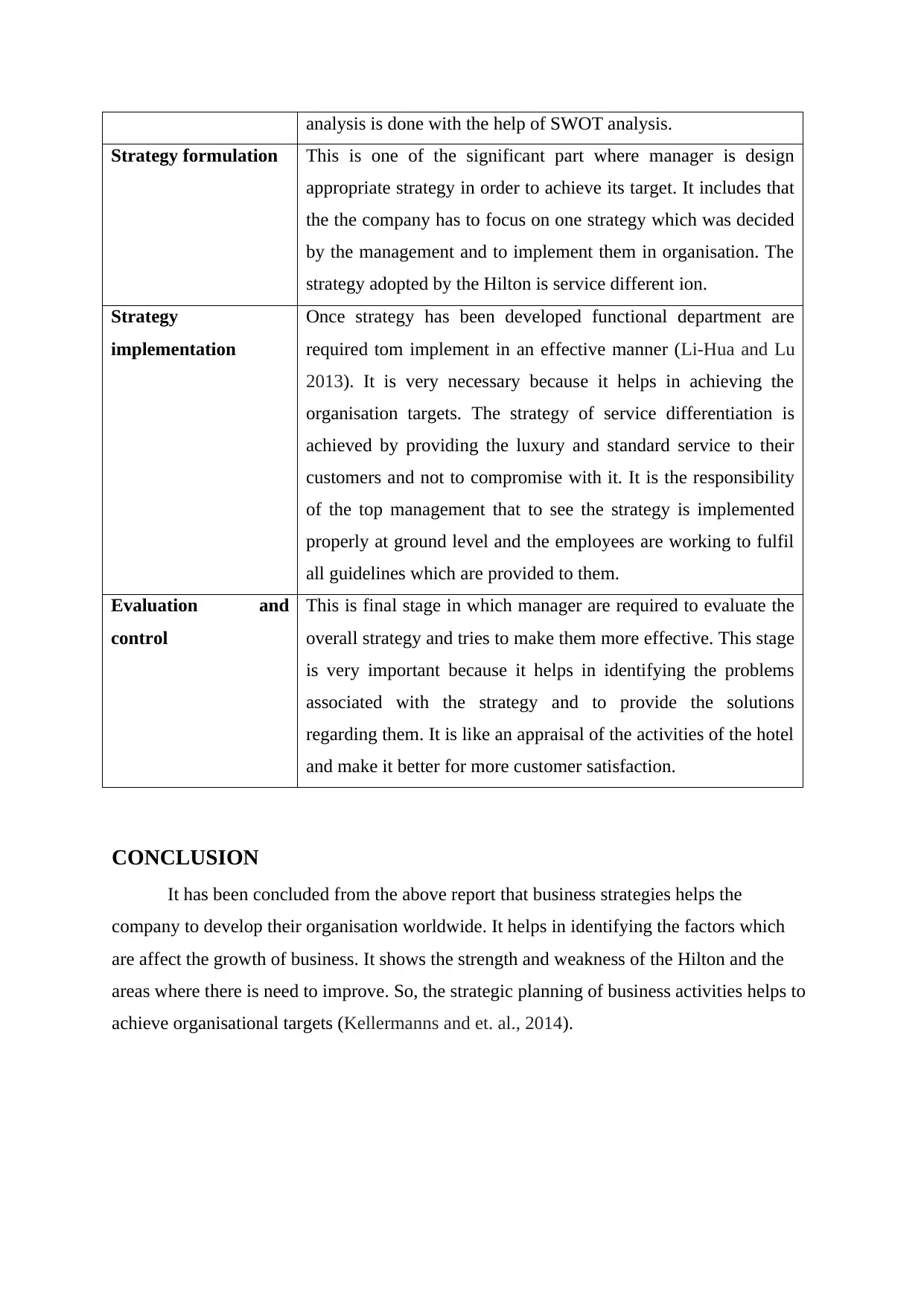
analysis is done with the help of SWOT analysis.
Strategy formulation This is one of the significant part where manager is design
appropriate strategy in order to achieve its target. It includes that
the the company has to focus on one strategy which was decided
by the management and to implement them in organisation. The
strategy adopted by the Hilton is service different ion.
Strategy
implementation
Once strategy has been developed functional department are
required tom implement in an effective manner (Li-Hua and Lu
2013). It is very necessary because it helps in achieving the
organisation targets. The strategy of service differentiation is
achieved by providing the luxury and standard service to their
customers and not to compromise with it. It is the responsibility
of the top management that to see the strategy is implemented
properly at ground level and the employees are working to fulfil
all guidelines which are provided to them.
Evaluation and
control
This is final stage in which manager are required to evaluate the
overall strategy and tries to make them more effective. This stage
is very important because it helps in identifying the problems
associated with the strategy and to provide the solutions
regarding them. It is like an appraisal of the activities of the hotel
and make it better for more customer satisfaction.
CONCLUSION
It has been concluded from the above report that business strategies helps the
company to develop their organisation worldwide. It helps in identifying the factors which
are affect the growth of business. It shows the strength and weakness of the Hilton and the
areas where there is need to improve. So, the strategic planning of business activities helps to
achieve organisational targets (Kellermanns and et. al., 2014).
Strategy formulation This is one of the significant part where manager is design
appropriate strategy in order to achieve its target. It includes that
the the company has to focus on one strategy which was decided
by the management and to implement them in organisation. The
strategy adopted by the Hilton is service different ion.
Strategy
implementation
Once strategy has been developed functional department are
required tom implement in an effective manner (Li-Hua and Lu
2013). It is very necessary because it helps in achieving the
organisation targets. The strategy of service differentiation is
achieved by providing the luxury and standard service to their
customers and not to compromise with it. It is the responsibility
of the top management that to see the strategy is implemented
properly at ground level and the employees are working to fulfil
all guidelines which are provided to them.
Evaluation and
control
This is final stage in which manager are required to evaluate the
overall strategy and tries to make them more effective. This stage
is very important because it helps in identifying the problems
associated with the strategy and to provide the solutions
regarding them. It is like an appraisal of the activities of the hotel
and make it better for more customer satisfaction.
CONCLUSION
It has been concluded from the above report that business strategies helps the
company to develop their organisation worldwide. It helps in identifying the factors which
are affect the growth of business. It shows the strength and weakness of the Hilton and the
areas where there is need to improve. So, the strategic planning of business activities helps to
achieve organisational targets (Kellermanns and et. al., 2014).
References
Books and Journal
Astrachan, J.H., 2010. Strategy in family business: Toward a multidimensional research
agenda. Journal of Family Business Strategy. 1(1). pp.6-14.
Chang, T.C. and Chuang, S.H., 2011. Performance implications of knowledge management
processes: Examining the roles of infrastructure capability and business strategy.
Expert systems with applications. 38(5). pp.6170-6178.
Davis, P. J., 2012. A model for strategy implementation and conflict resolution in the
franchise business. Strategy & Leadership. 40(5). pp.32-38.
Firnkorn, J. and Müller, M., 2012. Selling mobility instead of cars: new business strategies of
automakers and the impact on private vehicle holding. Business Strategy and the
environment. 21(4). pp.264-280.
Goll, I. and Rasheed, A. A., 2011. The effects of 9/11/2001 on business strategy variability in
the US air carrier industry. Management Decision. 49(6). pp.948-961.
Guoyou, Q., and et. al., 2013. Stakeholders' influences on corporate green innovation
strategy: a case study of manufacturing firms in China. Corporate Social
Responsibility and Environmental Management. 20(1). pp.1-14.
Kellermanns, and et. al., 2014. The role and impact of emotions in family business strategy:
New approaches and paradigms. Journal of Family Business Strategy. 5(3). pp.277-
279.
Klettner, A., Clarke, T. and Boersma, M., 2014. The governance of corporate sustainability:
Empirical insights into the development, leadership and implementation of
responsible business strategy. Journal of Business Ethics. 122(1). pp.145-165.
Li-Hua, R. and Lu, L., 2013. Technology strategy and sustainability of business: Empirical
experiences from Chinese cases. Journal of Technology Management in China. 8(2).
pp.62-82.
Meskendahl, S., 2010. The influence of business strategy on project portfolio management
and its success—a conceptual framework. International Journal of Project
Management. 28(8). pp.807-817.
Teece, D.J., 2010. Business models, business strategy and innovation. Long range planning.
43(2). pp.172-194.
Woodcock, N., Green, A. and Starkey, M., 2011. Social CRM as a business strategy. Journal
of Database Marketing & Customer Strategy Management. 18(1). pp.50-64.
Books and Journal
Astrachan, J.H., 2010. Strategy in family business: Toward a multidimensional research
agenda. Journal of Family Business Strategy. 1(1). pp.6-14.
Chang, T.C. and Chuang, S.H., 2011. Performance implications of knowledge management
processes: Examining the roles of infrastructure capability and business strategy.
Expert systems with applications. 38(5). pp.6170-6178.
Davis, P. J., 2012. A model for strategy implementation and conflict resolution in the
franchise business. Strategy & Leadership. 40(5). pp.32-38.
Firnkorn, J. and Müller, M., 2012. Selling mobility instead of cars: new business strategies of
automakers and the impact on private vehicle holding. Business Strategy and the
environment. 21(4). pp.264-280.
Goll, I. and Rasheed, A. A., 2011. The effects of 9/11/2001 on business strategy variability in
the US air carrier industry. Management Decision. 49(6). pp.948-961.
Guoyou, Q., and et. al., 2013. Stakeholders' influences on corporate green innovation
strategy: a case study of manufacturing firms in China. Corporate Social
Responsibility and Environmental Management. 20(1). pp.1-14.
Kellermanns, and et. al., 2014. The role and impact of emotions in family business strategy:
New approaches and paradigms. Journal of Family Business Strategy. 5(3). pp.277-
279.
Klettner, A., Clarke, T. and Boersma, M., 2014. The governance of corporate sustainability:
Empirical insights into the development, leadership and implementation of
responsible business strategy. Journal of Business Ethics. 122(1). pp.145-165.
Li-Hua, R. and Lu, L., 2013. Technology strategy and sustainability of business: Empirical
experiences from Chinese cases. Journal of Technology Management in China. 8(2).
pp.62-82.
Meskendahl, S., 2010. The influence of business strategy on project portfolio management
and its success—a conceptual framework. International Journal of Project
Management. 28(8). pp.807-817.
Teece, D.J., 2010. Business models, business strategy and innovation. Long range planning.
43(2). pp.172-194.
Woodcock, N., Green, A. and Starkey, M., 2011. Social CRM as a business strategy. Journal
of Database Marketing & Customer Strategy Management. 18(1). pp.50-64.
⊘ This is a preview!⊘
Do you want full access?
Subscribe today to unlock all pages.
Trusted by 1+ million students worldwide

1 out of 9


Related Documents


Your All-in-One AI-Powered Toolkit for Academic Success.
+13062052269
info@desklib.com
Available 24*7 on WhatsApp / Email
![[object Object]](/_next/static/media/star-bottom.7253800d.svg)
Unlock your academic potential
Copyright © 2020–2026 A2Z Services. All Rights Reserved. Developed and managed by ZUCOL.