Business Strategy Report: Analyzing John Lewis's Internal Capabilities
VerifiedAdded on 2021/02/22
|13
|4056
|108
Report
AI Summary
This report provides a comprehensive analysis of John Lewis Ltd's business strategy. It begins with an examination of the macro-environment using the PESTLE framework, assessing political, economic, social, technological, legal, and environmental factors impacting the company. The report then delves into the internal capabilities of John Lewis, employing VRIO and SWOT analyses to evaluate its strengths, weaknesses, opportunities, and threats, along with its valuable, rare, inimitable, and organized resources. Furthermore, the report evaluates the competitive forces within the retail sector using Porter's Five Forces model, assessing the threat of new entrants, substitute products, bargaining power of suppliers and buyers, and competitive rivalry. Finally, it explores strategic planning, offering recommendations for John Lewis to maintain and enhance its competitive advantage. The report aims to provide a strategic framework for John Lewis's continued success in a dynamic market environment.
BUSINESS
STRATEGY
STRATEGY

Paraphrase This Document
Need a fresh take? Get an instant paraphrase of this document with our AI Paraphraser
Table of Contents
TASK 1............................................................................................................................................4
P1. Analyse the impact of macro environment on the organisation...........................................4
TASK 2............................................................................................................................................5
P2. Analyse the internal capabilities of an organisation.............................................................5
TASK 3............................................................................................................................................8
P3. Evaluate the competitive forces of retail sector for organisation.........................................8
TASK 4............................................................................................................................................9
P4. Application of theories, models and devise strategic planning for the organisation............9
CONCLUSION..............................................................................................................................11
REFERENCES..............................................................................................................................11
TASK 1............................................................................................................................................4
P1. Analyse the impact of macro environment on the organisation...........................................4
TASK 2............................................................................................................................................5
P2. Analyse the internal capabilities of an organisation.............................................................5
TASK 3............................................................................................................................................8
P3. Evaluate the competitive forces of retail sector for organisation.........................................8
TASK 4............................................................................................................................................9
P4. Application of theories, models and devise strategic planning for the organisation............9
CONCLUSION..............................................................................................................................11
REFERENCES..............................................................................................................................11
INTRODUCTION
Business strategy refers to the course of action or decisions which can be taken by the
owner or the entrepreneur in order to accomplish objectives and targets of an organisation. It is a
kind of master plan which a company make to secure its position in the market (Johnson, 2016).
It is useful in operations, production, manufacturing and other tasks of the company which needs
to be achieved in a smooth and effective manner. Business strategy is the backbone of the
business which guide and support its operational activities and overall task. Moreover, it also
contain risk as its plans and strategies are based on the assumptions and research based data and
figures. When the competition increases, then it becomes important for the company to make
more and more strategy to achieve success in the market. This report is in the context of John
Lewis Ltd which is a British company, headquarter in London, England, UK. Company operates
various departmental stores, financial services and supermarkets. This assignment is based on the
environmental analysis and strategic growth management plan which is based on the internal and
external analysis. It also evaluates the various types of strategic directions suitable for the
company and also produce a strategic plan which helps the company in accomplishing its
objectives.
TASK 1
P1. Analyse the impact of macro environment on the organisation
PESTLE is a framework or technique which is used to determine and analyse the
conditions of external factors which is helpful in order to increase the performance of an
organisation (Chang, 2016). It is useful for those companies who start a new company or want to
enter in new market. It helps in identifying the threats by conducting research of various factors
which is important for expanding business. John Lewis use this framework to conduct market
research in order to analyse the barriers and identify the requirement of market.
Political: This factor depends on the government of the country and their influencing
policies which impact the business and its policies (Moseley III, 2017). This factor influence
John Lewis tremendously as new policies and laws brings lot of changes in the working style and
decisions of the company. John Lewis is part of EU market and many competitors enter in the
market without any restrictions in order to survive in competitive market. There are various laws
which affect John Lewis such as sales of good act 1979, trade description act 1968 and data
Business strategy refers to the course of action or decisions which can be taken by the
owner or the entrepreneur in order to accomplish objectives and targets of an organisation. It is a
kind of master plan which a company make to secure its position in the market (Johnson, 2016).
It is useful in operations, production, manufacturing and other tasks of the company which needs
to be achieved in a smooth and effective manner. Business strategy is the backbone of the
business which guide and support its operational activities and overall task. Moreover, it also
contain risk as its plans and strategies are based on the assumptions and research based data and
figures. When the competition increases, then it becomes important for the company to make
more and more strategy to achieve success in the market. This report is in the context of John
Lewis Ltd which is a British company, headquarter in London, England, UK. Company operates
various departmental stores, financial services and supermarkets. This assignment is based on the
environmental analysis and strategic growth management plan which is based on the internal and
external analysis. It also evaluates the various types of strategic directions suitable for the
company and also produce a strategic plan which helps the company in accomplishing its
objectives.
TASK 1
P1. Analyse the impact of macro environment on the organisation
PESTLE is a framework or technique which is used to determine and analyse the
conditions of external factors which is helpful in order to increase the performance of an
organisation (Chang, 2016). It is useful for those companies who start a new company or want to
enter in new market. It helps in identifying the threats by conducting research of various factors
which is important for expanding business. John Lewis use this framework to conduct market
research in order to analyse the barriers and identify the requirement of market.
Political: This factor depends on the government of the country and their influencing
policies which impact the business and its policies (Moseley III, 2017). This factor influence
John Lewis tremendously as new policies and laws brings lot of changes in the working style and
decisions of the company. John Lewis is part of EU market and many competitors enter in the
market without any restrictions in order to survive in competitive market. There are various laws
which affect John Lewis such as sales of good act 1979, trade description act 1968 and data
⊘ This is a preview!⊘
Do you want full access?
Subscribe today to unlock all pages.

Trusted by 1+ million students worldwide
protection act 1998. in order to face these act, John Lewis adopt various strategies such as in sale
of good act, company provide training to their staff in order to market their products. Make clear
things to their customers, company already mention the description on their packaging of the
product which helps the buyers to purchase product. Company also make changes in its website
in order to collection information form their sources.
Environmental: The recyclable resources used in manufacturing of the production is
considered as the environmental production (Grayson and Hodges, 2017). If companies does not
follow the environmental protection act then it become threat for the company and they could
face legal penalties for breaching the health and safety act. Every company is curious about how
to reduce emission of carbon dioxide to follow the regulations of environmental act. Carbon gas
brings lot of change in climate which nowadays affect the weather conditions and produces
greenhouse in the environment. For this, John Lewis adopt various responsibilities to promote
sustainable environment and offers organic or eco-friendly products.
Social: Frequently changing preferences and lifestyle of the customers affect the social
factors. This can become an opportunity for entering into the new market where customers are
more aware about the fashion and trends. There are many factors which affect the fashion of
John Lewis but its trends and packaging of the products attract the customers. Company face
boom in its sale and it includes various branded items from clothing to kitchen products and this
increases the demand of their products. For this, John Lewis has increased its stock and invest
more and more in its production. To increase production, company recruit more people in its
clothing departments and make goods available for all the time.
Technological: These factors are related to innovation in technology which influences
the operations of company. It includes research and development activities, automation,
technological changes and many more (Buckley, Burton and Mirza, 2016). Currently, online
shopping is trendy in retail sector which impact the sale of a company. Here, company adopts
paperless work and operations in order to carry its IT systems which makes the flexibility in the
operations. With the help of internet, John Lewis is capable enough to sell it products through
online and can use online advertisement to increase its sale. For this, John Lewis can recruit
more members in its IT staff which helps them in maintaining and managing its network areas
and standard of various servers. Company has also started online chat with its customers to know
their view point and reviews of the product.
of good act, company provide training to their staff in order to market their products. Make clear
things to their customers, company already mention the description on their packaging of the
product which helps the buyers to purchase product. Company also make changes in its website
in order to collection information form their sources.
Environmental: The recyclable resources used in manufacturing of the production is
considered as the environmental production (Grayson and Hodges, 2017). If companies does not
follow the environmental protection act then it become threat for the company and they could
face legal penalties for breaching the health and safety act. Every company is curious about how
to reduce emission of carbon dioxide to follow the regulations of environmental act. Carbon gas
brings lot of change in climate which nowadays affect the weather conditions and produces
greenhouse in the environment. For this, John Lewis adopt various responsibilities to promote
sustainable environment and offers organic or eco-friendly products.
Social: Frequently changing preferences and lifestyle of the customers affect the social
factors. This can become an opportunity for entering into the new market where customers are
more aware about the fashion and trends. There are many factors which affect the fashion of
John Lewis but its trends and packaging of the products attract the customers. Company face
boom in its sale and it includes various branded items from clothing to kitchen products and this
increases the demand of their products. For this, John Lewis has increased its stock and invest
more and more in its production. To increase production, company recruit more people in its
clothing departments and make goods available for all the time.
Technological: These factors are related to innovation in technology which influences
the operations of company. It includes research and development activities, automation,
technological changes and many more (Buckley, Burton and Mirza, 2016). Currently, online
shopping is trendy in retail sector which impact the sale of a company. Here, company adopts
paperless work and operations in order to carry its IT systems which makes the flexibility in the
operations. With the help of internet, John Lewis is capable enough to sell it products through
online and can use online advertisement to increase its sale. For this, John Lewis can recruit
more members in its IT staff which helps them in maintaining and managing its network areas
and standard of various servers. Company has also started online chat with its customers to know
their view point and reviews of the product.
Paraphrase This Document
Need a fresh take? Get an instant paraphrase of this document with our AI Paraphraser
Legal: This factor is based on the legislation which alter health and safety of consumer
rights. It is overlap with political factors as government impacts the laws and policies. There are
various factors such as equal opportunities, standards of advertising, product safety act etc.
Therefore, John Lewis should clearly know about the legal factors in order to trade successfully.
As John Lewis is traded at international level and it becomes quiet tricky for them to know about
each and every aspect and political view of country.
Economical: Economy of UK is facing recession and very sensitive in its rates which are
fluctuate. There is tough competition in retail sector as there are many companies who are
offering latest trends and fashion according to the demand of customers (Akter and et. al., 2016).
Therefore, the fluctuating economy impact the cost or pricing of John Lewis because of this
company need to decrease its prices.
TASK 2
P2. Analyse the internal capabilities of an organisation
To analyse the internal capabilities, John Lewis use two frameworks to sustain
competitive advantage for business environment.
VRIO analysis
Resources Valuable Rare Inimitable Organised
Corporate social
responsibility
Corporate social
responsibility
- - -
Customer service Customer service Customer service - -
Organisational
culture
Organisational
culture
Organisational
culture
Organisational
culture
-
Human resource Human resource Human resource Human resource Human resource
Valuable: CSR: It is valuable for John Lewis as their main responsibility is to serve for their society Customer service: It is essential as provide service to their customers is profitability of
them.
rights. It is overlap with political factors as government impacts the laws and policies. There are
various factors such as equal opportunities, standards of advertising, product safety act etc.
Therefore, John Lewis should clearly know about the legal factors in order to trade successfully.
As John Lewis is traded at international level and it becomes quiet tricky for them to know about
each and every aspect and political view of country.
Economical: Economy of UK is facing recession and very sensitive in its rates which are
fluctuate. There is tough competition in retail sector as there are many companies who are
offering latest trends and fashion according to the demand of customers (Akter and et. al., 2016).
Therefore, the fluctuating economy impact the cost or pricing of John Lewis because of this
company need to decrease its prices.
TASK 2
P2. Analyse the internal capabilities of an organisation
To analyse the internal capabilities, John Lewis use two frameworks to sustain
competitive advantage for business environment.
VRIO analysis
Resources Valuable Rare Inimitable Organised
Corporate social
responsibility
Corporate social
responsibility
- - -
Customer service Customer service Customer service - -
Organisational
culture
Organisational
culture
Organisational
culture
Organisational
culture
-
Human resource Human resource Human resource Human resource Human resource
Valuable: CSR: It is valuable for John Lewis as their main responsibility is to serve for their society Customer service: It is essential as provide service to their customers is profitability of
them.
Organisational culture: Their culture is important as it helps in maintaining the
discipline in the organisation. Human resource: It is valuable for company as these resources are important in order to
manage the organisation.
Rare: Customer service: It is rare as every organisation has its own way to deal with customers
in order to attract them towards organisation. Organisational culture: It is rare as there are various cultures which an organisation
follows but John Lewis has it own which is rare for it. Human resource: Human resources are rare because everyone has their innovative talent
which in unique.
Inimitable: Organisational culture: It is hard to imitate because every organisation cannot easily
adopt other culture and resist in order to adopt changes. Human resource: This skill is expensive as it is hard to duplicate or find the exact
substitute of the resources.
Organised:
Human resource: To smooth running of an organisation it is important to organise the
available resources and important to manage it for the betterment of company.
SWOT analysis
It is used to analyse the internal factors for concern of business in order to develop
effective strategies for company. It is evaluated as under:
Strengths: It states that what factors or elements make organisation different form its
competitors which can be its brand image, customer base, technology and many more (Peng,
2017). John Lewis is a retail store which great management skills and services. As a unique
management model, they suppose that they have advantage to take participate in the decision
making of company. Company has various strength as it has online presence in the market which
is valuable and worthy for its customers and itself. John Lewis always focus on innovating new
products which is profitable for it in order to accomplish new market segment and its brand
image can become a strength for it by which company offers variety of products in qualitative
manner.
discipline in the organisation. Human resource: It is valuable for company as these resources are important in order to
manage the organisation.
Rare: Customer service: It is rare as every organisation has its own way to deal with customers
in order to attract them towards organisation. Organisational culture: It is rare as there are various cultures which an organisation
follows but John Lewis has it own which is rare for it. Human resource: Human resources are rare because everyone has their innovative talent
which in unique.
Inimitable: Organisational culture: It is hard to imitate because every organisation cannot easily
adopt other culture and resist in order to adopt changes. Human resource: This skill is expensive as it is hard to duplicate or find the exact
substitute of the resources.
Organised:
Human resource: To smooth running of an organisation it is important to organise the
available resources and important to manage it for the betterment of company.
SWOT analysis
It is used to analyse the internal factors for concern of business in order to develop
effective strategies for company. It is evaluated as under:
Strengths: It states that what factors or elements make organisation different form its
competitors which can be its brand image, customer base, technology and many more (Peng,
2017). John Lewis is a retail store which great management skills and services. As a unique
management model, they suppose that they have advantage to take participate in the decision
making of company. Company has various strength as it has online presence in the market which
is valuable and worthy for its customers and itself. John Lewis always focus on innovating new
products which is profitable for it in order to accomplish new market segment and its brand
image can become a strength for it by which company offers variety of products in qualitative
manner.
⊘ This is a preview!⊘
Do you want full access?
Subscribe today to unlock all pages.
Trusted by 1+ million students worldwide
Weaknesses: It stops the company to perform at its level best or at the optimum level.
These are the elements which needs to be improve to get high turnover and maintain the level of
supply chain (Amran and et. al., 2016). As John Lewis is the top retailer in UK but it does not
have international market despite of its online website. Furthermore, the prices which company
offers are higher than their competitors which can reduce the customer base. Company also have
fluctuating profitability as its decisions affect the revenues and sale.
Opportunities: These are the factors which can become favourable and by considering
them company can expand its business. For these elements the organisation can achieve
competitive advantage and can increase its sales, reputation and market share (Razak, and et. al.,
2016). Usage of advanced technology is an opportunity for John Lewis in order to launch its new
products in market according to the requirement of customers and by analysing the social
platform. To launch its products in developing market can bring valuable opportunity for the
company. As company offer trendy products which is helpful in developing the lifestyle and
through this their purchasing power increases.
Threats: These are those factors which can harm the organisation and it includes natural
calamities, rising cost of materials, competition increases, labour supply and many more.
Competition in retail market is tough as their competitors also provide best goods and services to
customers at minimum price. For John Lewis, local market can become threat for the company
as they also offer good quality products at valuable price.
TASK 3
P3. Evaluate the competitive forces of retail sector for organisation
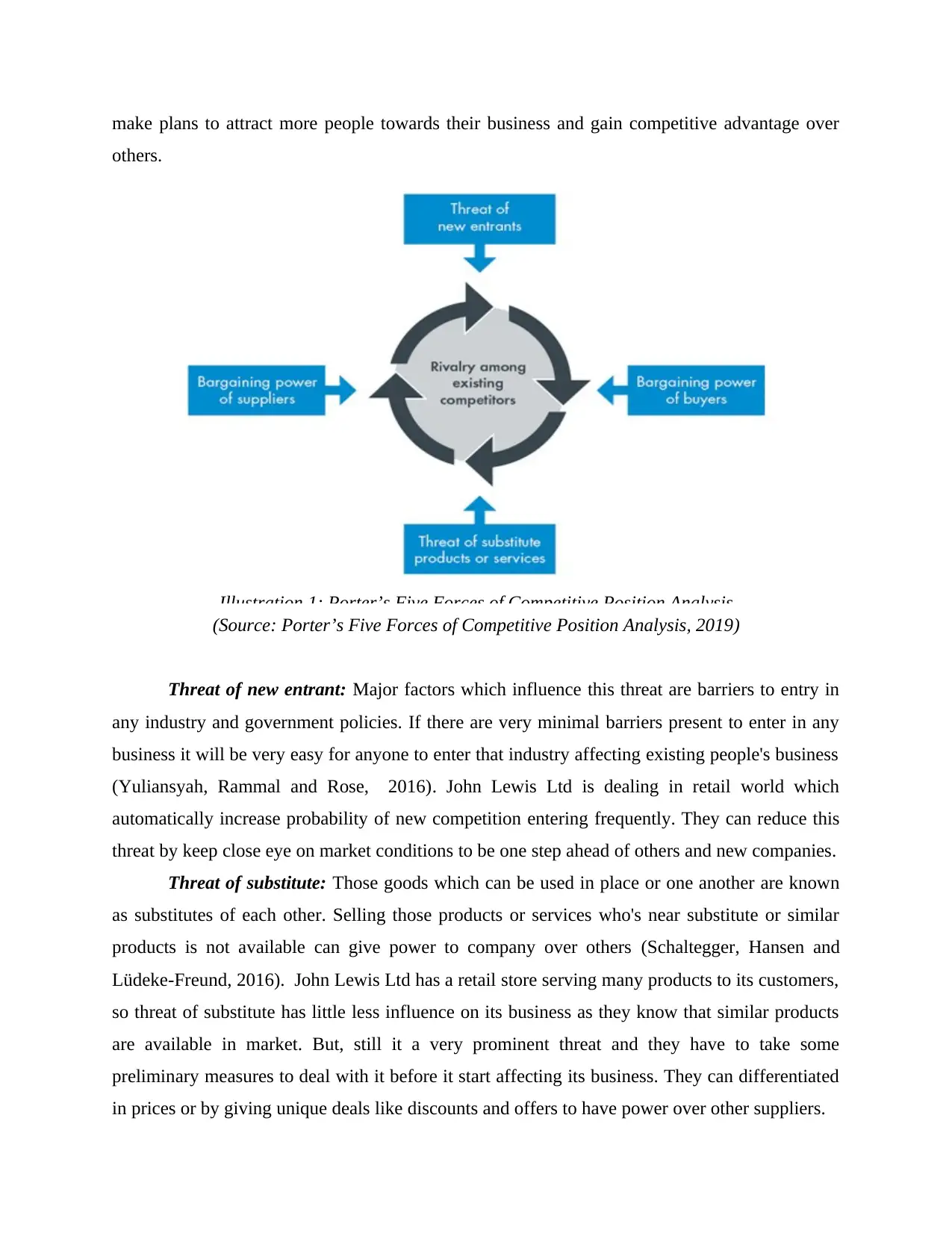
Porter's five forces model is tools used to analysis external environment of an
organisation to determine corporate strategy and to gain competitive advantage over other
competitors in market (Porter’s Five Forces of Competitive Position Analysis, 2019). This model
is a mixture of five elements helps in measuring company's competition, profitability and
attractiveness. John Lewis Ltd is a British company founded in 1929 by John Spedan Lewis. Its
dealing in many different sectors or industry. It has foot in different industries like supermarkets,
financial services, clothing, watches etc. which widens it market and raised requirement to study
external market to see what are different trends and strategies used in market and accordingly
These are the elements which needs to be improve to get high turnover and maintain the level of
supply chain (Amran and et. al., 2016). As John Lewis is the top retailer in UK but it does not
have international market despite of its online website. Furthermore, the prices which company
offers are higher than their competitors which can reduce the customer base. Company also have
fluctuating profitability as its decisions affect the revenues and sale.
Opportunities: These are the factors which can become favourable and by considering
them company can expand its business. For these elements the organisation can achieve
competitive advantage and can increase its sales, reputation and market share (Razak, and et. al.,
2016). Usage of advanced technology is an opportunity for John Lewis in order to launch its new
products in market according to the requirement of customers and by analysing the social
platform. To launch its products in developing market can bring valuable opportunity for the
company. As company offer trendy products which is helpful in developing the lifestyle and
through this their purchasing power increases.
Threats: These are those factors which can harm the organisation and it includes natural
calamities, rising cost of materials, competition increases, labour supply and many more.
Competition in retail market is tough as their competitors also provide best goods and services to
customers at minimum price. For John Lewis, local market can become threat for the company
as they also offer good quality products at valuable price.
TASK 3
P3. Evaluate the competitive forces of retail sector for organisation
Porter's five forces model is tools used to analysis external environment of an
organisation to determine corporate strategy and to gain competitive advantage over other
competitors in market (Porter’s Five Forces of Competitive Position Analysis, 2019). This model
is a mixture of five elements helps in measuring company's competition, profitability and
attractiveness. John Lewis Ltd is a British company founded in 1929 by John Spedan Lewis. Its
dealing in many different sectors or industry. It has foot in different industries like supermarkets,
financial services, clothing, watches etc. which widens it market and raised requirement to study
external market to see what are different trends and strategies used in market and accordingly
Paraphrase This Document
Need a fresh take? Get an instant paraphrase of this document with our AI Paraphraser
make plans to attract more people towards their business and gain competitive advantage over
others.
(Source: Porter’s Five Forces of Competitive Position Analysis, 2019)
Threat of new entrant: Major factors which influence this threat are barriers to entry in
any industry and government policies. If there are very minimal barriers present to enter in any
business it will be very easy for anyone to enter that industry affecting existing people's business
(Yuliansyah, Rammal and Rose, 2016). John Lewis Ltd is dealing in retail world which
automatically increase probability of new competition entering frequently. They can reduce this
threat by keep close eye on market conditions to be one step ahead of others and new companies.
Threat of substitute: Those goods which can be used in place or one another are known
as substitutes of each other. Selling those products or services who's near substitute or similar
products is not available can give power to company over others (Schaltegger, Hansen and
Lüdeke-Freund, 2016). John Lewis Ltd has a retail store serving many products to its customers,
so threat of substitute has little less influence on its business as they know that similar products
are available in market. But, still it a very prominent threat and they have to take some
preliminary measures to deal with it before it start affecting its business. They can differentiated
in prices or by giving unique deals like discounts and offers to have power over other suppliers.
Illustration 1: Porter’s Five Forces of Competitive Position Analysis
others.
(Source: Porter’s Five Forces of Competitive Position Analysis, 2019)
Threat of new entrant: Major factors which influence this threat are barriers to entry in
any industry and government policies. If there are very minimal barriers present to enter in any
business it will be very easy for anyone to enter that industry affecting existing people's business
(Yuliansyah, Rammal and Rose, 2016). John Lewis Ltd is dealing in retail world which
automatically increase probability of new competition entering frequently. They can reduce this
threat by keep close eye on market conditions to be one step ahead of others and new companies.
Threat of substitute: Those goods which can be used in place or one another are known
as substitutes of each other. Selling those products or services who's near substitute or similar
products is not available can give power to company over others (Schaltegger, Hansen and
Lüdeke-Freund, 2016). John Lewis Ltd has a retail store serving many products to its customers,
so threat of substitute has little less influence on its business as they know that similar products
are available in market. But, still it a very prominent threat and they have to take some
preliminary measures to deal with it before it start affecting its business. They can differentiated
in prices or by giving unique deals like discounts and offers to have power over other suppliers.
Illustration 1: Porter’s Five Forces of Competitive Position Analysis
Bargaining power of supplier: Having a upper hand then customers in deciding prices of
a products depends on how many suppliers are present. If company is doing business in
monopoly market then its in their favour and they can charge prices accordingly. John Lewis Ltd
is not dealing in monopolistic market, it has many competitors present in market giving
customers choice to select from different suppliers therefore, their bargaining power is low. John
Lewis Ltd has to set prices of their products in relation with market until and unless they are
offering any differentiated product to consumers for which no substitute or supplier is present.
Bargaining power of customers: This force specifically deals with consumers power
over suppliers to bring prices down (Yuliansyah, Gurd and Mohamed, 2017). It depends on size
of customer base and how influencing or powerful they are. In case of John Lewis Ltd this force
is very effective and has to be properly monitored. Because if customers are not happy with
adopted pricing strategy they will switch as switching cost is almost nil as better prices are
available in market with other suppliers.
Existing Rivalry: This force is talking about competitors already existing in market.
Larger the existing competition, with offering same or substitute products or services lesser or
divided will be the influence and power company has on market. John Lewis Ltd facing this
issue as it has many competitors serving same products and services to people. They can reduce
its effects if manage to provide better deals with less prices to its customers fulfilling their needs
by gaining advantage over its rivals.
TASK 4
P4. Application of theories, models and devise strategic planning for the organisation
To plan for the company, it is important to make a base concept and analyse its objectives
and strategies to achieve competitive advantage for company.
Company overview: John Lewis is a retailing store in UK and also located in Australis
and Ireland. It is big chain as it is employee owned organisation which is also known as
partnership company. It is founded in 1929, by Spedan Lewis son of John Lewis. Company deals
in various sectors such as in supermarket, financial services and other activities.
Vision and mission: Their vision is to create their customer presence at international
market in order to acquire competency and competitive advantage and mission is to create more
partners which is good for the company which makes it a great company.
a products depends on how many suppliers are present. If company is doing business in
monopoly market then its in their favour and they can charge prices accordingly. John Lewis Ltd
is not dealing in monopolistic market, it has many competitors present in market giving
customers choice to select from different suppliers therefore, their bargaining power is low. John
Lewis Ltd has to set prices of their products in relation with market until and unless they are
offering any differentiated product to consumers for which no substitute or supplier is present.
Bargaining power of customers: This force specifically deals with consumers power
over suppliers to bring prices down (Yuliansyah, Gurd and Mohamed, 2017). It depends on size
of customer base and how influencing or powerful they are. In case of John Lewis Ltd this force
is very effective and has to be properly monitored. Because if customers are not happy with
adopted pricing strategy they will switch as switching cost is almost nil as better prices are
available in market with other suppliers.
Existing Rivalry: This force is talking about competitors already existing in market.
Larger the existing competition, with offering same or substitute products or services lesser or
divided will be the influence and power company has on market. John Lewis Ltd facing this
issue as it has many competitors serving same products and services to people. They can reduce
its effects if manage to provide better deals with less prices to its customers fulfilling their needs
by gaining advantage over its rivals.
TASK 4
P4. Application of theories, models and devise strategic planning for the organisation
To plan for the company, it is important to make a base concept and analyse its objectives
and strategies to achieve competitive advantage for company.
Company overview: John Lewis is a retailing store in UK and also located in Australis
and Ireland. It is big chain as it is employee owned organisation which is also known as
partnership company. It is founded in 1929, by Spedan Lewis son of John Lewis. Company deals
in various sectors such as in supermarket, financial services and other activities.
Vision and mission: Their vision is to create their customer presence at international
market in order to acquire competency and competitive advantage and mission is to create more
partners which is good for the company which makes it a great company.
⊘ This is a preview!⊘
Do you want full access?
Subscribe today to unlock all pages.
Trusted by 1+ million students worldwide
Objectives: Marketing objective for John Lewis is based on the SMART principles which
are acquire at least 15% of departmental stores in Shanghai and Beijing. Achieve annually
growth of minimum 18% of international market and make sure that the revenues from that
market collect minimum 45% of the total revenues.
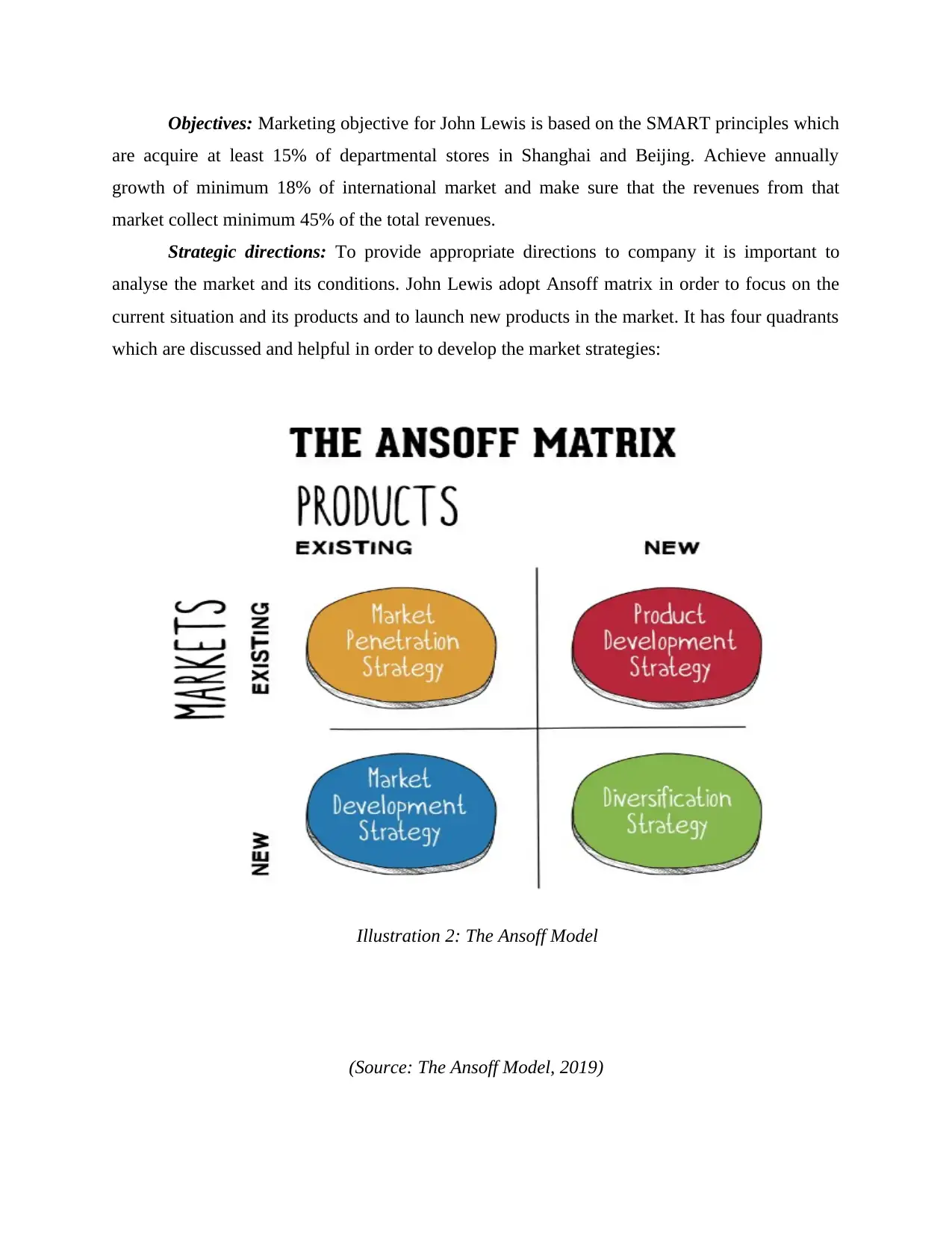
Strategic directions: To provide appropriate directions to company it is important to
analyse the market and its conditions. John Lewis adopt Ansoff matrix in order to focus on the
current situation and its products and to launch new products in the market. It has four quadrants
which are discussed and helpful in order to develop the market strategies:
(Source: The Ansoff Model, 2019)
Illustration 2: The Ansoff Model
are acquire at least 15% of departmental stores in Shanghai and Beijing. Achieve annually
growth of minimum 18% of international market and make sure that the revenues from that
market collect minimum 45% of the total revenues.
Strategic directions: To provide appropriate directions to company it is important to
analyse the market and its conditions. John Lewis adopt Ansoff matrix in order to focus on the
current situation and its products and to launch new products in the market. It has four quadrants
which are discussed and helpful in order to develop the market strategies:
(Source: The Ansoff Model, 2019)
Illustration 2: The Ansoff Model
Paraphrase This Document
Need a fresh take? Get an instant paraphrase of this document with our AI Paraphraser
Market Penetration: This strategy is less risky as in this company delivers it products in
the existing market with existing resources (Anwar and Hasnu, 2016). In this market
company deals in a very safest way as less risk is associated in it. Chances to achieve
competitive advantage are become limited as they does not deal in the new market
segment. In this strategy, company adopt penetration pricing policy which is while
launching products initially their prices are low and when demand increases or reach at
the saturation point company increases its prices to earn profitability. Market development: It is risky as here products are launched in new market with the
purpose to acquire them (Strategy, 2017). Here, John Lewis can achieve growth by
targeting new customers with its existing products. It includes new area which means
carry more risk and for this, company need to do proper research and develop strong
strategy if the competencies are concerned with particular product instead of special
market segment. As company is expanding its business into new market then its is
important for them to make strong strategy by which their risk factors gets eliminate or
reduce. Product Development: In this strategy, new products are introduced in order to target
existing market. This strategy is less or more risky as here company offer products by
conducting research of its market where it has its loyal customer base which is a strength
for company which is concerned with their specific customer base (Chen, Eshleman, and
Soileau, 2016). But it carries risk also as launching of new product depends on the
research of the company in which they try to increase their market share. Diversification: This strategy carry high level of risk with it here new product is
launched in the new market. It requires to develop strategies in order to launch its product
in market with the purpose of to earn more profit and revenues (Johnson, 2016). It is very
complex from the above discussed strategies and it is a reasonable choice of company
which require lot of courage and investment as high risk is associated with high rate of
return. It also has another benefit as it has potential to attract more customers and
industries and eliminates the overall risk from its competitors.
the existing market with existing resources (Anwar and Hasnu, 2016). In this market
company deals in a very safest way as less risk is associated in it. Chances to achieve
competitive advantage are become limited as they does not deal in the new market
segment. In this strategy, company adopt penetration pricing policy which is while
launching products initially their prices are low and when demand increases or reach at
the saturation point company increases its prices to earn profitability. Market development: It is risky as here products are launched in new market with the
purpose to acquire them (Strategy, 2017). Here, John Lewis can achieve growth by
targeting new customers with its existing products. It includes new area which means
carry more risk and for this, company need to do proper research and develop strong
strategy if the competencies are concerned with particular product instead of special
market segment. As company is expanding its business into new market then its is
important for them to make strong strategy by which their risk factors gets eliminate or
reduce. Product Development: In this strategy, new products are introduced in order to target
existing market. This strategy is less or more risky as here company offer products by
conducting research of its market where it has its loyal customer base which is a strength
for company which is concerned with their specific customer base (Chen, Eshleman, and
Soileau, 2016). But it carries risk also as launching of new product depends on the
research of the company in which they try to increase their market share. Diversification: This strategy carry high level of risk with it here new product is
launched in the new market. It requires to develop strategies in order to launch its product
in market with the purpose of to earn more profit and revenues (Johnson, 2016). It is very
complex from the above discussed strategies and it is a reasonable choice of company
which require lot of courage and investment as high risk is associated with high rate of
return. It also has another benefit as it has potential to attract more customers and
industries and eliminates the overall risk from its competitors.
Monitoring and controlling: It states that after the implementation of the strategic plan,
expertise need to monitor the business processes and have control on it. By which it becomes
easy for them to attain success at the marketplace by analysing the various aspect and conducting
research of the external factors.
CONCLUSION
From the above discussion it is concluded that business strategy is important to make
plans successful and to achieve competitive advantage of market. In order to make strategies,
companies need to analyse various data, facts and figures to design it. As it includes strategic
plan which describes the vision, mission, objectives and strategies used by the company. In order
to expand business, John Lewis need to conduct research of external market and SWOT analysis
for its internal aspects both are consequently helpful in achieving success in the organisation.
Moreover, it also include Porter's five forces to determine the other aspects of market like which
impacts more or less in order to enter into new market. Apart from this, a strategic plan is made
to interpret the various directions available for an organisation.
expertise need to monitor the business processes and have control on it. By which it becomes
easy for them to attain success at the marketplace by analysing the various aspect and conducting
research of the external factors.
CONCLUSION
From the above discussion it is concluded that business strategy is important to make
plans successful and to achieve competitive advantage of market. In order to make strategies,
companies need to analyse various data, facts and figures to design it. As it includes strategic
plan which describes the vision, mission, objectives and strategies used by the company. In order
to expand business, John Lewis need to conduct research of external market and SWOT analysis
for its internal aspects both are consequently helpful in achieving success in the organisation.
Moreover, it also include Porter's five forces to determine the other aspects of market like which
impacts more or less in order to enter into new market. Apart from this, a strategic plan is made
to interpret the various directions available for an organisation.
⊘ This is a preview!⊘
Do you want full access?
Subscribe today to unlock all pages.
Trusted by 1+ million students worldwide

1 out of 13


Related Documents


Your All-in-One AI-Powered Toolkit for Academic Success.
+13062052269
info@desklib.com
Available 24*7 on WhatsApp / Email
![[object Object]](/_next/static/media/star-bottom.7253800d.svg)
Unlock your academic potential
Copyright © 2020–2026 A2Z Services. All Rights Reserved. Developed and managed by ZUCOL.