Business Strategy Report: Next Plc. Analysis and Recommendations
VerifiedAdded on 2019/12/28
|13
|3814
|1333
Report
AI Summary
This report provides a comprehensive analysis of Next Plc.'s business strategy, examining its mission, vision, goals, and core competencies. The report delves into the factors crucial for formulating a strategic plan, evaluating the effectiveness of techniques such as the Ansoff Matrix and BCG Matrix. It assesses Next Plc.'s current strategic position through SWOT and PESTLE analyses, highlighting the significance of stakeholder analysis in developing a new strategy. The study proposes a new strategy for Next Plc., justified by an organizational audit and stakeholder analysis, and discusses the roles and responsibilities for implementation, estimated resource requirements, and the contribution of SMART targets. The analysis reveals key insights into Next Plc.'s market position, competitive landscape, and strategic options, offering a detailed understanding of its business operations and future directions.

BUSINESS STRATEGY

Paraphrase This Document
Need a fresh take? Get an instant paraphrase of this document with our AI Paraphraser
TABLE OF CONTENTS
INTRODUCTION......................................................................................................................1
TASK 1......................................................................................................................................1
1.1 Next Plc. mission, vision, goals and objectives as well as the core competencies..........1
1.2 Factors that have to be considered when formulating a strategic plan............................2
1.3 Effectiveness of at least two techniques used when developing strategic business plans
................................................................................................................................................3
Ansoff Matrix......................................................................................................................3
BCG Matrix........................................................................................................................3
TASK 2......................................................................................................................................4
2.1 Current strategic position.................................................................................................4
2.2 Environmental Audit PESTLE Analysis..........................................................................5
2.3 Significance of stakeholders’ analysis when formulating a new strategy...................5
2.4 New strategy for Next Plc. based on organisational audit and stakeholders’ analysis....6
TASK 3......................................................................................................................................6
3.1 Appropriateness of alternative strategies.........................................................................6
3.2 Justification for the selection of new strategy..................................................................7
TASK 4......................................................................................................................................7
4.1 Roles and responsibilities of personnel in charge of implementing the strategy.............7
4.2 Estimated resource requirements to implement the new strategy....................................7
4.3 Contributions of SMART targets to the achievement of the strategy implementation....8
CONCLUSION..........................................................................................................................8
REFERENCES...........................................................................................................................9
INTRODUCTION......................................................................................................................1
TASK 1......................................................................................................................................1
1.1 Next Plc. mission, vision, goals and objectives as well as the core competencies..........1
1.2 Factors that have to be considered when formulating a strategic plan............................2
1.3 Effectiveness of at least two techniques used when developing strategic business plans
................................................................................................................................................3
Ansoff Matrix......................................................................................................................3
BCG Matrix........................................................................................................................3
TASK 2......................................................................................................................................4
2.1 Current strategic position.................................................................................................4
2.2 Environmental Audit PESTLE Analysis..........................................................................5
2.3 Significance of stakeholders’ analysis when formulating a new strategy...................5
2.4 New strategy for Next Plc. based on organisational audit and stakeholders’ analysis....6
TASK 3......................................................................................................................................6
3.1 Appropriateness of alternative strategies.........................................................................6
3.2 Justification for the selection of new strategy..................................................................7
TASK 4......................................................................................................................................7
4.1 Roles and responsibilities of personnel in charge of implementing the strategy.............7
4.2 Estimated resource requirements to implement the new strategy....................................7
4.3 Contributions of SMART targets to the achievement of the strategy implementation....8
CONCLUSION..........................................................................................................................8
REFERENCES...........................................................................................................................9

LIST OF FIGURES
Figure 1 Ansoff Matrix..............................................................................................................3
Figure 1 Ansoff Matrix..............................................................................................................3
⊘ This is a preview!⊘
Do you want full access?
Subscribe today to unlock all pages.

Trusted by 1+ million students worldwide
INTRODUCTION
Nowadays most of the firms are trying to develop several strategies through which
they can achieve higher competitive advantage. For this, they are setting their firm’s
objectives as well as future directions which they want to attain (Roumboutsos and Chiara,
2010). In this context, the present study is based on the business strategy of Next Plc. which
is second largest retailers of UK after M&S and having more than 500 stored in the UK itself.
The company is listed in London stock exchange and they are one of the leading clothing
retailers. Further, this study presents the appropriate information about the Next Plc. as well
as its business strategies to attain their goals and objectives in an effective manner. It is the
means through which Next can set out for achieving its desired objectives. It can also be
referred as a long-term business planning.
TASK 1
1.1 Next Plc. mission, vision, goals and objectives as well as the core competencies
Strategies can be defined as a long term planned actions and activities which are taken
into consideration by every organization. Through this, firms can easily achieve their goals
and objectives. However, Next Plc. can get a correct path by setting their future direction
such as:
Mission: They have the mission to become the natural choice of retailer in the UK for
all those people who are having unique choice as well as distinction and quality from
their clothing.
Vision: The vision statement of company is to deliver long term return to
shareholders through the combination of sustainable growth.
Goals: They have the goal of increasing the customer satisfaction by introducing new
initiatives such as next day delivery to home etc. They wants to meet the exceeded
consumer expectations by providing them beautifully designed, excellent quality
clothing.
Objectives: The main objective of company is to deliver quality services to their
customers such as fashionable clothing, accessories and furnishings for a good price.
Another major objective of company is that no one should harm at the time when
products are being made.
Core competencies: The major core competencies of Next Plc. are their intra seasonal
style trends and demanding customers, customer values, integration, team building
spirit etc. Freedom of association, equal opportunity, culture as well as their
Page | 1
Nowadays most of the firms are trying to develop several strategies through which
they can achieve higher competitive advantage. For this, they are setting their firm’s
objectives as well as future directions which they want to attain (Roumboutsos and Chiara,
2010). In this context, the present study is based on the business strategy of Next Plc. which
is second largest retailers of UK after M&S and having more than 500 stored in the UK itself.
The company is listed in London stock exchange and they are one of the leading clothing
retailers. Further, this study presents the appropriate information about the Next Plc. as well
as its business strategies to attain their goals and objectives in an effective manner. It is the
means through which Next can set out for achieving its desired objectives. It can also be
referred as a long-term business planning.
TASK 1
1.1 Next Plc. mission, vision, goals and objectives as well as the core competencies
Strategies can be defined as a long term planned actions and activities which are taken
into consideration by every organization. Through this, firms can easily achieve their goals
and objectives. However, Next Plc. can get a correct path by setting their future direction
such as:
Mission: They have the mission to become the natural choice of retailer in the UK for
all those people who are having unique choice as well as distinction and quality from
their clothing.
Vision: The vision statement of company is to deliver long term return to
shareholders through the combination of sustainable growth.
Goals: They have the goal of increasing the customer satisfaction by introducing new
initiatives such as next day delivery to home etc. They wants to meet the exceeded
consumer expectations by providing them beautifully designed, excellent quality
clothing.
Objectives: The main objective of company is to deliver quality services to their
customers such as fashionable clothing, accessories and furnishings for a good price.
Another major objective of company is that no one should harm at the time when
products are being made.
Core competencies: The major core competencies of Next Plc. are their intra seasonal
style trends and demanding customers, customer values, integration, team building
spirit etc. Freedom of association, equal opportunity, culture as well as their
Page | 1
Paraphrase This Document
Need a fresh take? Get an instant paraphrase of this document with our AI Paraphraser
diversification in apparel retailing. The major strength of any business over their
competitors is known as core competencies. Here, Next Plc. core competency was
used to differentiate their services by providing quality services and unique featured
product to their customers.
1.2 Factors that have to be considered when formulating a strategic plan
At the time of formulating strategic plan for Next Plc. they must have to consider
several factors. With the help of these factors they are able to attain higher competitive
advantage. It also defines as a strategic planning where manager can easily define their goals
and objectives in an effective manner. Factors that have to be considered are as follows:
Marketing perspective or analysis: It is the most important point which must be taken
into consideration at the time of formulation of any strategy (Nieuwenhuizen and Koch,
2007). In this, company can easily review and change their strategic plan as per their
customers’ needs and demands. For this, Next Plc. should go through the proper market
research so that they can satisfy their customers’ needs by providing them quality services.
Goals and Objectives of company: At the time of formulating strategic plan company
must keep their goals and objectives on their top most priorities. It is the best effective way
through which they can develop appropriate strategy related to their goals and objectives.
Future direction of company: Next Plc. is second largest retailer of UK after M&S.
They have set their future direction and want to become the top most retailer of company
(Burden, 2000). In order to attain this position it is essential for them to set their future
direction with their target customers as well.
SWOT analysis: Company must go through their internal analysis so that they can
identify all the areas regarding their strengths, weaknesses, opportunities and threats. It helps
them in expanding their business as per their strengths and easily found out the opportunities.
It is the best technique through which Next Plc. can easily identify the competition within the
area and try to develop strategies accordingly (Thompson, 2004).
Define strategies: After analysing the market as well as Internal conditions of Firm,
Next can easily elaborate the strategies which helps them in achieving higher competitive.
However, after completion of formulation of strategies it is essential for them to review all
the strategies as well as its effects. In case of having any type of misleads or issues they
requires to resolve them appropriately
By following all the above points, Next Plc. is able to select right people so that best
plan can be formulated and objective can be easily achieved.
Page | 2
competitors is known as core competencies. Here, Next Plc. core competency was
used to differentiate their services by providing quality services and unique featured
product to their customers.
1.2 Factors that have to be considered when formulating a strategic plan
At the time of formulating strategic plan for Next Plc. they must have to consider
several factors. With the help of these factors they are able to attain higher competitive
advantage. It also defines as a strategic planning where manager can easily define their goals
and objectives in an effective manner. Factors that have to be considered are as follows:
Marketing perspective or analysis: It is the most important point which must be taken
into consideration at the time of formulation of any strategy (Nieuwenhuizen and Koch,
2007). In this, company can easily review and change their strategic plan as per their
customers’ needs and demands. For this, Next Plc. should go through the proper market
research so that they can satisfy their customers’ needs by providing them quality services.
Goals and Objectives of company: At the time of formulating strategic plan company
must keep their goals and objectives on their top most priorities. It is the best effective way
through which they can develop appropriate strategy related to their goals and objectives.
Future direction of company: Next Plc. is second largest retailer of UK after M&S.
They have set their future direction and want to become the top most retailer of company
(Burden, 2000). In order to attain this position it is essential for them to set their future
direction with their target customers as well.
SWOT analysis: Company must go through their internal analysis so that they can
identify all the areas regarding their strengths, weaknesses, opportunities and threats. It helps
them in expanding their business as per their strengths and easily found out the opportunities.
It is the best technique through which Next Plc. can easily identify the competition within the
area and try to develop strategies accordingly (Thompson, 2004).
Define strategies: After analysing the market as well as Internal conditions of Firm,
Next can easily elaborate the strategies which helps them in achieving higher competitive.
However, after completion of formulation of strategies it is essential for them to review all
the strategies as well as its effects. In case of having any type of misleads or issues they
requires to resolve them appropriately
By following all the above points, Next Plc. is able to select right people so that best
plan can be formulated and objective can be easily achieved.
Page | 2
1.3 Effectiveness of at least two techniques used when developing strategic business plans
Ansoff Matrix
At the time of developing any strategic business plan Next Plc. can easily review their
market growth. This technique assists organizations to map their strategic product growth. It
can also define as a planning tool through which company can easily evaluate the better
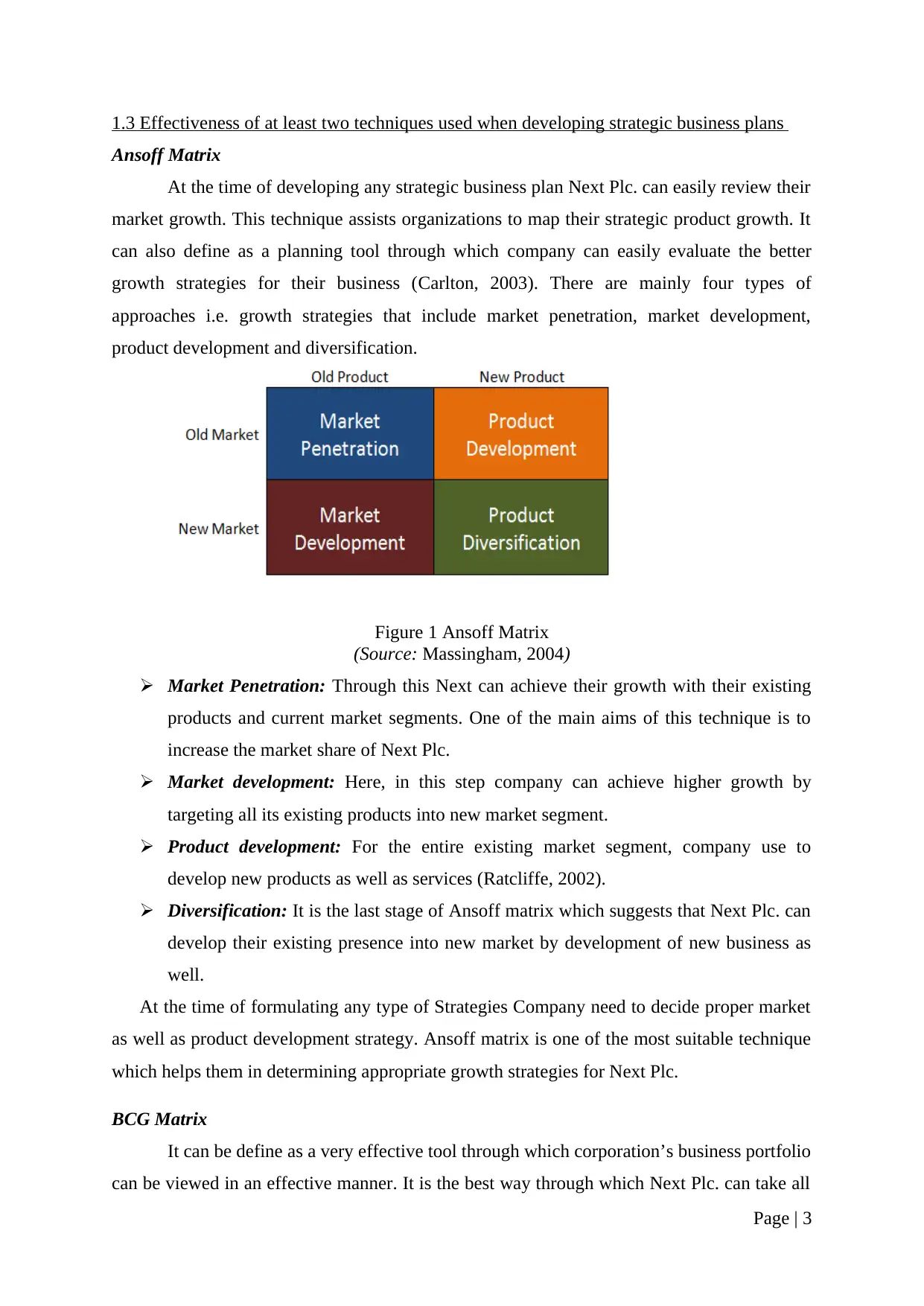
growth strategies for their business (Carlton, 2003). There are mainly four types of
approaches i.e. growth strategies that include market penetration, market development,
product development and diversification.
Figure 1 Ansoff Matrix
(Source: Massingham, 2004)
Market Penetration: Through this Next can achieve their growth with their existing
products and current market segments. One of the main aims of this technique is to
increase the market share of Next Plc.
Market development: Here, in this step company can achieve higher growth by
targeting all its existing products into new market segment.
Product development: For the entire existing market segment, company use to
develop new products as well as services (Ratcliffe, 2002).
Diversification: It is the last stage of Ansoff matrix which suggests that Next Plc. can
develop their existing presence into new market by development of new business as
well.
At the time of formulating any type of Strategies Company need to decide proper market
as well as product development strategy. Ansoff matrix is one of the most suitable technique
which helps them in determining appropriate growth strategies for Next Plc.
BCG Matrix
It can be define as a very effective tool through which corporation’s business portfolio
can be viewed in an effective manner. It is the best way through which Next Plc. can take all
Page | 3
Ansoff Matrix
At the time of developing any strategic business plan Next Plc. can easily review their
market growth. This technique assists organizations to map their strategic product growth. It
can also define as a planning tool through which company can easily evaluate the better
growth strategies for their business (Carlton, 2003). There are mainly four types of
approaches i.e. growth strategies that include market penetration, market development,
product development and diversification.
Figure 1 Ansoff Matrix
(Source: Massingham, 2004)
Market Penetration: Through this Next can achieve their growth with their existing
products and current market segments. One of the main aims of this technique is to
increase the market share of Next Plc.
Market development: Here, in this step company can achieve higher growth by
targeting all its existing products into new market segment.
Product development: For the entire existing market segment, company use to
develop new products as well as services (Ratcliffe, 2002).
Diversification: It is the last stage of Ansoff matrix which suggests that Next Plc. can
develop their existing presence into new market by development of new business as
well.
At the time of formulating any type of Strategies Company need to decide proper market
as well as product development strategy. Ansoff matrix is one of the most suitable technique
which helps them in determining appropriate growth strategies for Next Plc.
BCG Matrix
It can be define as a very effective tool through which corporation’s business portfolio
can be viewed in an effective manner. It is the best way through which Next Plc. can take all
Page | 3
⊘ This is a preview!⊘
Do you want full access?
Subscribe today to unlock all pages.
Trusted by 1+ million students worldwide
the appropriate decisions. With the help of this technique Next Plc. can see their current
position of the company. By using this technique company can divide its products in to the
four quadrants which are:
Star: It consists of all those products which covers high growth and high market share
of company. With the help of this company can gain higher margin profit.
Cash Cow: All those products of company who are having high market share but low
growth comes under this category (Flor and Oltra, 2010).
Dogs: Under this category all those products exists which are having the low market
share and growth. It is the best way through which companies can easily decide whether
products should be eliminated from portfolio of company or not.
Questions: All the newly launched products exist into this category. These products
help on increasing market share as well as profit margin of company.
TASK 2
2.1 Current strategic position
SWOT ANALYSIS
Strengths:
Highest performance in recent years
Advertising and marketing
Powerful designing
Innovation
Brand and advertising
Weaknesses:
Declined profit margin than previous years
Overpriced
Expensive currency
Opportunities:
Expansion into new markets
Optimize store space
Threats:
Reduced target market
M&S Biggest competitor
Over crowded market
New entrants
Page | 4
position of the company. By using this technique company can divide its products in to the
four quadrants which are:
Star: It consists of all those products which covers high growth and high market share
of company. With the help of this company can gain higher margin profit.
Cash Cow: All those products of company who are having high market share but low
growth comes under this category (Flor and Oltra, 2010).
Dogs: Under this category all those products exists which are having the low market
share and growth. It is the best way through which companies can easily decide whether
products should be eliminated from portfolio of company or not.
Questions: All the newly launched products exist into this category. These products
help on increasing market share as well as profit margin of company.
TASK 2
2.1 Current strategic position
SWOT ANALYSIS
Strengths:
Highest performance in recent years
Advertising and marketing
Powerful designing
Innovation
Brand and advertising
Weaknesses:
Declined profit margin than previous years
Overpriced
Expensive currency
Opportunities:
Expansion into new markets
Optimize store space
Threats:
Reduced target market
M&S Biggest competitor
Over crowded market
New entrants
Page | 4
Paraphrase This Document
Need a fresh take? Get an instant paraphrase of this document with our AI Paraphraser
2.2 Environmental Audit PESTLE Analysis
Political factors: This is one of the most essential factors which Next Plc. must have
to take into consideration in order to carry out all their business operations more effectives.
By the help of going through appropriate environmental audit company can easily plan out
their new strategies. UK is a member state of European Union and it fulfils all the political
surroundings. With the help of this, Next Plc. is able to take better long term decisions.
Further, this is the best way through which company can gain a higher scope of economic
conditions (Gilligan, 2005). During the hard economic times meant overall spending by
customers was suppressed. Moreover, there are different policies of UK which create huge
impact on the functioning of the business.
Economic factors: Within the UK whole economic climate is unstable due to which
short term volatility in Next sales has seen. Unemployment is another major factor which has
slowed down the spending of customers in the UK. In addition to this, within the Next Plc.
there are was less availability of consumer credit to both consumers and businesses alike.
Social Factors: Due to the high population of UK there are lot of customers of Next
Plc. Here, it can be define that their lifestyle or changing needs due to the changing fashion as
well as changes in demographics labour are some of the major factors which totally affects
the total market share of company (Platts, 2005).
Technological factors: All the new inventions as well as developments and changes
in Information technology is considered as a most important factors that highly influence the
whole company’s performance. Further, this has given Next Plc. a lot of potential
opportunities to boost up their profit margin.
Environmental factors: Next Plc. have recognises the current trends in consumers
and government demanding to reduce their carbon footprints. Next Plc. is highly responsible
for lowering down the transport emissions as well minimising the waste.
Legal: This is the last factor which can also highly affects the business operations of
Next Plc. due to the different government policies such as increased VAT, Tax rates etc.
(Gilligan, 2005).
2.3 Significance of stakeholders’ analysis when formulating a new strategy
Stakeholders are the persons who get affected by all the organizational decisions. Next
Plc. is able to attain their objectives with the help of their stakeholders such as:
Page | 5
Political factors: This is one of the most essential factors which Next Plc. must have
to take into consideration in order to carry out all their business operations more effectives.
By the help of going through appropriate environmental audit company can easily plan out
their new strategies. UK is a member state of European Union and it fulfils all the political
surroundings. With the help of this, Next Plc. is able to take better long term decisions.
Further, this is the best way through which company can gain a higher scope of economic
conditions (Gilligan, 2005). During the hard economic times meant overall spending by
customers was suppressed. Moreover, there are different policies of UK which create huge
impact on the functioning of the business.
Economic factors: Within the UK whole economic climate is unstable due to which
short term volatility in Next sales has seen. Unemployment is another major factor which has
slowed down the spending of customers in the UK. In addition to this, within the Next Plc.
there are was less availability of consumer credit to both consumers and businesses alike.
Social Factors: Due to the high population of UK there are lot of customers of Next
Plc. Here, it can be define that their lifestyle or changing needs due to the changing fashion as
well as changes in demographics labour are some of the major factors which totally affects
the total market share of company (Platts, 2005).
Technological factors: All the new inventions as well as developments and changes
in Information technology is considered as a most important factors that highly influence the
whole company’s performance. Further, this has given Next Plc. a lot of potential
opportunities to boost up their profit margin.
Environmental factors: Next Plc. have recognises the current trends in consumers
and government demanding to reduce their carbon footprints. Next Plc. is highly responsible
for lowering down the transport emissions as well minimising the waste.
Legal: This is the last factor which can also highly affects the business operations of
Next Plc. due to the different government policies such as increased VAT, Tax rates etc.
(Gilligan, 2005).
2.3 Significance of stakeholders’ analysis when formulating a new strategy
Stakeholders are the persons who get affected by all the organizational decisions. Next
Plc. is able to attain their objectives with the help of their stakeholders such as:
Page | 5
Employees: Here, they are the most important stakeholders as company is totally
depended on employees (Recklies, 2008). Due to this, they are having high power and high
interest in the company.
Customers: They are the most essential asset of any organization in which power of
the buyers is very high as the company serves its business operations for customers only.
Local Government: There are various policies and a regulation which must be
followed by Next Plc. Due to this local government has very high power and low interest in
the company.
Shareholders: They are having a great influence on the company as they are the
investors of company (Nieuwenhuizen and Koch, 2007). They play a major role due to the
existing large presence of the company.
2.4 New strategy for Next Plc. based on organisational audit and stakeholders’ analysis
As per the above given organizational audit it has been founded that company’s major
strength is their highest performance in the recent years as well as brand name. Next Plc.
basically wants to boost up the shopping experience of their customers by providing them
quality services. Further, success of an organisation in today's competitive world depends
largely on the extent of strategy formulation and implementation (Henderson, 2000). In order
to maintain their luxury position and grow in future Next Plc. has developed a new strategy
for market expansion within different countries. With the help of this, they can enhance their
target base of customers and also raise their profit margin as well.
TASK 3
3.1 Appropriateness of alternative strategies
There are several alternative strategies which have been adopted by Next Plc. in order
to expand their business operations such as:
Market entry: In this manager of Next Plc. can set their future direction by
developing their market existence in different countries by partnership, merger and
acquisition as well as direct exporting etc.
Substantive growth: With the help of this strategy Next Plc. can enhance their current
development growth by increasing their financial resources (Platts, 2005).
Limited growth: Under this two techniques can be used by them market penetration
as well as development. With the help of market penetration Next Plc. can sell their products
to more customers as per their market expansion. In addition to this, company can directly
sell their products internationally as per their market development.
Page | 6
depended on employees (Recklies, 2008). Due to this, they are having high power and high
interest in the company.
Customers: They are the most essential asset of any organization in which power of
the buyers is very high as the company serves its business operations for customers only.
Local Government: There are various policies and a regulation which must be
followed by Next Plc. Due to this local government has very high power and low interest in
the company.
Shareholders: They are having a great influence on the company as they are the
investors of company (Nieuwenhuizen and Koch, 2007). They play a major role due to the
existing large presence of the company.
2.4 New strategy for Next Plc. based on organisational audit and stakeholders’ analysis
As per the above given organizational audit it has been founded that company’s major
strength is their highest performance in the recent years as well as brand name. Next Plc.
basically wants to boost up the shopping experience of their customers by providing them
quality services. Further, success of an organisation in today's competitive world depends
largely on the extent of strategy formulation and implementation (Henderson, 2000). In order
to maintain their luxury position and grow in future Next Plc. has developed a new strategy
for market expansion within different countries. With the help of this, they can enhance their
target base of customers and also raise their profit margin as well.
TASK 3
3.1 Appropriateness of alternative strategies
There are several alternative strategies which have been adopted by Next Plc. in order
to expand their business operations such as:
Market entry: In this manager of Next Plc. can set their future direction by
developing their market existence in different countries by partnership, merger and
acquisition as well as direct exporting etc.
Substantive growth: With the help of this strategy Next Plc. can enhance their current
development growth by increasing their financial resources (Platts, 2005).
Limited growth: Under this two techniques can be used by them market penetration
as well as development. With the help of market penetration Next Plc. can sell their products
to more customers as per their market expansion. In addition to this, company can directly
sell their products internationally as per their market development.
Page | 6
⊘ This is a preview!⊘
Do you want full access?
Subscribe today to unlock all pages.
Trusted by 1+ million students worldwide
Retrenchment: Direct efforts can be made by managers in order to maintain their
sales. For this, they have to select internet as their advertising and promotional tool. In this
company can directly contact with their customers (Oetinger, 2001).
3.2 Justification for the selection of new strategy
Next Plc. can adopt market development as well as expansion strategy in which they
enter into new markets. It is the best way through which they can create their sales as well as
maintain their declining market share as well as sales. It is considered as a most appropriate
strategy through which company can easily attract huge base of customers (Jackson, 2012). It
helps them in developing their global identity and establishing their presence where they have
not established. In addition to this, they can also reduce the dangers of sales decline and give
NEXT an extra profit from the new target group within new country.
TASK 4
4.1 Roles and responsibilities of personnel in charge of implementing the strategy
At the time of strategic implementation there are different personnel's which are
involved and all of them are having different responsibilities such as:
CEO: He is the one who is responsible for all the management level decisions as well as
day to day business decisions (John, 2005). In this, CEO can plan out for the long term vision
of company.
Store level staff: They are responsible for close monitoring of all the products so that any
type of error cannot be easily occurred. Management team of Next Plc. need to go through
the monitoring of their different departments such as wholesale, retail etc.
Finance department: They are responsible for managing budgeting and performance
evaluation (Massingham, 2004). It is the only way through which total performance and
profit margin of company can be evaluated.
Shop floor workers: They are responsible for customer support services to all their
consumers. Next Plc. need to provide high customer support services so that they can easily
maintain customer loyalty.
4.2 Estimated resource requirements to implement the new strategy
There are various resources required by company at the time of implementation of
new strategy such as:
Finance: This can be considered as a most important resource. At the time of
implementing any new strategy for their company they must have to go through their
financial resources (Marren, 2007). It must be supported to their future activity. Further, it
Page | 7
sales. For this, they have to select internet as their advertising and promotional tool. In this
company can directly contact with their customers (Oetinger, 2001).
3.2 Justification for the selection of new strategy
Next Plc. can adopt market development as well as expansion strategy in which they
enter into new markets. It is the best way through which they can create their sales as well as
maintain their declining market share as well as sales. It is considered as a most appropriate
strategy through which company can easily attract huge base of customers (Jackson, 2012). It
helps them in developing their global identity and establishing their presence where they have
not established. In addition to this, they can also reduce the dangers of sales decline and give
NEXT an extra profit from the new target group within new country.
TASK 4
4.1 Roles and responsibilities of personnel in charge of implementing the strategy
At the time of strategic implementation there are different personnel's which are
involved and all of them are having different responsibilities such as:
CEO: He is the one who is responsible for all the management level decisions as well as
day to day business decisions (John, 2005). In this, CEO can plan out for the long term vision
of company.
Store level staff: They are responsible for close monitoring of all the products so that any
type of error cannot be easily occurred. Management team of Next Plc. need to go through
the monitoring of their different departments such as wholesale, retail etc.
Finance department: They are responsible for managing budgeting and performance
evaluation (Massingham, 2004). It is the only way through which total performance and
profit margin of company can be evaluated.
Shop floor workers: They are responsible for customer support services to all their
consumers. Next Plc. need to provide high customer support services so that they can easily
maintain customer loyalty.
4.2 Estimated resource requirements to implement the new strategy
There are various resources required by company at the time of implementation of
new strategy such as:
Finance: This can be considered as a most important resource. At the time of
implementing any new strategy for their company they must have to go through their
financial resources (Marren, 2007). It must be supported to their future activity. Further, it
Page | 7
Paraphrase This Document
Need a fresh take? Get an instant paraphrase of this document with our AI Paraphraser
can be stated that Next Plc. must have appropriate budget before planning for market
expansion strategy.
Human Resource: It is quite essential to have appropriate personnel’s so that all the
needs of their customers can be easily fulfilled (Flor and Oltra, 2010). With the help of
trained human resource company is able to provide high quality products to all their
consumers.
Technological resources: In order to go through the market expansion company must
have proper technological resources through which they can properly communicate with each
other. Huge technological equipment’s are required by them so that they can differentiate
their products and services more effectively.
4.3 Contributions of SMART targets to the achievement of the strategy implementation
Specific: Firstly, company have developed their specific objectives in which they
requires to go through proper market expansion of their business within different
countries.
Measurable: They have set their measurable goal within their strategic
implementation in which they require to expand their business in almost 3 countries
(Oetinger, 2001).
Attainable: In order to attain the set target goals it is quite essential for them to go
through the appropriate market analysis and auditing.
Realistic: For this, they have set their realistic goals in which they can expand their
business through licensing, franchising, merger and acquisition etc.
Target: In order to accomplish their set goals they have decided appropriate target for
2 years (Gilligan, 2005). In this given timeline Next Plc. required to develop their
international position within 3 countries.
CONCLUSION
From the presentation it has been articulated that Next Plc. can easily sustain their
luxury position in the market by implementing some of the best strategies. Market expansion
is one of their growth strategy through which they can easily achieve their objectives. By the
help of appropriate resources such as HR, technological equipment as well as financial
resources as well as proper market Analysis Company can easily develop their best strategy.
Page | 8
expansion strategy.
Human Resource: It is quite essential to have appropriate personnel’s so that all the
needs of their customers can be easily fulfilled (Flor and Oltra, 2010). With the help of
trained human resource company is able to provide high quality products to all their
consumers.
Technological resources: In order to go through the market expansion company must
have proper technological resources through which they can properly communicate with each
other. Huge technological equipment’s are required by them so that they can differentiate
their products and services more effectively.
4.3 Contributions of SMART targets to the achievement of the strategy implementation
Specific: Firstly, company have developed their specific objectives in which they
requires to go through proper market expansion of their business within different
countries.
Measurable: They have set their measurable goal within their strategic
implementation in which they require to expand their business in almost 3 countries
(Oetinger, 2001).
Attainable: In order to attain the set target goals it is quite essential for them to go
through the appropriate market analysis and auditing.
Realistic: For this, they have set their realistic goals in which they can expand their
business through licensing, franchising, merger and acquisition etc.
Target: In order to accomplish their set goals they have decided appropriate target for
2 years (Gilligan, 2005). In this given timeline Next Plc. required to develop their
international position within 3 countries.
CONCLUSION
From the presentation it has been articulated that Next Plc. can easily sustain their
luxury position in the market by implementing some of the best strategies. Market expansion
is one of their growth strategy through which they can easily achieve their objectives. By the
help of appropriate resources such as HR, technological equipment as well as financial
resources as well as proper market Analysis Company can easily develop their best strategy.
Page | 8
REFERENCES
Burden, P., 2000. Powerful Classroom Management Strategies: Motivating Students to
Learn. Corwin Press.
Carlton, J., 2003. Invasive Species: Vectors And Management Strategies. Island Press.
Flor, M. L. and Oltra, M. J., 2010. The moderating effect of business strategy on the
relationship between operations strategy and firms' results. International Journal of
Operations & Production Management. 30(6). pp. 612–638.
Gilligan, C., 2005. Strategic Marketing Management: Planning, Implementation and Control.
Routledge.
Hagel, J. and Brown, J., 2005. The Only Sustainable Edge: Why Business Strategy Depends
on Productive Friction and Dynamic Specialization. Harvard Business Press.
Henderson, B., 2000. The logic of business strategy. Ballinger Pub. Co.
Jackson, S., 2012. Five secrets to success in business strategy. Journal of Business Strategy.
33(2).
John, R., 2005. Global Business Strategy. Cengage Learning EMEA.
Marren, M., 2007. High-functioning business strategy. Journal of Business Strategy. 28(6).
pp.37–39.
Massingham, P., 2004. Linking business level strategy with activities and knowledge
resources. Journal of Knowledge Management. 8(6). pp.50–62.
Nieuwenhuizen, P. and Koch, R., 2007. A good business strategy need not be difficult: How
Simply Strategy can improve your business. Strategic Direction. 23(3). pp.3–5.
Oetinger, B., 2001. THE RENAISSANCE STRATEGIST. Journal of Business Strategy.
22(6). pp.38 – 42.
Peterson, S. and Tenenbaum, H., 2000. Behavior Management: Strategies and Techniques.
University Press of America.
Platts, K., 2005. Effective strategic action planning: a process and tool. Business Process
Management Journal. 11(2). pp.137 – 157.
Poulfelt, F., 2009. Discount Business Strategy: How the New Market Leaders are Redefining
Business Strategy. John Wiley & Sons.
Ratcliffe, J., 2002. Scenario planning: strategic interviews and conversations. Foresight. 4(1).
pp.19 – 30.
Roumboutsos, A. and Chiara, N., 2010. A strategic partnering framework analysis
methodology for public-private partnerships. Journal of Financial Management of
Property and Construction. 15(3). pp.235–246.
Page | 9
Burden, P., 2000. Powerful Classroom Management Strategies: Motivating Students to
Learn. Corwin Press.
Carlton, J., 2003. Invasive Species: Vectors And Management Strategies. Island Press.
Flor, M. L. and Oltra, M. J., 2010. The moderating effect of business strategy on the
relationship between operations strategy and firms' results. International Journal of
Operations & Production Management. 30(6). pp. 612–638.
Gilligan, C., 2005. Strategic Marketing Management: Planning, Implementation and Control.
Routledge.
Hagel, J. and Brown, J., 2005. The Only Sustainable Edge: Why Business Strategy Depends
on Productive Friction and Dynamic Specialization. Harvard Business Press.
Henderson, B., 2000. The logic of business strategy. Ballinger Pub. Co.
Jackson, S., 2012. Five secrets to success in business strategy. Journal of Business Strategy.
33(2).
John, R., 2005. Global Business Strategy. Cengage Learning EMEA.
Marren, M., 2007. High-functioning business strategy. Journal of Business Strategy. 28(6).
pp.37–39.
Massingham, P., 2004. Linking business level strategy with activities and knowledge
resources. Journal of Knowledge Management. 8(6). pp.50–62.
Nieuwenhuizen, P. and Koch, R., 2007. A good business strategy need not be difficult: How
Simply Strategy can improve your business. Strategic Direction. 23(3). pp.3–5.
Oetinger, B., 2001. THE RENAISSANCE STRATEGIST. Journal of Business Strategy.
22(6). pp.38 – 42.
Peterson, S. and Tenenbaum, H., 2000. Behavior Management: Strategies and Techniques.
University Press of America.
Platts, K., 2005. Effective strategic action planning: a process and tool. Business Process
Management Journal. 11(2). pp.137 – 157.
Poulfelt, F., 2009. Discount Business Strategy: How the New Market Leaders are Redefining
Business Strategy. John Wiley & Sons.
Ratcliffe, J., 2002. Scenario planning: strategic interviews and conversations. Foresight. 4(1).
pp.19 – 30.
Roumboutsos, A. and Chiara, N., 2010. A strategic partnering framework analysis
methodology for public-private partnerships. Journal of Financial Management of
Property and Construction. 15(3). pp.235–246.
Page | 9
⊘ This is a preview!⊘
Do you want full access?
Subscribe today to unlock all pages.
Trusted by 1+ million students worldwide

1 out of 13


Related Documents


Your All-in-One AI-Powered Toolkit for Academic Success.
+13062052269
info@desklib.com
Available 24*7 on WhatsApp / Email
![[object Object]](/_next/static/media/star-bottom.7253800d.svg)
Unlock your academic potential
Copyright © 2020–2026 A2Z Services. All Rights Reserved. Developed and managed by ZUCOL.