Business Strategy Report: Analysis and Recommendations for Tesco
VerifiedAdded on 2022/11/30
|21
|6615
|286
Report
AI Summary
This report provides a comprehensive analysis of Tesco's business strategy, covering various aspects of its operations and market position. It begins with an introduction to business strategies and provides an overview of Tesco, a leading UK-based supermarket chain. The main body of the report includes a detailed PESTLE analysis to examine the external environment, and a SWOT analysis to evaluate the company's internal strengths, weaknesses, opportunities, and threats. It also includes a VRIO framework to assess Tesco's resources and capabilities. The report further analyzes the competitive environment, identifies Tesco's competitive advantages, and outlines its strategies and tactical objectives. The second part of the report evaluates strategic options available to Tesco and recommends growth strategies, along with ways to monitor the chosen strategies for success. The report concludes with a summary of the findings and recommendations, supported by relevant references.
Business Strategy

Paraphrase This Document
Need a fresh take? Get an instant paraphrase of this document with our AI Paraphraser
Table of Contents
Introduction......................................................................................................................................3
Main Body.......................................................................................................................................5
Part A...............................................................................................................................................5
1. External and Internal environment analysis............................................................................5
2. Competitive environment analysis........................................................................................11
3. Tesco existing and/or potential competitive advantage.........................................................13
4. Strategies and tactical objectives of Tesco............................................................................14
Task B............................................................................................................................................16
1. Strategic directions available to Tesco..................................................................................16
2. Justification and recommendation of growth strategy of Tesco............................................17
3. Ways by which the chosen strategies can be monitored in order to ensure success..............18
Conclusion.....................................................................................................................................18
References......................................................................................................................................19
Introduction......................................................................................................................................3
Main Body.......................................................................................................................................5
Part A...............................................................................................................................................5
1. External and Internal environment analysis............................................................................5
2. Competitive environment analysis........................................................................................11
3. Tesco existing and/or potential competitive advantage.........................................................13
4. Strategies and tactical objectives of Tesco............................................................................14
Task B............................................................................................................................................16
1. Strategic directions available to Tesco..................................................................................16
2. Justification and recommendation of growth strategy of Tesco............................................17
3. Ways by which the chosen strategies can be monitored in order to ensure success..............18
Conclusion.....................................................................................................................................18
References......................................................................................................................................19
Introduction
Business strategies are ideas, plans and actions which are made by companies to achieve their
organisational goals. Strategies are made to work effectively and efficiently within an
organisation (Park and et. al., 2017). A good strategy also help to maintain employee’s
performance and it also help to manage competitive advantage by analysing external and internal
factors of an organisation. It helps to show the direction to employees that in which way they
must pursue their work to get success. Tesco is a chain of supermarket in UK which is founded
by Jack Cohen in the year 1919. It is headquartered in Welwyn Garden City, Hertfordshire,
England, and UK. The following report covers external and internal environment analysis,
competitive environment analysis, Tesco’s existing and potential competitive advantage,
strategies and tactics objectives, evaluation of different types of strategic directions, justification
and recommendation on growth strategies, evaluation of strategies opted for success of company
and conclusion of the study.
Company overview
Tesco is considered as the largest British retailer and the world's third largest grocery retailer,
with locations in Europe, the United States, and Asia. In 1924, Cohen purchased a container of
tea from T. E. Stockwell and combined three initials with the first two letters of his surname to
form the Tesco name. The revenue generated was £64.760 billion in 20202 with an operating
income of £3.005 billion. The numbers of employees working under Tesco are 423,092.
Strategic management:
The management of a firm's assets to meet its goals and objectives is referred to as strategic
management. The goal setting, examining the competitive environment, studying the internal
organisation, reviewing strategies and assuring that management implements the plans
throughout the company are all part of strategic management.
There are three different level of strategy which is mentioned below:
Business strategies are ideas, plans and actions which are made by companies to achieve their
organisational goals. Strategies are made to work effectively and efficiently within an
organisation (Park and et. al., 2017). A good strategy also help to maintain employee’s
performance and it also help to manage competitive advantage by analysing external and internal
factors of an organisation. It helps to show the direction to employees that in which way they
must pursue their work to get success. Tesco is a chain of supermarket in UK which is founded
by Jack Cohen in the year 1919. It is headquartered in Welwyn Garden City, Hertfordshire,
England, and UK. The following report covers external and internal environment analysis,
competitive environment analysis, Tesco’s existing and potential competitive advantage,
strategies and tactics objectives, evaluation of different types of strategic directions, justification
and recommendation on growth strategies, evaluation of strategies opted for success of company
and conclusion of the study.
Company overview
Tesco is considered as the largest British retailer and the world's third largest grocery retailer,
with locations in Europe, the United States, and Asia. In 1924, Cohen purchased a container of
tea from T. E. Stockwell and combined three initials with the first two letters of his surname to
form the Tesco name. The revenue generated was £64.760 billion in 20202 with an operating
income of £3.005 billion. The numbers of employees working under Tesco are 423,092.
Strategic management:
The management of a firm's assets to meet its goals and objectives is referred to as strategic
management. The goal setting, examining the competitive environment, studying the internal
organisation, reviewing strategies and assuring that management implements the plans
throughout the company are all part of strategic management.
There are three different level of strategy which is mentioned below:
⊘ This is a preview!⊘
Do you want full access?
Subscribe today to unlock all pages.

Trusted by 1+ million students worldwide
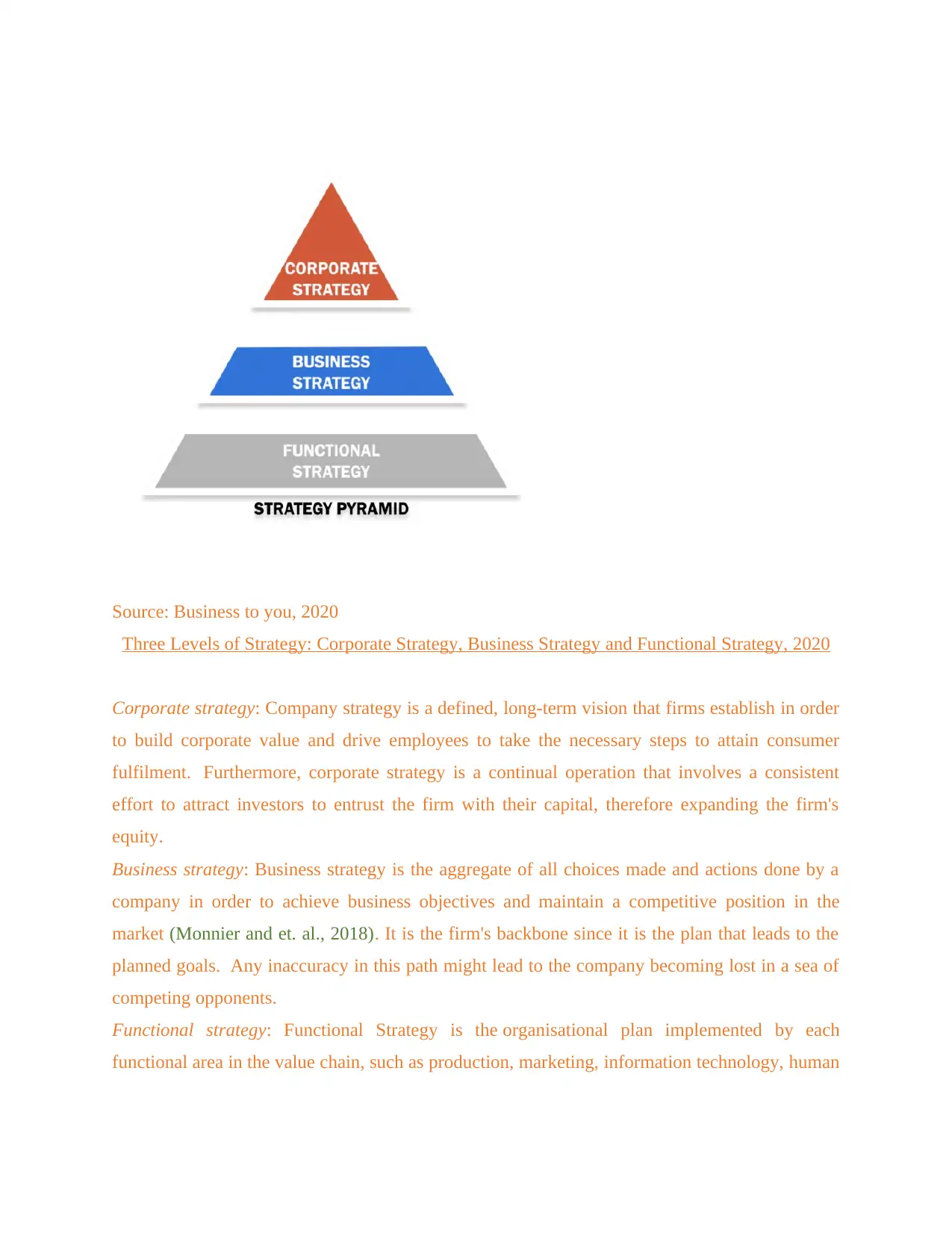
Source: Business to you, 2020
Three Levels of Strategy: Corporate Strategy, Business Strategy and Functional Strategy, 2020
Corporate strategy: Company strategy is a defined, long-term vision that firms establish in order
to build corporate value and drive employees to take the necessary steps to attain consumer
fulfilment. Furthermore, corporate strategy is a continual operation that involves a consistent
effort to attract investors to entrust the firm with their capital, therefore expanding the firm's
equity.
Business strategy: Business strategy is the aggregate of all choices made and actions done by a
company in order to achieve business objectives and maintain a competitive position in the
market (Monnier and et. al., 2018). It is the firm's backbone since it is the plan that leads to the
planned goals. Any inaccuracy in this path might lead to the company becoming lost in a sea of
competing opponents.
Functional strategy: Functional Strategy is the organisational plan implemented by each
functional area in the value chain, such as production, marketing, information technology, human
Three Levels of Strategy: Corporate Strategy, Business Strategy and Functional Strategy, 2020
Corporate strategy: Company strategy is a defined, long-term vision that firms establish in order
to build corporate value and drive employees to take the necessary steps to attain consumer
fulfilment. Furthermore, corporate strategy is a continual operation that involves a consistent
effort to attract investors to entrust the firm with their capital, therefore expanding the firm's
equity.
Business strategy: Business strategy is the aggregate of all choices made and actions done by a
company in order to achieve business objectives and maintain a competitive position in the
market (Monnier and et. al., 2018). It is the firm's backbone since it is the plan that leads to the
planned goals. Any inaccuracy in this path might lead to the company becoming lost in a sea of
competing opponents.
Functional strategy: Functional Strategy is the organisational plan implemented by each
functional area in the value chain, such as production, marketing, information technology, human
Paraphrase This Document
Need a fresh take? Get an instant paraphrase of this document with our AI Paraphraser
resources, finance and many more to execute the entire company strategy or vision in order to
achieve organisational level purposes.
Main Body
Part A
1. External and Internal environment analysis
PESTLE analysis
PESTLE analysis is considered as a framework to analyse and track macro environmental
factors which affect an organisation. Since the analysis is capable of adapting, organisations can
use it in a variety of situations. In context to Tesco, PESTLE analysis is mentioned below:
Political factors: These elements decide how much a government will control the economy or a
specific sector. Tesco, being a global company, must be alert of changing political situations in
all the economies. Political stability is a significant consideration. The more the opportunities for
trading, the much more stable the political atmosphere. Brexit is one example of this (Ogawa and
et. al., 2018). With Brexit, there is a dilemma concerning new regulation that may emerge and
cause a drop or boost in sales. These factors can create a huge impact on the performance of the
organisation these factors may stop the firm to expand its business as well as delivering
commodities to the people.
Economic factors: These elements are indicators of an economy's success that have a
major affect on a business and have long-term consequences. The organization should be careful
and aware of the multiple taxation policies in order to take advantage of them. The United
Kingdom generates the highest share of sales. Some changes in UK rules may need a
considerable shift in the firm's distribution model, with the extra expenses associated with
altering the firm potentially being considerable. This can lead to halt the functions performed in
countries where there are multiple taxation policies.
Social factors: These factors explore the market's social environment and assess factors
that contribute such as behavioural patterns, geography, population and many more. Customers'
opinions regarding natural products are evolving, and Tesco has tried to catch up by modifying
its strategy to promoting natural products in order to please its customers. Tesco emphasizes on
giving back to the community and recruiting locals and as a response, it has produced
achieve organisational level purposes.
Main Body
Part A
1. External and Internal environment analysis
PESTLE analysis
PESTLE analysis is considered as a framework to analyse and track macro environmental
factors which affect an organisation. Since the analysis is capable of adapting, organisations can
use it in a variety of situations. In context to Tesco, PESTLE analysis is mentioned below:
Political factors: These elements decide how much a government will control the economy or a
specific sector. Tesco, being a global company, must be alert of changing political situations in
all the economies. Political stability is a significant consideration. The more the opportunities for
trading, the much more stable the political atmosphere. Brexit is one example of this (Ogawa and
et. al., 2018). With Brexit, there is a dilemma concerning new regulation that may emerge and
cause a drop or boost in sales. These factors can create a huge impact on the performance of the
organisation these factors may stop the firm to expand its business as well as delivering
commodities to the people.
Economic factors: These elements are indicators of an economy's success that have a
major affect on a business and have long-term consequences. The organization should be careful
and aware of the multiple taxation policies in order to take advantage of them. The United
Kingdom generates the highest share of sales. Some changes in UK rules may need a
considerable shift in the firm's distribution model, with the extra expenses associated with
altering the firm potentially being considerable. This can lead to halt the functions performed in
countries where there are multiple taxation policies.
Social factors: These factors explore the market's social environment and assess factors
that contribute such as behavioural patterns, geography, population and many more. Customers'
opinions regarding natural products are evolving, and Tesco has tried to catch up by modifying
its strategy to promoting natural products in order to please its customers. Tesco emphasizes on
giving back to the community and recruiting locals and as a response, it has produced
opportunities in a variety of fields. Small deliveries are regarded as inefficient and costly to the
organisation and in return, effecting the organisation.
Technological factors: These factors are related to technological developments that can have a
positive or negative impact on the company's and market's functions. This adds to automation,
research and development, and the amount of technological expertise in an industry (Monnier
and et. al., 2017). Internet shopping, social media commercials and other methods of influencing
clients by providing various technical advantages are all examples. With 43% of its consumers
now purchasing from the internet site and receiving their things transported to their homes, the
company has managed to shift retail patterns to an online one. Tesco's recent announcement of a
cooperation with Amazon Go to explore revolutionary technology for cashier less billing marks a
significant milestone that might transform the way consumers buy for goods. This would allow
shoppers to skip large lineups and preserve time for quick billing. Due to COVID-19, initially
organisation was not able to run as people were not allowed to step out of their house which
leads in loss to the firm but due to their ecommerce platform, people are able to purchase
commodities.
Legal factors: These factors have both external and internal dimensions. Certain rules influence
the economic environment of a particular nation, whereas some regulations are maintained by
businesses by themselves. Legal analysis examines all of these aspects and then develops
approaches in terms of these laws (Hawking and Sellitto, 2017). The Food Retailing Commission
has developed such guidelines and restrictions, which must be followed by all retail operators.
Many allegations were lodged against Tesco in 2016 over age and gender inequality in the
working. Tesco has recently been there in the news for a criminal probe that resulting in a $12
million court settlement.
Environmental factors: Many of this categories includes elements that are impacted by
the surrounding environment. A firm environmental study includes weather, temperature,
geographical location, and other aspects. Tesco has developed a variety of projects aimed at
improving the environment and creating a more healthier society. Tesco just launched the second
part of its Remove, Reduce, Reuse, and Recycle campaign. The group has conducted a variety of
efforts to reduce and eradicate all non-recyclable plastic, as well as to create innovative methods
to utilise the residual plastic that is already in use.
SWOT analysis
organisation and in return, effecting the organisation.
Technological factors: These factors are related to technological developments that can have a
positive or negative impact on the company's and market's functions. This adds to automation,
research and development, and the amount of technological expertise in an industry (Monnier
and et. al., 2017). Internet shopping, social media commercials and other methods of influencing
clients by providing various technical advantages are all examples. With 43% of its consumers
now purchasing from the internet site and receiving their things transported to their homes, the
company has managed to shift retail patterns to an online one. Tesco's recent announcement of a
cooperation with Amazon Go to explore revolutionary technology for cashier less billing marks a
significant milestone that might transform the way consumers buy for goods. This would allow
shoppers to skip large lineups and preserve time for quick billing. Due to COVID-19, initially
organisation was not able to run as people were not allowed to step out of their house which
leads in loss to the firm but due to their ecommerce platform, people are able to purchase
commodities.
Legal factors: These factors have both external and internal dimensions. Certain rules influence
the economic environment of a particular nation, whereas some regulations are maintained by
businesses by themselves. Legal analysis examines all of these aspects and then develops
approaches in terms of these laws (Hawking and Sellitto, 2017). The Food Retailing Commission
has developed such guidelines and restrictions, which must be followed by all retail operators.
Many allegations were lodged against Tesco in 2016 over age and gender inequality in the
working. Tesco has recently been there in the news for a criminal probe that resulting in a $12
million court settlement.
Environmental factors: Many of this categories includes elements that are impacted by
the surrounding environment. A firm environmental study includes weather, temperature,
geographical location, and other aspects. Tesco has developed a variety of projects aimed at
improving the environment and creating a more healthier society. Tesco just launched the second
part of its Remove, Reduce, Reuse, and Recycle campaign. The group has conducted a variety of
efforts to reduce and eradicate all non-recyclable plastic, as well as to create innovative methods
to utilise the residual plastic that is already in use.
SWOT analysis
⊘ This is a preview!⊘
Do you want full access?
Subscribe today to unlock all pages.
Trusted by 1+ million students worldwide
SWOT analysis is a technique for assessing a firm's competitive role and developing
growth plans.
Strengths and weaknesses are internal factors for which the organisation has power and can
modify, while opportunities and threats are external factors that occur outside of the company, in
the wider market.
Strength: Strengths identify what a company excels and also what sets it apart from the
competitive environment (Wang, 2017). Tesco is the leading food retailer and the major retailer
in the United Kingdom. It leads most shopping brands in the United Kingdom in terms of
revenues and profits. They also established a number of retail concepts. Among the many shop
sites such as Tesco Homeplus, Tesco Metro, Tesco Extra, Tesco Express, One Stop and Tesco
Superstores. It has a large network of efficient raw material suppliers, enable it to address major
supply chain problems. Tesco has built a solid distribution model over the years, allowing it to
capitalise on the majority of its commercial opportunities.
Weaknesses: Weaknesses prevent a company from operating at its full. These are areas
that the company wants to change in order to be successful. Tesco's share price fell with over 9%
in October 2018 due to a decline in operational profitability. It came out that it was the
company's poor performance since the Brexit (Yuan and et. al., 2018). Tesco's operational
profitability is badly affected due to its huge expenditure and credit card obligation. While Tesco
is the market leader in terms of cost, its low-cost approach can result in lower company profits.
Opportunities: Opportunities are potential influences that can provide a company with a
strategic edge. Tesco will gain immensely from smart alliances with well-known brands. As a
result, Tesco will be capable to promote more brands and attract more customers. Joint ventures
may be available in places where Tesco shops operate poorly. Local firms may also have
extensive industry expertise, which can help to maximise quality in such areas. Tesco has outlets
in several industrialised nations, although, expanding its operations to developing markets such
as South Korea, Turkey, and Indonesia might be an immense potential for the company. Over the
years, the organisation has invested a large quantity of capital in the web. As a result of this
investments, Tesco now has a new logistics network In the next years, the firm will build on this
edge by better understanding and serving the demands of its clients using big data analytics. The
low inflation rate provides price stability and helps Tesco consumers to access borrowing at
reduced interest rates.
growth plans.
Strengths and weaknesses are internal factors for which the organisation has power and can
modify, while opportunities and threats are external factors that occur outside of the company, in
the wider market.
Strength: Strengths identify what a company excels and also what sets it apart from the
competitive environment (Wang, 2017). Tesco is the leading food retailer and the major retailer
in the United Kingdom. It leads most shopping brands in the United Kingdom in terms of
revenues and profits. They also established a number of retail concepts. Among the many shop
sites such as Tesco Homeplus, Tesco Metro, Tesco Extra, Tesco Express, One Stop and Tesco
Superstores. It has a large network of efficient raw material suppliers, enable it to address major
supply chain problems. Tesco has built a solid distribution model over the years, allowing it to
capitalise on the majority of its commercial opportunities.
Weaknesses: Weaknesses prevent a company from operating at its full. These are areas
that the company wants to change in order to be successful. Tesco's share price fell with over 9%
in October 2018 due to a decline in operational profitability. It came out that it was the
company's poor performance since the Brexit (Yuan and et. al., 2018). Tesco's operational
profitability is badly affected due to its huge expenditure and credit card obligation. While Tesco
is the market leader in terms of cost, its low-cost approach can result in lower company profits.
Opportunities: Opportunities are potential influences that can provide a company with a
strategic edge. Tesco will gain immensely from smart alliances with well-known brands. As a
result, Tesco will be capable to promote more brands and attract more customers. Joint ventures
may be available in places where Tesco shops operate poorly. Local firms may also have
extensive industry expertise, which can help to maximise quality in such areas. Tesco has outlets
in several industrialised nations, although, expanding its operations to developing markets such
as South Korea, Turkey, and Indonesia might be an immense potential for the company. Over the
years, the organisation has invested a large quantity of capital in the web. As a result of this
investments, Tesco now has a new logistics network In the next years, the firm will build on this
edge by better understanding and serving the demands of its clients using big data analytics. The
low inflation rate provides price stability and helps Tesco consumers to access borrowing at
reduced interest rates.
Paraphrase This Document
Need a fresh take? Get an instant paraphrase of this document with our AI Paraphraser
Threats: Threats are elements that have the potential to cause damage to an organisation.
When Tesco introduced its Christmas commercial in 2017, it received criticism on social media.
People protested the retailer, claiming that Tesco was disrespectful to Christianity. Tesco was
alleged of tricking customers by utilising false farm branding names and marketing its goods
under the Woodside Farms label ((Kaul, 2019). In 2017, it faced serious legal consequences as a
result of the case.
VRIO framework
VRIO Analysis is an effective analytical tool for assessing a company's capabilities and,
as a result, its strategic edge. In context to the selected organisation, VRIO framework is
mentioned below:
Valuable: Valuable competencies enable Tesco in focusing on resources available and
managing risk from the internal and external environments. These abilities enable a firm to
expand, improve, and develop. Tesco has a well established corporate social responsibility role
(Heo and et. al., 2021). They involve in social responsibility activities on a daily basis and make
them visible. Tesco's brand image has evolved across time as a result of sustained dedication and
product offering.
Rare: Competencies that are unique in nature are maintained and created by just just few
organisations in the market and they help Tesco build a competitive edge. Tesco has a worldwide
presence and works in many countries. Their global footprint has enabled the firm to develop an
increased customer base and gain sales in several countries, providing the company with not just
greater financial power but also greater cultural visibility and international recognition. Tesco
has been allowed to concentrate on its worldwide history and skills, which is a once in a lifetime
opportunity.
Inimitable: These various capabilities add to a company's strategic advantage and long-
term income. Competitors find it extremely difficult and costly to reproduce these tools and
abilities. Tesco has effective processing capabilities that serve on a large scale. The group has
sustained operating expenses under management through growth and steady demand. They have
since implemented innovation to reduce costs and enhance organisational procedures and
operations (Singer, 2018). This cost-cutting role enables the company to retain consistently
favourable prices in contrast to competitors.
When Tesco introduced its Christmas commercial in 2017, it received criticism on social media.
People protested the retailer, claiming that Tesco was disrespectful to Christianity. Tesco was
alleged of tricking customers by utilising false farm branding names and marketing its goods
under the Woodside Farms label ((Kaul, 2019). In 2017, it faced serious legal consequences as a
result of the case.
VRIO framework
VRIO Analysis is an effective analytical tool for assessing a company's capabilities and,
as a result, its strategic edge. In context to the selected organisation, VRIO framework is
mentioned below:
Valuable: Valuable competencies enable Tesco in focusing on resources available and
managing risk from the internal and external environments. These abilities enable a firm to
expand, improve, and develop. Tesco has a well established corporate social responsibility role
(Heo and et. al., 2021). They involve in social responsibility activities on a daily basis and make
them visible. Tesco's brand image has evolved across time as a result of sustained dedication and
product offering.
Rare: Competencies that are unique in nature are maintained and created by just just few
organisations in the market and they help Tesco build a competitive edge. Tesco has a worldwide
presence and works in many countries. Their global footprint has enabled the firm to develop an
increased customer base and gain sales in several countries, providing the company with not just
greater financial power but also greater cultural visibility and international recognition. Tesco
has been allowed to concentrate on its worldwide history and skills, which is a once in a lifetime
opportunity.
Inimitable: These various capabilities add to a company's strategic advantage and long-
term income. Competitors find it extremely difficult and costly to reproduce these tools and
abilities. Tesco has effective processing capabilities that serve on a large scale. The group has
sustained operating expenses under management through growth and steady demand. They have
since implemented innovation to reduce costs and enhance organisational procedures and
operations (Singer, 2018). This cost-cutting role enables the company to retain consistently
favourable prices in contrast to competitors.
Organised: These commodities have no substitutes and hence cannot be employed by
firms other than Tesco, letting the business to benefit on possibilities and optimally utilise
capabilities for commercial progress. Tesco's marketing strategies and communication have a
strong standardised organizational structure. This broad approach is organized at various national
levels and focused on individual countries depending on their target groups and demographics.
Tesco has increased its popularity and brand recognition as a result of this customization.
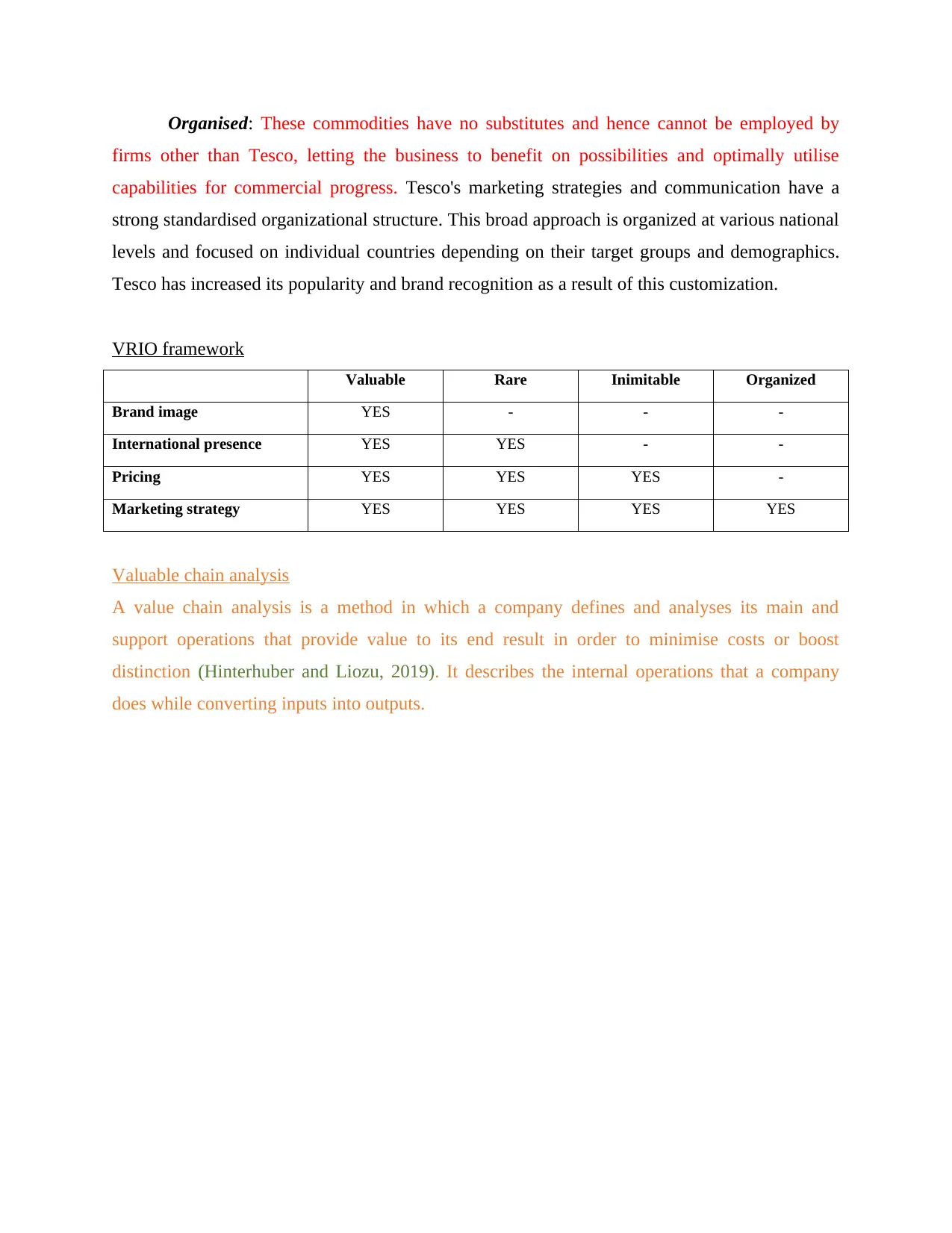
VRIO framework
Valuable Rare Inimitable Organized
Brand image YES - - -
International presence YES YES - -
Pricing YES YES YES -
Marketing strategy YES YES YES YES
Valuable chain analysis
A value chain analysis is a method in which a company defines and analyses its main and
support operations that provide value to its end result in order to minimise costs or boost
distinction (Hinterhuber and Liozu, 2019). It describes the internal operations that a company
does while converting inputs into outputs.
firms other than Tesco, letting the business to benefit on possibilities and optimally utilise
capabilities for commercial progress. Tesco's marketing strategies and communication have a
strong standardised organizational structure. This broad approach is organized at various national
levels and focused on individual countries depending on their target groups and demographics.
Tesco has increased its popularity and brand recognition as a result of this customization.
VRIO framework
Valuable Rare Inimitable Organized
Brand image YES - - -
International presence YES YES - -
Pricing YES YES YES -
Marketing strategy YES YES YES YES
Valuable chain analysis
A value chain analysis is a method in which a company defines and analyses its main and
support operations that provide value to its end result in order to minimise costs or boost
distinction (Hinterhuber and Liozu, 2019). It describes the internal operations that a company
does while converting inputs into outputs.
⊘ This is a preview!⊘
Do you want full access?
Subscribe today to unlock all pages.
Trusted by 1+ million students worldwide
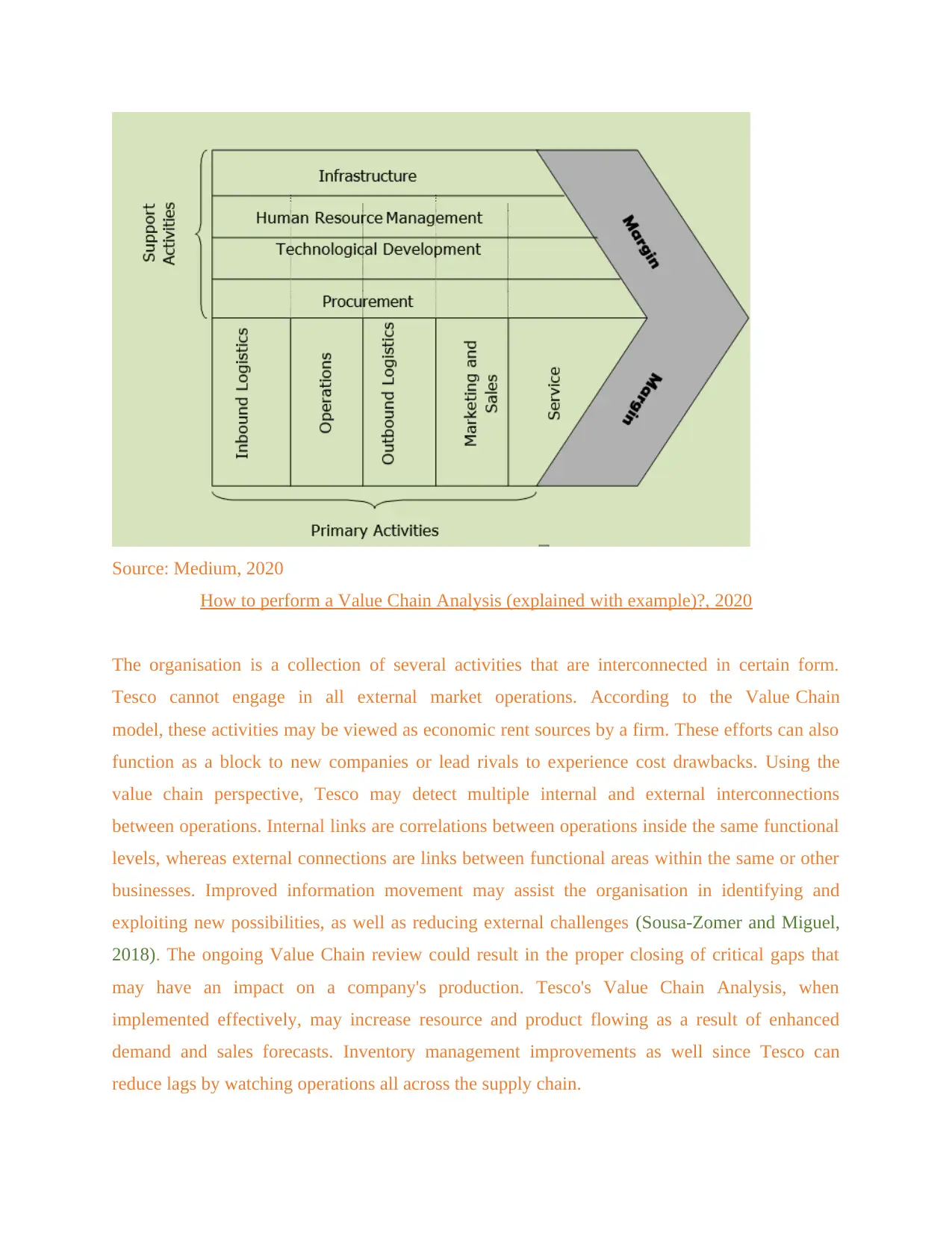
Source: Medium, 2020
How to perform a Value Chain Analysis (explained with example)?, 2020
The organisation is a collection of several activities that are interconnected in certain form.
Tesco cannot engage in all external market operations. According to the Value Chain
model, these activities may be viewed as economic rent sources by a firm. These efforts can also
function as a block to new companies or lead rivals to experience cost drawbacks. Using the
value chain perspective, Tesco may detect multiple internal and external interconnections
between operations. Internal links are correlations between operations inside the same functional
levels, whereas external connections are links between functional areas within the same or other
businesses. Improved information movement may assist the organisation in identifying and
exploiting new possibilities, as well as reducing external challenges (Sousa-Zomer and Miguel,
2018). The ongoing Value Chain review could result in the proper closing of critical gaps that
may have an impact on a company's production. Tesco's Value Chain Analysis, when
implemented effectively, may increase resource and product flowing as a result of enhanced
demand and sales forecasts. Inventory management improvements as well since Tesco can
reduce lags by watching operations all across the supply chain.
How to perform a Value Chain Analysis (explained with example)?, 2020
The organisation is a collection of several activities that are interconnected in certain form.
Tesco cannot engage in all external market operations. According to the Value Chain
model, these activities may be viewed as economic rent sources by a firm. These efforts can also
function as a block to new companies or lead rivals to experience cost drawbacks. Using the
value chain perspective, Tesco may detect multiple internal and external interconnections
between operations. Internal links are correlations between operations inside the same functional
levels, whereas external connections are links between functional areas within the same or other
businesses. Improved information movement may assist the organisation in identifying and
exploiting new possibilities, as well as reducing external challenges (Sousa-Zomer and Miguel,
2018). The ongoing Value Chain review could result in the proper closing of critical gaps that
may have an impact on a company's production. Tesco's Value Chain Analysis, when
implemented effectively, may increase resource and product flowing as a result of enhanced
demand and sales forecasts. Inventory management improvements as well since Tesco can
reduce lags by watching operations all across the supply chain.
Paraphrase This Document
Need a fresh take? Get an instant paraphrase of this document with our AI Paraphraser
Nowadays consumers place a great value on prompt responses and fast accessibility to key
product details. Spontaneous interruptions in data flow might have an impact on the customer-
supplier relationship. Value chain analysis of Tesco and its execution helps identify and
eliminate data flow obstacles.
2. Competitive environment analysis
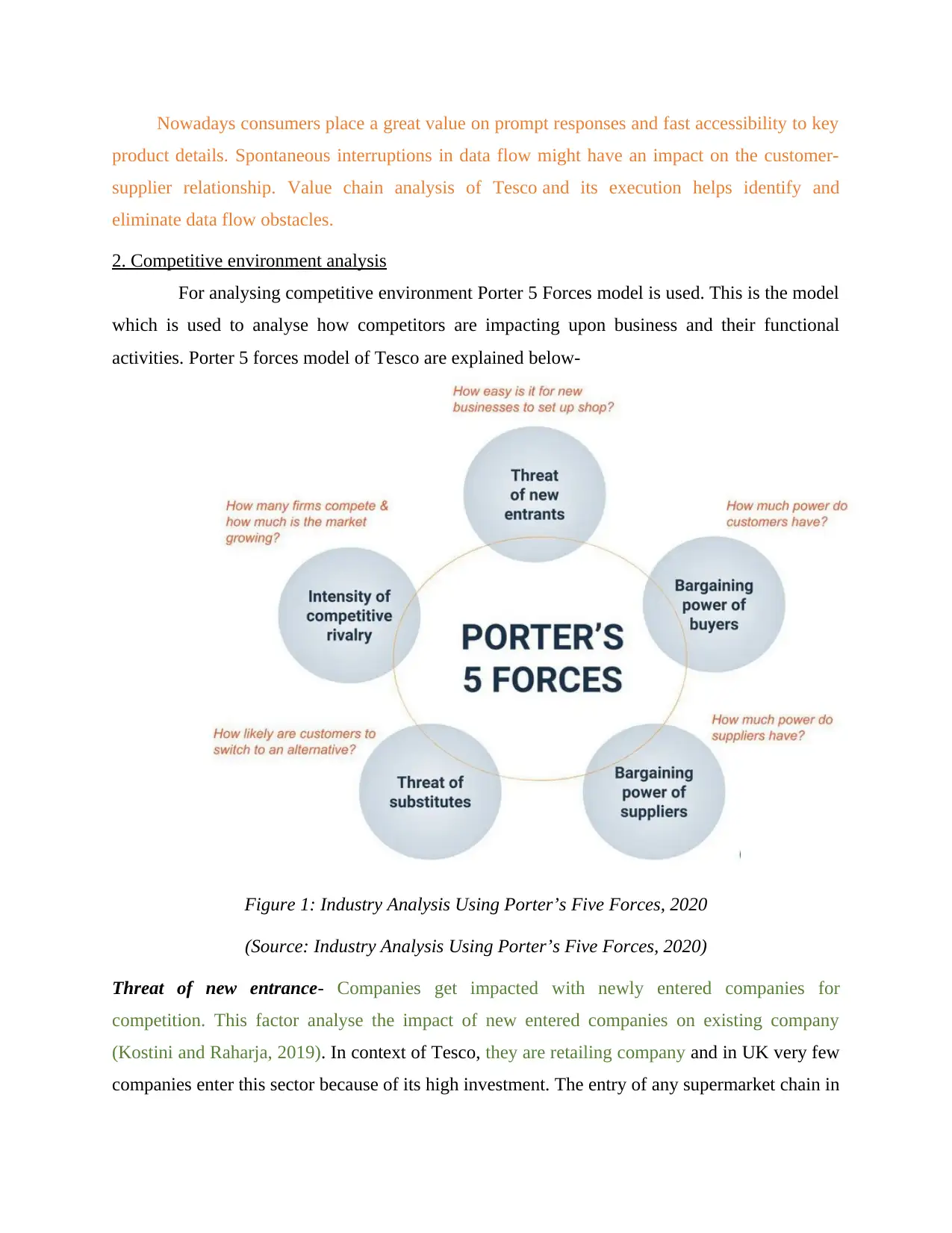
For analysing competitive environment Porter 5 Forces model is used. This is the model
which is used to analyse how competitors are impacting upon business and their functional
activities. Porter 5 forces model of Tesco are explained below-
Figure 1: Industry Analysis Using Porter’s Five Forces, 2020
(Source: Industry Analysis Using Porter’s Five Forces, 2020)
Threat of new entrance- Companies get impacted with newly entered companies for
competition. This factor analyse the impact of new entered companies on existing company
(Kostini and Raharja, 2019). In context of Tesco, they are retailing company and in UK very few
companies enter this sector because of its high investment. The entry of any supermarket chain in
product details. Spontaneous interruptions in data flow might have an impact on the customer-
supplier relationship. Value chain analysis of Tesco and its execution helps identify and
eliminate data flow obstacles.
2. Competitive environment analysis
For analysing competitive environment Porter 5 Forces model is used. This is the model
which is used to analyse how competitors are impacting upon business and their functional
activities. Porter 5 forces model of Tesco are explained below-
Figure 1: Industry Analysis Using Porter’s Five Forces, 2020
(Source: Industry Analysis Using Porter’s Five Forces, 2020)
Threat of new entrance- Companies get impacted with newly entered companies for
competition. This factor analyse the impact of new entered companies on existing company
(Kostini and Raharja, 2019). In context of Tesco, they are retailing company and in UK very few
companies enter this sector because of its high investment. The entry of any supermarket chain in
UK require high investment in today’s scenario and it is very tough for new companies to invest
this much amount in their business. Secondly, Tesco gain high reputation and brand image in UK
among their customers. Hence, their loyal customers did not switch to other brand whether it is
new or old. Hence, Tesco is safe from this threat of new entrance of companies in their industry.
Strength of this factor for Tesco is that retailing industry need high investment to enter the UK
market and new companies did not spend their initial investment to fight with their competitors
the need to establish them self first then think of adopting competitive strategies. So, here, Tesco
is safe. In context of weakness then Tesco did not change their strategies for longer period of
time which help the new companies to attack on their strategies.
Threat of Substitute goods- This factor states that what the impact of substitute goods
upon existing company are. Substitute goods are offered by competitors for gaining more
competitors. In context of Tesco, they are highly branded company; hence every competitor
wishes to copy their goods and services at lower prices. This is the biggest drawback of
substitute goods and they are they did not take guarantee for good quality. Hence, Tesco is
suggested to mention in their advertisements about some proofs of their products and quality.
they may also mention the difference of their products and substitute products for their
customers. Strength of this factor from Tesco point of view is that Tesco uses their packaging
system and aware their customers about their real products and their substitutes. Their packaging
and labelling helps the customers to identify them. Weakness regarding this factor is that here,
many substitute companies provide products same as Tesco’s products in low prices.
Bargaining power of suppliers- This factor includes that how many suppliers a company
have and it also analyse the behaviour and attitude of suppliers toward the company (de Sousa
Jabbour, 2019). In context of Tesco, they have almost 2500 suppliers in UK and many more are
presented abroad. Tesco have so many suppliers that in case if few of them switch their services
to other companies then there will be no impact upon Tesco. Beside this they care and know the
value of their each supplier. Tesco provide good amount to their suppliers for their products to
maintain good profit margin for their suppliers too. Secondly, Tesco is such a good reputed
company that most of the suppliers are interested to work with them and very few suppliers
switch them self from Tesco to other brand but there is no impact of this upon Tesco. Hence,
Tesco is safe from this threat too. Tesco strength for this factor is that they have many suppliers
so in case few suppliers left them then there is no impact on them and they also built a strong
this much amount in their business. Secondly, Tesco gain high reputation and brand image in UK
among their customers. Hence, their loyal customers did not switch to other brand whether it is
new or old. Hence, Tesco is safe from this threat of new entrance of companies in their industry.
Strength of this factor for Tesco is that retailing industry need high investment to enter the UK
market and new companies did not spend their initial investment to fight with their competitors
the need to establish them self first then think of adopting competitive strategies. So, here, Tesco
is safe. In context of weakness then Tesco did not change their strategies for longer period of
time which help the new companies to attack on their strategies.
Threat of Substitute goods- This factor states that what the impact of substitute goods
upon existing company are. Substitute goods are offered by competitors for gaining more
competitors. In context of Tesco, they are highly branded company; hence every competitor
wishes to copy their goods and services at lower prices. This is the biggest drawback of
substitute goods and they are they did not take guarantee for good quality. Hence, Tesco is
suggested to mention in their advertisements about some proofs of their products and quality.
they may also mention the difference of their products and substitute products for their
customers. Strength of this factor from Tesco point of view is that Tesco uses their packaging
system and aware their customers about their real products and their substitutes. Their packaging
and labelling helps the customers to identify them. Weakness regarding this factor is that here,
many substitute companies provide products same as Tesco’s products in low prices.
Bargaining power of suppliers- This factor includes that how many suppliers a company
have and it also analyse the behaviour and attitude of suppliers toward the company (de Sousa
Jabbour, 2019). In context of Tesco, they have almost 2500 suppliers in UK and many more are
presented abroad. Tesco have so many suppliers that in case if few of them switch their services
to other companies then there will be no impact upon Tesco. Beside this they care and know the
value of their each supplier. Tesco provide good amount to their suppliers for their products to
maintain good profit margin for their suppliers too. Secondly, Tesco is such a good reputed
company that most of the suppliers are interested to work with them and very few suppliers
switch them self from Tesco to other brand but there is no impact of this upon Tesco. Hence,
Tesco is safe from this threat too. Tesco strength for this factor is that they have many suppliers
so in case few suppliers left them then there is no impact on them and they also built a strong
⊘ This is a preview!⊘
Do you want full access?
Subscribe today to unlock all pages.
Trusted by 1+ million students worldwide

1 out of 21


Related Documents


Your All-in-One AI-Powered Toolkit for Academic Success.
+13062052269
info@desklib.com
Available 24*7 on WhatsApp / Email
![[object Object]](/_next/static/media/star-bottom.7253800d.svg)
Unlock your academic potential
Copyright © 2020–2026 A2Z Services. All Rights Reserved. Developed and managed by ZUCOL.