Business Strategy Report: Analysis of Unilever's Strategic Decisions
VerifiedAdded on 2023/01/18
|17
|4458
|42
Report
AI Summary
This report provides a comprehensive analysis of Unilever's business strategy. It begins with an introduction to the company and its global presence, followed by an examination of the macro-environment through stakeholder and PESTLE analyses. The report then assesses Unilever's internal capabilities using the resource-based view and explores strategic options via the Ansoff matrix and SWOT analysis. Furthermore, it evaluates outcomes using Porter's Five Forces model and interprets various strategic decisions available to Unilever. The report emphasizes key strategies like market penetration and product development, concluding with recommendations for the company's future strategic direction. The report uses various business models and frameworks to analyze the company's performance and make recommendations for improvement. Finally, the report uses various business models and frameworks to analyze the company's performance and make recommendations for improvement.
BUSINESS
STRATEGY
STRATEGY

Paraphrase This Document
Need a fresh take? Get an instant paraphrase of this document with our AI Paraphraser
Table of Contents
INTRODUCTION...........................................................................................................................3
TASK 1............................................................................................................................................3
Analysis of influence and impact of macro environment on organisation..................................3
TASK 2............................................................................................................................................8
Assessment of internal capabilities and environment.................................................................8
TASK 3............................................................................................................................................9
Evaluate outcomes by application of Porters five force model...................................................9
TASK 4..........................................................................................................................................10
Interpretation of various strategic decision available to a organisation by application of
various theories, models and concepts......................................................................................10
CONCLUSION..............................................................................................................................13
CONCLUSION..............................................................................................................................16
Reference.......................................................................................................................................17
INTRODUCTION...........................................................................................................................3
TASK 1............................................................................................................................................3
Analysis of influence and impact of macro environment on organisation..................................3
TASK 2............................................................................................................................................8
Assessment of internal capabilities and environment.................................................................8
TASK 3............................................................................................................................................9
Evaluate outcomes by application of Porters five force model...................................................9
TASK 4..........................................................................................................................................10
Interpretation of various strategic decision available to a organisation by application of
various theories, models and concepts......................................................................................10
CONCLUSION..............................................................................................................................13
CONCLUSION..............................................................................................................................16
Reference.......................................................................................................................................17
INTRODUCTION
Business strategy plays a very important part in every company as there are many
decisions which have to be taken by a company while in their regular course of functioning and
operating. For ensuring smooth functioning it becomes very necessary that strategies which are
formulated by company are according to changing business environment both internal and
external factors have a affect on strategies being formed inn companies. This report is based on
Unilever which is a Transnational consumer goods company and their headquarters are located
in London, united kingdom and also in Rotterdam, Netherlands (Spieth, Schneckenberg and
Matzler, 2016). They are dealing in Food and beverages, beauty products, personal care
products, cleaning agents etc. this company is on seventh number being most valuable company
and they are having presence in approximately 190 countries across world. This report is on
various aspects such as analysis of macro environment, assessment of internal capabilities of a
company, evaluation of various outcomes by application of models such as porter's five force
model and various strategic decisions are interpreted based on models, concepts and theories.
TASK 1
Analysis of influence and impact of macro environment on organisation
Stake holder analysis
This is a analysis which is a procedure used for identification of those persons who can
impact performance of company specially at stage where project is being initiated. This is a
analysis which can help Unilever in benefiting their stakeholders in accordance with their
interest,, participation and also could have a positive impact on their project. There are basically
three steps which are used for doing stakeholder analysis as discussed below:
Step 1: In this step there are different stakeholders which are identified these are all the
related and potential stakeholders of company (Thompson, Strickland and Gamble, 2015). In
Unilever potential stakeholders if company will be sales department, marketing executives,
Business strategy plays a very important part in every company as there are many
decisions which have to be taken by a company while in their regular course of functioning and
operating. For ensuring smooth functioning it becomes very necessary that strategies which are
formulated by company are according to changing business environment both internal and
external factors have a affect on strategies being formed inn companies. This report is based on
Unilever which is a Transnational consumer goods company and their headquarters are located
in London, united kingdom and also in Rotterdam, Netherlands (Spieth, Schneckenberg and
Matzler, 2016). They are dealing in Food and beverages, beauty products, personal care
products, cleaning agents etc. this company is on seventh number being most valuable company
and they are having presence in approximately 190 countries across world. This report is on
various aspects such as analysis of macro environment, assessment of internal capabilities of a
company, evaluation of various outcomes by application of models such as porter's five force
model and various strategic decisions are interpreted based on models, concepts and theories.
TASK 1
Analysis of influence and impact of macro environment on organisation
Stake holder analysis
This is a analysis which is a procedure used for identification of those persons who can
impact performance of company specially at stage where project is being initiated. This is a
analysis which can help Unilever in benefiting their stakeholders in accordance with their
interest,, participation and also could have a positive impact on their project. There are basically
three steps which are used for doing stakeholder analysis as discussed below:
Step 1: In this step there are different stakeholders which are identified these are all the
related and potential stakeholders of company (Thompson, Strickland and Gamble, 2015). In
Unilever potential stakeholders if company will be sales department, marketing executives,
⊘ This is a preview!⊘
Do you want full access?
Subscribe today to unlock all pages.

Trusted by 1+ million students worldwide
employees, government, customers, shareholders who can be internal or external depending on
contribution which they are making for functioning of company.
Resource based view strategy
It is a frameworks that is used by companies to find out strategic resources that helps in
gaining sustainability as well as competitive edge in the market. In reference to Resource based
view strategy, the resources are divided into two parts that is tangible as well as intangible
resources. Tangible resources are those that can be touch for instance land, machinery, capital,
building, equipments and so on. The resources that have no physical presence and that can only
be feel is term as intangible resources. It includes goodwill, intellectual property, brand
reputation and so on.
Step 2: After all important stakeholders have been identified then there is a need to
prioritize all of them in accordance with various categories such as level of participation, interest
and influence which they have on various business operations (Souto, 2015).
High power, high interest: There are stakeholders who are very important for Unilever
this is a key which can help them in smooth performance of various business functions.
High power, low interest: These are those stakeholders who have influence on overall
working of company but they don't have any interest on overall activities or projects in Unilever.
Low power, high interest: These are those stakeholders who are required to be informed
as they posses a huge interest in business projects so that there is no problem or barriers which
occur during performance of company.
Low power, low interest: These stakeholders are not much interested in overall business
activities of company, make aware about various business activities which does not have a very
significant effect on working of a company.
Step 3: This is third step, in which managers of Unilever will lay down communication
channels so that they are having support of various stakeholders which can help them in
accomplishing of project without any barrier (Schumacher, Erol, and Sihn, 2016).
Vision: The vision of Unilever is to expand its business size and to create sustainable living. The
company believe that in this manner they will grow and sustain in the market for long term.
Mission: The mission of Unilever is to meet with the daily needs of its customer. To
provide those goods that help customers to feel good and look good. The company run
programmes in order to promote empowerment, environmental awareness, hygiene and nutrition.
contribution which they are making for functioning of company.
Resource based view strategy
It is a frameworks that is used by companies to find out strategic resources that helps in
gaining sustainability as well as competitive edge in the market. In reference to Resource based
view strategy, the resources are divided into two parts that is tangible as well as intangible
resources. Tangible resources are those that can be touch for instance land, machinery, capital,
building, equipments and so on. The resources that have no physical presence and that can only
be feel is term as intangible resources. It includes goodwill, intellectual property, brand
reputation and so on.
Step 2: After all important stakeholders have been identified then there is a need to
prioritize all of them in accordance with various categories such as level of participation, interest
and influence which they have on various business operations (Souto, 2015).
High power, high interest: There are stakeholders who are very important for Unilever
this is a key which can help them in smooth performance of various business functions.
High power, low interest: These are those stakeholders who have influence on overall
working of company but they don't have any interest on overall activities or projects in Unilever.
Low power, high interest: These are those stakeholders who are required to be informed
as they posses a huge interest in business projects so that there is no problem or barriers which
occur during performance of company.
Low power, low interest: These stakeholders are not much interested in overall business
activities of company, make aware about various business activities which does not have a very
significant effect on working of a company.
Step 3: This is third step, in which managers of Unilever will lay down communication
channels so that they are having support of various stakeholders which can help them in
accomplishing of project without any barrier (Schumacher, Erol, and Sihn, 2016).
Vision: The vision of Unilever is to expand its business size and to create sustainable living. The
company believe that in this manner they will grow and sustain in the market for long term.
Mission: The mission of Unilever is to meet with the daily needs of its customer. To
provide those goods that help customers to feel good and look good. The company run
programmes in order to promote empowerment, environmental awareness, hygiene and nutrition.
Paraphrase This Document
Need a fresh take? Get an instant paraphrase of this document with our AI Paraphraser
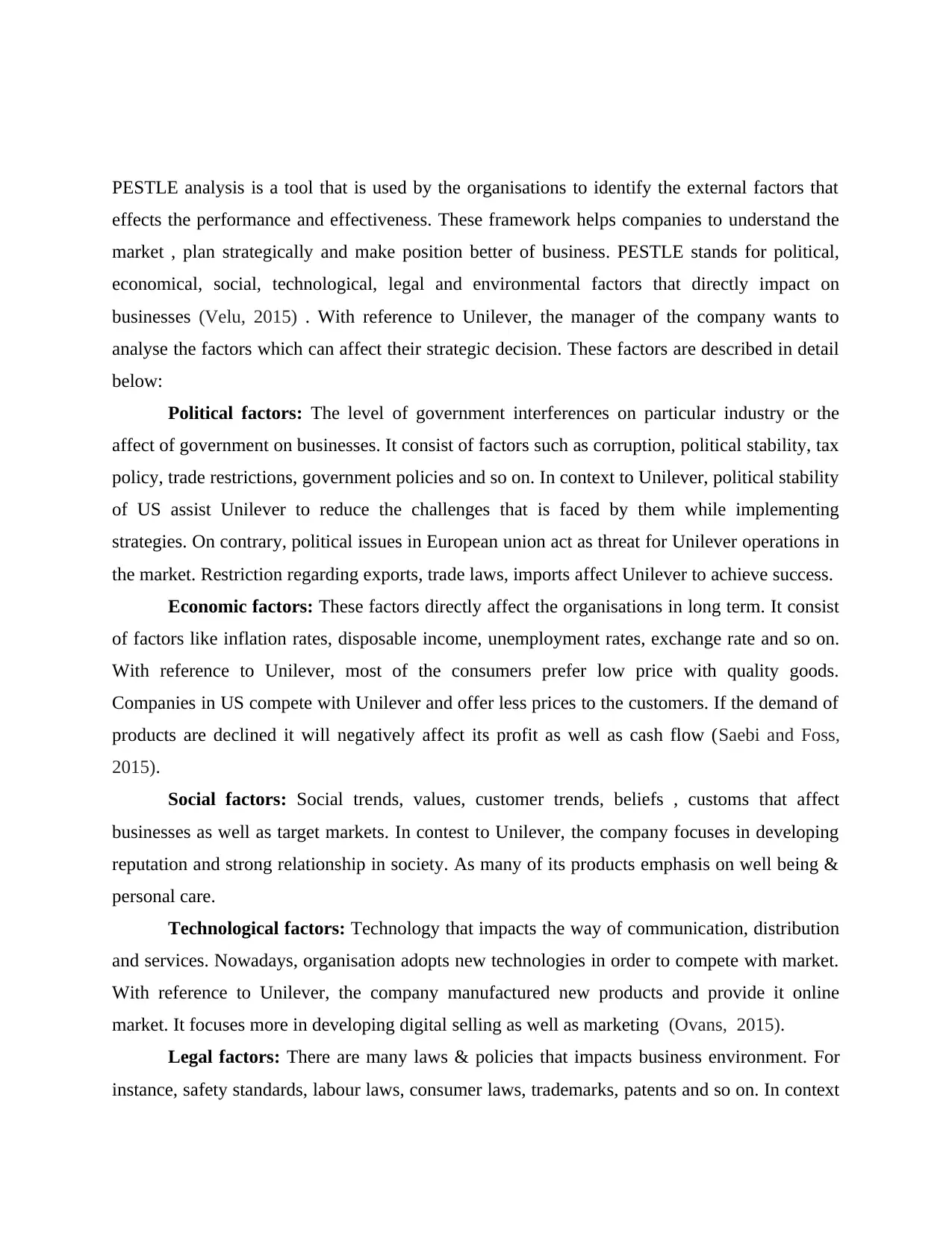
PESTLE analysis is a tool that is used by the organisations to identify the external factors that
effects the performance and effectiveness. These framework helps companies to understand the
market , plan strategically and make position better of business. PESTLE stands for political,
economical, social, technological, legal and environmental factors that directly impact on
businesses (Velu, 2015) . With reference to Unilever, the manager of the company wants to
analyse the factors which can affect their strategic decision. These factors are described in detail
below:
Political factors: The level of government interferences on particular industry or the
affect of government on businesses. It consist of factors such as corruption, political stability, tax
policy, trade restrictions, government policies and so on. In context to Unilever, political stability
of US assist Unilever to reduce the challenges that is faced by them while implementing
strategies. On contrary, political issues in European union act as threat for Unilever operations in
the market. Restriction regarding exports, trade laws, imports affect Unilever to achieve success.
Economic factors: These factors directly affect the organisations in long term. It consist
of factors like inflation rates, disposable income, unemployment rates, exchange rate and so on.
With reference to Unilever, most of the consumers prefer low price with quality goods.
Companies in US compete with Unilever and offer less prices to the customers. If the demand of
products are declined it will negatively affect its profit as well as cash flow (Saebi and Foss,
2015).
Social factors: Social trends, values, customer trends, beliefs , customs that affect
businesses as well as target markets. In contest to Unilever, the company focuses in developing
reputation and strong relationship in society. As many of its products emphasis on well being &
personal care.
Technological factors: Technology that impacts the way of communication, distribution
and services. Nowadays, organisation adopts new technologies in order to compete with market.
With reference to Unilever, the company manufactured new products and provide it online
market. It focuses more in developing digital selling as well as marketing (Ovans, 2015).
Legal factors: There are many laws & policies that impacts business environment. For
instance, safety standards, labour laws, consumer laws, trademarks, patents and so on. In context
effects the performance and effectiveness. These framework helps companies to understand the
market , plan strategically and make position better of business. PESTLE stands for political,
economical, social, technological, legal and environmental factors that directly impact on
businesses (Velu, 2015) . With reference to Unilever, the manager of the company wants to
analyse the factors which can affect their strategic decision. These factors are described in detail
below:
Political factors: The level of government interferences on particular industry or the
affect of government on businesses. It consist of factors such as corruption, political stability, tax
policy, trade restrictions, government policies and so on. In context to Unilever, political stability
of US assist Unilever to reduce the challenges that is faced by them while implementing
strategies. On contrary, political issues in European union act as threat for Unilever operations in
the market. Restriction regarding exports, trade laws, imports affect Unilever to achieve success.
Economic factors: These factors directly affect the organisations in long term. It consist
of factors like inflation rates, disposable income, unemployment rates, exchange rate and so on.
With reference to Unilever, most of the consumers prefer low price with quality goods.
Companies in US compete with Unilever and offer less prices to the customers. If the demand of
products are declined it will negatively affect its profit as well as cash flow (Saebi and Foss,
2015).
Social factors: Social trends, values, customer trends, beliefs , customs that affect
businesses as well as target markets. In contest to Unilever, the company focuses in developing
reputation and strong relationship in society. As many of its products emphasis on well being &
personal care.
Technological factors: Technology that impacts the way of communication, distribution
and services. Nowadays, organisation adopts new technologies in order to compete with market.
With reference to Unilever, the company manufactured new products and provide it online
market. It focuses more in developing digital selling as well as marketing (Ovans, 2015).
Legal factors: There are many laws & policies that impacts business environment. For
instance, safety standards, labour laws, consumer laws, trademarks, patents and so on. In context
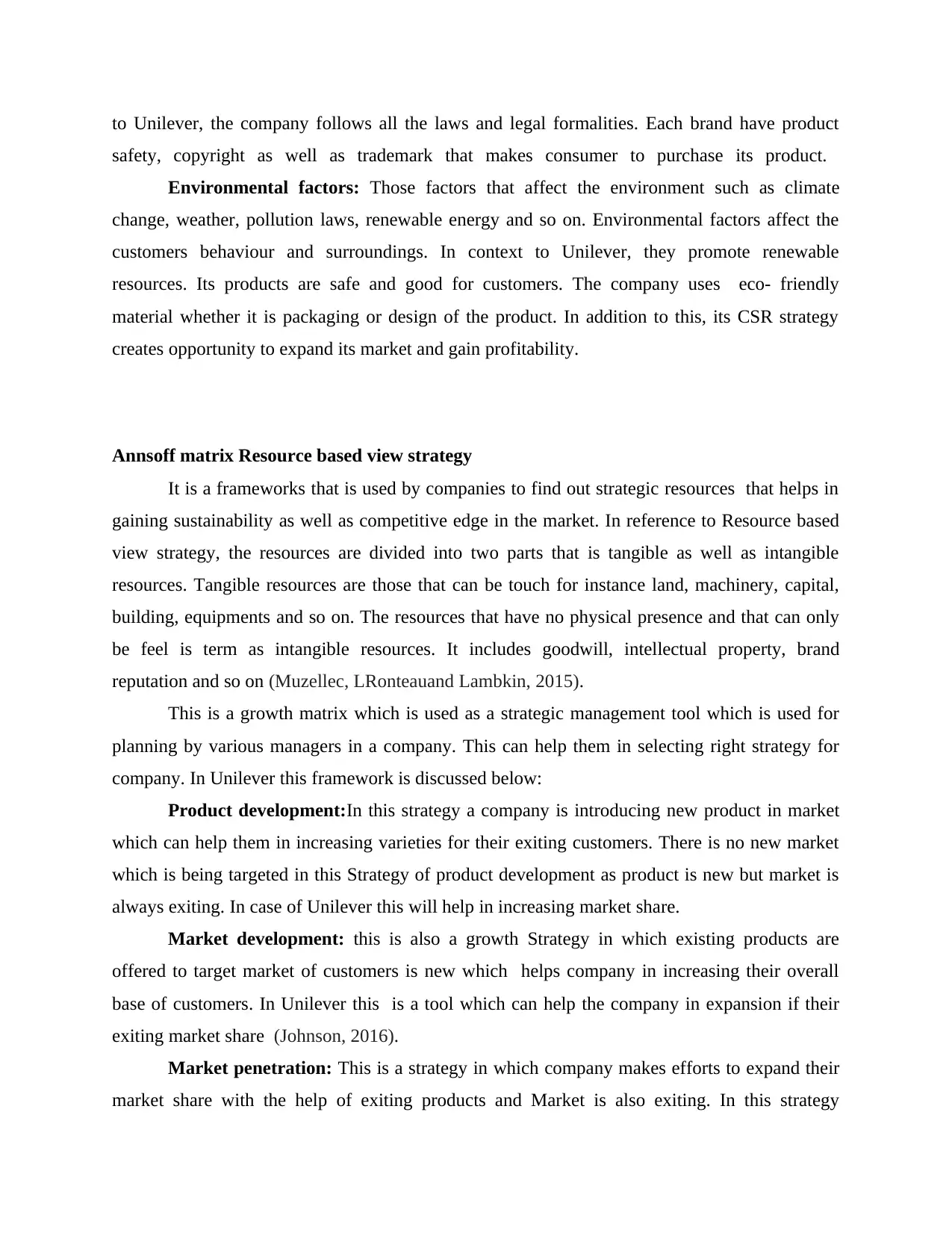
to Unilever, the company follows all the laws and legal formalities. Each brand have product
safety, copyright as well as trademark that makes consumer to purchase its product.
Environmental factors: Those factors that affect the environment such as climate
change, weather, pollution laws, renewable energy and so on. Environmental factors affect the
customers behaviour and surroundings. In context to Unilever, they promote renewable
resources. Its products are safe and good for customers. The company uses eco- friendly
material whether it is packaging or design of the product. In addition to this, its CSR strategy
creates opportunity to expand its market and gain profitability.
Annsoff matrix Resource based view strategy
It is a frameworks that is used by companies to find out strategic resources that helps in
gaining sustainability as well as competitive edge in the market. In reference to Resource based
view strategy, the resources are divided into two parts that is tangible as well as intangible
resources. Tangible resources are those that can be touch for instance land, machinery, capital,
building, equipments and so on. The resources that have no physical presence and that can only
be feel is term as intangible resources. It includes goodwill, intellectual property, brand
reputation and so on (Muzellec, LRonteauand Lambkin, 2015).
This is a growth matrix which is used as a strategic management tool which is used for
planning by various managers in a company. This can help them in selecting right strategy for
company. In Unilever this framework is discussed below:
Product development:In this strategy a company is introducing new product in market
which can help them in increasing varieties for their exiting customers. There is no new market
which is being targeted in this Strategy of product development as product is new but market is
always exiting. In case of Unilever this will help in increasing market share.
Market development: this is also a growth Strategy in which existing products are
offered to target market of customers is new which helps company in increasing their overall
base of customers. In Unilever this is a tool which can help the company in expansion if their
exiting market share (Johnson, 2016).
Market penetration: This is a strategy in which company makes efforts to expand their
market share with the help of exiting products and Market is also exiting. In this strategy
safety, copyright as well as trademark that makes consumer to purchase its product.
Environmental factors: Those factors that affect the environment such as climate
change, weather, pollution laws, renewable energy and so on. Environmental factors affect the
customers behaviour and surroundings. In context to Unilever, they promote renewable
resources. Its products are safe and good for customers. The company uses eco- friendly
material whether it is packaging or design of the product. In addition to this, its CSR strategy
creates opportunity to expand its market and gain profitability.
Annsoff matrix Resource based view strategy
It is a frameworks that is used by companies to find out strategic resources that helps in
gaining sustainability as well as competitive edge in the market. In reference to Resource based
view strategy, the resources are divided into two parts that is tangible as well as intangible
resources. Tangible resources are those that can be touch for instance land, machinery, capital,
building, equipments and so on. The resources that have no physical presence and that can only
be feel is term as intangible resources. It includes goodwill, intellectual property, brand
reputation and so on (Muzellec, LRonteauand Lambkin, 2015).
This is a growth matrix which is used as a strategic management tool which is used for
planning by various managers in a company. This can help them in selecting right strategy for
company. In Unilever this framework is discussed below:
Product development:In this strategy a company is introducing new product in market
which can help them in increasing varieties for their exiting customers. There is no new market
which is being targeted in this Strategy of product development as product is new but market is
always exiting. In case of Unilever this will help in increasing market share.
Market development: this is also a growth Strategy in which existing products are
offered to target market of customers is new which helps company in increasing their overall
base of customers. In Unilever this is a tool which can help the company in expansion if their
exiting market share (Johnson, 2016).
Market penetration: This is a strategy in which company makes efforts to expand their
market share with the help of exiting products and Market is also exiting. In this strategy
⊘ This is a preview!⊘
Do you want full access?
Subscribe today to unlock all pages.
Trusted by 1+ million students worldwide
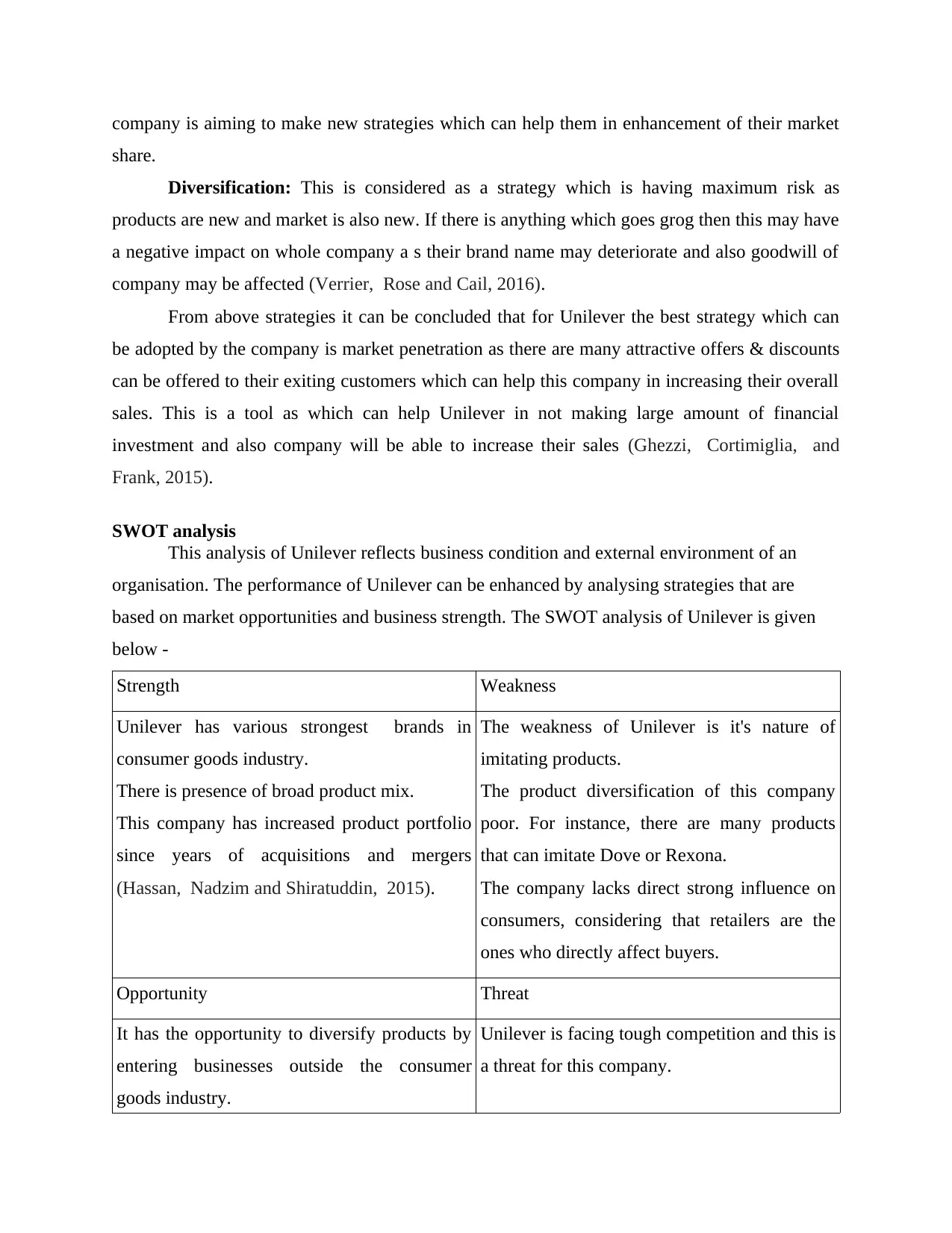
company is aiming to make new strategies which can help them in enhancement of their market
share.
Diversification: This is considered as a strategy which is having maximum risk as
products are new and market is also new. If there is anything which goes grog then this may have
a negative impact on whole company a s their brand name may deteriorate and also goodwill of
company may be affected (Verrier, Rose and Cail, 2016).
From above strategies it can be concluded that for Unilever the best strategy which can
be adopted by the company is market penetration as there are many attractive offers & discounts
can be offered to their exiting customers which can help this company in increasing their overall
sales. This is a tool as which can help Unilever in not making large amount of financial
investment and also company will be able to increase their sales (Ghezzi, Cortimiglia, and
Frank, 2015).
SWOT analysis
This analysis of Unilever reflects business condition and external environment of an
organisation. The performance of Unilever can be enhanced by analysing strategies that are
based on market opportunities and business strength. The SWOT analysis of Unilever is given
below -
Strength Weakness
Unilever has various strongest brands in
consumer goods industry.
There is presence of broad product mix.
This company has increased product portfolio
since years of acquisitions and mergers
(Hassan, Nadzim and Shiratuddin, 2015).
The weakness of Unilever is it's nature of
imitating products.
The product diversification of this company
poor. For instance, there are many products
that can imitate Dove or Rexona.
The company lacks direct strong influence on
consumers, considering that retailers are the
ones who directly affect buyers.
Opportunity Threat
It has the opportunity to diversify products by
entering businesses outside the consumer
goods industry.
Unilever is facing tough competition and this is
a threat for this company.
share.
Diversification: This is considered as a strategy which is having maximum risk as
products are new and market is also new. If there is anything which goes grog then this may have
a negative impact on whole company a s their brand name may deteriorate and also goodwill of
company may be affected (Verrier, Rose and Cail, 2016).
From above strategies it can be concluded that for Unilever the best strategy which can
be adopted by the company is market penetration as there are many attractive offers & discounts
can be offered to their exiting customers which can help this company in increasing their overall
sales. This is a tool as which can help Unilever in not making large amount of financial
investment and also company will be able to increase their sales (Ghezzi, Cortimiglia, and
Frank, 2015).
SWOT analysis
This analysis of Unilever reflects business condition and external environment of an
organisation. The performance of Unilever can be enhanced by analysing strategies that are
based on market opportunities and business strength. The SWOT analysis of Unilever is given
below -
Strength Weakness
Unilever has various strongest brands in
consumer goods industry.
There is presence of broad product mix.
This company has increased product portfolio
since years of acquisitions and mergers
(Hassan, Nadzim and Shiratuddin, 2015).
The weakness of Unilever is it's nature of
imitating products.
The product diversification of this company
poor. For instance, there are many products
that can imitate Dove or Rexona.
The company lacks direct strong influence on
consumers, considering that retailers are the
ones who directly affect buyers.
Opportunity Threat
It has the opportunity to diversify products by
entering businesses outside the consumer
goods industry.
Unilever is facing tough competition and this is
a threat for this company.
Paraphrase This Document
Need a fresh take? Get an instant paraphrase of this document with our AI Paraphraser
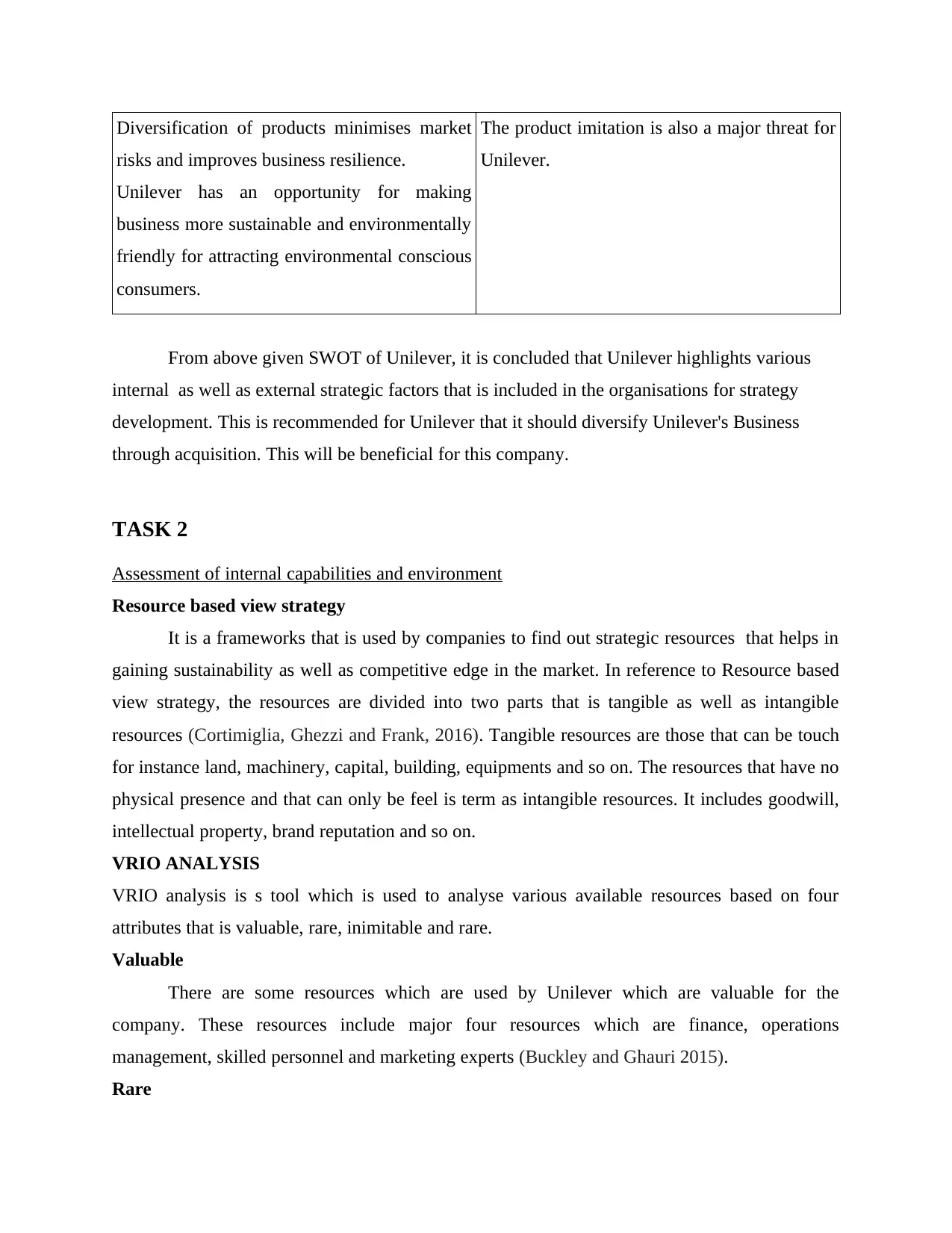
Diversification of products minimises market
risks and improves business resilience.
Unilever has an opportunity for making
business more sustainable and environmentally
friendly for attracting environmental conscious
consumers.
The product imitation is also a major threat for
Unilever.
From above given SWOT of Unilever, it is concluded that Unilever highlights various
internal as well as external strategic factors that is included in the organisations for strategy
development. This is recommended for Unilever that it should diversify Unilever's Business
through acquisition. This will be beneficial for this company.
TASK 2
Assessment of internal capabilities and environment
Resource based view strategy
It is a frameworks that is used by companies to find out strategic resources that helps in
gaining sustainability as well as competitive edge in the market. In reference to Resource based
view strategy, the resources are divided into two parts that is tangible as well as intangible
resources (Cortimiglia, Ghezzi and Frank, 2016). Tangible resources are those that can be touch
for instance land, machinery, capital, building, equipments and so on. The resources that have no
physical presence and that can only be feel is term as intangible resources. It includes goodwill,
intellectual property, brand reputation and so on.
VRIO ANALYSIS
VRIO analysis is s tool which is used to analyse various available resources based on four
attributes that is valuable, rare, inimitable and rare.
Valuable
There are some resources which are used by Unilever which are valuable for the
company. These resources include major four resources which are finance, operations
management, skilled personnel and marketing experts (Buckley and Ghauri 2015).
Rare
risks and improves business resilience.
Unilever has an opportunity for making
business more sustainable and environmentally
friendly for attracting environmental conscious
consumers.
The product imitation is also a major threat for
Unilever.
From above given SWOT of Unilever, it is concluded that Unilever highlights various
internal as well as external strategic factors that is included in the organisations for strategy
development. This is recommended for Unilever that it should diversify Unilever's Business
through acquisition. This will be beneficial for this company.
TASK 2
Assessment of internal capabilities and environment
Resource based view strategy
It is a frameworks that is used by companies to find out strategic resources that helps in
gaining sustainability as well as competitive edge in the market. In reference to Resource based
view strategy, the resources are divided into two parts that is tangible as well as intangible
resources (Cortimiglia, Ghezzi and Frank, 2016). Tangible resources are those that can be touch
for instance land, machinery, capital, building, equipments and so on. The resources that have no
physical presence and that can only be feel is term as intangible resources. It includes goodwill,
intellectual property, brand reputation and so on.
VRIO ANALYSIS
VRIO analysis is s tool which is used to analyse various available resources based on four
attributes that is valuable, rare, inimitable and rare.
Valuable
There are some resources which are used by Unilever which are valuable for the
company. These resources include major four resources which are finance, operations
management, skilled personnel and marketing experts (Buckley and Ghauri 2015).
Rare
There are some resources which are very rare and this is also posses by Unilever these are
very uncommon or rarely found in a company. If such resources are commonly available and
accessible at same time then it becomes easier for competitors of Unilever to use them but if
they are rarely available then it leads to having a competitive advantage for the company.
operations management, skilled personnel and marketing experts are three resources which are
very rarely available with company.
Imitation
This is a procedure which is very expensive for rival firms of Unilever. As there are only
two ways which can be used by Unilever, when they will be launching replacement of the
product this will lead to changing or increase in cost. Skilled workforce and marketing experts
are two resources which cant be imitated by any other organisation (Bocken,and Short, 2016).
Organisation
It is very important for Unilever to organize their exiting resources so that they are able to
get a competitive advantage as compared to their competitors so it is responsibility to organise
their resource such as their skilled workforce is the most crucial resource for them,
TASK 3
Evaluate outcomes by application of Porters five force model
Porter's five force analysis is very useful for making various strategic decisions of
company with consideration of future outcomes and focus is not only on the present situation of
company. There are basically five aspects which are related to this as discussed below:
Threat of new entrants: This is a factor which is related to New Companies who are
dealing in similar products which are entering market and this has a threat for Unilever. In case
of Unilever they are already having presence across many countries hence they will not be much
affected by any new entrant (Belz, and Binder, 2017).
Bargaining power of suppliers: This is a power which is related to number of suppliers
available with company. Unilever is a global brand which is having large number of suppliers,
very uncommon or rarely found in a company. If such resources are commonly available and
accessible at same time then it becomes easier for competitors of Unilever to use them but if
they are rarely available then it leads to having a competitive advantage for the company.
operations management, skilled personnel and marketing experts are three resources which are
very rarely available with company.
Imitation
This is a procedure which is very expensive for rival firms of Unilever. As there are only
two ways which can be used by Unilever, when they will be launching replacement of the
product this will lead to changing or increase in cost. Skilled workforce and marketing experts
are two resources which cant be imitated by any other organisation (Bocken,and Short, 2016).
Organisation
It is very important for Unilever to organize their exiting resources so that they are able to
get a competitive advantage as compared to their competitors so it is responsibility to organise
their resource such as their skilled workforce is the most crucial resource for them,
TASK 3
Evaluate outcomes by application of Porters five force model
Porter's five force analysis is very useful for making various strategic decisions of
company with consideration of future outcomes and focus is not only on the present situation of
company. There are basically five aspects which are related to this as discussed below:
Threat of new entrants: This is a factor which is related to New Companies who are
dealing in similar products which are entering market and this has a threat for Unilever. In case
of Unilever they are already having presence across many countries hence they will not be much
affected by any new entrant (Belz, and Binder, 2017).
Bargaining power of suppliers: This is a power which is related to number of suppliers
available with company. Unilever is a global brand which is having large number of suppliers,
⊘ This is a preview!⊘
Do you want full access?
Subscribe today to unlock all pages.
Trusted by 1+ million students worldwide
but at same time there is also a situation which is that moderate level of overall supply has a very
significant but limited influence on suppliers of company. Such as any changes in production
levels will lead to limited changes in availability of raw material for Unilever.
Bargaining power of buyers: This factor has a relation with power posses by customers
of Unilever. There are situations in which there are many options available with customers which
increase their bargaining power. In Unilever, there is very low switching cost posses by
customers which makes it very easy for them to switch between their products.
Threat of substitutes: this is a threat which can have a negative impact on as substitutes
lead to switching of customers very easily from one product to another. There is a very minor
issue of threat of substitutes for Unilever (Angot, and Plé, 2015).
Rivalry among existing competitors: Unilever is a big brand and they are having large
number of branches across world. Competition is very high because of presence of many big
giants such as Kraft, Nestle, P & G etc. All these companies are providing large amount of
competition to Unilever. Also, the lower switching cost allows their customers to easily switch
between their products very easily.
TASK 4
Interpretation of various strategic decision available to a organisation by application of various
theories, models and concepts.
Porter's generic strategies:
Generic strategies of Porter is benefiting company so that they are able to get a competitive
advantage in the market. There are three strategies such as cost leadership, differentiation and
focus.
Cost leadership: This strategy deals with having a cost advantage in comparison with their
competitors by offering of very reasonable price so that their products are preferred as Compared
to their competitors(Aithal, Shailashree and Kumar, 2015) .
Differentiation: In this strategy company is willing to offer innovative products to customers
which can help them in having differentiated products with comparison to other Companies
offering similar products. Unilever is also willing to offer new and innovative products so that
their overall sales can be increased.
significant but limited influence on suppliers of company. Such as any changes in production
levels will lead to limited changes in availability of raw material for Unilever.
Bargaining power of buyers: This factor has a relation with power posses by customers
of Unilever. There are situations in which there are many options available with customers which
increase their bargaining power. In Unilever, there is very low switching cost posses by
customers which makes it very easy for them to switch between their products.
Threat of substitutes: this is a threat which can have a negative impact on as substitutes
lead to switching of customers very easily from one product to another. There is a very minor
issue of threat of substitutes for Unilever (Angot, and Plé, 2015).
Rivalry among existing competitors: Unilever is a big brand and they are having large
number of branches across world. Competition is very high because of presence of many big
giants such as Kraft, Nestle, P & G etc. All these companies are providing large amount of
competition to Unilever. Also, the lower switching cost allows their customers to easily switch
between their products very easily.
TASK 4
Interpretation of various strategic decision available to a organisation by application of various
theories, models and concepts.
Porter's generic strategies:
Generic strategies of Porter is benefiting company so that they are able to get a competitive
advantage in the market. There are three strategies such as cost leadership, differentiation and
focus.
Cost leadership: This strategy deals with having a cost advantage in comparison with their
competitors by offering of very reasonable price so that their products are preferred as Compared
to their competitors(Aithal, Shailashree and Kumar, 2015) .
Differentiation: In this strategy company is willing to offer innovative products to customers
which can help them in having differentiated products with comparison to other Companies
offering similar products. Unilever is also willing to offer new and innovative products so that
their overall sales can be increased.
Paraphrase This Document
Need a fresh take? Get an instant paraphrase of this document with our AI Paraphraser
Focus: This strategy has two aspects which are differentiation focus and cost focus. In cost
focus Unilever will be making attempts to keep prices of heir products low as compared to their
competitors and in differentiation modern products will be offered so that customers can
purchase and price is least consider in this strategy.
Strategic management Plan:
Strategic planning is very helpful for a organisation in identifying activities, resources,
focus, operations etc. this ensures that whole workforce in organisation is working towards a
particular direction.
Vision: to expand their exiting share of market and achieve a growth of sales by 10%.
Mission: The mission is to achieve this growth of sales by a minimum increase in cost and
ensuring effectiveness in their new strategy.
Strategies: The strategy which can be adopted in Unilever is market development as there are
sufficient capabilities so that they are able to utilise their existing core products to increase their
sales which can be done by approaching new segment of market or having government support
or nay other way which is not leading to increase in cost for company.
Objectives: main objective is to increase their customer base by around 15% by covering more
areas where they are not having presence.
Tactics: Tactics which will be used by organisation is making usage of marketing mix for
development of Strategy of marketing mix.
Product The products in which Unilever is dealing with
are products such as food, refreshments,
personal care, home care and many other
related categories. They will be using such
exiting categories so that they are able to
attract more customers.
Price Prices are most essential factor which affects
sales of a company. So Unilever is making
efforts that they are bale to keep their prices in
accordance with the overall value which is
focus Unilever will be making attempts to keep prices of heir products low as compared to their
competitors and in differentiation modern products will be offered so that customers can
purchase and price is least consider in this strategy.
Strategic management Plan:
Strategic planning is very helpful for a organisation in identifying activities, resources,
focus, operations etc. this ensures that whole workforce in organisation is working towards a
particular direction.
Vision: to expand their exiting share of market and achieve a growth of sales by 10%.
Mission: The mission is to achieve this growth of sales by a minimum increase in cost and
ensuring effectiveness in their new strategy.
Strategies: The strategy which can be adopted in Unilever is market development as there are
sufficient capabilities so that they are able to utilise their existing core products to increase their
sales which can be done by approaching new segment of market or having government support
or nay other way which is not leading to increase in cost for company.
Objectives: main objective is to increase their customer base by around 15% by covering more
areas where they are not having presence.
Tactics: Tactics which will be used by organisation is making usage of marketing mix for
development of Strategy of marketing mix.
Product The products in which Unilever is dealing with
are products such as food, refreshments,
personal care, home care and many other
related categories. They will be using such
exiting categories so that they are able to
attract more customers.
Price Prices are most essential factor which affects
sales of a company. So Unilever is making
efforts that they are bale to keep their prices in
accordance with the overall value which is
being provided to their customers.
Place There are global operation of Unilever which is
helping the to approach all the customers
across world. Which is helping them in having
maximum reach.
Promotion Various direct and indirect promotional tools
are used by Unilever which is helping them in
making their prospective customers aware and
informed about the products that are dealing in.
Evaluation:
This is concerned with collection of information and then following up of plan which can help
them in removing of all the hurdles which can affect overall performance level of company.
(Aithal, Shailashree and Kumar, 2015)(Angot, and Plé, 2015)(Belz, and Binder, 2017)
(Bocken,and Short, 2016)(Buckley and Ghauri 2015)(Cortimiglia,Ghezzi, and Frank, 2016)
(Ghezzi, Cortimiglia, and Frank, 2015)(Hassan, Nadzim and Shiratuddin, 2015)(Johnson,
2016)(Muzellec, LRonteauand Lambkin, 2015)(Ovans, 2015)(Saebi and Foss, 2015)
(Schumacher, Erol, and Sihn, 2016)(Souto, 2015)(Spieth, Schneckenberg and Matzler, 2016)
(Thompson, Strickland and Gamble, 2015)9Tsai and Liao, 2017)(Velu, 2015)(Verrier, Rose
and Caillaud, 2016)
Place There are global operation of Unilever which is
helping the to approach all the customers
across world. Which is helping them in having
maximum reach.
Promotion Various direct and indirect promotional tools
are used by Unilever which is helping them in
making their prospective customers aware and
informed about the products that are dealing in.
Evaluation:
This is concerned with collection of information and then following up of plan which can help
them in removing of all the hurdles which can affect overall performance level of company.
(Aithal, Shailashree and Kumar, 2015)(Angot, and Plé, 2015)(Belz, and Binder, 2017)
(Bocken,and Short, 2016)(Buckley and Ghauri 2015)(Cortimiglia,Ghezzi, and Frank, 2016)
(Ghezzi, Cortimiglia, and Frank, 2015)(Hassan, Nadzim and Shiratuddin, 2015)(Johnson,
2016)(Muzellec, LRonteauand Lambkin, 2015)(Ovans, 2015)(Saebi and Foss, 2015)
(Schumacher, Erol, and Sihn, 2016)(Souto, 2015)(Spieth, Schneckenberg and Matzler, 2016)
(Thompson, Strickland and Gamble, 2015)9Tsai and Liao, 2017)(Velu, 2015)(Verrier, Rose
and Caillaud, 2016)
⊘ This is a preview!⊘
Do you want full access?
Subscribe today to unlock all pages.
Trusted by 1+ million students worldwide

1 out of 17


Related Documents


Your All-in-One AI-Powered Toolkit for Academic Success.
+13062052269
info@desklib.com
Available 24*7 on WhatsApp / Email
![[object Object]](/_next/static/media/star-bottom.7253800d.svg)
Unlock your academic potential
Copyright © 2020–2026 A2Z Services. All Rights Reserved. Developed and managed by ZUCOL.