Business Structure and Human Resource Policies: A Detailed Report
VerifiedAdded on 2022/11/23
|17
|4270
|158
Report
AI Summary
This report provides a comprehensive analysis of business structures, focusing on PLC, LTD, and registered charities. It explores the legal foundations, strengths, and weaknesses of each structure, along with an examination of sources of finance for business start-ups, including bank loans, family and friends, and crowdfunding. The report also delves into the UK's business sectors, comparing their differences and value to the UK economy. Furthermore, it investigates the importance of human resource policies in the modern workplace. The report's findings offer valuable insights into business operations, legal considerations, financial strategies, and the significance of HR policies in fostering a successful business environment.
The Structure of
Business
Business

Paraphrase This Document
Need a fresh take? Get an instant paraphrase of this document with our AI Paraphraser


Table of Contents
⊘ This is a preview!⊘
Do you want full access?
Subscribe today to unlock all pages.

Trusted by 1+ million students worldwide
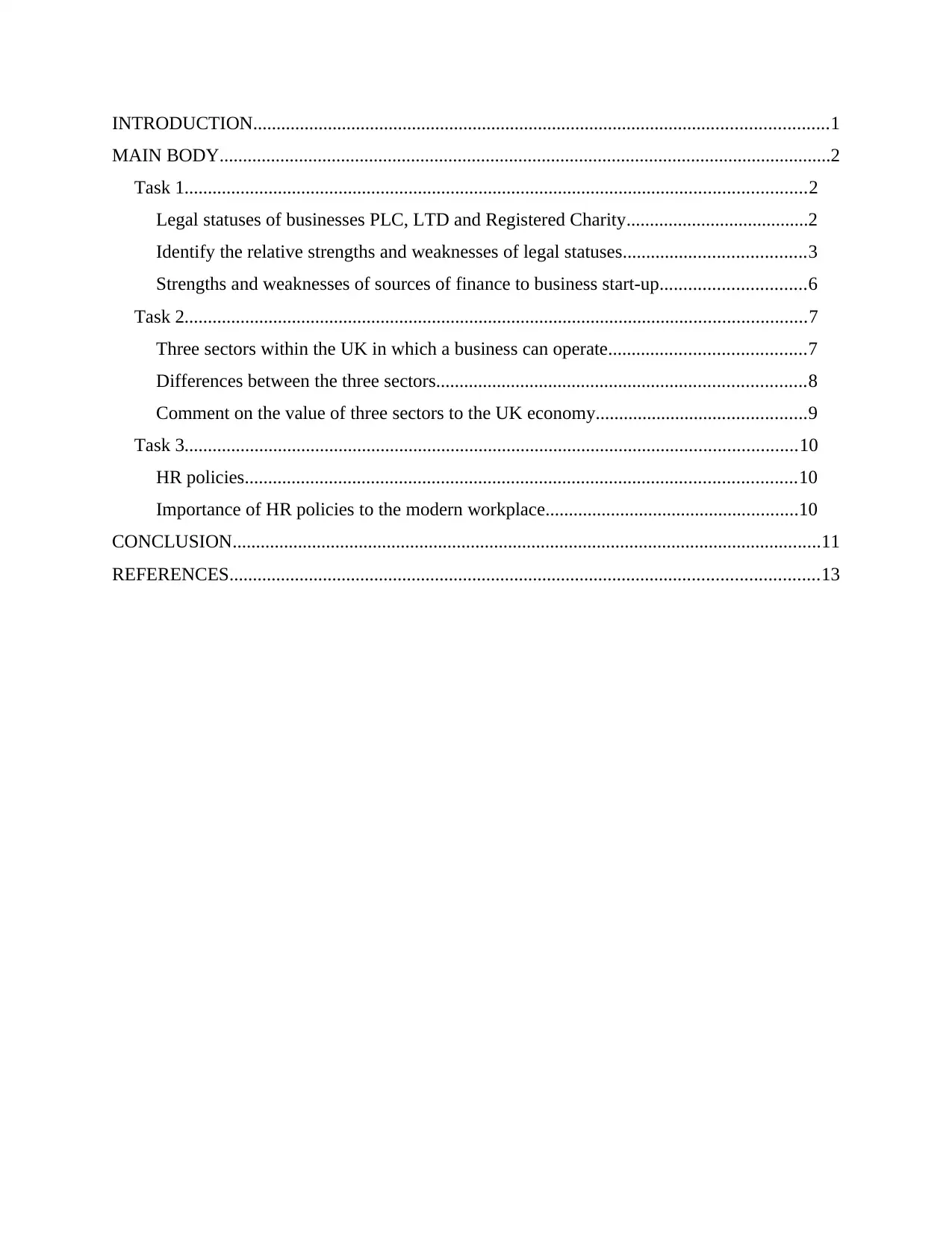
INTRODUCTION...........................................................................................................................1
MAIN BODY...................................................................................................................................2
Task 1.....................................................................................................................................2
Legal statuses of businesses PLC, LTD and Registered Charity.......................................2
Identify the relative strengths and weaknesses of legal statuses.......................................3
Strengths and weaknesses of sources of finance to business start-up...............................6
Task 2.....................................................................................................................................7
Three sectors within the UK in which a business can operate..........................................7
Differences between the three sectors...............................................................................8
Comment on the value of three sectors to the UK economy.............................................9
Task 3...................................................................................................................................10
HR policies......................................................................................................................10
Importance of HR policies to the modern workplace......................................................10
CONCLUSION..............................................................................................................................11
REFERENCES..............................................................................................................................13
MAIN BODY...................................................................................................................................2
Task 1.....................................................................................................................................2
Legal statuses of businesses PLC, LTD and Registered Charity.......................................2
Identify the relative strengths and weaknesses of legal statuses.......................................3
Strengths and weaknesses of sources of finance to business start-up...............................6
Task 2.....................................................................................................................................7
Three sectors within the UK in which a business can operate..........................................7
Differences between the three sectors...............................................................................8
Comment on the value of three sectors to the UK economy.............................................9
Task 3...................................................................................................................................10
HR policies......................................................................................................................10
Importance of HR policies to the modern workplace......................................................10
CONCLUSION..............................................................................................................................11
REFERENCES..............................................................................................................................13
Paraphrase This Document
Need a fresh take? Get an instant paraphrase of this document with our AI Paraphraser
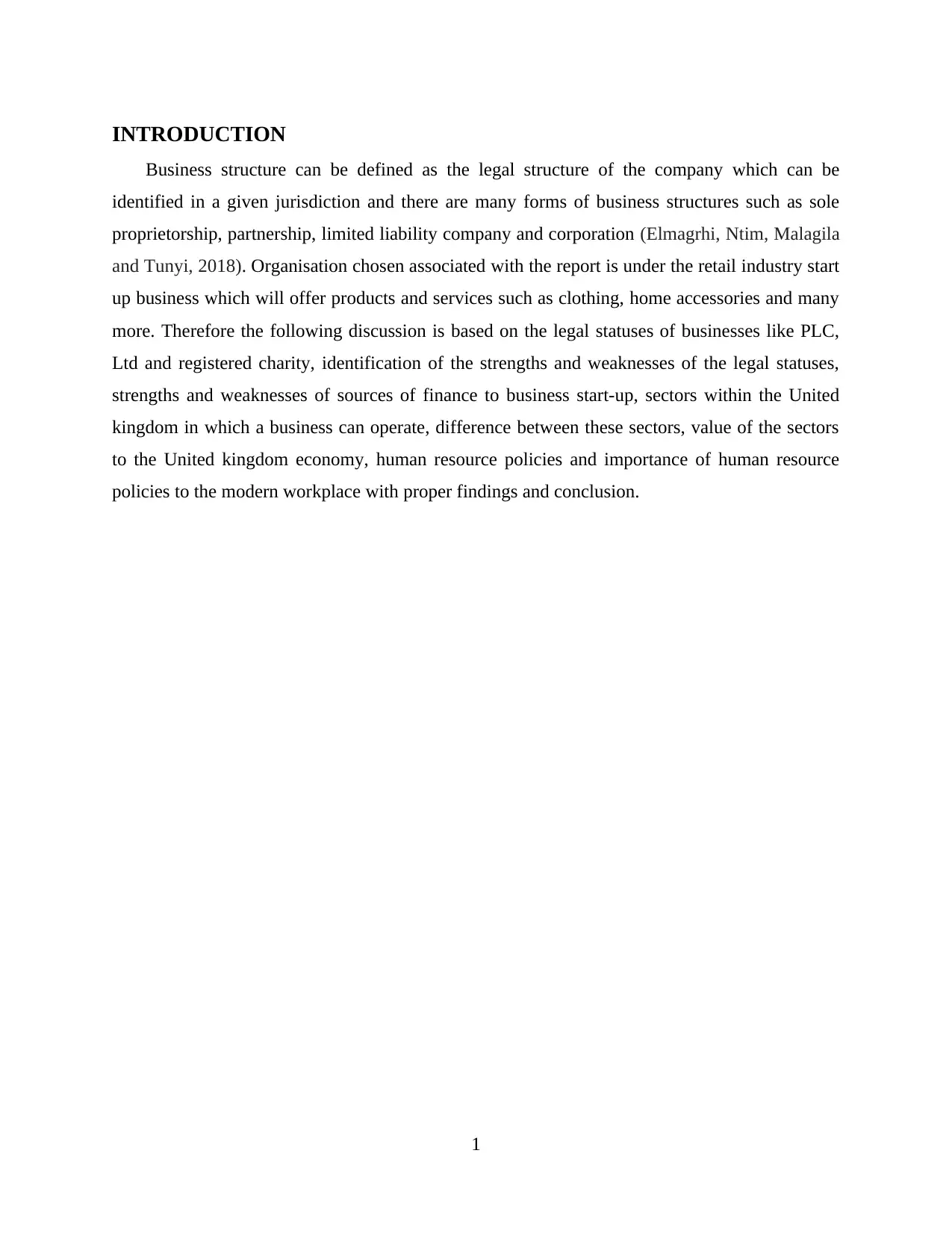
INTRODUCTION
Business structure can be defined as the legal structure of the company which can be
identified in a given jurisdiction and there are many forms of business structures such as sole
proprietorship, partnership, limited liability company and corporation (Elmagrhi, Ntim, Malagila
and Tunyi, 2018). Organisation chosen associated with the report is under the retail industry start
up business which will offer products and services such as clothing, home accessories and many
more. Therefore the following discussion is based on the legal statuses of businesses like PLC,
Ltd and registered charity, identification of the strengths and weaknesses of the legal statuses,
strengths and weaknesses of sources of finance to business start-up, sectors within the United
kingdom in which a business can operate, difference between these sectors, value of the sectors
to the United kingdom economy, human resource policies and importance of human resource
policies to the modern workplace with proper findings and conclusion.
1
Business structure can be defined as the legal structure of the company which can be
identified in a given jurisdiction and there are many forms of business structures such as sole
proprietorship, partnership, limited liability company and corporation (Elmagrhi, Ntim, Malagila
and Tunyi, 2018). Organisation chosen associated with the report is under the retail industry start
up business which will offer products and services such as clothing, home accessories and many
more. Therefore the following discussion is based on the legal statuses of businesses like PLC,
Ltd and registered charity, identification of the strengths and weaknesses of the legal statuses,
strengths and weaknesses of sources of finance to business start-up, sectors within the United
kingdom in which a business can operate, difference between these sectors, value of the sectors
to the United kingdom economy, human resource policies and importance of human resource
policies to the modern workplace with proper findings and conclusion.
1
MAIN BODY
Task 1
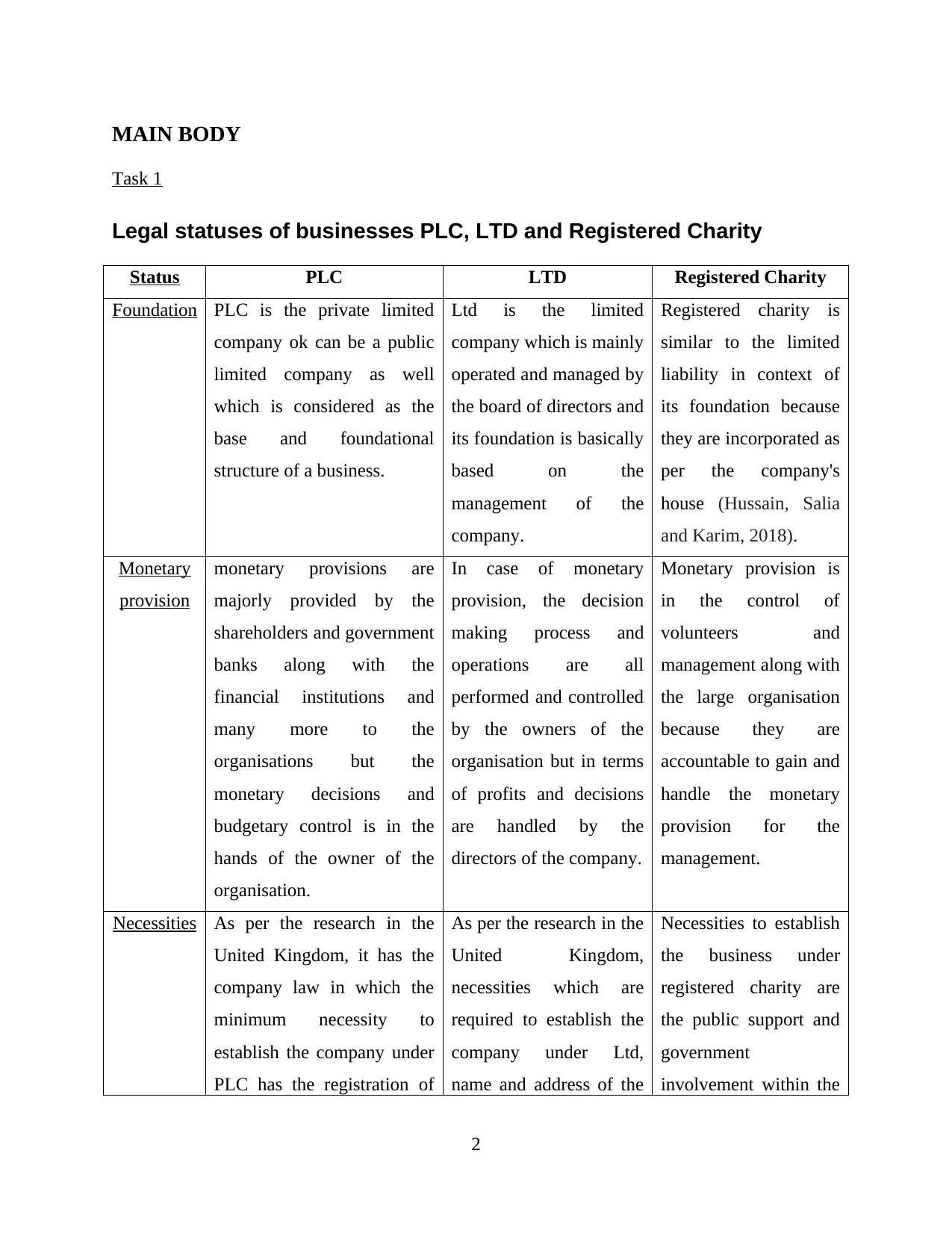
Legal statuses of businesses PLC, LTD and Registered Charity
Status PLC LTD Registered Charity
Foundation PLC is the private limited
company ok can be a public
limited company as well
which is considered as the
base and foundational
structure of a business.
Ltd is the limited
company which is mainly
operated and managed by
the board of directors and
its foundation is basically
based on the
management of the
company.
Registered charity is
similar to the limited
liability in context of
its foundation because
they are incorporated as
per the company's
house (Hussain, Salia
and Karim, 2018).
Monetary
provision
monetary provisions are
majorly provided by the
shareholders and government
banks along with the
financial institutions and
many more to the
organisations but the
monetary decisions and
budgetary control is in the
hands of the owner of the
organisation.
In case of monetary
provision, the decision
making process and
operations are all
performed and controlled
by the owners of the
organisation but in terms
of profits and decisions
are handled by the
directors of the company.
Monetary provision is
in the control of
volunteers and
management along with
the large organisation
because they are
accountable to gain and
handle the monetary
provision for the
management.
Necessities As per the research in the
United Kingdom, it has the
company law in which the
minimum necessity to
establish the company under
PLC has the registration of
As per the research in the
United Kingdom,
necessities which are
required to establish the
company under Ltd,
name and address of the
Necessities to establish
the business under
registered charity are
the public support and
government
involvement within the
2
Task 1
Legal statuses of businesses PLC, LTD and Registered Charity
Status PLC LTD Registered Charity
Foundation PLC is the private limited
company ok can be a public
limited company as well
which is considered as the
base and foundational
structure of a business.
Ltd is the limited
company which is mainly
operated and managed by
the board of directors and
its foundation is basically
based on the
management of the
company.
Registered charity is
similar to the limited
liability in context of
its foundation because
they are incorporated as
per the company's
house (Hussain, Salia
and Karim, 2018).
Monetary
provision
monetary provisions are
majorly provided by the
shareholders and government
banks along with the
financial institutions and
many more to the
organisations but the
monetary decisions and
budgetary control is in the
hands of the owner of the
organisation.
In case of monetary
provision, the decision
making process and
operations are all
performed and controlled
by the owners of the
organisation but in terms
of profits and decisions
are handled by the
directors of the company.
Monetary provision is
in the control of
volunteers and
management along with
the large organisation
because they are
accountable to gain and
handle the monetary
provision for the
management.
Necessities As per the research in the
United Kingdom, it has the
company law in which the
minimum necessity to
establish the company under
PLC has the registration of
As per the research in the
United Kingdom,
necessities which are
required to establish the
company under Ltd,
name and address of the
Necessities to establish
the business under
registered charity are
the public support and
government
involvement within the
2
⊘ This is a preview!⊘
Do you want full access?
Subscribe today to unlock all pages.
Trusted by 1+ million students worldwide
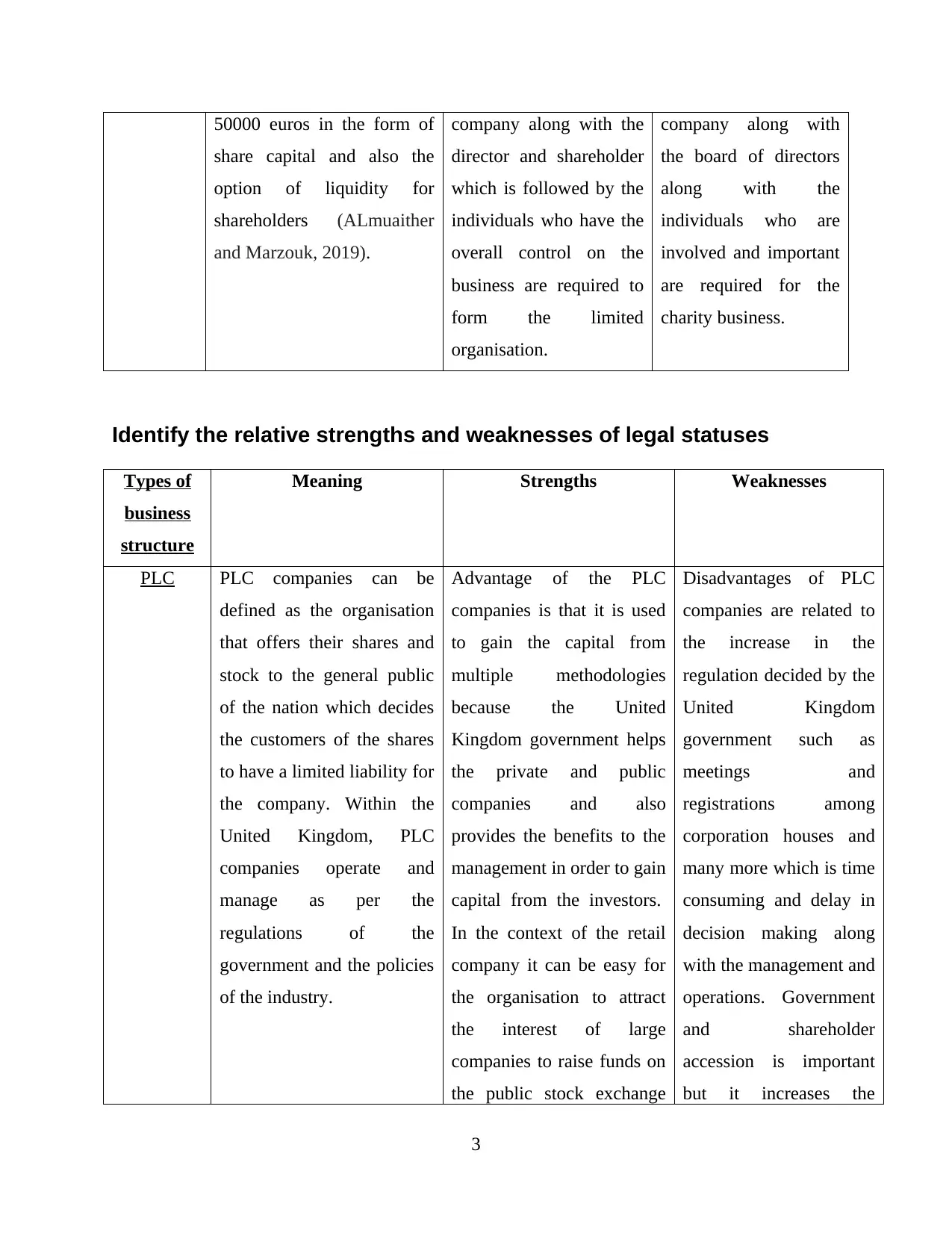
50000 euros in the form of
share capital and also the
option of liquidity for
shareholders (ALmuaither
and Marzouk, 2019).
company along with the
director and shareholder
which is followed by the
individuals who have the
overall control on the
business are required to
form the limited
organisation.
company along with
the board of directors
along with the
individuals who are
involved and important
are required for the
charity business.
Identify the relative strengths and weaknesses of legal statuses
Types of
business
structure
Meaning Strengths Weaknesses
PLC PLC companies can be
defined as the organisation
that offers their shares and
stock to the general public
of the nation which decides
the customers of the shares
to have a limited liability for
the company. Within the
United Kingdom, PLC
companies operate and
manage as per the
regulations of the
government and the policies
of the industry.
Advantage of the PLC
companies is that it is used
to gain the capital from
multiple methodologies
because the United
Kingdom government helps
the private and public
companies and also
provides the benefits to the
management in order to gain
capital from the investors.
In the context of the retail
company it can be easy for
the organisation to attract
the interest of large
companies to raise funds on
the public stock exchange
Disadvantages of PLC
companies are related to
the increase in the
regulation decided by the
United Kingdom
government such as
meetings and
registrations among
corporation houses and
many more which is time
consuming and delay in
decision making along
with the management and
operations. Government
and shareholder
accession is important
but it increases the
3
share capital and also the
option of liquidity for
shareholders (ALmuaither
and Marzouk, 2019).
company along with the
director and shareholder
which is followed by the
individuals who have the
overall control on the
business are required to
form the limited
organisation.
company along with
the board of directors
along with the
individuals who are
involved and important
are required for the
charity business.
Identify the relative strengths and weaknesses of legal statuses
Types of
business
structure
Meaning Strengths Weaknesses
PLC PLC companies can be
defined as the organisation
that offers their shares and
stock to the general public
of the nation which decides
the customers of the shares
to have a limited liability for
the company. Within the
United Kingdom, PLC
companies operate and
manage as per the
regulations of the
government and the policies
of the industry.
Advantage of the PLC
companies is that it is used
to gain the capital from
multiple methodologies
because the United
Kingdom government helps
the private and public
companies and also
provides the benefits to the
management in order to gain
capital from the investors.
In the context of the retail
company it can be easy for
the organisation to attract
the interest of large
companies to raise funds on
the public stock exchange
Disadvantages of PLC
companies are related to
the increase in the
regulation decided by the
United Kingdom
government such as
meetings and
registrations among
corporation houses and
many more which is time
consuming and delay in
decision making along
with the management and
operations. Government
and shareholder
accession is important
but it increases the
3
Paraphrase This Document
Need a fresh take? Get an instant paraphrase of this document with our AI Paraphraser
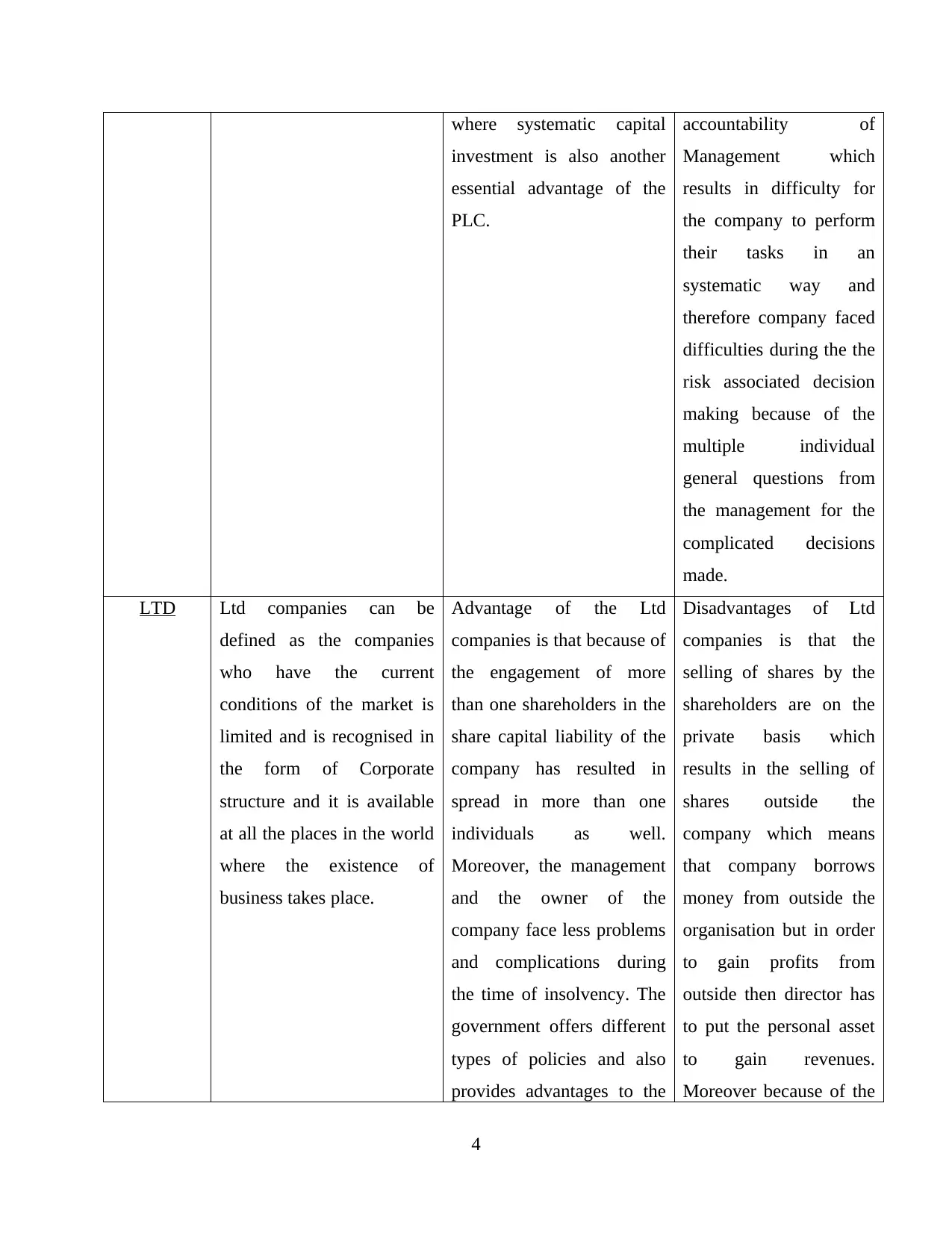
where systematic capital
investment is also another
essential advantage of the
PLC.
accountability of
Management which
results in difficulty for
the company to perform
their tasks in an
systematic way and
therefore company faced
difficulties during the the
risk associated decision
making because of the
multiple individual
general questions from
the management for the
complicated decisions
made.
LTD Ltd companies can be
defined as the companies
who have the current
conditions of the market is
limited and is recognised in
the form of Corporate
structure and it is available
at all the places in the world
where the existence of
business takes place.
Advantage of the Ltd
companies is that because of
the engagement of more
than one shareholders in the
share capital liability of the
company has resulted in
spread in more than one
individuals as well.
Moreover, the management
and the owner of the
company face less problems
and complications during
the time of insolvency. The
government offers different
types of policies and also
provides advantages to the
Disadvantages of Ltd
companies is that the
selling of shares by the
shareholders are on the
private basis which
results in the selling of
shares outside the
company which means
that company borrows
money from outside the
organisation but in order
to gain profits from
outside then director has
to put the personal asset
to gain revenues.
Moreover because of the
4
investment is also another
essential advantage of the
PLC.
accountability of
Management which
results in difficulty for
the company to perform
their tasks in an
systematic way and
therefore company faced
difficulties during the the
risk associated decision
making because of the
multiple individual
general questions from
the management for the
complicated decisions
made.
LTD Ltd companies can be
defined as the companies
who have the current
conditions of the market is
limited and is recognised in
the form of Corporate
structure and it is available
at all the places in the world
where the existence of
business takes place.
Advantage of the Ltd
companies is that because of
the engagement of more
than one shareholders in the
share capital liability of the
company has resulted in
spread in more than one
individuals as well.
Moreover, the management
and the owner of the
company face less problems
and complications during
the time of insolvency. The
government offers different
types of policies and also
provides advantages to the
Disadvantages of Ltd
companies is that the
selling of shares by the
shareholders are on the
private basis which
results in the selling of
shares outside the
company which means
that company borrows
money from outside the
organisation but in order
to gain profits from
outside then director has
to put the personal asset
to gain revenues.
Moreover because of the
4
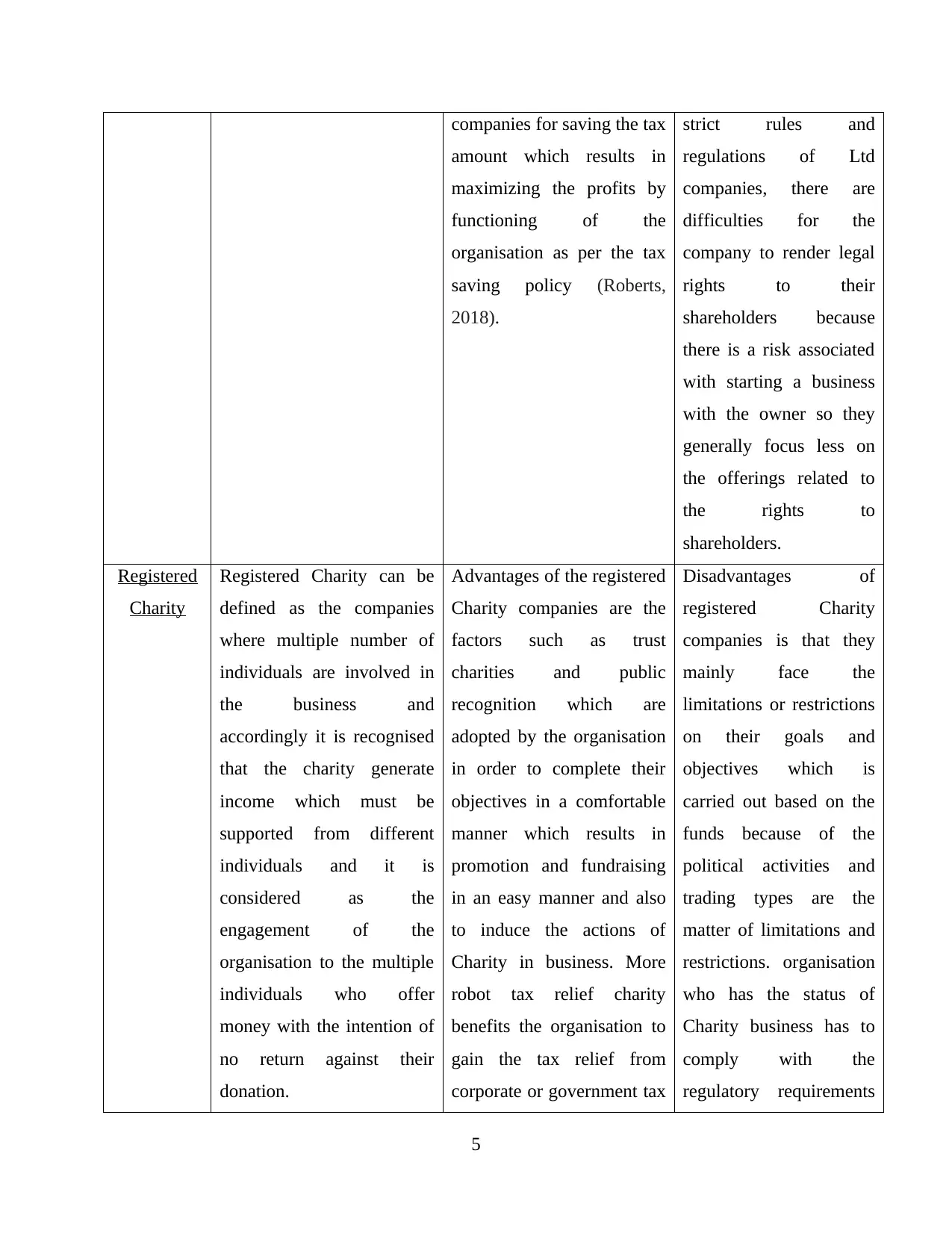
companies for saving the tax
amount which results in
maximizing the profits by
functioning of the
organisation as per the tax
saving policy (Roberts,
2018).
strict rules and
regulations of Ltd
companies, there are
difficulties for the
company to render legal
rights to their
shareholders because
there is a risk associated
with starting a business
with the owner so they
generally focus less on
the offerings related to
the rights to
shareholders.
Registered
Charity
Registered Charity can be
defined as the companies
where multiple number of
individuals are involved in
the business and
accordingly it is recognised
that the charity generate
income which must be
supported from different
individuals and it is
considered as the
engagement of the
organisation to the multiple
individuals who offer
money with the intention of
no return against their
donation.
Advantages of the registered
Charity companies are the
factors such as trust
charities and public
recognition which are
adopted by the organisation
in order to complete their
objectives in a comfortable
manner which results in
promotion and fundraising
in an easy manner and also
to induce the actions of
Charity in business. More
robot tax relief charity
benefits the organisation to
gain the tax relief from
corporate or government tax
Disadvantages of
registered Charity
companies is that they
mainly face the
limitations or restrictions
on their goals and
objectives which is
carried out based on the
funds because of the
political activities and
trading types are the
matter of limitations and
restrictions. organisation
who has the status of
Charity business has to
comply with the
regulatory requirements
5
amount which results in
maximizing the profits by
functioning of the
organisation as per the tax
saving policy (Roberts,
2018).
strict rules and
regulations of Ltd
companies, there are
difficulties for the
company to render legal
rights to their
shareholders because
there is a risk associated
with starting a business
with the owner so they
generally focus less on
the offerings related to
the rights to
shareholders.
Registered
Charity
Registered Charity can be
defined as the companies
where multiple number of
individuals are involved in
the business and
accordingly it is recognised
that the charity generate
income which must be
supported from different
individuals and it is
considered as the
engagement of the
organisation to the multiple
individuals who offer
money with the intention of
no return against their
donation.
Advantages of the registered
Charity companies are the
factors such as trust
charities and public
recognition which are
adopted by the organisation
in order to complete their
objectives in a comfortable
manner which results in
promotion and fundraising
in an easy manner and also
to induce the actions of
Charity in business. More
robot tax relief charity
benefits the organisation to
gain the tax relief from
corporate or government tax
Disadvantages of
registered Charity
companies is that they
mainly face the
limitations or restrictions
on their goals and
objectives which is
carried out based on the
funds because of the
political activities and
trading types are the
matter of limitations and
restrictions. organisation
who has the status of
Charity business has to
comply with the
regulatory requirements
5
⊘ This is a preview!⊘
Do you want full access?
Subscribe today to unlock all pages.
Trusted by 1+ million students worldwide
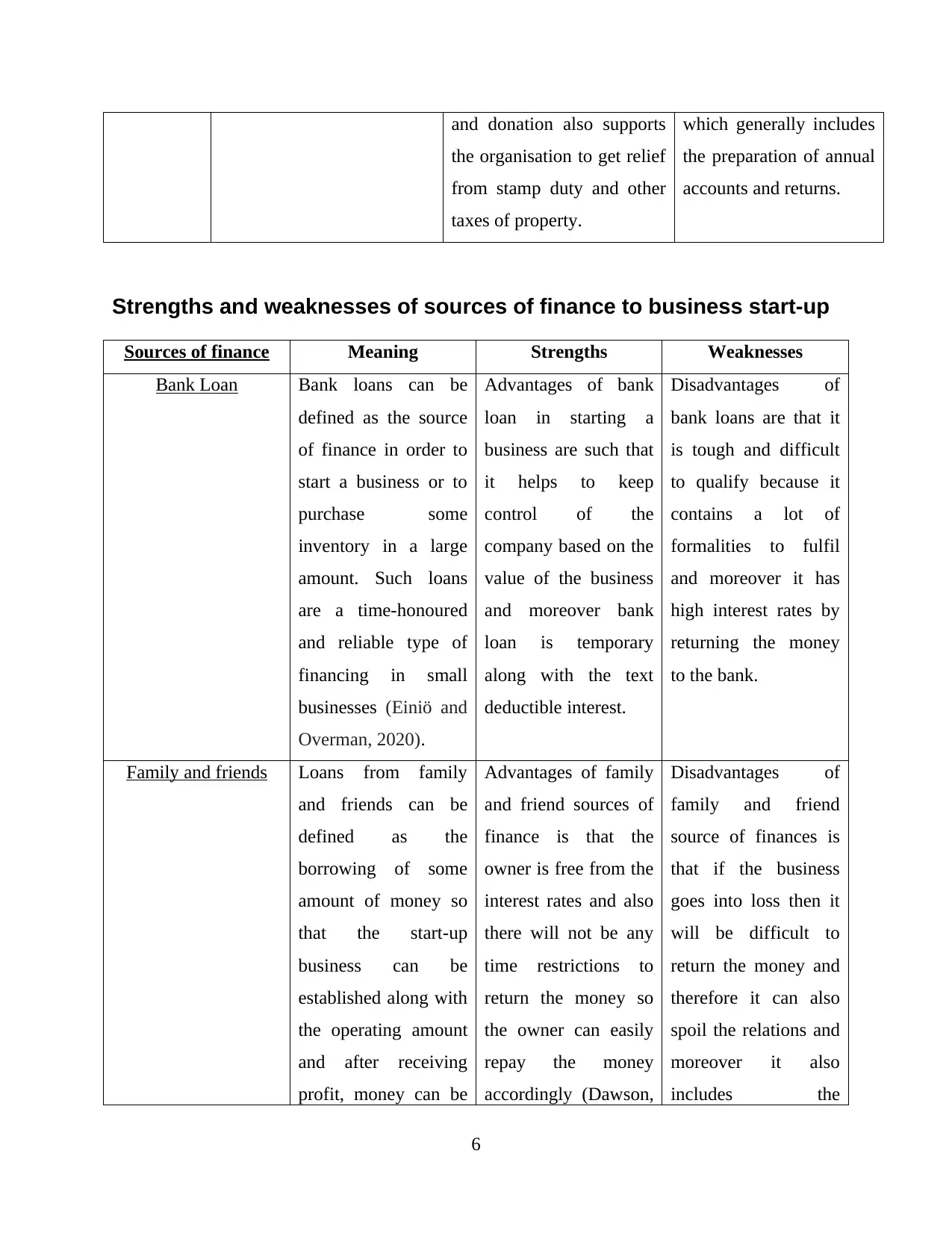
and donation also supports
the organisation to get relief
from stamp duty and other
taxes of property.
which generally includes
the preparation of annual
accounts and returns.
Strengths and weaknesses of sources of finance to business start-up
Sources of finance Meaning Strengths Weaknesses
Bank Loan Bank loans can be
defined as the source
of finance in order to
start a business or to
purchase some
inventory in a large
amount. Such loans
are a time-honoured
and reliable type of
financing in small
businesses (Einiö and
Overman, 2020).
Advantages of bank
loan in starting a
business are such that
it helps to keep
control of the
company based on the
value of the business
and moreover bank
loan is temporary
along with the text
deductible interest.
Disadvantages of
bank loans are that it
is tough and difficult
to qualify because it
contains a lot of
formalities to fulfil
and moreover it has
high interest rates by
returning the money
to the bank.
Family and friends Loans from family
and friends can be
defined as the
borrowing of some
amount of money so
that the start-up
business can be
established along with
the operating amount
and after receiving
profit, money can be
Advantages of family
and friend sources of
finance is that the
owner is free from the
interest rates and also
there will not be any
time restrictions to
return the money so
the owner can easily
repay the money
accordingly (Dawson,
Disadvantages of
family and friend
source of finances is
that if the business
goes into loss then it
will be difficult to
return the money and
therefore it can also
spoil the relations and
moreover it also
includes the
6
the organisation to get relief
from stamp duty and other
taxes of property.
which generally includes
the preparation of annual
accounts and returns.
Strengths and weaknesses of sources of finance to business start-up
Sources of finance Meaning Strengths Weaknesses
Bank Loan Bank loans can be
defined as the source
of finance in order to
start a business or to
purchase some
inventory in a large
amount. Such loans
are a time-honoured
and reliable type of
financing in small
businesses (Einiö and
Overman, 2020).
Advantages of bank
loan in starting a
business are such that
it helps to keep
control of the
company based on the
value of the business
and moreover bank
loan is temporary
along with the text
deductible interest.
Disadvantages of
bank loans are that it
is tough and difficult
to qualify because it
contains a lot of
formalities to fulfil
and moreover it has
high interest rates by
returning the money
to the bank.
Family and friends Loans from family
and friends can be
defined as the
borrowing of some
amount of money so
that the start-up
business can be
established along with
the operating amount
and after receiving
profit, money can be
Advantages of family
and friend sources of
finance is that the
owner is free from the
interest rates and also
there will not be any
time restrictions to
return the money so
the owner can easily
repay the money
accordingly (Dawson,
Disadvantages of
family and friend
source of finances is
that if the business
goes into loss then it
will be difficult to
return the money and
therefore it can also
spoil the relations and
moreover it also
includes the
6
Paraphrase This Document
Need a fresh take? Get an instant paraphrase of this document with our AI Paraphraser
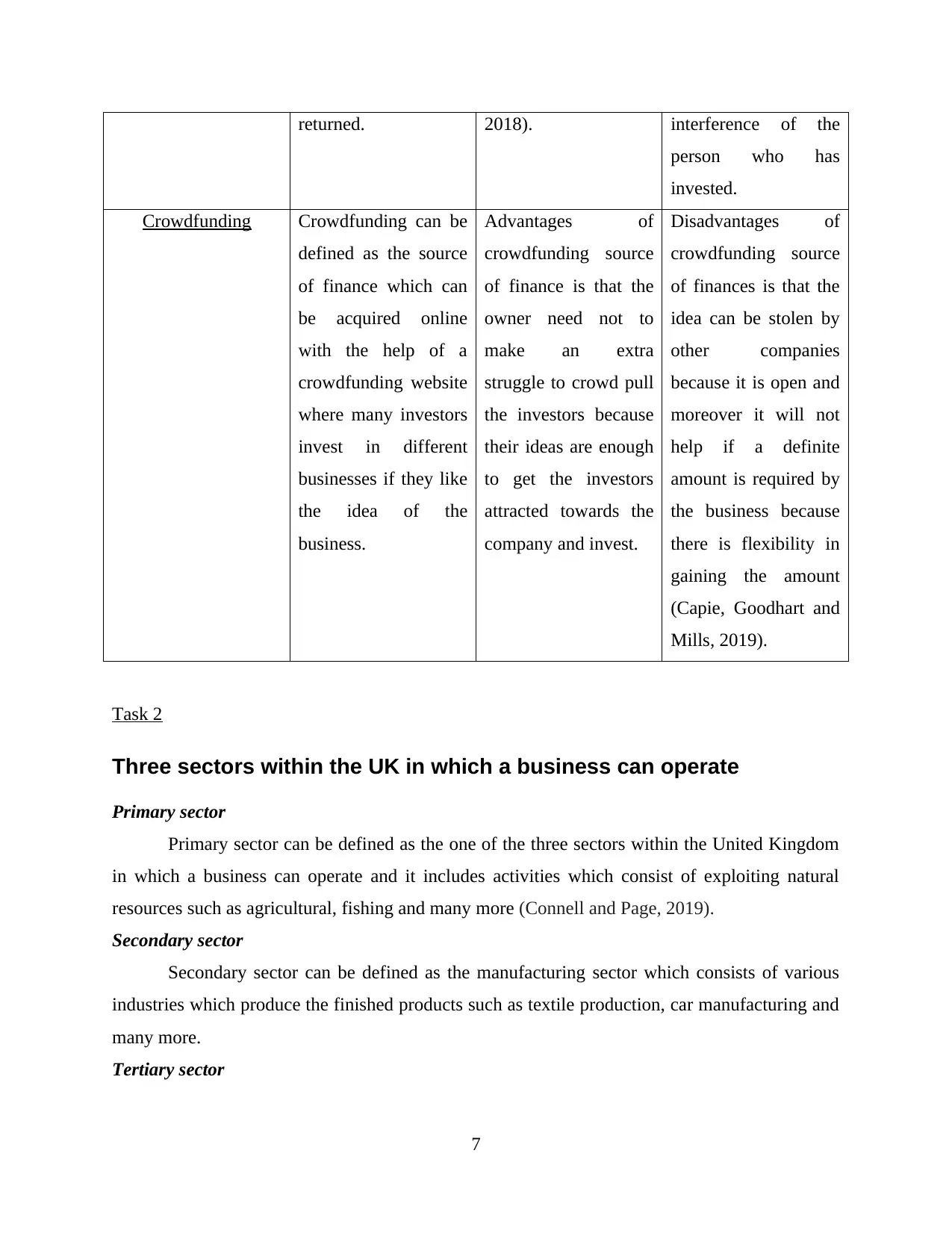
returned. 2018). interference of the
person who has
invested.
Crowdfunding Crowdfunding can be
defined as the source
of finance which can
be acquired online
with the help of a
crowdfunding website
where many investors
invest in different
businesses if they like
the idea of the
business.
Advantages of
crowdfunding source
of finance is that the
owner need not to
make an extra
struggle to crowd pull
the investors because
their ideas are enough
to get the investors
attracted towards the
company and invest.
Disadvantages of
crowdfunding source
of finances is that the
idea can be stolen by
other companies
because it is open and
moreover it will not
help if a definite
amount is required by
the business because
there is flexibility in
gaining the amount
(Capie, Goodhart and
Mills, 2019).
Task 2
Three sectors within the UK in which a business can operate
Primary sector
Primary sector can be defined as the one of the three sectors within the United Kingdom
in which a business can operate and it includes activities which consist of exploiting natural
resources such as agricultural, fishing and many more (Connell and Page, 2019).
Secondary sector
Secondary sector can be defined as the manufacturing sector which consists of various
industries which produce the finished products such as textile production, car manufacturing and
many more.
Tertiary sector
7
person who has
invested.
Crowdfunding Crowdfunding can be
defined as the source
of finance which can
be acquired online
with the help of a
crowdfunding website
where many investors
invest in different
businesses if they like
the idea of the
business.
Advantages of
crowdfunding source
of finance is that the
owner need not to
make an extra
struggle to crowd pull
the investors because
their ideas are enough
to get the investors
attracted towards the
company and invest.
Disadvantages of
crowdfunding source
of finances is that the
idea can be stolen by
other companies
because it is open and
moreover it will not
help if a definite
amount is required by
the business because
there is flexibility in
gaining the amount
(Capie, Goodhart and
Mills, 2019).
Task 2
Three sectors within the UK in which a business can operate
Primary sector
Primary sector can be defined as the one of the three sectors within the United Kingdom
in which a business can operate and it includes activities which consist of exploiting natural
resources such as agricultural, fishing and many more (Connell and Page, 2019).
Secondary sector
Secondary sector can be defined as the manufacturing sector which consists of various
industries which produce the finished products such as textile production, car manufacturing and
many more.
Tertiary sector
7
The Tertiary sector can be defined as the service sector which consists of the production
of services instead of end products and finally handing over the final product to the customers
such as education, social work and many more (Rong, Lin, Li and Yu, 2018).
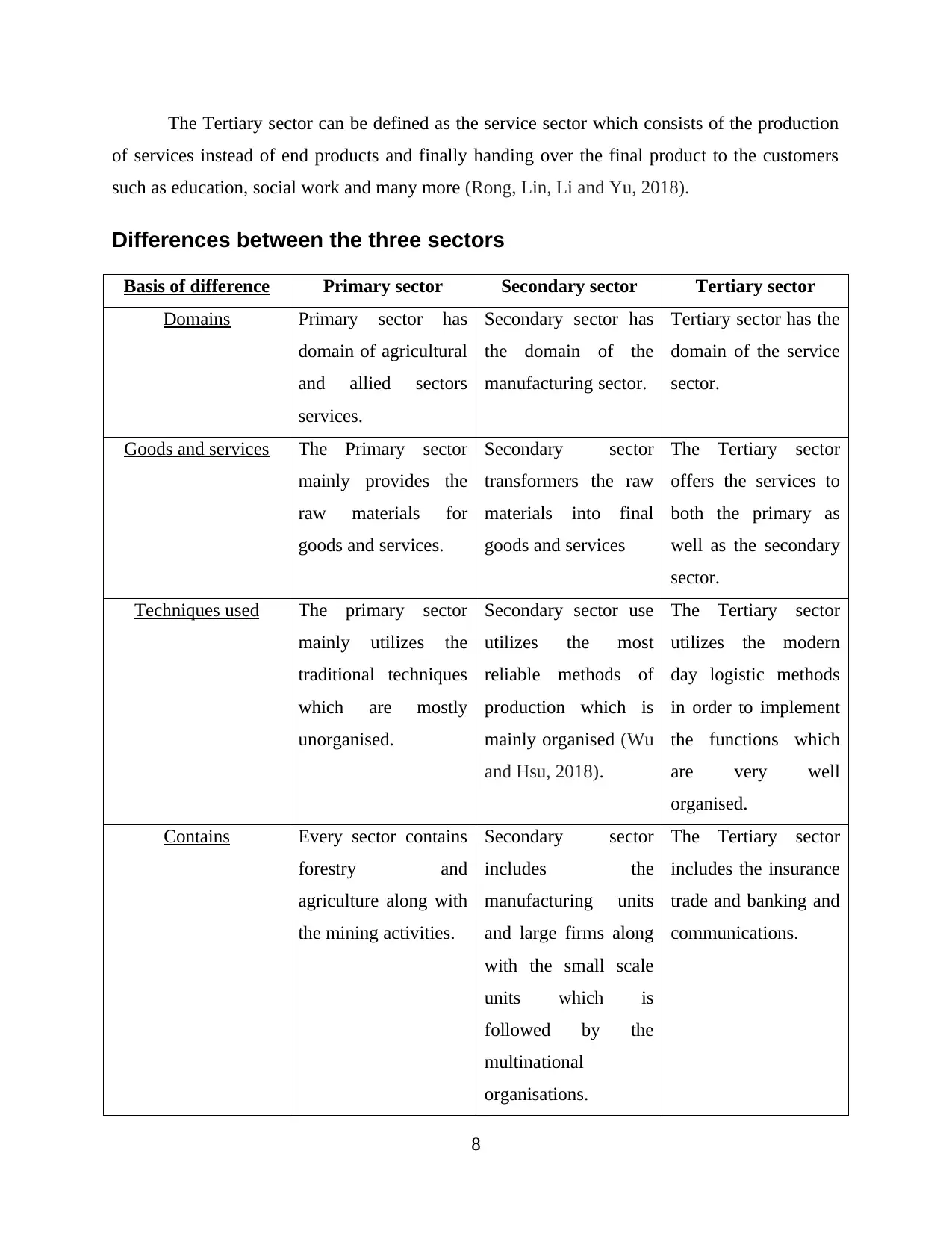
Differences between the three sectors
Basis of difference Primary sector Secondary sector Tertiary sector
Domains Primary sector has
domain of agricultural
and allied sectors
services.
Secondary sector has
the domain of the
manufacturing sector.
Tertiary sector has the
domain of the service
sector.
Goods and services The Primary sector
mainly provides the
raw materials for
goods and services.
Secondary sector
transformers the raw
materials into final
goods and services
The Tertiary sector
offers the services to
both the primary as
well as the secondary
sector.
Techniques used The primary sector
mainly utilizes the
traditional techniques
which are mostly
unorganised.
Secondary sector use
utilizes the most
reliable methods of
production which is
mainly organised (Wu
and Hsu, 2018).
The Tertiary sector
utilizes the modern
day logistic methods
in order to implement
the functions which
are very well
organised.
Contains Every sector contains
forestry and
agriculture along with
the mining activities.
Secondary sector
includes the
manufacturing units
and large firms along
with the small scale
units which is
followed by the
multinational
organisations.
The Tertiary sector
includes the insurance
trade and banking and
communications.
8
of services instead of end products and finally handing over the final product to the customers
such as education, social work and many more (Rong, Lin, Li and Yu, 2018).
Differences between the three sectors
Basis of difference Primary sector Secondary sector Tertiary sector
Domains Primary sector has
domain of agricultural
and allied sectors
services.
Secondary sector has
the domain of the
manufacturing sector.
Tertiary sector has the
domain of the service
sector.
Goods and services The Primary sector
mainly provides the
raw materials for
goods and services.
Secondary sector
transformers the raw
materials into final
goods and services
The Tertiary sector
offers the services to
both the primary as
well as the secondary
sector.
Techniques used The primary sector
mainly utilizes the
traditional techniques
which are mostly
unorganised.
Secondary sector use
utilizes the most
reliable methods of
production which is
mainly organised (Wu
and Hsu, 2018).
The Tertiary sector
utilizes the modern
day logistic methods
in order to implement
the functions which
are very well
organised.
Contains Every sector contains
forestry and
agriculture along with
the mining activities.
Secondary sector
includes the
manufacturing units
and large firms along
with the small scale
units which is
followed by the
multinational
organisations.
The Tertiary sector
includes the insurance
trade and banking and
communications.
8
⊘ This is a preview!⊘
Do you want full access?
Subscribe today to unlock all pages.
Trusted by 1+ million students worldwide

1 out of 17


Related Documents


Your All-in-One AI-Powered Toolkit for Academic Success.
+13062052269
info@desklib.com
Available 24*7 on WhatsApp / Email
![[object Object]](/_next/static/media/star-bottom.7253800d.svg)
Unlock your academic potential
Copyright © 2020–2026 A2Z Services. All Rights Reserved. Developed and managed by ZUCOL.