Analysis of Business Environment and Sustainability
VerifiedAdded on 2021/01/02
|7
|1723
|177
Essay
AI Summary
This essay provides an in-depth analysis of the micro and macro environmental factors that significantly impact the nature of modern business within a global context. It explores the influence of stakeholders like customers, employees, and suppliers (micro factors), and political, technological, legal, and social elements (macro factors). The essay also delves into the critical importance of organizational and individual commitment to sustainability and ethical behavior, encompassing economic, environmental, social, and ethical dimensions. It emphasizes how businesses can navigate these factors to achieve success and highlights the interconnectedness of these elements in shaping the global business landscape. The work concludes by summarizing the significance of these factors in the contemporary business world.
Context of business
Paraphrase This Document
Need a fresh take? Get an instant paraphrase of this document with our AI Paraphraser

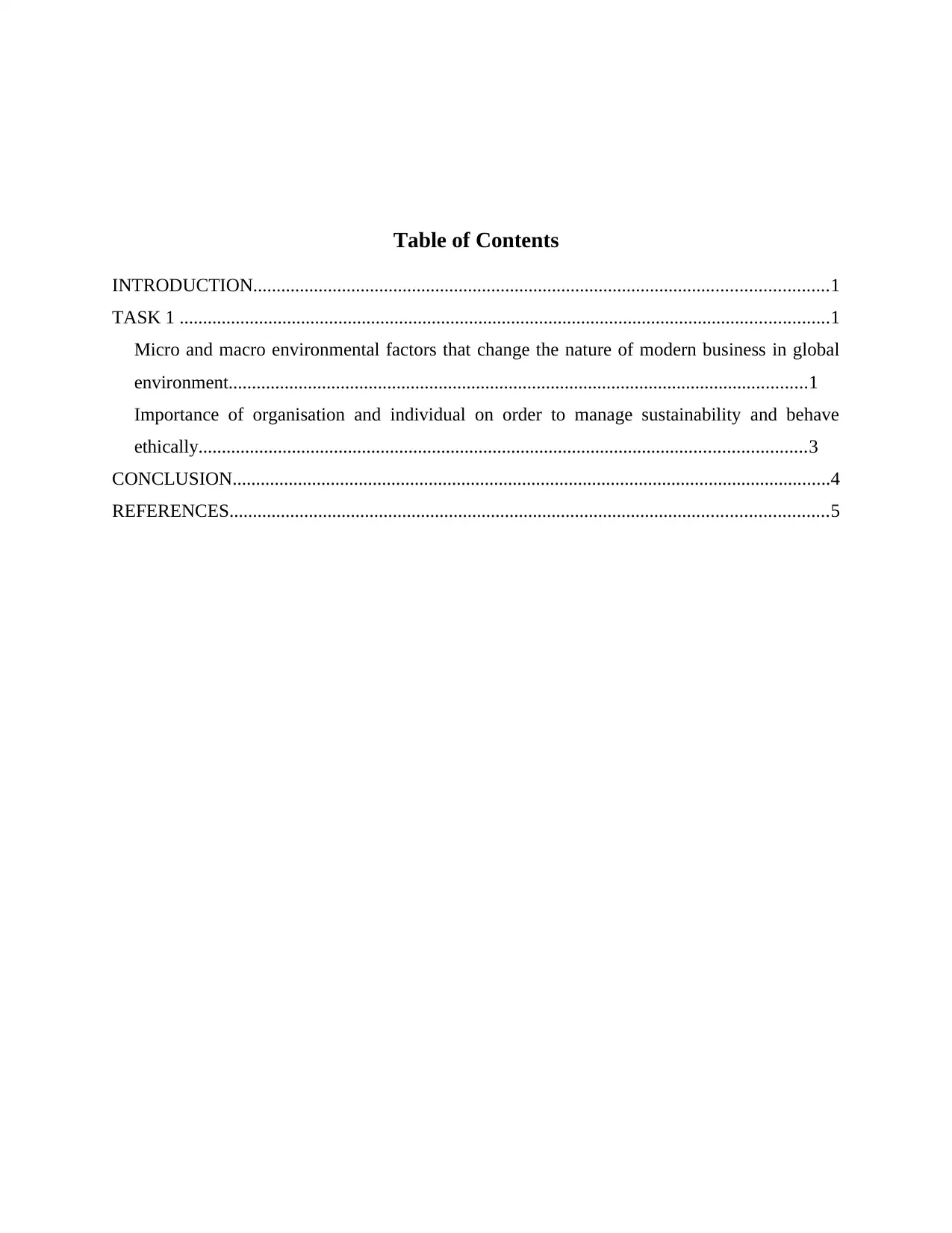
Table of Contents
INTRODUCTION...........................................................................................................................1
TASK 1 ...........................................................................................................................................1
Micro and macro environmental factors that change the nature of modern business in global
environment............................................................................................................................1
Importance of organisation and individual on order to manage sustainability and behave
ethically..................................................................................................................................3
CONCLUSION................................................................................................................................4
REFERENCES................................................................................................................................5
INTRODUCTION...........................................................................................................................1
TASK 1 ...........................................................................................................................................1
Micro and macro environmental factors that change the nature of modern business in global
environment............................................................................................................................1
Importance of organisation and individual on order to manage sustainability and behave
ethically..................................................................................................................................3
CONCLUSION................................................................................................................................4
REFERENCES................................................................................................................................5

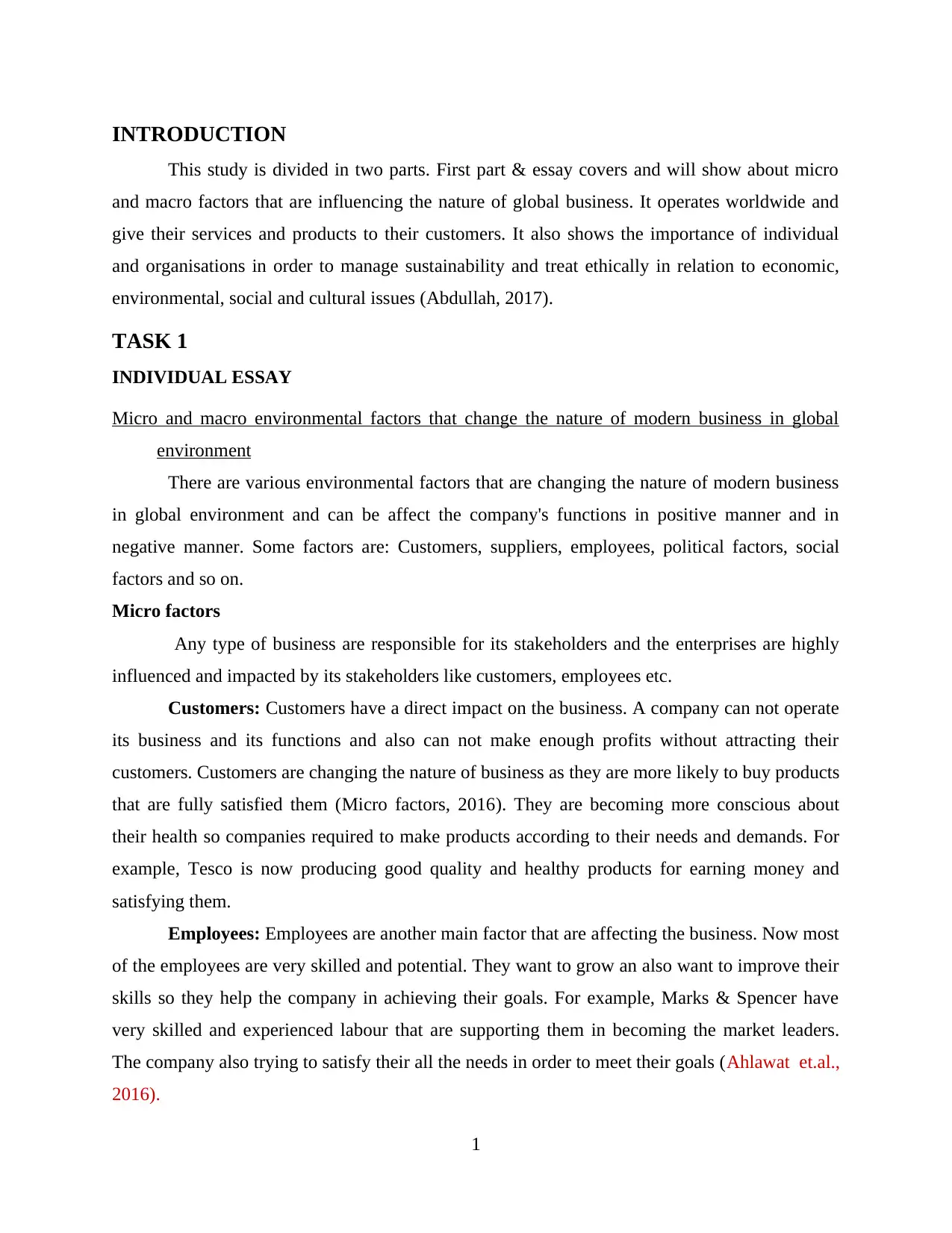
INTRODUCTION
This study is divided in two parts. First part & essay covers and will show about micro
and macro factors that are influencing the nature of global business. It operates worldwide and
give their services and products to their customers. It also shows the importance of individual
and organisations in order to manage sustainability and treat ethically in relation to economic,
environmental, social and cultural issues (Abdullah, 2017).
TASK 1
INDIVIDUAL ESSAY
Micro and macro environmental factors that change the nature of modern business in global
environment
There are various environmental factors that are changing the nature of modern business
in global environment and can be affect the company's functions in positive manner and in
negative manner. Some factors are: Customers, suppliers, employees, political factors, social
factors and so on.
Micro factors
Any type of business are responsible for its stakeholders and the enterprises are highly
influenced and impacted by its stakeholders like customers, employees etc.
Customers: Customers have a direct impact on the business. A company can not operate
its business and its functions and also can not make enough profits without attracting their
customers. Customers are changing the nature of business as they are more likely to buy products
that are fully satisfied them (Micro factors, 2016). They are becoming more conscious about
their health so companies required to make products according to their needs and demands. For
example, Tesco is now producing good quality and healthy products for earning money and
satisfying them.
Employees: Employees are another main factor that are affecting the business. Now most
of the employees are very skilled and potential. They want to grow an also want to improve their
skills so they help the company in achieving their goals. For example, Marks & Spencer have
very skilled and experienced labour that are supporting them in becoming the market leaders.
The company also trying to satisfy their all the needs in order to meet their goals (Ahlawat et.al.,
2016).
1
This study is divided in two parts. First part & essay covers and will show about micro
and macro factors that are influencing the nature of global business. It operates worldwide and
give their services and products to their customers. It also shows the importance of individual
and organisations in order to manage sustainability and treat ethically in relation to economic,
environmental, social and cultural issues (Abdullah, 2017).
TASK 1
INDIVIDUAL ESSAY
Micro and macro environmental factors that change the nature of modern business in global
environment
There are various environmental factors that are changing the nature of modern business
in global environment and can be affect the company's functions in positive manner and in
negative manner. Some factors are: Customers, suppliers, employees, political factors, social
factors and so on.
Micro factors
Any type of business are responsible for its stakeholders and the enterprises are highly
influenced and impacted by its stakeholders like customers, employees etc.
Customers: Customers have a direct impact on the business. A company can not operate
its business and its functions and also can not make enough profits without attracting their
customers. Customers are changing the nature of business as they are more likely to buy products
that are fully satisfied them (Micro factors, 2016). They are becoming more conscious about
their health so companies required to make products according to their needs and demands. For
example, Tesco is now producing good quality and healthy products for earning money and
satisfying them.
Employees: Employees are another main factor that are affecting the business. Now most
of the employees are very skilled and potential. They want to grow an also want to improve their
skills so they help the company in achieving their goals. For example, Marks & Spencer have
very skilled and experienced labour that are supporting them in becoming the market leaders.
The company also trying to satisfy their all the needs in order to meet their goals (Ahlawat et.al.,
2016).
1
⊘ This is a preview!⊘
Do you want full access?
Subscribe today to unlock all pages.

Trusted by 1+ million students worldwide

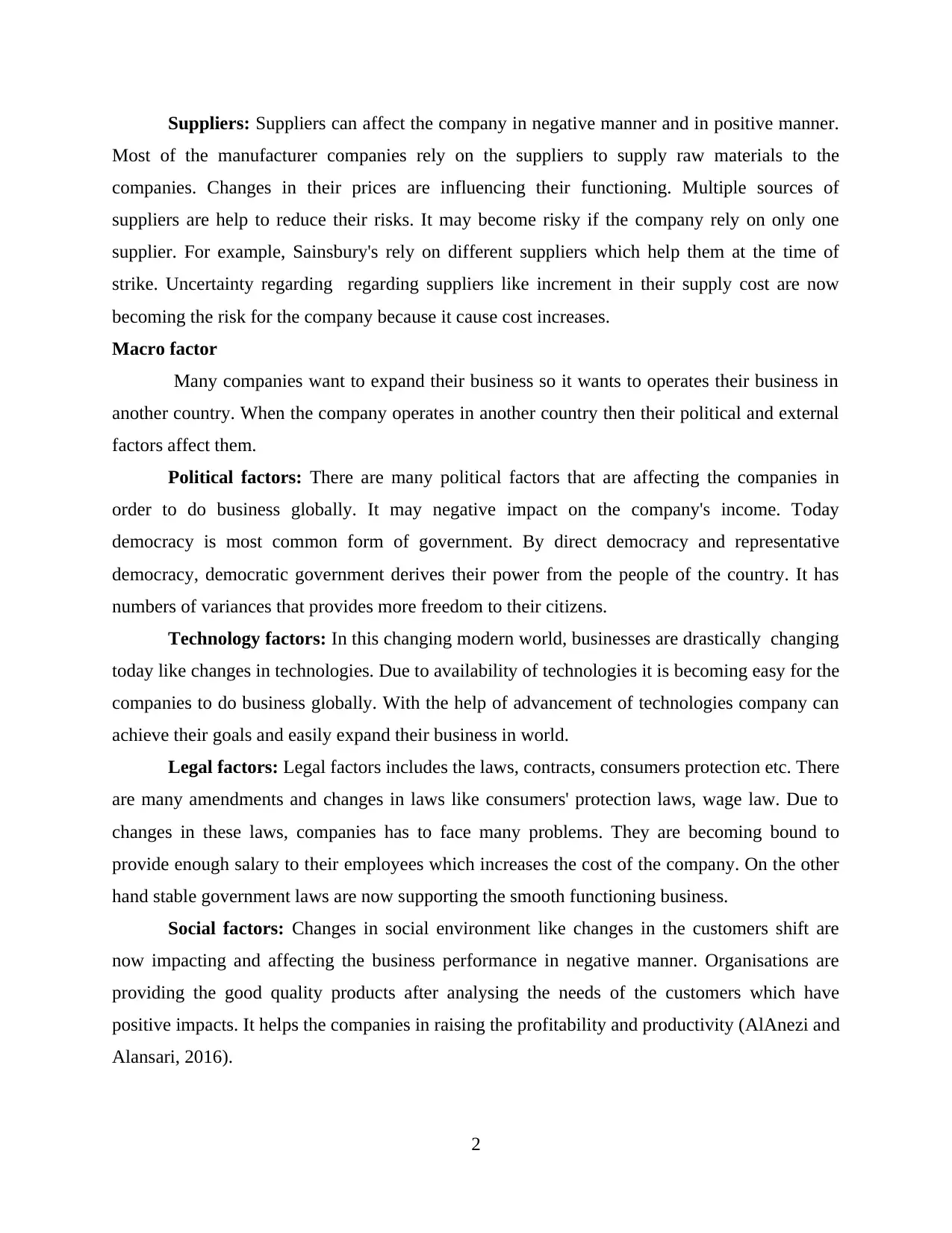
Suppliers: Suppliers can affect the company in negative manner and in positive manner.
Most of the manufacturer companies rely on the suppliers to supply raw materials to the
companies. Changes in their prices are influencing their functioning. Multiple sources of
suppliers are help to reduce their risks. It may become risky if the company rely on only one
supplier. For example, Sainsbury's rely on different suppliers which help them at the time of
strike. Uncertainty regarding regarding suppliers like increment in their supply cost are now
becoming the risk for the company because it cause cost increases.
Macro factor
Many companies want to expand their business so it wants to operates their business in
another country. When the company operates in another country then their political and external
factors affect them.
Political factors: There are many political factors that are affecting the companies in
order to do business globally. It may negative impact on the company's income. Today
democracy is most common form of government. By direct democracy and representative
democracy, democratic government derives their power from the people of the country. It has
numbers of variances that provides more freedom to their citizens.
Technology factors: In this changing modern world, businesses are drastically changing
today like changes in technologies. Due to availability of technologies it is becoming easy for the
companies to do business globally. With the help of advancement of technologies company can
achieve their goals and easily expand their business in world.
Legal factors: Legal factors includes the laws, contracts, consumers protection etc. There
are many amendments and changes in laws like consumers' protection laws, wage law. Due to
changes in these laws, companies has to face many problems. They are becoming bound to
provide enough salary to their employees which increases the cost of the company. On the other
hand stable government laws are now supporting the smooth functioning business.
Social factors: Changes in social environment like changes in the customers shift are
now impacting and affecting the business performance in negative manner. Organisations are
providing the good quality products after analysing the needs of the customers which have
positive impacts. It helps the companies in raising the profitability and productivity (AlAnezi and
Alansari, 2016).
2
Most of the manufacturer companies rely on the suppliers to supply raw materials to the
companies. Changes in their prices are influencing their functioning. Multiple sources of
suppliers are help to reduce their risks. It may become risky if the company rely on only one
supplier. For example, Sainsbury's rely on different suppliers which help them at the time of
strike. Uncertainty regarding regarding suppliers like increment in their supply cost are now
becoming the risk for the company because it cause cost increases.
Macro factor
Many companies want to expand their business so it wants to operates their business in
another country. When the company operates in another country then their political and external
factors affect them.
Political factors: There are many political factors that are affecting the companies in
order to do business globally. It may negative impact on the company's income. Today
democracy is most common form of government. By direct democracy and representative
democracy, democratic government derives their power from the people of the country. It has
numbers of variances that provides more freedom to their citizens.
Technology factors: In this changing modern world, businesses are drastically changing
today like changes in technologies. Due to availability of technologies it is becoming easy for the
companies to do business globally. With the help of advancement of technologies company can
achieve their goals and easily expand their business in world.
Legal factors: Legal factors includes the laws, contracts, consumers protection etc. There
are many amendments and changes in laws like consumers' protection laws, wage law. Due to
changes in these laws, companies has to face many problems. They are becoming bound to
provide enough salary to their employees which increases the cost of the company. On the other
hand stable government laws are now supporting the smooth functioning business.
Social factors: Changes in social environment like changes in the customers shift are
now impacting and affecting the business performance in negative manner. Organisations are
providing the good quality products after analysing the needs of the customers which have
positive impacts. It helps the companies in raising the profitability and productivity (AlAnezi and
Alansari, 2016).
2
Paraphrase This Document
Need a fresh take? Get an instant paraphrase of this document with our AI Paraphraser

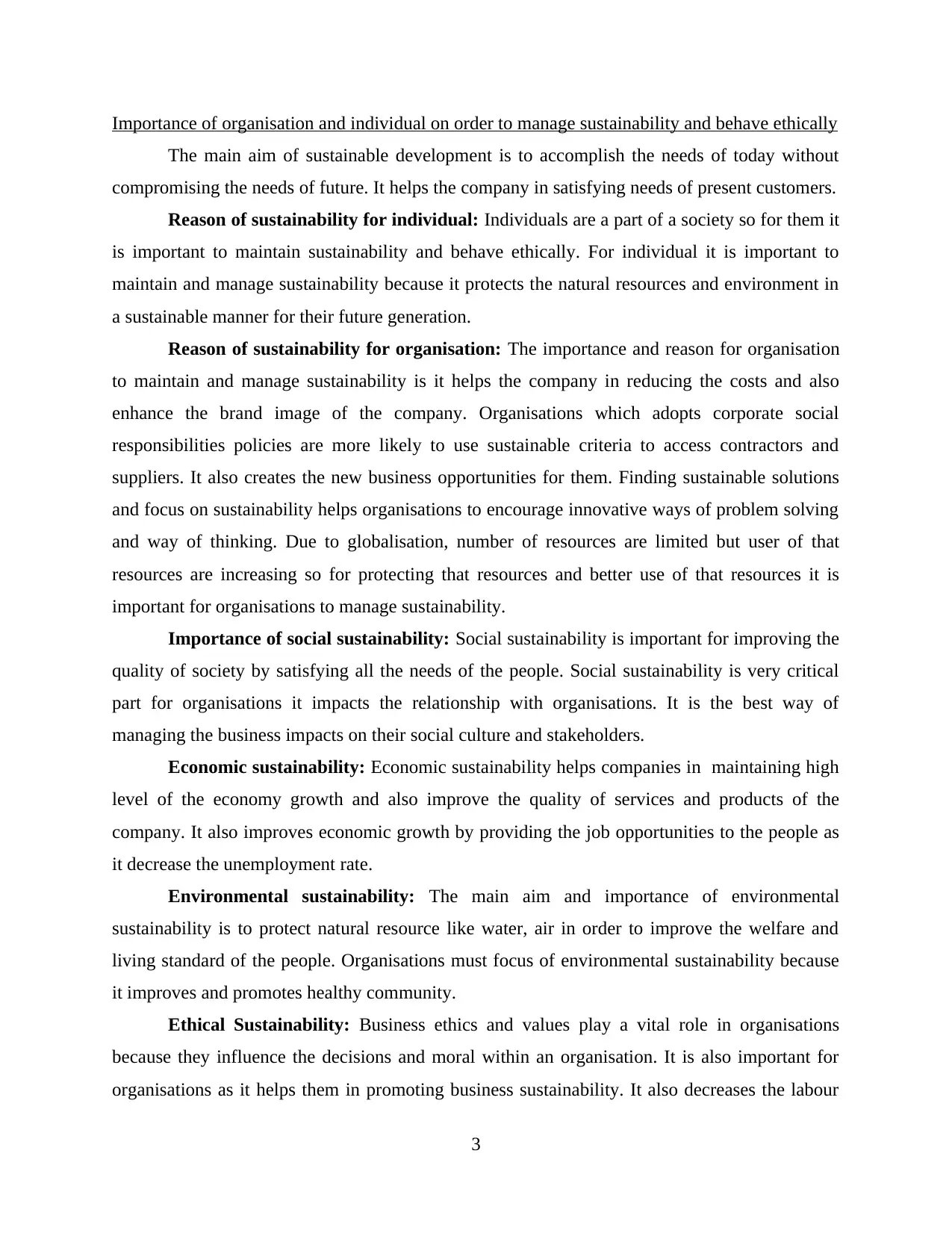
Importance of organisation and individual on order to manage sustainability and behave ethically
The main aim of sustainable development is to accomplish the needs of today without
compromising the needs of future. It helps the company in satisfying needs of present customers.
Reason of sustainability for individual: Individuals are a part of a society so for them it
is important to maintain sustainability and behave ethically. For individual it is important to
maintain and manage sustainability because it protects the natural resources and environment in
a sustainable manner for their future generation.
Reason of sustainability for organisation: The importance and reason for organisation
to maintain and manage sustainability is it helps the company in reducing the costs and also
enhance the brand image of the company. Organisations which adopts corporate social
responsibilities policies are more likely to use sustainable criteria to access contractors and
suppliers. It also creates the new business opportunities for them. Finding sustainable solutions
and focus on sustainability helps organisations to encourage innovative ways of problem solving
and way of thinking. Due to globalisation, number of resources are limited but user of that
resources are increasing so for protecting that resources and better use of that resources it is
important for organisations to manage sustainability.
Importance of social sustainability: Social sustainability is important for improving the
quality of society by satisfying all the needs of the people. Social sustainability is very critical
part for organisations it impacts the relationship with organisations. It is the best way of
managing the business impacts on their social culture and stakeholders.
Economic sustainability: Economic sustainability helps companies in maintaining high
level of the economy growth and also improve the quality of services and products of the
company. It also improves economic growth by providing the job opportunities to the people as
it decrease the unemployment rate.
Environmental sustainability: The main aim and importance of environmental
sustainability is to protect natural resource like water, air in order to improve the welfare and
living standard of the people. Organisations must focus of environmental sustainability because
it improves and promotes healthy community.
Ethical Sustainability: Business ethics and values play a vital role in organisations
because they influence the decisions and moral within an organisation. It is also important for
organisations as it helps them in promoting business sustainability. It also decreases the labour
3
The main aim of sustainable development is to accomplish the needs of today without
compromising the needs of future. It helps the company in satisfying needs of present customers.
Reason of sustainability for individual: Individuals are a part of a society so for them it
is important to maintain sustainability and behave ethically. For individual it is important to
maintain and manage sustainability because it protects the natural resources and environment in
a sustainable manner for their future generation.
Reason of sustainability for organisation: The importance and reason for organisation
to maintain and manage sustainability is it helps the company in reducing the costs and also
enhance the brand image of the company. Organisations which adopts corporate social
responsibilities policies are more likely to use sustainable criteria to access contractors and
suppliers. It also creates the new business opportunities for them. Finding sustainable solutions
and focus on sustainability helps organisations to encourage innovative ways of problem solving
and way of thinking. Due to globalisation, number of resources are limited but user of that
resources are increasing so for protecting that resources and better use of that resources it is
important for organisations to manage sustainability.
Importance of social sustainability: Social sustainability is important for improving the
quality of society by satisfying all the needs of the people. Social sustainability is very critical
part for organisations it impacts the relationship with organisations. It is the best way of
managing the business impacts on their social culture and stakeholders.
Economic sustainability: Economic sustainability helps companies in maintaining high
level of the economy growth and also improve the quality of services and products of the
company. It also improves economic growth by providing the job opportunities to the people as
it decrease the unemployment rate.
Environmental sustainability: The main aim and importance of environmental
sustainability is to protect natural resource like water, air in order to improve the welfare and
living standard of the people. Organisations must focus of environmental sustainability because
it improves and promotes healthy community.
Ethical Sustainability: Business ethics and values play a vital role in organisations
because they influence the decisions and moral within an organisation. It is also important for
organisations as it helps them in promoting business sustainability. It also decreases the labour
3

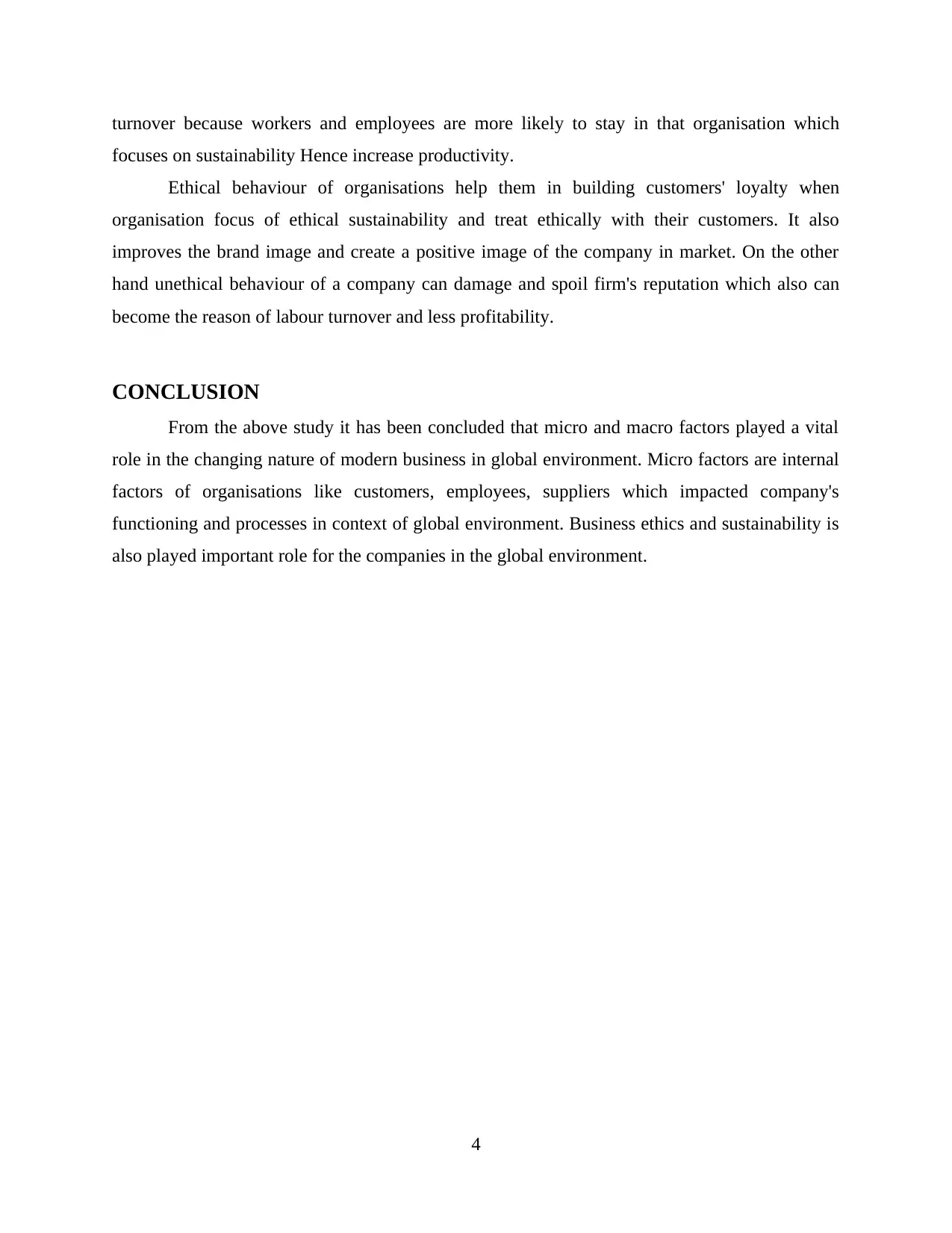
turnover because workers and employees are more likely to stay in that organisation which
focuses on sustainability Hence increase productivity.
Ethical behaviour of organisations help them in building customers' loyalty when
organisation focus of ethical sustainability and treat ethically with their customers. It also
improves the brand image and create a positive image of the company in market. On the other
hand unethical behaviour of a company can damage and spoil firm's reputation which also can
become the reason of labour turnover and less profitability.
CONCLUSION
From the above study it has been concluded that micro and macro factors played a vital
role in the changing nature of modern business in global environment. Micro factors are internal
factors of organisations like customers, employees, suppliers which impacted company's
functioning and processes in context of global environment. Business ethics and sustainability is
also played important role for the companies in the global environment.
4
focuses on sustainability Hence increase productivity.
Ethical behaviour of organisations help them in building customers' loyalty when
organisation focus of ethical sustainability and treat ethically with their customers. It also
improves the brand image and create a positive image of the company in market. On the other
hand unethical behaviour of a company can damage and spoil firm's reputation which also can
become the reason of labour turnover and less profitability.
CONCLUSION
From the above study it has been concluded that micro and macro factors played a vital
role in the changing nature of modern business in global environment. Micro factors are internal
factors of organisations like customers, employees, suppliers which impacted company's
functioning and processes in context of global environment. Business ethics and sustainability is
also played important role for the companies in the global environment.
4
⊘ This is a preview!⊘
Do you want full access?
Subscribe today to unlock all pages.

Trusted by 1+ million students worldwide

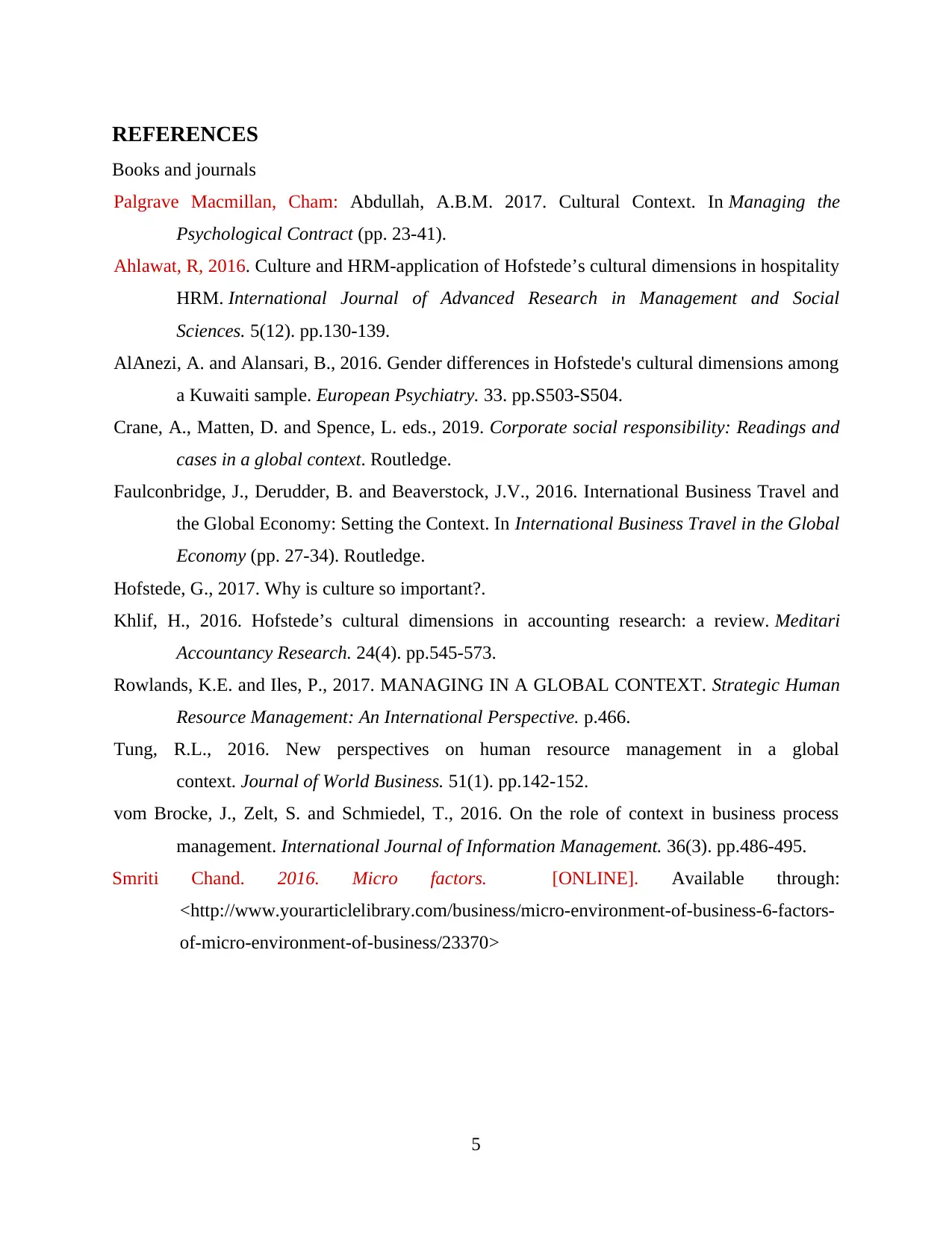
REFERENCES
Books and journals
Palgrave Macmillan, Cham: Abdullah, A.B.M. 2017. Cultural Context. In Managing the
Psychological Contract (pp. 23-41).
Ahlawat, R, 2016. Culture and HRM-application of Hofstede’s cultural dimensions in hospitality
HRM. International Journal of Advanced Research in Management and Social
Sciences. 5(12). pp.130-139.
AlAnezi, A. and Alansari, B., 2016. Gender differences in Hofstede's cultural dimensions among
a Kuwaiti sample. European Psychiatry. 33. pp.S503-S504.
Crane, A., Matten, D. and Spence, L. eds., 2019. Corporate social responsibility: Readings and
cases in a global context. Routledge.
Faulconbridge, J., Derudder, B. and Beaverstock, J.V., 2016. International Business Travel and
the Global Economy: Setting the Context. In International Business Travel in the Global
Economy (pp. 27-34). Routledge.
Hofstede, G., 2017. Why is culture so important?.
Khlif, H., 2016. Hofstede’s cultural dimensions in accounting research: a review. Meditari
Accountancy Research. 24(4). pp.545-573.
Rowlands, K.E. and Iles, P., 2017. MANAGING IN A GLOBAL CONTEXT. Strategic Human
Resource Management: An International Perspective. p.466.
Tung, R.L., 2016. New perspectives on human resource management in a global
context. Journal of World Business. 51(1). pp.142-152.
vom Brocke, J., Zelt, S. and Schmiedel, T., 2016. On the role of context in business process
management. International Journal of Information Management. 36(3). pp.486-495.
Smriti Chand. 2016. Micro factors. [ONLINE]. Available through:
<http://www.yourarticlelibrary.com/business/micro-environment-of-business-6-factors-
of-micro-environment-of-business/23370>
5
Books and journals
Palgrave Macmillan, Cham: Abdullah, A.B.M. 2017. Cultural Context. In Managing the
Psychological Contract (pp. 23-41).
Ahlawat, R, 2016. Culture and HRM-application of Hofstede’s cultural dimensions in hospitality
HRM. International Journal of Advanced Research in Management and Social
Sciences. 5(12). pp.130-139.
AlAnezi, A. and Alansari, B., 2016. Gender differences in Hofstede's cultural dimensions among
a Kuwaiti sample. European Psychiatry. 33. pp.S503-S504.
Crane, A., Matten, D. and Spence, L. eds., 2019. Corporate social responsibility: Readings and
cases in a global context. Routledge.
Faulconbridge, J., Derudder, B. and Beaverstock, J.V., 2016. International Business Travel and
the Global Economy: Setting the Context. In International Business Travel in the Global
Economy (pp. 27-34). Routledge.
Hofstede, G., 2017. Why is culture so important?.
Khlif, H., 2016. Hofstede’s cultural dimensions in accounting research: a review. Meditari
Accountancy Research. 24(4). pp.545-573.
Rowlands, K.E. and Iles, P., 2017. MANAGING IN A GLOBAL CONTEXT. Strategic Human
Resource Management: An International Perspective. p.466.
Tung, R.L., 2016. New perspectives on human resource management in a global
context. Journal of World Business. 51(1). pp.142-152.
vom Brocke, J., Zelt, S. and Schmiedel, T., 2016. On the role of context in business process
management. International Journal of Information Management. 36(3). pp.486-495.
Smriti Chand. 2016. Micro factors. [ONLINE]. Available through:
<http://www.yourarticlelibrary.com/business/micro-environment-of-business-6-factors-
of-micro-environment-of-business/23370>
5
1 out of 7
Related Documents
Your All-in-One AI-Powered Toolkit for Academic Success.
+13062052269
info@desklib.com
Available 24*7 on WhatsApp / Email
Unlock your academic potential
Copyright © 2020–2025 A2Z Services. All Rights Reserved. Developed and managed by ZUCOL.