Business Proposal: Accounting and Economic Research for Sustainability
VerifiedAdded on 2021/06/18
|22
|5365
|87
Report
AI Summary
This business proposal delves into the application of accounting and economic research towards sustainability initiatives. It explores the critical need for organizations to consider environmental and societal impacts alongside profit, highlighting the triple bottom line concept. The report examines various sustainability initiatives, measurement methods, and relevant economic and accounting indicators. It outlines the research design, including data usage, collection methods, and justification of the research strategy, while also addressing potential challenges. The proposal emphasizes the importance of integrating sustainability into financial statements and accounting reports, advocating for a framework that provides economic guidance for social, environmental, and financial performance. It aims to provide recommendations for organizations to effectively implement sustainability accounting and research, contributing to the existing knowledge base and offering practical tools for managers and researchers in the field.
Business Proposal 1
APPLICATION OF ACCOUNTING AND ECONOMIC RESEARCH TOWARDS
SUSTAINABILITY INITIATIVE
Name
Institution
Course
Tutor
City/State
Date
APPLICATION OF ACCOUNTING AND ECONOMIC RESEARCH TOWARDS
SUSTAINABILITY INITIATIVE
Name
Institution
Course
Tutor
City/State
Date

Paraphrase This Document
Need a fresh take? Get an instant paraphrase of this document with our AI Paraphraser
Business Proposal 2
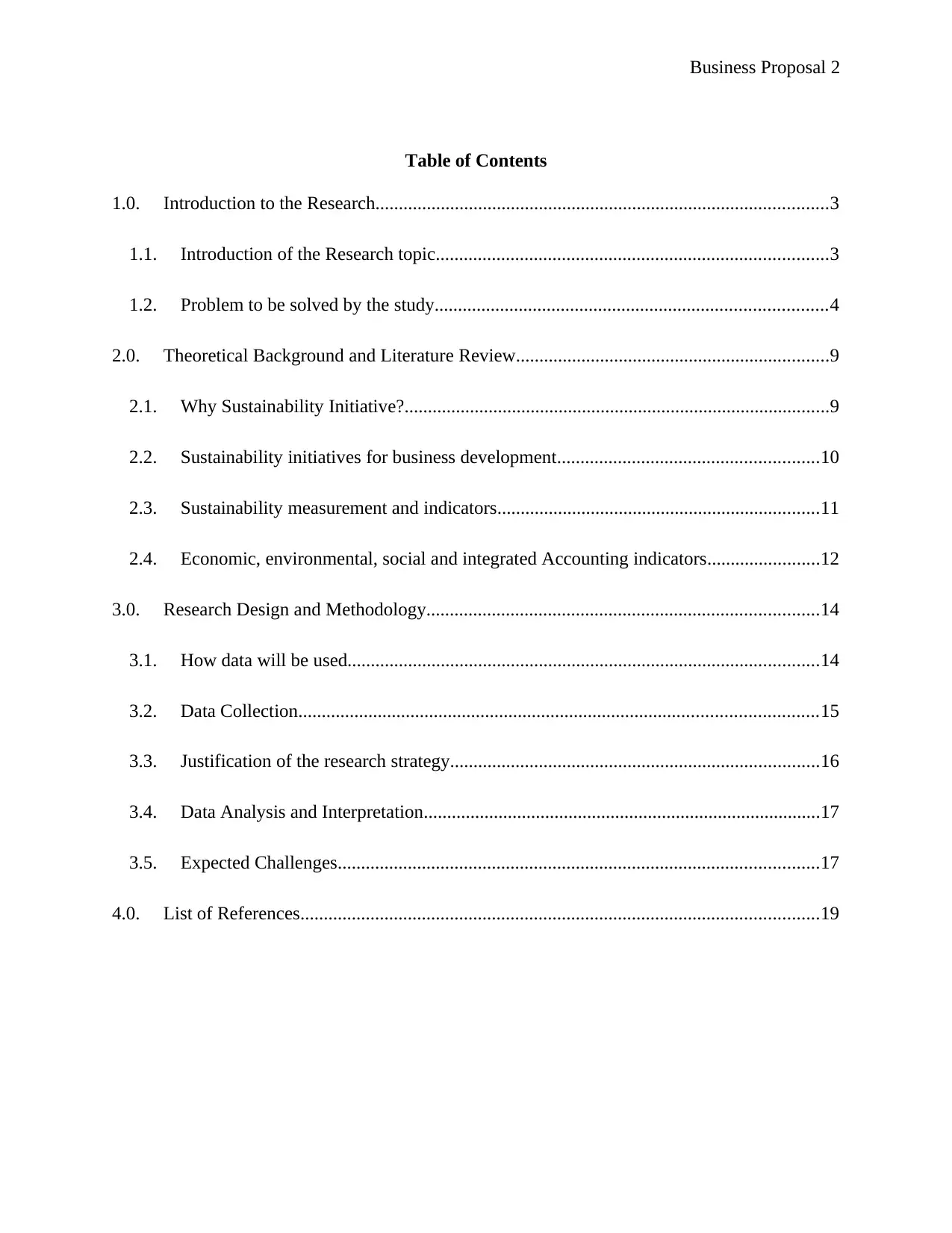
Table of Contents
1.0. Introduction to the Research.................................................................................................3
1.1. Introduction of the Research topic....................................................................................3
1.2. Problem to be solved by the study....................................................................................4
2.0. Theoretical Background and Literature Review...................................................................9
2.1. Why Sustainability Initiative?...........................................................................................9
2.2. Sustainability initiatives for business development........................................................10
2.3. Sustainability measurement and indicators.....................................................................11
2.4. Economic, environmental, social and integrated Accounting indicators........................12
3.0. Research Design and Methodology....................................................................................14
3.1. How data will be used.....................................................................................................14
3.2. Data Collection...............................................................................................................15
3.3. Justification of the research strategy...............................................................................16
3.4. Data Analysis and Interpretation.....................................................................................17
3.5. Expected Challenges.......................................................................................................17
4.0. List of References...............................................................................................................19
Table of Contents
1.0. Introduction to the Research.................................................................................................3
1.1. Introduction of the Research topic....................................................................................3
1.2. Problem to be solved by the study....................................................................................4
2.0. Theoretical Background and Literature Review...................................................................9
2.1. Why Sustainability Initiative?...........................................................................................9
2.2. Sustainability initiatives for business development........................................................10
2.3. Sustainability measurement and indicators.....................................................................11
2.4. Economic, environmental, social and integrated Accounting indicators........................12
3.0. Research Design and Methodology....................................................................................14
3.1. How data will be used.....................................................................................................14
3.2. Data Collection...............................................................................................................15
3.3. Justification of the research strategy...............................................................................16
3.4. Data Analysis and Interpretation.....................................................................................17
3.5. Expected Challenges.......................................................................................................17
4.0. List of References...............................................................................................................19
Business Proposal 3
Executive Summary
In the current business environment, care is given to how the business benefits the environment
and the community instead of only considering the profit making. The society and environment
are also considered in the process. As companies’ benefits from various facets of business
development such as economic progress and advancement in technology, they often face
criticism on the environmental and societal challenges they create. This study will employ
qualitative and quantitative study methods to understand the application of accounting and
economic research towards sustainability initiative.
1.0. Introduction to the Research
1.1. Introduction of the Research topic
In the current business industry, sustainable management and development has taken the center
stage of organizational success. In a systematic study, Lee, Fraser, and Fillis (2018) denote that
small and large scale organizations are not only focused on the success of their businesses. Care
is also given to how the business benefits the environment and the community. In other words,
focus is given not only on profit making but the society and environment are also considered. In
another study, Essig (2018) denotes that even though companies’ benefits from various facets of
business development such as economic progress and advancement in technology, they often
face criticism on the environmental and societal challenges they create. It is referred to as a triple
bottom line concept involving the environment, economy, and the society. These aspects often
translate to people, profit, and planet. As a result, most organizations can no longer focus only on
Executive Summary
In the current business environment, care is given to how the business benefits the environment
and the community instead of only considering the profit making. The society and environment
are also considered in the process. As companies’ benefits from various facets of business
development such as economic progress and advancement in technology, they often face
criticism on the environmental and societal challenges they create. This study will employ
qualitative and quantitative study methods to understand the application of accounting and
economic research towards sustainability initiative.
1.0. Introduction to the Research
1.1. Introduction of the Research topic
In the current business industry, sustainable management and development has taken the center
stage of organizational success. In a systematic study, Lee, Fraser, and Fillis (2018) denote that
small and large scale organizations are not only focused on the success of their businesses. Care
is also given to how the business benefits the environment and the community. In other words,
focus is given not only on profit making but the society and environment are also considered. In
another study, Essig (2018) denotes that even though companies’ benefits from various facets of
business development such as economic progress and advancement in technology, they often
face criticism on the environmental and societal challenges they create. It is referred to as a triple
bottom line concept involving the environment, economy, and the society. These aspects often
translate to people, profit, and planet. As a result, most organizations can no longer focus only on
⊘ This is a preview!⊘
Do you want full access?
Subscribe today to unlock all pages.

Trusted by 1+ million students worldwide
Business Proposal 4
financial gains as the achievement without considering the impacts it can pose on the
environment.
1.2. Problem to be solved by the study
According to Choi and Ng (2011), most organizations have negative impacts on the environment
in a level that varies from one company to another depending on the product or services the
company offers. The same study denotes that the ruthless and continuous depletion of the natural
resources as well as the exploration of the societies where they are located and operates in
generating their revenue results to negative sentiments from the stakeholders. When not
considered or managed, there is high possibility that the organization can be dismissed and
operations brought to a standstill. In other words, these organizations are currently forced to find
ways or adopt strategies that can help in mitigating the impacts. This has resulted into the
adoption of more environmentally related strategies to mitigate these impacts. In many cases,
these initiatives are communicated though sustainability as pointed out by Swaim, Maloni,
Napshin, and Henley (2014, p. 45).
Even though concern is given to the environment, many organizations fail to financially support
the procedures and steps required to achieve financial support towards achieving the required
level of sustainability. As a result, most organizations either fails to start or do not go through to
the end once the necessary strategies are adopted. In a systematic study, Essig (2018) denotes
that there are several reasons why failure occurs at this level irrespective of how good are the
strategic objectives adopted for the process. Therefore, this study is focused on the need of
economic and accounting research necessary to achieve effective sustainability initiatives.
1.3. Structure of Justification of the Proposal
financial gains as the achievement without considering the impacts it can pose on the
environment.
1.2. Problem to be solved by the study
According to Choi and Ng (2011), most organizations have negative impacts on the environment
in a level that varies from one company to another depending on the product or services the
company offers. The same study denotes that the ruthless and continuous depletion of the natural
resources as well as the exploration of the societies where they are located and operates in
generating their revenue results to negative sentiments from the stakeholders. When not
considered or managed, there is high possibility that the organization can be dismissed and
operations brought to a standstill. In other words, these organizations are currently forced to find
ways or adopt strategies that can help in mitigating the impacts. This has resulted into the
adoption of more environmentally related strategies to mitigate these impacts. In many cases,
these initiatives are communicated though sustainability as pointed out by Swaim, Maloni,
Napshin, and Henley (2014, p. 45).
Even though concern is given to the environment, many organizations fail to financially support
the procedures and steps required to achieve financial support towards achieving the required
level of sustainability. As a result, most organizations either fails to start or do not go through to
the end once the necessary strategies are adopted. In a systematic study, Essig (2018) denotes
that there are several reasons why failure occurs at this level irrespective of how good are the
strategic objectives adopted for the process. Therefore, this study is focused on the need of
economic and accounting research necessary to achieve effective sustainability initiatives.
1.3. Structure of Justification of the Proposal
Paraphrase This Document
Need a fresh take? Get an instant paraphrase of this document with our AI Paraphraser
Business Proposal 5
The current business environment is complex and competitive. With advancement in technology,
change in the consumer preferences, issues related to environmental and societal concerns, and
sustainability efficiency, Sanders, Myers, Gawron, Simmons, and Turok (2018) denote that
companies are currently adopting policies that will ensure they remain competitive and effective
in the market. The same study denotes that organizations are more focused on tracking social
development initiatives with the aim of achieving different goals. For instance, focus is given to
enhance the ability of tracking progress against objectives and set targets, and developing greater
awareness of broad issues towards environment. Luthra, S, Mangla, S, Chan, F, & Venkatesh
(2018) also denotes that it ensures it meets the compliance requirements towards the governance
of the its license of operation. They are also focused on enhancing their reputation, identify cost
effectiveness, improve the workplace and the moral of the staff, as well as achieving an all-round
credibility from greater transparency as pointed out by Zerbini (2017, p. 90)
Despite these efforts, full consequences to conduct business is not reflected in the financial
statements and accounting reports for most organizations. Corbett, Webster, and Jenkin (2018)
identifies that in many cases, organizations are measuring the level of their success and profit
making by excluding the bulk of transactional costs from the environmental and social aspects.
At the same time, Unerman (2018) points out that the existing limitations on financial reporting
methodologies and frameworks in the societal and environmental transactions are not clearly
understood. It is because they are inadequately identified or even not reported in a consistent
framework in case it is reported. Therefore, there is a need for effective study and analysis on the
necessary accounting and economic research in ensuring organizations achieve effective
sustainability initiatives. This hence forms the basis for the justification of this study.
1.4. Problem and Research Objectives
The current business environment is complex and competitive. With advancement in technology,
change in the consumer preferences, issues related to environmental and societal concerns, and
sustainability efficiency, Sanders, Myers, Gawron, Simmons, and Turok (2018) denote that
companies are currently adopting policies that will ensure they remain competitive and effective
in the market. The same study denotes that organizations are more focused on tracking social
development initiatives with the aim of achieving different goals. For instance, focus is given to
enhance the ability of tracking progress against objectives and set targets, and developing greater
awareness of broad issues towards environment. Luthra, S, Mangla, S, Chan, F, & Venkatesh
(2018) also denotes that it ensures it meets the compliance requirements towards the governance
of the its license of operation. They are also focused on enhancing their reputation, identify cost
effectiveness, improve the workplace and the moral of the staff, as well as achieving an all-round
credibility from greater transparency as pointed out by Zerbini (2017, p. 90)
Despite these efforts, full consequences to conduct business is not reflected in the financial
statements and accounting reports for most organizations. Corbett, Webster, and Jenkin (2018)
identifies that in many cases, organizations are measuring the level of their success and profit
making by excluding the bulk of transactional costs from the environmental and social aspects.
At the same time, Unerman (2018) points out that the existing limitations on financial reporting
methodologies and frameworks in the societal and environmental transactions are not clearly
understood. It is because they are inadequately identified or even not reported in a consistent
framework in case it is reported. Therefore, there is a need for effective study and analysis on the
necessary accounting and economic research in ensuring organizations achieve effective
sustainability initiatives. This hence forms the basis for the justification of this study.
1.4. Problem and Research Objectives
Business Proposal 6
The main aim of the study is to evaluate and have a clear understanding on the concept of
sustainability initiatives adopted by large scale organizations in respect to accounting and
economic research therein. To achieve this aim, the study will focus on the following objectives;
To investigate the different sustainability initiatives adopted by large scale organizations
To evaluate the understanding of the management and other stakeholders on the need of
accounting and economic research towards sustainability strategies within their
respective organizations.
To establish an effective role of accounting and economic research in pursuing the United
Nations Sustainability Development Goals.
To establish a clear framework for effective understanding of sustainable development
To outline recommendations that should be taken in adopting sustainability accounting in
different organizations.
1.5. Research Questions
In respect to the above objectives, the study will focus on answering the following questions;
What is the level of understanding of the management of different organizations in the
general concept of accounting and economic research?
What are the sustainability initiatives adopted by the organizations?
What are the accounting and economic reports adopted by organizations towards
sustainability?
1.6. Hypothesis of the Study
The main aim of the study is to evaluate and have a clear understanding on the concept of
sustainability initiatives adopted by large scale organizations in respect to accounting and
economic research therein. To achieve this aim, the study will focus on the following objectives;
To investigate the different sustainability initiatives adopted by large scale organizations
To evaluate the understanding of the management and other stakeholders on the need of
accounting and economic research towards sustainability strategies within their
respective organizations.
To establish an effective role of accounting and economic research in pursuing the United
Nations Sustainability Development Goals.
To establish a clear framework for effective understanding of sustainable development
To outline recommendations that should be taken in adopting sustainability accounting in
different organizations.
1.5. Research Questions
In respect to the above objectives, the study will focus on answering the following questions;
What is the level of understanding of the management of different organizations in the
general concept of accounting and economic research?
What are the sustainability initiatives adopted by the organizations?
What are the accounting and economic reports adopted by organizations towards
sustainability?
1.6. Hypothesis of the Study
⊘ This is a preview!⊘
Do you want full access?
Subscribe today to unlock all pages.
Trusted by 1+ million students worldwide
Business Proposal 7
According to Essig (2018), the primary weakness of gross domestic product in economic
research is that it minimally considers environmental damage and sustainability initiatives. In a
study, Sanders, Myers, Gawron, Simmons, and Turok (2018) point out that the challenge of
accounting and economic research is ensuring effective development and collaboration
frameworks that explicitly converse sustainable valuation procedures as well as the inclusion of
different ethical procedures aimed at value to the environment. As a result, the hypothesis for
this study will be;
Null Hypothesis: The aspect of including sustainability initiatives faces challenges as it is
complex to measure environment damage
Alternative Hypothesis: The aspect of including sustainability initiatives does not face
any challenge as it is complex to measure environment damage
1.7. Significance of the Study
In the current business arena, concern to the environment has taken a central stage for most
organizations. Therefore, sustainability initiatives are mentioned in every stakeholder’s meeting
as a goal of the business, governments, and non-profit organizations. However, measuring the
level or degree to which the organizations are being sustainable or achieving sustainable growth
is complex and challenges many organizations. In a systematic study, Chang and McIlkenny
(2017) pointed out that sustainability initiative is one of the major goals for the United Nations
Sustainable Development (UNSD). The study is hence focused on providing a resilient
knowledge and understanding on the strategic options that can be adopted by the organization in
achieving human development and environmental ambitions. For scholars focused on accounting
and economic research, the study will provide a clear overview of the relevant accounting
According to Essig (2018), the primary weakness of gross domestic product in economic
research is that it minimally considers environmental damage and sustainability initiatives. In a
study, Sanders, Myers, Gawron, Simmons, and Turok (2018) point out that the challenge of
accounting and economic research is ensuring effective development and collaboration
frameworks that explicitly converse sustainable valuation procedures as well as the inclusion of
different ethical procedures aimed at value to the environment. As a result, the hypothesis for
this study will be;
Null Hypothesis: The aspect of including sustainability initiatives faces challenges as it is
complex to measure environment damage
Alternative Hypothesis: The aspect of including sustainability initiatives does not face
any challenge as it is complex to measure environment damage
1.7. Significance of the Study
In the current business arena, concern to the environment has taken a central stage for most
organizations. Therefore, sustainability initiatives are mentioned in every stakeholder’s meeting
as a goal of the business, governments, and non-profit organizations. However, measuring the
level or degree to which the organizations are being sustainable or achieving sustainable growth
is complex and challenges many organizations. In a systematic study, Chang and McIlkenny
(2017) pointed out that sustainability initiative is one of the major goals for the United Nations
Sustainable Development (UNSD). The study is hence focused on providing a resilient
knowledge and understanding on the strategic options that can be adopted by the organization in
achieving human development and environmental ambitions. For scholars focused on accounting
and economic research, the study will provide a clear overview of the relevant accounting
Paraphrase This Document
Need a fresh take? Get an instant paraphrase of this document with our AI Paraphraser
Business Proposal 8
practice as well as the principles and concepts of initiatives towards sustainability accounting
and research.
1.8. Expected Outcomes
In response to the aforementioned challenges facing the economics of the organization towards
achieving a sustainable initiative, this study will provide a drive towards economic
accountability and transparency practices. It will proved recommendations to small and large
scale organizations to ensure both financial and non-financial data is included in the reporting
and management of sustainability initiatives. In many cases, different scholars in different
aspects of sustainability initiatives have carried out studies as pointed out by Essig (2018, p. 97).
However, little attention has been given on the necessary accounting and financial research to
achieve the targeted sustainability goals and initiatives for both small and large scale
organizations. The study will thus provide an accounting framework that offers economic
guidance to achieve social, environmental, and financial performance at once.
For those with responsibilities in the organizations such as the management and leadership in
both small and large scale organizations, the study is expected to introduce sustainability
accounting as a practical and legitimate response to ensure there is ease of accounting and
economic research in achieving sustainability goals within the organizations. In other words, the
result is intended to resonance for both economic research and accounting for managers with the
responsibility of implementing sustainability policies within the organizations. It will also offer
explanatory tools for research on how the economies of scale towards research on sustainability
initiatives can be achieved with the aim of assisting on how they can prioritize in the future
actions of the organizations as supported by Essig (2018, p. 90). The study will hence add on the
practice as well as the principles and concepts of initiatives towards sustainability accounting
and research.
1.8. Expected Outcomes
In response to the aforementioned challenges facing the economics of the organization towards
achieving a sustainable initiative, this study will provide a drive towards economic
accountability and transparency practices. It will proved recommendations to small and large
scale organizations to ensure both financial and non-financial data is included in the reporting
and management of sustainability initiatives. In many cases, different scholars in different
aspects of sustainability initiatives have carried out studies as pointed out by Essig (2018, p. 97).
However, little attention has been given on the necessary accounting and financial research to
achieve the targeted sustainability goals and initiatives for both small and large scale
organizations. The study will thus provide an accounting framework that offers economic
guidance to achieve social, environmental, and financial performance at once.
For those with responsibilities in the organizations such as the management and leadership in
both small and large scale organizations, the study is expected to introduce sustainability
accounting as a practical and legitimate response to ensure there is ease of accounting and
economic research in achieving sustainability goals within the organizations. In other words, the
result is intended to resonance for both economic research and accounting for managers with the
responsibility of implementing sustainability policies within the organizations. It will also offer
explanatory tools for research on how the economies of scale towards research on sustainability
initiatives can be achieved with the aim of assisting on how they can prioritize in the future
actions of the organizations as supported by Essig (2018, p. 90). The study will hence add on the
Business Proposal 9
knowledge and data base on published information regarding economic and accounting research
towards sustainability initiatives within different organizations. In other words, it will act as a
resourceful information on studying the evaluation of sustainability policies and initiatives
towards the evolving accounting practices as well as in understanding concepts and principles of
sustainability initiatives in accounting research.
2.0. Theoretical Background and Literature Review
In considering the sustainability goals of organizations, focus is given not only in creating
economic value but also providing services and goods that can enhance the living standards.
WarshawskY (2016) also identifies actively engaging in mitigating different social and
environmental challenges that they cause though their production activities as a vital
sustainability aspect for different organizations. Therefore, there is a need to have a clear
understanding on the proactive management sustainability initiatives that can help in delivering
an improved service delivery not only to the business but the environment as well.
2.1. Why Sustainability Initiative?
Sustainable development highlights the importance of making decisions that recognize the
connections between actions and effects on the environment, the economy and the society Essig
(2018, p. 90). It as well involves long-term thinking with respect to the kind of legacy to be left
to the future generations. Corbett, Webster, and Jenkin (2018) acknowledge that short term
goals cannot be neglected in favor of preservation and protection, hence economic development
cannot be stopped. For economic development to fit within the planets ecological and natural
resource boundaries, across connection is required (Corbett, Webster, & Jenkin 2018, P. 262).
knowledge and data base on published information regarding economic and accounting research
towards sustainability initiatives within different organizations. In other words, it will act as a
resourceful information on studying the evaluation of sustainability policies and initiatives
towards the evolving accounting practices as well as in understanding concepts and principles of
sustainability initiatives in accounting research.
2.0. Theoretical Background and Literature Review
In considering the sustainability goals of organizations, focus is given not only in creating
economic value but also providing services and goods that can enhance the living standards.
WarshawskY (2016) also identifies actively engaging in mitigating different social and
environmental challenges that they cause though their production activities as a vital
sustainability aspect for different organizations. Therefore, there is a need to have a clear
understanding on the proactive management sustainability initiatives that can help in delivering
an improved service delivery not only to the business but the environment as well.
2.1. Why Sustainability Initiative?
Sustainable development highlights the importance of making decisions that recognize the
connections between actions and effects on the environment, the economy and the society Essig
(2018, p. 90). It as well involves long-term thinking with respect to the kind of legacy to be left
to the future generations. Corbett, Webster, and Jenkin (2018) acknowledge that short term
goals cannot be neglected in favor of preservation and protection, hence economic development
cannot be stopped. For economic development to fit within the planets ecological and natural
resource boundaries, across connection is required (Corbett, Webster, & Jenkin 2018, P. 262).
⊘ This is a preview!⊘
Do you want full access?
Subscribe today to unlock all pages.
Trusted by 1+ million students worldwide
Business Proposal 10
When senior officials from 179 governments met in 1992 at Reo de Janeiro after watching a
series of potentially catastrophic events unfold across the globe, that is; the leak of a poisonous
gas from a chemical plant at Bophal, the Chemobyl disaster, the hole in the Antarctic ozone
layer, leaking chemical dumps, growing fears regarding chemical contamination and conflicts
over the decreasing
The society, business and environment are the key players for sustainable development as
pointed out by Swaim, J, Maloni, M, Napshin, S, & Henley (2014, p. 90). Economic factors such
as industries and companies compromise the business aspect of the sustainable development. The
government, citizens and non-governmental organization make up the social aspect. Finally,
environment is considered the stakeholder. The business and society can be seen as part of the
natural environment. The societal groups raised the environmental and social issues while
business actors raise the economic issues. Globalization has led to all the dimensions of
sustainable development becoming equally important to both the society and business.
Integration of sustainability performance to business practices enables companies to reduce risks
and increase profitability. The environmental and social performances motivate companies to
practice environmentally and socially sustainable development along with economic
development.
2.2. Sustainability initiatives for business development
For sustainable development, Orenstein and Shach-Pinsley (2017) denotes that there are relevant
sustainability initiatives, documents and agendas at different level. Most of the sustainability
initiatives focus on economic, social or environmental sustainability. Depending on the agenda,
When senior officials from 179 governments met in 1992 at Reo de Janeiro after watching a
series of potentially catastrophic events unfold across the globe, that is; the leak of a poisonous
gas from a chemical plant at Bophal, the Chemobyl disaster, the hole in the Antarctic ozone
layer, leaking chemical dumps, growing fears regarding chemical contamination and conflicts
over the decreasing
The society, business and environment are the key players for sustainable development as
pointed out by Swaim, J, Maloni, M, Napshin, S, & Henley (2014, p. 90). Economic factors such
as industries and companies compromise the business aspect of the sustainable development. The
government, citizens and non-governmental organization make up the social aspect. Finally,
environment is considered the stakeholder. The business and society can be seen as part of the
natural environment. The societal groups raised the environmental and social issues while
business actors raise the economic issues. Globalization has led to all the dimensions of
sustainable development becoming equally important to both the society and business.
Integration of sustainability performance to business practices enables companies to reduce risks
and increase profitability. The environmental and social performances motivate companies to
practice environmentally and socially sustainable development along with economic
development.
2.2. Sustainability initiatives for business development
For sustainable development, Orenstein and Shach-Pinsley (2017) denotes that there are relevant
sustainability initiatives, documents and agendas at different level. Most of the sustainability
initiatives focus on economic, social or environmental sustainability. Depending on the agenda,
Paraphrase This Document
Need a fresh take? Get an instant paraphrase of this document with our AI Paraphraser
Business Proposal 11
the initiatives may focus on either 2 or 3 dimensions. Different environmental, social economical
and initiatives and documents are relevant to sustainable business development and the core
missions. Many of the sustainability initiatives started as macro-level initiatives. Corbett,
Webster, and Jenkin (2018) denote that a macro level initiative addresses broader sustainability
debate at regional, national and global level. Global level initiatives are increasingly becoming
important due to globalization and multi-national enterprises.
Environmentally sustainable development is well recognized and has well defined policies and
become a start point for the global and national environmentally defined policies as pointed out
by Lee, Fraser, and Fillis (2018, p. 7). Many policies have now broadened the concept of
sustainable development initiatives to cover both the economic and socially sustainable
initiatives. The main purpose of initiatives is to provide standards and guidelines to businesses
for developing policies; measures, reporting, and implementation of corporate responsibility and
improve corporate environmental, social and economic management.
2.3. Sustainability measurement and indicators
According to Essig (2018), one cannot manage what cannot be measured and sustainability
indicators are the main tools used in measuring sustainability in sustainable developments.
Financial stakeholders, non-financial stakeholders, the public, buyers and biosphere are main
driving forces in the pressure for business environmental performance measurements.
Sustainability initiatives include the sustainability indicators which refer to the understanding of
what needs to be done, what we need to achieve and how far we are from where we want to be.
the initiatives may focus on either 2 or 3 dimensions. Different environmental, social economical
and initiatives and documents are relevant to sustainable business development and the core
missions. Many of the sustainability initiatives started as macro-level initiatives. Corbett,
Webster, and Jenkin (2018) denote that a macro level initiative addresses broader sustainability
debate at regional, national and global level. Global level initiatives are increasingly becoming
important due to globalization and multi-national enterprises.
Environmentally sustainable development is well recognized and has well defined policies and
become a start point for the global and national environmentally defined policies as pointed out
by Lee, Fraser, and Fillis (2018, p. 7). Many policies have now broadened the concept of
sustainable development initiatives to cover both the economic and socially sustainable
initiatives. The main purpose of initiatives is to provide standards and guidelines to businesses
for developing policies; measures, reporting, and implementation of corporate responsibility and
improve corporate environmental, social and economic management.
2.3. Sustainability measurement and indicators
According to Essig (2018), one cannot manage what cannot be measured and sustainability
indicators are the main tools used in measuring sustainability in sustainable developments.
Financial stakeholders, non-financial stakeholders, the public, buyers and biosphere are main
driving forces in the pressure for business environmental performance measurements.
Sustainability initiatives include the sustainability indicators which refer to the understanding of
what needs to be done, what we need to achieve and how far we are from where we want to be.
Business Proposal 12
The indicators alerts one of the problems involved and recognizes ways of solving them before
they become a disaster. There are different characteristics of sustainability indicators at all levels:
2.4. Economic, environmental, social and integrated Accounting indicators
The indicators are intended to measure the 3 dimensions of sustainable development that is
environmental, social and economic. All indicators can be used to measure economic,
environmental and social dimensions. More emphasis is on the environmental factors. Most
companies use the corporate responsibility reports to include information on economic,
environmental and social performances. Corbett, Webster, and Jenkin (2018) provide a
summary of different types of indicators and their research on applicability to environmental,
social and economic issues. Descriptive indicators describe the states, pressure and impact of
responses while qualitative and quantitative indicators describe the statement facts of the
situation. They apply to environmental, social and economic issues in sustainability
developments. Another indicators is performance, it measures the actual situation with targets
and compare to the progress made towards achieving the set targets during the initiatives that are
measured. Accounting indicators is also used for the purpose of both internal and external
reporting. Its main focus is on transportation tracking, liability management and efficiency in
waste production and disposals. Another indicator used is economical which values the external
environmental and social costs for the sustainability of the initiative. These indicators evaluate
the performance of the organization and are very important in determining the degree of
sustainable initiative.
2.5. Quantitative and qualitative indicators
The indicators alerts one of the problems involved and recognizes ways of solving them before
they become a disaster. There are different characteristics of sustainability indicators at all levels:
2.4. Economic, environmental, social and integrated Accounting indicators
The indicators are intended to measure the 3 dimensions of sustainable development that is
environmental, social and economic. All indicators can be used to measure economic,
environmental and social dimensions. More emphasis is on the environmental factors. Most
companies use the corporate responsibility reports to include information on economic,
environmental and social performances. Corbett, Webster, and Jenkin (2018) provide a
summary of different types of indicators and their research on applicability to environmental,
social and economic issues. Descriptive indicators describe the states, pressure and impact of
responses while qualitative and quantitative indicators describe the statement facts of the
situation. They apply to environmental, social and economic issues in sustainability
developments. Another indicators is performance, it measures the actual situation with targets
and compare to the progress made towards achieving the set targets during the initiatives that are
measured. Accounting indicators is also used for the purpose of both internal and external
reporting. Its main focus is on transportation tracking, liability management and efficiency in
waste production and disposals. Another indicator used is economical which values the external
environmental and social costs for the sustainability of the initiative. These indicators evaluate
the performance of the organization and are very important in determining the degree of
sustainable initiative.
2.5. Quantitative and qualitative indicators
⊘ This is a preview!⊘
Do you want full access?
Subscribe today to unlock all pages.
Trusted by 1+ million students worldwide

1 out of 22


Related Documents


Your All-in-One AI-Powered Toolkit for Academic Success.
+13062052269
info@desklib.com
Available 24*7 on WhatsApp / Email
![[object Object]](/_next/static/media/star-bottom.7253800d.svg)
Unlock your academic potential
Copyright © 2020–2026 A2Z Services. All Rights Reserved. Developed and managed by ZUCOL.