Business Sustainability and Innovation: Scenario Planning Report
VerifiedAdded on 2020/12/29
|7
|1488
|379
Report
AI Summary
This report delves into the concept of scenario planning as a crucial method for businesses to achieve sustainability and innovation. It begins with an introduction to scenario planning, explaining its role in creating flexible long-term strategies and its application in addressing environmental and social problems. The report then details the critical elements in constructing successful scenarios, including the six-step process of identifying the focal issue, investigating drivers, ranking importance and uncertainties, selecting scenario logics, fleshing out scenarios, and analyzing implications. Finally, it evaluates the utility of scenario planning in preparing companies for a climate-changed future, highlighting its use as a strategic tool and emphasizing its application in both research and planning. The report references various sources and includes an appendix with notes and a PEST analysis to understand the business environment, offering a comprehensive overview of scenario planning's significance in ensuring business success and adaptability.
Strategies for Business
Sustainability and Innovation
Paraphrase This Document
Need a fresh take? Get an instant paraphrase of this document with our AI Paraphraser

Table of Contents
INTRODUCTION...........................................................................................................................1
Introduction to Scenario planning...............................................................................................1
Describe critical elements in constructing successful scenarios.................................................2
Evaluate Utility of scenario planning in preparing company for climate changed future..........2
Appendix..........................................................................................................................................4
Notes...........................................................................................................................................4
REFERENCES................................................................................................................................5
INTRODUCTION...........................................................................................................................1
Introduction to Scenario planning...............................................................................................1
Describe critical elements in constructing successful scenarios.................................................2
Evaluate Utility of scenario planning in preparing company for climate changed future..........2
Appendix..........................................................................................................................................4
Notes...........................................................................................................................................4
REFERENCES................................................................................................................................5

INTRODUCTION
For businesses to be successful, sustainability is considered as powerful and defining idea
that creates profit for its shareholders, while preventing the environment. Every day
organisations are supposed to find new strategies to develop solutions for environmental and
social problems. Therefore, for this scenario planning is a method that they can use to make
flexible long term plans. The report will demonstrate the concept of scenario planning including
critical elements.
Introduction to Scenario planning.
Scenario planning is a method also known as scenario thinking or analysis. This method
is used by various organisations to build flexible long term plans. Apart from this, it refers to a
practice of making varying courses of action for a business to apply it according to the events *
situations known as scenarios. In the year 1950, scenarios refers to the strategic foresight to
explore the future and during that time Kahn used them to evaluate different military strategies.
Moreover, I have explained about scenarios to many people that they have been used since years
to guide government policies & plans (Buurman and Babovic, 2016).
Scenario planning addresses:
Current environmental problems, events and trends that are of great concern for decision
makers in the organisation.
Elements that exist in the surroundings that are considered certain or predictable.
Other components that are uncertain such as; trend breakers, discontinuities in the
business, prior unencountered events.
As per my opinion, Scenario planning is supposed to use when a company is facing critical
decisions for the future, and the business environment is complex & dynamic. In this case,
scenarios provide many benefits over traditional prediction techniques. The reason I think about
why should organisations should implement scenario planning is; first they can use this approach
to risk management, to create new rules of competition. Moreover, it has been determined that
for effective scenario planning they must use it properly so that managers can make good
business judgements (Field, ed., 2014).
1
For businesses to be successful, sustainability is considered as powerful and defining idea
that creates profit for its shareholders, while preventing the environment. Every day
organisations are supposed to find new strategies to develop solutions for environmental and
social problems. Therefore, for this scenario planning is a method that they can use to make
flexible long term plans. The report will demonstrate the concept of scenario planning including
critical elements.
Introduction to Scenario planning.
Scenario planning is a method also known as scenario thinking or analysis. This method
is used by various organisations to build flexible long term plans. Apart from this, it refers to a
practice of making varying courses of action for a business to apply it according to the events *
situations known as scenarios. In the year 1950, scenarios refers to the strategic foresight to
explore the future and during that time Kahn used them to evaluate different military strategies.
Moreover, I have explained about scenarios to many people that they have been used since years
to guide government policies & plans (Buurman and Babovic, 2016).
Scenario planning addresses:
Current environmental problems, events and trends that are of great concern for decision
makers in the organisation.
Elements that exist in the surroundings that are considered certain or predictable.
Other components that are uncertain such as; trend breakers, discontinuities in the
business, prior unencountered events.
As per my opinion, Scenario planning is supposed to use when a company is facing critical
decisions for the future, and the business environment is complex & dynamic. In this case,
scenarios provide many benefits over traditional prediction techniques. The reason I think about
why should organisations should implement scenario planning is; first they can use this approach
to risk management, to create new rules of competition. Moreover, it has been determined that
for effective scenario planning they must use it properly so that managers can make good
business judgements (Field, ed., 2014).
1
⊘ This is a preview!⊘
Do you want full access?
Subscribe today to unlock all pages.

Trusted by 1+ million students worldwide

Describe critical elements in constructing successful scenarios.
Scenario planning refers to a process which is created to support decision makers to
navigate uncertainties & assist them identify things which are and which are not possible in the
future (Gramberger, Zellmer and Metzger, 2015). It has been determined that scenarios can be
build by different ways. I suggest, one best possible approach that organisations may adapt
defined as 'walk through the process'. This process is divided into 6 steps with two key elements.
First is decision focus of the scenarios, which is defined as the process the starts & ends not with
vision of the future, but with the agreement on the strategic decision. The second key element I
found is the Scenario Logic by which core of the process is constitutes. 6 steps are: Step 1 Identify the focal issue:- this step states that it is suggested to start from the inside
out while developing a scenario. Basically it means that it should start with a specific
decision then creating out towards the environment (Rickards, Ison and Wiseman, 2014). Step 2 Identification & investigation of the drivers :- the next step is finding key drivers
that will impact the key factors at micro and macro level. Further, it requires some kind
of desk research in order to describe driving forces. Step 3 Rank by importance & uncertainties :- in this third step the ranking of the driving
forces is done on the basis of the degree of importance of the central problem in step 1 &
uncertainty surrounding these forces. Step 4 Selecting scenario logics :- based on the results of third step, this will assist in
finding the axes along which the scenarios can be build/constructed, hence identify the
logics. Step 5 Fleshing out the scenarios :- it has been discovered that the literature on scenario
constructing suggests incorporating elements of both desirable & undesirable futures
within various scenarios (Rickards, Wiseman and Biggs, 2014).
Step 6 Implication of scenario :- at this final stage we close it by linking back to the
decision focus in the first step and begin to convert scenarios into strategy. Further, they
are analysed in detail.
Evaluate Utility of scenario planning in preparing company for climate changed future.
As I have stated above, that how scenario planning prepares the organisation to undertake
the exercise for relevant future. My thought about what research say regarding scenario planning
is that the research is very limited. Also in general, evaluating it seems tough as unlike the case
2
Scenario planning refers to a process which is created to support decision makers to
navigate uncertainties & assist them identify things which are and which are not possible in the
future (Gramberger, Zellmer and Metzger, 2015). It has been determined that scenarios can be
build by different ways. I suggest, one best possible approach that organisations may adapt
defined as 'walk through the process'. This process is divided into 6 steps with two key elements.
First is decision focus of the scenarios, which is defined as the process the starts & ends not with
vision of the future, but with the agreement on the strategic decision. The second key element I
found is the Scenario Logic by which core of the process is constitutes. 6 steps are: Step 1 Identify the focal issue:- this step states that it is suggested to start from the inside
out while developing a scenario. Basically it means that it should start with a specific
decision then creating out towards the environment (Rickards, Ison and Wiseman, 2014). Step 2 Identification & investigation of the drivers :- the next step is finding key drivers
that will impact the key factors at micro and macro level. Further, it requires some kind
of desk research in order to describe driving forces. Step 3 Rank by importance & uncertainties :- in this third step the ranking of the driving
forces is done on the basis of the degree of importance of the central problem in step 1 &
uncertainty surrounding these forces. Step 4 Selecting scenario logics :- based on the results of third step, this will assist in
finding the axes along which the scenarios can be build/constructed, hence identify the
logics. Step 5 Fleshing out the scenarios :- it has been discovered that the literature on scenario
constructing suggests incorporating elements of both desirable & undesirable futures
within various scenarios (Rickards, Wiseman and Biggs, 2014).
Step 6 Implication of scenario :- at this final stage we close it by linking back to the
decision focus in the first step and begin to convert scenarios into strategy. Further, they
are analysed in detail.
Evaluate Utility of scenario planning in preparing company for climate changed future.
As I have stated above, that how scenario planning prepares the organisation to undertake
the exercise for relevant future. My thought about what research say regarding scenario planning
is that the research is very limited. Also in general, evaluating it seems tough as unlike the case
2
Paraphrase This Document
Need a fresh take? Get an instant paraphrase of this document with our AI Paraphraser

of forecasting, where the quality of the prediction is a good first proxy for utility. As per my
opinion companies must construct a successful scenario planning as it is considered as a strategic
tool that provides organisational managers with a route map for the future. It was also said by
Peter Schwartz that, using scenarios is rehearsing the future. Based on my research, scenario
planning was also used by Royal Dutch Shell to predict to dramatic changes that occur in oil
industry (Schmitz, Lawler and Pierce, 2015).
Additionally, in adaptation implementation, they are used in two crucial ways; as a
research tool & planning tool. In research tool, various scenarios based on model are utilised on
climate change as a means of showing future conditions while declaring uncertainty about them.
In second way of planning tool it emphasizes on educating stakeholders regarding the harm
climate change can affect them. Moreover, it also assists them in finding possible & correct
responses. Therefore, it is clear with all these statements I have assessed that, decision makers
make use of scenario planning to make decisions for future uncertainties. Also, based on my
assessment I think that scenario planning is useful for company to think about future & for
climate changed.
3
opinion companies must construct a successful scenario planning as it is considered as a strategic
tool that provides organisational managers with a route map for the future. It was also said by
Peter Schwartz that, using scenarios is rehearsing the future. Based on my research, scenario
planning was also used by Royal Dutch Shell to predict to dramatic changes that occur in oil
industry (Schmitz, Lawler and Pierce, 2015).
Additionally, in adaptation implementation, they are used in two crucial ways; as a
research tool & planning tool. In research tool, various scenarios based on model are utilised on
climate change as a means of showing future conditions while declaring uncertainty about them.
In second way of planning tool it emphasizes on educating stakeholders regarding the harm
climate change can affect them. Moreover, it also assists them in finding possible & correct
responses. Therefore, it is clear with all these statements I have assessed that, decision makers
make use of scenario planning to make decisions for future uncertainties. Also, based on my
assessment I think that scenario planning is useful for company to think about future & for
climate changed.
3

Appendix
Notes
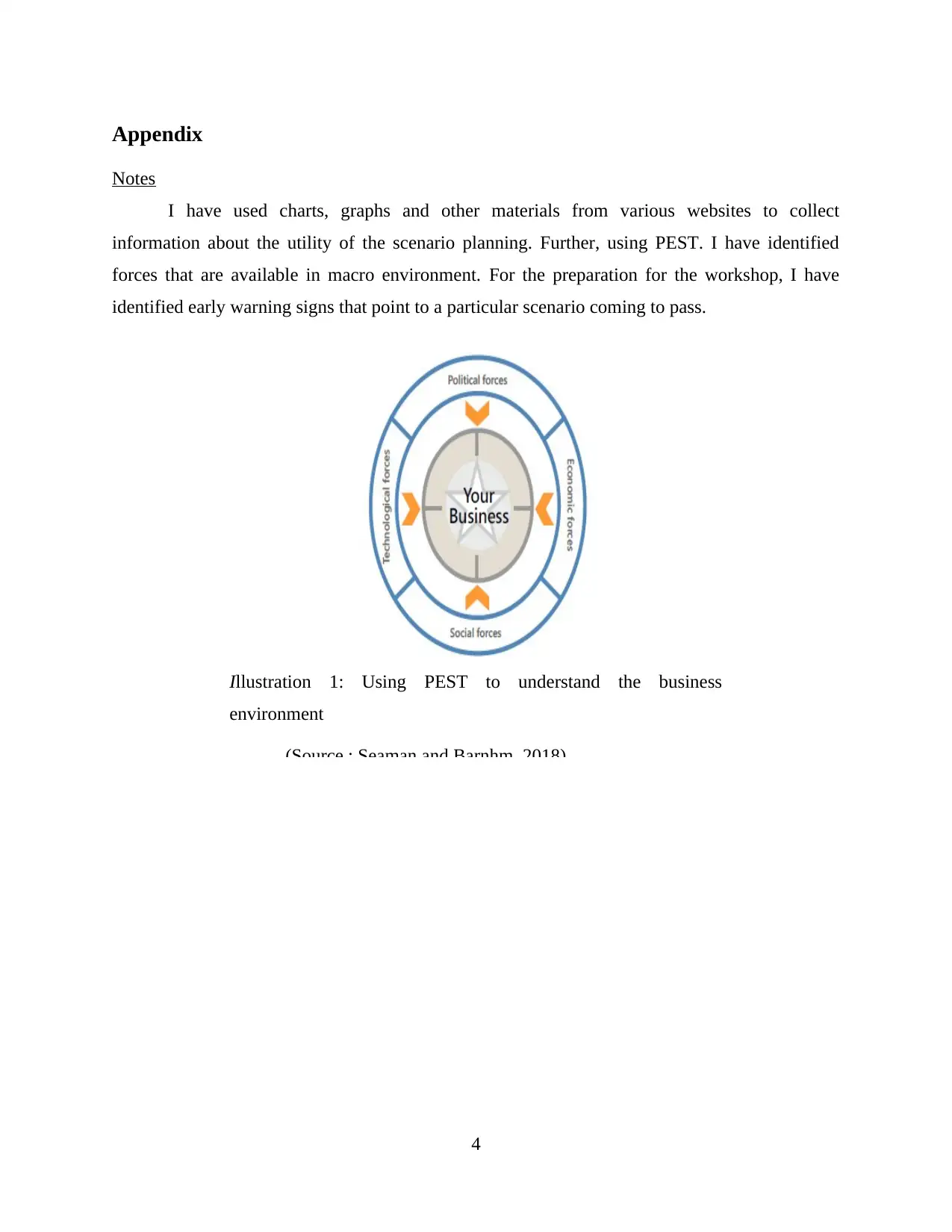
I have used charts, graphs and other materials from various websites to collect
information about the utility of the scenario planning. Further, using PEST. I have identified
forces that are available in macro environment. For the preparation for the workshop, I have
identified early warning signs that point to a particular scenario coming to pass.
4
Illustration 1: Using PEST to understand the business
environment
(Source : Seaman and Barnhm, 2018)
Notes
I have used charts, graphs and other materials from various websites to collect
information about the utility of the scenario planning. Further, using PEST. I have identified
forces that are available in macro environment. For the preparation for the workshop, I have
identified early warning signs that point to a particular scenario coming to pass.
4
Illustration 1: Using PEST to understand the business
environment
(Source : Seaman and Barnhm, 2018)
⊘ This is a preview!⊘
Do you want full access?
Subscribe today to unlock all pages.

Trusted by 1+ million students worldwide

REFERENCES
Books & Journals
Buurman, J. and Babovic, V., 2016. Adaptation Pathways and Real Options Analysis: An
approach to deep uncertainty in climate change adaptation policies. Policy and
Society. 35(2). pp.137-150.
Field, C.B. ed., 2014. Climate change 2014–Impacts, adaptation and vulnerability: Regional
aspects. Cambridge University Press.
Gramberger, M., Zellmer, K. and Metzger, M.J., 2015. Stakeholder integrated research (STIR): a
new approach tested in climate change adaptation research. Climatic change. 128(3-4).
pp.201-214.
Rickards, L., Ison, R. and Wiseman, J., 2014. Opening and closing the future: climate change,
adaptation, and scenario planning. Environment and Planning C: Government and
Policy. 32(4). pp.587-602.
Rickards, L., Wiseman, J. and Biggs, C., 2014. The problem of fit: scenario planning and climate
change adaptation in the public sector. Environment and Planning C: Government and
Policy. 32(4). pp.641-662.
Schmitz, O. J., Lawler, J. J. and Pierce, D. J., 2015. Conserving biodiversity: practical guidance
about climate change adaptation approaches in support of land-use planning. Natural Areas
Journal. 35(1). pp.190-203.
Online
Seaman, D. and Barnhm, L., 2018. Rehearsing the future – Making better strategic decisions.
[Online]. Available on: <https://www.b2binternational.com/publications/strategic-decisions-
planning/>
5
Books & Journals
Buurman, J. and Babovic, V., 2016. Adaptation Pathways and Real Options Analysis: An
approach to deep uncertainty in climate change adaptation policies. Policy and
Society. 35(2). pp.137-150.
Field, C.B. ed., 2014. Climate change 2014–Impacts, adaptation and vulnerability: Regional
aspects. Cambridge University Press.
Gramberger, M., Zellmer, K. and Metzger, M.J., 2015. Stakeholder integrated research (STIR): a
new approach tested in climate change adaptation research. Climatic change. 128(3-4).
pp.201-214.
Rickards, L., Ison, R. and Wiseman, J., 2014. Opening and closing the future: climate change,
adaptation, and scenario planning. Environment and Planning C: Government and
Policy. 32(4). pp.587-602.
Rickards, L., Wiseman, J. and Biggs, C., 2014. The problem of fit: scenario planning and climate
change adaptation in the public sector. Environment and Planning C: Government and
Policy. 32(4). pp.641-662.
Schmitz, O. J., Lawler, J. J. and Pierce, D. J., 2015. Conserving biodiversity: practical guidance
about climate change adaptation approaches in support of land-use planning. Natural Areas
Journal. 35(1). pp.190-203.
Online
Seaman, D. and Barnhm, L., 2018. Rehearsing the future – Making better strategic decisions.
[Online]. Available on: <https://www.b2binternational.com/publications/strategic-decisions-
planning/>
5
1 out of 7
Related Documents
Your All-in-One AI-Powered Toolkit for Academic Success.
+13062052269
info@desklib.com
Available 24*7 on WhatsApp / Email
Unlock your academic potential
Copyright © 2020–2025 A2Z Services. All Rights Reserved. Developed and managed by ZUCOL.