Central Queensland University - MRKT20057: Global Marketing Report
VerifiedAdded on 2022/10/11
|11
|2555
|15
Report
AI Summary
This report provides a comprehensive analysis of Byron Bay Cookie's global marketing strategies. It begins with an introduction to the company, highlighting its background and evolution from a local Australian business to a global player. The report then delves into key aspects of global marketing, including market selection and entry strategies, competitive analysis, and pricing strategies. It explores the company's promotional tactics, such as discounts, food fair participation, and sample distributions, as well as its distribution strategies, encompassing indirect, direct, and intensive distribution methods. The report also includes recommendations for future growth and expansion. The assignment also includes an executive summary which highlights the company's desire to expand in Singapore and the opportunities this presents.
Submission Date:
Running head: GLOBAL MARKETING 1
GLOBAL MARKETING
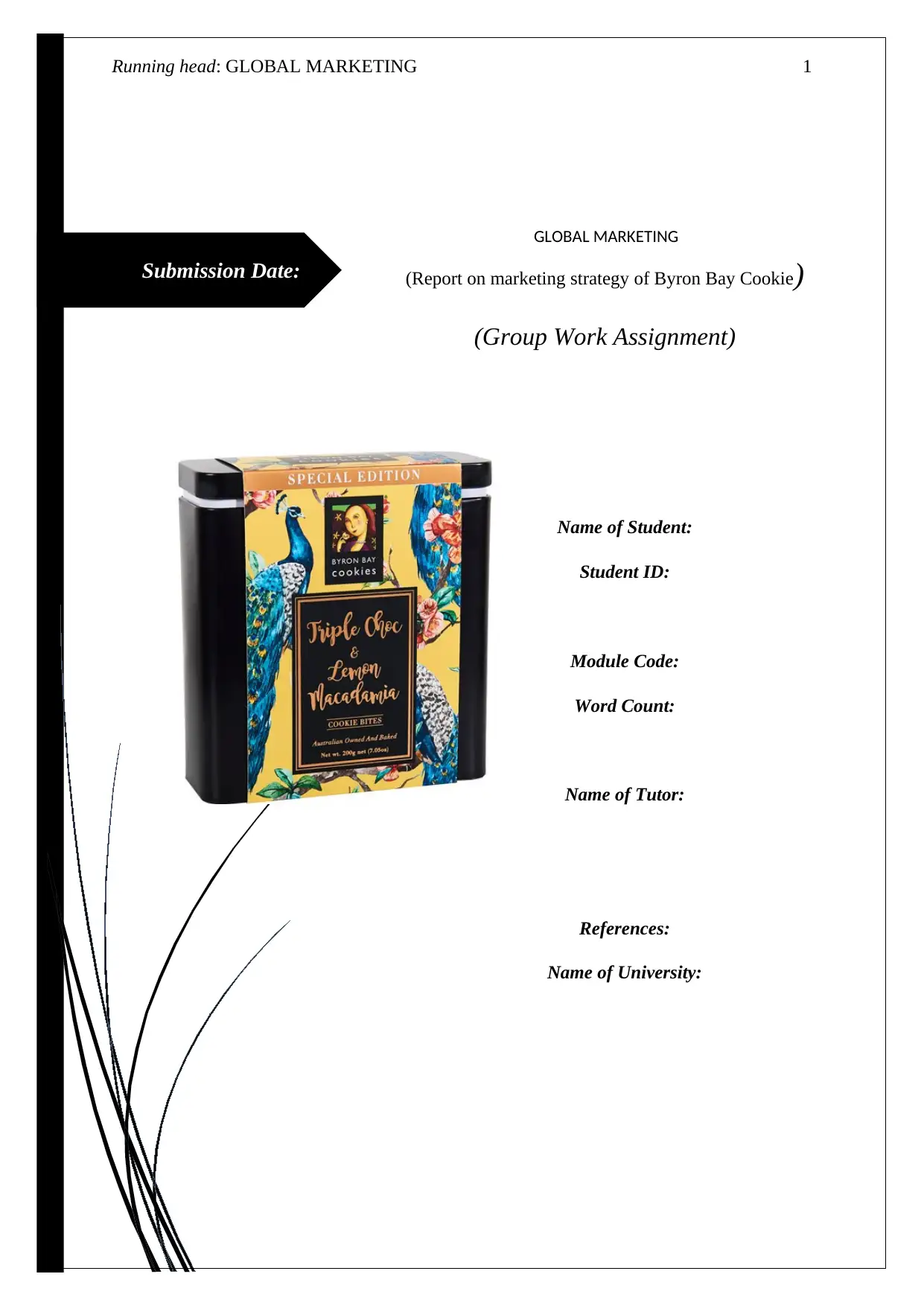
(Report on marketing strategy of Byron Bay Cookie)
(Group Work Assignment)
Name of Student:
Student ID:
Module Code:
Word Count:
Name of Tutor:
References:
Name of University:
Running head: GLOBAL MARKETING 1
GLOBAL MARKETING
(Report on marketing strategy of Byron Bay Cookie)
(Group Work Assignment)
Name of Student:
Student ID:
Module Code:
Word Count:
Name of Tutor:
References:
Name of University:

Paraphrase This Document
Need a fresh take? Get an instant paraphrase of this document with our AI Paraphraser
GLOBAL MARKETING 2
Table of Contents
1. Introduction............................................................................................................................3
1.1 Company background......................................................................................................3
2. Global Marketing...................................................................................................................3
3. Market selection and entry strategy.......................................................................................3
4. Competitive strategy..............................................................................................................4
5. Pricing strategy.......................................................................................................................4
6. Promotional strategy..............................................................................................................5
6.1 Discount giving while distributing product......................................................................6
6.2 Participation in food fair..................................................................................................6
6.3 Free sample of cookies distribution.................................................................................6
6.4 Create an Alluring Logo...................................................................................................6
7. Distribution Strategy..............................................................................................................6
7.1 Indirect distribution..........................................................................................................6
7.2 Direct distribution............................................................................................................6
7.3 Intensive distribution........................................................................................................7
8. Conclusion and Recommendations........................................................................................7
8.1 Recommendation..............................................................................................................7
References..................................................................................................................................9
Table of Contents
1. Introduction............................................................................................................................3
1.1 Company background......................................................................................................3
2. Global Marketing...................................................................................................................3
3. Market selection and entry strategy.......................................................................................3
4. Competitive strategy..............................................................................................................4
5. Pricing strategy.......................................................................................................................4
6. Promotional strategy..............................................................................................................5
6.1 Discount giving while distributing product......................................................................6
6.2 Participation in food fair..................................................................................................6
6.3 Free sample of cookies distribution.................................................................................6
6.4 Create an Alluring Logo...................................................................................................6
7. Distribution Strategy..............................................................................................................6
7.1 Indirect distribution..........................................................................................................6
7.2 Direct distribution............................................................................................................6
7.3 Intensive distribution........................................................................................................7
8. Conclusion and Recommendations........................................................................................7
8.1 Recommendation..............................................................................................................7
References..................................................................................................................................9
GLOBAL MARKETING 3
1. Introduction
1.1 Company background
Byron Bay cookie is an Australian based original cookie company, and it has its cafe
which is serving for the last 25 years. This company is famous for making glass cookie jars
which are found on many cafes all over the country. The company was started in the year
1990 as a small business that provided the original recipe of baked cookies under its brand
name and sold its products in local markets. This company's innovative recipe of cookies
influenced the change in the whole market. Its famous cookie products are White Cho Chunk
and Macadamia Nut and triple Cho Fudge which were the most popular products of the
company. Later, the company became attained significant growth with its increasing product
popularity. Therefore, the company started using different strategies for global marketing in
order to expand its business.
2. Global Marketing
Global marketing is comprised of different processes of regulating the marketing
strategies of an individual company and to adapt the terms and conditions of another country.
The primary aim of global marketing is to sell the product or service through the worldwide
market along with the combination of the process of positioning, planning, creating and
promoting the products globally (Alon, 2016). Businesses with sustainable growth expand to
stabilize their position in the regional market as well as in the international market. In terms
of Byron Bay Cookie Company, the global marketing, they are termed as the leading
producers of the deliciously decadent gourmet cookies, in the region of Australia. They
sustain a strong comprehensive marketing process for their stabilise market growth and
significant numbers of customers as well.
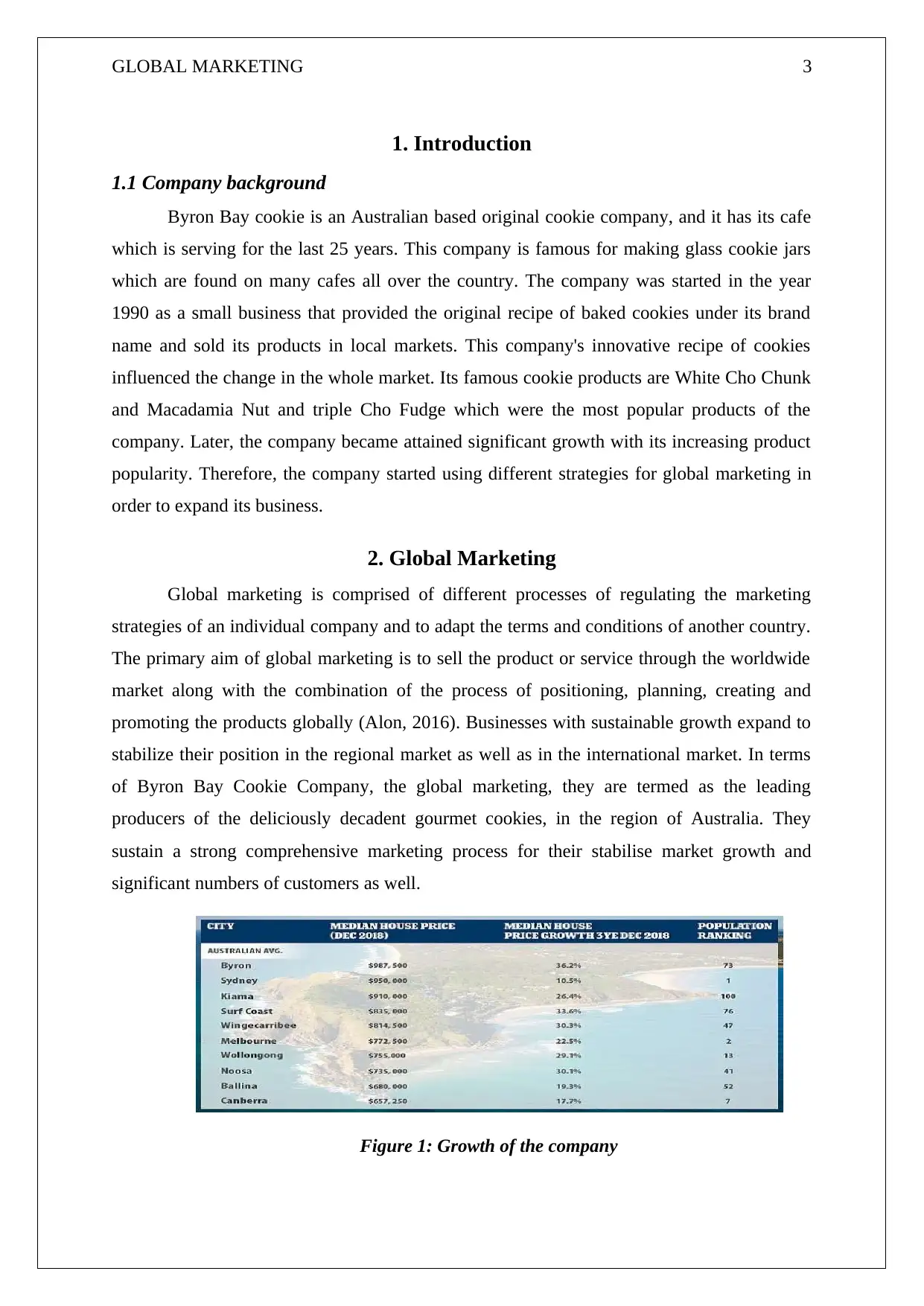
Figure 1: Growth of the company
1. Introduction
1.1 Company background
Byron Bay cookie is an Australian based original cookie company, and it has its cafe
which is serving for the last 25 years. This company is famous for making glass cookie jars
which are found on many cafes all over the country. The company was started in the year
1990 as a small business that provided the original recipe of baked cookies under its brand
name and sold its products in local markets. This company's innovative recipe of cookies
influenced the change in the whole market. Its famous cookie products are White Cho Chunk
and Macadamia Nut and triple Cho Fudge which were the most popular products of the
company. Later, the company became attained significant growth with its increasing product
popularity. Therefore, the company started using different strategies for global marketing in
order to expand its business.
2. Global Marketing
Global marketing is comprised of different processes of regulating the marketing
strategies of an individual company and to adapt the terms and conditions of another country.
The primary aim of global marketing is to sell the product or service through the worldwide
market along with the combination of the process of positioning, planning, creating and
promoting the products globally (Alon, 2016). Businesses with sustainable growth expand to
stabilize their position in the regional market as well as in the international market. In terms
of Byron Bay Cookie Company, the global marketing, they are termed as the leading
producers of the deliciously decadent gourmet cookies, in the region of Australia. They
sustain a strong comprehensive marketing process for their stabilise market growth and
significant numbers of customers as well.
Figure 1: Growth of the company
⊘ This is a preview!⊘
Do you want full access?
Subscribe today to unlock all pages.

Trusted by 1+ million students worldwide
GLOBAL MARKETING 4
(Source: Alon, 2016)
3. Market selection and entry strategy
According to Hohenthal, Johanson & Johanson, (2015), market selection is termed as
the marketing strategy which is decided on a broad target market of the customers, business
or countries common needs, priorities and interest. Based on this criterion, the company
makes the design in the initial stage and then implement it to achieve the target. The market
selection of Organic Wildlife Biscuits is based on mixing of three factors like behavioural,
demographic and psychographic, and it depends based on income. There are specific age
group enjoying these products. Among those, children mostly prefer this kind of products.
Organic Wildlife Biscuits generally depends on the capacity of production (De Villa, Rajwani
& Lawton, 2015).
The cost price of several packets, the packaging designs also attract the customers.
There are many other factors which increase the demand for this product like its storage
facilities, in the time of occasion its outlets expand the product at a rapid rate. The organic
wildlife biscuit product segmentation has done based on flavours and size (Watson, Weaven,
Perkins, Sardana & Palmatier, 2018). This biscuit is offering in various types of flavours like
malt, cocoa and banana, the price of this biscuit is an inexpensive and different group of
customers easily afford this biscuit in the market. The people from all age group like this
product and have a huge demand in the market. The consumer purchases it and uses it
regularly, and it has placed itself in the market with a high position (Mooij, 2018).
4. Competitive strategy
The penetration of the product in the market across the world, therefore there are no
barriers in the market. Due to this reason, it causes high competition in the market. Several
biscuit companies have hit the market, and there is enormous competition among the
companies in the market (Prajogo, 2016). Based on the consumer demands the manufacturers
are launching a new type of innovative products with useful goods, like the product, contain
high protein, using different kinds of ingredients like seeds, nuts and dry fruits in biscuits.
The growing demand for biscuits and cookies in the market develop the incremental pace in
the global stage (Daisy-Jones, 2019).
The Byron Bay company used many types of advanced technology in the processing
of raw materials and the innovation of different flavour in the biscuit supporting the growth
(Source: Alon, 2016)
3. Market selection and entry strategy
According to Hohenthal, Johanson & Johanson, (2015), market selection is termed as
the marketing strategy which is decided on a broad target market of the customers, business
or countries common needs, priorities and interest. Based on this criterion, the company
makes the design in the initial stage and then implement it to achieve the target. The market
selection of Organic Wildlife Biscuits is based on mixing of three factors like behavioural,
demographic and psychographic, and it depends based on income. There are specific age
group enjoying these products. Among those, children mostly prefer this kind of products.
Organic Wildlife Biscuits generally depends on the capacity of production (De Villa, Rajwani
& Lawton, 2015).
The cost price of several packets, the packaging designs also attract the customers.
There are many other factors which increase the demand for this product like its storage
facilities, in the time of occasion its outlets expand the product at a rapid rate. The organic
wildlife biscuit product segmentation has done based on flavours and size (Watson, Weaven,
Perkins, Sardana & Palmatier, 2018). This biscuit is offering in various types of flavours like
malt, cocoa and banana, the price of this biscuit is an inexpensive and different group of
customers easily afford this biscuit in the market. The people from all age group like this
product and have a huge demand in the market. The consumer purchases it and uses it
regularly, and it has placed itself in the market with a high position (Mooij, 2018).
4. Competitive strategy
The penetration of the product in the market across the world, therefore there are no
barriers in the market. Due to this reason, it causes high competition in the market. Several
biscuit companies have hit the market, and there is enormous competition among the
companies in the market (Prajogo, 2016). Based on the consumer demands the manufacturers
are launching a new type of innovative products with useful goods, like the product, contain
high protein, using different kinds of ingredients like seeds, nuts and dry fruits in biscuits.
The growing demand for biscuits and cookies in the market develop the incremental pace in
the global stage (Daisy-Jones, 2019).
The Byron Bay company used many types of advanced technology in the processing
of raw materials and the innovation of different flavour in the biscuit supporting the growth
Paraphrase This Document
Need a fresh take? Get an instant paraphrase of this document with our AI Paraphraser

GLOBAL MARKETING 5
of the market. The company mainly focus on the progress of the technologies as it
manufactures an efficient and organic cookie at a massive scale (Davcik & Sharma, 2016).
The usage of this modern technology in this biscuit industry has played a significant role as it
satisfies the consumer needs through all the regions of the world. The company also maintain
a healthy competition with other companies, the use of organic products and its moderate
price increase the demand in the global market.
5. Pricing strategy
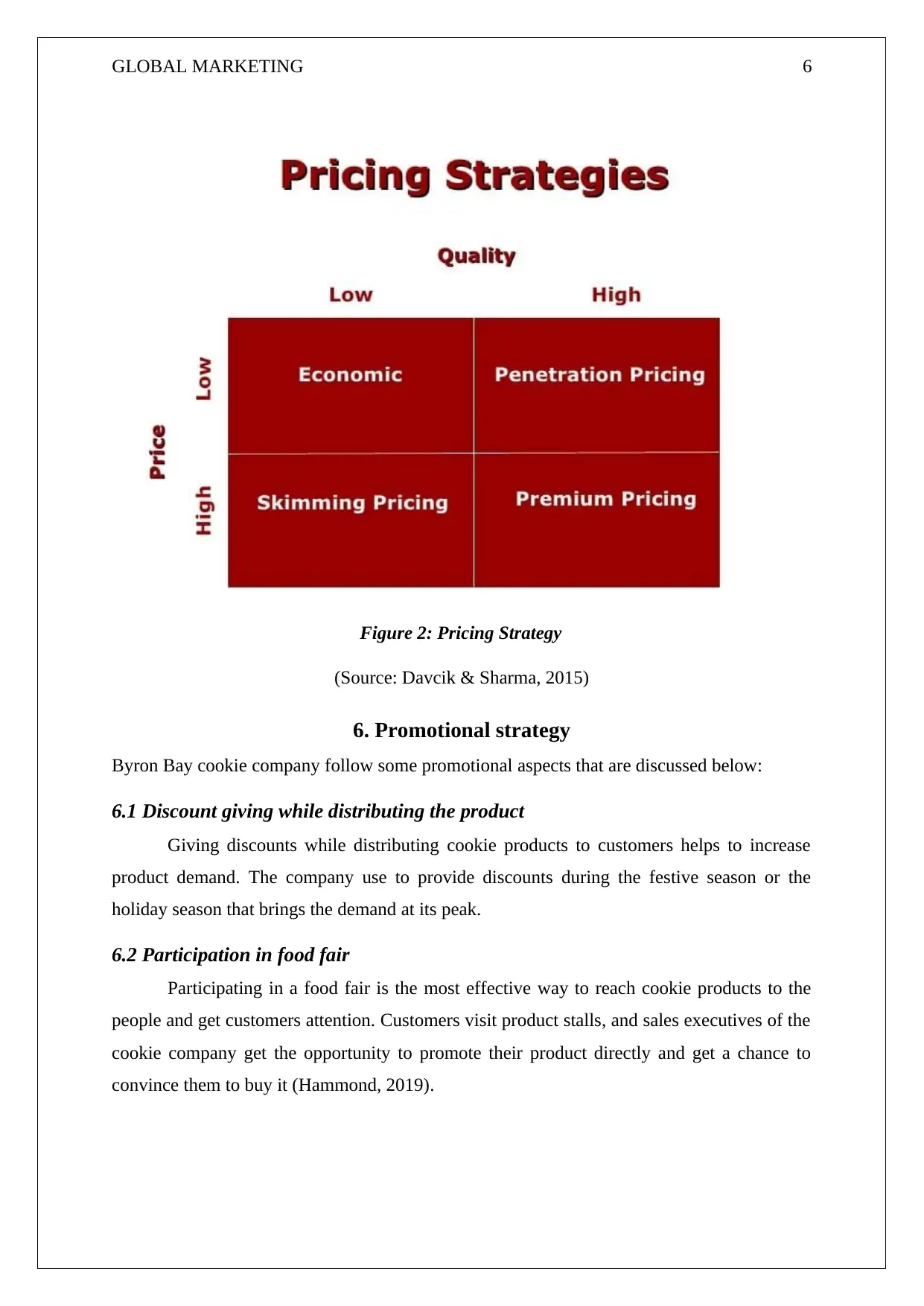
The pricing strategy of the Byron Bay cookie company is presented as follows:
Pricing strategy is a key that has a great impact on generating turnover. There are
several pricing strategies such as premium pricing, penetration pricing, price
skimming, psychological pricing, economy pricing and bundle pricing (Baker, Collier
& Jayaraman, 2017).
Byron Bay cookie company set its product pricing to compete with other competitors
in the market that is called economy pricing.
The company set its product pricing to penetrate its competitors to reach its
consumers, that is penetration pricing (Kienzler & Kowalkowski, 2017).
Psychological pricing is also followed by the company that is made understanding the
consumer's emotion (Aflaki, Swinney & Feldman, 2016).
In that factor, the company should follow up the economy pricing pattern, in which,
they will come out with different kinds of variants of their main products to reach a wide
range of audiences (Bussi, 2019). Apart from that, a bundle pricing method should also be
accompanied by this factor. Consumers will get a lower rate of products if they purchase each
of the item individually (Davcik & Sharma, 2015).
of the market. The company mainly focus on the progress of the technologies as it
manufactures an efficient and organic cookie at a massive scale (Davcik & Sharma, 2016).
The usage of this modern technology in this biscuit industry has played a significant role as it
satisfies the consumer needs through all the regions of the world. The company also maintain
a healthy competition with other companies, the use of organic products and its moderate
price increase the demand in the global market.
5. Pricing strategy
The pricing strategy of the Byron Bay cookie company is presented as follows:
Pricing strategy is a key that has a great impact on generating turnover. There are
several pricing strategies such as premium pricing, penetration pricing, price
skimming, psychological pricing, economy pricing and bundle pricing (Baker, Collier
& Jayaraman, 2017).
Byron Bay cookie company set its product pricing to compete with other competitors
in the market that is called economy pricing.
The company set its product pricing to penetrate its competitors to reach its
consumers, that is penetration pricing (Kienzler & Kowalkowski, 2017).
Psychological pricing is also followed by the company that is made understanding the
consumer's emotion (Aflaki, Swinney & Feldman, 2016).
In that factor, the company should follow up the economy pricing pattern, in which,
they will come out with different kinds of variants of their main products to reach a wide
range of audiences (Bussi, 2019). Apart from that, a bundle pricing method should also be
accompanied by this factor. Consumers will get a lower rate of products if they purchase each
of the item individually (Davcik & Sharma, 2015).
GLOBAL MARKETING 6
Figure 2: Pricing Strategy
(Source: Davcik & Sharma, 2015)
6. Promotional strategy
Byron Bay cookie company follow some promotional aspects that are discussed below:
6.1 Discount giving while distributing the product
Giving discounts while distributing cookie products to customers helps to increase
product demand. The company use to provide discounts during the festive season or the
holiday season that brings the demand at its peak.
6.2 Participation in food fair
Participating in a food fair is the most effective way to reach cookie products to the
people and get customers attention. Customers visit product stalls, and sales executives of the
cookie company get the opportunity to promote their product directly and get a chance to
convince them to buy it (Hammond, 2019).
Figure 2: Pricing Strategy
(Source: Davcik & Sharma, 2015)
6. Promotional strategy
Byron Bay cookie company follow some promotional aspects that are discussed below:
6.1 Discount giving while distributing the product
Giving discounts while distributing cookie products to customers helps to increase
product demand. The company use to provide discounts during the festive season or the
holiday season that brings the demand at its peak.
6.2 Participation in food fair
Participating in a food fair is the most effective way to reach cookie products to the
people and get customers attention. Customers visit product stalls, and sales executives of the
cookie company get the opportunity to promote their product directly and get a chance to
convince them to buy it (Hammond, 2019).
⊘ This is a preview!⊘
Do you want full access?
Subscribe today to unlock all pages.
Trusted by 1+ million students worldwide
GLOBAL MARKETING 7
6.3 Free sample of cookies distribution
Giving free sample distribution through arranging live events can enhance the brand
popularity and customer acceptability. In the packets of free sample company put their
contact details, because of customers who are like the cookie products, can contact them for
further purchase of more products.
6.4 Create an Alluring Logo
A well-designed brand logo with the appropriate colour combination is great
promotional aspect for business as customers get attracted by its vibrant packaging and logo.
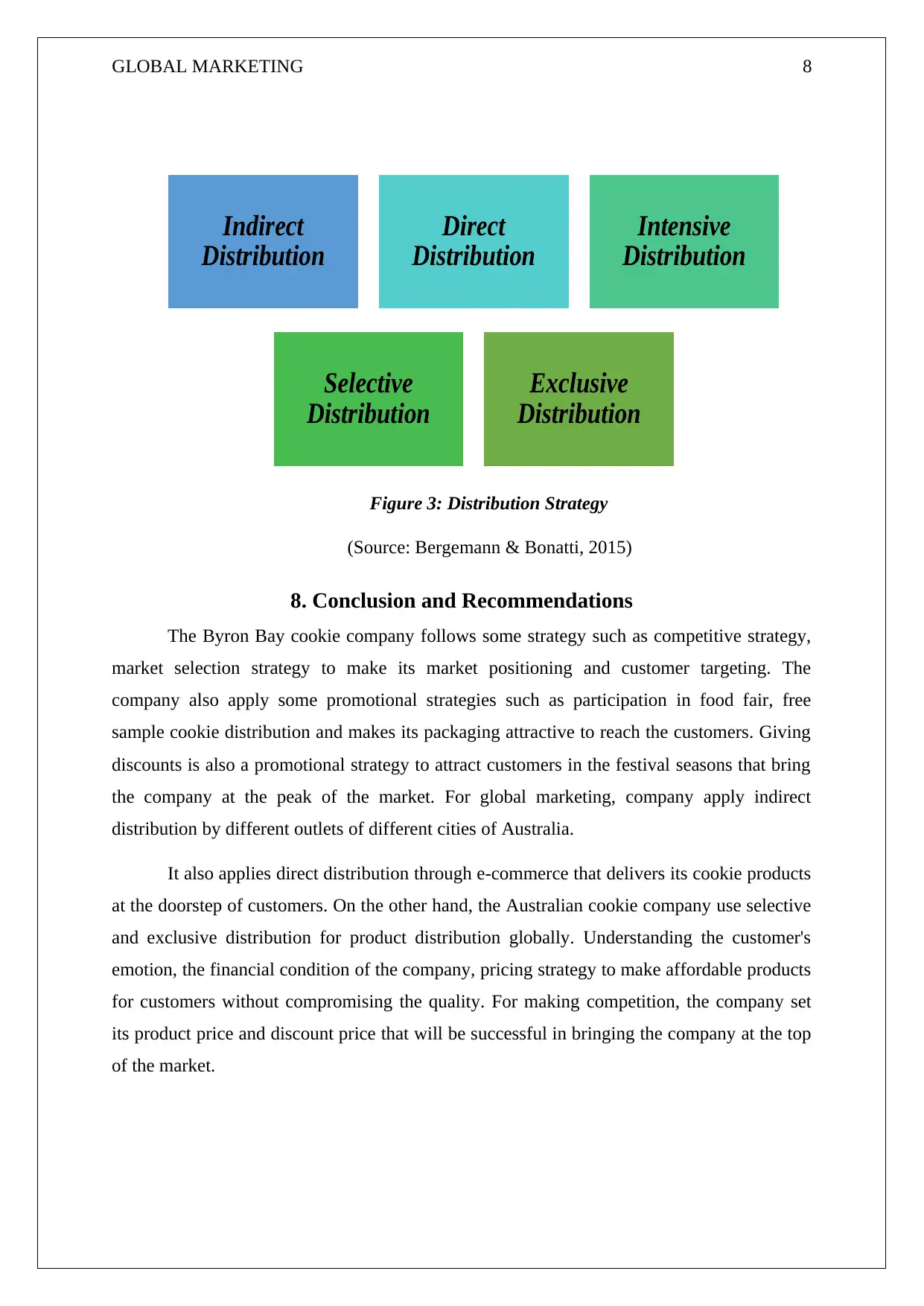
7. Distribution Strategy
There are five strategies of the global distribution of a product those are indirect
distribution, direct distribution, intensive distribution, selective distribution and exclusive
distribution. Byron Bay cookie company follow a distribution channel for its product
distribution.
7.1 Indirect distribution
In the indirect strategy method, the company tie-up with some local businesses as well
as numerous channels to distribute its products. The company has its shop as well from where
customers can get the cookie products as per their demand.
7.2 Direct distribution
Direct distribution by an e-commerce portal and through modern retail that distributes
all cookie products to the customer's doorstep enhanced the company's outcome.
Furthermore, depending on this strategy, the company makes penetration by following
marketing mix that involves product, promotion and price.
7.3 Intensive distribution
Intensive distribution refers to broad-scale product distribution by displaying products
in various way to get customers attention. This process depends on the targeting market,
production capacity, pricing and promotion policies.
Apart from this company uses selective distribution and exclusive distribution to the
target of its customer where the company is able to supply cookie products as per demand by
its outlets (Bergemann & Bonatti, 2015).
6.3 Free sample of cookies distribution
Giving free sample distribution through arranging live events can enhance the brand
popularity and customer acceptability. In the packets of free sample company put their
contact details, because of customers who are like the cookie products, can contact them for
further purchase of more products.
6.4 Create an Alluring Logo
A well-designed brand logo with the appropriate colour combination is great
promotional aspect for business as customers get attracted by its vibrant packaging and logo.
7. Distribution Strategy
There are five strategies of the global distribution of a product those are indirect
distribution, direct distribution, intensive distribution, selective distribution and exclusive
distribution. Byron Bay cookie company follow a distribution channel for its product
distribution.
7.1 Indirect distribution
In the indirect strategy method, the company tie-up with some local businesses as well
as numerous channels to distribute its products. The company has its shop as well from where
customers can get the cookie products as per their demand.
7.2 Direct distribution
Direct distribution by an e-commerce portal and through modern retail that distributes
all cookie products to the customer's doorstep enhanced the company's outcome.
Furthermore, depending on this strategy, the company makes penetration by following
marketing mix that involves product, promotion and price.
7.3 Intensive distribution
Intensive distribution refers to broad-scale product distribution by displaying products
in various way to get customers attention. This process depends on the targeting market,
production capacity, pricing and promotion policies.
Apart from this company uses selective distribution and exclusive distribution to the
target of its customer where the company is able to supply cookie products as per demand by
its outlets (Bergemann & Bonatti, 2015).
Paraphrase This Document
Need a fresh take? Get an instant paraphrase of this document with our AI Paraphraser
GLOBAL MARKETING 8
Figure 3: Distribution Strategy
(Source: Bergemann & Bonatti, 2015)
8. Conclusion and Recommendations
The Byron Bay cookie company follows some strategy such as competitive strategy,
market selection strategy to make its market positioning and customer targeting. The
company also apply some promotional strategies such as participation in food fair, free
sample cookie distribution and makes its packaging attractive to reach the customers. Giving
discounts is also a promotional strategy to attract customers in the festival seasons that bring
the company at the peak of the market. For global marketing, company apply indirect
distribution by different outlets of different cities of Australia.
It also applies direct distribution through e-commerce that delivers its cookie products
at the doorstep of customers. On the other hand, the Australian cookie company use selective
and exclusive distribution for product distribution globally. Understanding the customer's
emotion, the financial condition of the company, pricing strategy to make affordable products
for customers without compromising the quality. For making competition, the company set
its product price and discount price that will be successful in bringing the company at the top
of the market.
Indirect
Distribution
Direct
Distribution
Intensive
Distribution
Selective
Distribution
Exclusive
Distribution
Figure 3: Distribution Strategy
(Source: Bergemann & Bonatti, 2015)
8. Conclusion and Recommendations
The Byron Bay cookie company follows some strategy such as competitive strategy,
market selection strategy to make its market positioning and customer targeting. The
company also apply some promotional strategies such as participation in food fair, free
sample cookie distribution and makes its packaging attractive to reach the customers. Giving
discounts is also a promotional strategy to attract customers in the festival seasons that bring
the company at the peak of the market. For global marketing, company apply indirect
distribution by different outlets of different cities of Australia.
It also applies direct distribution through e-commerce that delivers its cookie products
at the doorstep of customers. On the other hand, the Australian cookie company use selective
and exclusive distribution for product distribution globally. Understanding the customer's
emotion, the financial condition of the company, pricing strategy to make affordable products
for customers without compromising the quality. For making competition, the company set
its product price and discount price that will be successful in bringing the company at the top
of the market.
Indirect
Distribution
Direct
Distribution
Intensive
Distribution
Selective
Distribution
Exclusive
Distribution
GLOBAL MARKETING 9
8.1 Recommendation
By understanding the marketing strategy and competitive strategy, it is recommended
that the company should manage all processes like product processing, distribution and
pricing in a way that it can reach to the customers. The company should modify its pricing
strategy to target consumers that will help to target market. For global marketing, the firm
should focus on its stakeholders and should maintain a good relationship between local
marketing teams. A right quality product always attracts the customers worldwide, so the
company should work to enhance it's quality and marketing strategies to acquire the global
market. The company should train all its employee with good marketing approaches that will
be convincing for customers.
8.1 Recommendation
By understanding the marketing strategy and competitive strategy, it is recommended
that the company should manage all processes like product processing, distribution and
pricing in a way that it can reach to the customers. The company should modify its pricing
strategy to target consumers that will help to target market. For global marketing, the firm
should focus on its stakeholders and should maintain a good relationship between local
marketing teams. A right quality product always attracts the customers worldwide, so the
company should work to enhance it's quality and marketing strategies to acquire the global
market. The company should train all its employee with good marketing approaches that will
be convincing for customers.
⊘ This is a preview!⊘
Do you want full access?
Subscribe today to unlock all pages.
Trusted by 1+ million students worldwide
GLOBAL MARKETING 10
References
Aflaki, A., Swinney, R., & Feldman, P. (2016). Choosing to Be Strategic: Implications of the
Endogenous Adoption of Forward-Looking Purchasing Behavior on Multiperiod
Pricing. SSRN Electronic Journal. doi: 10.2139/ssrn.2834895
Alon, I., Jaffe, E., Prange, C., & Vianelli, D. (2016). Global marketing (2nd ed.). New York:
Routledge.
Baker, T., Collier, D., & Jayaraman, V. (2017). A new pricing strategy evaluation
model. International Journal Of Operational Research, 29(3), 295. doi:
10.1504/ijor.2017.084357
Bergemann, D., & Bonatti, A. (2015). Selling Cookies. American Economic Journal:
Microeconomics, 7(3), 259-294. doi: 10.1257/mic.20140155
Bussi, L. (2019). Retrieved 24 September 2019, from https://paulwriter.com/magic-of-oats-
cookie-and-coffee-product-pricing-strategy/
Daisy-Jones, L. (2019). Engaging Australia's new biscuit generation. Retrieved 24 September
2019, from https://www.mintel.com/blog/food-market-news/engaging-australias-new-
biscuit-generation
Davcik, N., & Sharma, P. (2015). Impact of product differentiation, marketing investments
and brand equity on pricing strategies. European Journal Of Marketing, 49(5/6), 760-
781. doi: 10.1108/ejm-03-2014-0150
Davcik, N., & Sharma, P. (2016). Marketing resources, performance, and competitive
advantage: A review and future research directions. Journal Of Business
Research, 69(12), 5547-5552. doi: 10.1016/j.jbusres.2016.04.169
De Villa, M., Rajwani, T., & Lawton, T. (2015). Market entry modes in a multipolar world:
Untangling the moderating effect of the political environment. International Business
Review, 24(3), 419-429. doi: 10.1016/j.ibusrev.2014.10.001
Hammond, M. (2019). Homegrown cookie franchise bites into global market -
SmartCompany. Retrieved 23 September 2019, from
https://www.smartcompany.com.au/startupsmart/advice/startupsmart-growth/
homegrown-cookie-franchise-bites-into-global-market/
References
Aflaki, A., Swinney, R., & Feldman, P. (2016). Choosing to Be Strategic: Implications of the
Endogenous Adoption of Forward-Looking Purchasing Behavior on Multiperiod
Pricing. SSRN Electronic Journal. doi: 10.2139/ssrn.2834895
Alon, I., Jaffe, E., Prange, C., & Vianelli, D. (2016). Global marketing (2nd ed.). New York:
Routledge.
Baker, T., Collier, D., & Jayaraman, V. (2017). A new pricing strategy evaluation
model. International Journal Of Operational Research, 29(3), 295. doi:
10.1504/ijor.2017.084357
Bergemann, D., & Bonatti, A. (2015). Selling Cookies. American Economic Journal:
Microeconomics, 7(3), 259-294. doi: 10.1257/mic.20140155
Bussi, L. (2019). Retrieved 24 September 2019, from https://paulwriter.com/magic-of-oats-
cookie-and-coffee-product-pricing-strategy/
Daisy-Jones, L. (2019). Engaging Australia's new biscuit generation. Retrieved 24 September
2019, from https://www.mintel.com/blog/food-market-news/engaging-australias-new-
biscuit-generation
Davcik, N., & Sharma, P. (2015). Impact of product differentiation, marketing investments
and brand equity on pricing strategies. European Journal Of Marketing, 49(5/6), 760-
781. doi: 10.1108/ejm-03-2014-0150
Davcik, N., & Sharma, P. (2016). Marketing resources, performance, and competitive
advantage: A review and future research directions. Journal Of Business
Research, 69(12), 5547-5552. doi: 10.1016/j.jbusres.2016.04.169
De Villa, M., Rajwani, T., & Lawton, T. (2015). Market entry modes in a multipolar world:
Untangling the moderating effect of the political environment. International Business
Review, 24(3), 419-429. doi: 10.1016/j.ibusrev.2014.10.001
Hammond, M. (2019). Homegrown cookie franchise bites into global market -
SmartCompany. Retrieved 23 September 2019, from
https://www.smartcompany.com.au/startupsmart/advice/startupsmart-growth/
homegrown-cookie-franchise-bites-into-global-market/
Paraphrase This Document
Need a fresh take? Get an instant paraphrase of this document with our AI Paraphraser
GLOBAL MARKETING 11
Hohenthal, J., Johanson, J., & Johanson, M. (2015). Network knowledge and business-
relationship value in the foreign market. International Business Review, 23(1), 4-19.
doi: 10.1016/j.ibusrev.2013.08.002
Kienzler, M., & Kowalkowski, C. (2017). Pricing strategy: A review of 22 years of marketing
research. Journal Of Business Research, 78, 101-110. doi:
10.1016/j.jbusres.2017.05.005
Mooij, M. (2018). Global marketing and advertising. Los Angeles: Sage.
Prajogo, D. (2016). The strategic fit between innovation strategies and business environment
in delivering business performance. International Journal Of Production
Economics, 171, 241-249. doi: 10.1016/j.ijpe.2015.07.037
Watson, G., Weaven, S., Perkins, H., Sardana, D., & Palmatier, R. (2018). International
Market Entry Strategies: Relational, Digital, and Hybrid Approaches. Journal Of
International Marketing, 26(1), 30-60. doi: 10.1509/jim.17.0034
Hohenthal, J., Johanson, J., & Johanson, M. (2015). Network knowledge and business-
relationship value in the foreign market. International Business Review, 23(1), 4-19.
doi: 10.1016/j.ibusrev.2013.08.002
Kienzler, M., & Kowalkowski, C. (2017). Pricing strategy: A review of 22 years of marketing
research. Journal Of Business Research, 78, 101-110. doi:
10.1016/j.jbusres.2017.05.005
Mooij, M. (2018). Global marketing and advertising. Los Angeles: Sage.
Prajogo, D. (2016). The strategic fit between innovation strategies and business environment
in delivering business performance. International Journal Of Production
Economics, 171, 241-249. doi: 10.1016/j.ijpe.2015.07.037
Watson, G., Weaven, S., Perkins, H., Sardana, D., & Palmatier, R. (2018). International
Market Entry Strategies: Relational, Digital, and Hybrid Approaches. Journal Of
International Marketing, 26(1), 30-60. doi: 10.1509/jim.17.0034

1 out of 11


Related Documents


Your All-in-One AI-Powered Toolkit for Academic Success.
+13062052269
info@desklib.com
Available 24*7 on WhatsApp / Email
![[object Object]](/_next/static/media/star-bottom.7253800d.svg)
Unlock your academic potential
Copyright © 2020–2026 A2Z Services. All Rights Reserved. Developed and managed by ZUCOL.