ENGL 111 Summary Assignment: Analyzing Darley & Latane's Research

Verified

Added on  2023/04/25

|2
|332
|297
Homework Assignment
AI Summary
This summary, based on John Darley and Bibb Latane's work, explores the reasons behind bystander inaction during emergencies. The authors analyze the cognitive processes of potential helpers, highlighting the importance of noticing the event, interpreting it as an emergency, and assuming personal responsibility for intervention. They contrast North American behavior, where intervention can be seen as intrusive, with the various reactions observed in emergencies. Darley and Latane's research delves into the complexity of human responses, considering factors like stress, fear, and the diffusion of responsibility, leading to varied responses, including inaction. The study emphasizes that individuals may fail to help due to a complex interplay of factors, not necessarily a lack of concern. The research highlights that stereotyped personalities who proves to be inaccurate to handle the misfortunes held with others.
Document Page
Summary
Student Name
tabler-icon-diamond-filled.svg

Paraphrase This Document

Need a fresh take? Get an instant paraphrase of this document with our AI Paraphraser
Document Page
Summary 1
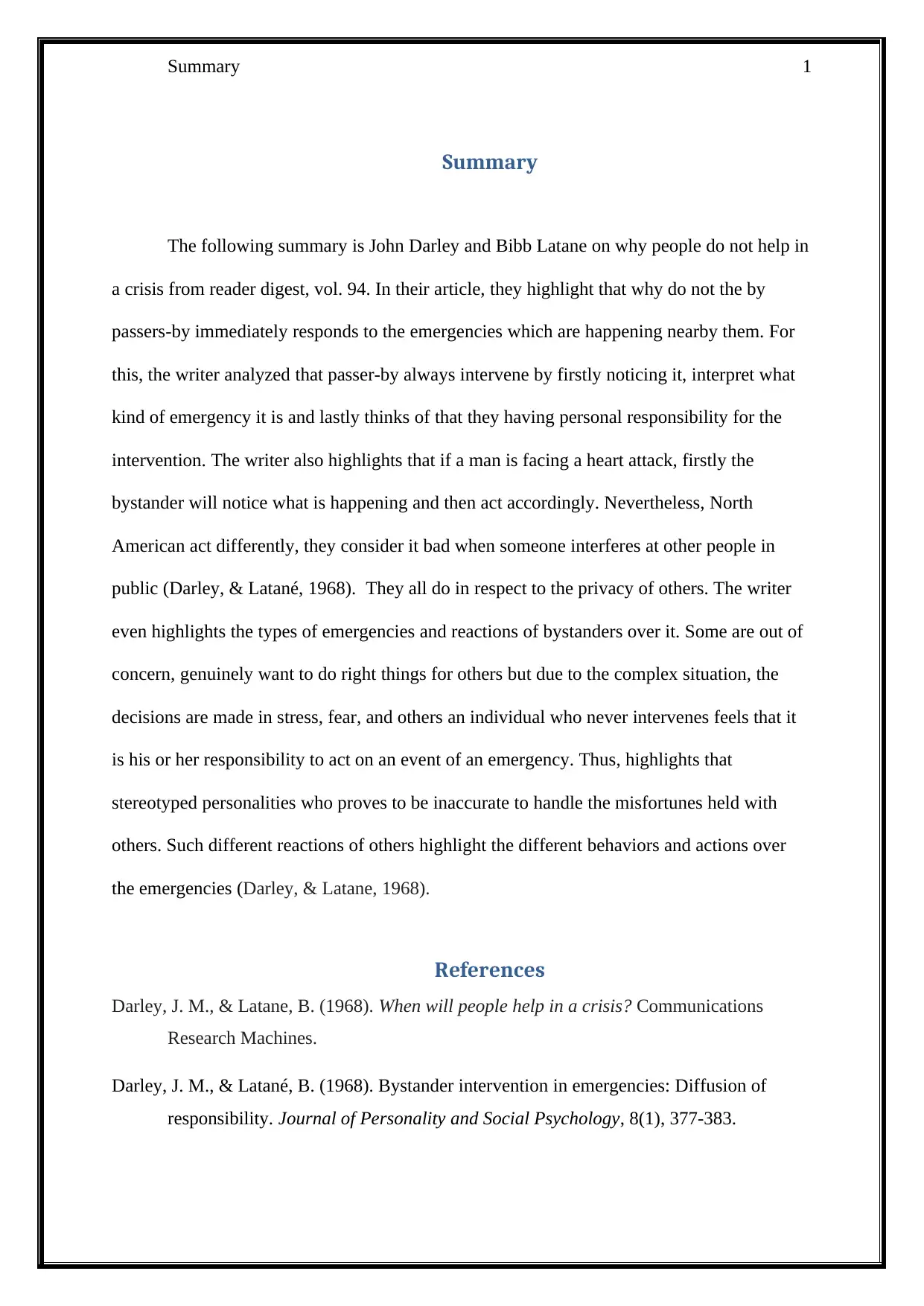
Summary
The following summary is John Darley and Bibb Latane on why people do not help in
a crisis from reader digest, vol. 94. In their article, they highlight that why do not the by
passers-by immediately responds to the emergencies which are happening nearby them. For
this, the writer analyzed that passer-by always intervene by firstly noticing it, interpret what
kind of emergency it is and lastly thinks of that they having personal responsibility for the
intervention. The writer also highlights that if a man is facing a heart attack, firstly the
bystander will notice what is happening and then act accordingly. Nevertheless, North
American act differently, they consider it bad when someone interferes at other people in
public (Darley, & Latané, 1968). They all do in respect to the privacy of others. The writer
even highlights the types of emergencies and reactions of bystanders over it. Some are out of
concern, genuinely want to do right things for others but due to the complex situation, the
decisions are made in stress, fear, and others an individual who never intervenes feels that it
is his or her responsibility to act on an event of an emergency. Thus, highlights that
stereotyped personalities who proves to be inaccurate to handle the misfortunes held with
others. Such different reactions of others highlight the different behaviors and actions over
the emergencies (Darley, & Latane, 1968).
References
Darley, J. M., & Latane, B. (1968). When will people help in a crisis? Communications
Research Machines.
Darley, J. M., & Latané, B. (1968). Bystander intervention in emergencies: Diffusion of
responsibility. Journal of Personality and Social Psychology, 8(1), 377-383.
chevron_up_icon
1 out of 2
circle_padding
hide_on_mobile
zoom_out_icon
[object Object]