Analysis of Cadbury's Marketing in the Global Market
VerifiedAdded on 2023/03/20
|20
|4563
|91
Report
AI Summary
This report provides a comprehensive analysis of Cadbury's marketing strategies within the global chocolate market. It begins with an executive summary and an introduction that highlights the importance of marketing in multinational companies. The report then offers a company introduction, followed by an industry overview using Porter's Five Forces model, assessing the threats of new entrants, bargaining power of customers and suppliers, threats from substitutes, and competitive rivalry. A detailed SWOT analysis explores Cadbury's strengths (financial stability, Royal Warrant, global brand, and partnerships), weaknesses (subsidiary status, health issues, and limited product umbrella), opportunities (becoming a full-fledged company, product line extension), and threats (data theft and counterfeit products). The report continues with an examination of Cadbury's segmentation, targeting, and positioning (STP) strategies. The marketing mix, including product, price, place, and promotion, is analyzed. The conclusion summarizes the findings, emphasizing the importance of strategic marketing in the chocolate industry. The report uses financial statements and industry reports to support its arguments.
Running head: MARKETING OF CADBURY
Marketing of Cadbury
Name of the Student:
Name of the University:
Author Note:
Marketing of Cadbury
Name of the Student:
Name of the University:
Author Note:

Paraphrase This Document
Need a fresh take? Get an instant paraphrase of this document with our AI Paraphraser
1
MARKETING OF CADBURY
Executive Summary:
Marketing is a key activity which multinational companies have to manage extremely
strategically to be able to sustain in the market. The report shows that marketing operations have
direct impact on other crucial functions like finance. Thus, it can be pointed out that Cadbury in
spite of being a global leader in the chocolate market, suffers from various short comings and
need to take steps to manage them. The management needs to the deal strictly with data thefts
and counterfeit product manufacturers. Secondly, the company strengthen its stand by adopting a
public limited company status.
MARKETING OF CADBURY
Executive Summary:
Marketing is a key activity which multinational companies have to manage extremely
strategically to be able to sustain in the market. The report shows that marketing operations have
direct impact on other crucial functions like finance. Thus, it can be pointed out that Cadbury in
spite of being a global leader in the chocolate market, suffers from various short comings and
need to take steps to manage them. The management needs to the deal strictly with data thefts
and counterfeit product manufacturers. Secondly, the company strengthen its stand by adopting a
public limited company status.
2
MARKETING OF CADBURY
Table of Contents
Executive Summary:........................................................................................................................1
1. Introduction:................................................................................................................................2
2. Company Introduction:................................................................................................................3
3. Brief Industry Overview:.............................................................................................................3
Threats of new entrants:...............................................................................................................3
Bargaining power of customers:..................................................................................................5
Bargaining power of suppliers:....................................................................................................5
Threats from substitutes:..................................................................................................................6
Competitive rivalry:.........................................................................................................................6
4. SWOT Analysis:..........................................................................................................................7
Strengths:.....................................................................................................................................7
Financially strong:...................................................................................................................7
Royal Warrant:.........................................................................................................................8
Global brand:...........................................................................................................................8
Partnership and innovation:.....................................................................................................8
Weaknesses:.................................................................................................................................9
Subsidiary status:.....................................................................................................................9
Health issues:...........................................................................................................................9
Limited product umbrella:.......................................................................................................9
MARKETING OF CADBURY
Table of Contents
Executive Summary:........................................................................................................................1
1. Introduction:................................................................................................................................2
2. Company Introduction:................................................................................................................3
3. Brief Industry Overview:.............................................................................................................3
Threats of new entrants:...............................................................................................................3
Bargaining power of customers:..................................................................................................5
Bargaining power of suppliers:....................................................................................................5
Threats from substitutes:..................................................................................................................6
Competitive rivalry:.........................................................................................................................6
4. SWOT Analysis:..........................................................................................................................7
Strengths:.....................................................................................................................................7
Financially strong:...................................................................................................................7
Royal Warrant:.........................................................................................................................8
Global brand:...........................................................................................................................8
Partnership and innovation:.....................................................................................................8
Weaknesses:.................................................................................................................................9
Subsidiary status:.....................................................................................................................9
Health issues:...........................................................................................................................9
Limited product umbrella:.......................................................................................................9
⊘ This is a preview!⊘
Do you want full access?
Subscribe today to unlock all pages.

Trusted by 1+ million students worldwide
3
MARKETING OF CADBURY
Opportunities:............................................................................................................................10
Converting into a full-fledged company instead of subsidiary status:..................................10
Health issues:.........................................................................................................................10
Extension of product line:......................................................................................................10
Threats:......................................................................................................................................10
Data theft risks:......................................................................................................................11
Threats from counterfeit products:........................................................................................11
5. Segmentation, Targeting & Positioning....................................................................................11
5.1 Segmentation:......................................................................................................................11
5.2 Targeting:.............................................................................................................................12
5.3 Positioning:..........................................................................................................................12
6. Marketing Mix...........................................................................................................................12
6.1 Product:................................................................................................................................12
6.2 Price:....................................................................................................................................12
6.3 Place:....................................................................................................................................13
6.4 Promotion:...........................................................................................................................13
7. Conclusion:................................................................................................................................13
References......................................................................................................................................13
MARKETING OF CADBURY
Opportunities:............................................................................................................................10
Converting into a full-fledged company instead of subsidiary status:..................................10
Health issues:.........................................................................................................................10
Extension of product line:......................................................................................................10
Threats:......................................................................................................................................10
Data theft risks:......................................................................................................................11
Threats from counterfeit products:........................................................................................11
5. Segmentation, Targeting & Positioning....................................................................................11
5.1 Segmentation:......................................................................................................................11
5.2 Targeting:.............................................................................................................................12
5.3 Positioning:..........................................................................................................................12
6. Marketing Mix...........................................................................................................................12
6.1 Product:................................................................................................................................12
6.2 Price:....................................................................................................................................12
6.3 Place:....................................................................................................................................13
6.4 Promotion:...........................................................................................................................13
7. Conclusion:................................................................................................................................13
References......................................................................................................................................13
Paraphrase This Document
Need a fresh take? Get an instant paraphrase of this document with our AI Paraphraser
4
MARKETING OF CADBURY
1. Introduction:
Marketing is one of the most important area of operation of multinational companies
around the world. Ranga & Suri (2017) in their book mentioned the famous definition of the
marketing coined by Philip Kotler, often heralded as the ‘father of marketing. The definition
reads, “Marketing is the science and art of exploring, creating, and delivering value to satisfy
the needs of a target market at a profit. Marketing identifies unfulfilled needs and desires. It
defines measures and quantifies the size of the identified market and the profit potential. It
pinpoints which segments the company is capable of serving best and it designs and promotes
the appropriate products and services.” The analysis of the definition brings into light several
aspects of marketing which has made it so important in business operations of multinational
companies. First, marketing aims to recognising the ways in which business organisations can
create values for customers. Azar and Ciabuschi (2017) point out that this need to create values
for customers necessitate companies to carry on continuous innovations to introduce new
products or improved versions of existing products which is the second aspect which transpires
from the analysis of the definition. This aspect finds application in the marketing mixes of
companies. The third aspect is that marketing requires companies to recognise target market by
using the segmentation, targeting and positioning or STP strategies. The fifth finding from the
analysis is that marketing of appropriate products enables the business organisations generate
profit which in turn provide them with financial strength. Thus it is clear from the discussion that
marketing enables firms to generate revenue by creating values for the customers. It is also clear
that marketing involves several models which form base of significant marketing strategies. The
aim of the paper would be exploring four models namely, SWOT, industry overview (Porters
five forces), STP and marketing mix to uncover the marketing strategies adopted by
MARKETING OF CADBURY
1. Introduction:
Marketing is one of the most important area of operation of multinational companies
around the world. Ranga & Suri (2017) in their book mentioned the famous definition of the
marketing coined by Philip Kotler, often heralded as the ‘father of marketing. The definition
reads, “Marketing is the science and art of exploring, creating, and delivering value to satisfy
the needs of a target market at a profit. Marketing identifies unfulfilled needs and desires. It
defines measures and quantifies the size of the identified market and the profit potential. It
pinpoints which segments the company is capable of serving best and it designs and promotes
the appropriate products and services.” The analysis of the definition brings into light several
aspects of marketing which has made it so important in business operations of multinational
companies. First, marketing aims to recognising the ways in which business organisations can
create values for customers. Azar and Ciabuschi (2017) point out that this need to create values
for customers necessitate companies to carry on continuous innovations to introduce new
products or improved versions of existing products which is the second aspect which transpires
from the analysis of the definition. This aspect finds application in the marketing mixes of
companies. The third aspect is that marketing requires companies to recognise target market by
using the segmentation, targeting and positioning or STP strategies. The fifth finding from the
analysis is that marketing of appropriate products enables the business organisations generate
profit which in turn provide them with financial strength. Thus it is clear from the discussion that
marketing enables firms to generate revenue by creating values for the customers. It is also clear
that marketing involves several models which form base of significant marketing strategies. The
aim of the paper would be exploring four models namely, SWOT, industry overview (Porters
five forces), STP and marketing mix to uncover the marketing strategies adopted by
5
MARKETING OF CADBURY
multinational companies. The company which would form the basis of the research would be
Cadbury, the British multinational company is at present owned by Mondelez International. The
paper would consider four main marketing theories namely, brief over of the chocolate industry
using five forces model by Michael Porter, SWOT analysis, STP and marketing mix model.
2. Company Introduction:
Cadbury is a British multinational company which manufactures confectionary, bakery
and health drink product. The company is headquarters in Burmingham, England and has
operations in about a hundred nations. The leadership of Cadbury is headed by Irene Rosenfeld
who has already led the holding company of Cadbury namely, Mondelez International Inc. based
in the US. Cadbury holds some of the top brands in the global confectionary market like Cadbury
Dairymilk and Bournville. The company was awarded the Royal Warrant in 1854. HM Queen
Elizabeth II conferred the Royal Warrant on the company since 1955. The main competitors of
Cadbury are multinational companies like Ferrero Rocher based in Italy and Ghirardelii
Chocolate Company based in the US.
3. Brief Industry Overview:
The analysis of the chocolate industry would be conducted using five forces model
coined by Michael Porter.
Threats of new entrants:
The first threat which Cadbury faces in the global market is threats of newly entering
firms into the chocolate industry. According to Mierzwa and Zimmer (2017), the newly entering
firms into the chocolate industry are threats to the existing companies like Cadbury. The global
chocolate market is estimated to attend a value of USD 161.56 billion by 2024
MARKETING OF CADBURY
multinational companies. The company which would form the basis of the research would be
Cadbury, the British multinational company is at present owned by Mondelez International. The
paper would consider four main marketing theories namely, brief over of the chocolate industry
using five forces model by Michael Porter, SWOT analysis, STP and marketing mix model.
2. Company Introduction:
Cadbury is a British multinational company which manufactures confectionary, bakery
and health drink product. The company is headquarters in Burmingham, England and has
operations in about a hundred nations. The leadership of Cadbury is headed by Irene Rosenfeld
who has already led the holding company of Cadbury namely, Mondelez International Inc. based
in the US. Cadbury holds some of the top brands in the global confectionary market like Cadbury
Dairymilk and Bournville. The company was awarded the Royal Warrant in 1854. HM Queen
Elizabeth II conferred the Royal Warrant on the company since 1955. The main competitors of
Cadbury are multinational companies like Ferrero Rocher based in Italy and Ghirardelii
Chocolate Company based in the US.
3. Brief Industry Overview:
The analysis of the chocolate industry would be conducted using five forces model
coined by Michael Porter.
Threats of new entrants:
The first threat which Cadbury faces in the global market is threats of newly entering
firms into the chocolate industry. According to Mierzwa and Zimmer (2017), the newly entering
firms into the chocolate industry are threats to the existing companies like Cadbury. The global
chocolate market is estimated to attend a value of USD 161.56 billion by 2024
⊘ This is a preview!⊘
Do you want full access?
Subscribe today to unlock all pages.
Trusted by 1+ million students worldwide
6
MARKETING OF CADBURY
(Globenewswire.com, 2018). This means that the chocolate market is extremely profitable and is
attracting new firms. This newly entering firms would poach customers from the existing
players which would lead to reduction in their supernormal profits. The newly companies most
of which belong to the small and medium scale, market chocolate bars and cubes at lower prices
than multinational companies like Cadbury. Sloan et al. (2019) argues that as far as products like
chocolate are concerned, quality and product safety are important criteria which have to be
considered in order to create values for chocolate consumers. Purba et al. (2018) support the
opinion of the previous authors by pointing out maintaining high quality and food safety
standards requires continuous research and development to bring about innovation in the
chocolate products manufacturing and marketing. This continuous R&D attracts immense capital
investment which smaller companies cannot afford. This factor by default create barriers before
newly entering chocolate manufacturing firms. Khamkar and Bobade (2016) contradicts this
opinion of the previous authors and point out that some of the newly entering firms are leaders in
their respective home markets and seeking to expand into foreign markets to strengthen their
positions. For example, Anand Milk Union Limited or Amul is the leader in the Indian chocolate
market with an immense consumer base. The company, in order to counteract the stiff challenge
it is facing in the Indian market, has already established itself in western markets like Europe and
the US (Businesstoday.in, 2016). The company has already entered Russia as an exporter
(Business-standard.com 2014). It can also be pointed out that these large scale companies like
Amul maintain high quality standards for their products. Thus, it transpires from the discussion
that the rate of threats from newly entering which Cadbury faces varies according to scale of
operations of the newly entering companies. The threat is low to medium when the newly
MARKETING OF CADBURY
(Globenewswire.com, 2018). This means that the chocolate market is extremely profitable and is
attracting new firms. This newly entering firms would poach customers from the existing
players which would lead to reduction in their supernormal profits. The newly companies most
of which belong to the small and medium scale, market chocolate bars and cubes at lower prices
than multinational companies like Cadbury. Sloan et al. (2019) argues that as far as products like
chocolate are concerned, quality and product safety are important criteria which have to be
considered in order to create values for chocolate consumers. Purba et al. (2018) support the
opinion of the previous authors by pointing out maintaining high quality and food safety
standards requires continuous research and development to bring about innovation in the
chocolate products manufacturing and marketing. This continuous R&D attracts immense capital
investment which smaller companies cannot afford. This factor by default create barriers before
newly entering chocolate manufacturing firms. Khamkar and Bobade (2016) contradicts this
opinion of the previous authors and point out that some of the newly entering firms are leaders in
their respective home markets and seeking to expand into foreign markets to strengthen their
positions. For example, Anand Milk Union Limited or Amul is the leader in the Indian chocolate
market with an immense consumer base. The company, in order to counteract the stiff challenge
it is facing in the Indian market, has already established itself in western markets like Europe and
the US (Businesstoday.in, 2016). The company has already entered Russia as an exporter
(Business-standard.com 2014). It can also be pointed out that these large scale companies like
Amul maintain high quality standards for their products. Thus, it transpires from the discussion
that the rate of threats from newly entering which Cadbury faces varies according to scale of
operations of the newly entering companies. The threat is low to medium when the newly
Paraphrase This Document
Need a fresh take? Get an instant paraphrase of this document with our AI Paraphraser
7
MARKETING OF CADBURY
entering companies are of small to medium scale. The rate of threat is high when the size of the
competitor is big with international presence.
Bargaining power of customers:
The customers enter immense bargaining power in the chocolate market owing to a large
number of companies offering chocolate products. The customers today can purchase different
types of chocolate like white chocolate, milk chocolate and dark chocolate. The companies
manufacturing chocolate today offer chocolate products in different forms like bars and cubes
(Gallo, Antolin-Lopez & Montiel, 2018). Thus, the consumers are in the position to choose from
a wide range of chocolate products at varying rates according to their preferences. Moreover,
customers can also order chocolate products online which enable them to order for chocolate
products available in foreign markets. Thus, on the whole the level of bargaining power of the
consumers remain high in the chocolate market (Noble, 2017).
Bargaining power of suppliers:
The bargaining power of suppliers are very high in the chocolate market due to several
reasons. First of the all the companies like Cadbury have high quality standards for their
products. Secondly, the main raw material for chocolate product namely cocoa is produced in a
small number of countries in Africa and South America. Similarly, the chocolate companies in
order to ensure high quality of finished products acquire raw materials like milk and nuts from
selected suppliers (Diaz-Osborn & Osborn, 2016). This scarcity of the suppliers producing raw
materials for chocolate products gives the opportunities to the suppliers immense prices for their
supply of raw materials. Moreover, leading companies like Nestle and Cadbury are able to
control the rates of the raw materials for chocolate products. Thus, it is evident from the
description that the suppliers supplying raw materials to the leading companies have more
MARKETING OF CADBURY
entering companies are of small to medium scale. The rate of threat is high when the size of the
competitor is big with international presence.
Bargaining power of customers:
The customers enter immense bargaining power in the chocolate market owing to a large
number of companies offering chocolate products. The customers today can purchase different
types of chocolate like white chocolate, milk chocolate and dark chocolate. The companies
manufacturing chocolate today offer chocolate products in different forms like bars and cubes
(Gallo, Antolin-Lopez & Montiel, 2018). Thus, the consumers are in the position to choose from
a wide range of chocolate products at varying rates according to their preferences. Moreover,
customers can also order chocolate products online which enable them to order for chocolate
products available in foreign markets. Thus, on the whole the level of bargaining power of the
consumers remain high in the chocolate market (Noble, 2017).
Bargaining power of suppliers:
The bargaining power of suppliers are very high in the chocolate market due to several
reasons. First of the all the companies like Cadbury have high quality standards for their
products. Secondly, the main raw material for chocolate product namely cocoa is produced in a
small number of countries in Africa and South America. Similarly, the chocolate companies in
order to ensure high quality of finished products acquire raw materials like milk and nuts from
selected suppliers (Diaz-Osborn & Osborn, 2016). This scarcity of the suppliers producing raw
materials for chocolate products gives the opportunities to the suppliers immense prices for their
supply of raw materials. Moreover, leading companies like Nestle and Cadbury are able to
control the rates of the raw materials for chocolate products. Thus, it is evident from the
description that the suppliers supplying raw materials to the leading companies have more
8
MARKETING OF CADBURY
controlling power in the market compared to suppliers supplying to the smaller players (Neilson
et al., 2018).
Threats from substitutes:
The threats from substitutes in the chocolate market is very high. This is because the
consumers have access to large variety of confectionary products who are substitutes to the
chocolate products manufactured by companies like Cadbury. The company manufactures
chocolate products in different forms like bars and cubes. There is a growing concern that
chocolate harms teeth and raises sugar levels in the blood of the consumers. This means that the
consumers can opt to consume healthier product like biscuits which have less sugar compared to
chocolate bars. Further, it can also be pointed out that consumers can also opt to sugarless
products like low calorie drinks, all of which are substitutes to confectionary products like
Cadbury (Tabari et al., 2017).
Competitive rivalry:
The rate of competitive rivalry is very high in the confectionary market owing to
presence of several multinational companies marketing variety of premium chocolate products.
For example, Cadbury Diary Milk, the flagship product of the company faces competition from
Kitkat, manufactured by Nestle, the largest food manufacturing company in the world. This
extremely competition which Cadbury receives from its rivals poses serious threats to the market
position of the company (Bharucha, 2016). This is because, the rivals like Nestle are capable of
manufacturing products of the same quality parameter as Cadbury. Similarly, these multinational
competitors have extensive product lines offering chocolate products of several varieties like
fruit and nuts variant and dark chocolate variant. Thus, these competitors are able to poach
consumers from Cadbury and reduce its revenue generation. Thus, it transpires from the
MARKETING OF CADBURY
controlling power in the market compared to suppliers supplying to the smaller players (Neilson
et al., 2018).
Threats from substitutes:
The threats from substitutes in the chocolate market is very high. This is because the
consumers have access to large variety of confectionary products who are substitutes to the
chocolate products manufactured by companies like Cadbury. The company manufactures
chocolate products in different forms like bars and cubes. There is a growing concern that
chocolate harms teeth and raises sugar levels in the blood of the consumers. This means that the
consumers can opt to consume healthier product like biscuits which have less sugar compared to
chocolate bars. Further, it can also be pointed out that consumers can also opt to sugarless
products like low calorie drinks, all of which are substitutes to confectionary products like
Cadbury (Tabari et al., 2017).
Competitive rivalry:
The rate of competitive rivalry is very high in the confectionary market owing to
presence of several multinational companies marketing variety of premium chocolate products.
For example, Cadbury Diary Milk, the flagship product of the company faces competition from
Kitkat, manufactured by Nestle, the largest food manufacturing company in the world. This
extremely competition which Cadbury receives from its rivals poses serious threats to the market
position of the company (Bharucha, 2016). This is because, the rivals like Nestle are capable of
manufacturing products of the same quality parameter as Cadbury. Similarly, these multinational
competitors have extensive product lines offering chocolate products of several varieties like
fruit and nuts variant and dark chocolate variant. Thus, these competitors are able to poach
consumers from Cadbury and reduce its revenue generation. Thus, it transpires from the
⊘ This is a preview!⊘
Do you want full access?
Subscribe today to unlock all pages.
Trusted by 1+ million students worldwide
9
MARKETING OF CADBURY
discussion that Cadbury faces serious threats due to high competition from its rival companies
(Ramli, 2017).
4. SWOT Analysis:
The following section would view the strengths, weaknesses, opportunities and threats
which Cadbury would likely face while operating in the global market:
Strengths:
The following are the strengths of the Cadbury in the global market:
Financially strong:
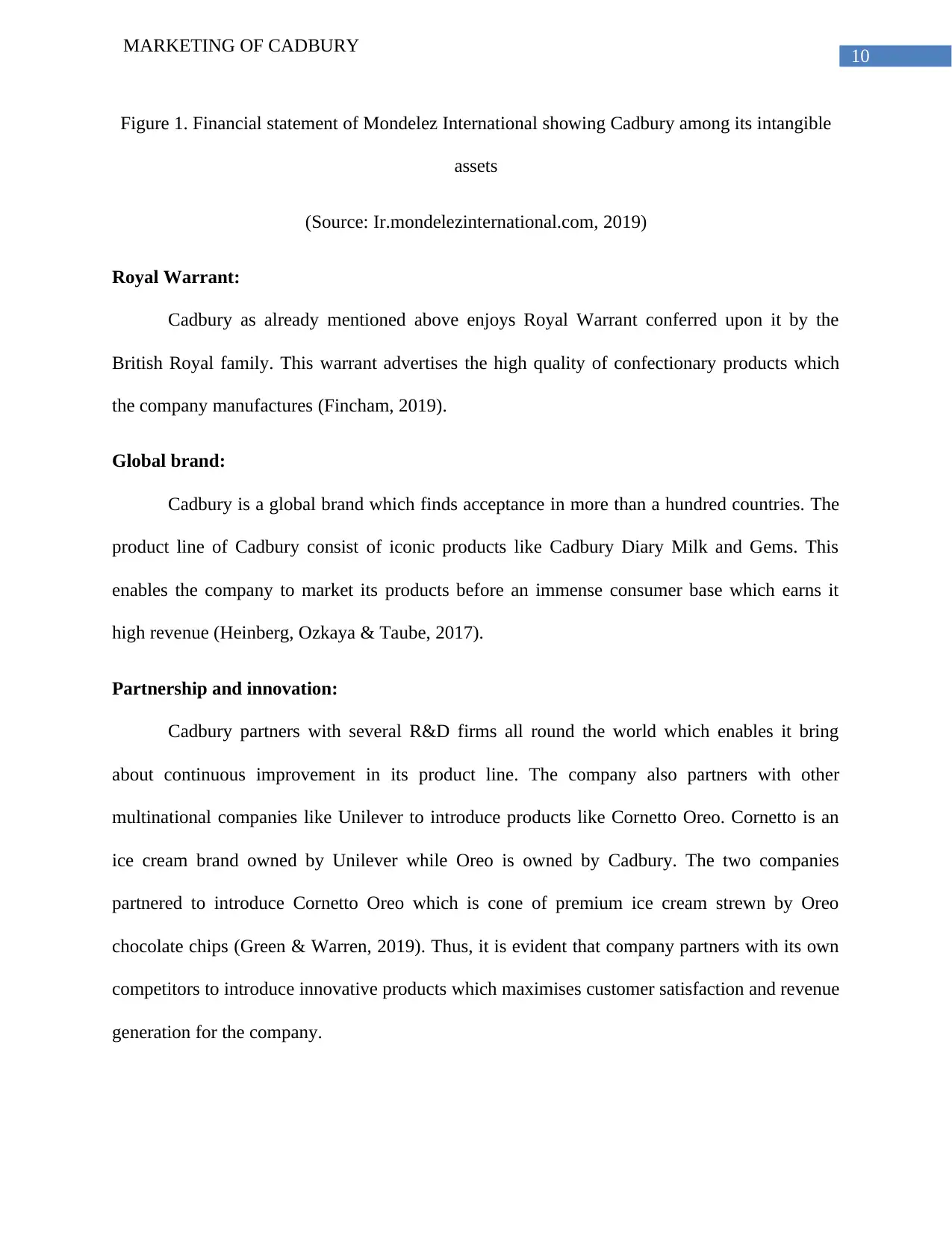
Cadbury is financially strong and operates in about more than a hundred nations. The
company owns brands like Bournville and Diary Milk which finds acceptance among the global
consumers. This enables the company to generate immense revenue. Moreover, the owner of
Cadbury, namely Mondelez International is a global company company listed on NYSE. This
means that the latter is able to provide the former with immense capital which combined with the
revenue base attributes Cadbury its financial strength.
MARKETING OF CADBURY
discussion that Cadbury faces serious threats due to high competition from its rival companies
(Ramli, 2017).
4. SWOT Analysis:
The following section would view the strengths, weaknesses, opportunities and threats
which Cadbury would likely face while operating in the global market:
Strengths:
The following are the strengths of the Cadbury in the global market:
Financially strong:
Cadbury is financially strong and operates in about more than a hundred nations. The
company owns brands like Bournville and Diary Milk which finds acceptance among the global
consumers. This enables the company to generate immense revenue. Moreover, the owner of
Cadbury, namely Mondelez International is a global company company listed on NYSE. This
means that the latter is able to provide the former with immense capital which combined with the
revenue base attributes Cadbury its financial strength.
Paraphrase This Document
Need a fresh take? Get an instant paraphrase of this document with our AI Paraphraser
10
MARKETING OF CADBURY
Figure 1. Financial statement of Mondelez International showing Cadbury among its intangible
assets
(Source: Ir.mondelezinternational.com, 2019)
Royal Warrant:
Cadbury as already mentioned above enjoys Royal Warrant conferred upon it by the
British Royal family. This warrant advertises the high quality of confectionary products which
the company manufactures (Fincham, 2019).
Global brand:
Cadbury is a global brand which finds acceptance in more than a hundred countries. The
product line of Cadbury consist of iconic products like Cadbury Diary Milk and Gems. This
enables the company to market its products before an immense consumer base which earns it
high revenue (Heinberg, Ozkaya & Taube, 2017).
Partnership and innovation:
Cadbury partners with several R&D firms all round the world which enables it bring
about continuous improvement in its product line. The company also partners with other
multinational companies like Unilever to introduce products like Cornetto Oreo. Cornetto is an
ice cream brand owned by Unilever while Oreo is owned by Cadbury. The two companies
partnered to introduce Cornetto Oreo which is cone of premium ice cream strewn by Oreo
chocolate chips (Green & Warren, 2019). Thus, it is evident that company partners with its own
competitors to introduce innovative products which maximises customer satisfaction and revenue
generation for the company.
MARKETING OF CADBURY
Figure 1. Financial statement of Mondelez International showing Cadbury among its intangible
assets
(Source: Ir.mondelezinternational.com, 2019)
Royal Warrant:
Cadbury as already mentioned above enjoys Royal Warrant conferred upon it by the
British Royal family. This warrant advertises the high quality of confectionary products which
the company manufactures (Fincham, 2019).
Global brand:
Cadbury is a global brand which finds acceptance in more than a hundred countries. The
product line of Cadbury consist of iconic products like Cadbury Diary Milk and Gems. This
enables the company to market its products before an immense consumer base which earns it
high revenue (Heinberg, Ozkaya & Taube, 2017).
Partnership and innovation:
Cadbury partners with several R&D firms all round the world which enables it bring
about continuous improvement in its product line. The company also partners with other
multinational companies like Unilever to introduce products like Cornetto Oreo. Cornetto is an
ice cream brand owned by Unilever while Oreo is owned by Cadbury. The two companies
partnered to introduce Cornetto Oreo which is cone of premium ice cream strewn by Oreo
chocolate chips (Green & Warren, 2019). Thus, it is evident that company partners with its own
competitors to introduce innovative products which maximises customer satisfaction and revenue
generation for the company.
11
MARKETING OF CADBURY
Weaknesses:
The following are the weaknesses of Cadbury:
Subsidiary status:
The first weakness of Cadbury is its subsidiary status. The company is a subsidiary to
Mondelez International whereas its competitors like Nestle are public limited companies.
Cadbury is dependent on Mondelez International for all major business aspects right from
financing to marketing. Public limited chocolate companies like Nestle enjoy far more autonomy
compared to Cadbury (Szalavetz, 2015).
Health issues:
Cadbury faces challenges due to health issues since chocolate products have high content
of sugar. Moreover, the chocolate causes cavity in teeth. Thus, doctors and health experts often
advice consumers against consuming chocolate products.
Limited product umbrella:
The product umbrella of Cadbury is limited to products like chocolate bars, biscuits,
drinks and candies. This limited product lime creates revenue risk management issues for the
company. The company is dependent on these four types of products, most of which are
chocolate based to generate revenue. Now, if the demand for chocolate goes down even for a
short period or any of its strong competitors introduce more innovative chocolate products, the
sales of all the products goes down (Tuz Zahra, 2018). This can be compared to the product
strategies of companies like Nestle and Amul. These companies have product umbrella
consisting of large diversities of products. For example, Nestle manufactures chocolate products,
spices, noodles, dairy products and baby food. Thus, the company cam diversify its expenses and
market risks over the revenue generated from this diverse variety of products. Thus, Nestle has a
MARKETING OF CADBURY
Weaknesses:
The following are the weaknesses of Cadbury:
Subsidiary status:
The first weakness of Cadbury is its subsidiary status. The company is a subsidiary to
Mondelez International whereas its competitors like Nestle are public limited companies.
Cadbury is dependent on Mondelez International for all major business aspects right from
financing to marketing. Public limited chocolate companies like Nestle enjoy far more autonomy
compared to Cadbury (Szalavetz, 2015).
Health issues:
Cadbury faces challenges due to health issues since chocolate products have high content
of sugar. Moreover, the chocolate causes cavity in teeth. Thus, doctors and health experts often
advice consumers against consuming chocolate products.
Limited product umbrella:
The product umbrella of Cadbury is limited to products like chocolate bars, biscuits,
drinks and candies. This limited product lime creates revenue risk management issues for the
company. The company is dependent on these four types of products, most of which are
chocolate based to generate revenue. Now, if the demand for chocolate goes down even for a
short period or any of its strong competitors introduce more innovative chocolate products, the
sales of all the products goes down (Tuz Zahra, 2018). This can be compared to the product
strategies of companies like Nestle and Amul. These companies have product umbrella
consisting of large diversities of products. For example, Nestle manufactures chocolate products,
spices, noodles, dairy products and baby food. Thus, the company cam diversify its expenses and
market risks over the revenue generated from this diverse variety of products. Thus, Nestle has a
⊘ This is a preview!⊘
Do you want full access?
Subscribe today to unlock all pages.
Trusted by 1+ million students worldwide

1 out of 20


Related Documents


Your All-in-One AI-Powered Toolkit for Academic Success.
+13062052269
info@desklib.com
Available 24*7 on WhatsApp / Email
![[object Object]](/_next/static/media/star-bottom.7253800d.svg)
Unlock your academic potential
Copyright © 2020–2026 A2Z Services. All Rights Reserved. Developed and managed by ZUCOL.