Marketing Report: Cadbury's Strategies and Environmental Factors
VerifiedAdded on 2020/02/03
|19
|5622
|214
Report
AI Summary
This report provides a detailed analysis of Cadbury's marketing management, encompassing marketing concepts, environmental factors, and strategic recommendations. It begins by defining marketing management and its various activities, such as advertising, promotion, and sales. The report then delves into Cadbury's marketing efforts, including cost reduction, distribution, and consumer education. Key marketing concepts and philosophies, including production, product, selling, marketing, and societal marketing, are examined, along with market orientation, holistic marketing, and the marketing mix. The report also assesses Cadbury's internal and micro marketing environments, including suppliers, intermediaries, customers, and competitors. Finally, it offers recommendations for improving Cadbury's segmentation, targeting, and positioning strategies to expand its customer base and enhance brand credibility in the market. The analysis highlights Cadbury's strong market position and potential for geographical expansion.
Marketing
Management
Management

Paraphrase This Document
Need a fresh take? Get an instant paraphrase of this document with our AI Paraphraser
EXECUTIVE SUMMARY
Marketing management seeks to manage marketing activities and resources of a firm.
The marketing umbrella encompasses various activities including advertising, promotion, sales
and public. Cadbury has made marketing efforts to reduce the cost of production and strengthen
its distribution system which affects the economies of large scale production. Cadbury
concentrates its efforts of marketing towards attracting and educating consumers. Cadbury focus
on product development whose demand is high in the market to fulfil customer desire through its
product choices. It has been noted that the management is aware about not only the needs of
customers but also about the requirements of internal customers of the company as well as the
demands of external environment. Cadbury needs to improve its segmentation, targeting and
positioning strategy so that it can sell its products in new target markets and widen its customer
base. Cadbury has a good position in the market and it is capable of expanding its business in
geographical market places. Thus, shaping market offerings shall enhance the credibility of the
brand and help in attracting ideal purchasers as a result company gets competitive edge.
Marketing management seeks to manage marketing activities and resources of a firm.
The marketing umbrella encompasses various activities including advertising, promotion, sales
and public. Cadbury has made marketing efforts to reduce the cost of production and strengthen
its distribution system which affects the economies of large scale production. Cadbury
concentrates its efforts of marketing towards attracting and educating consumers. Cadbury focus
on product development whose demand is high in the market to fulfil customer desire through its
product choices. It has been noted that the management is aware about not only the needs of
customers but also about the requirements of internal customers of the company as well as the
demands of external environment. Cadbury needs to improve its segmentation, targeting and
positioning strategy so that it can sell its products in new target markets and widen its customer
base. Cadbury has a good position in the market and it is capable of expanding its business in
geographical market places. Thus, shaping market offerings shall enhance the credibility of the
brand and help in attracting ideal purchasers as a result company gets competitive edge.
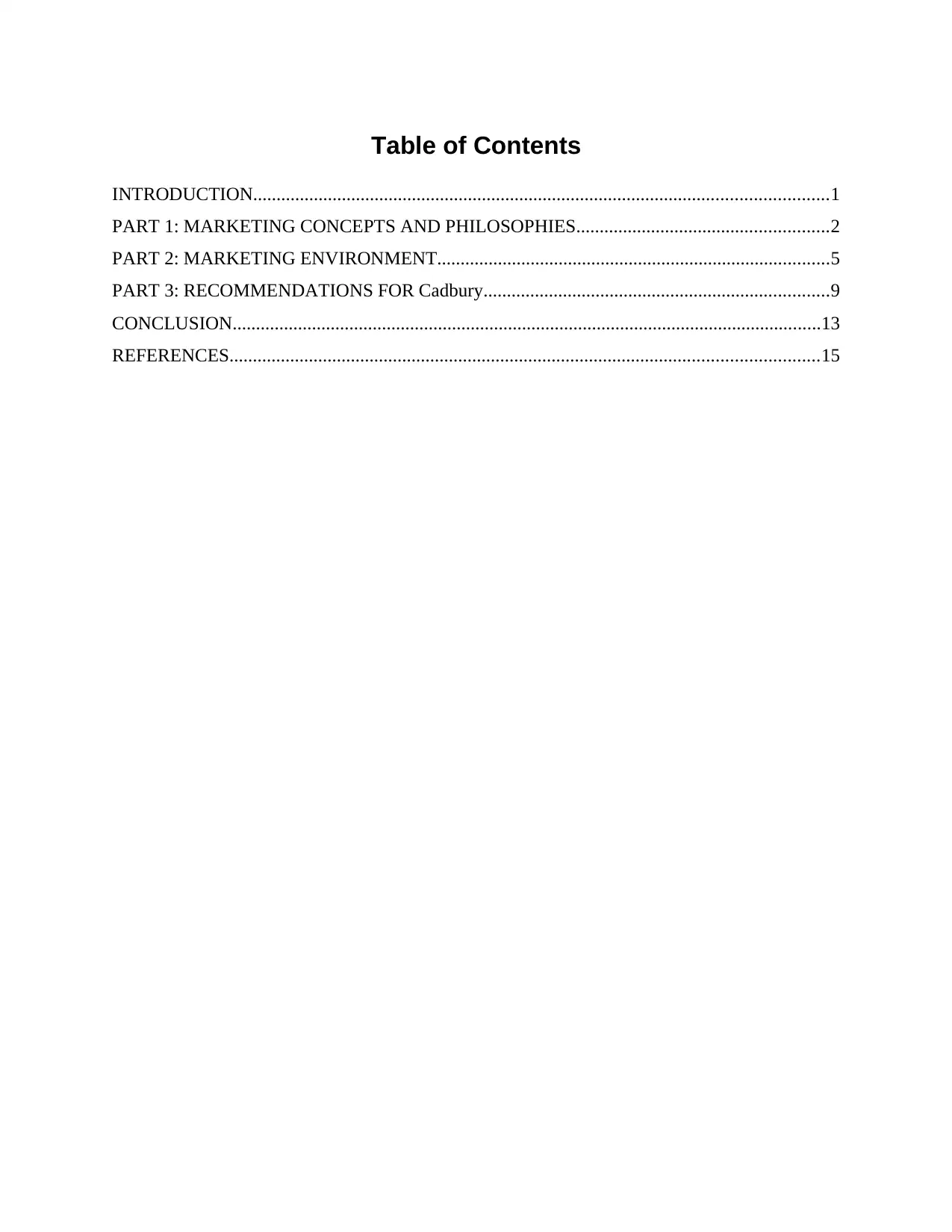
Table of Contents
INTRODUCTION...........................................................................................................................1
PART 1: MARKETING CONCEPTS AND PHILOSOPHIES......................................................2
PART 2: MARKETING ENVIRONMENT....................................................................................5
PART 3: RECOMMENDATIONS FOR Cadbury..........................................................................9
CONCLUSION..............................................................................................................................13
REFERENCES..............................................................................................................................15
INTRODUCTION...........................................................................................................................1
PART 1: MARKETING CONCEPTS AND PHILOSOPHIES......................................................2
PART 2: MARKETING ENVIRONMENT....................................................................................5
PART 3: RECOMMENDATIONS FOR Cadbury..........................................................................9
CONCLUSION..............................................................................................................................13
REFERENCES..............................................................................................................................15
⊘ This is a preview!⊘
Do you want full access?
Subscribe today to unlock all pages.

Trusted by 1+ million students worldwide
INTRODUCTION
Marketing management can be determined as an organisational discipline in which focus
is laid on practical application of orientation, methods and techniques related to marketing within
an enterprise. It seeks to manage marketing activities and resources of a firm. The marketing
umbrella encompasses various activities including advertising, promotion, sales and public
relations (Marchegiani and Phau, 2011). The present report emphasizes on confectionery
industry which deals in the sweets and candy. This has major two division such as sugar
confections and bakers confections. The products covers under the industry are; backed goods
and cakes as well as pastries which produced in accordance with desire of the customers. These
products include daily use household products which are non – durable such as processed foods,
toiletries, soft drinks etc. It is a multimillion dollar industry which is marketing some of the
largest household brand like Cadbury, Hope and Greenwood and Needlers etc.
This study provides an understanding on different marketing concepts and philosophies
adopted by Cadbury which is transnational beverage and food organization based in UK. It
offers a wide range of products including breakfast cereals, baby food, dairy products, frozen
food, medical food, tea and coffee, snacks and confectionery. Moreover, dynamics and trends
within the marketing environment are evaluated to identify factors that could have positive or
negative impact on Cadbury brand (Lindgreen, Hingley and Morgan, 2012). Lastly,
recommendations are provided in the assignment for enhancing the market share, profitability
and sustainability of cited organisation.
PART 1: MARKETING CONCEPTS AND PHILOSOPHIES
1.1
1
Marketing management can be determined as an organisational discipline in which focus
is laid on practical application of orientation, methods and techniques related to marketing within
an enterprise. It seeks to manage marketing activities and resources of a firm. The marketing
umbrella encompasses various activities including advertising, promotion, sales and public
relations (Marchegiani and Phau, 2011). The present report emphasizes on confectionery
industry which deals in the sweets and candy. This has major two division such as sugar
confections and bakers confections. The products covers under the industry are; backed goods
and cakes as well as pastries which produced in accordance with desire of the customers. These
products include daily use household products which are non – durable such as processed foods,
toiletries, soft drinks etc. It is a multimillion dollar industry which is marketing some of the
largest household brand like Cadbury, Hope and Greenwood and Needlers etc.
This study provides an understanding on different marketing concepts and philosophies
adopted by Cadbury which is transnational beverage and food organization based in UK. It
offers a wide range of products including breakfast cereals, baby food, dairy products, frozen
food, medical food, tea and coffee, snacks and confectionery. Moreover, dynamics and trends
within the marketing environment are evaluated to identify factors that could have positive or
negative impact on Cadbury brand (Lindgreen, Hingley and Morgan, 2012). Lastly,
recommendations are provided in the assignment for enhancing the market share, profitability
and sustainability of cited organisation.
PART 1: MARKETING CONCEPTS AND PHILOSOPHIES
1.1
1
Paraphrase This Document
Need a fresh take? Get an instant paraphrase of this document with our AI Paraphraser
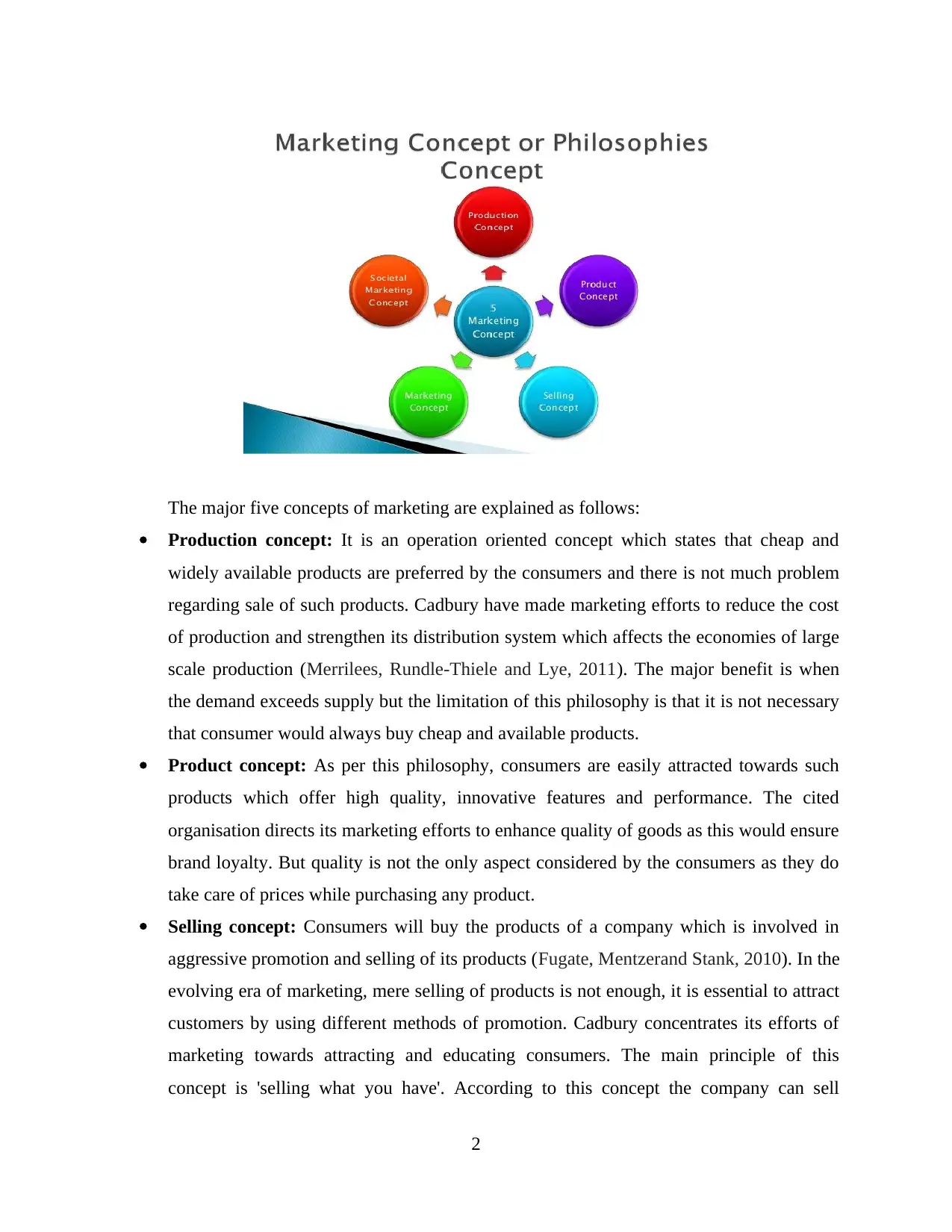
The major five concepts of marketing are explained as follows:
Production concept: It is an operation oriented concept which states that cheap and
widely available products are preferred by the consumers and there is not much problem
regarding sale of such products. Cadbury have made marketing efforts to reduce the cost
of production and strengthen its distribution system which affects the economies of large
scale production (Merrilees, Rundle-Thiele and Lye, 2011). The major benefit is when
the demand exceeds supply but the limitation of this philosophy is that it is not necessary
that consumer would always buy cheap and available products.
Product concept: As per this philosophy, consumers are easily attracted towards such
products which offer high quality, innovative features and performance. The cited
organisation directs its marketing efforts to enhance quality of goods as this would ensure
brand loyalty. But quality is not the only aspect considered by the consumers as they do
take care of prices while purchasing any product.
Selling concept: Consumers will buy the products of a company which is involved in
aggressive promotion and selling of its products (Fugate, Mentzerand Stank, 2010). In the
evolving era of marketing, mere selling of products is not enough, it is essential to attract
customers by using different methods of promotion. Cadbury concentrates its efforts of
marketing towards attracting and educating consumers. The main principle of this
concept is 'selling what you have'. According to this concept the company can sell
2
Production concept: It is an operation oriented concept which states that cheap and
widely available products are preferred by the consumers and there is not much problem
regarding sale of such products. Cadbury have made marketing efforts to reduce the cost
of production and strengthen its distribution system which affects the economies of large
scale production (Merrilees, Rundle-Thiele and Lye, 2011). The major benefit is when
the demand exceeds supply but the limitation of this philosophy is that it is not necessary
that consumer would always buy cheap and available products.
Product concept: As per this philosophy, consumers are easily attracted towards such
products which offer high quality, innovative features and performance. The cited
organisation directs its marketing efforts to enhance quality of goods as this would ensure
brand loyalty. But quality is not the only aspect considered by the consumers as they do
take care of prices while purchasing any product.
Selling concept: Consumers will buy the products of a company which is involved in
aggressive promotion and selling of its products (Fugate, Mentzerand Stank, 2010). In the
evolving era of marketing, mere selling of products is not enough, it is essential to attract
customers by using different methods of promotion. Cadbury concentrates its efforts of
marketing towards attracting and educating consumers. The main principle of this
concept is 'selling what you have'. According to this concept the company can sell
2
anything to its customers by repetitive efforts. But this is not true as consumers can be
attracted once but not every time. Thus, it can be asserted that this theory is advantageous
for the short term and not for long term benefits.
Marketing concept: Marketing is the heart of a successful business. It is a process for
introduction and promotion of products and services of an organisation to the potential
customers. As per the marketing concept, for becoming successful, it is imperative to
ensure customer satisfaction. The demand and needs of target market should be focused
and company should deliver value better than its competitors. Marketing concept focuses
on pull strategy and states that the company's brand should be strong enough that
consumers prefer company's brand over any other competitor's brand (Weinstein, and
Pohlman, 2015). Cadbury directs its marketing efforts to attract more customers by
understanding their needs and expectations to achieve customer satisfaction. It is a
modern concept and helps an organisation in increasing profitability in the long run but
the drawback is that social welfare is not taken into consideration.
Societal marketing concept: The societal marketing concept is an offshoot of marketing
concept. It not only focuses on customer satisfaction but also on the welfare of the society
as a whole. It provides that an organisation should produce better products for the
consumer and societal welfare. It is the duty of the cited organisation to identify demands
and needs of target market and ensure that the desired satisfaction is delivered more
effectively and efficiently than the competitors in such a way that the society's and
consumer's well-being is preserved or enhanced (Storbacka, 2011). As per societal
marketing concept, marketers should take into consideration ethical and social aspects
into their marketing practices. This ensures long term success for an organisation.
1.2
Some other aspects related to marketing philosophies are described below:
Market orientation: Market orientation can be determined as a philosophy of the
company which focuses on identification and meeting the customer's needs and desires
through the product mix. It attempts to meet demands and expectations of customers by
tailoring products which helps company to gain competitive advantage. It is a consumer
centred approach for designing the products (Marketing: Marketing Orientation, 2012).
Cadbury focus on product development whose demand is high in the market to fulfil
3
attracted once but not every time. Thus, it can be asserted that this theory is advantageous
for the short term and not for long term benefits.
Marketing concept: Marketing is the heart of a successful business. It is a process for
introduction and promotion of products and services of an organisation to the potential
customers. As per the marketing concept, for becoming successful, it is imperative to
ensure customer satisfaction. The demand and needs of target market should be focused
and company should deliver value better than its competitors. Marketing concept focuses
on pull strategy and states that the company's brand should be strong enough that
consumers prefer company's brand over any other competitor's brand (Weinstein, and
Pohlman, 2015). Cadbury directs its marketing efforts to attract more customers by
understanding their needs and expectations to achieve customer satisfaction. It is a
modern concept and helps an organisation in increasing profitability in the long run but
the drawback is that social welfare is not taken into consideration.
Societal marketing concept: The societal marketing concept is an offshoot of marketing
concept. It not only focuses on customer satisfaction but also on the welfare of the society
as a whole. It provides that an organisation should produce better products for the
consumer and societal welfare. It is the duty of the cited organisation to identify demands
and needs of target market and ensure that the desired satisfaction is delivered more
effectively and efficiently than the competitors in such a way that the society's and
consumer's well-being is preserved or enhanced (Storbacka, 2011). As per societal
marketing concept, marketers should take into consideration ethical and social aspects
into their marketing practices. This ensures long term success for an organisation.
1.2
Some other aspects related to marketing philosophies are described below:
Market orientation: Market orientation can be determined as a philosophy of the
company which focuses on identification and meeting the customer's needs and desires
through the product mix. It attempts to meet demands and expectations of customers by
tailoring products which helps company to gain competitive advantage. It is a consumer
centred approach for designing the products (Marketing: Marketing Orientation, 2012).
Cadbury focus on product development whose demand is high in the market to fulfil
3
⊘ This is a preview!⊘
Do you want full access?
Subscribe today to unlock all pages.
Trusted by 1+ million students worldwide
customer desire through its product choices. It helps in ensuring high customer
satisfaction and enhances brand loyalty and word of mouth publicity.
Holistic marketing: It is defined as an integrative concept of marketing that takes into
consideration business as a whole and not focuses on development of a specific
marketing activity (Holistic marketing concept, 2016). It provides development and
maintenance of multiple perspectives on the commercial activities of Cadbury. It attempts
in designing, developing and implementing activities, processes and programmes of
marketing whereby interdependencies are recognised.
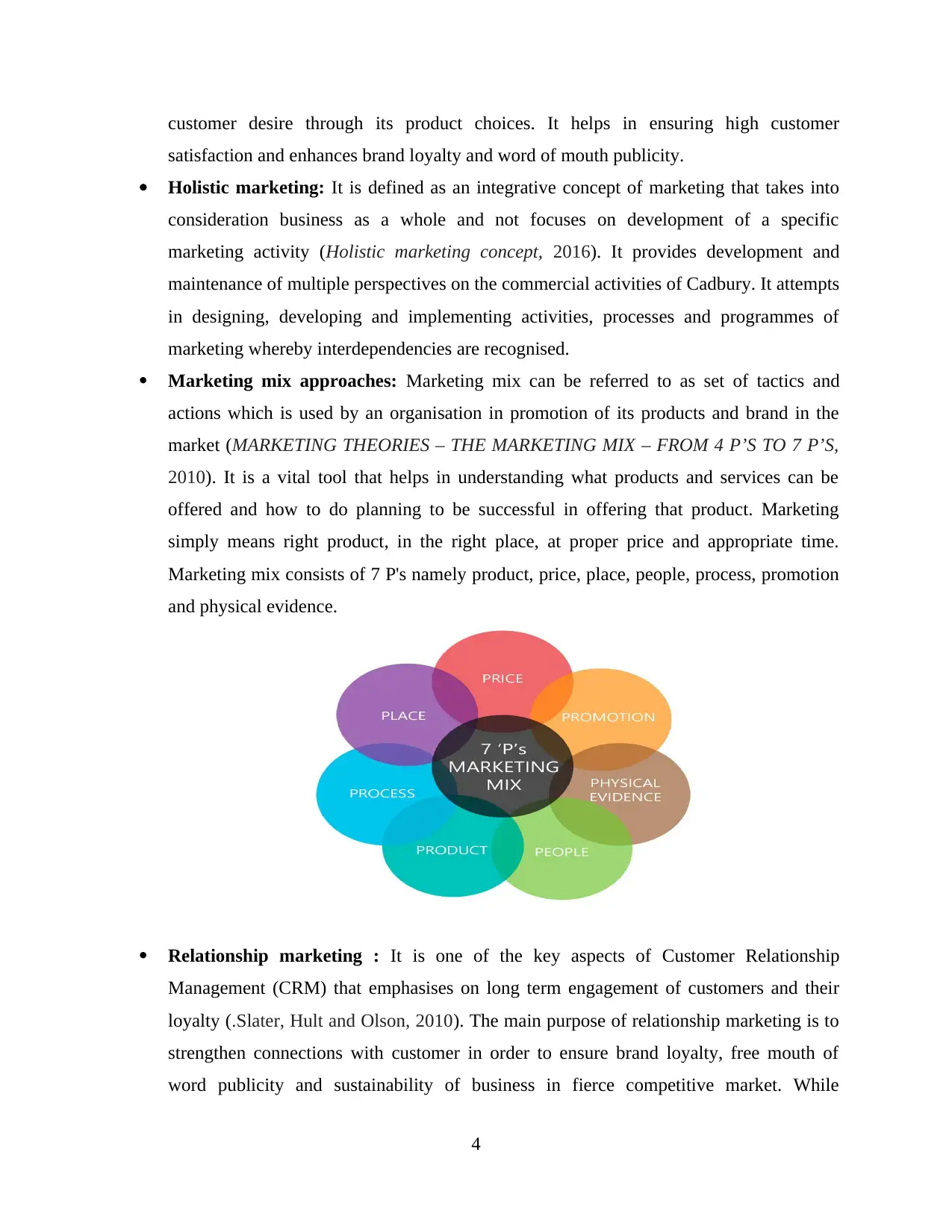
Marketing mix approaches: Marketing mix can be referred to as set of tactics and
actions which is used by an organisation in promotion of its products and brand in the
market (MARKETING THEORIES – THE MARKETING MIX – FROM 4 P’S TO 7 P’S,
2010). It is a vital tool that helps in understanding what products and services can be
offered and how to do planning to be successful in offering that product. Marketing
simply means right product, in the right place, at proper price and appropriate time.
Marketing mix consists of 7 P's namely product, price, place, people, process, promotion
and physical evidence.
Relationship marketing : It is one of the key aspects of Customer Relationship
Management (CRM) that emphasises on long term engagement of customers and their
loyalty (.Slater, Hult and Olson, 2010). The main purpose of relationship marketing is to
strengthen connections with customer in order to ensure brand loyalty, free mouth of
word publicity and sustainability of business in fierce competitive market. While
4
satisfaction and enhances brand loyalty and word of mouth publicity.
Holistic marketing: It is defined as an integrative concept of marketing that takes into
consideration business as a whole and not focuses on development of a specific
marketing activity (Holistic marketing concept, 2016). It provides development and
maintenance of multiple perspectives on the commercial activities of Cadbury. It attempts
in designing, developing and implementing activities, processes and programmes of
marketing whereby interdependencies are recognised.
Marketing mix approaches: Marketing mix can be referred to as set of tactics and
actions which is used by an organisation in promotion of its products and brand in the
market (MARKETING THEORIES – THE MARKETING MIX – FROM 4 P’S TO 7 P’S,
2010). It is a vital tool that helps in understanding what products and services can be
offered and how to do planning to be successful in offering that product. Marketing
simply means right product, in the right place, at proper price and appropriate time.
Marketing mix consists of 7 P's namely product, price, place, people, process, promotion
and physical evidence.
Relationship marketing : It is one of the key aspects of Customer Relationship
Management (CRM) that emphasises on long term engagement of customers and their
loyalty (.Slater, Hult and Olson, 2010). The main purpose of relationship marketing is to
strengthen connections with customer in order to ensure brand loyalty, free mouth of
word publicity and sustainability of business in fierce competitive market. While
4
Paraphrase This Document
Need a fresh take? Get an instant paraphrase of this document with our AI Paraphraser
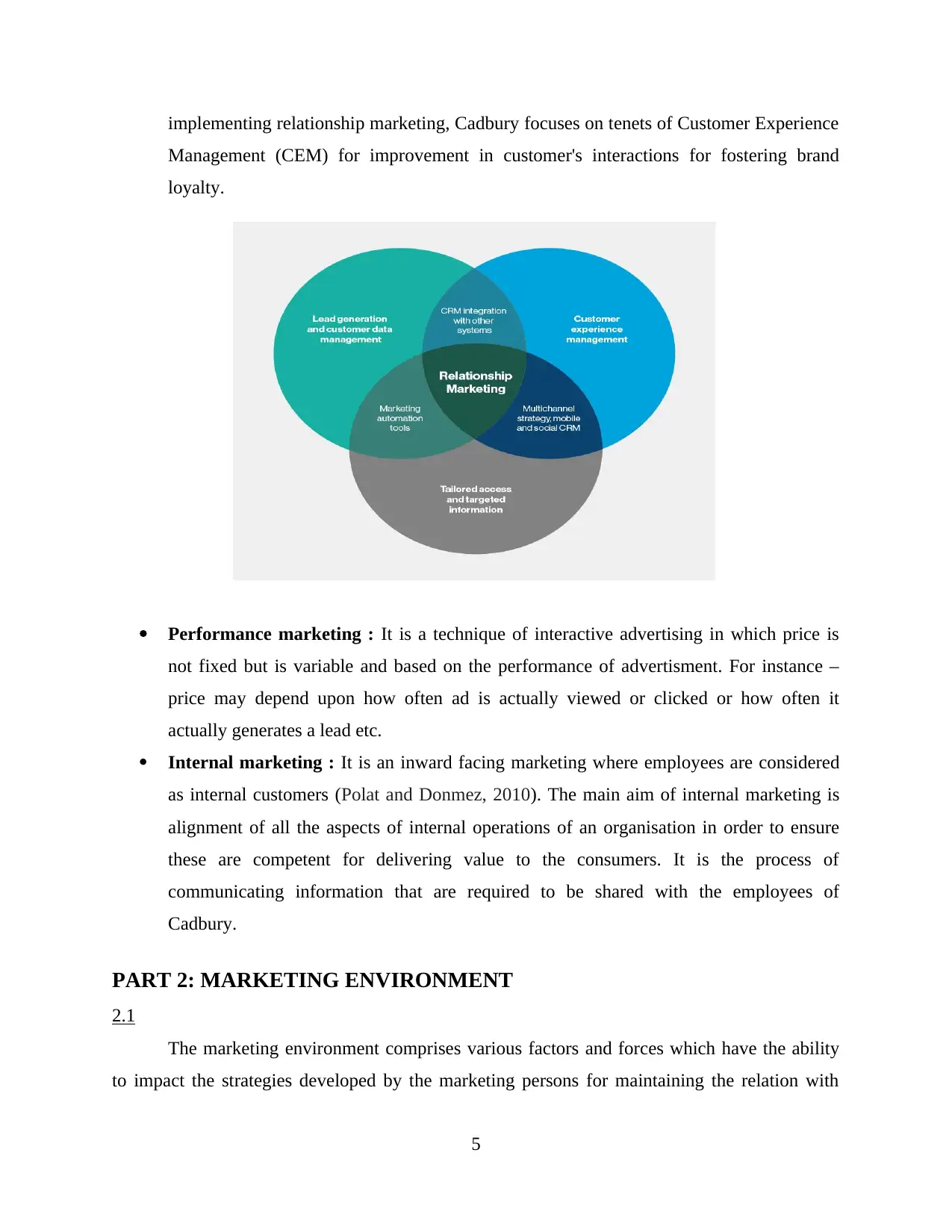
implementing relationship marketing, Cadbury focuses on tenets of Customer Experience
Management (CEM) for improvement in customer's interactions for fostering brand
loyalty.
Performance marketing : It is a technique of interactive advertising in which price is
not fixed but is variable and based on the performance of advertisment. For instance –
price may depend upon how often ad is actually viewed or clicked or how often it
actually generates a lead etc.
Internal marketing : It is an inward facing marketing where employees are considered
as internal customers (Polat and Donmez, 2010). The main aim of internal marketing is
alignment of all the aspects of internal operations of an organisation in order to ensure
these are competent for delivering value to the consumers. It is the process of
communicating information that are required to be shared with the employees of
Cadbury.
PART 2: MARKETING ENVIRONMENT
2.1
The marketing environment comprises various factors and forces which have the ability
to impact the strategies developed by the marketing persons for maintaining the relation with
5
Management (CEM) for improvement in customer's interactions for fostering brand
loyalty.
Performance marketing : It is a technique of interactive advertising in which price is
not fixed but is variable and based on the performance of advertisment. For instance –
price may depend upon how often ad is actually viewed or clicked or how often it
actually generates a lead etc.
Internal marketing : It is an inward facing marketing where employees are considered
as internal customers (Polat and Donmez, 2010). The main aim of internal marketing is
alignment of all the aspects of internal operations of an organisation in order to ensure
these are competent for delivering value to the consumers. It is the process of
communicating information that are required to be shared with the employees of
Cadbury.
PART 2: MARKETING ENVIRONMENT
2.1
The marketing environment comprises various factors and forces which have the ability
to impact the strategies developed by the marketing persons for maintaining the relation with
5
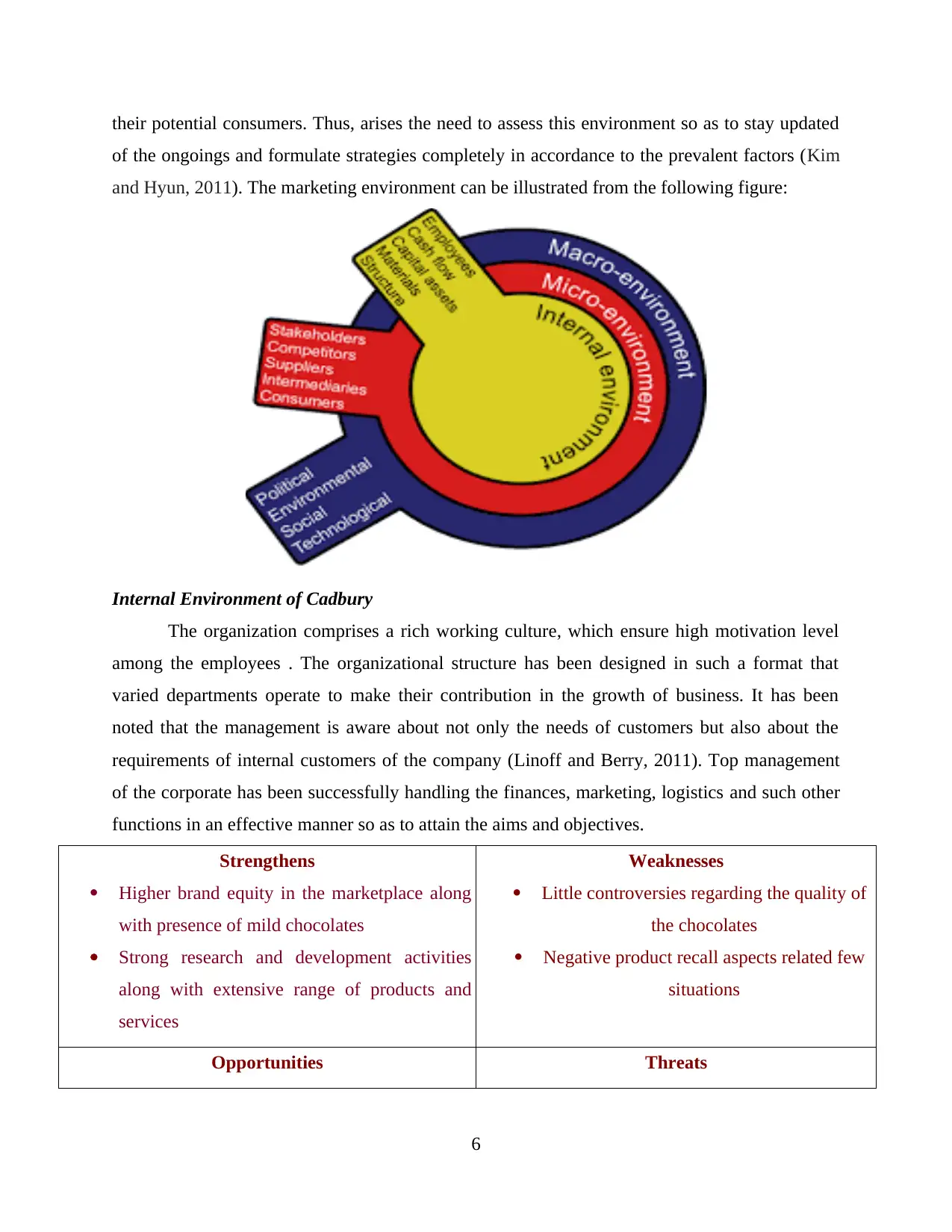
their potential consumers. Thus, arises the need to assess this environment so as to stay updated
of the ongoings and formulate strategies completely in accordance to the prevalent factors (Kim
and Hyun, 2011). The marketing environment can be illustrated from the following figure:
Internal Environment of Cadbury
The organization comprises a rich working culture, which ensure high motivation level
among the employees . The organizational structure has been designed in such a format that
varied departments operate to make their contribution in the growth of business. It has been
noted that the management is aware about not only the needs of customers but also about the
requirements of internal customers of the company (Linoff and Berry, 2011). Top management
of the corporate has been successfully handling the finances, marketing, logistics and such other
functions in an effective manner so as to attain the aims and objectives.
Strengthens
Higher brand equity in the marketplace along
with presence of mild chocolates
Strong research and development activities
along with extensive range of products and
services
Weaknesses
Little controversies regarding the quality of
the chocolates
Negative product recall aspects related few
situations
Opportunities Threats
6
of the ongoings and formulate strategies completely in accordance to the prevalent factors (Kim
and Hyun, 2011). The marketing environment can be illustrated from the following figure:
Internal Environment of Cadbury
The organization comprises a rich working culture, which ensure high motivation level
among the employees . The organizational structure has been designed in such a format that
varied departments operate to make their contribution in the growth of business. It has been
noted that the management is aware about not only the needs of customers but also about the
requirements of internal customers of the company (Linoff and Berry, 2011). Top management
of the corporate has been successfully handling the finances, marketing, logistics and such other
functions in an effective manner so as to attain the aims and objectives.
Strengthens
Higher brand equity in the marketplace along
with presence of mild chocolates
Strong research and development activities
along with extensive range of products and
services
Weaknesses
Little controversies regarding the quality of
the chocolates
Negative product recall aspects related few
situations
Opportunities Threats
6
⊘ This is a preview!⊘
Do you want full access?
Subscribe today to unlock all pages.
Trusted by 1+ million students worldwide
Expansion into rural areas
Diversification of the business in the food
segment
Expansion into the untapped market
Changing preferences of buyers
Higher cost of raw material
Micro Environment
The micro Environment is formulated on the basis of the following divisions:
1. Suppliers: The suppliers of Cadbury can be bifurcated into Labor supplier and Material
suppliers. The former ensures that the company never faces issue in respect to the
quantity of labor which is required production at an optimum level. The latter procures its
raw materials directly from the farmers or traders. Cadbury has established a strong team
of suppiers all over the world and in the event any one supplier pose problems the
company has the capacity to readily procure material from other suppliers (Tadajewski
and Jones, 2012.).
2. Marketing Intermediaries: These are the service departments of organization which
enable the products to reach the end users in an effective and timely format. Cadbury
maintain a highly coordinated and smooth relation with all the concerned intermediaries,
thereby offering a differential advantage to the company.
3. Customers: The company enjoys a wide range of consumers all over the world. The
immediate consumers of Cadbury are the grocery or local stores which make the
company's products available for the wide range of end consumers of the brand. It is
interesting to note that the consumers of Cadbury are from all age groups and the
products available with the brand is made to cater to the needs of each and every age
group.
4. Competitors: The FMCG industry comprises fierce competition among the many
corporates which are currently operating and established their brand name in the market.
However, Cadbury occupies a highly strong position in the market with its trusted
distribution channel (Gustavo, 2013). In addition, the quality and price of products is
another attribute which has enabled the company to maintain its brand image over the
yeas. There still lies scope within the strategies to compete with other competitors.
7
Diversification of the business in the food
segment
Expansion into the untapped market
Changing preferences of buyers
Higher cost of raw material
Micro Environment
The micro Environment is formulated on the basis of the following divisions:
1. Suppliers: The suppliers of Cadbury can be bifurcated into Labor supplier and Material
suppliers. The former ensures that the company never faces issue in respect to the
quantity of labor which is required production at an optimum level. The latter procures its
raw materials directly from the farmers or traders. Cadbury has established a strong team
of suppiers all over the world and in the event any one supplier pose problems the
company has the capacity to readily procure material from other suppliers (Tadajewski
and Jones, 2012.).
2. Marketing Intermediaries: These are the service departments of organization which
enable the products to reach the end users in an effective and timely format. Cadbury
maintain a highly coordinated and smooth relation with all the concerned intermediaries,
thereby offering a differential advantage to the company.
3. Customers: The company enjoys a wide range of consumers all over the world. The
immediate consumers of Cadbury are the grocery or local stores which make the
company's products available for the wide range of end consumers of the brand. It is
interesting to note that the consumers of Cadbury are from all age groups and the
products available with the brand is made to cater to the needs of each and every age
group.
4. Competitors: The FMCG industry comprises fierce competition among the many
corporates which are currently operating and established their brand name in the market.
However, Cadbury occupies a highly strong position in the market with its trusted
distribution channel (Gustavo, 2013). In addition, the quality and price of products is
another attribute which has enabled the company to maintain its brand image over the
yeas. There still lies scope within the strategies to compete with other competitors.
7
Paraphrase This Document
Need a fresh take? Get an instant paraphrase of this document with our AI Paraphraser
5. Stakeholders: All the corporate policies as well as commitments of Cadbury have been
developed with the assistance of stakeholder engagement (Stakeholder engagement,
2017). It is interesting to note that the corporate conducts an annual meeting for
stakeholders which also enable them to develop shared values. This interaction has
enabled the company over the years to facilitate collective actions.
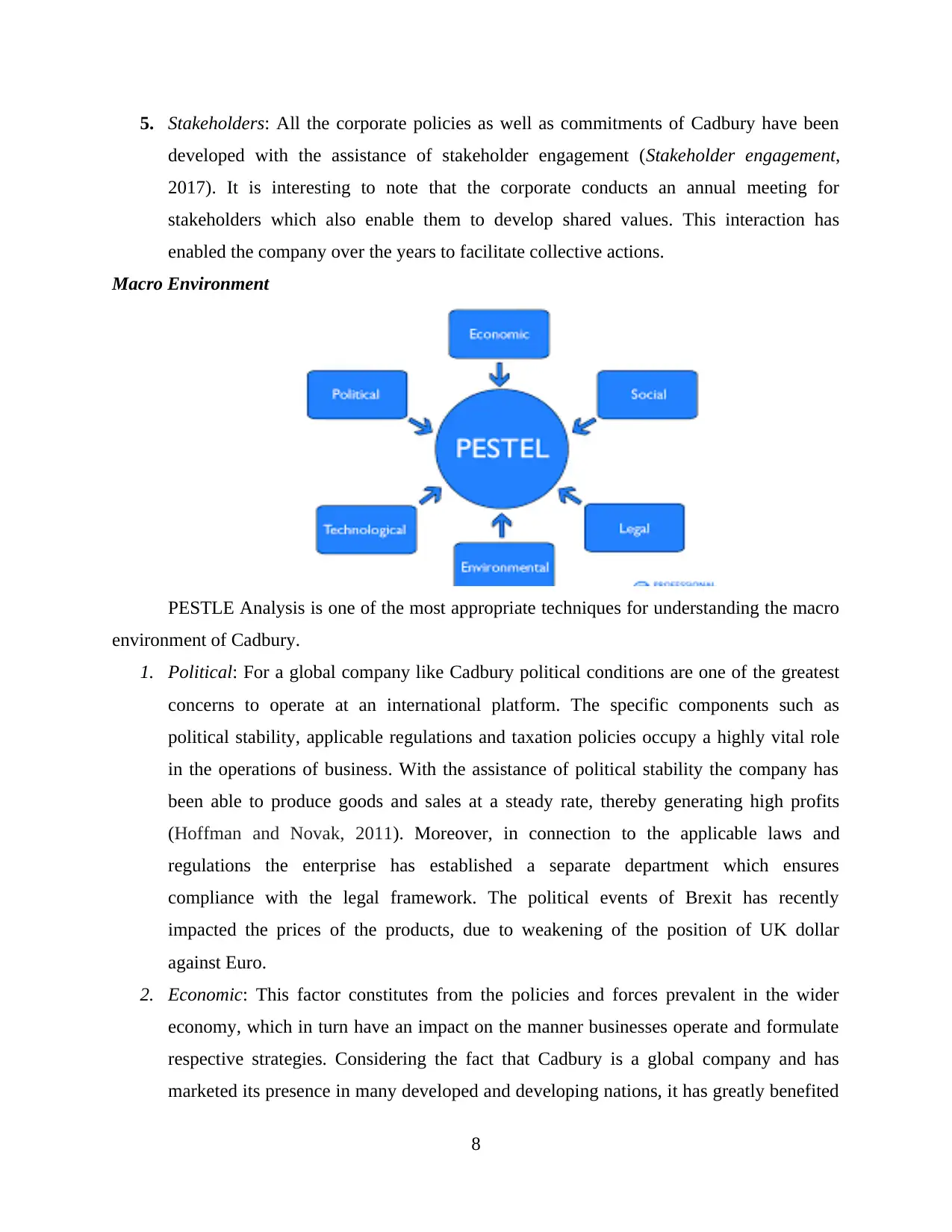
Macro Environment
PESTLE Analysis is one of the most appropriate techniques for understanding the macro
environment of Cadbury.
1. Political: For a global company like Cadbury political conditions are one of the greatest
concerns to operate at an international platform. The specific components such as
political stability, applicable regulations and taxation policies occupy a highly vital role
in the operations of business. With the assistance of political stability the company has
been able to produce goods and sales at a steady rate, thereby generating high profits
(Hoffman and Novak, 2011). Moreover, in connection to the applicable laws and
regulations the enterprise has established a separate department which ensures
compliance with the legal framework. The political events of Brexit has recently
impacted the prices of the products, due to weakening of the position of UK dollar
against Euro.
2. Economic: This factor constitutes from the policies and forces prevalent in the wider
economy, which in turn have an impact on the manner businesses operate and formulate
respective strategies. Considering the fact that Cadbury is a global company and has
marketed its presence in many developed and developing nations, it has greatly benefited
8
developed with the assistance of stakeholder engagement (Stakeholder engagement,
2017). It is interesting to note that the corporate conducts an annual meeting for
stakeholders which also enable them to develop shared values. This interaction has
enabled the company over the years to facilitate collective actions.
Macro Environment
PESTLE Analysis is one of the most appropriate techniques for understanding the macro
environment of Cadbury.
1. Political: For a global company like Cadbury political conditions are one of the greatest
concerns to operate at an international platform. The specific components such as
political stability, applicable regulations and taxation policies occupy a highly vital role
in the operations of business. With the assistance of political stability the company has
been able to produce goods and sales at a steady rate, thereby generating high profits
(Hoffman and Novak, 2011). Moreover, in connection to the applicable laws and
regulations the enterprise has established a separate department which ensures
compliance with the legal framework. The political events of Brexit has recently
impacted the prices of the products, due to weakening of the position of UK dollar
against Euro.
2. Economic: This factor constitutes from the policies and forces prevalent in the wider
economy, which in turn have an impact on the manner businesses operate and formulate
respective strategies. Considering the fact that Cadbury is a global company and has
marketed its presence in many developed and developing nations, it has greatly benefited
8
from the economic developments being taking place in different markets. In pursuance to
these trends, it has been found that the primary focus of Cadbury is going to shift to the
developing nations of Asia or Middle East. The rationale behind the same has been
ascertained as increasing disposable income in the mentioned economies.
3. Socio-cultural: Considering the fact that Cadbury is a global company, it is highly
imperative for the management to stay appraised of the socio cultural environment of the
concerned environment (Chan, Chan and Wang, 2012). Some of the specific constituents
of this environment are language, traditions, education, religion preferences, aesthetics
and so on. In order to develop effective strategies for business in varied market of the
globe, Cadbury gains a clear and unambiguous picture of the socio-cultural environment.
For instance in the case of African countries, the brand has introduced small packets of
chicken bouillon cube which specifically caters the needs of all income groups of the
country.
4. Technological: The Brand has received great benefits from availability of strong centres
which undertake intensive research and development activities for the company. It has
been ascertained that the R&D network of the entity is the largest in world, which in turn
has enabled then to develop products which specifically cater to the needs and demands
of consumers of all age. In addition, it has been understood that the technology being
utilized by the company is highly advanced and is constantly updated with any
advancement. This has enabled the brand to create opportunities for development of new
products or innovate the existing product line to gain a competitive advantage in the
market (Cooper and Dreher, 2010). However, it has been observed that the company has
still not made a presence on the digital platform by opening its own online store and
selling the products. However, it has collaborated with other online portals to sell its
products and stay connected with its consumers through an indirect route.
PART 3: RECOMMENDATIONS FOR Cadbury
As a manager, following recommendations are provided in different aspects to improve
market share, profitability and sustainability of Cadbury.
Segmentation, targetting and positioning (STP)
9
these trends, it has been found that the primary focus of Cadbury is going to shift to the
developing nations of Asia or Middle East. The rationale behind the same has been
ascertained as increasing disposable income in the mentioned economies.
3. Socio-cultural: Considering the fact that Cadbury is a global company, it is highly
imperative for the management to stay appraised of the socio cultural environment of the
concerned environment (Chan, Chan and Wang, 2012). Some of the specific constituents
of this environment are language, traditions, education, religion preferences, aesthetics
and so on. In order to develop effective strategies for business in varied market of the
globe, Cadbury gains a clear and unambiguous picture of the socio-cultural environment.
For instance in the case of African countries, the brand has introduced small packets of
chicken bouillon cube which specifically caters the needs of all income groups of the
country.
4. Technological: The Brand has received great benefits from availability of strong centres
which undertake intensive research and development activities for the company. It has
been ascertained that the R&D network of the entity is the largest in world, which in turn
has enabled then to develop products which specifically cater to the needs and demands
of consumers of all age. In addition, it has been understood that the technology being
utilized by the company is highly advanced and is constantly updated with any
advancement. This has enabled the brand to create opportunities for development of new
products or innovate the existing product line to gain a competitive advantage in the
market (Cooper and Dreher, 2010). However, it has been observed that the company has
still not made a presence on the digital platform by opening its own online store and
selling the products. However, it has collaborated with other online portals to sell its
products and stay connected with its consumers through an indirect route.
PART 3: RECOMMENDATIONS FOR Cadbury
As a manager, following recommendations are provided in different aspects to improve
market share, profitability and sustainability of Cadbury.
Segmentation, targetting and positioning (STP)
9
⊘ This is a preview!⊘
Do you want full access?
Subscribe today to unlock all pages.
Trusted by 1+ million students worldwide

1 out of 19


Related Documents


Your All-in-One AI-Powered Toolkit for Academic Success.
+13062052269
info@desklib.com
Available 24*7 on WhatsApp / Email
![[object Object]](/_next/static/media/star-bottom.7253800d.svg)
Unlock your academic potential
Copyright © 2020–2026 A2Z Services. All Rights Reserved. Developed and managed by ZUCOL.