Cadbury: Shaping Organizational Behavior in a Changing Environment
VerifiedAdded on 2023/01/12
|11
|3655
|72
Report
AI Summary
This report provides a comprehensive analysis of Cadbury, a British multinational confectionery company, examining how business, cultural, and natural environments shape its organizational behavior. It explores the impact of both economic and non-economic factors, including economic policies, conditions, and systems; and natural, demographic, and cultural influences. The report utilizes Edgar Schein's model to analyze Cadbury's organizational culture, and employs PESTEL and SWOT analyses to assess external and internal factors affecting the company's performance. The analysis highlights the importance of adapting to changing environments and leveraging opportunities in the global market, considering factors like global warming, demographic trends, and cultural values. The report concludes with a discussion of how Cadbury can navigate these challenges and maintain its position in the confectionery industry.

Academic

Paraphrase This Document
Need a fresh take? Get an instant paraphrase of this document with our AI Paraphraser
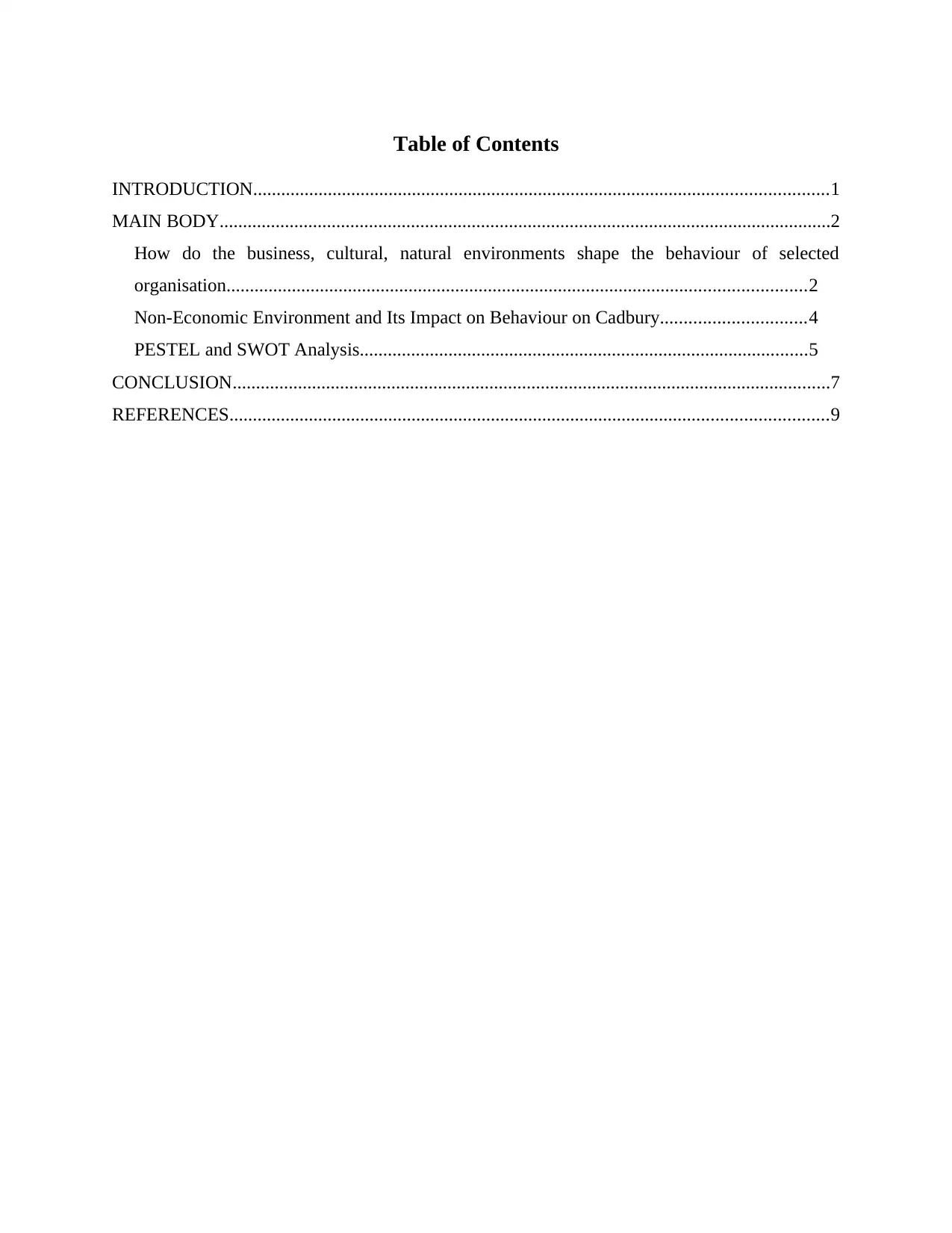
Table of Contents
INTRODUCTION...........................................................................................................................1
MAIN BODY...................................................................................................................................2
How do the business, cultural, natural environments shape the behaviour of selected
organisation............................................................................................................................2
Non-Economic Environment and Its Impact on Behaviour on Cadbury...............................4
PESTEL and SWOT Analysis................................................................................................5
CONCLUSION................................................................................................................................7
REFERENCES................................................................................................................................9
INTRODUCTION...........................................................................................................................1
MAIN BODY...................................................................................................................................2
How do the business, cultural, natural environments shape the behaviour of selected
organisation............................................................................................................................2
Non-Economic Environment and Its Impact on Behaviour on Cadbury...............................4
PESTEL and SWOT Analysis................................................................................................5
CONCLUSION................................................................................................................................7
REFERENCES................................................................................................................................9
INTRODUCTION
A business environment is defined total of all the inner and external aspects like customer
requirement, staff members and supply & demand. These factors impact on the operational
activities of business in direct and indirect manner. Through business environment recognise all
the opportunities, assist in planning and increase overall growth in order to increase profitability
of an organisation (Barbu, 2013). On the other side business culture beliefs and behaviours that
analysis how a staff members and administration is interact and conduct all the business
transactions. Business Culture as well as environment shows great impact on organisational
behaviour. There are identifying two types of business environment like economic environment
an non economic environment. The economic environment consist of economic system, policies
and condition. While, non economic environment involves natural, demographic, legal,
technological, social and political environment. Moreover, the natural environment consist of
ecological and geographical aspects that impact on the organisation behaviour in direct manner.
On the basis of these factors analysis the availability of natural resources, changes in atmosphere
and weather. The culture factors impact on an organisation in extensive manner and determine
that how staff members are effective arranged all the values on priorities basis. It impacts on the
different functional areas like sales, marketing and distribution. On the basis of these factors a
company take right decision to tap into international market. Along with business environment
based on the internal as well as external activities. For this require to analysis those factors that
directly impact on the business activities and prepare policies in regard of them (Cibreiro and
López, 2013).
To better understand the changes of business environment and culture selected
organisation Cadbury, which is a British multinational confectionery organisation wholly
operated by Mondelez international since 2010. It is famous organisation which is getting second
rank in confectionery brand in the world. The company has been dealing into different types of
products such as chocolates, crème egg, roses selection box and many others. The company was
founded in 1824 at Birmingham, Warwickshire, England. This report based on the business,
cultural and natural environments that helps a business to provide shape the behaviour of
Cadbury. Along with identify all the key elements of internal and external environments that
impact on the business activities and interact with each other.
1
A business environment is defined total of all the inner and external aspects like customer
requirement, staff members and supply & demand. These factors impact on the operational
activities of business in direct and indirect manner. Through business environment recognise all
the opportunities, assist in planning and increase overall growth in order to increase profitability
of an organisation (Barbu, 2013). On the other side business culture beliefs and behaviours that
analysis how a staff members and administration is interact and conduct all the business
transactions. Business Culture as well as environment shows great impact on organisational
behaviour. There are identifying two types of business environment like economic environment
an non economic environment. The economic environment consist of economic system, policies
and condition. While, non economic environment involves natural, demographic, legal,
technological, social and political environment. Moreover, the natural environment consist of
ecological and geographical aspects that impact on the organisation behaviour in direct manner.
On the basis of these factors analysis the availability of natural resources, changes in atmosphere
and weather. The culture factors impact on an organisation in extensive manner and determine
that how staff members are effective arranged all the values on priorities basis. It impacts on the
different functional areas like sales, marketing and distribution. On the basis of these factors a
company take right decision to tap into international market. Along with business environment
based on the internal as well as external activities. For this require to analysis those factors that
directly impact on the business activities and prepare policies in regard of them (Cibreiro and
López, 2013).
To better understand the changes of business environment and culture selected
organisation Cadbury, which is a British multinational confectionery organisation wholly
operated by Mondelez international since 2010. It is famous organisation which is getting second
rank in confectionery brand in the world. The company has been dealing into different types of
products such as chocolates, crème egg, roses selection box and many others. The company was
founded in 1824 at Birmingham, Warwickshire, England. This report based on the business,
cultural and natural environments that helps a business to provide shape the behaviour of
Cadbury. Along with identify all the key elements of internal and external environments that
impact on the business activities and interact with each other.
1
⊘ This is a preview!⊘
Do you want full access?
Subscribe today to unlock all pages.

Trusted by 1+ million students worldwide
MAIN BODY
How do the business, cultural, natural environments shape the behaviour of selected organisation
Organisation behaviour is the study of human behaviour in which analysis organizational
setting, the overlap between human behaviour as well as business. It is subset of management
activities which is related with the understanding, estimating and effecting on organisational
setting in direct manner. Cadbury plc is famous global confectionery organisation which an
outstanding portfolio for chocolate, gum and candy brands. The company get 20th position in the
world and also get 50th position in confectionery markets. The business has broadest spread
emerging markets that conduct in any confectionery business (El Kalla, Zec and Jugović, 2017).
Analysis of cadbury's culture
Edgar Schein's model of organizational culture is effective theory which is applied by the
business to analysis of culture that generated in the 80s. As per the Schein's model, organization
culture categorised into three different levels which is basically depended on the different
assumptions, artifacts, values and beliefs. Cadbury is not followed culture in a single day rather
then formed in due courses of time where all the staff members work as per the changes and
select external environment so sort out the problems. In context of Cadbury defined three types
of level of this culture model that follow by the business.
Economic environment of an organisation is the mixture of all the factors which
influences the economy of the country and have impacts upon the industry and organisations
operating in the particular industry. These factors are known as the macro factors which affects
the business and the practices which it undertakes. All these economic factors contains the rules
and regulations of country, the governmental policies, the condition of economy both past and
present and also those elements which are already existing in the systems. These factors affects
the company to work in an appropriate manner, which is best suitable to it and matches with the
changing environment and business situations.
Cadbury is a multinational confectionery company which is the second largest brand in
confectionery industry. The parent company of Cadbury is Mondelez International, which is its
owner since 2010. The company is operating worldwide serving to huge number of customers
belonging to separate geographical areas. This implies that company is part of varied economies
and have influence on its operations and behaviour of Cadbury (Gambetti, Melewar and Martin,
2017).
2
How do the business, cultural, natural environments shape the behaviour of selected organisation
Organisation behaviour is the study of human behaviour in which analysis organizational
setting, the overlap between human behaviour as well as business. It is subset of management
activities which is related with the understanding, estimating and effecting on organisational
setting in direct manner. Cadbury plc is famous global confectionery organisation which an
outstanding portfolio for chocolate, gum and candy brands. The company get 20th position in the
world and also get 50th position in confectionery markets. The business has broadest spread
emerging markets that conduct in any confectionery business (El Kalla, Zec and Jugović, 2017).
Analysis of cadbury's culture
Edgar Schein's model of organizational culture is effective theory which is applied by the
business to analysis of culture that generated in the 80s. As per the Schein's model, organization
culture categorised into three different levels which is basically depended on the different
assumptions, artifacts, values and beliefs. Cadbury is not followed culture in a single day rather
then formed in due courses of time where all the staff members work as per the changes and
select external environment so sort out the problems. In context of Cadbury defined three types
of level of this culture model that follow by the business.
Economic environment of an organisation is the mixture of all the factors which
influences the economy of the country and have impacts upon the industry and organisations
operating in the particular industry. These factors are known as the macro factors which affects
the business and the practices which it undertakes. All these economic factors contains the rules
and regulations of country, the governmental policies, the condition of economy both past and
present and also those elements which are already existing in the systems. These factors affects
the company to work in an appropriate manner, which is best suitable to it and matches with the
changing environment and business situations.
Cadbury is a multinational confectionery company which is the second largest brand in
confectionery industry. The parent company of Cadbury is Mondelez International, which is its
owner since 2010. The company is operating worldwide serving to huge number of customers
belonging to separate geographical areas. This implies that company is part of varied economies
and have influence on its operations and behaviour of Cadbury (Gambetti, Melewar and Martin,
2017).
2
Paraphrase This Document
Need a fresh take? Get an instant paraphrase of this document with our AI Paraphraser
Economic Policies- The economic policy structure of UK is made up of number of rules
and regulations which has direct and indirect impacts on the different industries
flourishing. This implies that confectionery industry is also, affected by it, which
influence the behaviour of Cadbury and it operations. The policy of UK is in favour of
the flourishing businesses as it enhances the government wealth by way of taxes. These
policies which are favourable Cadbury enables it to have a effective business which is
flexible and supportive for both the company and the economy. For instance, the UK
government made polices which are flexible for the domestic businesses which helps
Cadbury to increase its sustainability in marketplace. The polices of UK, ensures and in
favour of digitalisation, this opens new doors for Cadbury and works as a opportunity for
the company to have a effective digital tools to make its production more automatic and
efficient. This enhancing digitalisation and increasing support of government to the
businesses provided ease and comfort along with more digitalised infrastructure which
increases the production capacity and improves the profits of the organisation. Therefore,
all these positive outcomes of the polices of UK government is in favour of Cadbury and
its operational behaviours (Henry and Treanor, 2015). Economic Conditions- This element includes the economic condition of the countries in
which company is dealing and have its headquarters. The cadbury is a multinational
entity operating in several economies. But the company is mainly located in UK which
implies that its behaviour will be most affected by the economy of the UK. The factors
which are considered here is the GDP of the economy, inflation rates, tax policies and
few other elements. Cadbury is based in UK, who's economy is currently suffering from
BREXIT and its shortcomings. Therefore, the economic position is not stable and
supportive at all for the businesses. This factor negatively affects the operations of
Cadbury as the economy is suffering and it implications directly affects the industries
which are operating in it. The taxation policies, business laws and rules by which
economy is running changes. The EU do not support the economy any more which
changes the working style, exchanges rates has gone high which increases the expenses
and cost of business. Also, other economies are affected due to BREXIT which is making
the market go down, no money is present in economy for making any investments. All
3
and regulations which has direct and indirect impacts on the different industries
flourishing. This implies that confectionery industry is also, affected by it, which
influence the behaviour of Cadbury and it operations. The policy of UK is in favour of
the flourishing businesses as it enhances the government wealth by way of taxes. These
policies which are favourable Cadbury enables it to have a effective business which is
flexible and supportive for both the company and the economy. For instance, the UK
government made polices which are flexible for the domestic businesses which helps
Cadbury to increase its sustainability in marketplace. The polices of UK, ensures and in
favour of digitalisation, this opens new doors for Cadbury and works as a opportunity for
the company to have a effective digital tools to make its production more automatic and
efficient. This enhancing digitalisation and increasing support of government to the
businesses provided ease and comfort along with more digitalised infrastructure which
increases the production capacity and improves the profits of the organisation. Therefore,
all these positive outcomes of the polices of UK government is in favour of Cadbury and
its operational behaviours (Henry and Treanor, 2015). Economic Conditions- This element includes the economic condition of the countries in
which company is dealing and have its headquarters. The cadbury is a multinational
entity operating in several economies. But the company is mainly located in UK which
implies that its behaviour will be most affected by the economy of the UK. The factors
which are considered here is the GDP of the economy, inflation rates, tax policies and
few other elements. Cadbury is based in UK, who's economy is currently suffering from
BREXIT and its shortcomings. Therefore, the economic position is not stable and
supportive at all for the businesses. This factor negatively affects the operations of
Cadbury as the economy is suffering and it implications directly affects the industries
which are operating in it. The taxation policies, business laws and rules by which
economy is running changes. The EU do not support the economy any more which
changes the working style, exchanges rates has gone high which increases the expenses
and cost of business. Also, other economies are affected due to BREXIT which is making
the market go down, no money is present in economy for making any investments. All
3
these features are blocking the economy and consecutively the operations of industries
which includes Cadbury (Hsu, Lien and Chen, 2013)..
Economic Systems- The economic systems are talking about the manner in which
business operates and the systems of economy. Every country has their way of working,
their economy works according to their systems and regulation criteria. This states that
the economies in which Cadbury is operating have their unique systems, this will affects
its behaviour. The company needs to make its operations and activities according to the
different economic systems. This factor makes it important for Cadbury to have a flexible
working environment and processes by which it can put steps with similar manner in
varied economies. And even if it needs to adapt with the changes it can be a minute
change and can be worked by it. So basically, Cadbury has to make its systems and
organisational behaviour according to the economic system by making it flexible and
adaptive enough to run smoothly in different economies.
Non-Economic Environment and Its Impact on Behaviour on Cadbury
Non-economic environments are other elements which affects the behaviours, culture and
business of an organisation. The non-economic factors are those which are socially and
environmentally affecting the business. There are few factors which are affecting cadbury are
discussed below with their influence on the behaviour of the organisation and on its operations.
Natural- This non-economic factor represents the impacts of environmental factor which
are different from location to location geographically. Every country has a unique
weather conditions which are the huge feature of it and affects the industry which is
operating in it. The elements of natural factors are the, climate of a particular area, the
weather conditions and other geographical elements. Cadbury works in wide
geographical locations implying that the entity is affected by varied geographical
conditions (Joniaková and Blštáková, 2015). Out of these geographical factors the most
affecting is global warming, it is affecting all the economies and the working style of all
organisations. The company has to make its operations eco friendly or environment
friendly in order to make it sustainable. Also, it adds up to the company's CSR activity
which makes it very essential for Cadbury to operate in an effective manner by keeping
the environment and it needs in mind.
4
which includes Cadbury (Hsu, Lien and Chen, 2013)..
Economic Systems- The economic systems are talking about the manner in which
business operates and the systems of economy. Every country has their way of working,
their economy works according to their systems and regulation criteria. This states that
the economies in which Cadbury is operating have their unique systems, this will affects
its behaviour. The company needs to make its operations and activities according to the
different economic systems. This factor makes it important for Cadbury to have a flexible
working environment and processes by which it can put steps with similar manner in
varied economies. And even if it needs to adapt with the changes it can be a minute
change and can be worked by it. So basically, Cadbury has to make its systems and
organisational behaviour according to the economic system by making it flexible and
adaptive enough to run smoothly in different economies.
Non-Economic Environment and Its Impact on Behaviour on Cadbury
Non-economic environments are other elements which affects the behaviours, culture and
business of an organisation. The non-economic factors are those which are socially and
environmentally affecting the business. There are few factors which are affecting cadbury are
discussed below with their influence on the behaviour of the organisation and on its operations.
Natural- This non-economic factor represents the impacts of environmental factor which
are different from location to location geographically. Every country has a unique
weather conditions which are the huge feature of it and affects the industry which is
operating in it. The elements of natural factors are the, climate of a particular area, the
weather conditions and other geographical elements. Cadbury works in wide
geographical locations implying that the entity is affected by varied geographical
conditions (Joniaková and Blštáková, 2015). Out of these geographical factors the most
affecting is global warming, it is affecting all the economies and the working style of all
organisations. The company has to make its operations eco friendly or environment
friendly in order to make it sustainable. Also, it adds up to the company's CSR activity
which makes it very essential for Cadbury to operate in an effective manner by keeping
the environment and it needs in mind.
4
⊘ This is a preview!⊘
Do you want full access?
Subscribe today to unlock all pages.
Trusted by 1+ million students worldwide
Demographical: According to this factor mainly focus on the lifestyle, income, age,
social factors that impact on the organisational performance. So it is required to business
must focus on all the trends that follow by the people and according to that apply all the
modification in business. The living of standard in UK is high so people demand for high
level things and focus on unemployment levels, closure of MNCs within the country. In
context of Cadbury require to follow trends otherwise it shows positive as well as
negative impact on the environment of business. There are focusing on positive aspects
that possibility create more confectionery products foe every age type of people who like
more. Therefore, due to changes in demographic activities shows impact at market place
and struggle for the present market conditions (Kabalina, Zelenova and Reshetnikova,
2019).
Cultural: There are consist of social values, beliefs, relationship building and many
others. Such as in UK saw various types of varieties that related with the cultural
orientation and show different values. Therefore it shows positive effect on Cadbury,
after evaluation of values and standard of living people. It would enables to enterprise to
assure about the products that based on the activities in which follow all the norms and
values in effective manner. Therefore, in present time market fluctuated due to different
activities that carry out various opportunity for people in regard of Cadbury so take
advantage of this and take effective decision in regard of business.
PESTEL and SWOT Analysis
PESTEL Analysis: It is a tool which is utilised to recognise all the external things that
impact on the organisational activities. This tool helps to Cadbury to analysis of market for a
trade or a managerial unit in order to analysis of develop good performance of business. There
are defined all the aspects in regard of business such as:
Political: In the context of UK, Cadbury is international company which is conducted
their business into different countries with a strong presence in rising markets. Due to changes in
political condition impact on the business performance in direct manner (Weng and Lin, 2014).
The imposition of tax is essential political factor that leads to increase taxes to higher chocolate
prices and lower sales (Kolk, 2016).
Economical: There are consisting those factors which is related to economic facilities
like discount & exchange rate, interest & inflation rate and many others. The sales of Cadbury is
5
social factors that impact on the organisational performance. So it is required to business
must focus on all the trends that follow by the people and according to that apply all the
modification in business. The living of standard in UK is high so people demand for high
level things and focus on unemployment levels, closure of MNCs within the country. In
context of Cadbury require to follow trends otherwise it shows positive as well as
negative impact on the environment of business. There are focusing on positive aspects
that possibility create more confectionery products foe every age type of people who like
more. Therefore, due to changes in demographic activities shows impact at market place
and struggle for the present market conditions (Kabalina, Zelenova and Reshetnikova,
2019).
Cultural: There are consist of social values, beliefs, relationship building and many
others. Such as in UK saw various types of varieties that related with the cultural
orientation and show different values. Therefore it shows positive effect on Cadbury,
after evaluation of values and standard of living people. It would enables to enterprise to
assure about the products that based on the activities in which follow all the norms and
values in effective manner. Therefore, in present time market fluctuated due to different
activities that carry out various opportunity for people in regard of Cadbury so take
advantage of this and take effective decision in regard of business.
PESTEL and SWOT Analysis
PESTEL Analysis: It is a tool which is utilised to recognise all the external things that
impact on the organisational activities. This tool helps to Cadbury to analysis of market for a
trade or a managerial unit in order to analysis of develop good performance of business. There
are defined all the aspects in regard of business such as:
Political: In the context of UK, Cadbury is international company which is conducted
their business into different countries with a strong presence in rising markets. Due to changes in
political condition impact on the business performance in direct manner (Weng and Lin, 2014).
The imposition of tax is essential political factor that leads to increase taxes to higher chocolate
prices and lower sales (Kolk, 2016).
Economical: There are consisting those factors which is related to economic facilities
like discount & exchange rate, interest & inflation rate and many others. The sales of Cadbury is
5
Paraphrase This Document
Need a fresh take? Get an instant paraphrase of this document with our AI Paraphraser
quite stable so it impact on the business in direct manner. The company able to increase their
annual profit about 30% which is predomination of the sales of Dairy milk. Along with recession
an play essential role and decrease labour charges.
Social: This factor related with the values, beliefs and social activities of people. Cadbury
was born as a social factor which is running on basis of Quaker family. The products are sold by
the company is accept at social level and like by people in broad manner (Parker, 2014).
Technological: In present time technology has been changes any time that impact on the
business activities. In present time mostly people like to introduce new machine to increase
production activities. Along with use blend coffee and cocos gains in order to use testing system
and heat resistant chocolate.
Environmental: The environmental impact on Cadbury industry consist of variety of
scheme as well as programs which is supporting to improving the efficiency of environment
activities. This company is mainly focused on the green house gases and water usage.
Legal: To operate business effectively require to follow all the framework at local,
regional and national level. Along with Cadbury follow all the legal standards that impact on the
performance in lawful manner.
SWOT Analysis: It is a framework tool which is applied by the business to analysis all
internal activities that impact on business performance in direct manner. There are conducting
SWOT analysis of Cadbury such as:
Strength: There are defined strength of Cadbury business that helps to become leading
confectionery company such as:
Strong brand: It is one of the leading confectionery company which is dealing into
different types of products. The value of strong brand can not be understand in particular
market where mainly focus on the quality. There are identified all the features of
particular product line in order to set up effective brand (Parker, 2016).
Global Presence: Cadbury is strong and well established operations are not set any limit
in United kingdom. The global presence not only drive but also drives extra revenues that
acts as insurance policy.
Weakness
6
annual profit about 30% which is predomination of the sales of Dairy milk. Along with recession
an play essential role and decrease labour charges.
Social: This factor related with the values, beliefs and social activities of people. Cadbury
was born as a social factor which is running on basis of Quaker family. The products are sold by
the company is accept at social level and like by people in broad manner (Parker, 2014).
Technological: In present time technology has been changes any time that impact on the
business activities. In present time mostly people like to introduce new machine to increase
production activities. Along with use blend coffee and cocos gains in order to use testing system
and heat resistant chocolate.
Environmental: The environmental impact on Cadbury industry consist of variety of
scheme as well as programs which is supporting to improving the efficiency of environment
activities. This company is mainly focused on the green house gases and water usage.
Legal: To operate business effectively require to follow all the framework at local,
regional and national level. Along with Cadbury follow all the legal standards that impact on the
performance in lawful manner.
SWOT Analysis: It is a framework tool which is applied by the business to analysis all
internal activities that impact on business performance in direct manner. There are conducting
SWOT analysis of Cadbury such as:
Strength: There are defined strength of Cadbury business that helps to become leading
confectionery company such as:
Strong brand: It is one of the leading confectionery company which is dealing into
different types of products. The value of strong brand can not be understand in particular
market where mainly focus on the quality. There are identified all the features of
particular product line in order to set up effective brand (Parker, 2016).
Global Presence: Cadbury is strong and well established operations are not set any limit
in United kingdom. The global presence not only drive but also drives extra revenues that
acts as insurance policy.
Weakness
6
Limited Product range: Cadbury has limited product range so their brand offers a variety
of confectionery products. As a result, Cadbury is highly uncovered to the confectionery
products in times both good and bad.
Product Recalls: The another weakness of Cadbury that recall a portion of its
confectionery products on several events. The product recalls of this nature can easily
tarnish a brand's image (Roberts and Grover, 2012).
Opportunity
Emerging markets: It is big opportunity for Cadbury in emerging markets. Due to have
effective culture model deal into different countries easily because they analysis the
customer interest & preferences. After the analysis conduct marketing strategies that
influence them to purchase products.
Product range expansion: With proper research it is examining that Cadbury's potential
weakness that have limited product range. It is good opportunity of the business to spread
out its product range at broad level which supports to diversify its current market.
Threat
Sugar tax: Different number of countries take sugar tax an their sugary products that
designed by the curb consumption. In European market require to pay long-standing tax
that motivates each person to purchase confectionery abroad or in duty free zones.
Health consciousness: In present time people become health consciousness so according
to that purchase these products. Due to growth of science people learn that how to deal
with the healthy and unhealthy products (Thamhain, 2013).
CONCLUSION
As per the above report it has been analysed that organisation behaviour depend on the
different business activities. It has been concluded from the above report that business
environment is more complex in nature which affects the existing and decisions of organisations
operated at global level either in negative or positive manner. Thus, it is important for
management to analyse fluctuated factors and make decisions accordingly. Economic factors are
most important to evaluate as it provides an insight of all external factors in the context of
economy markets that makes direct as well as indirect impact on the behaviour of firm.
Increasing economy makes direct positive impact on buying behaviour of customers which
further helps organisation in increasing sales and revenue. Apart from this, the management also
7
of confectionery products. As a result, Cadbury is highly uncovered to the confectionery
products in times both good and bad.
Product Recalls: The another weakness of Cadbury that recall a portion of its
confectionery products on several events. The product recalls of this nature can easily
tarnish a brand's image (Roberts and Grover, 2012).
Opportunity
Emerging markets: It is big opportunity for Cadbury in emerging markets. Due to have
effective culture model deal into different countries easily because they analysis the
customer interest & preferences. After the analysis conduct marketing strategies that
influence them to purchase products.
Product range expansion: With proper research it is examining that Cadbury's potential
weakness that have limited product range. It is good opportunity of the business to spread
out its product range at broad level which supports to diversify its current market.
Threat
Sugar tax: Different number of countries take sugar tax an their sugary products that
designed by the curb consumption. In European market require to pay long-standing tax
that motivates each person to purchase confectionery abroad or in duty free zones.
Health consciousness: In present time people become health consciousness so according
to that purchase these products. Due to growth of science people learn that how to deal
with the healthy and unhealthy products (Thamhain, 2013).
CONCLUSION
As per the above report it has been analysed that organisation behaviour depend on the
different business activities. It has been concluded from the above report that business
environment is more complex in nature which affects the existing and decisions of organisations
operated at global level either in negative or positive manner. Thus, it is important for
management to analyse fluctuated factors and make decisions accordingly. Economic factors are
most important to evaluate as it provides an insight of all external factors in the context of
economy markets that makes direct as well as indirect impact on the behaviour of firm.
Increasing economy makes direct positive impact on buying behaviour of customers which
further helps organisation in increasing sales and revenue. Apart from this, the management also
7
⊘ This is a preview!⊘
Do you want full access?
Subscribe today to unlock all pages.
Trusted by 1+ million students worldwide
required to put maximum efforts in analyse internal factors through using SWOT Analysis. This
will help them in identifying the shortcomings faced by company internally which further drives
managers to update their existing policies in the favourable of an organisation. Along with this,
PESTLE Analysis also required to conduct in order to analyse external factors which can harm
the business organisation at high level. Lastly, it is imperative that these the internal and external
elements are interrelated to recommend an approach forward to the firm so that the strengths and
opportunities could be leveraged and internal weaknesses and threats of the company could be
reduced to gain competitive advantage, consistent growth and sustainability within the markets
in which the firm operates. There are identified all the economic and non economic factors that
impact on the business in direct and indirect manner. There are defined both factors in broad
manner and understanding that it impacts in great manner on the business activities and require
to aware for that.
8
will help them in identifying the shortcomings faced by company internally which further drives
managers to update their existing policies in the favourable of an organisation. Along with this,
PESTLE Analysis also required to conduct in order to analyse external factors which can harm
the business organisation at high level. Lastly, it is imperative that these the internal and external
elements are interrelated to recommend an approach forward to the firm so that the strengths and
opportunities could be leveraged and internal weaknesses and threats of the company could be
reduced to gain competitive advantage, consistent growth and sustainability within the markets
in which the firm operates. There are identified all the economic and non economic factors that
impact on the business in direct and indirect manner. There are defined both factors in broad
manner and understanding that it impacts in great manner on the business activities and require
to aware for that.
8
Paraphrase This Document
Need a fresh take? Get an instant paraphrase of this document with our AI Paraphraser
REFERENCES
Books and Journal
Barbu, A., 2013. Eight contemporary trends in the market research industry. Management &
Marketing. 8(3). p.429.
Cibreiro, E. and López, F. eds., 2013. Global Issues in Contemporary Hispanic Women's
Writing: Shaping Gender, the Environment, and Politics (Vol. 7). Routledge.
El Kalla, M., Zec, D. and Jugović, A., 2017. Container ports competition in light of
contemporary liner shipping market dynamics. Pomorstvo. 1(2). pp.128-136.
Gambetti, R.C., Melewar, T. C. and Martin, K. D., 2017. Guest Editors’ Introduction: Ethical
Management of Intangible Assets in Contemporary Organizations. Business Ethics
Quarterly. 27(3). pp.381-392.
Henry, C. and Treanor, L., 2015. The veterinary business landscape: Contemporary issues and
emerging trends.
Hsu, C. W., Lien, Y. C. and Chen, H., 2013. International ambidexterity and firm performance in
small emerging economies. Journal of World Business. 48(1). pp.58-67.
Joniaková, Z. and Blštáková, J., 2015. Age management as contemporary challenge to human
resources management in Slovak companies. Procedia Economics and Finance. 34.
pp.202-209.
Kabalina, V., Zelenova, O. and Reshetnikova, K., 2019. Contemporary Human Resource
Management Practices in Russia: Flexibility under Uncertainty. International Studies of
Management & Organization. 49(4). pp.422-440.
Kolk, A., 2016. The social responsibility of international business: From ethics and the
environment to CSR and sustainable development. Journal of World Business. 51(1).
pp.23-34.
Parker, L. D., 2014. Corporate social accountability through action: Contemporary insights from
British industrial pioneers. Accounting, Organizations and Society. 39(8). pp.632-659.
Parker, L. D., 2016. The global Fayol: Contemporary management and accounting
traces. Entreprises et histoire, (2), pp.51-63.
Roberts, N. and Grover, V., 2012. Investigating firm's customer agility and firm performance:
The importance of aligning sense and respond capabilities. Journal of Business
Research. 65(5). pp.579-585.
Thamhain, H., 2013. Managing risks in complex projects. Project management journal. 44(2).
pp.20-35.
Weng, W. H. and Lin, W. T., 2014. Development trends and strategy planning in big data
industry. Contemporary Management Research. 10(3).
9
Books and Journal
Barbu, A., 2013. Eight contemporary trends in the market research industry. Management &
Marketing. 8(3). p.429.
Cibreiro, E. and López, F. eds., 2013. Global Issues in Contemporary Hispanic Women's
Writing: Shaping Gender, the Environment, and Politics (Vol. 7). Routledge.
El Kalla, M., Zec, D. and Jugović, A., 2017. Container ports competition in light of
contemporary liner shipping market dynamics. Pomorstvo. 1(2). pp.128-136.
Gambetti, R.C., Melewar, T. C. and Martin, K. D., 2017. Guest Editors’ Introduction: Ethical
Management of Intangible Assets in Contemporary Organizations. Business Ethics
Quarterly. 27(3). pp.381-392.
Henry, C. and Treanor, L., 2015. The veterinary business landscape: Contemporary issues and
emerging trends.
Hsu, C. W., Lien, Y. C. and Chen, H., 2013. International ambidexterity and firm performance in
small emerging economies. Journal of World Business. 48(1). pp.58-67.
Joniaková, Z. and Blštáková, J., 2015. Age management as contemporary challenge to human
resources management in Slovak companies. Procedia Economics and Finance. 34.
pp.202-209.
Kabalina, V., Zelenova, O. and Reshetnikova, K., 2019. Contemporary Human Resource
Management Practices in Russia: Flexibility under Uncertainty. International Studies of
Management & Organization. 49(4). pp.422-440.
Kolk, A., 2016. The social responsibility of international business: From ethics and the
environment to CSR and sustainable development. Journal of World Business. 51(1).
pp.23-34.
Parker, L. D., 2014. Corporate social accountability through action: Contemporary insights from
British industrial pioneers. Accounting, Organizations and Society. 39(8). pp.632-659.
Parker, L. D., 2016. The global Fayol: Contemporary management and accounting
traces. Entreprises et histoire, (2), pp.51-63.
Roberts, N. and Grover, V., 2012. Investigating firm's customer agility and firm performance:
The importance of aligning sense and respond capabilities. Journal of Business
Research. 65(5). pp.579-585.
Thamhain, H., 2013. Managing risks in complex projects. Project management journal. 44(2).
pp.20-35.
Weng, W. H. and Lin, W. T., 2014. Development trends and strategy planning in big data
industry. Contemporary Management Research. 10(3).
9

1 out of 11


Related Documents


Your All-in-One AI-Powered Toolkit for Academic Success.
+13062052269
info@desklib.com
Available 24*7 on WhatsApp / Email
![[object Object]](/_next/static/media/star-bottom.7253800d.svg)
Unlock your academic potential
Copyright © 2020–2026 A2Z Services. All Rights Reserved. Developed and managed by ZUCOL.