University Calculus MATH 22981 Assignment 1: Limits and Viscosity

Verified

Added on  2022/08/21

|10
|540
|11
Homework Assignment
AI Summary
This document presents a solution to a Differential Calculus assignment (MATH 22981) focusing on the kinetic theory of gases and the analysis of limits. The assignment begins with a problem that requires students to determine the values of constants using linear regression based on experimental data related to gaseous viscosity and temperature. The solution includes plotting the function and deriving the values of the constants. The second part of the assignment involves evaluating limits, both at infinity and at finite points, providing detailed elaborations and graphical support for each answer. The solution demonstrates the application of limit theorems and algebraic manipulations to determine the behavior of functions. The document also includes references to relevant calculus textbooks. This comprehensive solution aims to assist students in understanding and solving complex calculus problems.
Document Page
Differential Calculus MATH 22981
Firstname Lastname
Name of Institution
tabler-icon-diamond-filled.svg

Paraphrase This Document

Need a fresh take? Get an instant paraphrase of this document with our AI Paraphraser
Document Page
Differential Calculus MATH 22981 Assignment 1 Winter 2020
1. According to the kinetic theory of gases the temperature-variation of gaseous
viscosity is given by:
μ=a Tn
Where μ and T are viscosity and absolute temperature, respectively. Also, a snd n are
constants. Base on the Boltzmann equation and Chapman–Enskog theory, n=0.5for an ideal
gas.
Using linear regression, find the values of a and n from the following experimental data and
evaluate this theory. [10 marks]
T 210 250 280 310 340 370 390 420
μ 0.0151 0.016 0.0172 0.018 0.0185 0.019 0.0195 0.0212
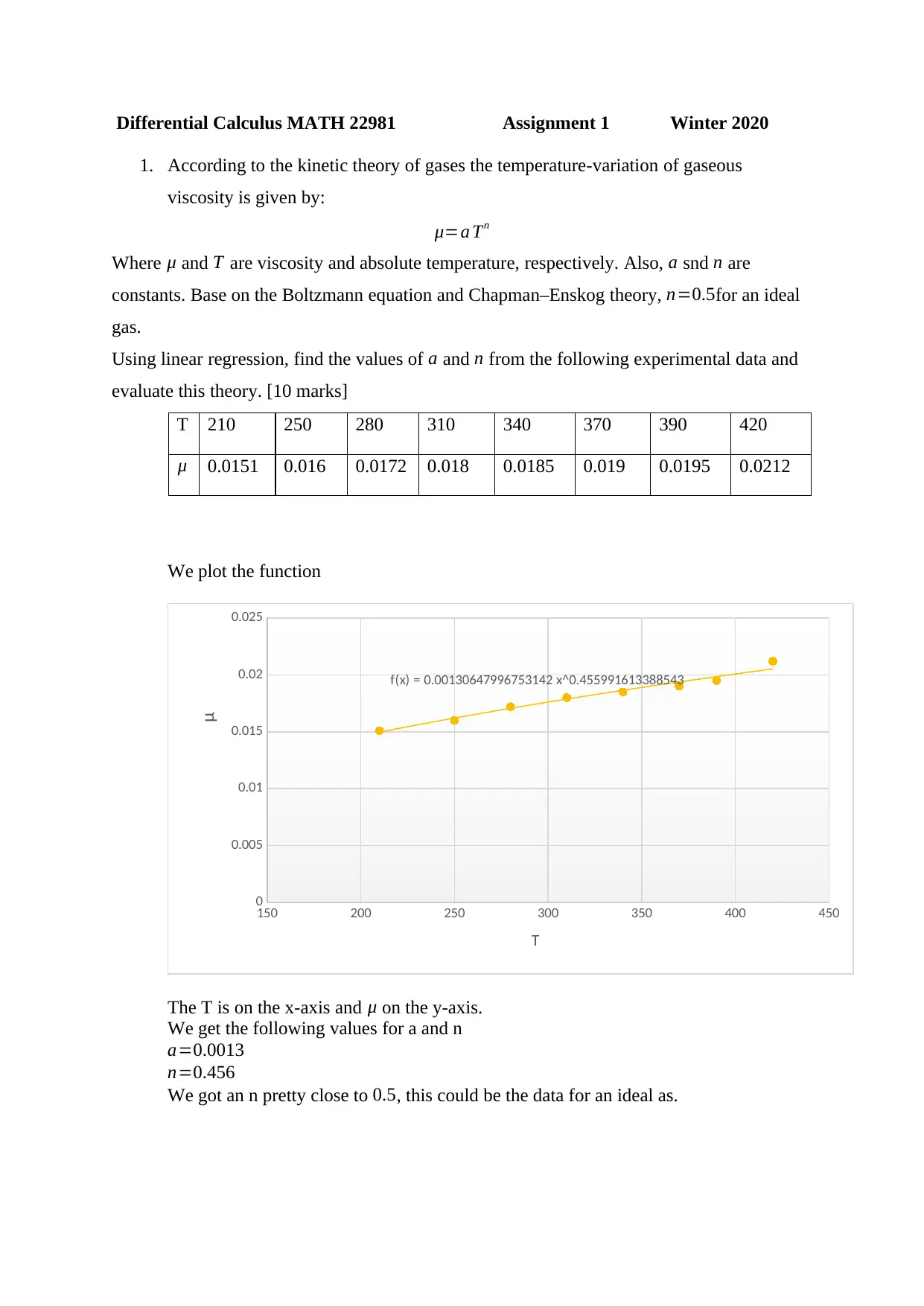
We plot the function
150 200 250 300 350 400 450
0
0.005
0.01
0.015
0.02
0.025
f(x) = 0.00130647996753142 x^0.455991613388543
T
μ
The T is on the x-axis and μ on the y-axis.
We get the following values for a and n
a=0.0013
n=0.456
We got an n pretty close to 0.5, this could be the data for an ideal as.
Document Page
2. The following limits deal with the behavior of a function at infinity. Evaluate the
following limits, providing with the necessary elaboration on your answers. Support
your answers using graphs. (You may use software.) [3×2 marks]
a) lim
x
x33 x2+5
2 x2 +50000
We divide both the numerator and denominator by x2, and we get
lim
x
x3+ 5
x2
2+ 50000
x2
If we take the limit as x tends to infinity we are left with
lim
x
x3+ 5
x2
2+ 50000
x2
= x3
2
Notice that this is a line with a positive slope, as x increases so will the line.
Therefore,
lim
x
x33 x2+5
2 x2 +50000 ¿
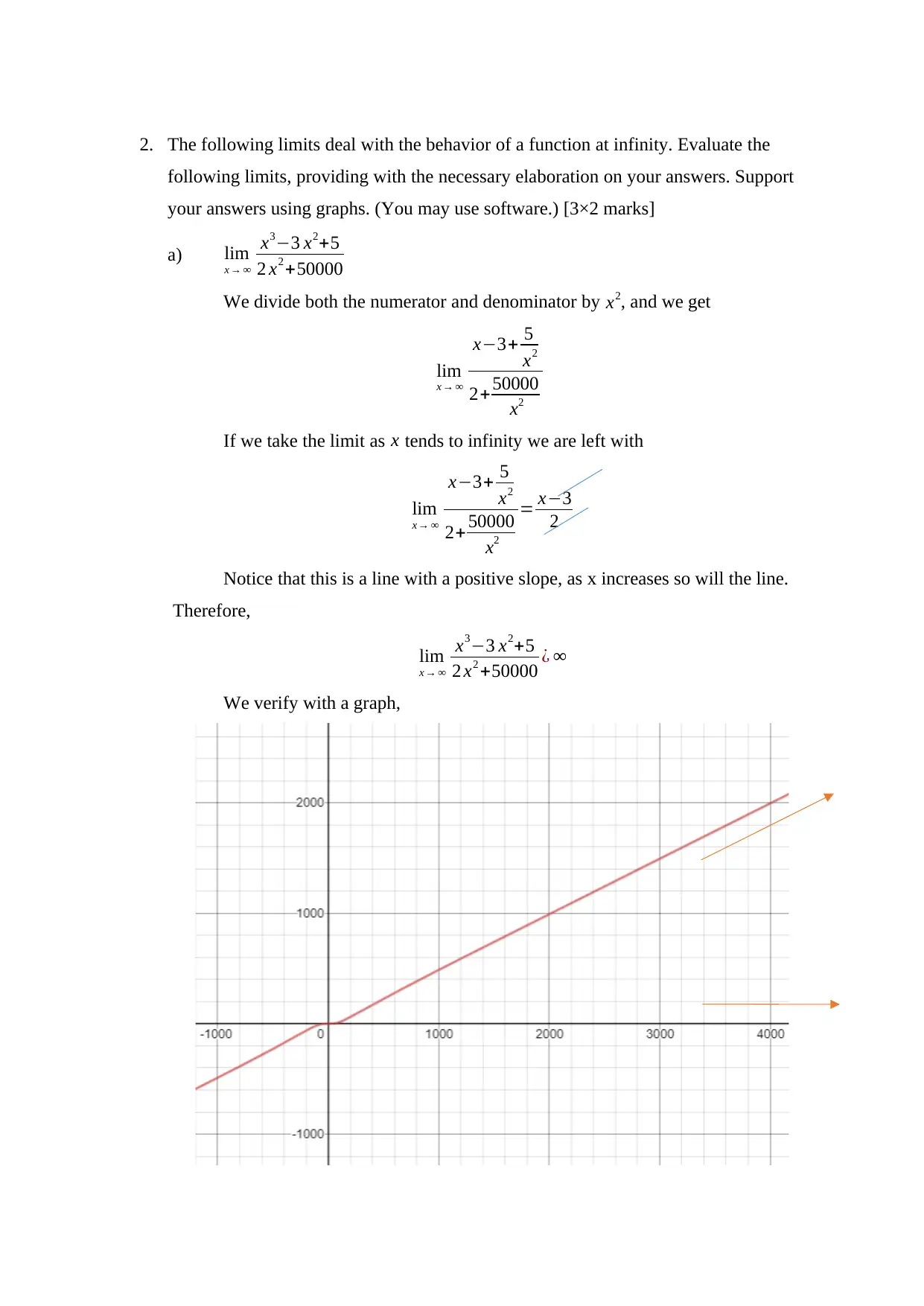
We verify with a graph,
Document Page
In graph we can see that the function does indeed tend to as x increases
b) lim
x
0.0001 x 4+ 3 x3 +10
10 x3+4 x +1
We divide both the numerator and denominator by x3, and we get
lim
x
0.0001 x +3+ 10
x3
10+ 4
x2 + 1
x3
We take the limit as x tends to infinity and we are left with
lim
x
0.0001 x +3+ 10
x3
10+ 4
x2 + 1
x3
=0.0001 x +3
10
Which we can simplify to
0.00001 x+ 0.3
This is a line with a negative slope, therefore, as x increases, the function tends to
although it does so slowly
lim
x
0.0001 x 4+ 3 x3 +10
10 x3+ 4 x +1 =
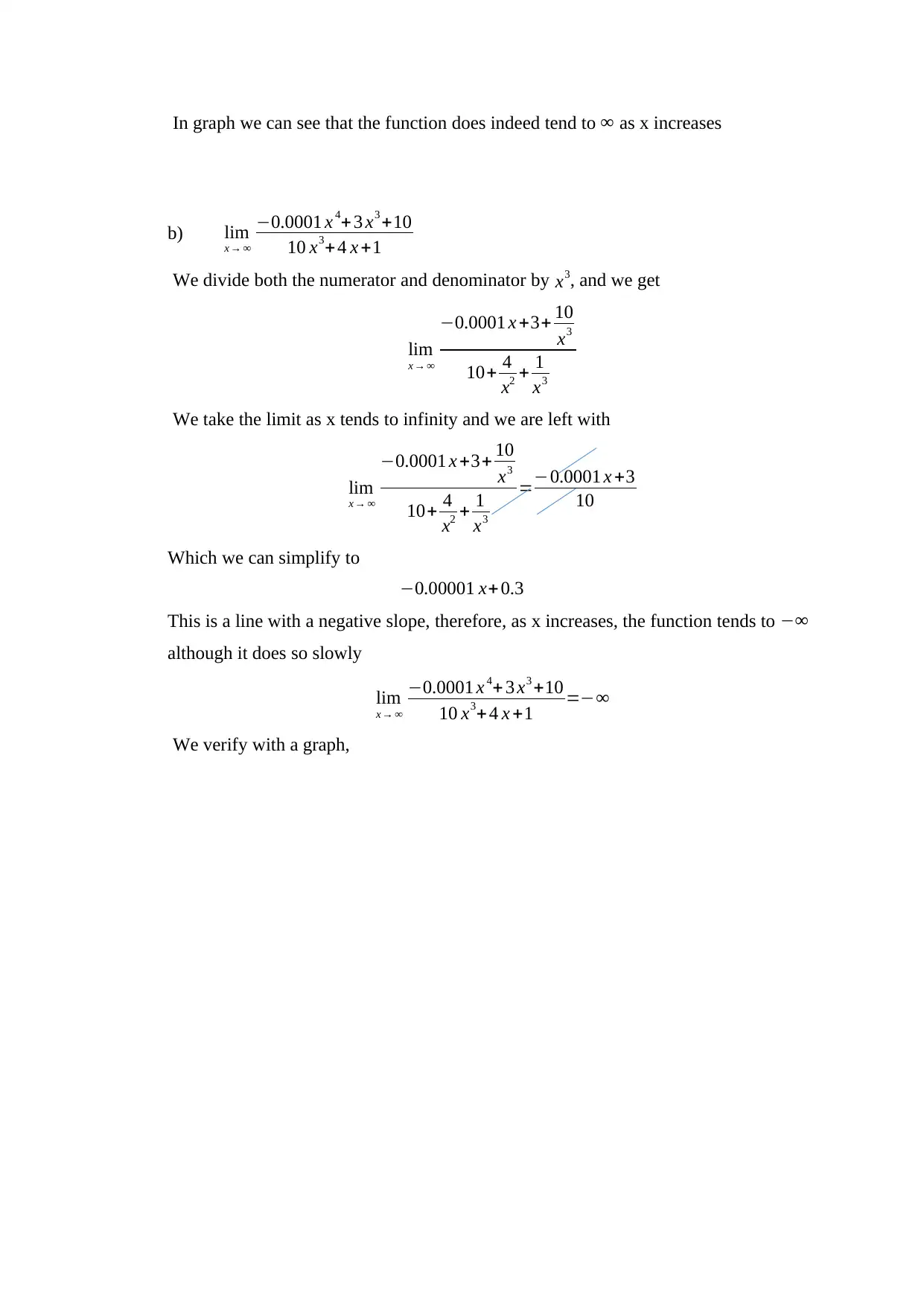
We verify with a graph,
tabler-icon-diamond-filled.svg

Paraphrase This Document

Need a fresh take? Get an instant paraphrase of this document with our AI Paraphraser
Document Page
In graph we can see that the function does indeed tend to - as x increases
c) lim
x
x
x+1
We divide both the numerator and denominator by x, we get
lim
x
1
x1/ 2
1+ 1
x
We take the limit as x tends to infinity and get
lim
x
1
x1/ 2
1+ 1
x
= 0
1 =0
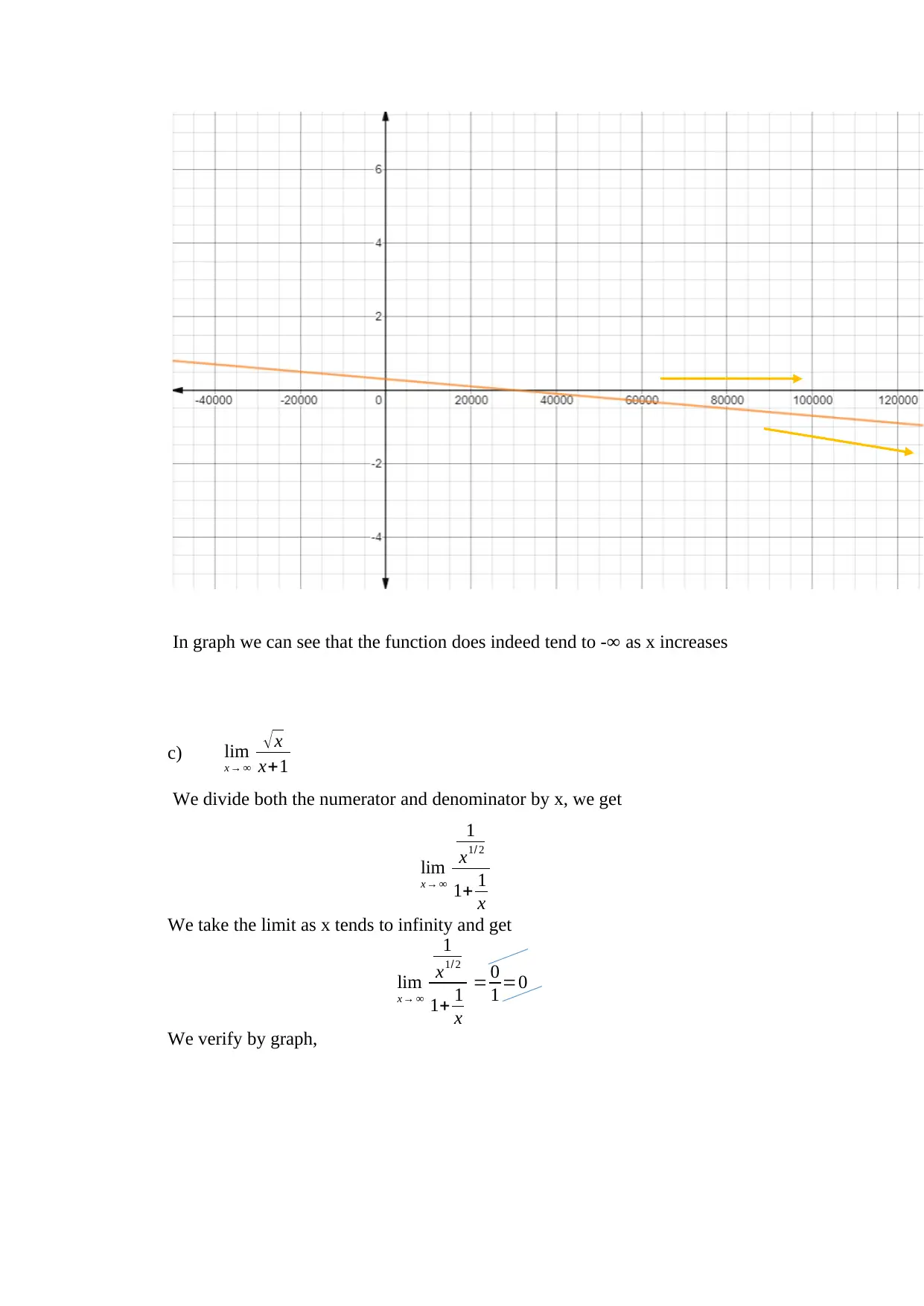
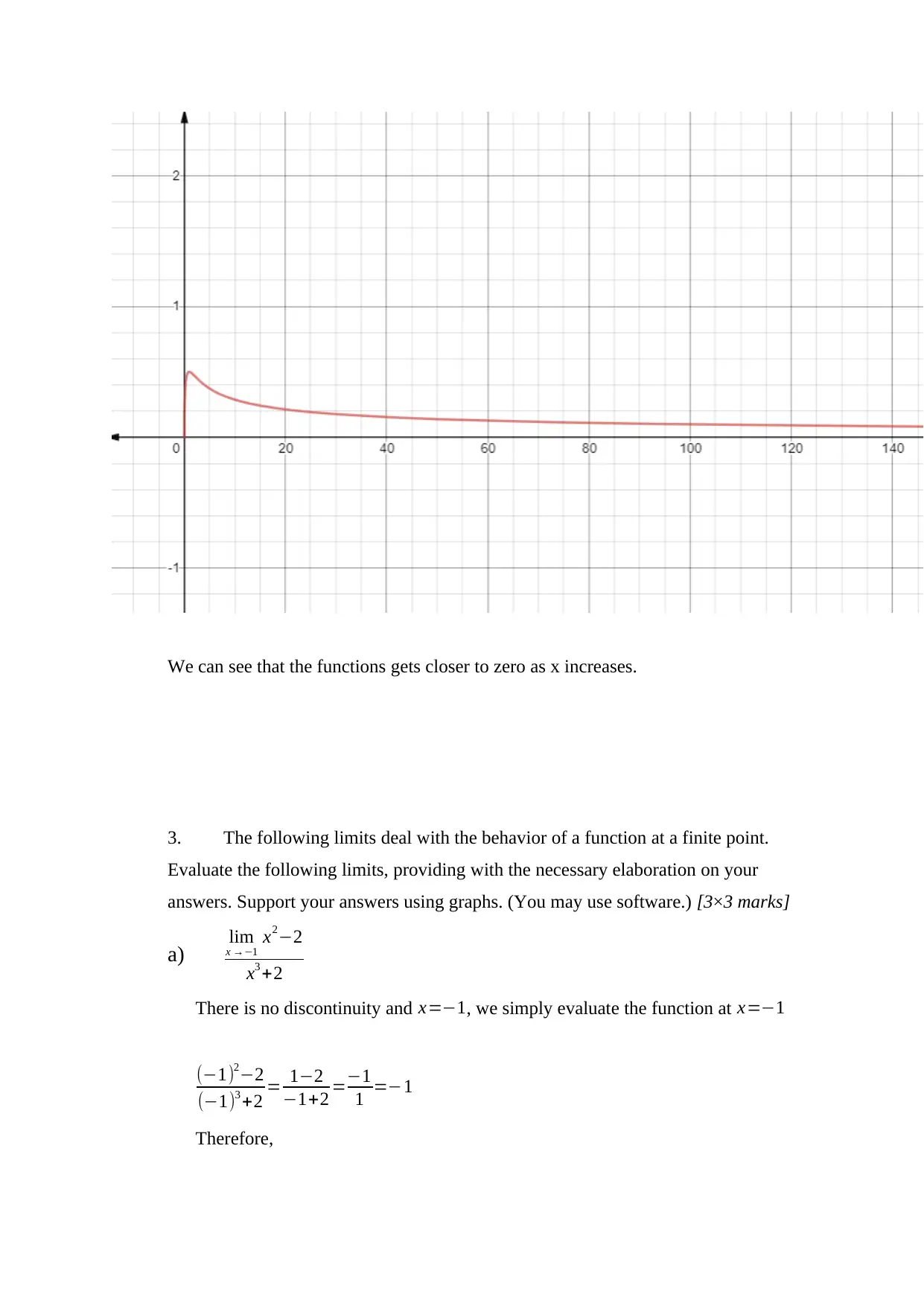
We verify by graph,
Document Page
We can see that the functions gets closer to zero as x increases.
3. The following limits deal with the behavior of a function at a finite point.
Evaluate the following limits, providing with the necessary elaboration on your
answers. Support your answers using graphs. (You may use software.) [3×3 marks]
a) lim
x 1
x22
x3 +2
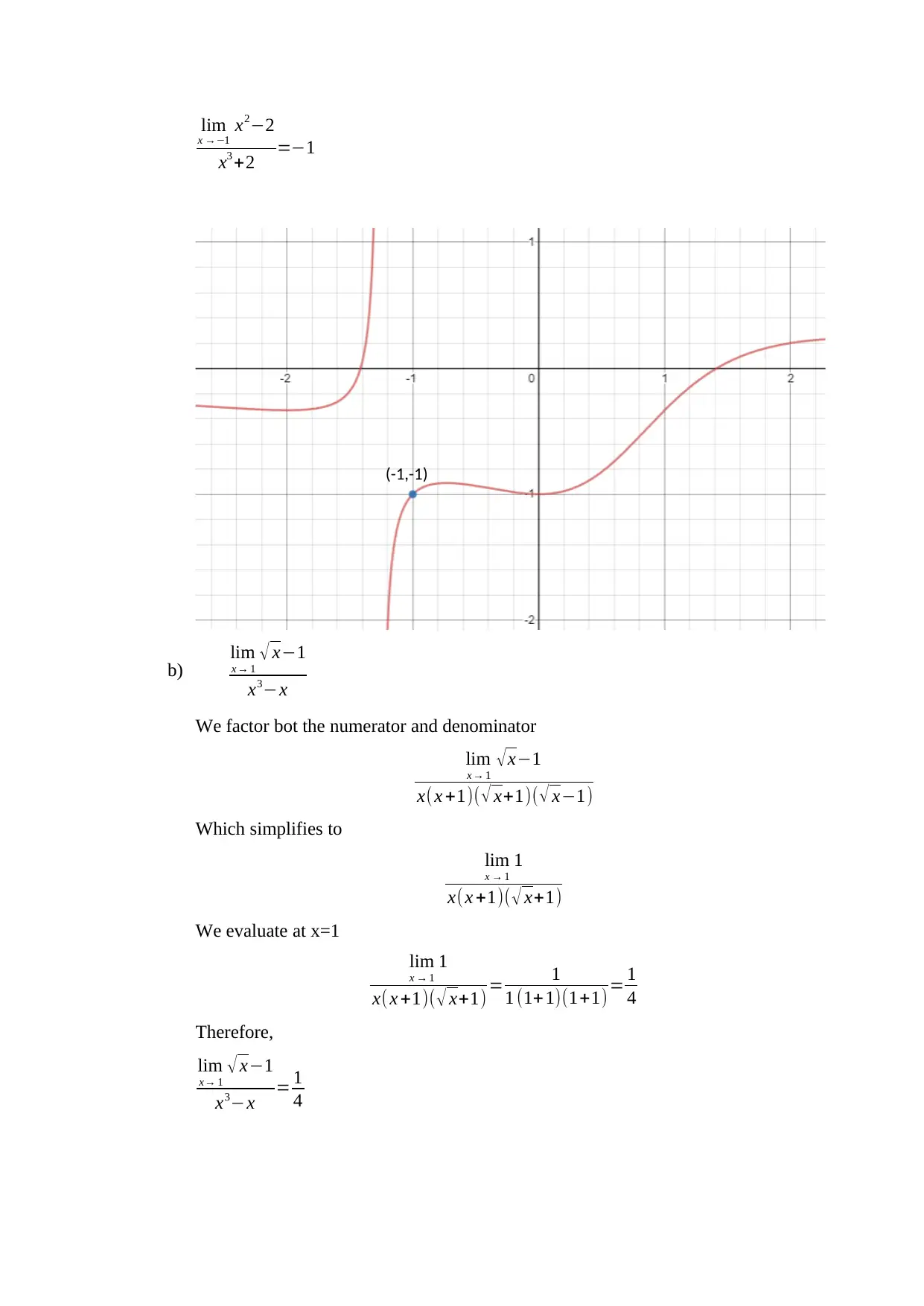
There is no discontinuity and x=1, we simply evaluate the function at x=1
(1)22
(1)3 +2 = 12
1+2 =1
1 =1
Therefore,
Document Page
lim
x 1
x22
x3 +2 =1
b) lim
x 1
x1
x3x
We factor bot the numerator and denominator
lim
x 1
x1
x(x +1)( x+1)( x1)
Which simplifies to
lim
x 1
1
x(x +1)( x+1)
We evaluate at x=1
lim
x 1
1
x(x +1)( x+1) = 1
1 (1+1)(1+1) = 1
4
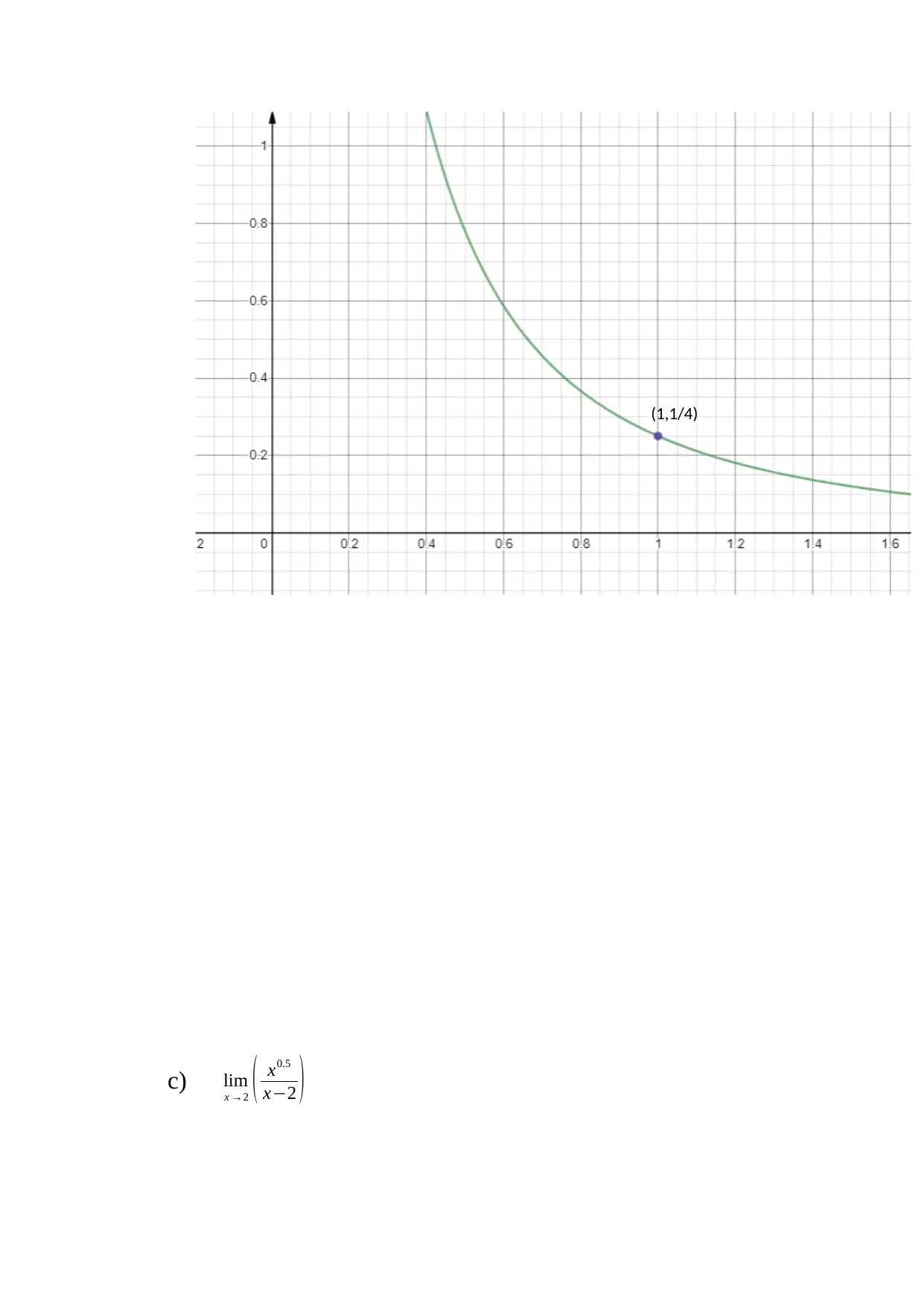
Therefore,
lim
x 1
x1
x3x = 1
4
(-1,-1)
tabler-icon-diamond-filled.svg

Paraphrase This Document

Need a fresh take? Get an instant paraphrase of this document with our AI Paraphraser
Document Page
c) lim
x 2 ( x0.5
x2 )
(1,1/4)
Document Page
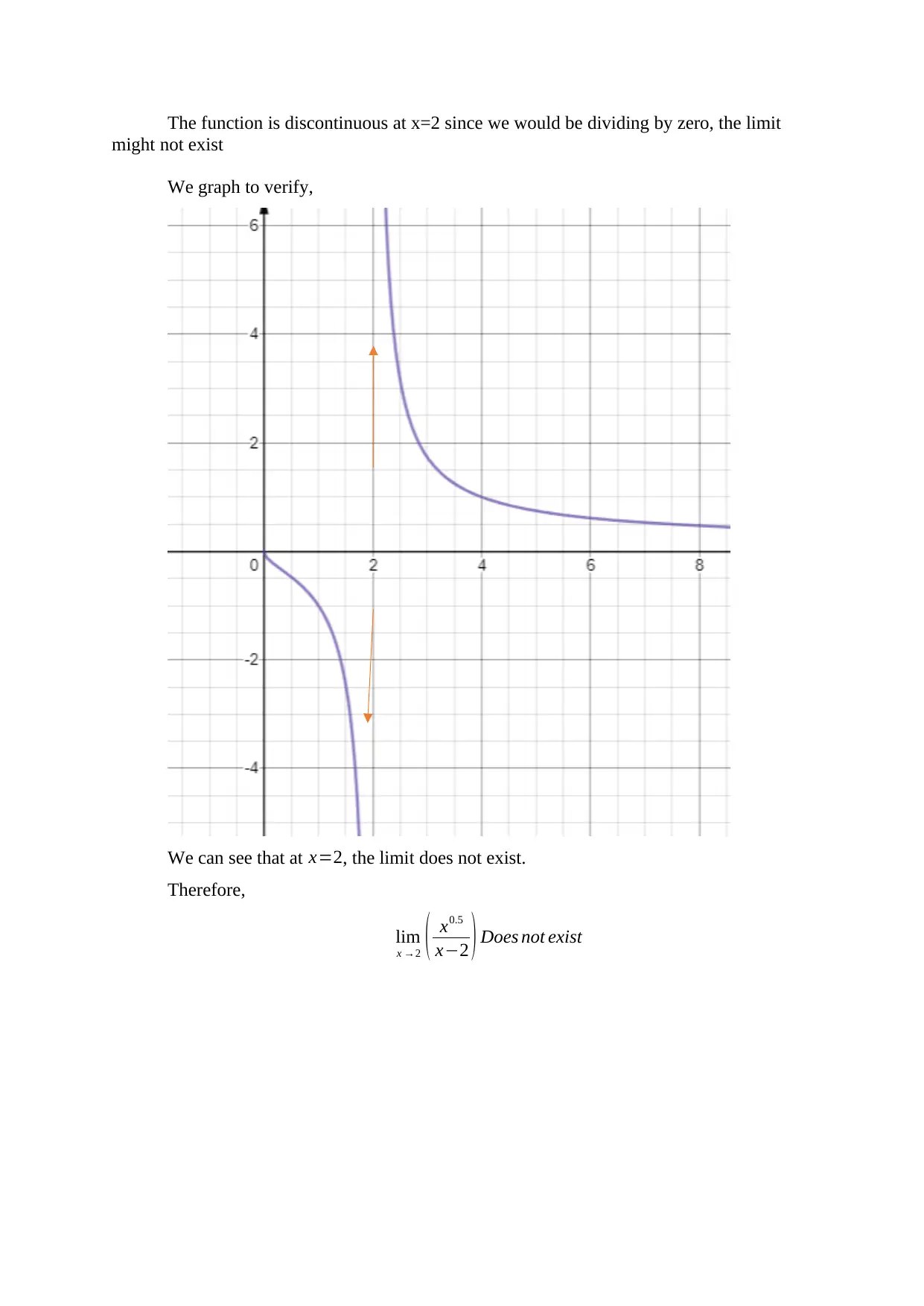
The function is discontinuous at x=2 since we would be dividing by zero, the limit
might not exist
We graph to verify,
We can see that at x=2, the limit does not exist.
Therefore,
lim
x 2 ( x0.5
x2 ) Does not exist
Document Page
References
Field MJ. Differential calculus and its applications. Courier Corporation; 2013 Apr 10.
Knopp K. Theory of functions, Parts I and II. Courier Corporation; 2013 Jul 24.
chevron_up_icon
1 out of 10
circle_padding
hide_on_mobile
zoom_out_icon
[object Object]