Analytic Geometry and Calculus I Assignment, Spring 2020

Verified

Added on  2022/08/17

|9
|1554
|23
Homework Assignment
AI Summary
This document presents a comprehensive solution to an Analytic Geometry and Calculus I assignment. It begins with the definition of a derivative and its application in proving a derivative rule. The solution then proceeds to determine the equation of a tangent line. The assignment covers various derivative rules, including product, quotient, and chain rules, and applies them to different functions. It also addresses finding critical points, intervals of increasing/decreasing behavior, concavity, and inflection points of a function. Furthermore, the solution explores velocity and displacement problems, function continuity and differentiability, and the Intermediate Value Theorem, including Newton's method for finding roots. The assignment concludes with some miscellaneous questions.
Document Page
Running head: ANALYTIC GEOMETRY AND CALCULUS I
ANALYTIC GEOMETRY AND CALCULUS I
Name of the Student
Name of the University
Author Note
tabler-icon-diamond-filled.svg

Paraphrase This Document

Need a fresh take? Get an instant paraphrase of this document with our AI Paraphraser
Document Page
1ANALYTIC GEOMETRY AND CALCULUS I
Question 1:
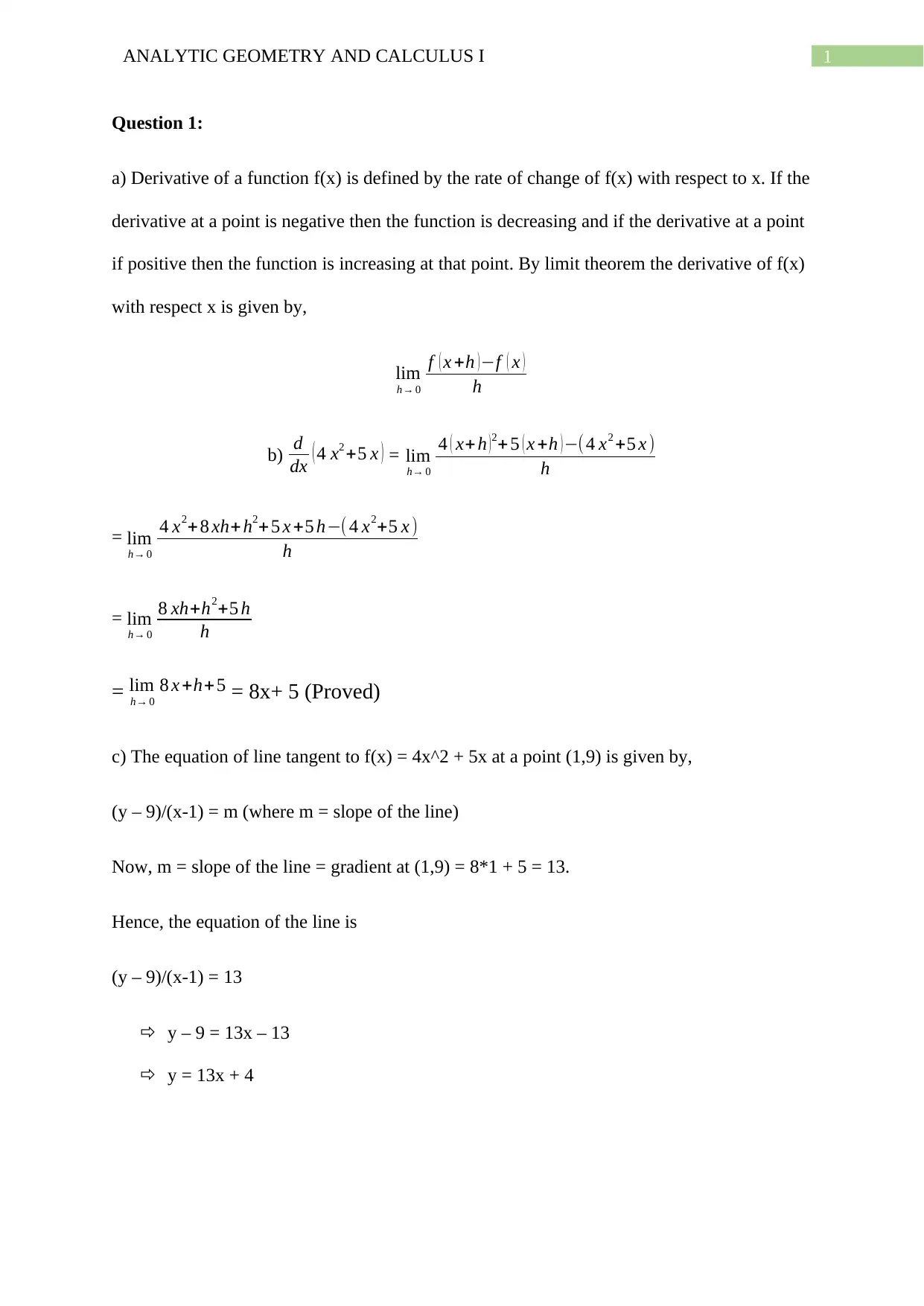
a) Derivative of a function f(x) is defined by the rate of change of f(x) with respect to x. If the
derivative at a point is negative then the function is decreasing and if the derivative at a point
if positive then the function is increasing at that point. By limit theorem the derivative of f(x)
with respect x is given by,
lim
h 0
f ( x +h ) f ( x )
h
b) d
dx ( 4 x2 +5 x ) = lim
h 0
4 ( x+ h ) 2+ 5 ( x +h ) (4 x2 +5 x )
h
= lim
h 0
4 x2+8 xh+ h2+5 x +5 h( 4 x2+5 x )
h
= lim
h 0
8 xh+h2+5 h
h
= lim
h 0
8 x +h+5 = 8x+ 5 (Proved)
c) The equation of line tangent to f(x) = 4x^2 + 5x at a point (1,9) is given by,
(y – 9)/(x-1) = m (where m = slope of the line)
Now, m = slope of the line = gradient at (1,9) = 8*1 + 5 = 13.
Hence, the equation of the line is
(y – 9)/(x-1) = 13
y – 9 = 13x – 13
y = 13x + 4
Document Page
2ANALYTIC GEOMETRY AND CALCULUS I
Question 2:
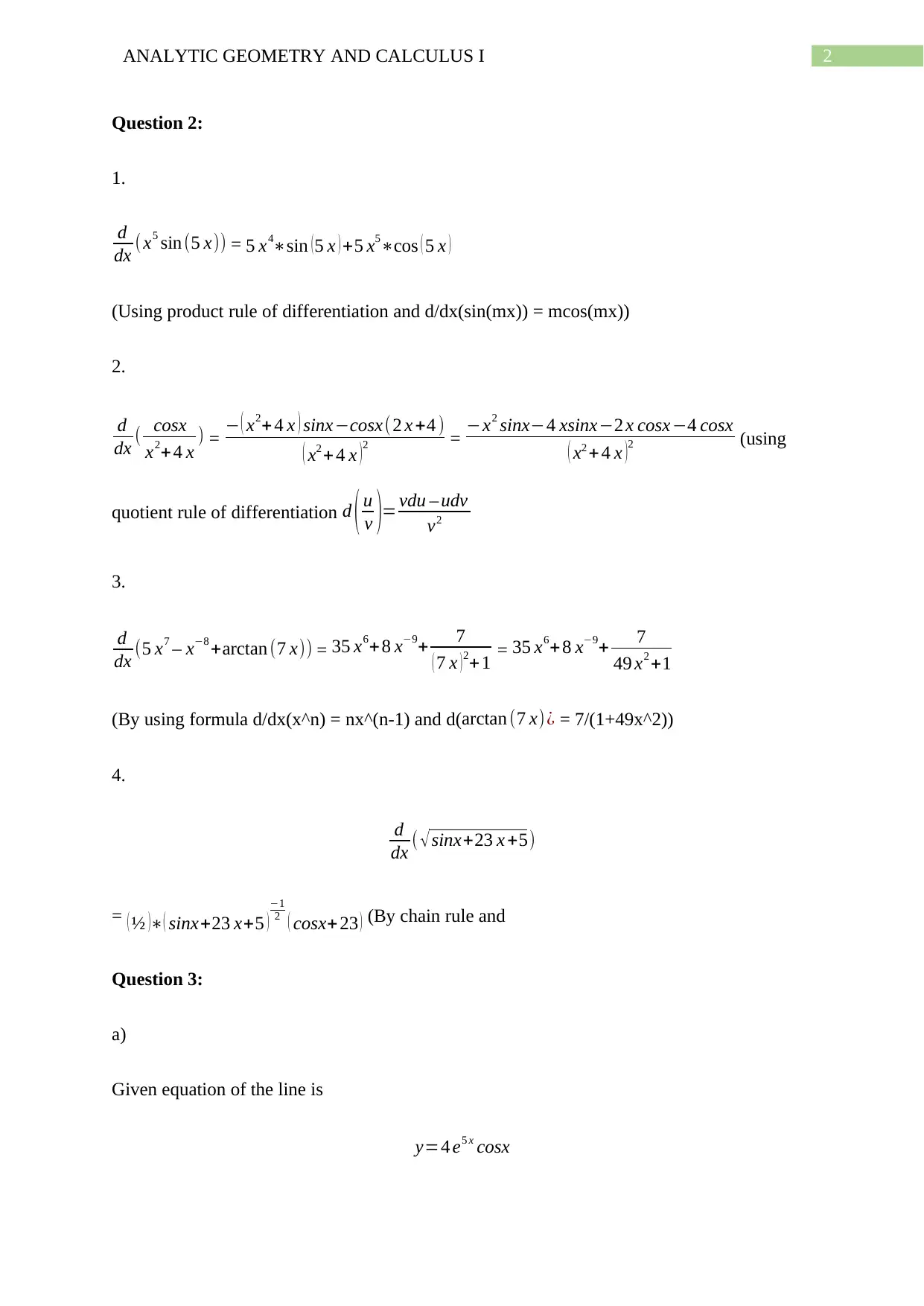
1.
d
dx ( x5 sin (5 x)) = 5 x4sin (5 x ) +5 x5cos ( 5 x )
(Using product rule of differentiation and d/dx(sin(mx)) = mcos(mx))
2.
d
dx ( cosx
x2+ 4 x ) = ( x2+ 4 x ) sinxcosx(2 x +4 )
( x2 + 4 x )2 = x2 sinx4 xsinx2 x cosx 4 cosx
( x2 +4 x )
2 (using
quotient rule of differentiation d ( u
v )= vdu udv
v2
3.
d
dx (5 x7 x8 +arctan (7 x)) = 35 x6+8 x9+ 7
( 7 x ) 2+1 = 35 x6+ 8 x9+ 7
49 x2 +1
(By using formula d/dx(x^n) = nx^(n-1) and d(arctan (7 x)¿ = 7/(1+49x^2))
4.
d
dx ( sinx+23 x +5)
= ( ½ )( sinx+23 x+5 )
1
2 ( cosx+ 23 ) (By chain rule and
Question 3:
a)
Given equation of the line is
y=4 e5 x cosx
Document Page
3ANALYTIC GEOMETRY AND CALCULUS I
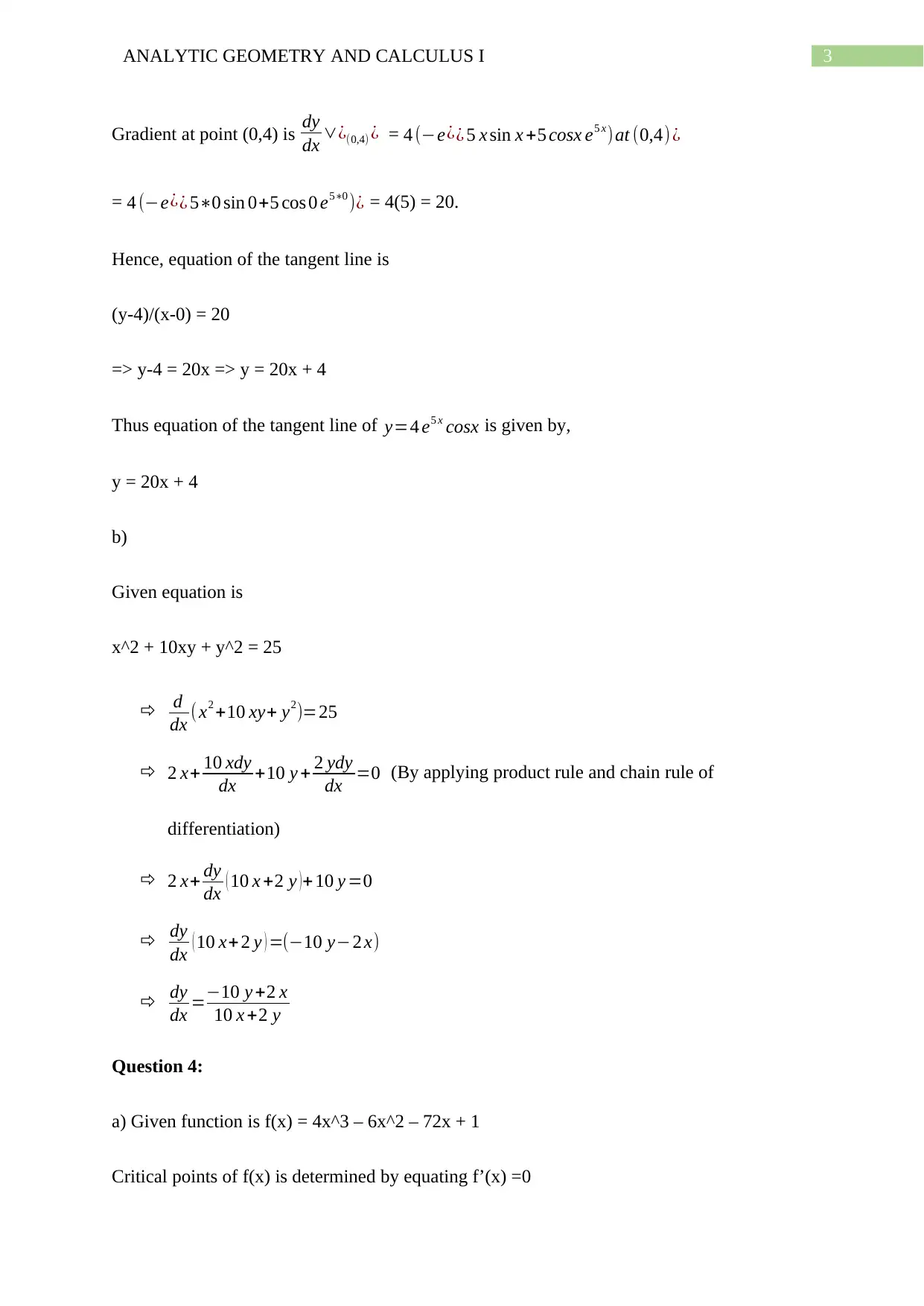
Gradient at point (0,4) is dy
dx ¿(0,4) ¿ = 4 (e¿¿ 5 x sin x +5 cosx e5 x)at (0,4) ¿
= 4 (e¿¿ 50 sin 0+5 cos 0 e50 )¿ = 4(5) = 20.
Hence, equation of the tangent line is
(y-4)/(x-0) = 20
=> y-4 = 20x => y = 20x + 4
Thus equation of the tangent line of y=4 e5 x cosx is given by,
y = 20x + 4
b)
Given equation is
x^2 + 10xy + y^2 = 25
d
dx (x2 +10 xy+ y2)=25
2 x+ 10 xdy
dx +10 y + 2 ydy
dx =0 (By applying product rule and chain rule of
differentiation)
2 x+ dy
dx ( 10 x +2 y )+10 y =0
dy
dx ( 10 x+ 2 y ) =(10 y2 x)
dy
dx =10 y +2 x
10 x +2 y
Question 4:
a) Given function is f(x) = 4x^3 – 6x^2 – 72x + 1
Critical points of f(x) is determined by equating f’(x) =0
tabler-icon-diamond-filled.svg

Paraphrase This Document

Need a fresh take? Get an instant paraphrase of this document with our AI Paraphraser
Document Page
4ANALYTIC GEOMETRY AND CALCULUS I
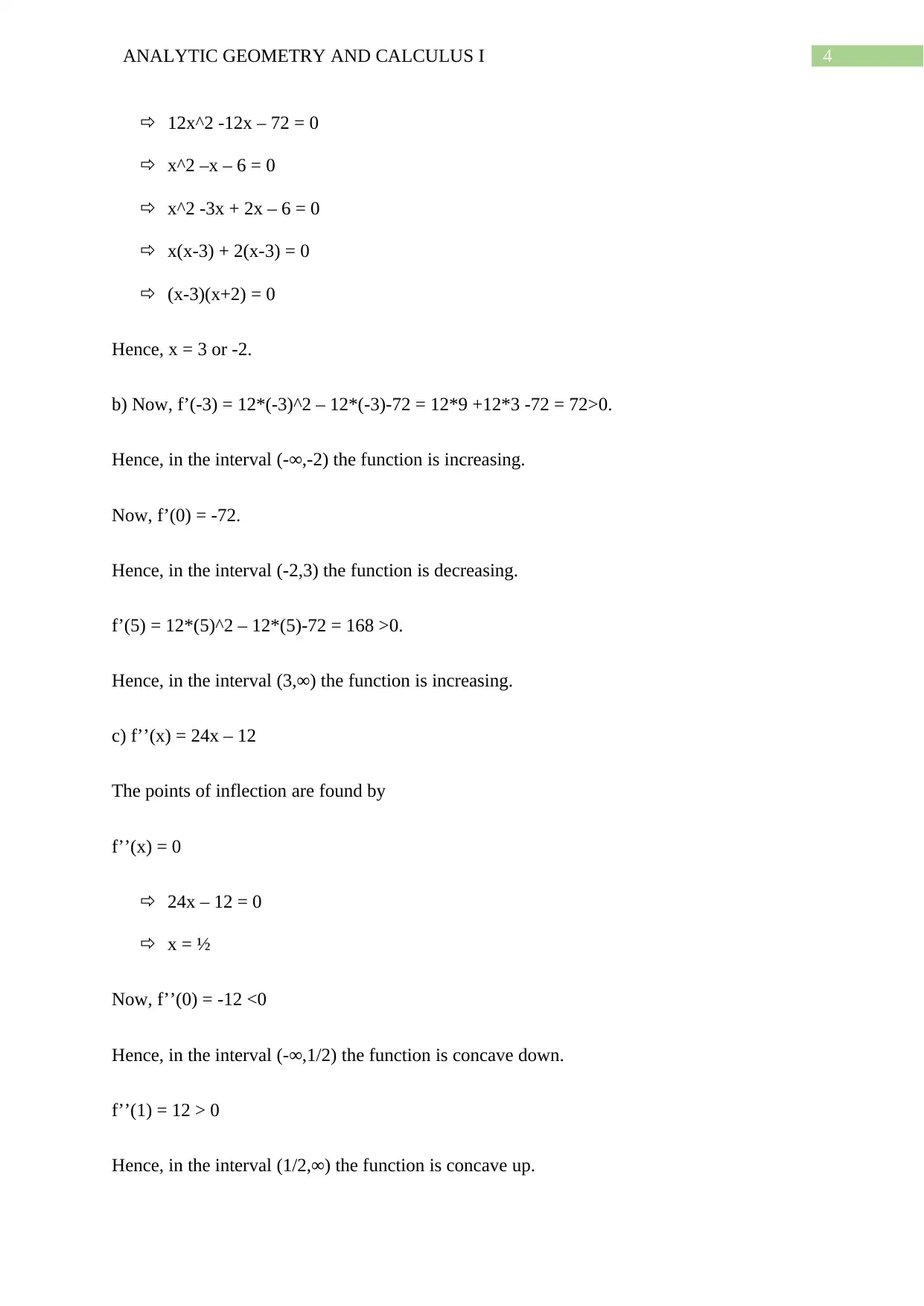
12x^2 -12x – 72 = 0
x^2 –x – 6 = 0
x^2 -3x + 2x – 6 = 0
x(x-3) + 2(x-3) = 0
(x-3)(x+2) = 0
Hence, x = 3 or -2.
b) Now, f’(-3) = 12*(-3)^2 – 12*(-3)-72 = 12*9 +12*3 -72 = 72>0.
Hence, in the interval (-∞,-2) the function is increasing.
Now, f’(0) = -72.
Hence, in the interval (-2,3) the function is decreasing.
f’(5) = 12*(5)^2 – 12*(5)-72 = 168 >0.
Hence, in the interval (3,∞) the function is increasing.
c) f’’(x) = 24x – 12
The points of inflection are found by
f’’(x) = 0
24x – 12 = 0
x = ½
Now, f’’(0) = -12 <0
Hence, in the interval (-∞,1/2) the function is concave down.
f’’(1) = 12 > 0
Hence, in the interval (1/2,∞) the function is concave up.
Document Page
5ANALYTIC GEOMETRY AND CALCULUS I
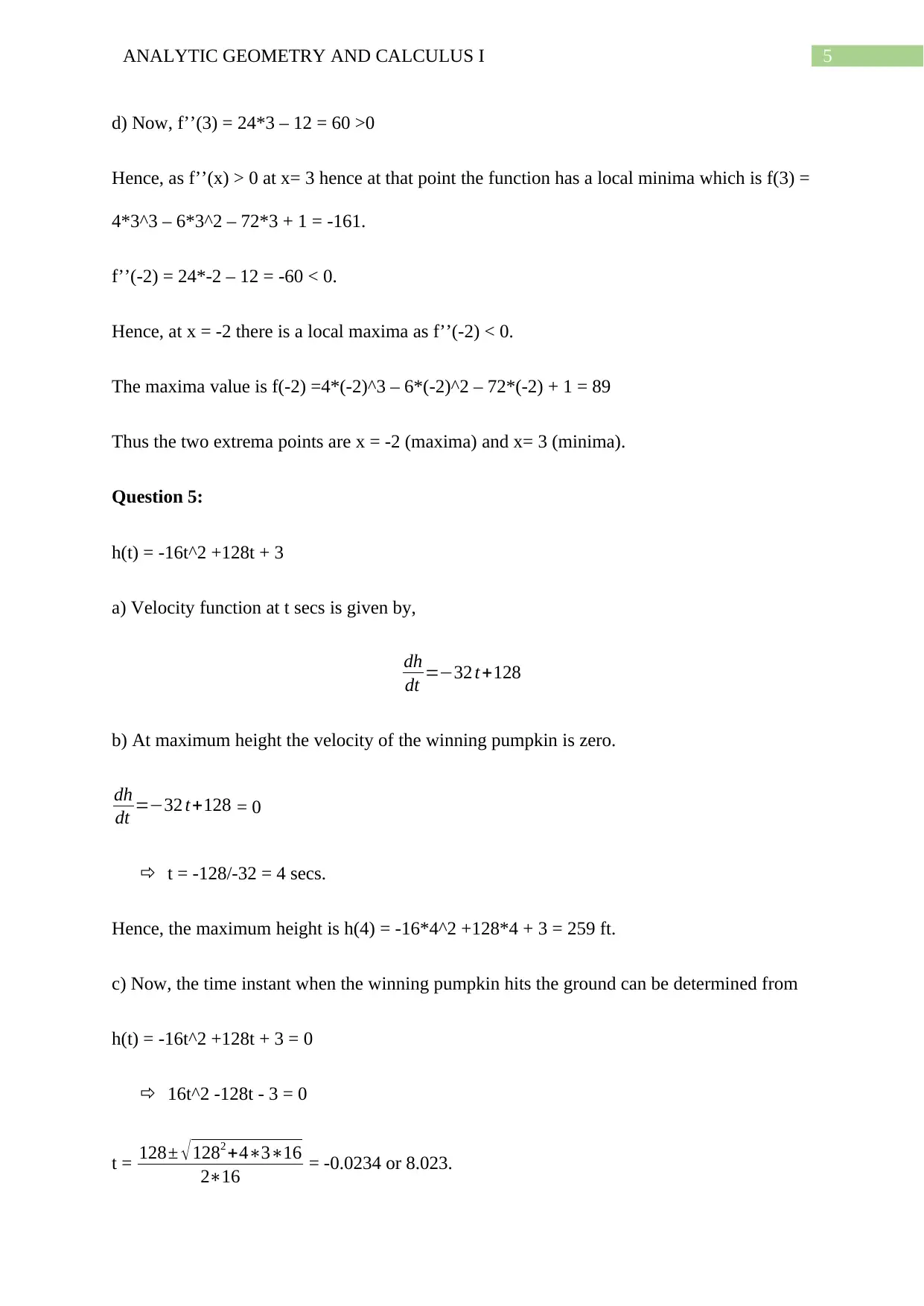
d) Now, f’’(3) = 24*3 – 12 = 60 >0
Hence, as f’’(x) > 0 at x= 3 hence at that point the function has a local minima which is f(3) =
4*3^3 – 6*3^2 – 72*3 + 1 = -161.
f’’(-2) = 24*-2 – 12 = -60 < 0.
Hence, at x = -2 there is a local maxima as f’’(-2) < 0.
The maxima value is f(-2) =4*(-2)^3 – 6*(-2)^2 – 72*(-2) + 1 = 89
Thus the two extrema points are x = -2 (maxima) and x= 3 (minima).
Question 5:
h(t) = -16t^2 +128t + 3
a) Velocity function at t secs is given by,
dh
dt =32 t+128
b) At maximum height the velocity of the winning pumpkin is zero.
dh
dt =32 t+128 = 0
t = -128/-32 = 4 secs.
Hence, the maximum height is h(4) = -16*4^2 +128*4 + 3 = 259 ft.
c) Now, the time instant when the winning pumpkin hits the ground can be determined from
h(t) = -16t^2 +128t + 3 = 0
16t^2 -128t - 3 = 0
t = 128± 1282 +4316
216 = -0.0234 or 8.023.
Document Page
6ANALYTIC GEOMETRY AND CALCULUS I
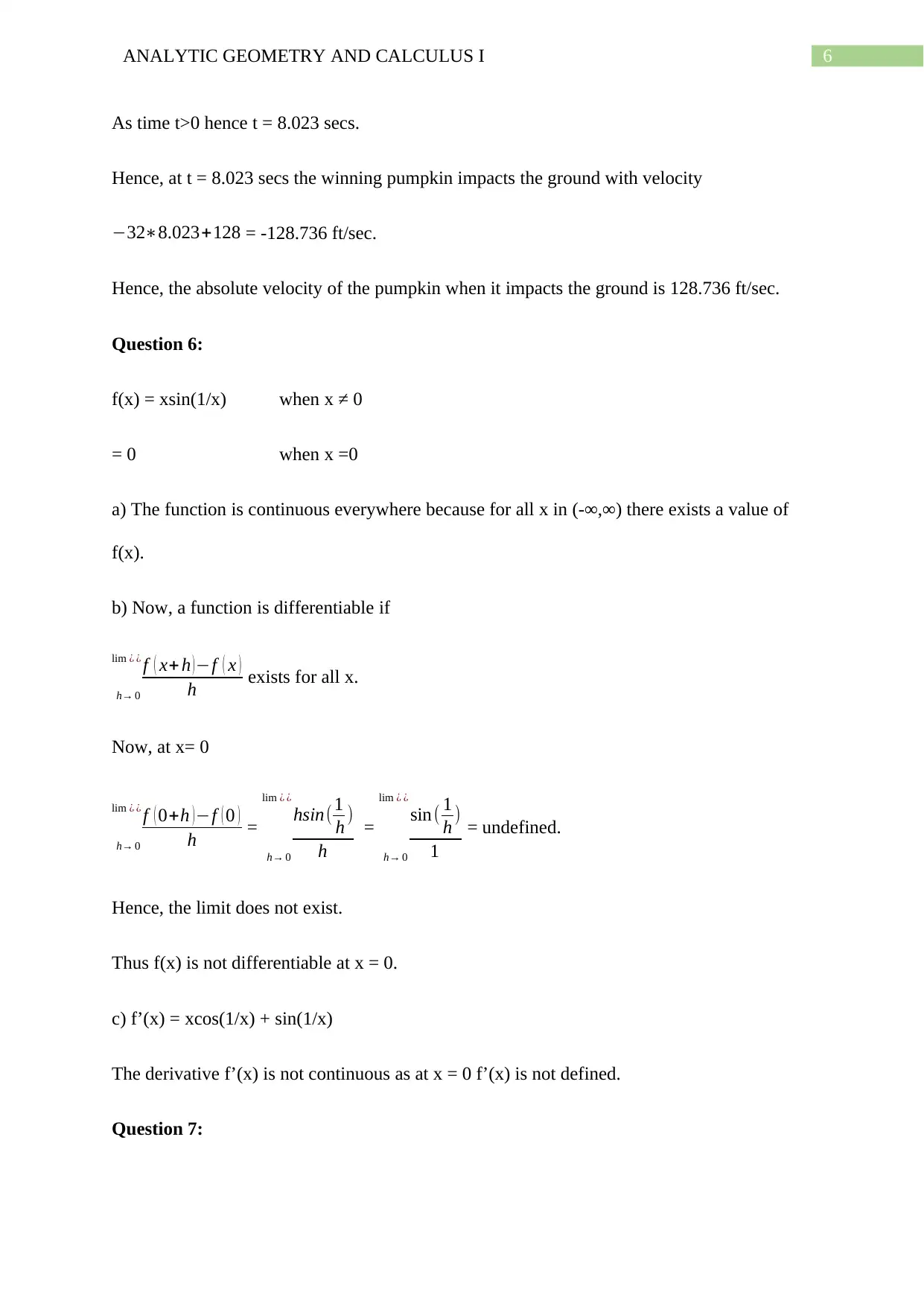
As time t>0 hence t = 8.023 secs.
Hence, at t = 8.023 secs the winning pumpkin impacts the ground with velocity
328.023+128 = -128.736 ft/sec.
Hence, the absolute velocity of the pumpkin when it impacts the ground is 128.736 ft/sec.
Question 6:
f(x) = xsin(1/x) when x ≠ 0
= 0 when x =0
a) The function is continuous everywhere because for all x in (-∞,∞) there exists a value of
f(x).
b) Now, a function is differentiable if
f ( x+ h )f ( x )
hh 0
lim ¿ ¿
exists for all x.
Now, at x= 0
f ( 0+h )f ( 0 )
hh 0
lim ¿ ¿
= hsin( 1
h )
hh 0
lim ¿ ¿
= sin( 1
h )
1h 0
lim ¿ ¿
= undefined.
Hence, the limit does not exist.
Thus f(x) is not differentiable at x = 0.
c) f’(x) = xcos(1/x) + sin(1/x)
The derivative f’(x) is not continuous as at x = 0 f’(x) is not defined.
Question 7:
tabler-icon-diamond-filled.svg

Paraphrase This Document

Need a fresh take? Get an instant paraphrase of this document with our AI Paraphraser
Document Page
7ANALYTIC GEOMETRY AND CALCULUS I
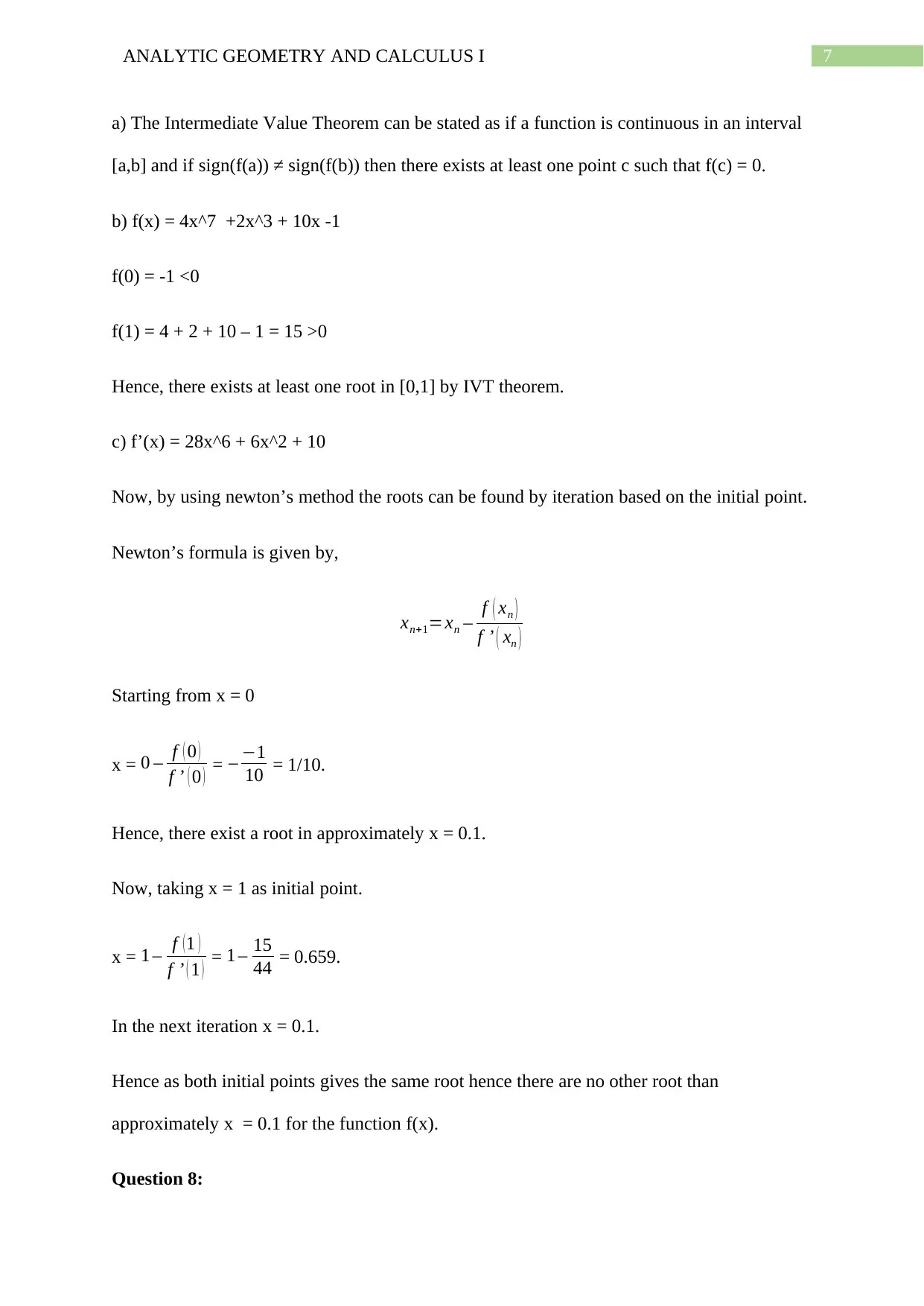
a) The Intermediate Value Theorem can be stated as if a function is continuous in an interval
[a,b] and if sign(f(a)) ≠ sign(f(b)) then there exists at least one point c such that f(c) = 0.
b) f(x) = 4x^7 +2x^3 + 10x -1
f(0) = -1 <0
f(1) = 4 + 2 + 10 – 1 = 15 >0
Hence, there exists at least one root in [0,1] by IVT theorem.
c) f’(x) = 28x^6 + 6x^2 + 10
Now, by using newton’s method the roots can be found by iteration based on the initial point.
Newton’s formula is given by,
xn+1=xn f ( xn )
f ( xn )
Starting from x = 0
x = 0 f ( 0 )
f ( 0 ) = 1
10 = 1/10.
Hence, there exist a root in approximately x = 0.1.
Now, taking x = 1 as initial point.
x = 1 f (1 )
f ( 1 ) = 1 15
44 = 0.659.
In the next iteration x = 0.1.
Hence as both initial points gives the same root hence there are no other root than
approximately x = 0.1 for the function f(x).
Question 8:
Document Page
8ANALYTIC GEOMETRY AND CALCULUS I
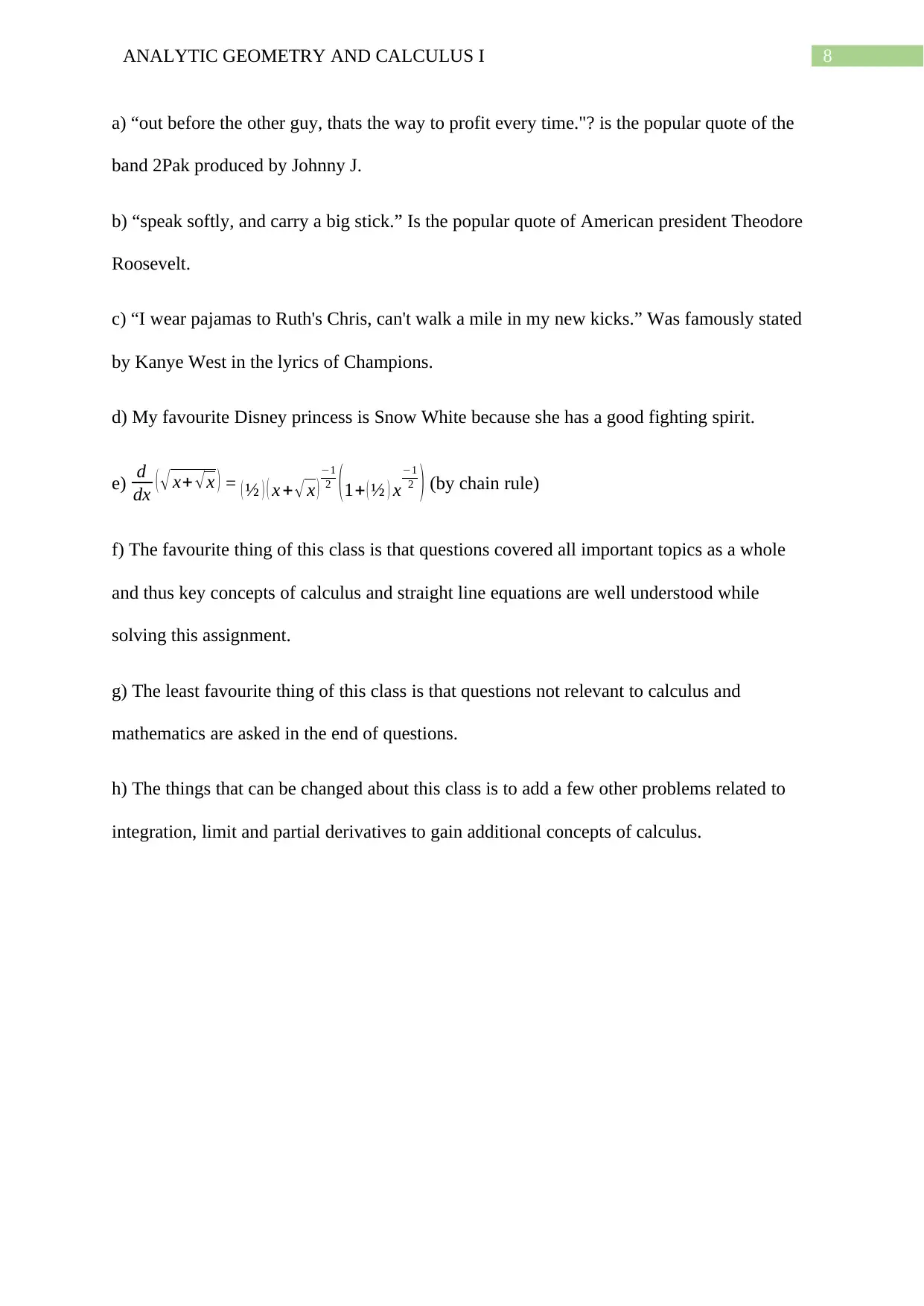
a) “out before the other guy, thats the way to profit every time."? is the popular quote of the
band 2Pak produced by Johnny J.
b) “speak softly, and carry a big stick.” Is the popular quote of American president Theodore
Roosevelt.
c) “I wear pajamas to Ruth's Chris, can't walk a mile in my new kicks.” Was famously stated
by Kanye West in the lyrics of Champions.
d) My favourite Disney princess is Snow White because she has a good fighting spirit.
e) d
dx ( x+ x ) = ( ½ ) ( x + x )
1
2 (1+ ( ½ ) x
1
2 ) (by chain rule)
f) The favourite thing of this class is that questions covered all important topics as a whole
and thus key concepts of calculus and straight line equations are well understood while
solving this assignment.
g) The least favourite thing of this class is that questions not relevant to calculus and
mathematics are asked in the end of questions.
h) The things that can be changed about this class is to add a few other problems related to
integration, limit and partial derivatives to gain additional concepts of calculus.
chevron_up_icon
1 out of 9
circle_padding
hide_on_mobile
zoom_out_icon
[object Object]