Calculus Homework: Plane Equations, Line Intersection, Error Analysis

Verified

Added on  2023/01/16

|7
|1416
|47
Homework Assignment
AI Summary
This calculus assignment presents solutions to problems involving plane equations, line intersections, and error analysis. The first question explores the intersection of two planes, determining their normal vectors, deriving Cartesian equations, and finding the parametric vector form of their line of intersection. The second question investigates the existence of a unique solution to an equation using the Intermediate Value Theorem and Rolle's Theorem. The third question approximates the error in a calculation using the Mean Value Theorem. The solutions demonstrate a strong understanding of calculus concepts and problem-solving techniques.
Document Page
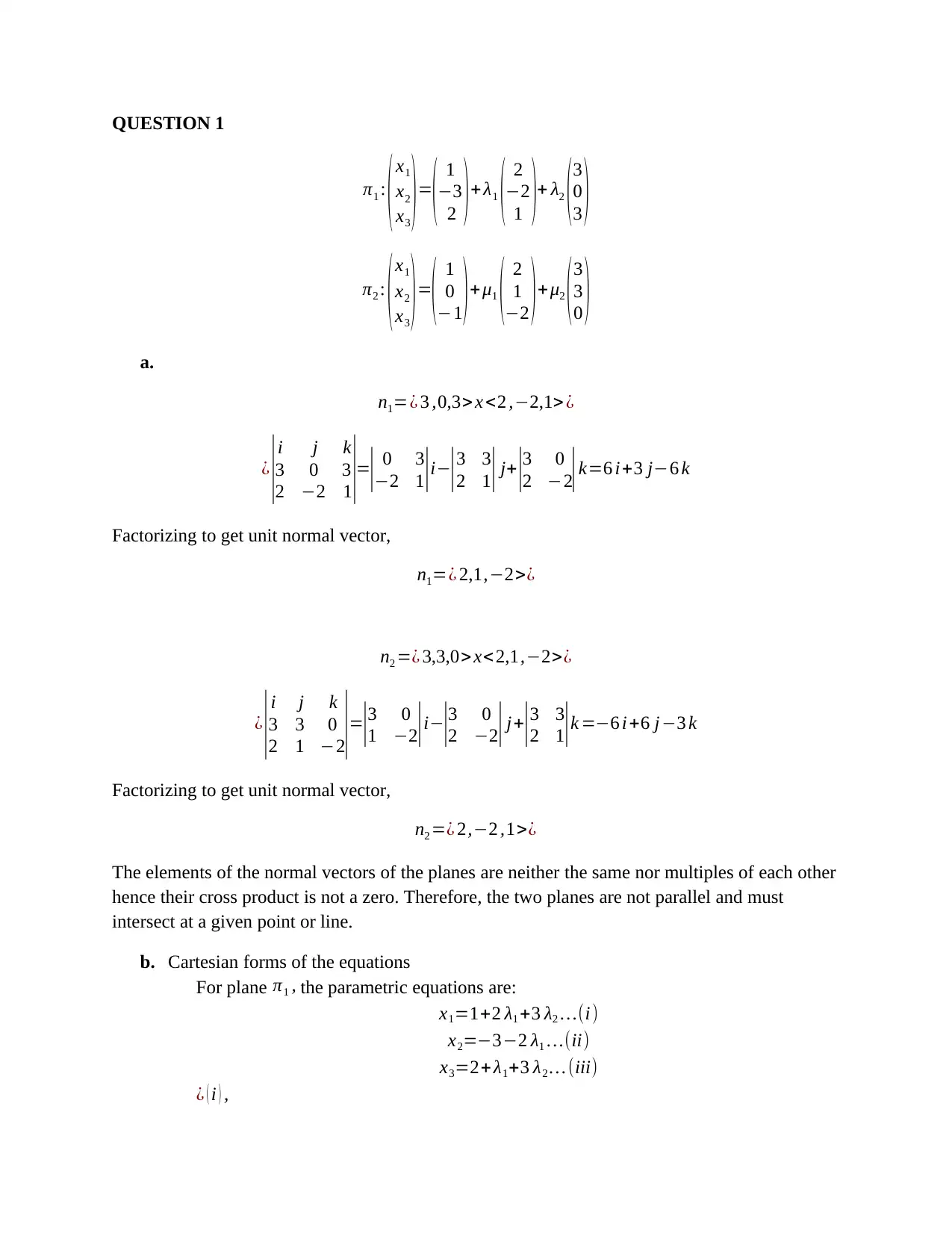
QUESTION 1
π1 :
( x1
x2
x3
) =
( 1
3
2 ) + λ1
( 2
2
1 )+ λ2
( 3
0
3 )
π2 :
(x1
x2
x3
)=
( 1
0
1 )+μ1
( 2
1
2 )+ μ2
(3
3
0 )
a.
n1=¿ 3 ,0,3> x <2 ,2,1> ¿
¿
|i j k
3 0 3
2 2 1|=| 0 3
2 1|i|3 3
2 1| j+|3 0
2 2|k=6 i+3 j6 k
Factorizing to get unit normal vector,
n1=¿ 2,1,2>¿
n2 =¿ 3,3,0> x<2,1,2>¿
¿
|i j k
3 3 0
2 1 2|=|3 0
1 2|i|3 0
2 2| j+|3 3
2 1|k =6 i+6 j3 k
Factorizing to get unit normal vector,
n2 =¿ 2,2 ,1>¿
The elements of the normal vectors of the planes are neither the same nor multiples of each other
hence their cross product is not a zero. Therefore, the two planes are not parallel and must
intersect at a given point or line.
b. Cartesian forms of the equations
For plane π1 , the parametric equations are:
x1=1+2 λ1 +3 λ2 (i)
x2=32 λ1 (ii)
x3=2+ λ1+3 λ2 (iii)
¿ ( i ) ,
tabler-icon-diamond-filled.svg

Paraphrase This Document

Need a fresh take? Get an instant paraphrase of this document with our AI Paraphraser
Document Page
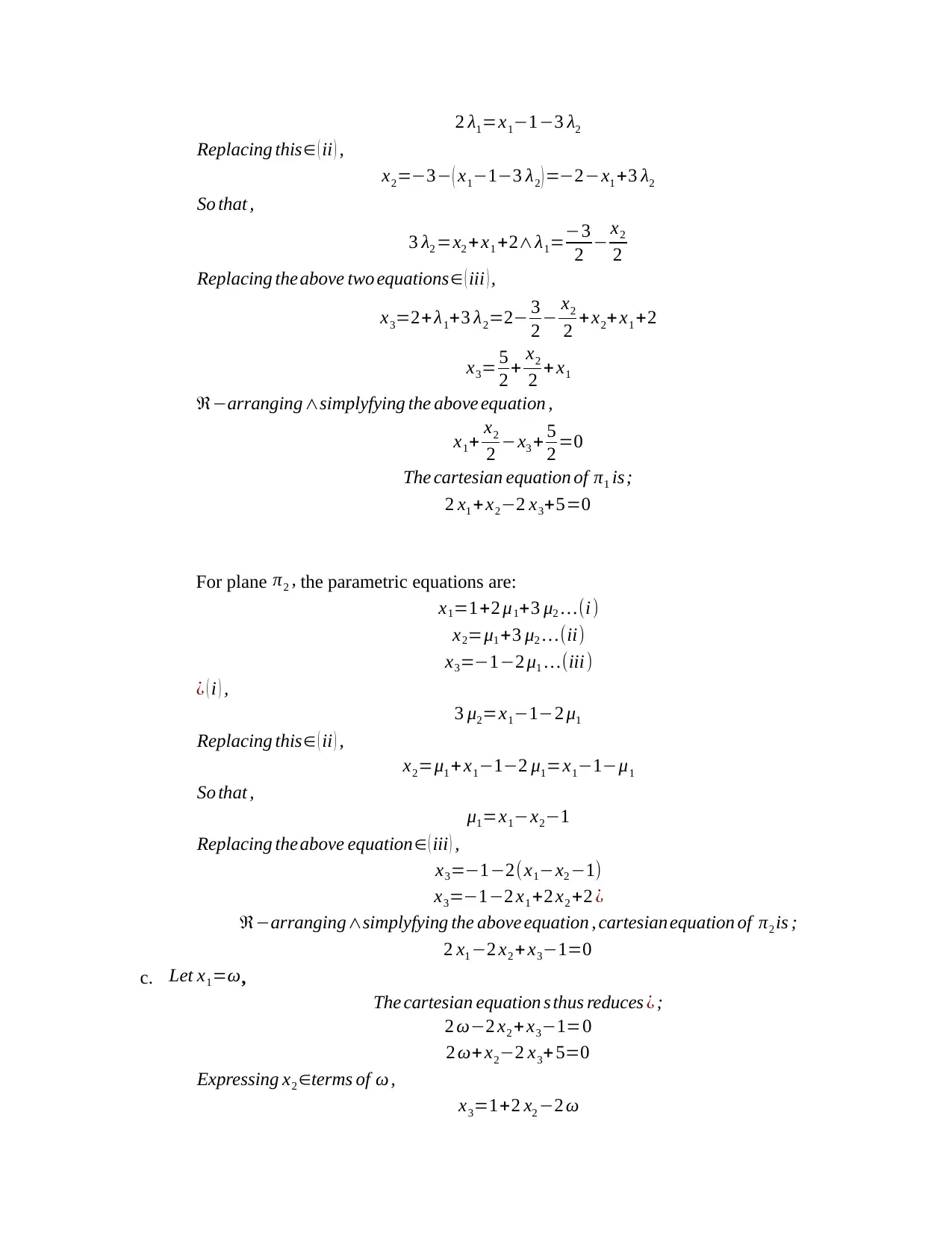
2 λ1=x113 λ2
Replacing this ( ii ) ,
x2=3 ( x113 λ2 ) =2x1 +3 λ2
So that ,
3 λ2 =x2 +x1 +2λ1=3
2 x2
2
Replacing theabove two equations ( iii ) ,
x3=2+ λ1+3 λ2=2 3
2 x2
2 +x2+x1 +2
x3= 5
2 + x2
2 + x1
arrangingsimplyfying the above equation ,
x1+ x2
2 x3 + 5
2 =0
The cartesian equation of π1 is;
2 x1 + x22 x3+5=0
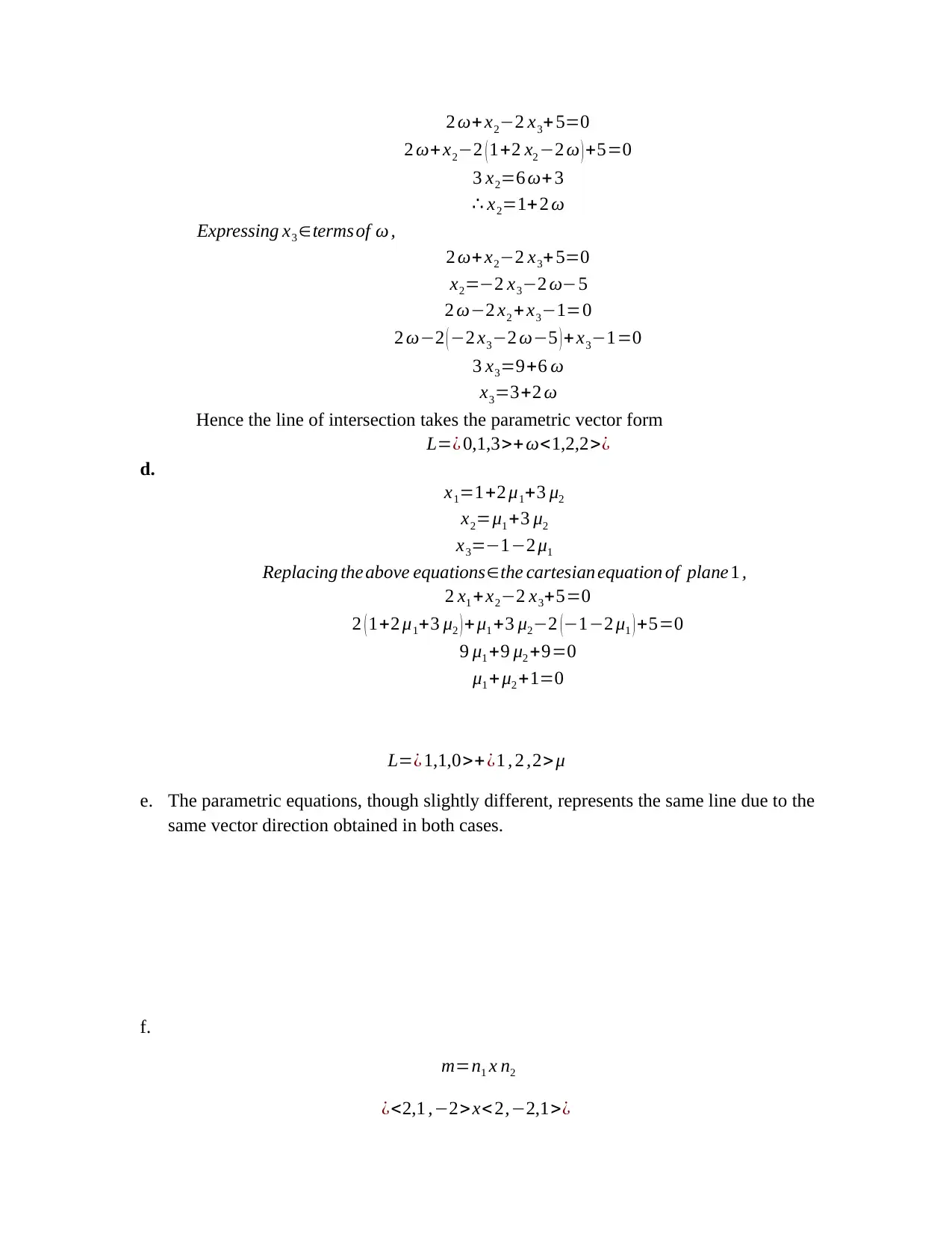
For plane π2 , the parametric equations are:
x1=1+2 μ1+3 μ2 (i)
x2=μ1 +3 μ2 (ii)
x3=12 μ1 (iii )
¿ ( i ) ,
3 μ2=x112 μ1
Replacing this ( ii ) ,
x2=μ1 + x112 μ1=x11μ1
So that ,
μ1=x1x21
Replacing theabove equation ( iii ) ,
x3=12(x1x2 1)
x3=12 x1 +2 x2 +2 ¿
arrangingsimplyfying the above equation , cartesianequation of π2 is ;
2 x1 2 x2 + x31=0
c. Let x1=ω,
The cartesian equation s thus reduces ¿ ;
2 ω2 x2 +x31=0
2 ω+ x22 x3+ 5=0
Expressing x2 terms of ω ,
x3=1+2 x2 2 ω
Document Page
2 ω+ x22 x3+ 5=0
2 ω+ x22 ( 1+2 x2 2 ω ) +5=0
3 x2=6 ω+3
x2=1+2 ω
Expressing x3 terms of ω ,
2 ω+ x22 x3+ 5=0
x2=2 x32 ω5
2 ω2 x2 +x31=0
2 ω2 ( 2 x32 ω5 )+ x31=0
3 x3=9+6 ω
x3=3+2 ω
Hence the line of intersection takes the parametric vector form
L=¿ 0,1,3>+ ω<1,2,2>¿
d.
x1=1+2 μ1+3 μ2
x2=μ1 +3 μ2
x3=12 μ1
Replacing the above equationsthe cartesian equation of plane1 ,
2 x1 + x22 x3+5=0
2 ( 1+2 μ1+3 μ2 ) + μ1 +3 μ22 ( 12 μ1 ) +5=0
9 μ1 +9 μ2 +9=0
μ1 + μ2 +1=0
L=¿ 1,1,0>+¿1 , 2 ,2> μ
e. The parametric equations, though slightly different, represents the same line due to the
same vector direction obtained in both cases.
f.
m=n1 x n2
¿<2,1 ,2>x<2,2,1>¿
Document Page
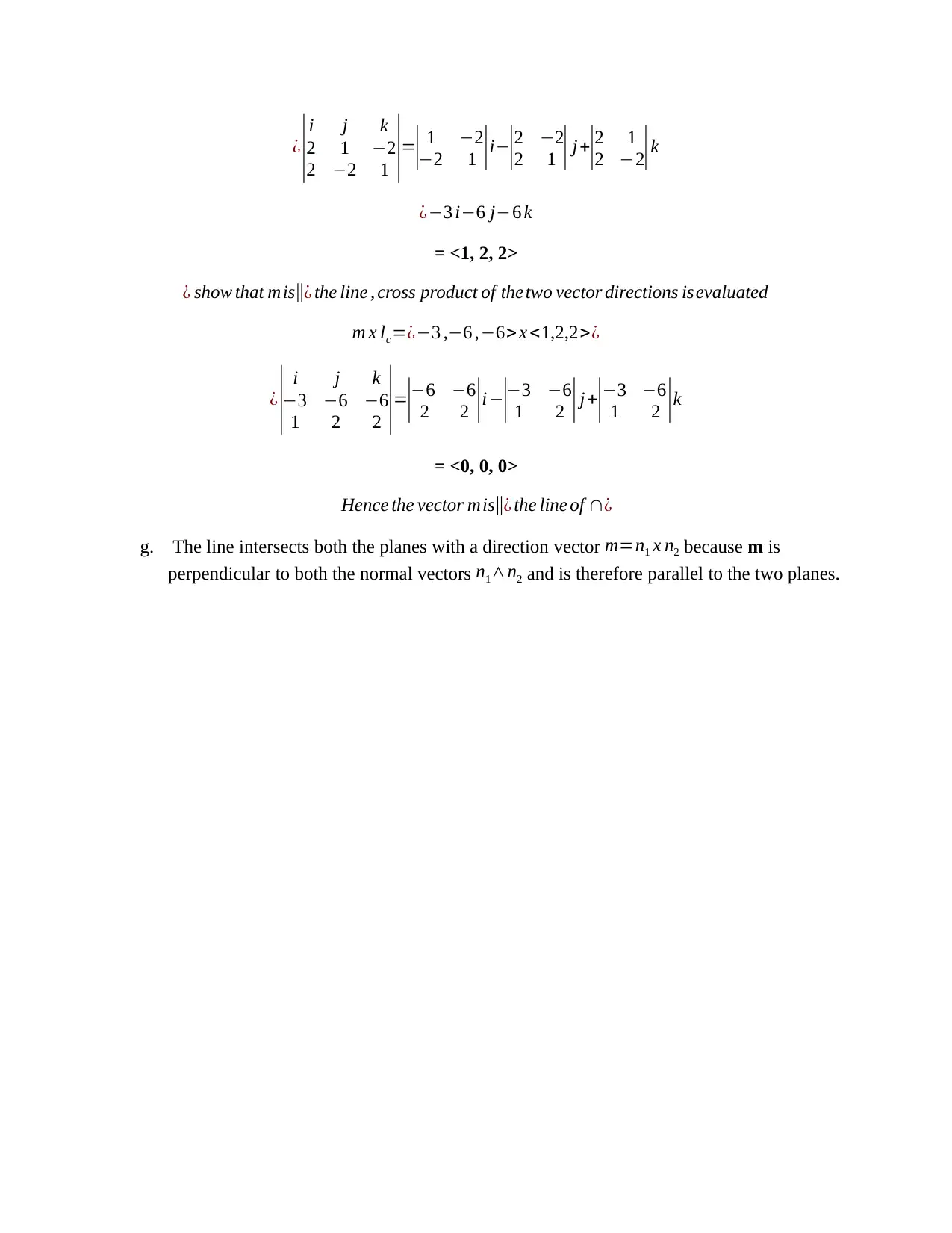
¿
|i j k
2 1 2
2 2 1 |=| 1 2
2 1 |i|2 2
2 1 | j+|2 1
2 2|k
¿3 i6 j6 k
= <1, 2, 2>
¿ show that mis¿ the line , cross product of thetwo vector directions isevaluated
m x lc=¿3 ,6 ,6> x <1,2,2>¿
¿
| i j k
3 6 6
1 2 2 |=|6 6
2 2 |i|3 6
1 2 | j+|3 6
1 2 |k
= <0, 0, 0>
Hence the vector mis¿ the line of ¿
g. The line intersects both the planes with a direction vector m=n1 x n2 because m is
perpendicular to both the normal vectors n1n2 and is therefore parallel to the two planes.
tabler-icon-diamond-filled.svg

Paraphrase This Document

Need a fresh take? Get an instant paraphrase of this document with our AI Paraphraser
Document Page
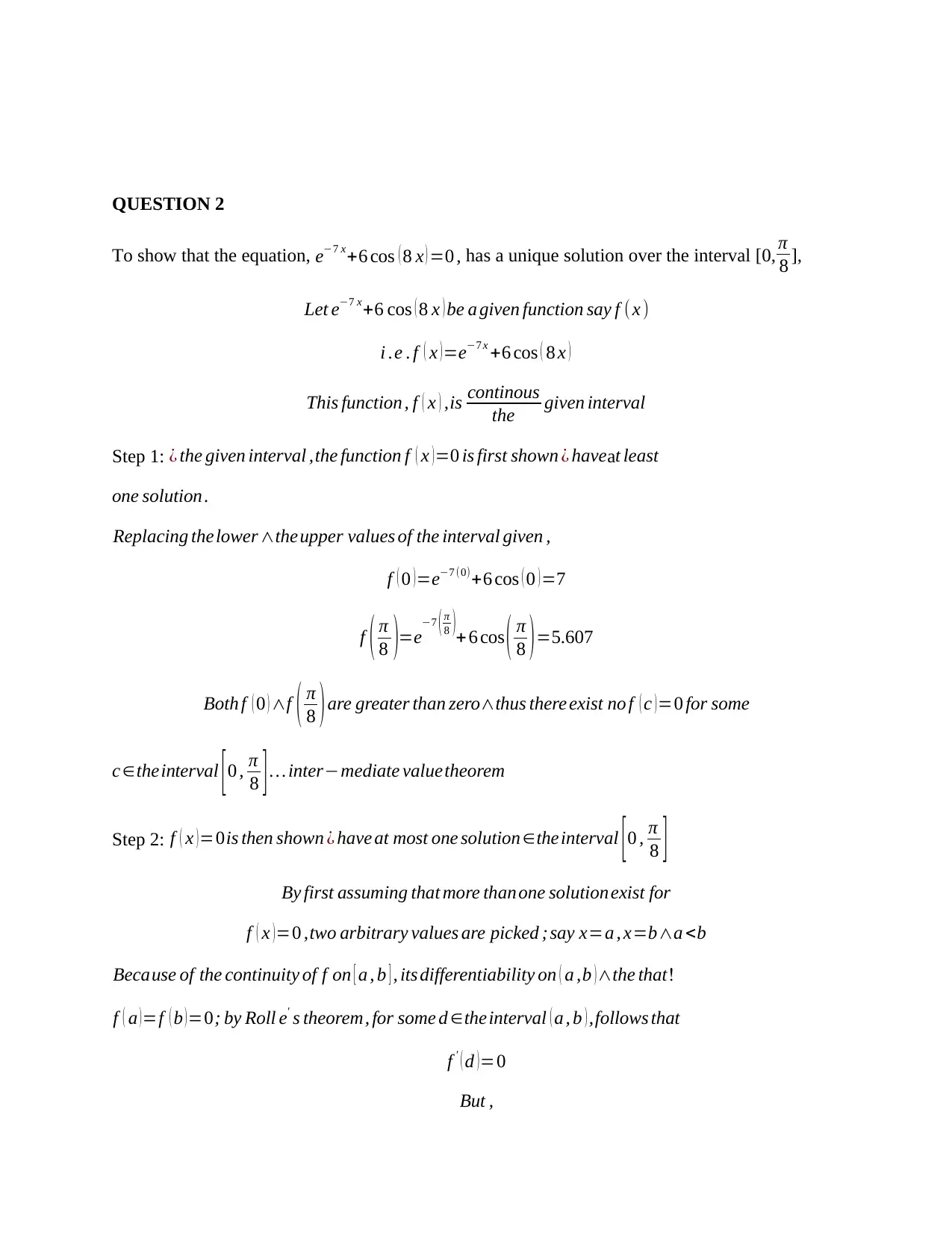
QUESTION 2
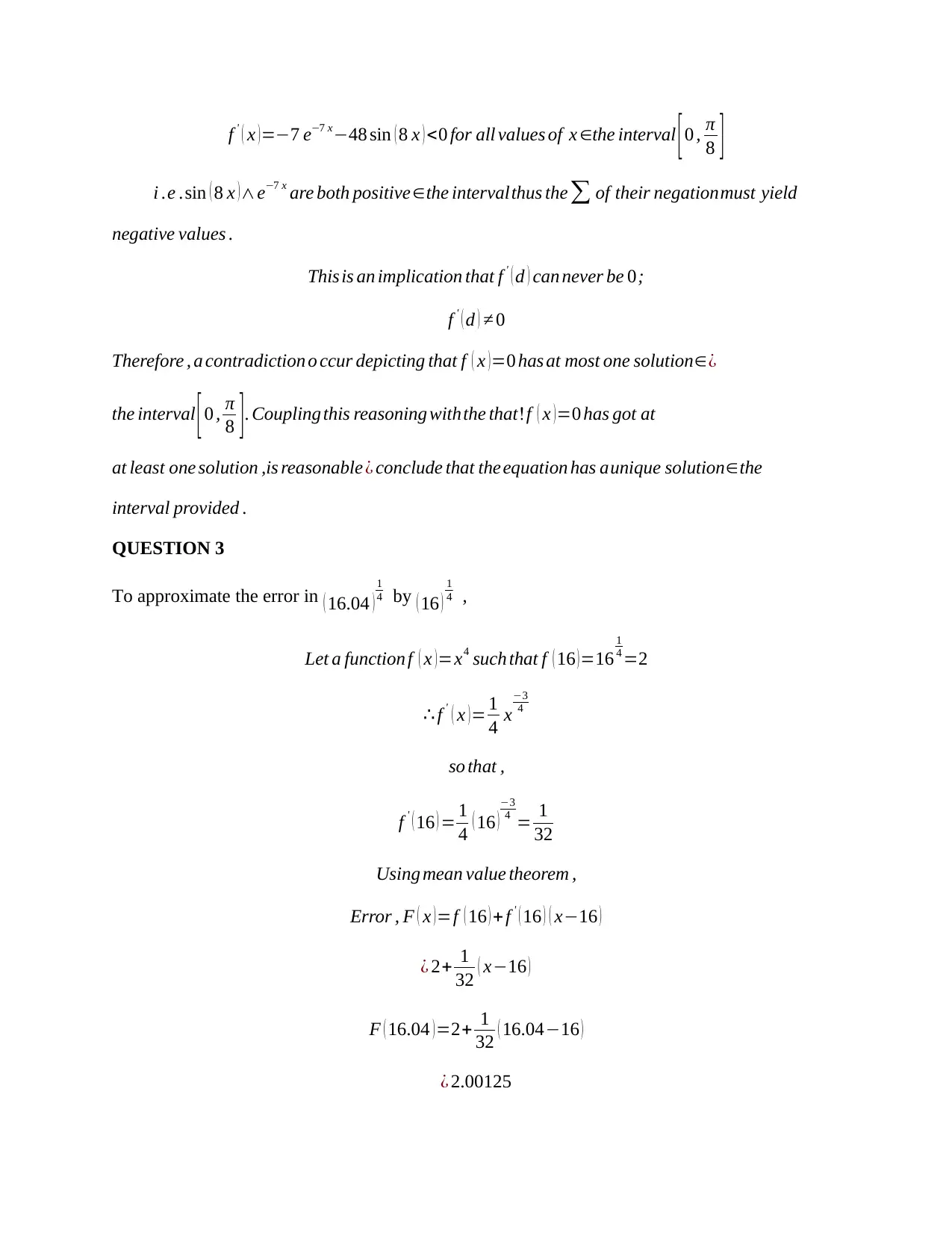
To show that the equation, e7 x+6 cos ( 8 x ) =0 , has a unique solution over the interval [0, π
8 ],
Let e7 x+6 cos ( 8 x ) be a given function say f ( x )
i .e . f ( x )=e7 x +6 cos ( 8 x )
This function , f ( x ) ,is continous
the given interval
Step 1: ¿ the given interval ,the function f ( x )=0 is first shown ¿ haveat least
one solution .
Replacing thelower theupper values of the interval given ,
f ( 0 ) =e7 (0)+6 cos ( 0 ) =7
f ( π
8 )=e7 ( π
8 )+ 6 cos ( π
8 )=5.607
Both f ( 0 ) f ( π
8 ) are greater than zerothus there exist no f ( c ) =0 for some
c theinterval [ 0 , π
8 ] intermediate valuetheorem
Step 2: f ( x ) =0is then shown ¿ have at most one solution theinterval [ 0 , π
8 ]
By first assuming that more than one solution exist for
f ( x )=0 ,two arbitrary values are picked ; say x=a , x=ba <b
Because of the continuity of f on [ a , b ] , its differentiability on ( a ,b ) the that!
f ( a )=f ( b )=0; by Roll e' s theorem, for some d theinterval ( a , b ) ,follows that
f ' ( d )=0
But ,
Document Page
f ' ( x )=7 e7 x48 sin ( 8 x ) <0 for all values of x the interval [0 , π
8 ]
i .e .sin ( 8 x ) e7 x are both positivethe intervalthus the of their negationmust yield
negative values .
Thisis an implication that f ' ( d ) can never be 0;
f ' ( d ) 0
Therefore , a contradiction o ccur depicting that f ( x ) =0 has at most one solution¿
the interval [ 0 , π
8 ] . Coupling this reasoning withthe that!f ( x ) =0 has got at
at least one solution ,is reasonable ¿ conclude that theequation has aunique solutionthe
interval provided .
QUESTION 3
To approximate the error in ( 16.04 )
1
4 by ( 16 )
1
4 ,
Let a function f ( x ) =x4 such that f ( 16 ) =16
1
4 =2
f ' ( x )= 1
4 x
3
4
so that ,
f ' ( 16 ) = 1
4 ( 16 )
3
4 = 1
32
Using mean value theorem ,
Error , F ( x )=f ( 16 ) + f ' ( 16 ) ( x16 )
¿ 2+ 1
32 ( x16 )
F ( 16.04 )=2+ 1
32 ( 16.0416 )
¿ 2.00125
Document Page
chevron_up_icon
1 out of 7
circle_padding
hide_on_mobile
zoom_out_icon
[object Object]