Comprehensive Project Management Report: Camden Sickle Cell Project
VerifiedAdded on 2023/01/05
|12
|2385
|84
Report
AI Summary
This report provides a comprehensive analysis of a project management plan for the Camden Sickle Cell and Thalassaemia Service Group. It begins with an introduction to project management principles and the specific goals of the project, which is to generate funding. The report then delves into several key areas of project management, including the development of a network diagram to visualize project activities, stakeholder analysis to identify and categorize project stakeholders, and the creation of a work breakdown structure to organize project tasks. Risk analysis is conducted to identify potential threats to the project's success, and quality expectations, acceptance criteria, and quality specifications are established to ensure project outcomes meet the required standards. The report also recommends the Waterfall methodology as the most suitable approach for this project, highlighting its benefits in terms of sequential task execution and successful goal attainment. The report concludes by summarizing the key findings and emphasizing the importance of effective project management practices for achieving the project's objectives.
Project Management

Paraphrase This Document
Need a fresh take? Get an instant paraphrase of this document with our AI Paraphraser
Table of Contents
Table of Contents.............................................................................................................................2
INTRODUCTION...........................................................................................................................1
TASK 1............................................................................................................................................1
Developing the network diagram manually to show the relationship between all the activities
along with calculation of earliest and latest starting time and earliest finishing and latest
finishing time for each of the activities.......................................................................................1
TASK 2............................................................................................................................................3
Undertaking the stakeholder analysis for the project..................................................................3
TASK 3............................................................................................................................................5
Word breakdown structure for all the activities..........................................................................5
TASK 4............................................................................................................................................5
Risk analysis for 20 risks that could affect the project................................................................5
TASK 5............................................................................................................................................7
Quality expectation, acceptance criteria, quality specification and measures that would be put
in place to control the event.........................................................................................................7
TASK 6............................................................................................................................................7
Methodology for the project along with benefits of it.................................................................7
CONCLUSION................................................................................................................................8
REFERENCES................................................................................................................................9
Table of Contents.............................................................................................................................2
INTRODUCTION...........................................................................................................................1
TASK 1............................................................................................................................................1
Developing the network diagram manually to show the relationship between all the activities
along with calculation of earliest and latest starting time and earliest finishing and latest
finishing time for each of the activities.......................................................................................1
TASK 2............................................................................................................................................3
Undertaking the stakeholder analysis for the project..................................................................3
TASK 3............................................................................................................................................5
Word breakdown structure for all the activities..........................................................................5
TASK 4............................................................................................................................................5
Risk analysis for 20 risks that could affect the project................................................................5
TASK 5............................................................................................................................................7
Quality expectation, acceptance criteria, quality specification and measures that would be put
in place to control the event.........................................................................................................7
TASK 6............................................................................................................................................7
Methodology for the project along with benefits of it.................................................................7
CONCLUSION................................................................................................................................8
REFERENCES................................................................................................................................9
INTRODUCTION
Project management could be described as the process of applying specific processes so that
a project could be initiated, planned, managed and executed in systematic manner. With the help
of it the way in which new initiatives can change the whole project are also implemented so that
the deadline could be met (Anbari, 2018). Present report is based upon the project of Camden
Sickle Cell and Thalassaemia Service Group. Main aim of this project is to generate funding for
the forum. This assignment covers various topics such as development of network diagram,
stakeholder analysis, work breakdown structure, risk analysis and assessment of various aspects
such as quality expectation, acceptance criteria, quality specification and measured. Apart from
this, the methodology which would be appropriate for this project along with benefits of it are
also covered under this report.
TASK 1
Developing the network diagram manually to show the relationship between all the activities
along with calculation of earliest and latest starting time and earliest finishing and latest
finishing time for each of the activities
Network diagram: It could be defined as a diagram which is a schematic depicting
nodes that are mainly used for reflecting interrelation between different activities of graphs. With
the help of it, graphical representation of different activities could be created. With the help of it,
all the activities of the network could be mapped out with variety of symbols and connections.
When it will be used for the project of Camden Sickle Cell and Thalassaemia Service Group then
it will be easy for the users to understand all the activities properly and easily (Ansah and
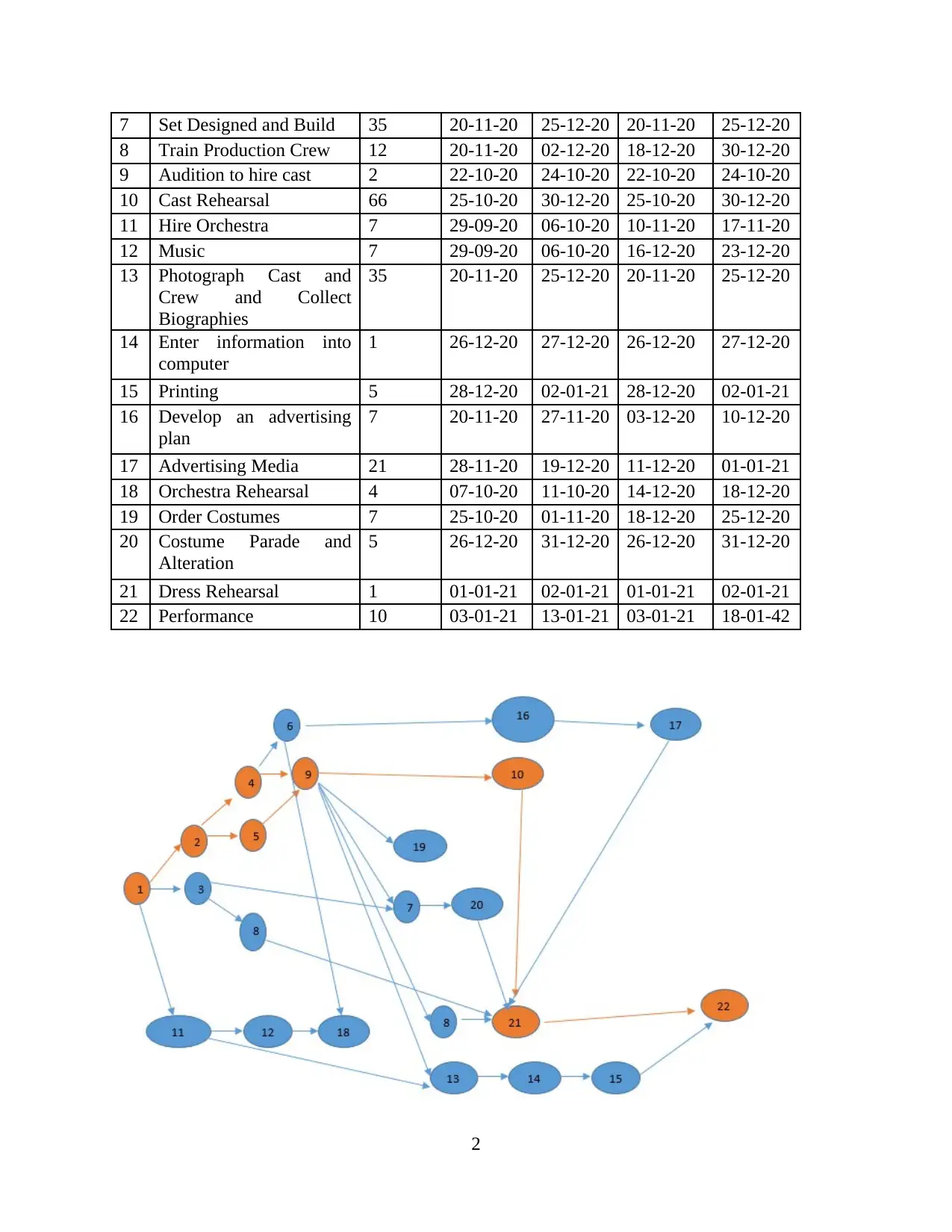
Sorooshian, 2018). The network diagram for the project is as follows:
Activities Duratio
n
ES EF LS LF
1 Budget approval 1 28-09-20 28-09-20 28-09-20 28-09-20
2 Hire publicity director 14 29-09-20 13-10-20 29-09-20 13-10-20
3 Hire Set Designer 14 29-09-20 13-10-20 04-11-20 18-11-20
4 Hire Place for Audition 7 14-10-20 21-10-20 14-10-20 21-10-20
5 Advertising to hire Crew
and Cast
7 14-10-20 21-10-20 14-10-20 21-10-20
6 Hire Production and
Publicity Crew
28 22-10-20 19-11-20 22-10-20 19-11-20
1
Project management could be described as the process of applying specific processes so that
a project could be initiated, planned, managed and executed in systematic manner. With the help
of it the way in which new initiatives can change the whole project are also implemented so that
the deadline could be met (Anbari, 2018). Present report is based upon the project of Camden
Sickle Cell and Thalassaemia Service Group. Main aim of this project is to generate funding for
the forum. This assignment covers various topics such as development of network diagram,
stakeholder analysis, work breakdown structure, risk analysis and assessment of various aspects
such as quality expectation, acceptance criteria, quality specification and measured. Apart from
this, the methodology which would be appropriate for this project along with benefits of it are
also covered under this report.
TASK 1
Developing the network diagram manually to show the relationship between all the activities
along with calculation of earliest and latest starting time and earliest finishing and latest
finishing time for each of the activities
Network diagram: It could be defined as a diagram which is a schematic depicting
nodes that are mainly used for reflecting interrelation between different activities of graphs. With
the help of it, graphical representation of different activities could be created. With the help of it,
all the activities of the network could be mapped out with variety of symbols and connections.
When it will be used for the project of Camden Sickle Cell and Thalassaemia Service Group then
it will be easy for the users to understand all the activities properly and easily (Ansah and
Sorooshian, 2018). The network diagram for the project is as follows:
Activities Duratio
n
ES EF LS LF
1 Budget approval 1 28-09-20 28-09-20 28-09-20 28-09-20
2 Hire publicity director 14 29-09-20 13-10-20 29-09-20 13-10-20
3 Hire Set Designer 14 29-09-20 13-10-20 04-11-20 18-11-20
4 Hire Place for Audition 7 14-10-20 21-10-20 14-10-20 21-10-20
5 Advertising to hire Crew
and Cast
7 14-10-20 21-10-20 14-10-20 21-10-20
6 Hire Production and
Publicity Crew
28 22-10-20 19-11-20 22-10-20 19-11-20
1
⊘ This is a preview!⊘
Do you want full access?
Subscribe today to unlock all pages.

Trusted by 1+ million students worldwide
7 Set Designed and Build 35 20-11-20 25-12-20 20-11-20 25-12-20
8 Train Production Crew 12 20-11-20 02-12-20 18-12-20 30-12-20
9 Audition to hire cast 2 22-10-20 24-10-20 22-10-20 24-10-20
10 Cast Rehearsal 66 25-10-20 30-12-20 25-10-20 30-12-20
11 Hire Orchestra 7 29-09-20 06-10-20 10-11-20 17-11-20
12 Music 7 29-09-20 06-10-20 16-12-20 23-12-20
13 Photograph Cast and
Crew and Collect
Biographies
35 20-11-20 25-12-20 20-11-20 25-12-20
14 Enter information into
computer
1 26-12-20 27-12-20 26-12-20 27-12-20
15 Printing 5 28-12-20 02-01-21 28-12-20 02-01-21
16 Develop an advertising
plan
7 20-11-20 27-11-20 03-12-20 10-12-20
17 Advertising Media 21 28-11-20 19-12-20 11-12-20 01-01-21
18 Orchestra Rehearsal 4 07-10-20 11-10-20 14-12-20 18-12-20
19 Order Costumes 7 25-10-20 01-11-20 18-12-20 25-12-20
20 Costume Parade and
Alteration
5 26-12-20 31-12-20 26-12-20 31-12-20
21 Dress Rehearsal 1 01-01-21 02-01-21 01-01-21 02-01-21
22 Performance 10 03-01-21 13-01-21 03-01-21 18-01-42
2
8 Train Production Crew 12 20-11-20 02-12-20 18-12-20 30-12-20
9 Audition to hire cast 2 22-10-20 24-10-20 22-10-20 24-10-20
10 Cast Rehearsal 66 25-10-20 30-12-20 25-10-20 30-12-20
11 Hire Orchestra 7 29-09-20 06-10-20 10-11-20 17-11-20
12 Music 7 29-09-20 06-10-20 16-12-20 23-12-20
13 Photograph Cast and
Crew and Collect
Biographies
35 20-11-20 25-12-20 20-11-20 25-12-20
14 Enter information into
computer
1 26-12-20 27-12-20 26-12-20 27-12-20
15 Printing 5 28-12-20 02-01-21 28-12-20 02-01-21
16 Develop an advertising
plan
7 20-11-20 27-11-20 03-12-20 10-12-20
17 Advertising Media 21 28-11-20 19-12-20 11-12-20 01-01-21
18 Orchestra Rehearsal 4 07-10-20 11-10-20 14-12-20 18-12-20
19 Order Costumes 7 25-10-20 01-11-20 18-12-20 25-12-20
20 Costume Parade and
Alteration
5 26-12-20 31-12-20 26-12-20 31-12-20
21 Dress Rehearsal 1 01-01-21 02-01-21 01-01-21 02-01-21
22 Performance 10 03-01-21 13-01-21 03-01-21 18-01-42
2
Paraphrase This Document
Need a fresh take? Get an instant paraphrase of this document with our AI Paraphraser
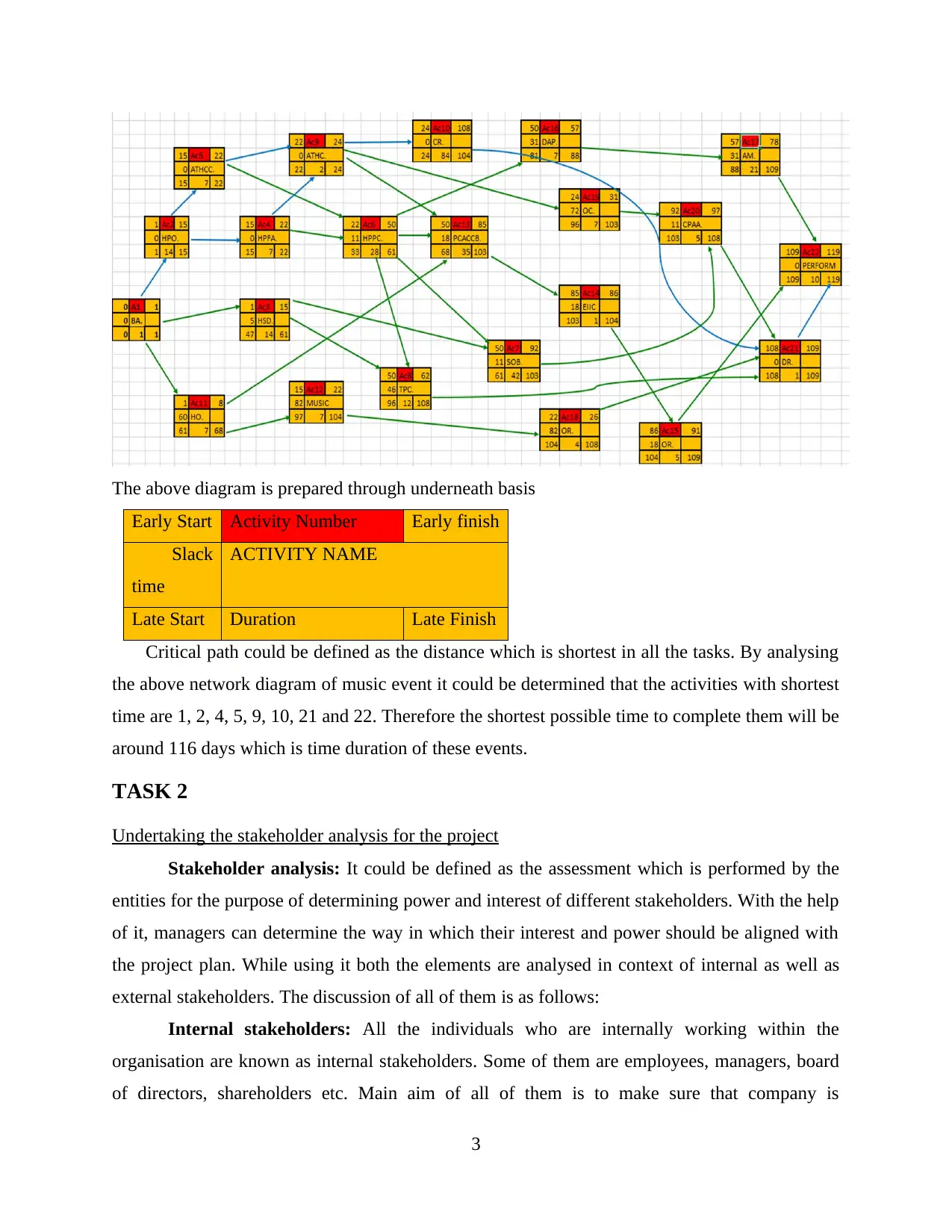
The above diagram is prepared through underneath basis
Early Start Activity Number Early finish
Slack
time
ACTIVITY NAME
Late Start Duration Late Finish
Critical path could be defined as the distance which is shortest in all the tasks. By analysing
the above network diagram of music event it could be determined that the activities with shortest
time are 1, 2, 4, 5, 9, 10, 21 and 22. Therefore the shortest possible time to complete them will be
around 116 days which is time duration of these events.
TASK 2
Undertaking the stakeholder analysis for the project
Stakeholder analysis: It could be defined as the assessment which is performed by the
entities for the purpose of determining power and interest of different stakeholders. With the help
of it, managers can determine the way in which their interest and power should be aligned with
the project plan. While using it both the elements are analysed in context of internal as well as
external stakeholders. The discussion of all of them is as follows:
Internal stakeholders: All the individuals who are internally working within the
organisation are known as internal stakeholders. Some of them are employees, managers, board
of directors, shareholders etc. Main aim of all of them is to make sure that company is
3
Early Start Activity Number Early finish
Slack
time
ACTIVITY NAME
Late Start Duration Late Finish
Critical path could be defined as the distance which is shortest in all the tasks. By analysing
the above network diagram of music event it could be determined that the activities with shortest
time are 1, 2, 4, 5, 9, 10, 21 and 22. Therefore the shortest possible time to complete them will be
around 116 days which is time duration of these events.
TASK 2
Undertaking the stakeholder analysis for the project
Stakeholder analysis: It could be defined as the assessment which is performed by the
entities for the purpose of determining power and interest of different stakeholders. With the help
of it, managers can determine the way in which their interest and power should be aligned with
the project plan. While using it both the elements are analysed in context of internal as well as
external stakeholders. The discussion of all of them is as follows:
Internal stakeholders: All the individuals who are internally working within the
organisation are known as internal stakeholders. Some of them are employees, managers, board
of directors, shareholders etc. Main aim of all of them is to make sure that company is
3
performing well so that the organisational as well as their personal goals could be fulfilled
(Cerdeiral and Santos 2019).
External stakeholders: The outsider parties of the entity are known as external
stakeholders who are interested in performance of business. Some of them are community,
clients, society, customers, government etc. They are interested in performance of business so
that decisions of buying products, making investment and providing credit could be taken.
While planning to conduct the stakeholder analysis the matrix could be used. All the key
aspects of it are discussed below in context of the project of Camden Sickle Cell and
Thalassaemia Service Group which is an event:
High power low interest: These are such stakeholders have low interest in the business
but they have high power to take decisions for the business. Government is considered as
the main stakeholder with this factor which is not interested in the event but the power for
making decisions for the same is high. If a new policy will be formed by legal authorities
in context of events, then the managers will have to comply with it (Galli, 2017).
High power high interest: All stakeholders who are having high interest in the
performance of event as well as have authority to make the decisions are related to this
element. Investors, managers, creditors etc. are some of the internal as well as external
stakeholders who have high power and high interest. They formulate decisions for
effective execution of all the activities and take interest in the performance.
Low power high interest: The stakeholders who are not having any power of formulating
decisions for the business or project but they are interested in the performance are the
part of this category. Customers are the main external stakeholders who are not having
power to pass judgement for the event but they are highly interested in proper execution
of all the activities.
Low power low interest: If the stakeholders do not have any power and interest in the
business then they are considered as the part of this category. Employees and staff
members are such stakeholders who are not having any power and interest in business as
they receive salary whether entity generates profit or not (Galli, 2018).
4
(Cerdeiral and Santos 2019).
External stakeholders: The outsider parties of the entity are known as external
stakeholders who are interested in performance of business. Some of them are community,
clients, society, customers, government etc. They are interested in performance of business so
that decisions of buying products, making investment and providing credit could be taken.
While planning to conduct the stakeholder analysis the matrix could be used. All the key
aspects of it are discussed below in context of the project of Camden Sickle Cell and
Thalassaemia Service Group which is an event:
High power low interest: These are such stakeholders have low interest in the business
but they have high power to take decisions for the business. Government is considered as
the main stakeholder with this factor which is not interested in the event but the power for
making decisions for the same is high. If a new policy will be formed by legal authorities
in context of events, then the managers will have to comply with it (Galli, 2017).
High power high interest: All stakeholders who are having high interest in the
performance of event as well as have authority to make the decisions are related to this
element. Investors, managers, creditors etc. are some of the internal as well as external
stakeholders who have high power and high interest. They formulate decisions for
effective execution of all the activities and take interest in the performance.
Low power high interest: The stakeholders who are not having any power of formulating
decisions for the business or project but they are interested in the performance are the
part of this category. Customers are the main external stakeholders who are not having
power to pass judgement for the event but they are highly interested in proper execution
of all the activities.
Low power low interest: If the stakeholders do not have any power and interest in the
business then they are considered as the part of this category. Employees and staff
members are such stakeholders who are not having any power and interest in business as
they receive salary whether entity generates profit or not (Galli, 2018).
4
⊘ This is a preview!⊘
Do you want full access?
Subscribe today to unlock all pages.
Trusted by 1+ million students worldwide
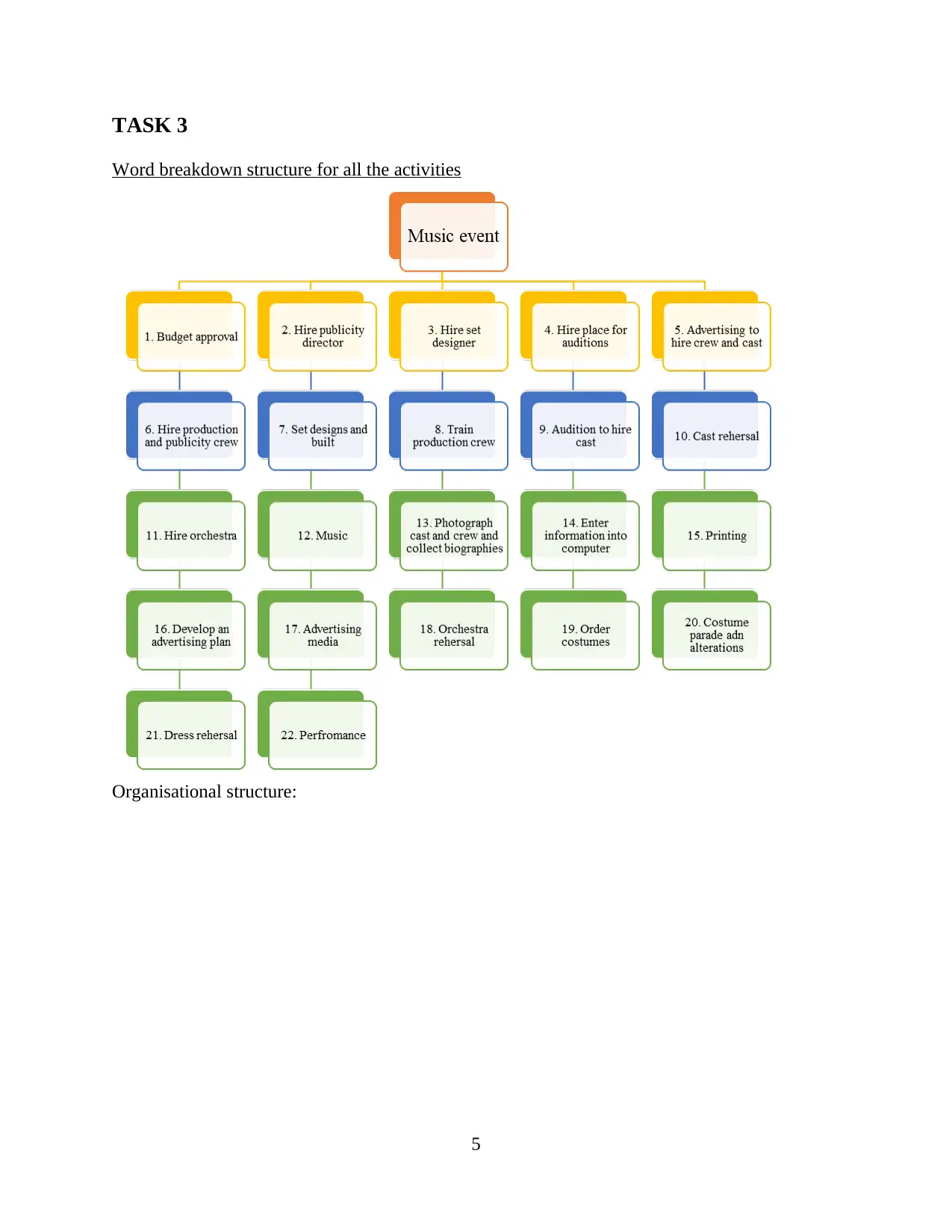
TASK 3
Word breakdown structure for all the activities
Organisational structure:
5
Word breakdown structure for all the activities
Organisational structure:
5
Paraphrase This Document
Need a fresh take? Get an instant paraphrase of this document with our AI Paraphraser
TASK 4
Risk analysis for 20 risks that could affect the project
No. Risk Effect Possibility Mitigation
1 Loss of reputation High Low Proper execution of event activities.
2 Financial loss Low Moderate Effective management of funds
3 Loss of equipment Moderate Low Arranging equipment systematically
4 Lack of staff members High High Recruiting appropriate number of
individuals
5 Safety and security Low Moderate Making arrangements of safety and
security
6 Hygiene of food High Low Paying attention towards food safety
6
Risk analysis for 20 risks that could affect the project
No. Risk Effect Possibility Mitigation
1 Loss of reputation High Low Proper execution of event activities.
2 Financial loss Low Moderate Effective management of funds
3 Loss of equipment Moderate Low Arranging equipment systematically
4 Lack of staff members High High Recruiting appropriate number of
individuals
5 Safety and security Low Moderate Making arrangements of safety and
security
6 Hygiene of food High Low Paying attention towards food safety
6
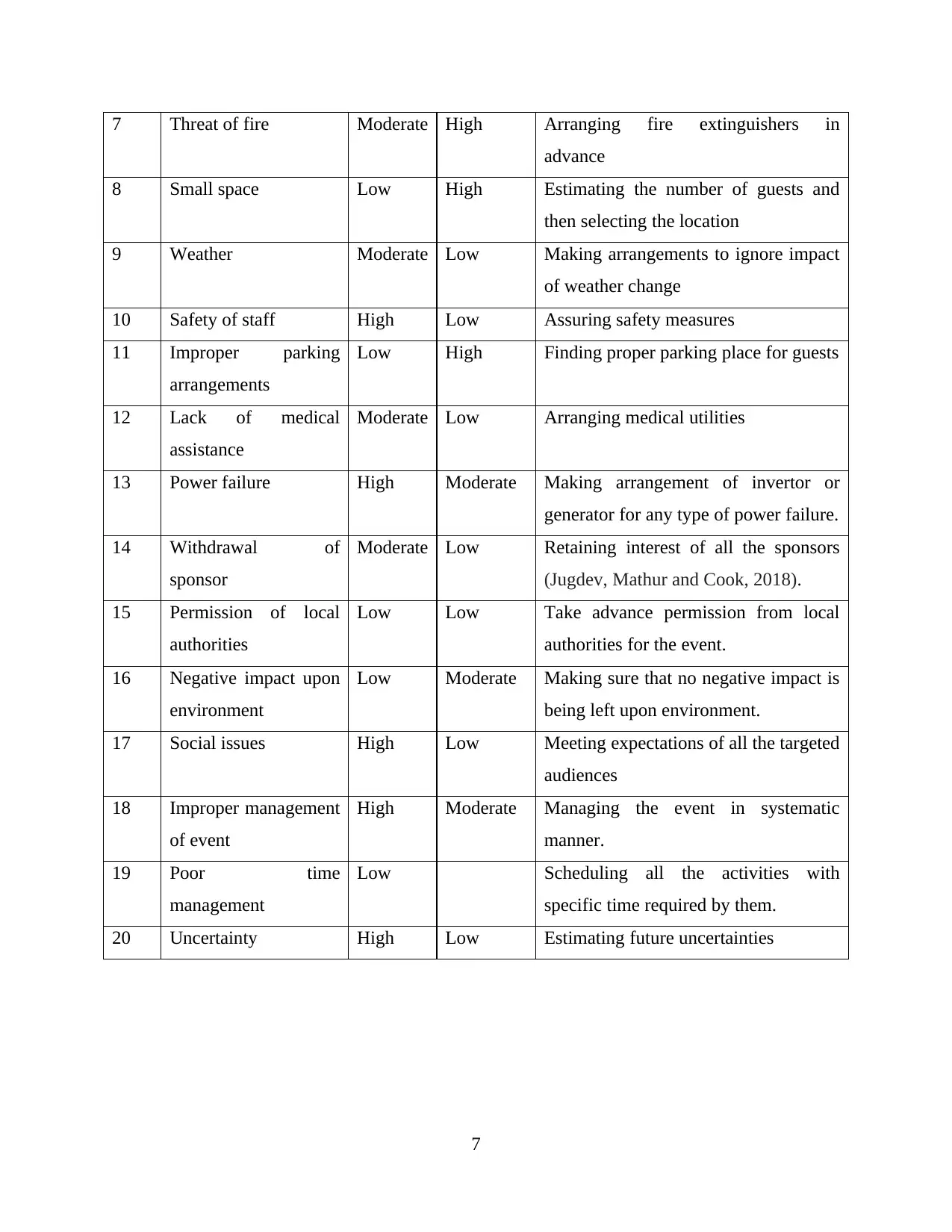
7 Threat of fire Moderate High Arranging fire extinguishers in
advance
8 Small space Low High Estimating the number of guests and
then selecting the location
9 Weather Moderate Low Making arrangements to ignore impact
of weather change
10 Safety of staff High Low Assuring safety measures
11 Improper parking
arrangements
Low High Finding proper parking place for guests
12 Lack of medical
assistance
Moderate Low Arranging medical utilities
13 Power failure High Moderate Making arrangement of invertor or
generator for any type of power failure.
14 Withdrawal of
sponsor
Moderate Low Retaining interest of all the sponsors
(Jugdev, Mathur and Cook, 2018).
15 Permission of local
authorities
Low Low Take advance permission from local
authorities for the event.
16 Negative impact upon
environment
Low Moderate Making sure that no negative impact is
being left upon environment.
17 Social issues High Low Meeting expectations of all the targeted
audiences
18 Improper management
of event
High Moderate Managing the event in systematic
manner.
19 Poor time
management
Low Scheduling all the activities with
specific time required by them.
20 Uncertainty High Low Estimating future uncertainties
7
advance
8 Small space Low High Estimating the number of guests and
then selecting the location
9 Weather Moderate Low Making arrangements to ignore impact
of weather change
10 Safety of staff High Low Assuring safety measures
11 Improper parking
arrangements
Low High Finding proper parking place for guests
12 Lack of medical
assistance
Moderate Low Arranging medical utilities
13 Power failure High Moderate Making arrangement of invertor or
generator for any type of power failure.
14 Withdrawal of
sponsor
Moderate Low Retaining interest of all the sponsors
(Jugdev, Mathur and Cook, 2018).
15 Permission of local
authorities
Low Low Take advance permission from local
authorities for the event.
16 Negative impact upon
environment
Low Moderate Making sure that no negative impact is
being left upon environment.
17 Social issues High Low Meeting expectations of all the targeted
audiences
18 Improper management
of event
High Moderate Managing the event in systematic
manner.
19 Poor time
management
Low Scheduling all the activities with
specific time required by them.
20 Uncertainty High Low Estimating future uncertainties
7
⊘ This is a preview!⊘
Do you want full access?
Subscribe today to unlock all pages.
Trusted by 1+ million students worldwide
TASK 5
Quality expectation, acceptance criteria, quality specification and measures that would be put in
place to control the event
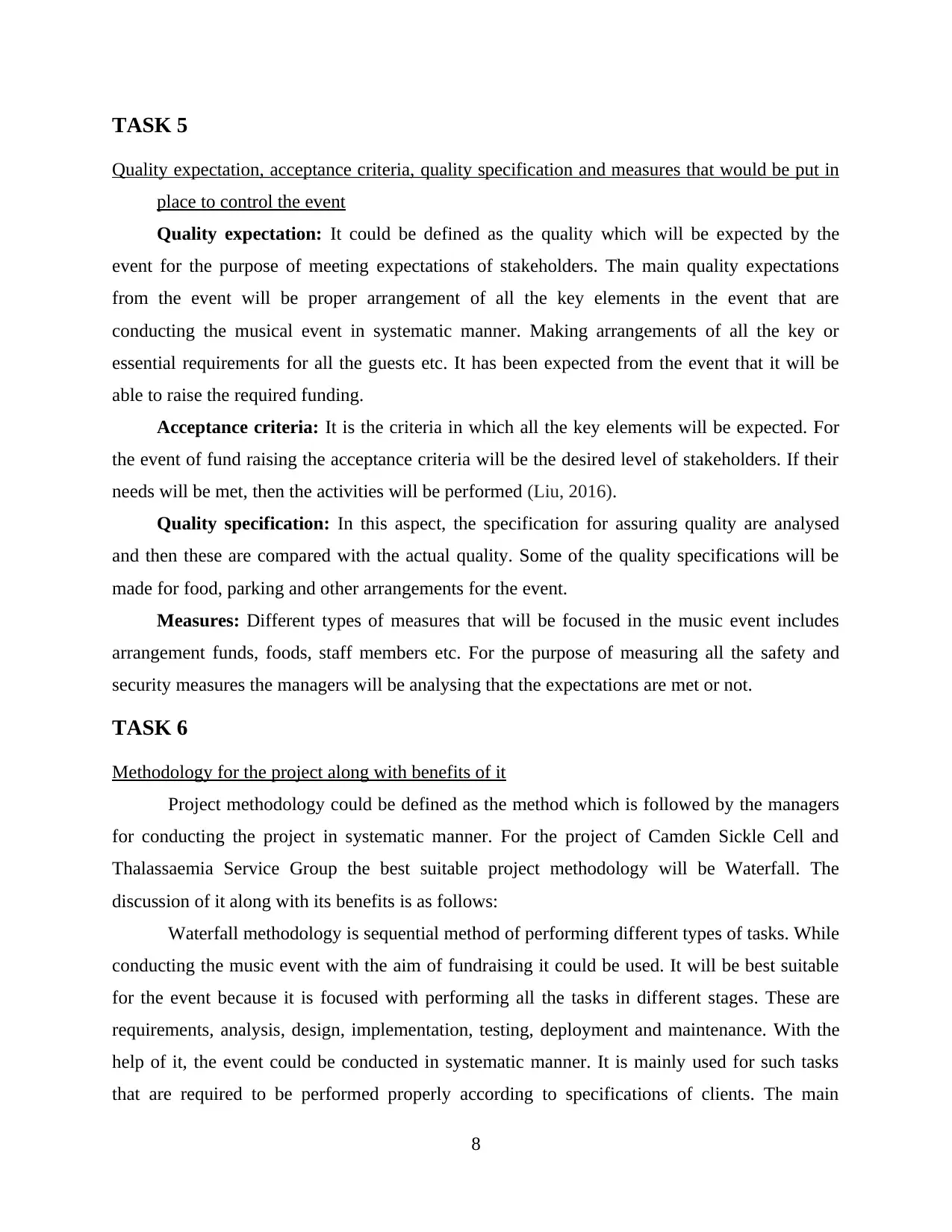
Quality expectation: It could be defined as the quality which will be expected by the
event for the purpose of meeting expectations of stakeholders. The main quality expectations
from the event will be proper arrangement of all the key elements in the event that are
conducting the musical event in systematic manner. Making arrangements of all the key or
essential requirements for all the guests etc. It has been expected from the event that it will be
able to raise the required funding.
Acceptance criteria: It is the criteria in which all the key elements will be expected. For
the event of fund raising the acceptance criteria will be the desired level of stakeholders. If their
needs will be met, then the activities will be performed (Liu, 2016).
Quality specification: In this aspect, the specification for assuring quality are analysed
and then these are compared with the actual quality. Some of the quality specifications will be
made for food, parking and other arrangements for the event.
Measures: Different types of measures that will be focused in the music event includes
arrangement funds, foods, staff members etc. For the purpose of measuring all the safety and
security measures the managers will be analysing that the expectations are met or not.
TASK 6
Methodology for the project along with benefits of it
Project methodology could be defined as the method which is followed by the managers
for conducting the project in systematic manner. For the project of Camden Sickle Cell and
Thalassaemia Service Group the best suitable project methodology will be Waterfall. The
discussion of it along with its benefits is as follows:
Waterfall methodology is sequential method of performing different types of tasks. While
conducting the music event with the aim of fundraising it could be used. It will be best suitable
for the event because it is focused with performing all the tasks in different stages. These are
requirements, analysis, design, implementation, testing, deployment and maintenance. With the
help of it, the event could be conducted in systematic manner. It is mainly used for such tasks
that are required to be performed properly according to specifications of clients. The main
8
Quality expectation, acceptance criteria, quality specification and measures that would be put in
place to control the event
Quality expectation: It could be defined as the quality which will be expected by the
event for the purpose of meeting expectations of stakeholders. The main quality expectations
from the event will be proper arrangement of all the key elements in the event that are
conducting the musical event in systematic manner. Making arrangements of all the key or
essential requirements for all the guests etc. It has been expected from the event that it will be
able to raise the required funding.
Acceptance criteria: It is the criteria in which all the key elements will be expected. For
the event of fund raising the acceptance criteria will be the desired level of stakeholders. If their
needs will be met, then the activities will be performed (Liu, 2016).
Quality specification: In this aspect, the specification for assuring quality are analysed
and then these are compared with the actual quality. Some of the quality specifications will be
made for food, parking and other arrangements for the event.
Measures: Different types of measures that will be focused in the music event includes
arrangement funds, foods, staff members etc. For the purpose of measuring all the safety and
security measures the managers will be analysing that the expectations are met or not.
TASK 6
Methodology for the project along with benefits of it
Project methodology could be defined as the method which is followed by the managers
for conducting the project in systematic manner. For the project of Camden Sickle Cell and
Thalassaemia Service Group the best suitable project methodology will be Waterfall. The
discussion of it along with its benefits is as follows:
Waterfall methodology is sequential method of performing different types of tasks. While
conducting the music event with the aim of fundraising it could be used. It will be best suitable
for the event because it is focused with performing all the tasks in different stages. These are
requirements, analysis, design, implementation, testing, deployment and maintenance. With the
help of it, the event could be conducted in systematic manner. It is mainly used for such tasks
that are required to be performed properly according to specifications of clients. The main
8
Paraphrase This Document
Need a fresh take? Get an instant paraphrase of this document with our AI Paraphraser
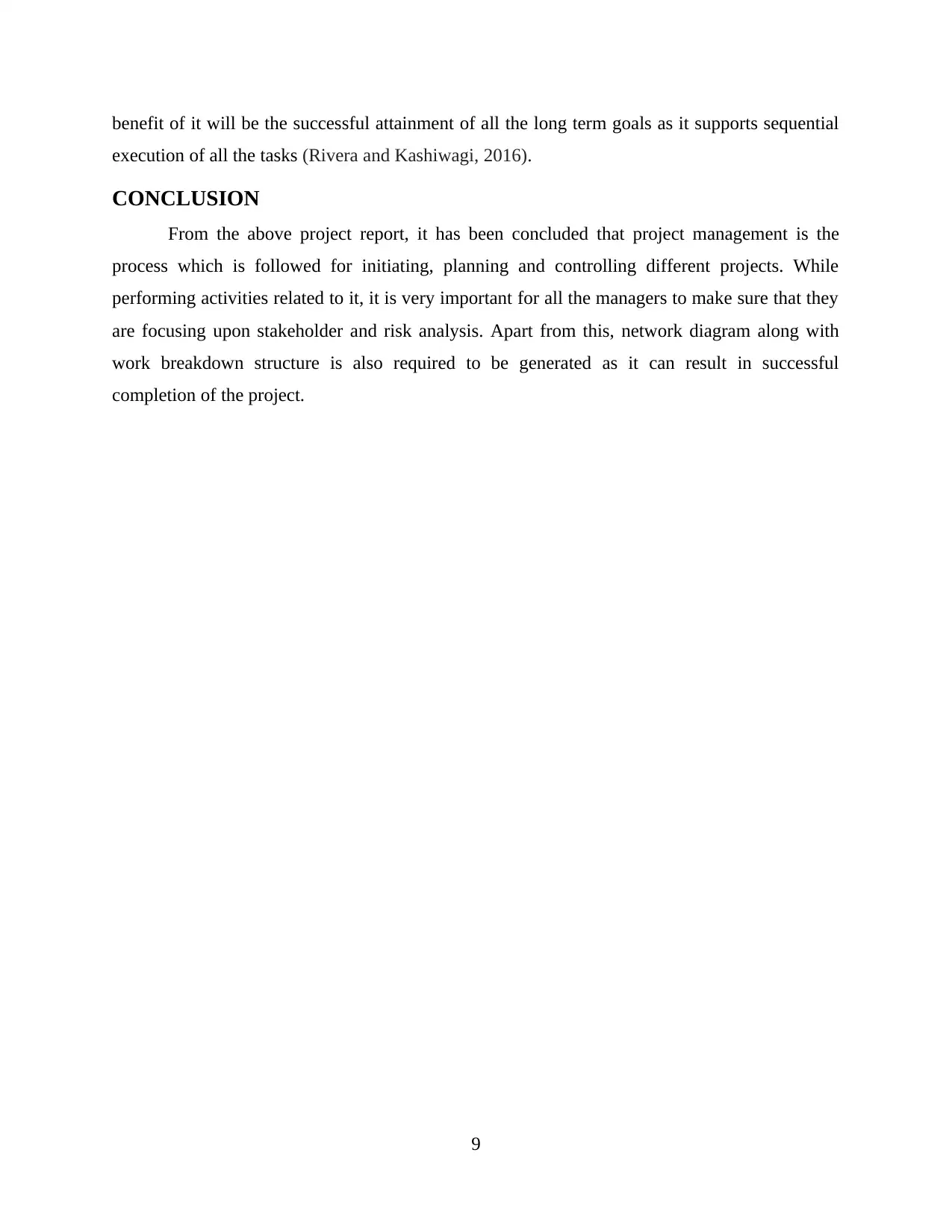
benefit of it will be the successful attainment of all the long term goals as it supports sequential
execution of all the tasks (Rivera and Kashiwagi, 2016).
CONCLUSION
From the above project report, it has been concluded that project management is the
process which is followed for initiating, planning and controlling different projects. While
performing activities related to it, it is very important for all the managers to make sure that they
are focusing upon stakeholder and risk analysis. Apart from this, network diagram along with
work breakdown structure is also required to be generated as it can result in successful
completion of the project.
9
execution of all the tasks (Rivera and Kashiwagi, 2016).
CONCLUSION
From the above project report, it has been concluded that project management is the
process which is followed for initiating, planning and controlling different projects. While
performing activities related to it, it is very important for all the managers to make sure that they
are focusing upon stakeholder and risk analysis. Apart from this, network diagram along with
work breakdown structure is also required to be generated as it can result in successful
completion of the project.
9
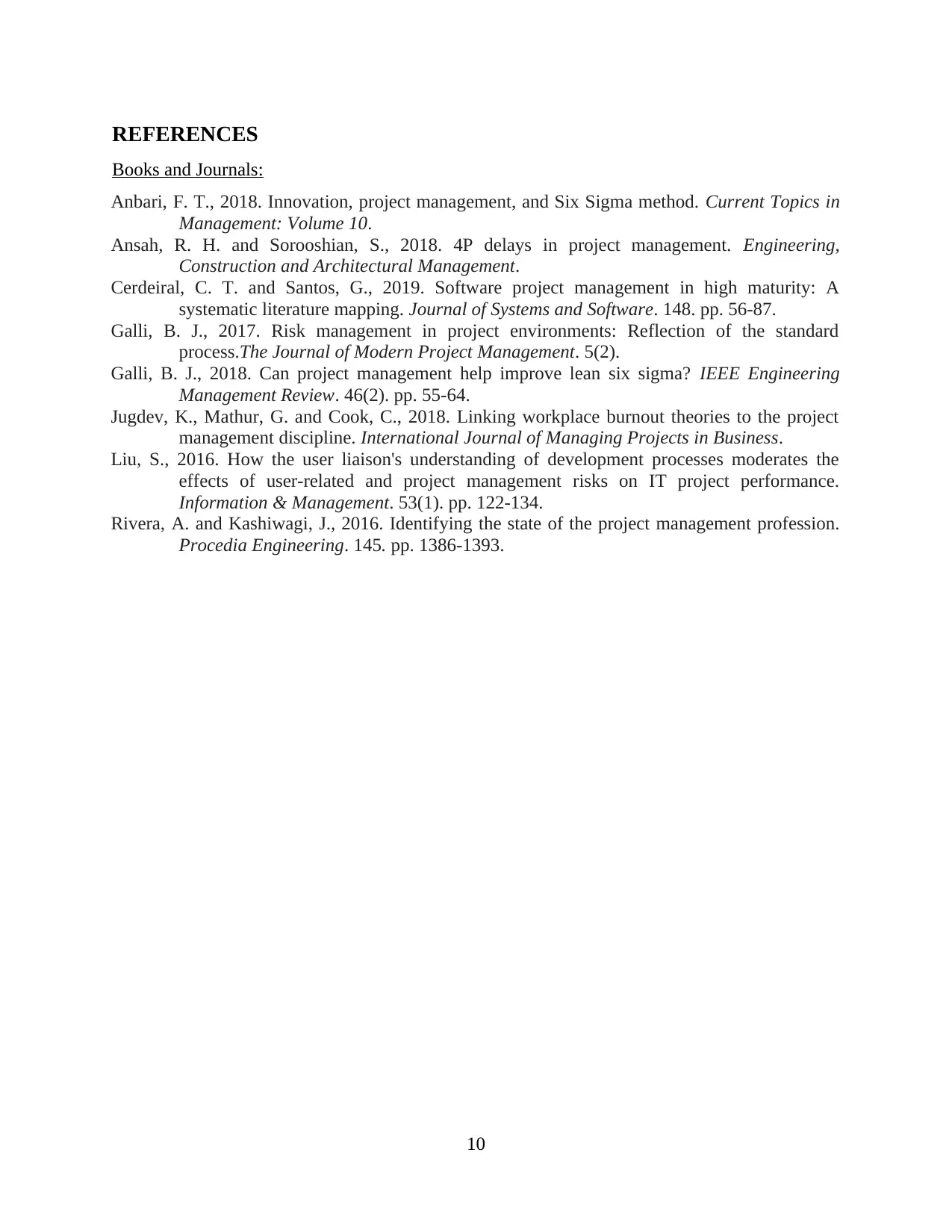
REFERENCES
Books and Journals:
Anbari, F. T., 2018. Innovation, project management, and Six Sigma method. Current Topics in
Management: Volume 10.
Ansah, R. H. and Sorooshian, S., 2018. 4P delays in project management. Engineering,
Construction and Architectural Management.
Cerdeiral, C. T. and Santos, G., 2019. Software project management in high maturity: A
systematic literature mapping. Journal of Systems and Software. 148. pp. 56-87.
Galli, B. J., 2017. Risk management in project environments: Reflection of the standard
process.The Journal of Modern Project Management. 5(2).
Galli, B. J., 2018. Can project management help improve lean six sigma? IEEE Engineering
Management Review. 46(2). pp. 55-64.
Jugdev, K., Mathur, G. and Cook, C., 2018. Linking workplace burnout theories to the project
management discipline. International Journal of Managing Projects in Business.
Liu, S., 2016. How the user liaison's understanding of development processes moderates the
effects of user-related and project management risks on IT project performance.
Information & Management. 53(1). pp. 122-134.
Rivera, A. and Kashiwagi, J., 2016. Identifying the state of the project management profession.
Procedia Engineering. 145. pp. 1386-1393.
10
Books and Journals:
Anbari, F. T., 2018. Innovation, project management, and Six Sigma method. Current Topics in
Management: Volume 10.
Ansah, R. H. and Sorooshian, S., 2018. 4P delays in project management. Engineering,
Construction and Architectural Management.
Cerdeiral, C. T. and Santos, G., 2019. Software project management in high maturity: A
systematic literature mapping. Journal of Systems and Software. 148. pp. 56-87.
Galli, B. J., 2017. Risk management in project environments: Reflection of the standard
process.The Journal of Modern Project Management. 5(2).
Galli, B. J., 2018. Can project management help improve lean six sigma? IEEE Engineering
Management Review. 46(2). pp. 55-64.
Jugdev, K., Mathur, G. and Cook, C., 2018. Linking workplace burnout theories to the project
management discipline. International Journal of Managing Projects in Business.
Liu, S., 2016. How the user liaison's understanding of development processes moderates the
effects of user-related and project management risks on IT project performance.
Information & Management. 53(1). pp. 122-134.
Rivera, A. and Kashiwagi, J., 2016. Identifying the state of the project management profession.
Procedia Engineering. 145. pp. 1386-1393.
10
⊘ This is a preview!⊘
Do you want full access?
Subscribe today to unlock all pages.
Trusted by 1+ million students worldwide

1 out of 12


Related Documents


Your All-in-One AI-Powered Toolkit for Academic Success.
+13062052269
info@desklib.com
Available 24*7 on WhatsApp / Email
![[object Object]](/_next/static/media/star-bottom.7253800d.svg)
Unlock your academic potential
Copyright © 2020–2026 A2Z Services. All Rights Reserved. Developed and managed by ZUCOL.