Canada Labor: Challenges, Defensive Stance, and Protecting New Workers

Verified

Added on  2023/05/27

|4
|654
|343
Essay
AI Summary
This essay explores the challenges confronting Canada's labor movement, including rising anti-union sentiments and governmental interference, which erode the right to strike. It highlights the perception of labor movements as outdated institutions hindering national progress. The essay also discusses how unions have adopted a defensive stance by securing support from international organizations, society, and influential leaders. Furthermore, it addresses the issue of 'new workers' employed on contract terms and emphasizes the need for unions to protect these workers from exploitation by ensuring reasonable employment conditions. Desklib offers a platform for students to access similar solved assignments and study resources.
Document Page
Running head: CANADA LABOR 1
CANADA LABOR
Student’s name
Institution affiliation
tabler-icon-diamond-filled.svg

Paraphrase This Document

Need a fresh take? Get an instant paraphrase of this document with our AI Paraphraser
Document Page
CANADA LABOR 2
Question 1
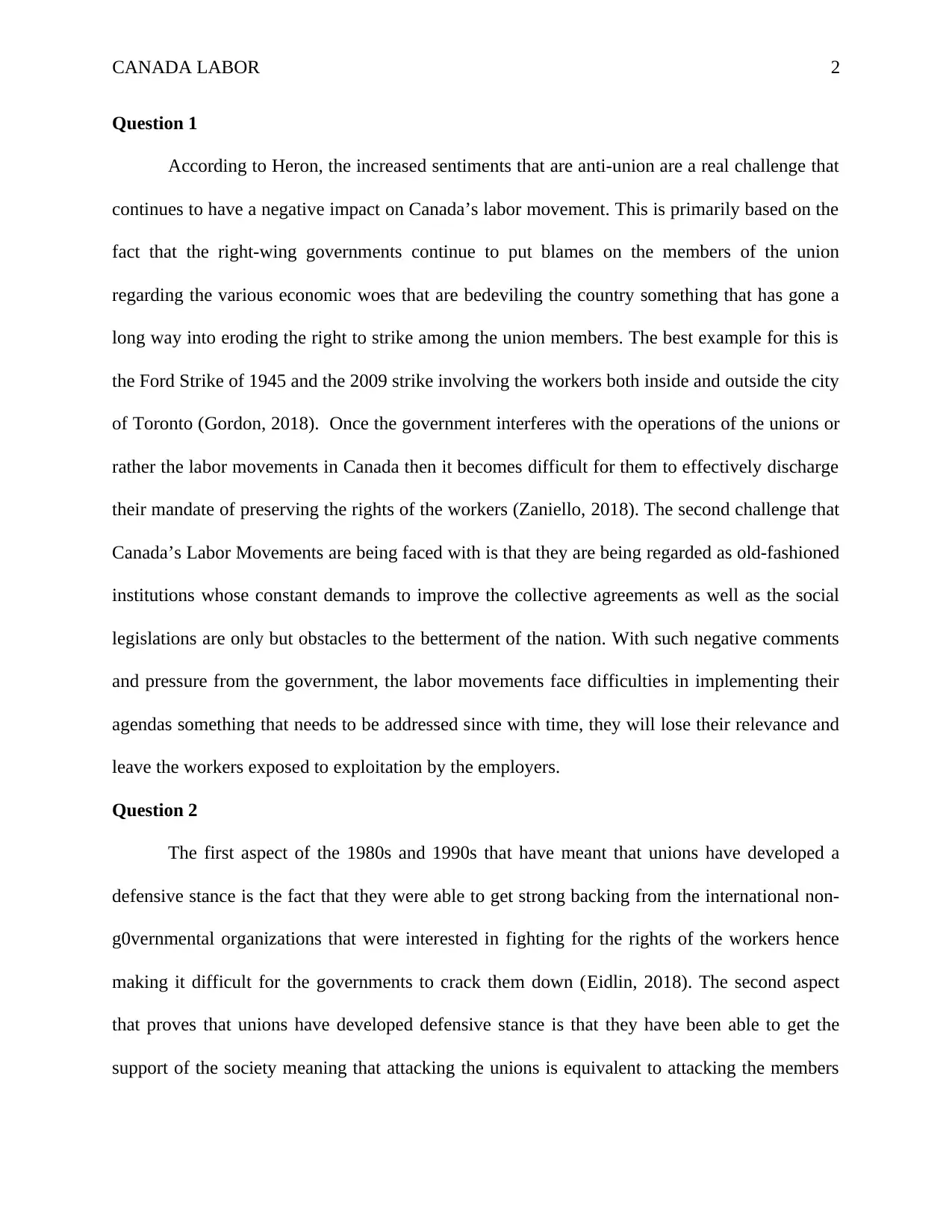
According to Heron, the increased sentiments that are anti-union are a real challenge that
continues to have a negative impact on Canada’s labor movement. This is primarily based on the
fact that the right-wing governments continue to put blames on the members of the union
regarding the various economic woes that are bedeviling the country something that has gone a
long way into eroding the right to strike among the union members. The best example for this is
the Ford Strike of 1945 and the 2009 strike involving the workers both inside and outside the city
of Toronto (Gordon, 2018). Once the government interferes with the operations of the unions or
rather the labor movements in Canada then it becomes difficult for them to effectively discharge
their mandate of preserving the rights of the workers (Zaniello, 2018). The second challenge that
Canada’s Labor Movements are being faced with is that they are being regarded as old-fashioned
institutions whose constant demands to improve the collective agreements as well as the social
legislations are only but obstacles to the betterment of the nation. With such negative comments
and pressure from the government, the labor movements face difficulties in implementing their
agendas something that needs to be addressed since with time, they will lose their relevance and
leave the workers exposed to exploitation by the employers.
Question 2
The first aspect of the 1980s and 1990s that have meant that unions have developed a
defensive stance is the fact that they were able to get strong backing from the international non-
g0vernmental organizations that were interested in fighting for the rights of the workers hence
making it difficult for the governments to crack them down (Eidlin, 2018). The second aspect
that proves that unions have developed defensive stance is that they have been able to get the
support of the society meaning that attacking the unions is equivalent to attacking the members
Document Page
CANADA LABOR 3
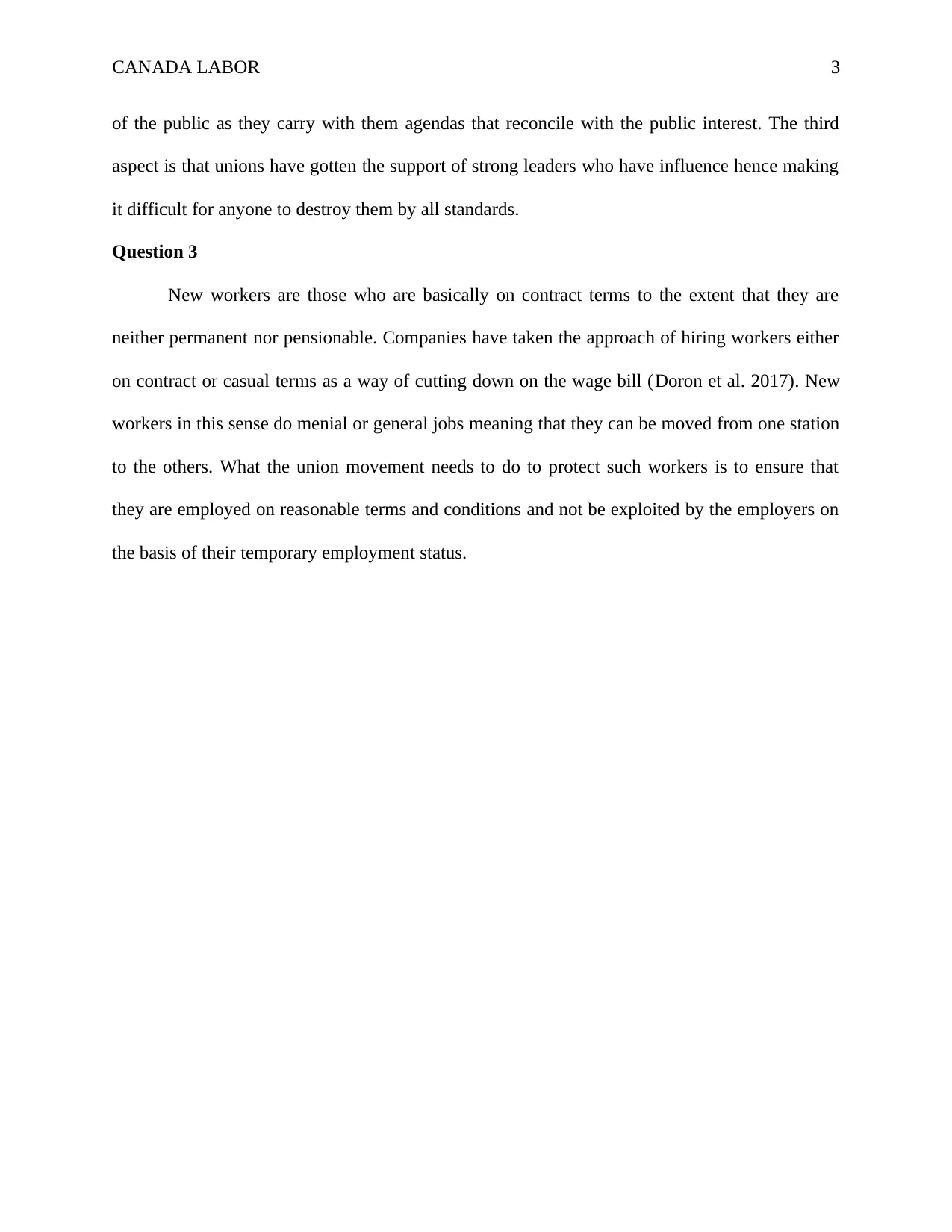
of the public as they carry with them agendas that reconcile with the public interest. The third
aspect is that unions have gotten the support of strong leaders who have influence hence making
it difficult for anyone to destroy them by all standards.
Question 3
New workers are those who are basically on contract terms to the extent that they are
neither permanent nor pensionable. Companies have taken the approach of hiring workers either
on contract or casual terms as a way of cutting down on the wage bill (Doron et al. 2017). New
workers in this sense do menial or general jobs meaning that they can be moved from one station
to the others. What the union movement needs to do to protect such workers is to ensure that
they are employed on reasonable terms and conditions and not be exploited by the employers on
the basis of their temporary employment status.
Document Page
CANADA LABOR 4
References
Doron, I., Lowenstein, A., & Biggs, S. (2017). Law and intergenerational relationships:
Comparing labor case law in the United States, Canada, and Israel. Journal of Applied
Gerontology, 36(3), 277-295.
Eidlin, B. (2018). Labor and the Class Idea in the United States and Canada. Cambridge
University Press.
Gordon, A. (2018). Portraits Of The Japanese Workplace: Labor Movements, Workers, And
Managers. Routledge.
Zaniello, T. (2018). Working stiffs, union maids, reds, and riffraff: an expanded guide to films
about labor. Cornell University Press.
chevron_up_icon
1 out of 4
circle_padding
hide_on_mobile
zoom_out_icon
[object Object]