A Comparative Report on the Tourism Competitiveness of Canada and USA
VerifiedAdded on 2023/05/29
|16
|3757
|246
Report
AI Summary
This report provides a comparative analysis of the tourism competitiveness of Canada and the USA, utilizing data from the Travel & Tourism Competitiveness Index and other relevant metrics. It examines the historical trends, current strategies, and competitive advantages of both countries in the tourism sector. The methodology involves a survey-based approach, gathering insights from tourism students and professionals, and employing statistical analysis to evaluate key hypotheses related to transport, hospitality, primary offers, and secondary fields. The report highlights the strengths and weaknesses of each country's tourism industry, focusing on factors such as infrastructure, natural resources, cultural attractions, and regulatory frameworks. It also discusses the impact of economic factors, such as currency exchange rates and oil prices, on domestic and international tourism. The analysis concludes with strategic recommendations for enhancing the competitiveness of both Canada and the USA in the global tourism market, emphasizing the importance of focusing on local travel models, leveraging domestic economic conditions, and fostering long-term travel preferences.
Running Head: COMPARISON OF CANADA AND USA TOURISM COMPETITENESS 1
Comparison of Canada’s and USA tourism competitiveness
Student’s Name
Institution
Comparison of Canada’s and USA tourism competitiveness
Student’s Name
Institution

Paraphrase This Document
Need a fresh take? Get an instant paraphrase of this document with our AI Paraphraser
COMPARISON OF CANADA’S AND USA TOURISM COMPETITIVENESS 2
Table of Contents
Introduction..........................................................................................................................2
Methodology........................................................................................................................3
Comparison between USA and Canada tourism.................................................................4
Current strategies priorities..................................................................................................7
Discussion and recommendation.........................................................................................8
Conclusion.........................................................................................................................11
References..........................................................................................................................13
Table of Contents
Introduction..........................................................................................................................2
Methodology........................................................................................................................3
Comparison between USA and Canada tourism.................................................................4
Current strategies priorities..................................................................................................7
Discussion and recommendation.........................................................................................8
Conclusion.........................................................................................................................11
References..........................................................................................................................13
COMPARISON OF CANADA’S AND USA TOURISM COMPETITIVENESS 3
Introduction
Tourism and the travel sectors in the USA and Canada have been encountering
tremendous threats based on its operational conditions. Therefore, in order this industry to be
improved there is need for the institutions of various tools which will enable managers evaluate
the situation. These tools are essential during the process of finding out and evaluating the
current problems and formulating vivid data on how to improvise the current situation.
Consequently, this facilitates the harmonization of some essential shareholders within the tourist
destinations in Canada and the USA. Therefore, the most effective tools in assessing the present
situation are used in determining the competitiveness of the tourist sector (Akhoondnejad, 2015).
According to the world economic forum, identifying the significance of the current international
economies of Canada and the US will be pointed out in this paper based on various competitive
data of years in the travel and tourism competitiveness index.
Thus with the stated objectives of the Tourism and travel there is need to evaluate the
national levels through a comparative evaluation of current stakeholders in order to acquire
prospective strategic forwardness. Additionally, there exist a greater tourism and travel literature
concerning the sectors competitiveness although there should be precise enactment of certain
competitive structures of the micro tourism destinations within the Canadian and the US tourism
industry. Therefore, the main objective of the paper is by evaluating the competitiveness of two
countries which are the US and Canada tourism destinations (Lew, 2018). Consequently, the
main aim of the paper is creating a better competitive nature of the two countries, and evaluating
Introduction
Tourism and the travel sectors in the USA and Canada have been encountering
tremendous threats based on its operational conditions. Therefore, in order this industry to be
improved there is need for the institutions of various tools which will enable managers evaluate
the situation. These tools are essential during the process of finding out and evaluating the
current problems and formulating vivid data on how to improvise the current situation.
Consequently, this facilitates the harmonization of some essential shareholders within the tourist
destinations in Canada and the USA. Therefore, the most effective tools in assessing the present
situation are used in determining the competitiveness of the tourist sector (Akhoondnejad, 2015).
According to the world economic forum, identifying the significance of the current international
economies of Canada and the US will be pointed out in this paper based on various competitive
data of years in the travel and tourism competitiveness index.
Thus with the stated objectives of the Tourism and travel there is need to evaluate the
national levels through a comparative evaluation of current stakeholders in order to acquire
prospective strategic forwardness. Additionally, there exist a greater tourism and travel literature
concerning the sectors competitiveness although there should be precise enactment of certain
competitive structures of the micro tourism destinations within the Canadian and the US tourism
industry. Therefore, the main objective of the paper is by evaluating the competitiveness of two
countries which are the US and Canada tourism destinations (Lew, 2018). Consequently, the
main aim of the paper is creating a better competitive nature of the two countries, and evaluating
⊘ This is a preview!⊘
Do you want full access?
Subscribe today to unlock all pages.

Trusted by 1+ million students worldwide
COMPARISON OF CANADA’S AND USA TOURISM COMPETITIVENESS 4
the tourism sectors of the countries. Thus the technique and the methods employed for the
implementation of the topic is centered on the various competitive models which will be outlined
in the paper below. Additionally, the paper will assess the competitive nature of Canada and
USA through evaluating a thorough evaluation of the countries competitive nature (Xiao, 2010).
Canada and USA were specifically selected due to the close linkage of history about the
infrastructure and the tourist sector of the two countries.
Research Question: What are the main difference between Canada’s and USA competitiveness
of the tourism sector?
Methodology
Relating to the chosen destinations of the tourism sectors, competitive nature models
presented by Katircioglu (2009), which evaluated the two countries survey analysis specifically
carried out the competitiveness of Canada and USA. Therefore the exact tourism destinations
chosen were similar relating to the set indicators which apply. Thus as recommended a list of
indicators will be chosen of Canada’s and USA destinations will be selected. Thus the
commonest research approach instituted in this paper’s competitiveness structure is based on the
tourism visitor’s recommendations. Based on this scenario, a survey will be conducted based on
various observations from young tourism students and other senior members of the tourism
department. Consequently, about 130 questionnaires were used with 73 from America and about
57 from the Canadian tourism sector.
the tourism sectors of the countries. Thus the technique and the methods employed for the
implementation of the topic is centered on the various competitive models which will be outlined
in the paper below. Additionally, the paper will assess the competitive nature of Canada and
USA through evaluating a thorough evaluation of the countries competitive nature (Xiao, 2010).
Canada and USA were specifically selected due to the close linkage of history about the
infrastructure and the tourist sector of the two countries.
Research Question: What are the main difference between Canada’s and USA competitiveness
of the tourism sector?
Methodology
Relating to the chosen destinations of the tourism sectors, competitive nature models
presented by Katircioglu (2009), which evaluated the two countries survey analysis specifically
carried out the competitiveness of Canada and USA. Therefore the exact tourism destinations
chosen were similar relating to the set indicators which apply. Thus as recommended a list of
indicators will be chosen of Canada’s and USA destinations will be selected. Thus the
commonest research approach instituted in this paper’s competitiveness structure is based on the
tourism visitor’s recommendations. Based on this scenario, a survey will be conducted based on
various observations from young tourism students and other senior members of the tourism
department. Consequently, about 130 questionnaires were used with 73 from America and about
57 from the Canadian tourism sector.
Paraphrase This Document
Need a fresh take? Get an instant paraphrase of this document with our AI Paraphraser
COMPARISON OF CANADA’S AND USA TOURISM COMPETITIVENESS 5
Thus in orders to acquire a more vivid evaluation of the respondents of certain
indicators, the final findings were categorized in ten segments. Thus in the ten divisions the
findings were recorded in tables and the mean and the standard deviations were thus recorded
together. Additionally, in evaluating the hypotheses, an independent sample T-test was applied in
this scenario (Plunkett & Park, 2018). Although the paper will have various types of T tests
which will be availed using the SPSS T test. An independent sample test will be employed in
order to acquire direct comparison of the groups mean scores of the people’s conditions. In this
set piece there will be dissimilar conditions used in Canada’s and USA tourism destinations
(LEDWINA & WYŁUPEK, 2012). Focused on the research question, 4 hypotheses were
suggested in order to create a clear comparison of the competitive nature of both Canada and
USA as the stated tourist destinations. Thus the hypotheses include:
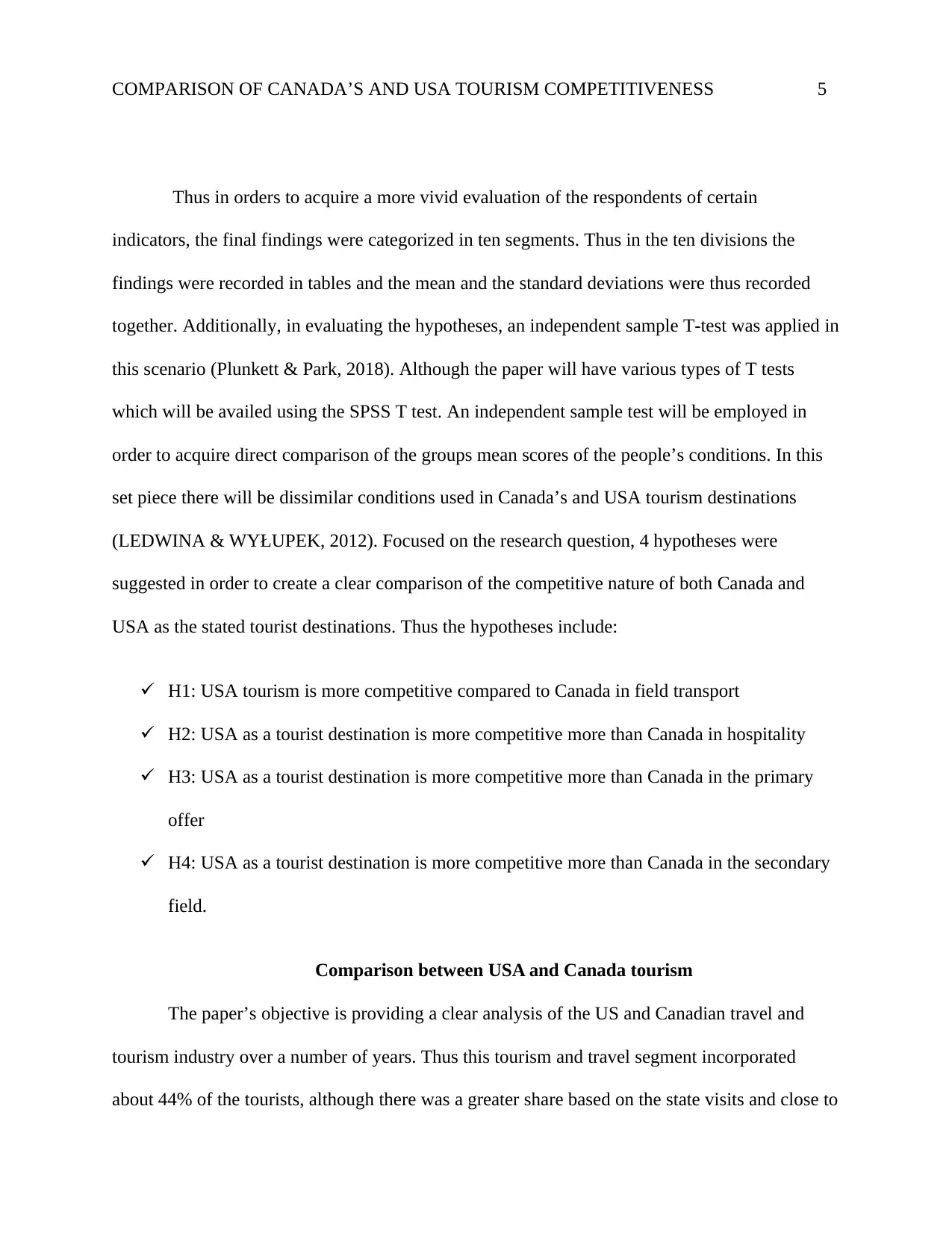
H1: USA tourism is more competitive compared to Canada in field transport
H2: USA as a tourist destination is more competitive more than Canada in hospitality
H3: USA as a tourist destination is more competitive more than Canada in the primary
offer
H4: USA as a tourist destination is more competitive more than Canada in the secondary
field.
Comparison between USA and Canada tourism
The paper’s objective is providing a clear analysis of the US and Canadian travel and
tourism industry over a number of years. Thus this tourism and travel segment incorporated
about 44% of the tourists, although there was a greater share based on the state visits and close to
Thus in orders to acquire a more vivid evaluation of the respondents of certain
indicators, the final findings were categorized in ten segments. Thus in the ten divisions the
findings were recorded in tables and the mean and the standard deviations were thus recorded
together. Additionally, in evaluating the hypotheses, an independent sample T-test was applied in
this scenario (Plunkett & Park, 2018). Although the paper will have various types of T tests
which will be availed using the SPSS T test. An independent sample test will be employed in
order to acquire direct comparison of the groups mean scores of the people’s conditions. In this
set piece there will be dissimilar conditions used in Canada’s and USA tourism destinations
(LEDWINA & WYŁUPEK, 2012). Focused on the research question, 4 hypotheses were
suggested in order to create a clear comparison of the competitive nature of both Canada and
USA as the stated tourist destinations. Thus the hypotheses include:
H1: USA tourism is more competitive compared to Canada in field transport
H2: USA as a tourist destination is more competitive more than Canada in hospitality
H3: USA as a tourist destination is more competitive more than Canada in the primary
offer
H4: USA as a tourist destination is more competitive more than Canada in the secondary
field.
Comparison between USA and Canada tourism
The paper’s objective is providing a clear analysis of the US and Canadian travel and
tourism industry over a number of years. Thus this tourism and travel segment incorporated
about 44% of the tourists, although there was a greater share based on the state visits and close to
COMPARISON OF CANADA’S AND USA TOURISM COMPETITIVENESS 6
all visitor’s spending rates. The past years tendency rates in the tourism sector in both countries
have hugely increased which are upheld for enhancement (Babushko, 2014). According a survey
conducted in the data analysis section sample results were drawn with about 18,637 responses
from the trip records, which in the end summed up to about 25,200 which were the unduplicated
stated person visits (Tavares & Tran, 2018). Consequently, this section will also provide a
thorough analysis of Canada’s and US tourism competitiveness using different metrics such as
the competitiveness index of the countries alongside the comparative advantages of the two
countries.
Travel & Tourism Competitiveness Index 2011 and 2009 comparison
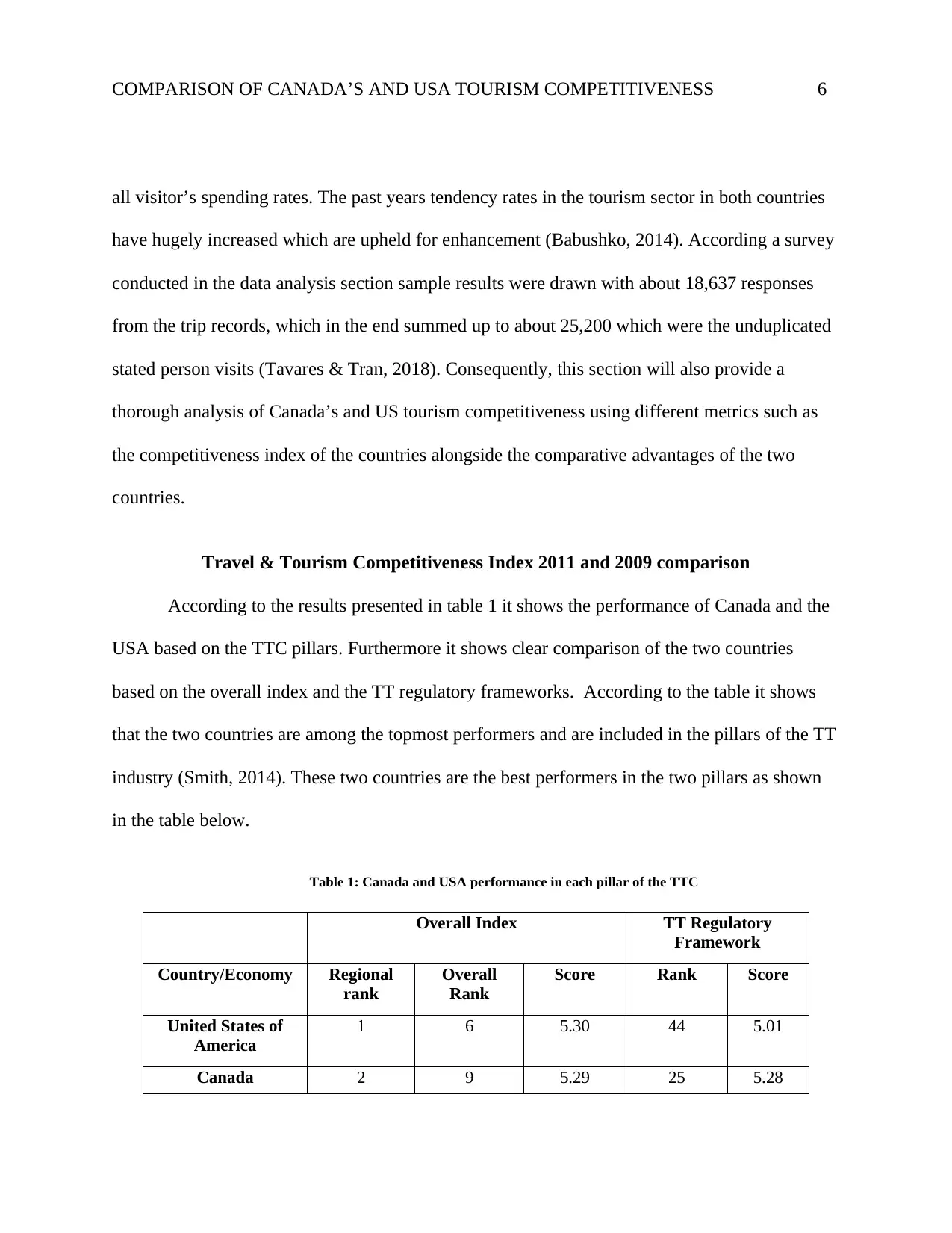
According to the results presented in table 1 it shows the performance of Canada and the
USA based on the TTC pillars. Furthermore it shows clear comparison of the two countries
based on the overall index and the TT regulatory frameworks. According to the table it shows
that the two countries are among the topmost performers and are included in the pillars of the TT
industry (Smith, 2014). These two countries are the best performers in the two pillars as shown
in the table below.
Table 1: Canada and USA performance in each pillar of the TTC
Overall Index TT Regulatory
Framework
Country/Economy Regional
rank
Overall
Rank
Score Rank Score
United States of
America
1 6 5.30 44 5.01
Canada 2 9 5.29 25 5.28
all visitor’s spending rates. The past years tendency rates in the tourism sector in both countries
have hugely increased which are upheld for enhancement (Babushko, 2014). According a survey
conducted in the data analysis section sample results were drawn with about 18,637 responses
from the trip records, which in the end summed up to about 25,200 which were the unduplicated
stated person visits (Tavares & Tran, 2018). Consequently, this section will also provide a
thorough analysis of Canada’s and US tourism competitiveness using different metrics such as
the competitiveness index of the countries alongside the comparative advantages of the two
countries.
Travel & Tourism Competitiveness Index 2011 and 2009 comparison
According to the results presented in table 1 it shows the performance of Canada and the
USA based on the TTC pillars. Furthermore it shows clear comparison of the two countries
based on the overall index and the TT regulatory frameworks. According to the table it shows
that the two countries are among the topmost performers and are included in the pillars of the TT
industry (Smith, 2014). These two countries are the best performers in the two pillars as shown
in the table below.
Table 1: Canada and USA performance in each pillar of the TTC
Overall Index TT Regulatory
Framework
Country/Economy Regional
rank
Overall
Rank
Score Rank Score
United States of
America
1 6 5.30 44 5.01
Canada 2 9 5.29 25 5.28
⊘ This is a preview!⊘
Do you want full access?
Subscribe today to unlock all pages.
Trusted by 1+ million students worldwide
COMPARISON OF CANADA’S AND USA TOURISM COMPETITIVENESS 7
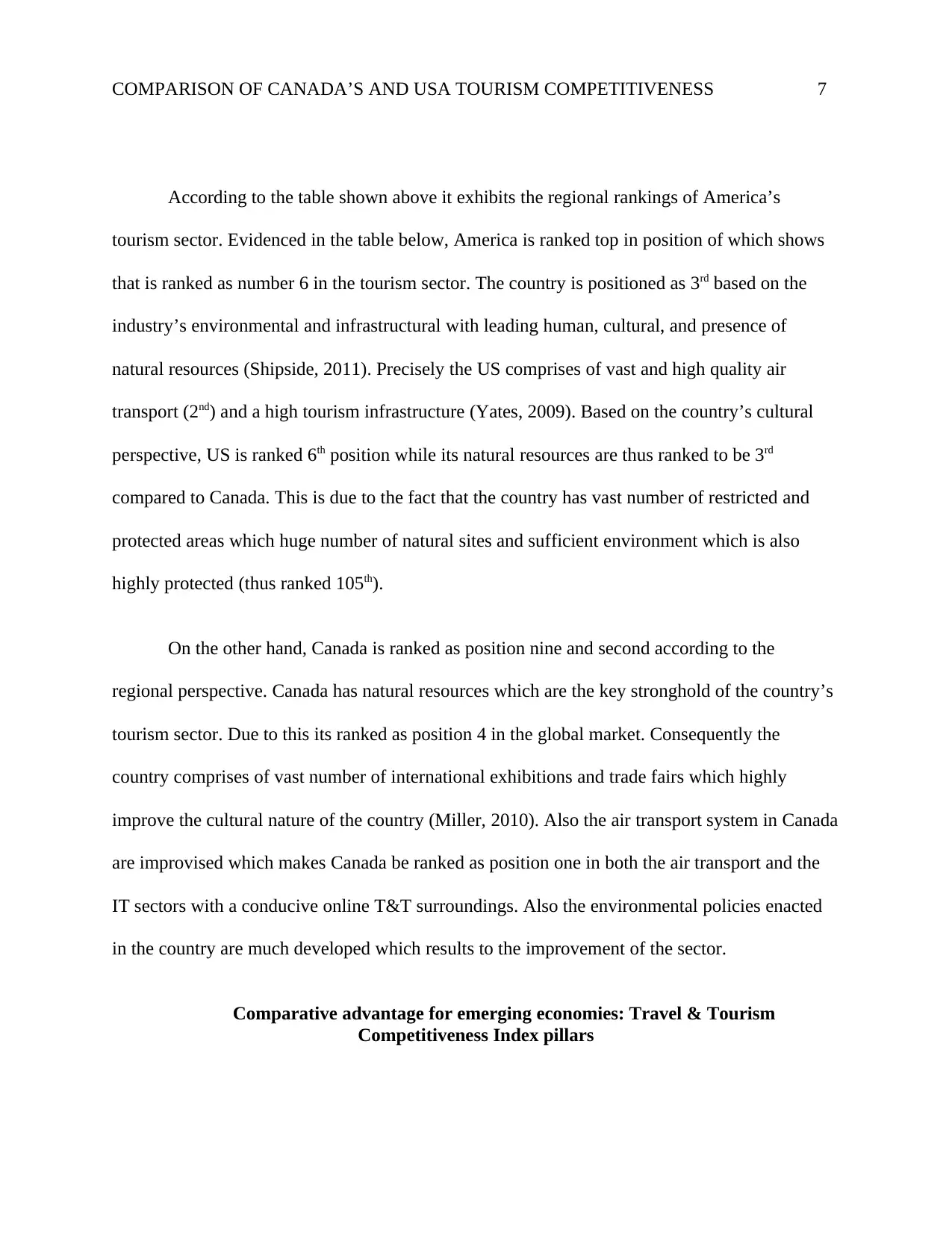
According to the table shown above it exhibits the regional rankings of America’s
tourism sector. Evidenced in the table below, America is ranked top in position of which shows
that is ranked as number 6 in the tourism sector. The country is positioned as 3rd based on the
industry’s environmental and infrastructural with leading human, cultural, and presence of
natural resources (Shipside, 2011). Precisely the US comprises of vast and high quality air
transport (2nd) and a high tourism infrastructure (Yates, 2009). Based on the country’s cultural
perspective, US is ranked 6th position while its natural resources are thus ranked to be 3rd
compared to Canada. This is due to the fact that the country has vast number of restricted and
protected areas which huge number of natural sites and sufficient environment which is also
highly protected (thus ranked 105th).
On the other hand, Canada is ranked as position nine and second according to the
regional perspective. Canada has natural resources which are the key stronghold of the country’s
tourism sector. Due to this its ranked as position 4 in the global market. Consequently the
country comprises of vast number of international exhibitions and trade fairs which highly
improve the cultural nature of the country (Miller, 2010). Also the air transport system in Canada
are improvised which makes Canada be ranked as position one in both the air transport and the
IT sectors with a conducive online T&T surroundings. Also the environmental policies enacted
in the country are much developed which results to the improvement of the sector.
Comparative advantage for emerging economies: Travel & Tourism
Competitiveness Index pillars
According to the table shown above it exhibits the regional rankings of America’s
tourism sector. Evidenced in the table below, America is ranked top in position of which shows
that is ranked as number 6 in the tourism sector. The country is positioned as 3rd based on the
industry’s environmental and infrastructural with leading human, cultural, and presence of
natural resources (Shipside, 2011). Precisely the US comprises of vast and high quality air
transport (2nd) and a high tourism infrastructure (Yates, 2009). Based on the country’s cultural
perspective, US is ranked 6th position while its natural resources are thus ranked to be 3rd
compared to Canada. This is due to the fact that the country has vast number of restricted and
protected areas which huge number of natural sites and sufficient environment which is also
highly protected (thus ranked 105th).
On the other hand, Canada is ranked as position nine and second according to the
regional perspective. Canada has natural resources which are the key stronghold of the country’s
tourism sector. Due to this its ranked as position 4 in the global market. Consequently the
country comprises of vast number of international exhibitions and trade fairs which highly
improve the cultural nature of the country (Miller, 2010). Also the air transport system in Canada
are improvised which makes Canada be ranked as position one in both the air transport and the
IT sectors with a conducive online T&T surroundings. Also the environmental policies enacted
in the country are much developed which results to the improvement of the sector.
Comparative advantage for emerging economies: Travel & Tourism
Competitiveness Index pillars
Paraphrase This Document
Need a fresh take? Get an instant paraphrase of this document with our AI Paraphraser
COMPARISON OF CANADA’S AND USA TOURISM COMPETITIVENESS 8
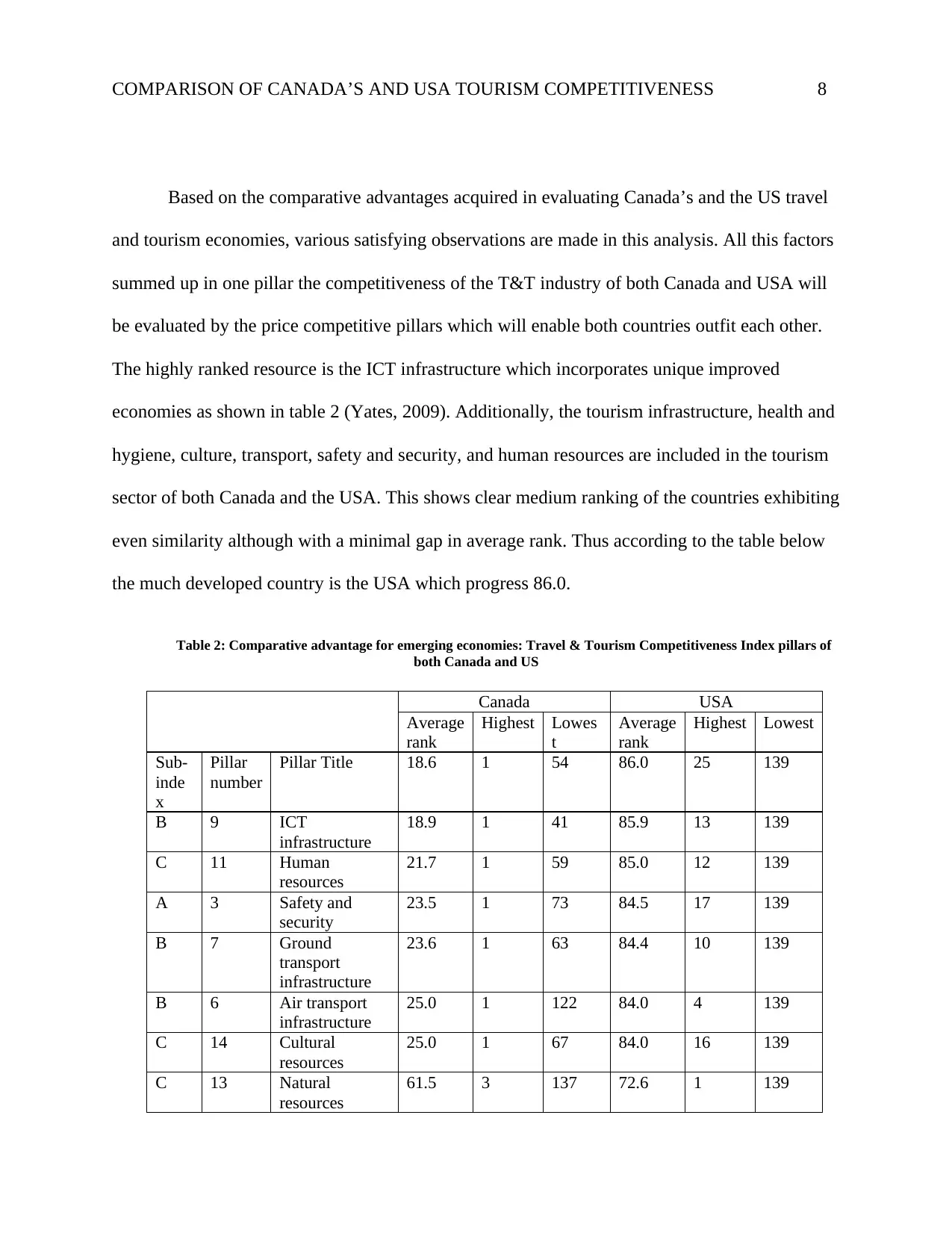
Based on the comparative advantages acquired in evaluating Canada’s and the US travel
and tourism economies, various satisfying observations are made in this analysis. All this factors
summed up in one pillar the competitiveness of the T&T industry of both Canada and USA will
be evaluated by the price competitive pillars which will enable both countries outfit each other.
The highly ranked resource is the ICT infrastructure which incorporates unique improved
economies as shown in table 2 (Yates, 2009). Additionally, the tourism infrastructure, health and
hygiene, culture, transport, safety and security, and human resources are included in the tourism
sector of both Canada and the USA. This shows clear medium ranking of the countries exhibiting
even similarity although with a minimal gap in average rank. Thus according to the table below
the much developed country is the USA which progress 86.0.
Table 2: Comparative advantage for emerging economies: Travel & Tourism Competitiveness Index pillars of
both Canada and US
Canada USA
Average
rank
Highest Lowes
t
Average
rank
Highest Lowest
Sub-
inde
x
Pillar
number
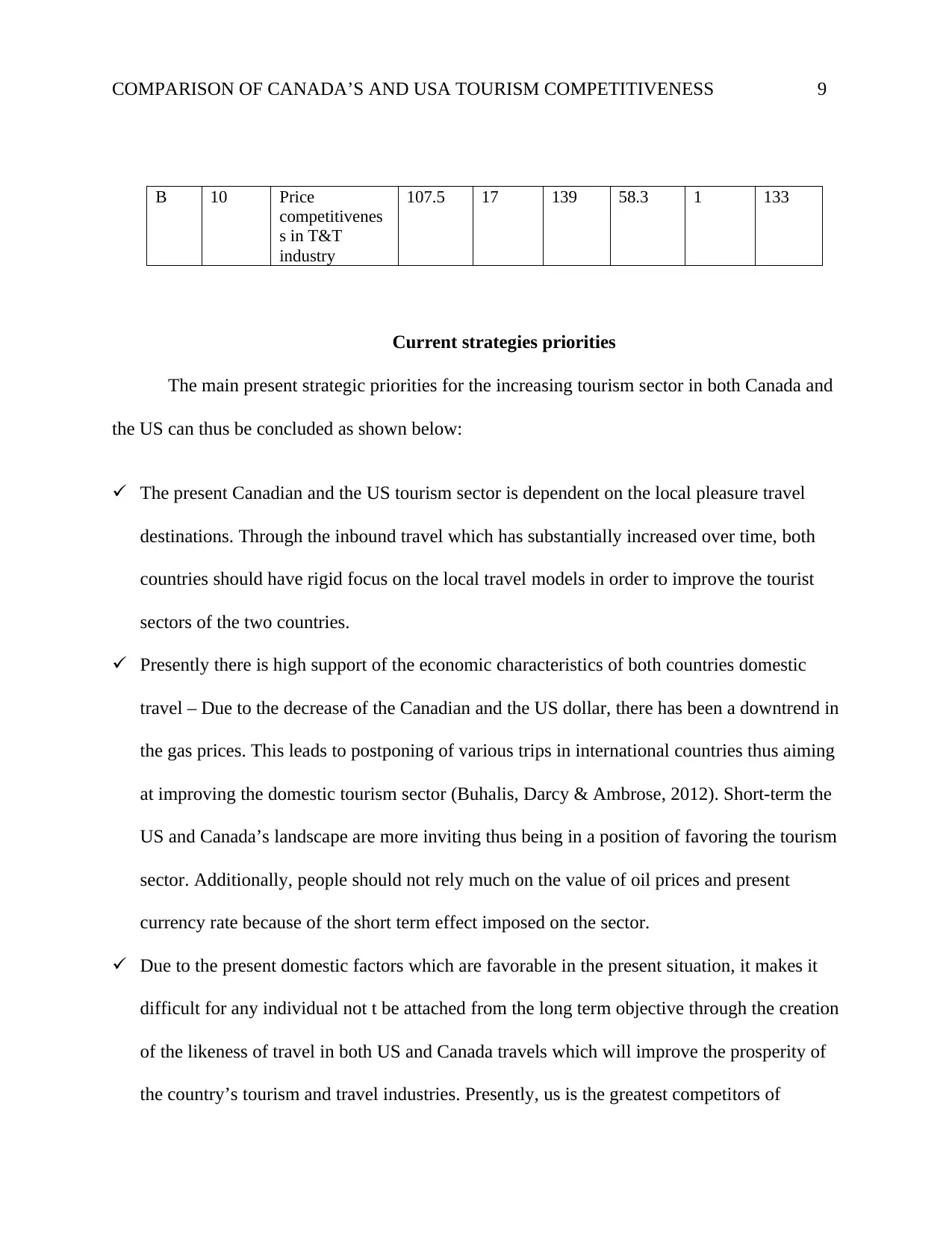
Pillar Title 18.6 1 54 86.0 25 139
B 9 ICT
infrastructure
18.9 1 41 85.9 13 139
C 11 Human
resources
21.7 1 59 85.0 12 139
A 3 Safety and
security
23.5 1 73 84.5 17 139
B 7 Ground
transport
infrastructure
23.6 1 63 84.4 10 139
B 6 Air transport
infrastructure
25.0 1 122 84.0 4 139
C 14 Cultural
resources
25.0 1 67 84.0 16 139
C 13 Natural
resources
61.5 3 137 72.6 1 139
Based on the comparative advantages acquired in evaluating Canada’s and the US travel
and tourism economies, various satisfying observations are made in this analysis. All this factors
summed up in one pillar the competitiveness of the T&T industry of both Canada and USA will
be evaluated by the price competitive pillars which will enable both countries outfit each other.
The highly ranked resource is the ICT infrastructure which incorporates unique improved
economies as shown in table 2 (Yates, 2009). Additionally, the tourism infrastructure, health and
hygiene, culture, transport, safety and security, and human resources are included in the tourism
sector of both Canada and the USA. This shows clear medium ranking of the countries exhibiting
even similarity although with a minimal gap in average rank. Thus according to the table below
the much developed country is the USA which progress 86.0.
Table 2: Comparative advantage for emerging economies: Travel & Tourism Competitiveness Index pillars of
both Canada and US
Canada USA
Average
rank
Highest Lowes
t
Average
rank
Highest Lowest
Sub-
inde
x
Pillar
number
Pillar Title 18.6 1 54 86.0 25 139
B 9 ICT
infrastructure
18.9 1 41 85.9 13 139
C 11 Human
resources
21.7 1 59 85.0 12 139
A 3 Safety and
security
23.5 1 73 84.5 17 139
B 7 Ground
transport
infrastructure
23.6 1 63 84.4 10 139
B 6 Air transport
infrastructure
25.0 1 122 84.0 4 139
C 14 Cultural
resources
25.0 1 67 84.0 16 139
C 13 Natural
resources
61.5 3 137 72.6 1 139
COMPARISON OF CANADA’S AND USA TOURISM COMPETITIVENESS 9
B 10 Price
competitivenes
s in T&T
industry
107.5 17 139 58.3 1 133
Current strategies priorities
The main present strategic priorities for the increasing tourism sector in both Canada and
the US can thus be concluded as shown below:
The present Canadian and the US tourism sector is dependent on the local pleasure travel
destinations. Through the inbound travel which has substantially increased over time, both
countries should have rigid focus on the local travel models in order to improve the tourist
sectors of the two countries.
Presently there is high support of the economic characteristics of both countries domestic
travel – Due to the decrease of the Canadian and the US dollar, there has been a downtrend in
the gas prices. This leads to postponing of various trips in international countries thus aiming
at improving the domestic tourism sector (Buhalis, Darcy & Ambrose, 2012). Short-term the
US and Canada’s landscape are more inviting thus being in a position of favoring the tourism
sector. Additionally, people should not rely much on the value of oil prices and present
currency rate because of the short term effect imposed on the sector.
Due to the present domestic factors which are favorable in the present situation, it makes it
difficult for any individual not t be attached from the long term objective through the creation
of the likeness of travel in both US and Canada travels which will improve the prosperity of
the country’s tourism and travel industries. Presently, us is the greatest competitors of
B 10 Price
competitivenes
s in T&T
industry
107.5 17 139 58.3 1 133
Current strategies priorities
The main present strategic priorities for the increasing tourism sector in both Canada and
the US can thus be concluded as shown below:
The present Canadian and the US tourism sector is dependent on the local pleasure travel
destinations. Through the inbound travel which has substantially increased over time, both
countries should have rigid focus on the local travel models in order to improve the tourist
sectors of the two countries.
Presently there is high support of the economic characteristics of both countries domestic
travel – Due to the decrease of the Canadian and the US dollar, there has been a downtrend in
the gas prices. This leads to postponing of various trips in international countries thus aiming
at improving the domestic tourism sector (Buhalis, Darcy & Ambrose, 2012). Short-term the
US and Canada’s landscape are more inviting thus being in a position of favoring the tourism
sector. Additionally, people should not rely much on the value of oil prices and present
currency rate because of the short term effect imposed on the sector.
Due to the present domestic factors which are favorable in the present situation, it makes it
difficult for any individual not t be attached from the long term objective through the creation
of the likeness of travel in both US and Canada travels which will improve the prosperity of
the country’s tourism and travel industries. Presently, us is the greatest competitors of
⊘ This is a preview!⊘
Do you want full access?
Subscribe today to unlock all pages.
Trusted by 1+ million students worldwide
COMPARISON OF CANADA’S AND USA TOURISM COMPETITIVENESS 10
Canada in the tourism sector, therefore this provides a common point where there should be
marketing efforts to be instituted in the tourist sector. Additionally, the currency exchange
rates provided clear merits which will upheld the tourism sector in Both Canada and the US
in the domestic sector.
Discussion and recommendation
In thus section the main discussion will be focused on around 112 items between the US
and Canada. Thus it is assumed that the current hypothesis based on Canada’s competitive nature
and the USA competitiveness has been evaluated based on a set of respondents. Projecting on the
overall hypothesis it is thus recorded that the USA is more competitive compared to the Canada
as stated by the results from respondents. On a personal perspective of the results, for 6 groups
selected from USA there was a greater mean, and for the whole results there was clear evidence
that the statistical results was statistically validated evidenced based (Arch G. Woodside., 2011).
The 112 items were assessed fewer than four which exhibits the critic of the respondent’s
perception of the stated destinations. Through the selection of the comparable countries and
direct evaluation of the two countries, the study evaded the critic of the search results, which was
difficult in comparing other nations.
Thus conducting a deep scan on the tourism students it was deduced that it was hard in assessing
the indicators which made it difficult for acquiring data from the two countries. Additionally the
respondents commented that the process of assessing the macro environment was rather much
difficult compared to the other segments due to limited information. Therefore, this provides
clear proof of the major weakness exhibited in the present models used in the research
Canada in the tourism sector, therefore this provides a common point where there should be
marketing efforts to be instituted in the tourist sector. Additionally, the currency exchange
rates provided clear merits which will upheld the tourism sector in Both Canada and the US
in the domestic sector.
Discussion and recommendation
In thus section the main discussion will be focused on around 112 items between the US
and Canada. Thus it is assumed that the current hypothesis based on Canada’s competitive nature
and the USA competitiveness has been evaluated based on a set of respondents. Projecting on the
overall hypothesis it is thus recorded that the USA is more competitive compared to the Canada
as stated by the results from respondents. On a personal perspective of the results, for 6 groups
selected from USA there was a greater mean, and for the whole results there was clear evidence
that the statistical results was statistically validated evidenced based (Arch G. Woodside., 2011).
The 112 items were assessed fewer than four which exhibits the critic of the respondent’s
perception of the stated destinations. Through the selection of the comparable countries and
direct evaluation of the two countries, the study evaded the critic of the search results, which was
difficult in comparing other nations.
Thus conducting a deep scan on the tourism students it was deduced that it was hard in assessing
the indicators which made it difficult for acquiring data from the two countries. Additionally the
respondents commented that the process of assessing the macro environment was rather much
difficult compared to the other segments due to limited information. Therefore, this provides
clear proof of the major weakness exhibited in the present models used in the research
Paraphrase This Document
Need a fresh take? Get an instant paraphrase of this document with our AI Paraphraser
COMPARISON OF CANADA’S AND USA TOURISM COMPETITIVENESS 11
methodology (Hottola, 2009). Additionally, according to search results it is reflected that there is
much use of the various generic instruments which both apply in the tourism destinations
competitiveness stated in the paper. Certainly, evaluating the competitiveness of these indicators,
this shows specific incorporation of the two destinations mentioned.
According to Arch G. Woodside (2011) expressing TTCI positioning just enlightens us
regarding the travel industry intensity or the capability of every nation dependent on its basic
monetary, infrastructural and natural elements, ignoring how much every nation takes advantage
of its superstructure, or the particular cordiality and the travel industry highlights it has made to
render the goal more appealing. Hottola, (2009) are affirming that TTCI is the most essential
instrument to gauge goal aggressiveness. This reality does not help smaller scale goals when they
wish to evaluate their intensity. They likewise require legitimate instruments to quantify
intensity. The hypothetical and down to earth ramifications of this examination are going toward
the path that we gain tried instrument for estimating the aggressiveness of small scale beach front
goals.
It is hard to get such an extensive number of genuine partners in the littler goals in the
district, which is the reason such genuine research is considerably more untrustworthy. As a
result of that it is much more basic that the instrument is legitimate and consistent to the most
noteworthy degree conceivable. It was our aim to make such research conditions so respondents
would have better comprehension of the considerable number of elements of goal aggressiveness
with the end goal to pass confinement proposed by Shipside, (2011). There are a few constraints
of this examination. To begin with, respondents were understudies. Given the feedback that
methodology (Hottola, 2009). Additionally, according to search results it is reflected that there is
much use of the various generic instruments which both apply in the tourism destinations
competitiveness stated in the paper. Certainly, evaluating the competitiveness of these indicators,
this shows specific incorporation of the two destinations mentioned.
According to Arch G. Woodside (2011) expressing TTCI positioning just enlightens us
regarding the travel industry intensity or the capability of every nation dependent on its basic
monetary, infrastructural and natural elements, ignoring how much every nation takes advantage
of its superstructure, or the particular cordiality and the travel industry highlights it has made to
render the goal more appealing. Hottola, (2009) are affirming that TTCI is the most essential
instrument to gauge goal aggressiveness. This reality does not help smaller scale goals when they
wish to evaluate their intensity. They likewise require legitimate instruments to quantify
intensity. The hypothetical and down to earth ramifications of this examination are going toward
the path that we gain tried instrument for estimating the aggressiveness of small scale beach front
goals.
It is hard to get such an extensive number of genuine partners in the littler goals in the
district, which is the reason such genuine research is considerably more untrustworthy. As a
result of that it is much more basic that the instrument is legitimate and consistent to the most
noteworthy degree conceivable. It was our aim to make such research conditions so respondents
would have better comprehension of the considerable number of elements of goal aggressiveness
with the end goal to pass confinement proposed by Shipside, (2011). There are a few constraints
of this examination. To begin with, respondents were understudies. Given the feedback that
COMPARISON OF CANADA’S AND USA TOURISM COMPETITIVENESS 12
voyagers don't have adequate learning of the goals (Smith, 2014), senior understudies of the
personnel were picked as respondents, who really speak to youthful the travel industry experts.
Second, respondents are for the most part residents of Croatia, which could establish subjectivity
in noting questions, as one goal is in Croatia.
A third constraint identified with the quantity of respondents is moderately little. It is
likewise evident that in the event that we would have the genuine partners in these goals as
respondents, the number would not surpass twenty for every goal. The truth of the matter is that
the discussion on the goal aggressiveness keeps going quite a while. It is likewise a reality that
we got a decent model at the full scale phase, yet we are falling behind in making practical
models for smaller scale goals (Hottola, 2009). On account of these realities we see numerous
open doors for further research, particularly in course of further testing the instrument for its
unwavering quality and legitimacy. We firmly trust that goal intensity models are basic devices
for any sort of vital advancement action of the travel industry goals.
Conclusion
Therefore it can be conclusively be stated that the USA is much greater compared to the
Canadian economy based on the competitive nature of the two countries and the allotting of
resources. The US beauty and availability of natural resources is sufficient reason as to why the
country has rigid competitive models in order to draw more tourist in the country compared to
Canada. Thus the main aim of paper was designed to dig deep down on the tourism field of both
Canada and the US economy. Therefore it is high time that Canada should increase its marketing
voyagers don't have adequate learning of the goals (Smith, 2014), senior understudies of the
personnel were picked as respondents, who really speak to youthful the travel industry experts.
Second, respondents are for the most part residents of Croatia, which could establish subjectivity
in noting questions, as one goal is in Croatia.
A third constraint identified with the quantity of respondents is moderately little. It is
likewise evident that in the event that we would have the genuine partners in these goals as
respondents, the number would not surpass twenty for every goal. The truth of the matter is that
the discussion on the goal aggressiveness keeps going quite a while. It is likewise a reality that
we got a decent model at the full scale phase, yet we are falling behind in making practical
models for smaller scale goals (Hottola, 2009). On account of these realities we see numerous
open doors for further research, particularly in course of further testing the instrument for its
unwavering quality and legitimacy. We firmly trust that goal intensity models are basic devices
for any sort of vital advancement action of the travel industry goals.
Conclusion
Therefore it can be conclusively be stated that the USA is much greater compared to the
Canadian economy based on the competitive nature of the two countries and the allotting of
resources. The US beauty and availability of natural resources is sufficient reason as to why the
country has rigid competitive models in order to draw more tourist in the country compared to
Canada. Thus the main aim of paper was designed to dig deep down on the tourism field of both
Canada and the US economy. Therefore it is high time that Canada should increase its marketing
⊘ This is a preview!⊘
Do you want full access?
Subscribe today to unlock all pages.
Trusted by 1+ million students worldwide

1 out of 16


Related Documents


Your All-in-One AI-Powered Toolkit for Academic Success.
+13062052269
info@desklib.com
Available 24*7 on WhatsApp / Email
![[object Object]](/_next/static/media/star-bottom.7253800d.svg)
Unlock your academic potential
Copyright © 2020–2026 A2Z Services. All Rights Reserved. Developed and managed by ZUCOL.