University History 102 Final: Canadian Wars and Women's Evolution

Verified

Added on  2022/07/28

|6
|1346
|15
Essay
AI Summary
This essay analyzes two key aspects of Canadian history. Firstly, it compares and contrasts Canada's experiences in World War I and World War II, examining similarities such as the use of Victory Bonds and the eventual recognition of Canada's autonomy, and differences like the method of joining the war and the role of women. Secondly, the essay explores the evolution of women's position and status in Canadian society during the 20th century, highlighting the impact of the feminist movement, women's suffrage, and the fight for gender equity. The essay concludes that while progress has been made, further efforts are needed to achieve full equity, but Canada is a leader in women's equality. The analysis is supported by citations from the provided readings, the textbook, and the class lectures, fulfilling the requirements of a History 102 final exam.

Document Page
TOPIC
Name
Course Title
Date of Submission
tabler-icon-diamond-filled.svg

Paraphrase This Document

Need a fresh take? Get an instant paraphrase of this document with our AI Paraphraser
Document Page
0
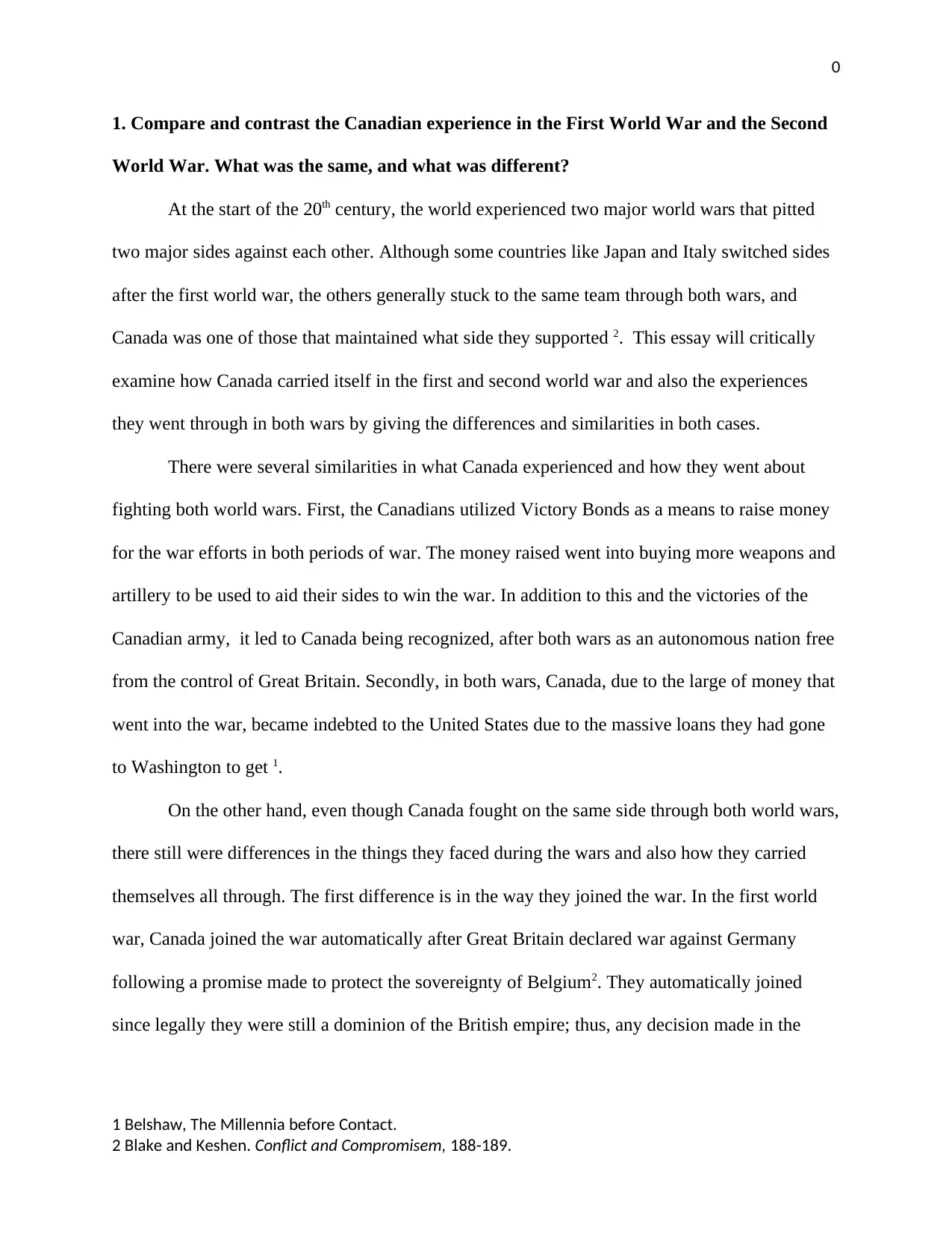
1. Compare and contrast the Canadian experience in the First World War and the Second
World War. What was the same, and what was different?
At the start of the 20th century, the world experienced two major world wars that pitted
two major sides against each other. Although some countries like Japan and Italy switched sides
after the first world war, the others generally stuck to the same team through both wars, and
Canada was one of those that maintained what side they supported 2. This essay will critically
examine how Canada carried itself in the first and second world war and also the experiences
they went through in both wars by giving the differences and similarities in both cases.
There were several similarities in what Canada experienced and how they went about
fighting both world wars. First, the Canadians utilized Victory Bonds as a means to raise money
for the war efforts in both periods of war. The money raised went into buying more weapons and
artillery to be used to aid their sides to win the war. In addition to this and the victories of the
Canadian army, it led to Canada being recognized, after both wars as an autonomous nation free
from the control of Great Britain. Secondly, in both wars, Canada, due to the large of money that
went into the war, became indebted to the United States due to the massive loans they had gone
to Washington to get 1.
On the other hand, even though Canada fought on the same side through both world wars,
there still were differences in the things they faced during the wars and also how they carried
themselves all through. The first difference is in the way they joined the war. In the first world
war, Canada joined the war automatically after Great Britain declared war against Germany
following a promise made to protect the sovereignty of Belgium2. They automatically joined
since legally they were still a dominion of the British empire; thus, any decision made in the
1 Belshaw, The Millennia before Contact.
2 Blake and Keshen. Conflict and Compromisem, 188-189.
Document Page
1
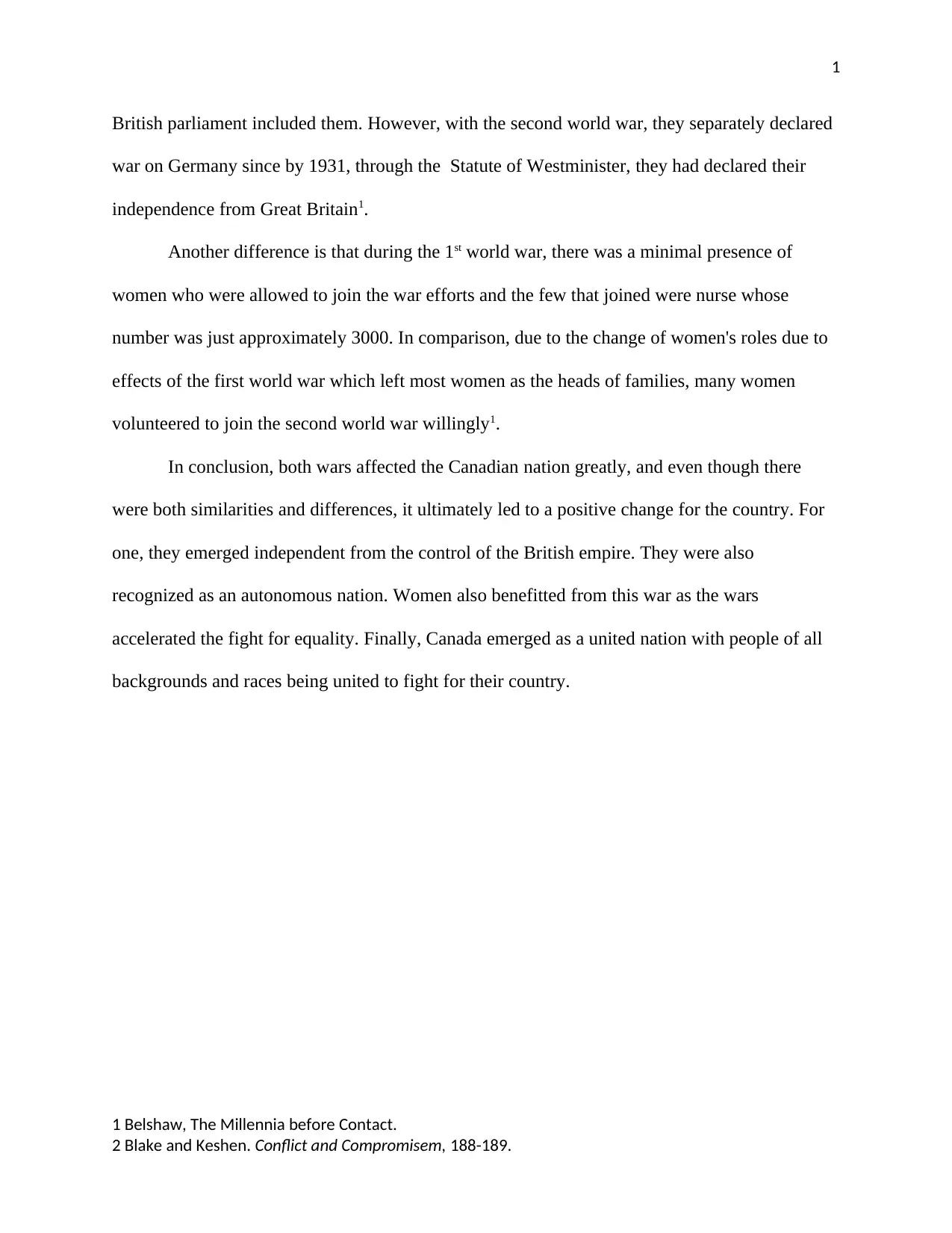
British parliament included them. However, with the second world war, they separately declared
war on Germany since by 1931, through the Statute of Westminister, they had declared their
independence from Great Britain1.
Another difference is that during the 1st world war, there was a minimal presence of
women who were allowed to join the war efforts and the few that joined were nurse whose
number was just approximately 3000. In comparison, due to the change of women's roles due to
effects of the first world war which left most women as the heads of families, many women
volunteered to join the second world war willingly1.
In conclusion, both wars affected the Canadian nation greatly, and even though there
were both similarities and differences, it ultimately led to a positive change for the country. For
one, they emerged independent from the control of the British empire. They were also
recognized as an autonomous nation. Women also benefitted from this war as the wars
accelerated the fight for equality. Finally, Canada emerged as a united nation with people of all
backgrounds and races being united to fight for their country.
1 Belshaw, The Millennia before Contact.
2 Blake and Keshen. Conflict and Compromisem, 188-189.
Document Page
0
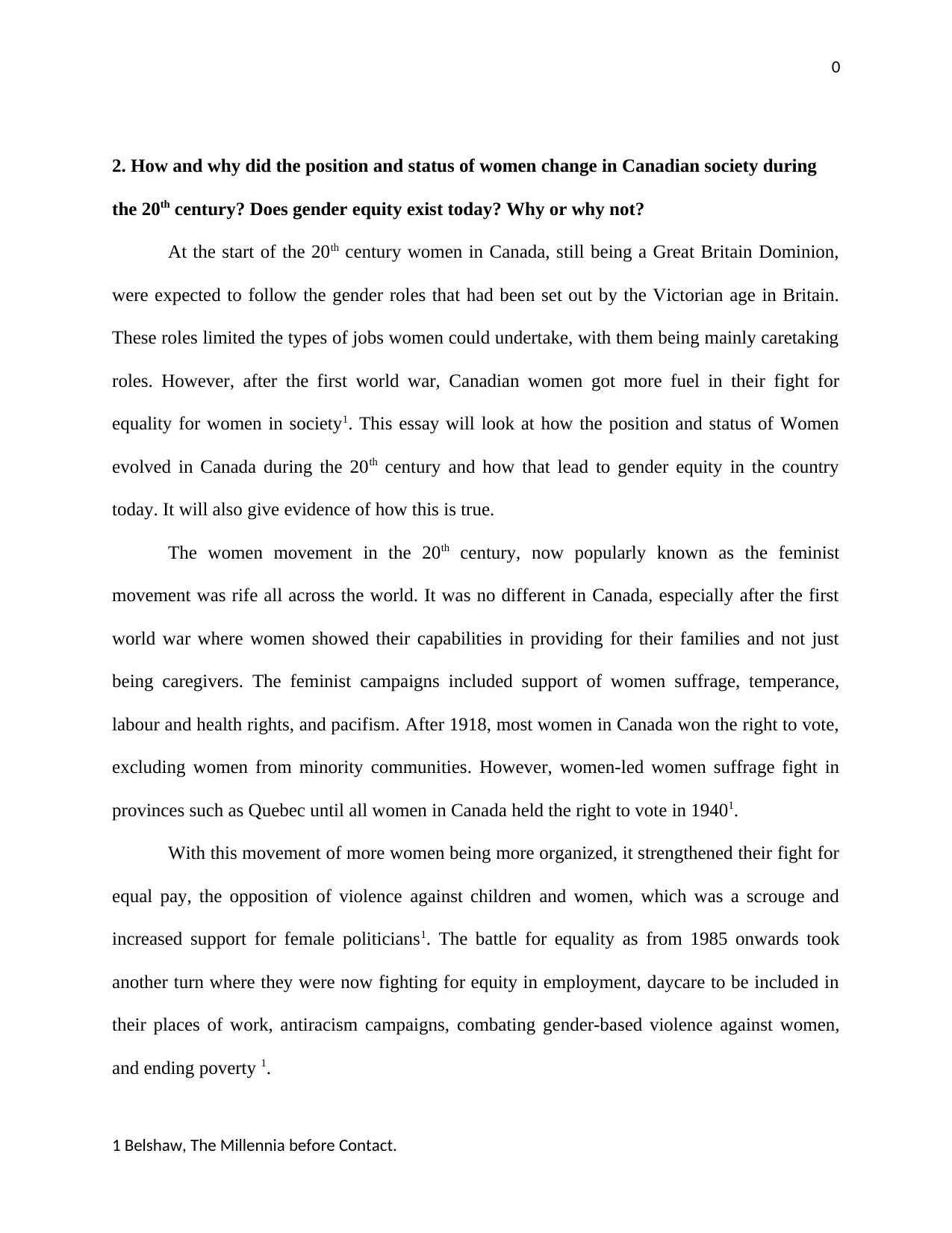
2. How and why did the position and status of women change in Canadian society during
the 20th century? Does gender equity exist today? Why or why not?
At the start of the 20th century women in Canada, still being a Great Britain Dominion,
were expected to follow the gender roles that had been set out by the Victorian age in Britain.
These roles limited the types of jobs women could undertake, with them being mainly caretaking
roles. However, after the first world war, Canadian women got more fuel in their fight for
equality for women in society1. This essay will look at how the position and status of Women
evolved in Canada during the 20th century and how that lead to gender equity in the country
today. It will also give evidence of how this is true.
The women movement in the 20th century, now popularly known as the feminist
movement was rife all across the world. It was no different in Canada, especially after the first
world war where women showed their capabilities in providing for their families and not just
being caregivers. The feminist campaigns included support of women suffrage, temperance,
labour and health rights, and pacifism. After 1918, most women in Canada won the right to vote,
excluding women from minority communities. However, women-led women suffrage fight in
provinces such as Quebec until all women in Canada held the right to vote in 19401.
With this movement of more women being more organized, it strengthened their fight for
equal pay, the opposition of violence against children and women, which was a scrouge and
increased support for female politicians1. The battle for equality as from 1985 onwards took
another turn where they were now fighting for equity in employment, daycare to be included in
their places of work, antiracism campaigns, combating gender-based violence against women,
and ending poverty 1.
1 Belshaw, The Millennia before Contact.
tabler-icon-diamond-filled.svg

Paraphrase This Document

Need a fresh take? Get an instant paraphrase of this document with our AI Paraphraser
Document Page
1
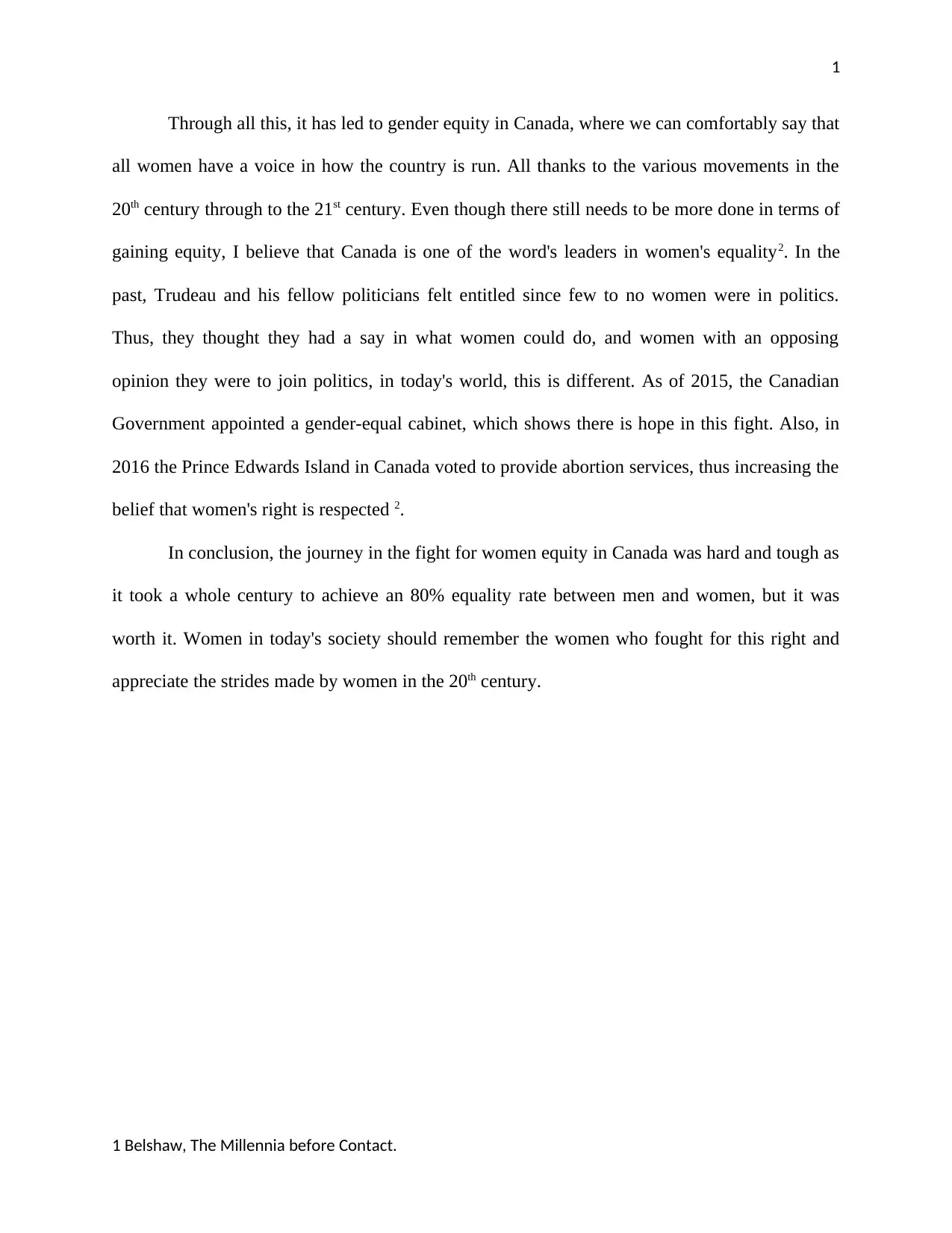
Through all this, it has led to gender equity in Canada, where we can comfortably say that
all women have a voice in how the country is run. All thanks to the various movements in the
20th century through to the 21st century. Even though there still needs to be more done in terms of
gaining equity, I believe that Canada is one of the word's leaders in women's equality2. In the
past, Trudeau and his fellow politicians felt entitled since few to no women were in politics.
Thus, they thought they had a say in what women could do, and women with an opposing
opinion they were to join politics, in today's world, this is different. As of 2015, the Canadian
Government appointed a gender-equal cabinet, which shows there is hope in this fight. Also, in
2016 the Prince Edwards Island in Canada voted to provide abortion services, thus increasing the
belief that women's right is respected 2.
In conclusion, the journey in the fight for women equity in Canada was hard and tough as
it took a whole century to achieve an 80% equality rate between men and women, but it was
worth it. Women in today's society should remember the women who fought for this right and
appreciate the strides made by women in the 20th century.
1 Belshaw, The Millennia before Contact.
Document Page
0
Bibliography
Belshaw, John Douglas. "2.4 The Millennia before Contact." Canadian History: Pre-
Confederation (2015).
Ramon Blake and Jeffrey Keshen. Conflict and Compromise: Post Confederation Canada,
Toronto.University of Toronto Press, 2017, 188-189.
Ramon Blake and Jeffrey Keshen. Conflict and Compromise: Post Confederation Canada,
Toronto.University of Toronto Press, 2017, 206-207.
chevron_up_icon
1 out of 6
circle_padding
hide_on_mobile
zoom_out_icon
[object Object]