Canadian Workplace Stress: Impact on Cancer and Smoking Cessation
VerifiedAdded on 2022/09/09
|7
|1402
|21
Report
AI Summary
This report investigates the significant impact of workplace stress on the health of Canadian workers, drawing on various research studies. It explores the correlation between workplace stress and mental health problems, cancer incidence, and smoking cessation. The discussion section examines studies that suggest a link between workplace stress and an increased risk of certain cancers, such as prostate, colon, lung, and bladder cancer. Furthermore, the report analyzes how workplace stress can influence smoking cessation, potentially leading to relapse. The findings highlight the importance of addressing workplace stress to improve the overall well-being of Canadian employees, emphasizing the need for leadership and management strategies that promote a healthy and supportive work environment. The report concludes by summarizing the adverse health outcomes associated with workplace stress and the need for interventions to mitigate its effects.
Running head: STRESS IMPACT
Stress in Canadian Workplace
Name of the Student
Name of the University
Author Note
Stress in Canadian Workplace
Name of the Student
Name of the University
Author Note
Paraphrase This Document
Need a fresh take? Get an instant paraphrase of this document with our AI Paraphraser

STRESS IMPACT
Stress in the Canadian Workplace
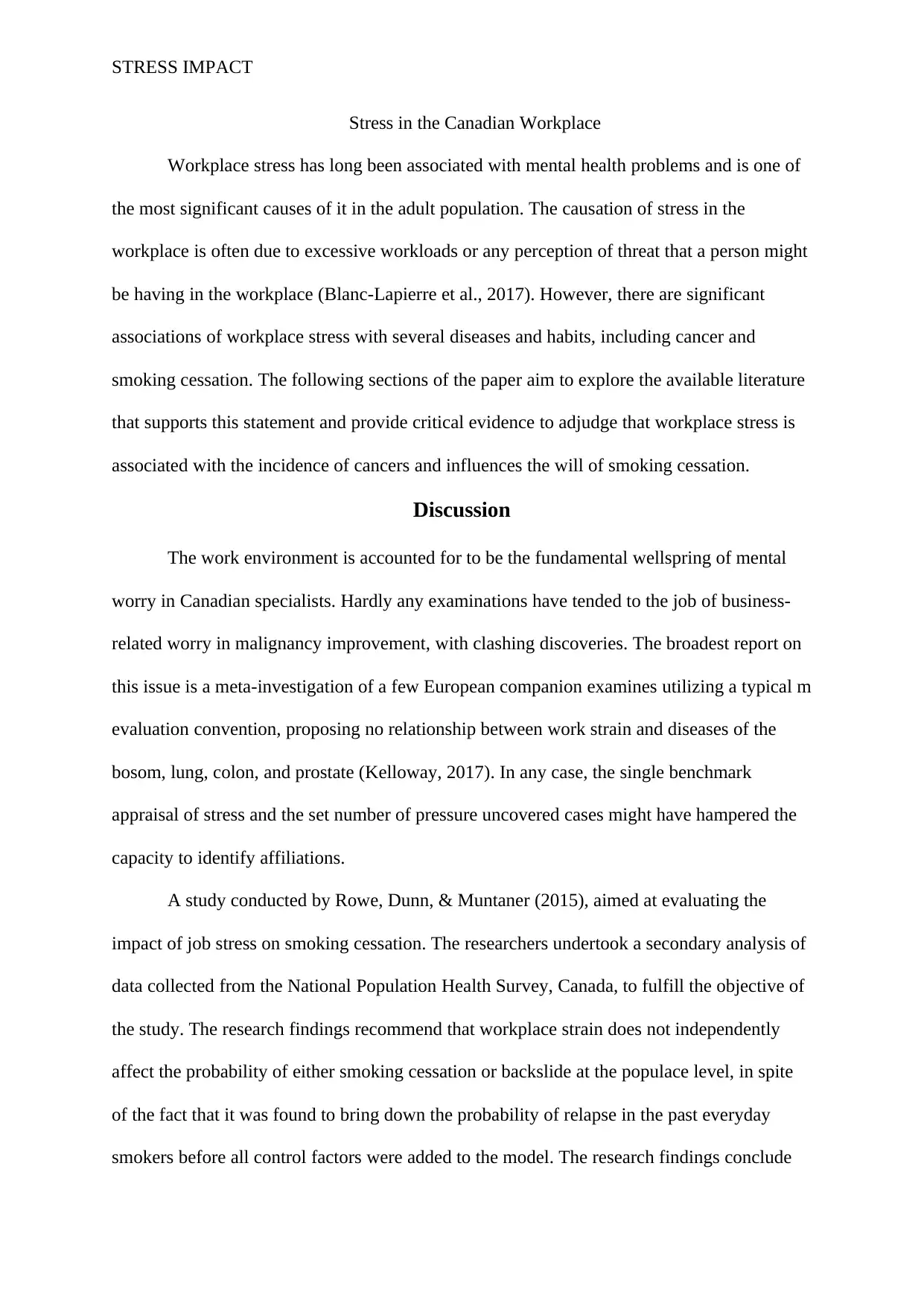
Workplace stress has long been associated with mental health problems and is one of
the most significant causes of it in the adult population. The causation of stress in the
workplace is often due to excessive workloads or any perception of threat that a person might
be having in the workplace (Blanc-Lapierre et al., 2017). However, there are significant
associations of workplace stress with several diseases and habits, including cancer and
smoking cessation. The following sections of the paper aim to explore the available literature
that supports this statement and provide critical evidence to adjudge that workplace stress is
associated with the incidence of cancers and influences the will of smoking cessation.
Discussion
The work environment is accounted for to be the fundamental wellspring of mental
worry in Canadian specialists. Hardly any examinations have tended to the job of business-
related worry in malignancy improvement, with clashing discoveries. The broadest report on
this issue is a meta-investigation of a few European companion examines utilizing a typical m
evaluation convention, proposing no relationship between work strain and diseases of the
bosom, lung, colon, and prostate (Kelloway, 2017). In any case, the single benchmark
appraisal of stress and the set number of pressure uncovered cases might have hampered the
capacity to identify affiliations.
A study conducted by Rowe, Dunn, & Muntaner (2015), aimed at evaluating the
impact of job stress on smoking cessation. The researchers undertook a secondary analysis of
data collected from the National Population Health Survey, Canada, to fulfill the objective of
the study. The research findings recommend that workplace strain does not independently
affect the probability of either smoking cessation or backslide at the populace level, in spite
of the fact that it was found to bring down the probability of relapse in the past everyday
smokers before all control factors were added to the model. The research findings conclude
Stress in the Canadian Workplace
Workplace stress has long been associated with mental health problems and is one of
the most significant causes of it in the adult population. The causation of stress in the
workplace is often due to excessive workloads or any perception of threat that a person might
be having in the workplace (Blanc-Lapierre et al., 2017). However, there are significant
associations of workplace stress with several diseases and habits, including cancer and
smoking cessation. The following sections of the paper aim to explore the available literature
that supports this statement and provide critical evidence to adjudge that workplace stress is
associated with the incidence of cancers and influences the will of smoking cessation.
Discussion
The work environment is accounted for to be the fundamental wellspring of mental
worry in Canadian specialists. Hardly any examinations have tended to the job of business-
related worry in malignancy improvement, with clashing discoveries. The broadest report on
this issue is a meta-investigation of a few European companion examines utilizing a typical m
evaluation convention, proposing no relationship between work strain and diseases of the
bosom, lung, colon, and prostate (Kelloway, 2017). In any case, the single benchmark
appraisal of stress and the set number of pressure uncovered cases might have hampered the
capacity to identify affiliations.
A study conducted by Rowe, Dunn, & Muntaner (2015), aimed at evaluating the
impact of job stress on smoking cessation. The researchers undertook a secondary analysis of
data collected from the National Population Health Survey, Canada, to fulfill the objective of
the study. The research findings recommend that workplace strain does not independently
affect the probability of either smoking cessation or backslide at the populace level, in spite
of the fact that it was found to bring down the probability of relapse in the past everyday
smokers before all control factors were added to the model. The research findings conclude

STRESS IMPACT
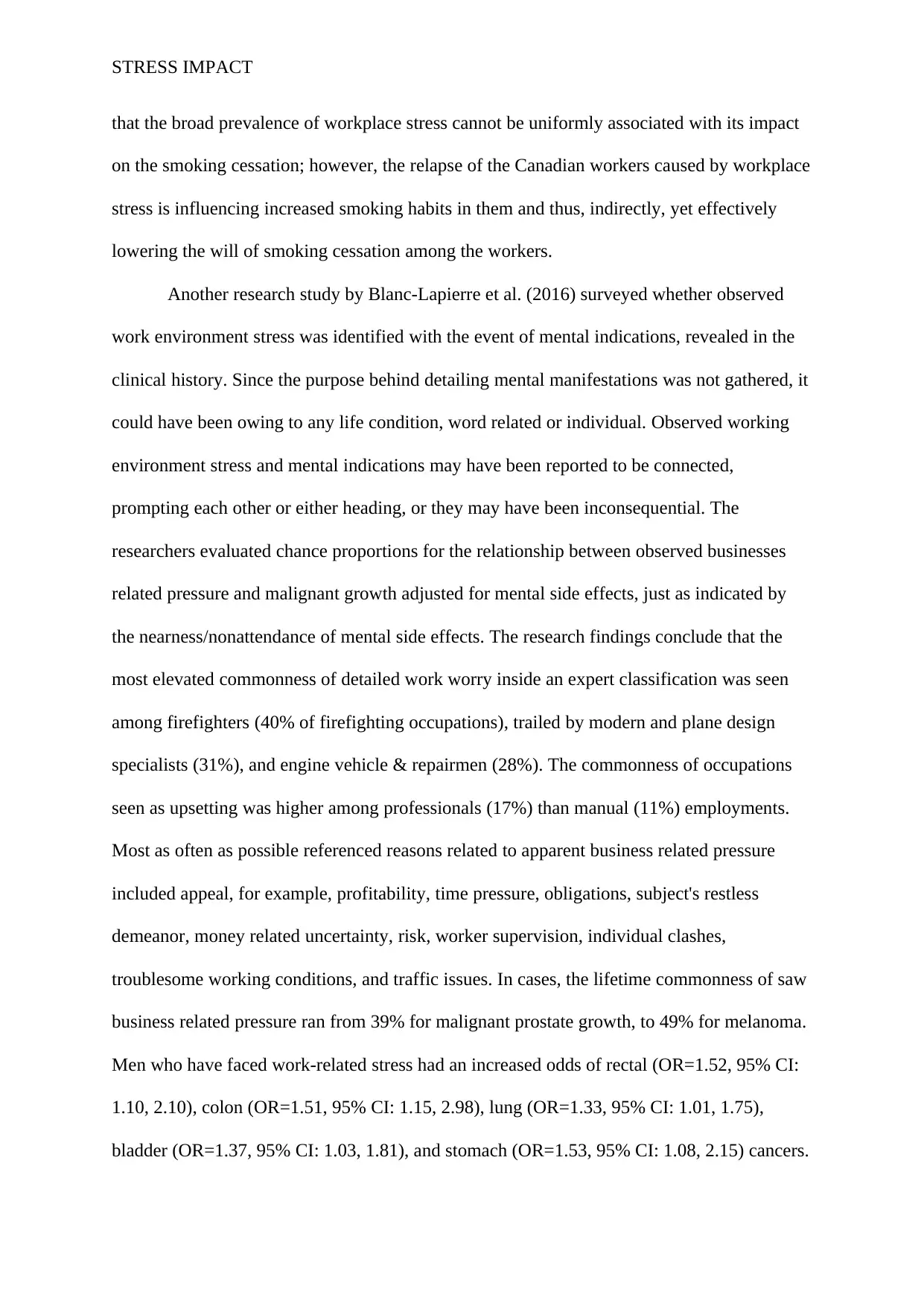
that the broad prevalence of workplace stress cannot be uniformly associated with its impact
on the smoking cessation; however, the relapse of the Canadian workers caused by workplace
stress is influencing increased smoking habits in them and thus, indirectly, yet effectively
lowering the will of smoking cessation among the workers.
Another research study by Blanc-Lapierre et al. (2016) surveyed whether observed
work environment stress was identified with the event of mental indications, revealed in the
clinical history. Since the purpose behind detailing mental manifestations was not gathered, it
could have been owing to any life condition, word related or individual. Observed working
environment stress and mental indications may have been reported to be connected,
prompting each other or either heading, or they may have been inconsequential. The
researchers evaluated chance proportions for the relationship between observed businesses
related pressure and malignant growth adjusted for mental side effects, just as indicated by
the nearness/nonattendance of mental side effects. The research findings conclude that the
most elevated commonness of detailed work worry inside an expert classification was seen
among firefighters (40% of firefighting occupations), trailed by modern and plane design
specialists (31%), and engine vehicle & repairmen (28%). The commonness of occupations
seen as upsetting was higher among professionals (17%) than manual (11%) employments.
Most as often as possible referenced reasons related to apparent business related pressure
included appeal, for example, profitability, time pressure, obligations, subject's restless
demeanor, money related uncertainty, risk, worker supervision, individual clashes,
troublesome working conditions, and traffic issues. In cases, the lifetime commonness of saw
business related pressure ran from 39% for malignant prostate growth, to 49% for melanoma.
Men who have faced work-related stress had an increased odds of rectal (OR=1.52, 95% CI:
1.10, 2.10), colon (OR=1.51, 95% CI: 1.15, 2.98), lung (OR=1.33, 95% CI: 1.01, 1.75),
bladder (OR=1.37, 95% CI: 1.03, 1.81), and stomach (OR=1.53, 95% CI: 1.08, 2.15) cancers.
that the broad prevalence of workplace stress cannot be uniformly associated with its impact
on the smoking cessation; however, the relapse of the Canadian workers caused by workplace
stress is influencing increased smoking habits in them and thus, indirectly, yet effectively
lowering the will of smoking cessation among the workers.
Another research study by Blanc-Lapierre et al. (2016) surveyed whether observed
work environment stress was identified with the event of mental indications, revealed in the
clinical history. Since the purpose behind detailing mental manifestations was not gathered, it
could have been owing to any life condition, word related or individual. Observed working
environment stress and mental indications may have been reported to be connected,
prompting each other or either heading, or they may have been inconsequential. The
researchers evaluated chance proportions for the relationship between observed businesses
related pressure and malignant growth adjusted for mental side effects, just as indicated by
the nearness/nonattendance of mental side effects. The research findings conclude that the
most elevated commonness of detailed work worry inside an expert classification was seen
among firefighters (40% of firefighting occupations), trailed by modern and plane design
specialists (31%), and engine vehicle & repairmen (28%). The commonness of occupations
seen as upsetting was higher among professionals (17%) than manual (11%) employments.
Most as often as possible referenced reasons related to apparent business related pressure
included appeal, for example, profitability, time pressure, obligations, subject's restless
demeanor, money related uncertainty, risk, worker supervision, individual clashes,
troublesome working conditions, and traffic issues. In cases, the lifetime commonness of saw
business related pressure ran from 39% for malignant prostate growth, to 49% for melanoma.
Men who have faced work-related stress had an increased odds of rectal (OR=1.52, 95% CI:
1.10, 2.10), colon (OR=1.51, 95% CI: 1.15, 2.98), lung (OR=1.33, 95% CI: 1.01, 1.75),
bladder (OR=1.37, 95% CI: 1.03, 1.81), and stomach (OR=1.53, 95% CI: 1.08, 2.15) cancers.
⊘ This is a preview!⊘
Do you want full access?
Subscribe today to unlock all pages.

Trusted by 1+ million students worldwide

STRESS IMPACT
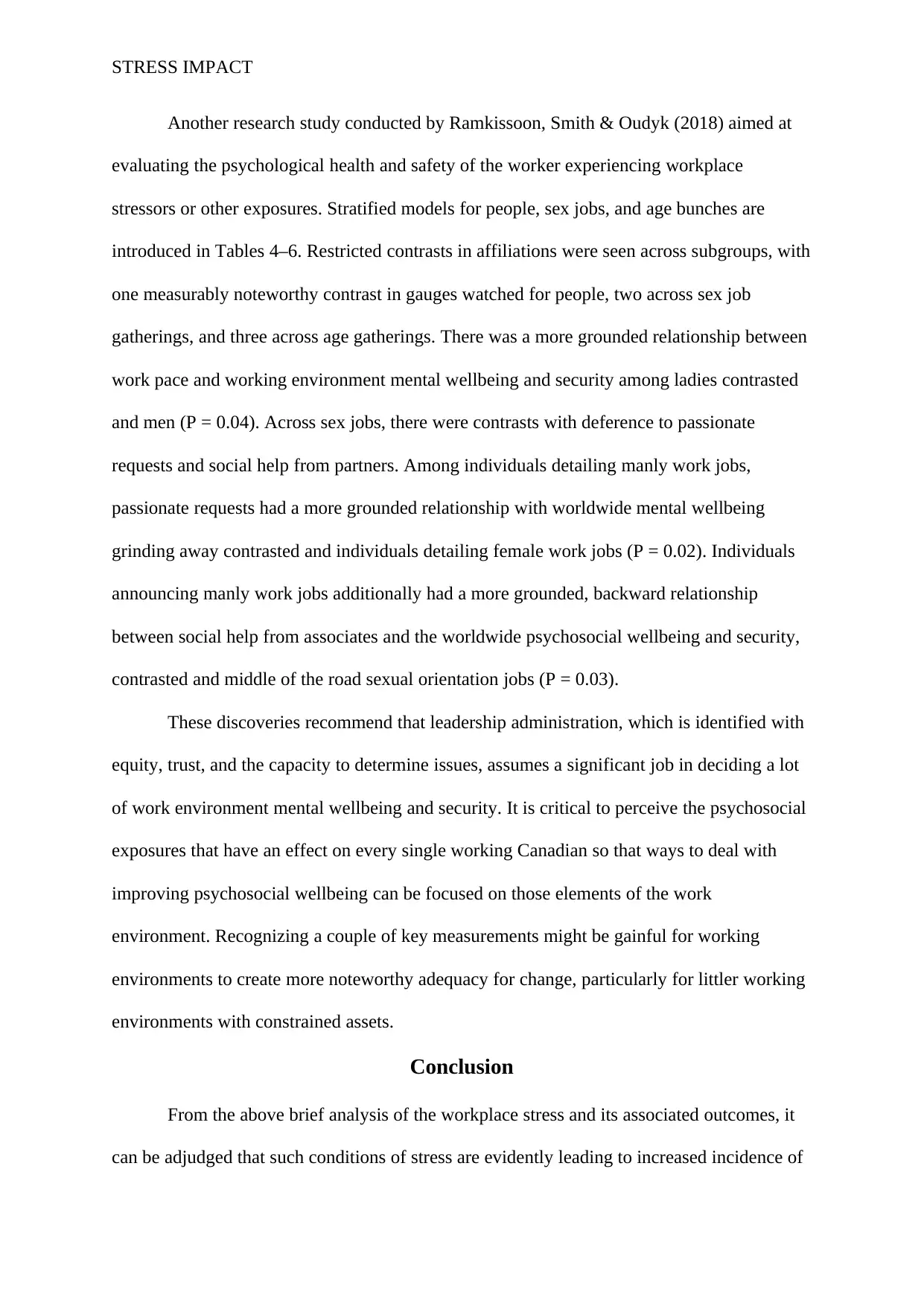
Another research study conducted by Ramkissoon, Smith & Oudyk (2018) aimed at
evaluating the psychological health and safety of the worker experiencing workplace
stressors or other exposures. Stratified models for people, sex jobs, and age bunches are
introduced in Tables 4–6. Restricted contrasts in affiliations were seen across subgroups, with
one measurably noteworthy contrast in gauges watched for people, two across sex job
gatherings, and three across age gatherings. There was a more grounded relationship between
work pace and working environment mental wellbeing and security among ladies contrasted
and men (P = 0.04). Across sex jobs, there were contrasts with deference to passionate
requests and social help from partners. Among individuals detailing manly work jobs,
passionate requests had a more grounded relationship with worldwide mental wellbeing
grinding away contrasted and individuals detailing female work jobs (P = 0.02). Individuals
announcing manly work jobs additionally had a more grounded, backward relationship
between social help from associates and the worldwide psychosocial wellbeing and security,
contrasted and middle of the road sexual orientation jobs (P = 0.03).
These discoveries recommend that leadership administration, which is identified with
equity, trust, and the capacity to determine issues, assumes a significant job in deciding a lot
of work environment mental wellbeing and security. It is critical to perceive the psychosocial
exposures that have an effect on every single working Canadian so that ways to deal with
improving psychosocial wellbeing can be focused on those elements of the work
environment. Recognizing a couple of key measurements might be gainful for working
environments to create more noteworthy adequacy for change, particularly for littler working
environments with constrained assets.
Conclusion
From the above brief analysis of the workplace stress and its associated outcomes, it
can be adjudged that such conditions of stress are evidently leading to increased incidence of
Another research study conducted by Ramkissoon, Smith & Oudyk (2018) aimed at
evaluating the psychological health and safety of the worker experiencing workplace
stressors or other exposures. Stratified models for people, sex jobs, and age bunches are
introduced in Tables 4–6. Restricted contrasts in affiliations were seen across subgroups, with
one measurably noteworthy contrast in gauges watched for people, two across sex job
gatherings, and three across age gatherings. There was a more grounded relationship between
work pace and working environment mental wellbeing and security among ladies contrasted
and men (P = 0.04). Across sex jobs, there were contrasts with deference to passionate
requests and social help from partners. Among individuals detailing manly work jobs,
passionate requests had a more grounded relationship with worldwide mental wellbeing
grinding away contrasted and individuals detailing female work jobs (P = 0.02). Individuals
announcing manly work jobs additionally had a more grounded, backward relationship
between social help from associates and the worldwide psychosocial wellbeing and security,
contrasted and middle of the road sexual orientation jobs (P = 0.03).
These discoveries recommend that leadership administration, which is identified with
equity, trust, and the capacity to determine issues, assumes a significant job in deciding a lot
of work environment mental wellbeing and security. It is critical to perceive the psychosocial
exposures that have an effect on every single working Canadian so that ways to deal with
improving psychosocial wellbeing can be focused on those elements of the work
environment. Recognizing a couple of key measurements might be gainful for working
environments to create more noteworthy adequacy for change, particularly for littler working
environments with constrained assets.
Conclusion
From the above brief analysis of the workplace stress and its associated outcomes, it
can be adjudged that such conditions of stress are evidently leading to increased incidence of
Paraphrase This Document
Need a fresh take? Get an instant paraphrase of this document with our AI Paraphraser

STRESS IMPACT
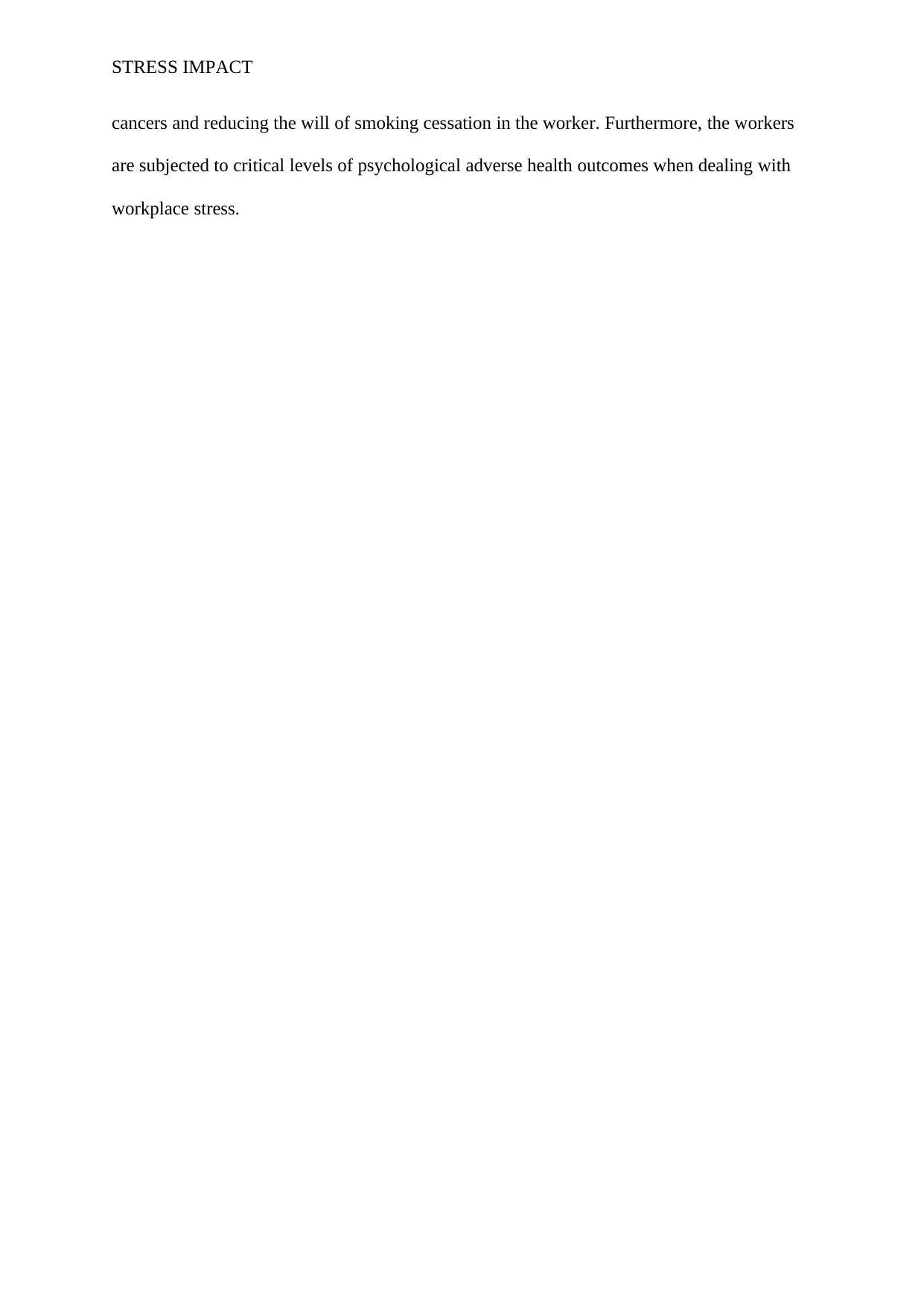
cancers and reducing the will of smoking cessation in the worker. Furthermore, the workers
are subjected to critical levels of psychological adverse health outcomes when dealing with
workplace stress.
cancers and reducing the will of smoking cessation in the worker. Furthermore, the workers
are subjected to critical levels of psychological adverse health outcomes when dealing with
workplace stress.

STRESS IMPACT
References
Blanc-Lapierre, A., Rousseau, M. C., & Parent, M. E. (2017). Perceived workplace stress is
associated with an increased risk of prostate cancer before age 65. Frontiers in
oncology, 7, 269. https://doi.org/10.3389/fonc.2017.00269
Blanc-Lapierre, A., Rousseau, M., Weiss, D., El-Zein, M., Siemiatycki, J., & Parent, M.
(2016). Lifetime report of perceived stress at work and cancer among men: A case-
control study in montreal, canada. Preventive Medicine, 96, 28-35.
doi:10.1016/j.ypmed.2016.12.004
Kelloway, E. K. (2017). Mental health in the workplace: Towards evidence-based
practice. Canadian Psychology/psychologie canadienne, 58(1), 1.
Ramkissoon, A., Smith, P., & Oudyk, J. (2019). Dissecting the effect of workplace exposures
on workers’ rating of psychological health and safety. American Journal of Industrial
Medicine, 62(5), 412-421. doi:10.1002/ajim.22964
Rowe, D. J., Dunn, J. R., & Muntaner, C. (2015). The impact of job strain on smoking
cessation and relapse in the canadian population: A cohort study. Journal of
Epidemiology and Community Health, 69(10), 931-936. doi:10.1136/jech-2014-
205227
References
Blanc-Lapierre, A., Rousseau, M. C., & Parent, M. E. (2017). Perceived workplace stress is
associated with an increased risk of prostate cancer before age 65. Frontiers in
oncology, 7, 269. https://doi.org/10.3389/fonc.2017.00269
Blanc-Lapierre, A., Rousseau, M., Weiss, D., El-Zein, M., Siemiatycki, J., & Parent, M.
(2016). Lifetime report of perceived stress at work and cancer among men: A case-
control study in montreal, canada. Preventive Medicine, 96, 28-35.
doi:10.1016/j.ypmed.2016.12.004
Kelloway, E. K. (2017). Mental health in the workplace: Towards evidence-based
practice. Canadian Psychology/psychologie canadienne, 58(1), 1.
Ramkissoon, A., Smith, P., & Oudyk, J. (2019). Dissecting the effect of workplace exposures
on workers’ rating of psychological health and safety. American Journal of Industrial
Medicine, 62(5), 412-421. doi:10.1002/ajim.22964
Rowe, D. J., Dunn, J. R., & Muntaner, C. (2015). The impact of job strain on smoking
cessation and relapse in the canadian population: A cohort study. Journal of
Epidemiology and Community Health, 69(10), 931-936. doi:10.1136/jech-2014-
205227
⊘ This is a preview!⊘
Do you want full access?
Subscribe today to unlock all pages.

Trusted by 1+ million students worldwide

STRESS IMPACT
Appendix
Glossary
1. Stress: a state of emotional tension or strain
2. Malignant growth: Uncontrollable division of cells, leading to cancer
3. Cessation: the process of ending something and bringing something to end
Appendix
Glossary
1. Stress: a state of emotional tension or strain
2. Malignant growth: Uncontrollable division of cells, leading to cancer
3. Cessation: the process of ending something and bringing something to end
1 out of 7
Your All-in-One AI-Powered Toolkit for Academic Success.
+13062052269
info@desklib.com
Available 24*7 on WhatsApp / Email
Unlock your academic potential
Copyright © 2020–2025 A2Z Services. All Rights Reserved. Developed and managed by ZUCOL.