Cancer, Age, and Gender: Analyzing Statistical Associations

Verified

Added on  2022/09/07

|9
|2080
|19
Report
AI Summary
This report investigates the relationship between cancer, age, and gender, aiming to determine if there's a statistical association between these variables. The study employs binomial logistic regression and correlation analysis to explore the research question: "Is there a relationship between Cancer, gender and age?" The report begins with an introduction outlining the growing concern of cancer as a major health issue and reviews existing literature on cancer risk factors, including age and gender. The methodology section describes the dependent and independent variables, the research question, and the null and alternative hypotheses. The report includes an annotated bibliography with summaries of relevant sources. The study anticipates that cancer development may be related to age and gender, and aims to test the association between the three variables, thereby contributing to the understanding of cancer disparities and risk factors. The paper is designed to assess the strength of the relationship between cancer, age, and gender and whether there is a causal relationship between these variables. The null hypothesis states that there is no relationship, while the alternative hypothesis posits an association. The paper provides a comprehensive overview of the statistical approach, data analysis, and results to validate or refute the original arguments. The paper also explores the epidemiology, genetics, and therapy of cancer and the differences in cancer-related gender.
Document Page
1
Introduction
Background
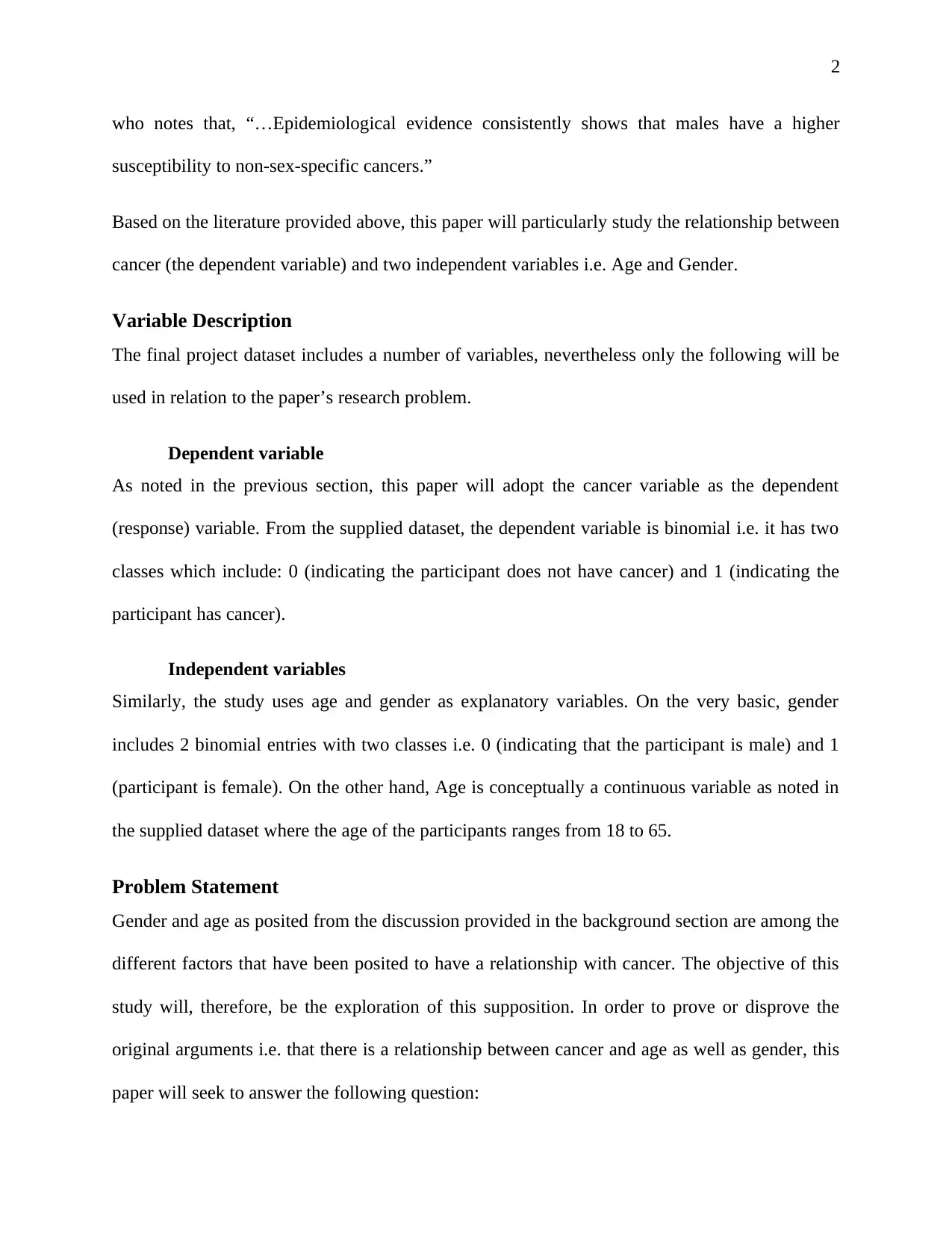
Over the past two decades, cancer has grown to become a major health concern throughout the
world and the 2nd leading cause of death in the United States second only after heart disease
(Siegel, Miller, & Jemal, 2019). (Miller, et al., 2019) reports that in 2019 alone, lung cancer and
bronchus cancer has caused the deaths of up to 76, 650 and 66, 020 males respectively while on
the other hand, up to 41,760 females have died of breast cancer. In an effort to answer various
questions surrounding cancer, WHO sponsored a symposium held in 1950 aimed at
understanding the dynamics of cancer in which it was learned that, “…people who migrated to
other countries, developed types of cancer common to their adopted countries, rather than their
homelands” (Blackadar, 2016).
In a study on the different types of cancer, (Siegel, Miller, & Jemal, 2019) posit that currently,
there are over 100 known types of cancer. Generally, there have been extensive studies that have
been conducted in an effort to learn this modern scourge, as will this paper. Other studies on the
factors that affect the probability of suffering from cancer indicate that one of such factors is age.
According to (Aunan, Cho, & Søreide, 2017), “… aging is the inevitable time-dependent decline
in physiological organ function and is a major risk factor for cancer development.” Another
factor associated with cancer disparity among victims is gender as argued by (Kim, Lim, &
Moon, 2018) who study differences in the development of cancer in relation to epidemiology,
underlying genetics, and therapy. The primary argument proposed by (Kim, Lim, & Moon, 2018)
is that cancer to some extent is related to the genetics of an individual i.e. males are likely to
develop cancer in their lifetime compared to the likelihood of their female counterparts to
develop cancer. The view held by (Kim, Lim, & Moon, 2018) is supported by (Tevfik, 2017)
tabler-icon-diamond-filled.svg

Paraphrase This Document

Need a fresh take? Get an instant paraphrase of this document with our AI Paraphraser
Document Page
2
who notes that, “…Epidemiological evidence consistently shows that males have a higher
susceptibility to non-sex-specific cancers.”
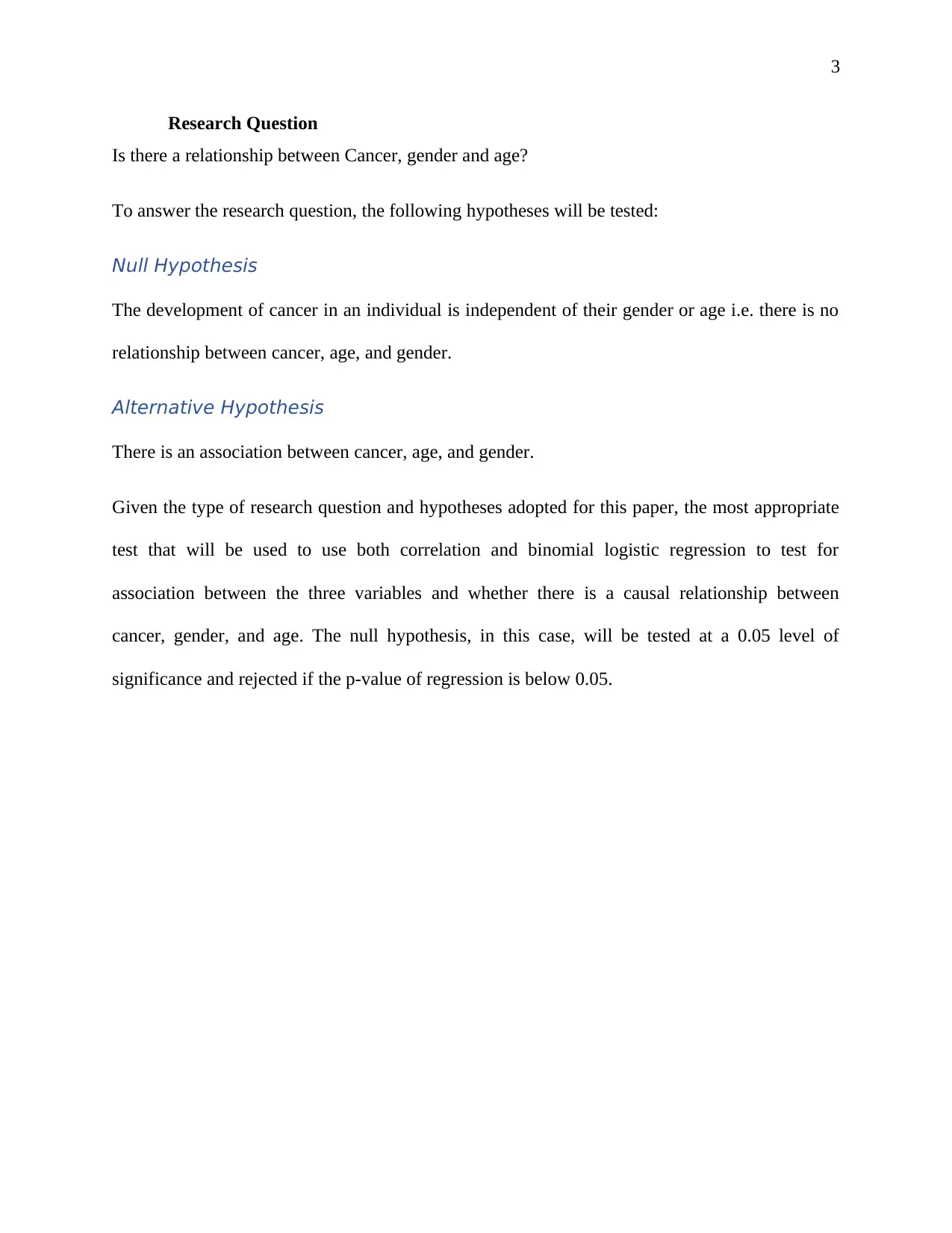
Based on the literature provided above, this paper will particularly study the relationship between
cancer (the dependent variable) and two independent variables i.e. Age and Gender.
Variable Description
The final project dataset includes a number of variables, nevertheless only the following will be
used in relation to the paper’s research problem.
Dependent variable
As noted in the previous section, this paper will adopt the cancer variable as the dependent
(response) variable. From the supplied dataset, the dependent variable is binomial i.e. it has two
classes which include: 0 (indicating the participant does not have cancer) and 1 (indicating the
participant has cancer).
Independent variables
Similarly, the study uses age and gender as explanatory variables. On the very basic, gender
includes 2 binomial entries with two classes i.e. 0 (indicating that the participant is male) and 1
(participant is female). On the other hand, Age is conceptually a continuous variable as noted in
the supplied dataset where the age of the participants ranges from 18 to 65.
Problem Statement
Gender and age as posited from the discussion provided in the background section are among the
different factors that have been posited to have a relationship with cancer. The objective of this
study will, therefore, be the exploration of this supposition. In order to prove or disprove the
original arguments i.e. that there is a relationship between cancer and age as well as gender, this
paper will seek to answer the following question:
Document Page
3
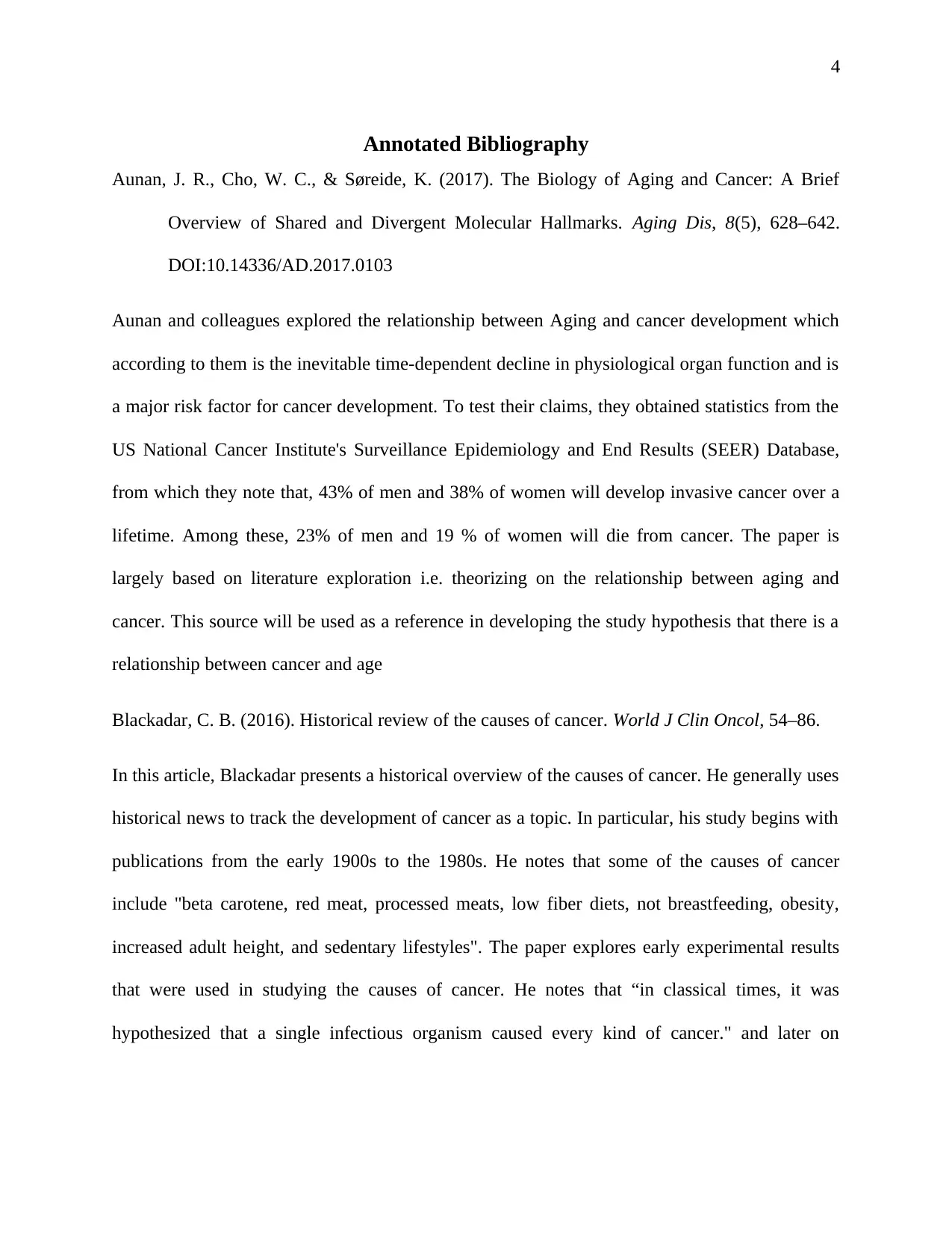
Research Question
Is there a relationship between Cancer, gender and age?
To answer the research question, the following hypotheses will be tested:
Null Hypothesis
The development of cancer in an individual is independent of their gender or age i.e. there is no
relationship between cancer, age, and gender.
Alternative Hypothesis
There is an association between cancer, age, and gender.
Given the type of research question and hypotheses adopted for this paper, the most appropriate
test that will be used to use both correlation and binomial logistic regression to test for
association between the three variables and whether there is a causal relationship between
cancer, gender, and age. The null hypothesis, in this case, will be tested at a 0.05 level of
significance and rejected if the p-value of regression is below 0.05.
Document Page
4
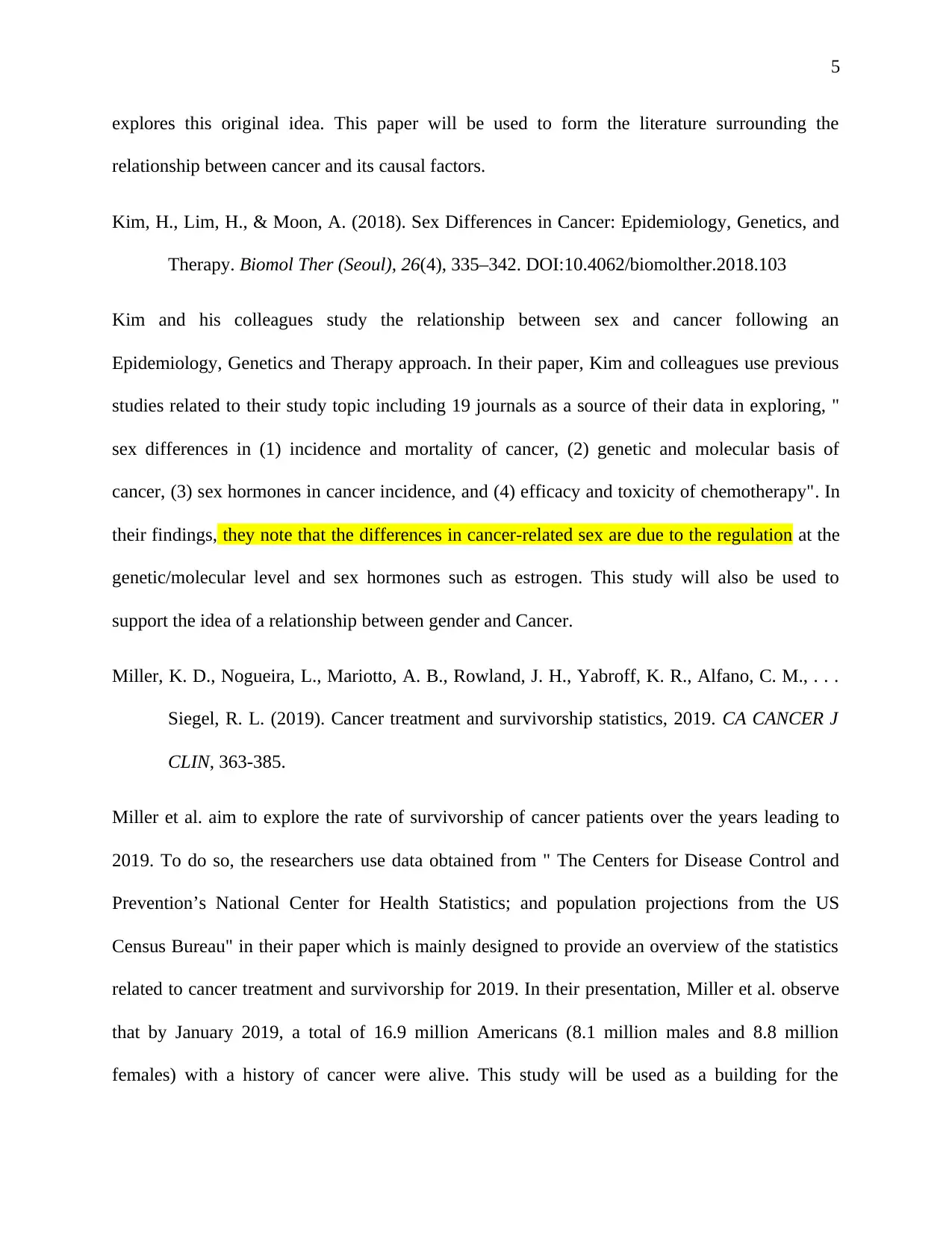
Annotated Bibliography
Aunan, J. R., Cho, W. C., & Søreide, K. (2017). The Biology of Aging and Cancer: A Brief
Overview of Shared and Divergent Molecular Hallmarks. Aging Dis, 8(5), 628–642.
DOI:10.14336/AD.2017.0103
Aunan and colleagues explored the relationship between Aging and cancer development which
according to them is the inevitable time-dependent decline in physiological organ function and is
a major risk factor for cancer development. To test their claims, they obtained statistics from the
US National Cancer Institute's Surveillance Epidemiology and End Results (SEER) Database,
from which they note that, 43% of men and 38% of women will develop invasive cancer over a
lifetime. Among these, 23% of men and 19 % of women will die from cancer. The paper is
largely based on literature exploration i.e. theorizing on the relationship between aging and
cancer. This source will be used as a reference in developing the study hypothesis that there is a
relationship between cancer and age
Blackadar, C. B. (2016). Historical review of the causes of cancer. World J Clin Oncol, 54–86.
In this article, Blackadar presents a historical overview of the causes of cancer. He generally uses
historical news to track the development of cancer as a topic. In particular, his study begins with
publications from the early 1900s to the 1980s. He notes that some of the causes of cancer
include "beta carotene, red meat, processed meats, low fiber diets, not breastfeeding, obesity,
increased adult height, and sedentary lifestyles". The paper explores early experimental results
that were used in studying the causes of cancer. He notes that “in classical times, it was
hypothesized that a single infectious organism caused every kind of cancer." and later on
tabler-icon-diamond-filled.svg

Paraphrase This Document

Need a fresh take? Get an instant paraphrase of this document with our AI Paraphraser
Document Page
5
explores this original idea. This paper will be used to form the literature surrounding the
relationship between cancer and its causal factors.
Kim, H., Lim, H., & Moon, A. (2018). Sex Differences in Cancer: Epidemiology, Genetics, and
Therapy. Biomol Ther (Seoul), 26(4), 335–342. DOI:10.4062/biomolther.2018.103
Kim and his colleagues study the relationship between sex and cancer following an
Epidemiology, Genetics and Therapy approach. In their paper, Kim and colleagues use previous
studies related to their study topic including 19 journals as a source of their data in exploring, "
sex differences in (1) incidence and mortality of cancer, (2) genetic and molecular basis of
cancer, (3) sex hormones in cancer incidence, and (4) efficacy and toxicity of chemotherapy". In
their findings, they note that the differences in cancer-related sex are due to the regulation at the
genetic/molecular level and sex hormones such as estrogen. This study will also be used to
support the idea of a relationship between gender and Cancer.
Miller, K. D., Nogueira, L., Mariotto, A. B., Rowland, J. H., Yabroff, K. R., Alfano, C. M., . . .
Siegel, R. L. (2019). Cancer treatment and survivorship statistics, 2019. CA CANCER J
CLIN, 363-385.
Miller et al. aim to explore the rate of survivorship of cancer patients over the years leading to
2019. To do so, the researchers use data obtained from " The Centers for Disease Control and
Prevention’s National Center for Health Statistics; and population projections from the US
Census Bureau" in their paper which is mainly designed to provide an overview of the statistics
related to cancer treatment and survivorship for 2019. In their presentation, Miller et al. observe
that by January 2019, a total of 16.9 million Americans (8.1 million males and 8.8 million
females) with a history of cancer were alive. This study will be used as a building for the
Document Page
6
literature of the current study i.e. in exploring the extent of the cancer epidemic in the United
States.
Siegel, R. L., Miller, K. D., & Jemal, A. (2019). Cancer statistics, 2019. CA CANCER J CLI,
69(2019), 7–34.
This paper has a similar structure as that of the "Cancer treatment and survivorship statistics,
2019" given that this paper uses statistics obtained from government databases i.e., " The Centers
for Disease Control and Prevention’s National Center for Health Statistics; and population
projections from the US Census Bureau" to present the extent with which the cancer problem is
spread in the United States. In their findings, the authors observe that in the years between 2007-
2016 the cancer death rate (2007-2016) declined annually by 1.4% and 1.8%, respectively. This
paper will be used as a basis for developing the hypothesis of a relationship between cancer and
gender.
Tevfik, D. M. (2017). Cancer: Gender Differences at the Molecular Level-Principles of Gender-
Specific Medicine. Gender in the genomic era, 401-416.
Tevfic makes an argument that “Epidemiological evidence consistently shows that males have a
higher susceptibility to non-sex-specific cancers.” In support of his argument, he used journal
sex-specific data in conducting his research in which he explores the basic differences between
male and female genes which leads to a difference in cancer susceptibility. This paper will be
used as a building block for the research question and the surrounding literature.
References
Document Page
7
Aunan, J. R., Cho, W. C., & Søreide, K. (2017). The Biology of Aging and Cancer: A Brief
Overview of Shared and Divergent Molecular Hallmarks. Aging Dis, 8(5), 628–642.
DOI:10.14336/AD.2017.0103
Blackadar, C. B. (2016). Historical review of the causes of cancer. World J Clin Oncol, 54–86.
Kim, H., Lim, H., & Moon, A. (2018). Sex Differences in Cancer: Epidemiology, Genetics, and
Therapy. Biomol Ther (Seoul), 26(4), 335–342. DOI:10.4062/biomolther.2018.103
Miller, K. D., Nogueira, L., Mariotto, A. B., Rowland, J. H., Yabroff, K. R., Alfano, C. M., . . .
Siegel, R. L. (2019). Cancer treatment and survivorship statistics, 2019. CA CANCER J
CLIN, 363-385.
Siegel, R. L., Miller, K. D., & Jemal, A. (2019). Cancer statistics, 2019. CA CANCER J CLI,
69(2019), 7–34.
Tevfik, D. M. (2017). Cancer: Gender Differences at the Molecular Level-Principles of Gender-
Specific Medicine. Gender in the genomic era, 401-416.
tabler-icon-diamond-filled.svg

Paraphrase This Document

Need a fresh take? Get an instant paraphrase of this document with our AI Paraphraser
Document Page
8
Appendix
Data Dictionary
Document Page
9
chevron_up_icon
1 out of 9
circle_padding
hide_on_mobile
zoom_out_icon
[object Object]