Analyzing the Capacities of Trusts within Equity and Trust Law

Verified

Added on  2022/09/18

|3
|328
|27
Essay
AI Summary
This essay delves into the capacities of trusts within the framework of equity and trust law, addressing the legal standing and operational limitations of trusts. It elucidates that a trust, unlike a company, lacks a distinct legal personality and cannot independently hold assets, enter into contracts, or initiate legal proceedings. Instead, the trustee, acting as the legal owner of the trust's assets, assumes these responsibilities on behalf of the trust and its beneficiaries. The essay references key legal decisions, such as Armitage v Nurse, to support its analysis and highlights the fiduciary relationship between the settlor, trustee, and beneficiary, emphasizing the trustee's duty to manage the trust assets for the benefit of the beneficiary. The discussion underscores the importance of understanding the trustee's role in enforcing rights, entering into contracts, and participating in legal actions related to the trust.
Document Page
Running head: EQUITY AND TRUST
EQUITY AND TRUST
Name of the Student:
Name of the University:
Author Note:
tabler-icon-diamond-filled.svg

Paraphrase This Document

Need a fresh take? Get an instant paraphrase of this document with our AI Paraphraser
Document Page
1
EQUITY AND TRUST
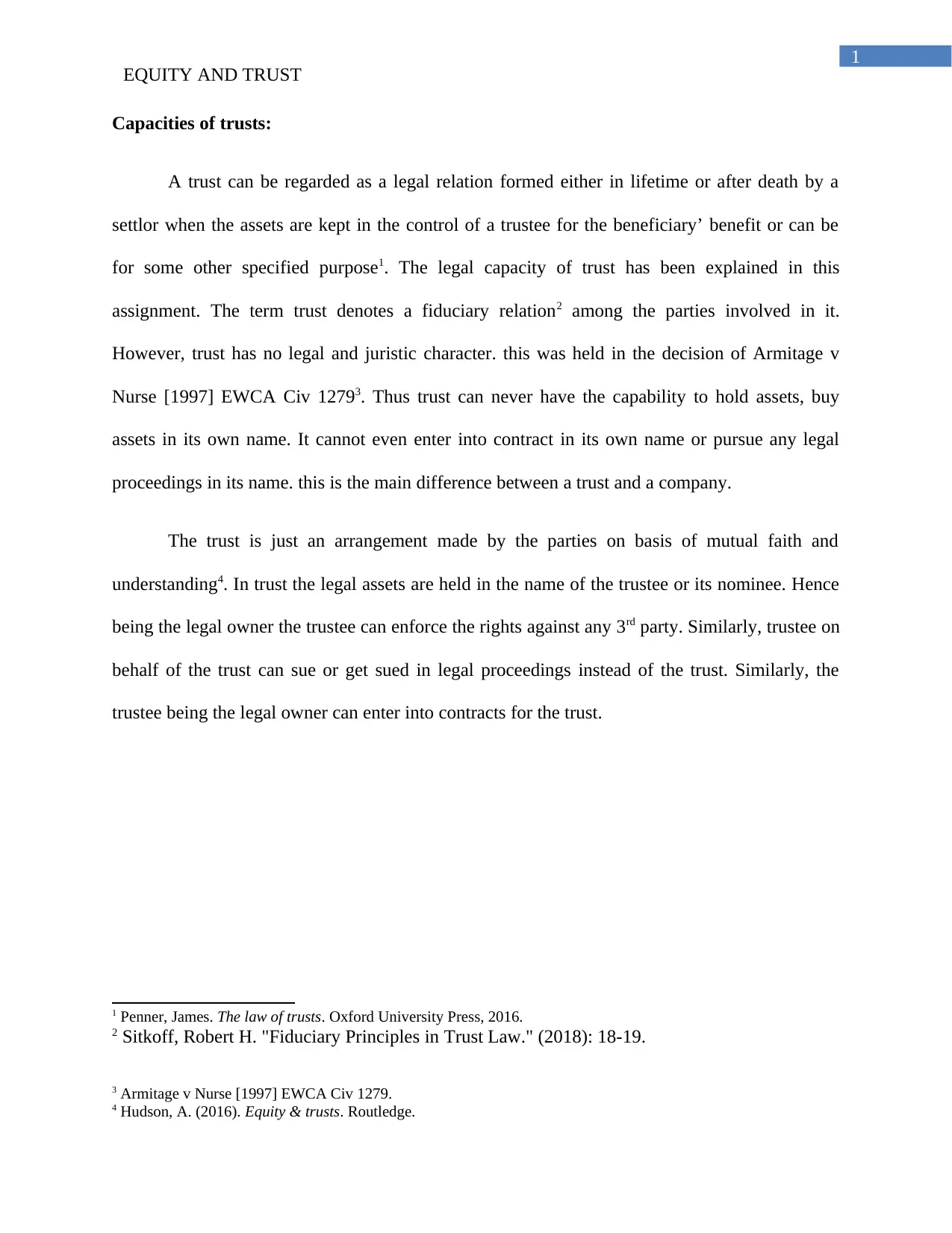
Capacities of trusts:
A trust can be regarded as a legal relation formed either in lifetime or after death by a
settlor when the assets are kept in the control of a trustee for the beneficiary’ benefit or can be
for some other specified purpose1. The legal capacity of trust has been explained in this
assignment. The term trust denotes a fiduciary relation2 among the parties involved in it.
However, trust has no legal and juristic character. this was held in the decision of Armitage v
Nurse [1997] EWCA Civ 12793. Thus trust can never have the capability to hold assets, buy
assets in its own name. It cannot even enter into contract in its own name or pursue any legal
proceedings in its name. this is the main difference between a trust and a company.
The trust is just an arrangement made by the parties on basis of mutual faith and
understanding4. In trust the legal assets are held in the name of the trustee or its nominee. Hence
being the legal owner the trustee can enforce the rights against any 3rd party. Similarly, trustee on
behalf of the trust can sue or get sued in legal proceedings instead of the trust. Similarly, the
trustee being the legal owner can enter into contracts for the trust.
1 Penner, James. The law of trusts. Oxford University Press, 2016.
2 Sitkoff, Robert H. "Fiduciary Principles in Trust Law." (2018): 18-19.
3 Armitage v Nurse [1997] EWCA Civ 1279.
4 Hudson, A. (2016). Equity & trusts. Routledge.
Document Page
2
EQUITY AND TRUST
References:
Armitage v Nurse [1997] EWCA Civ 1279.
Hudson, A. (2016). Equity & trusts. Routledge.
Penner, James. The law of trusts. Oxford University Press, 2016.
Sitkoff, Robert H. "Fiduciary Principles in Trust Law." (2018): 18-19.
chevron_up_icon
1 out of 3
circle_padding
hide_on_mobile
zoom_out_icon
[object Object]