FINA 1082 Principles of Finance - Project NPV and Stock DDM
VerifiedAdded on 2022/08/09
|16
|3463
|14
Report
AI Summary
This report addresses key concepts in finance, including project evaluation using Net Present Value (NPV) analysis and stock valuation using the Dividend Discount Model (DDM). The first question explores the appropriate cost of capital for a project, comparing the cost of debt and the Weighted Average Cost of Capital (WACC), and conducts a sensitivity analysis to assess the impact of changes in investment capital, projected sales value, and WACC on the project's NPV. The second question applies the DDM to value stocks, using Hormel Food Products and AT&T as examples, and discusses the assumptions underlying the model, including beta calculation, market rate of return, risk-free rate, and growth rate. Finally, it provides investment recommendations based on the comparison of intrinsic value and market price, considering the mean reversion property of stock prices. The report emphasizes the importance of considering various factors and assumptions in financial decision-making.

Running head: QUESTION AND ANSWERS
Question and Answers
Name of the Student:
Name of the University:
Author Note:
Question and Answers
Name of the Student:
Name of the University:
Author Note:

Paraphrase This Document
Need a fresh take? Get an instant paraphrase of this document with our AI Paraphraser
1QUESTION AND ANSWERS
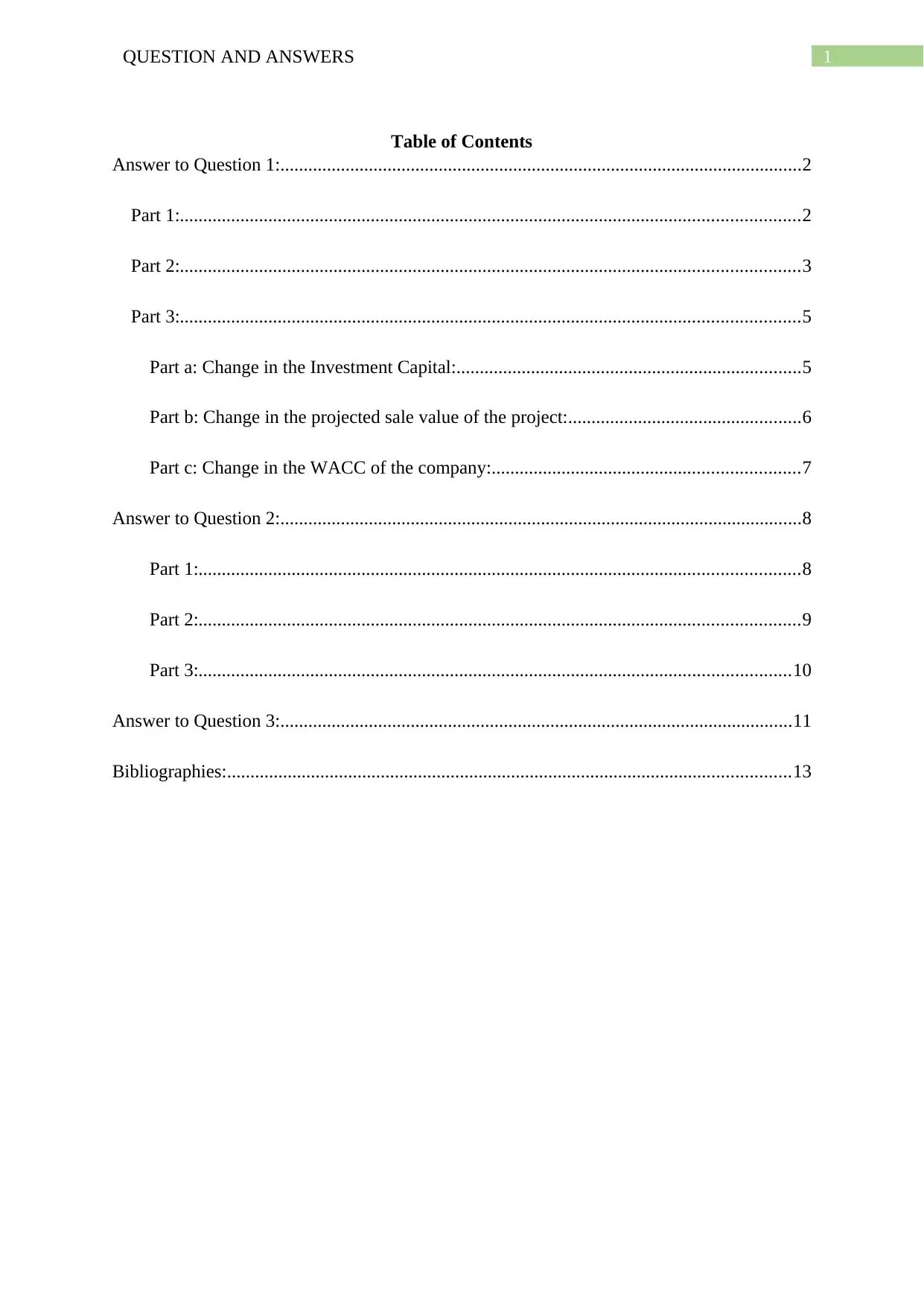
Table of Contents
Answer to Question 1:................................................................................................................2
Part 1:.....................................................................................................................................2
Part 2:.....................................................................................................................................3
Part 3:.....................................................................................................................................5
Part a: Change in the Investment Capital:..........................................................................5
Part b: Change in the projected sale value of the project:..................................................6
Part c: Change in the WACC of the company:..................................................................7
Answer to Question 2:................................................................................................................8
Part 1:.................................................................................................................................8
Part 2:.................................................................................................................................9
Part 3:...............................................................................................................................10
Answer to Question 3:..............................................................................................................11
Bibliographies:.........................................................................................................................13
Table of Contents
Answer to Question 1:................................................................................................................2
Part 1:.....................................................................................................................................2
Part 2:.....................................................................................................................................3
Part 3:.....................................................................................................................................5
Part a: Change in the Investment Capital:..........................................................................5
Part b: Change in the projected sale value of the project:..................................................6
Part c: Change in the WACC of the company:..................................................................7
Answer to Question 2:................................................................................................................8
Part 1:.................................................................................................................................8
Part 2:.................................................................................................................................9
Part 3:...............................................................................................................................10
Answer to Question 3:..............................................................................................................11
Bibliographies:.........................................................................................................................13
2QUESTION AND ANSWERS
Answer to Question 1:
Part 1:
The cost of capital of a project depends on various factors which needs to be
considered by the company management before selecting one for a project. The cost of
capital of debt as highlighted by the CEO wants to take as 6%, which is the cost of debt since
the project would be financed with debt. At first sight this seems to be appropriate, however
the debt would be recorded in the balance sheet of the company and would affect the credit
worthiness of the company. Thus, taking the cost of debt as the cost of capital for a project
would be incorrect as it would not highlight the true measure of risk which is present in the
project (Marcu and et.al 2017).
The project manager advised to take on the WACC of the company as the cost of
capital of the project. This is a correct measure only if the risk which is present in the project
is same as the risk of the company. Hence, if the risk is the same then the WACC of the
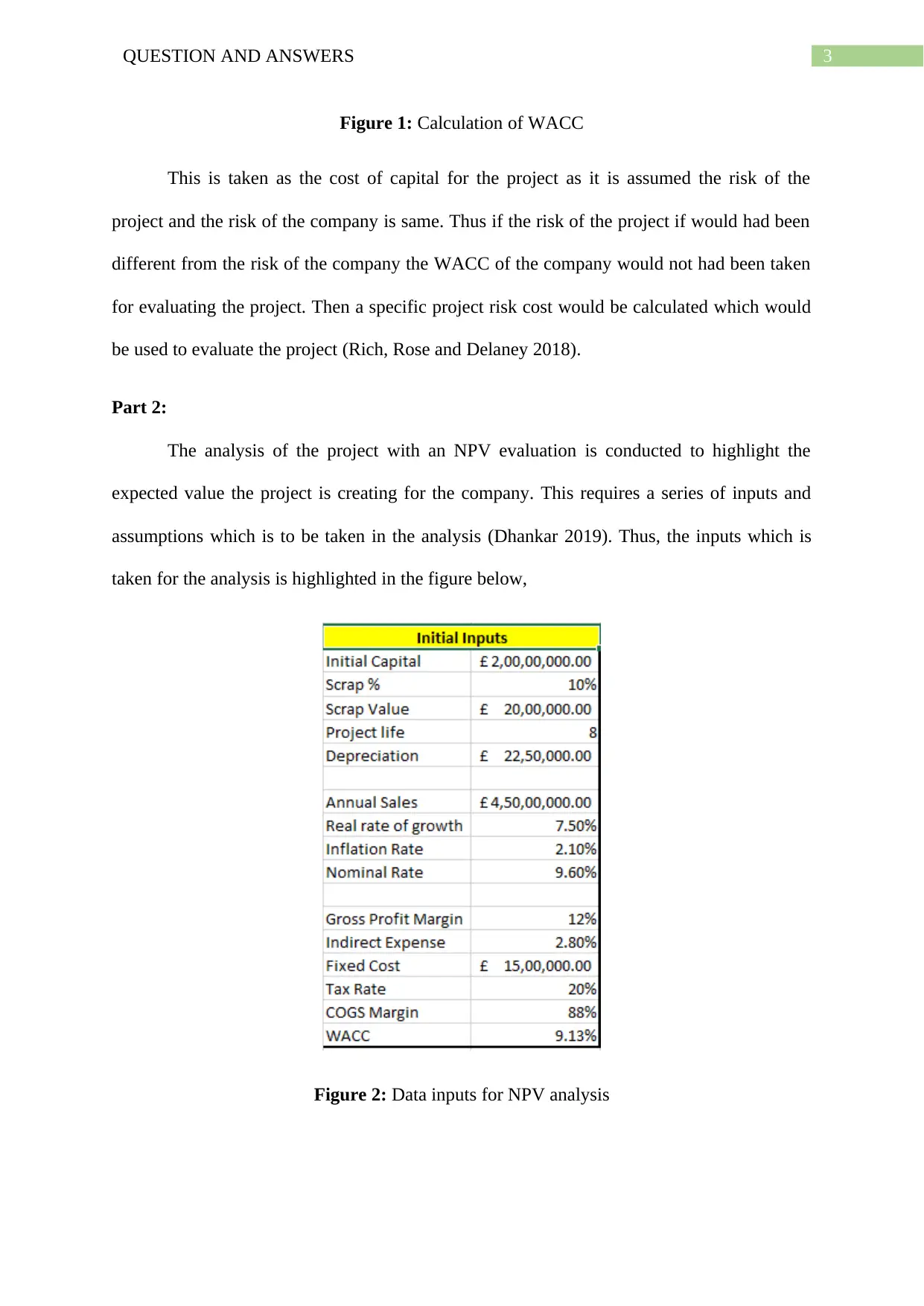
company which is 9.13% and is calculated in the figure below can be taken as the cost of
capital of the project.
Answer to Question 1:
Part 1:
The cost of capital of a project depends on various factors which needs to be
considered by the company management before selecting one for a project. The cost of
capital of debt as highlighted by the CEO wants to take as 6%, which is the cost of debt since
the project would be financed with debt. At first sight this seems to be appropriate, however
the debt would be recorded in the balance sheet of the company and would affect the credit
worthiness of the company. Thus, taking the cost of debt as the cost of capital for a project
would be incorrect as it would not highlight the true measure of risk which is present in the
project (Marcu and et.al 2017).
The project manager advised to take on the WACC of the company as the cost of
capital of the project. This is a correct measure only if the risk which is present in the project
is same as the risk of the company. Hence, if the risk is the same then the WACC of the
company which is 9.13% and is calculated in the figure below can be taken as the cost of
capital of the project.
⊘ This is a preview!⊘
Do you want full access?
Subscribe today to unlock all pages.

Trusted by 1+ million students worldwide
3QUESTION AND ANSWERS
Figure 1: Calculation of WACC
This is taken as the cost of capital for the project as it is assumed the risk of the
project and the risk of the company is same. Thus if the risk of the project if would had been
different from the risk of the company the WACC of the company would not had been taken
for evaluating the project. Then a specific project risk cost would be calculated which would
be used to evaluate the project (Rich, Rose and Delaney 2018).
Part 2:
The analysis of the project with an NPV evaluation is conducted to highlight the
expected value the project is creating for the company. This requires a series of inputs and
assumptions which is to be taken in the analysis (Dhankar 2019). Thus, the inputs which is
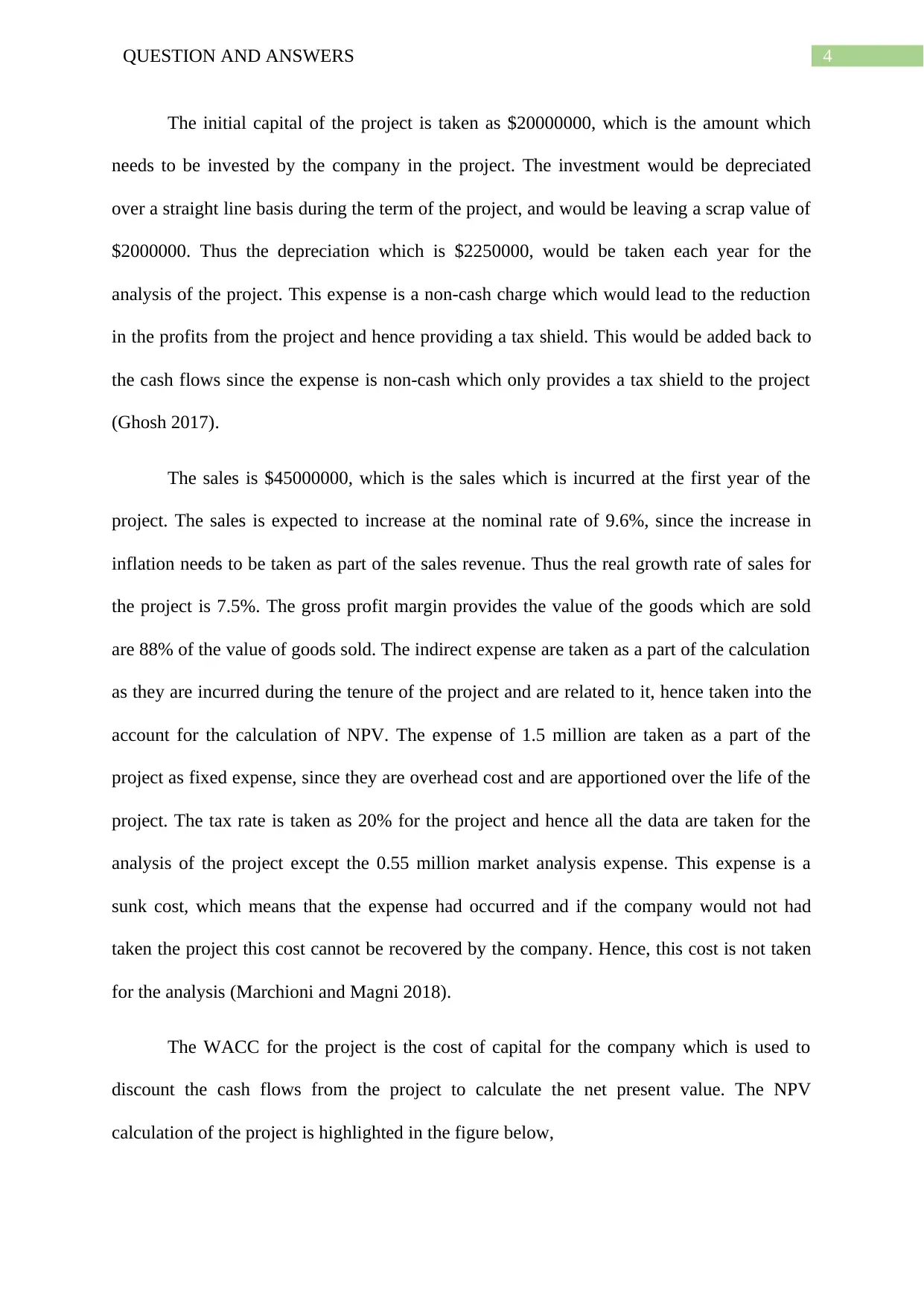
taken for the analysis is highlighted in the figure below,
Figure 2: Data inputs for NPV analysis
Figure 1: Calculation of WACC
This is taken as the cost of capital for the project as it is assumed the risk of the
project and the risk of the company is same. Thus if the risk of the project if would had been
different from the risk of the company the WACC of the company would not had been taken
for evaluating the project. Then a specific project risk cost would be calculated which would
be used to evaluate the project (Rich, Rose and Delaney 2018).
Part 2:
The analysis of the project with an NPV evaluation is conducted to highlight the
expected value the project is creating for the company. This requires a series of inputs and
assumptions which is to be taken in the analysis (Dhankar 2019). Thus, the inputs which is
taken for the analysis is highlighted in the figure below,
Figure 2: Data inputs for NPV analysis
Paraphrase This Document
Need a fresh take? Get an instant paraphrase of this document with our AI Paraphraser
4QUESTION AND ANSWERS
The initial capital of the project is taken as $20000000, which is the amount which
needs to be invested by the company in the project. The investment would be depreciated
over a straight line basis during the term of the project, and would be leaving a scrap value of
$2000000. Thus the depreciation which is $2250000, would be taken each year for the
analysis of the project. This expense is a non-cash charge which would lead to the reduction
in the profits from the project and hence providing a tax shield. This would be added back to
the cash flows since the expense is non-cash which only provides a tax shield to the project
(Ghosh 2017).
The sales is $45000000, which is the sales which is incurred at the first year of the
project. The sales is expected to increase at the nominal rate of 9.6%, since the increase in
inflation needs to be taken as part of the sales revenue. Thus the real growth rate of sales for
the project is 7.5%. The gross profit margin provides the value of the goods which are sold
are 88% of the value of goods sold. The indirect expense are taken as a part of the calculation
as they are incurred during the tenure of the project and are related to it, hence taken into the
account for the calculation of NPV. The expense of 1.5 million are taken as a part of the
project as fixed expense, since they are overhead cost and are apportioned over the life of the
project. The tax rate is taken as 20% for the project and hence all the data are taken for the
analysis of the project except the 0.55 million market analysis expense. This expense is a
sunk cost, which means that the expense had occurred and if the company would not had
taken the project this cost cannot be recovered by the company. Hence, this cost is not taken
for the analysis (Marchioni and Magni 2018).
The WACC for the project is the cost of capital for the company which is used to
discount the cash flows from the project to calculate the net present value. The NPV
calculation of the project is highlighted in the figure below,
The initial capital of the project is taken as $20000000, which is the amount which
needs to be invested by the company in the project. The investment would be depreciated
over a straight line basis during the term of the project, and would be leaving a scrap value of
$2000000. Thus the depreciation which is $2250000, would be taken each year for the
analysis of the project. This expense is a non-cash charge which would lead to the reduction
in the profits from the project and hence providing a tax shield. This would be added back to
the cash flows since the expense is non-cash which only provides a tax shield to the project
(Ghosh 2017).
The sales is $45000000, which is the sales which is incurred at the first year of the
project. The sales is expected to increase at the nominal rate of 9.6%, since the increase in
inflation needs to be taken as part of the sales revenue. Thus the real growth rate of sales for
the project is 7.5%. The gross profit margin provides the value of the goods which are sold
are 88% of the value of goods sold. The indirect expense are taken as a part of the calculation
as they are incurred during the tenure of the project and are related to it, hence taken into the
account for the calculation of NPV. The expense of 1.5 million are taken as a part of the
project as fixed expense, since they are overhead cost and are apportioned over the life of the
project. The tax rate is taken as 20% for the project and hence all the data are taken for the
analysis of the project except the 0.55 million market analysis expense. This expense is a
sunk cost, which means that the expense had occurred and if the company would not had
taken the project this cost cannot be recovered by the company. Hence, this cost is not taken
for the analysis (Marchioni and Magni 2018).
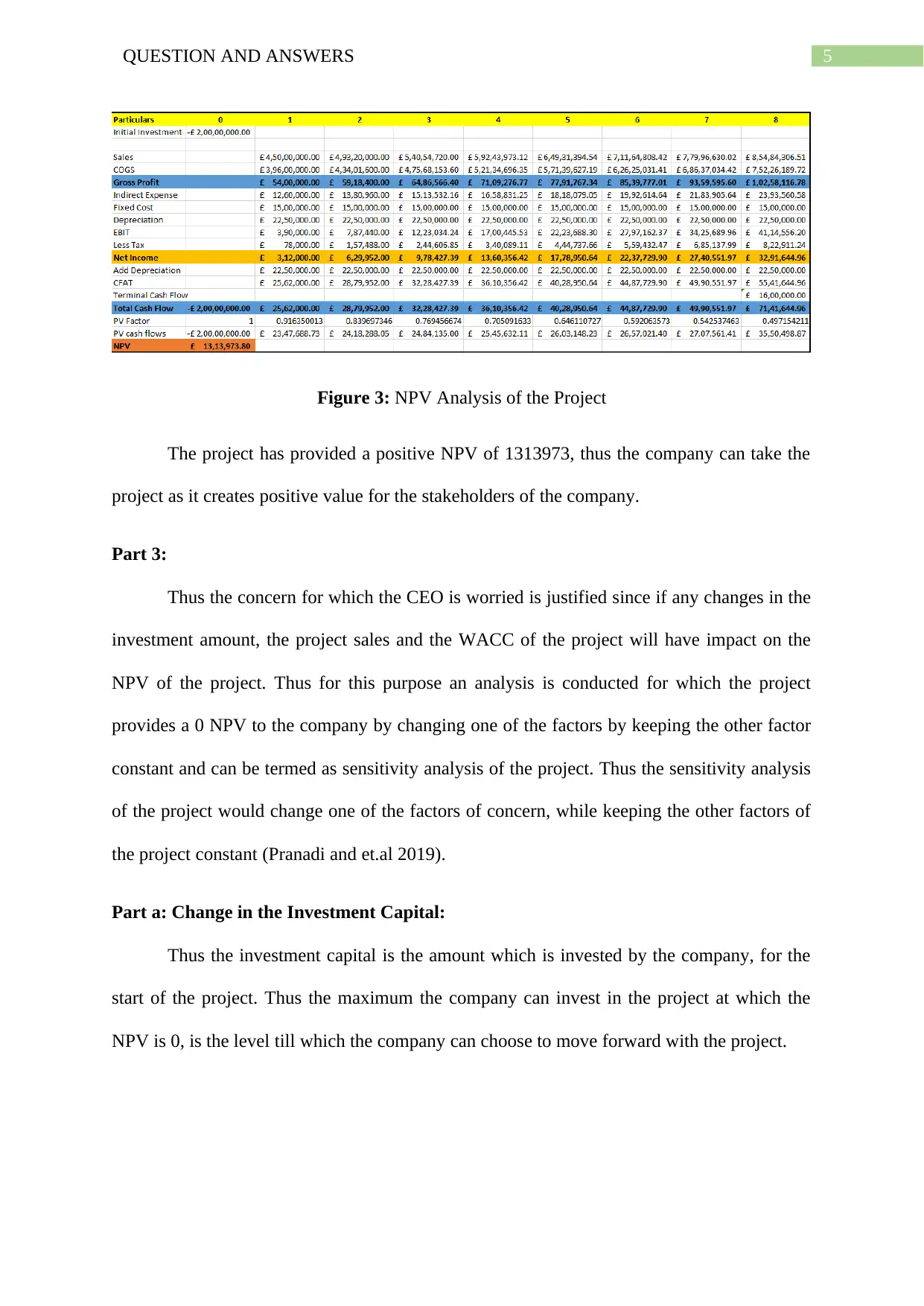
The WACC for the project is the cost of capital for the company which is used to
discount the cash flows from the project to calculate the net present value. The NPV
calculation of the project is highlighted in the figure below,
5QUESTION AND ANSWERS
Figure 3: NPV Analysis of the Project
The project has provided a positive NPV of 1313973, thus the company can take the
project as it creates positive value for the stakeholders of the company.
Part 3:
Thus the concern for which the CEO is worried is justified since if any changes in the
investment amount, the project sales and the WACC of the project will have impact on the
NPV of the project. Thus for this purpose an analysis is conducted for which the project
provides a 0 NPV to the company by changing one of the factors by keeping the other factor
constant and can be termed as sensitivity analysis of the project. Thus the sensitivity analysis
of the project would change one of the factors of concern, while keeping the other factors of
the project constant (Pranadi and et.al 2019).
Part a: Change in the Investment Capital:
Thus the investment capital is the amount which is invested by the company, for the
start of the project. Thus the maximum the company can invest in the project at which the
NPV is 0, is the level till which the company can choose to move forward with the project.
Figure 3: NPV Analysis of the Project
The project has provided a positive NPV of 1313973, thus the company can take the
project as it creates positive value for the stakeholders of the company.
Part 3:
Thus the concern for which the CEO is worried is justified since if any changes in the
investment amount, the project sales and the WACC of the project will have impact on the
NPV of the project. Thus for this purpose an analysis is conducted for which the project
provides a 0 NPV to the company by changing one of the factors by keeping the other factor
constant and can be termed as sensitivity analysis of the project. Thus the sensitivity analysis
of the project would change one of the factors of concern, while keeping the other factors of
the project constant (Pranadi and et.al 2019).
Part a: Change in the Investment Capital:
Thus the investment capital is the amount which is invested by the company, for the
start of the project. Thus the maximum the company can invest in the project at which the
NPV is 0, is the level till which the company can choose to move forward with the project.
⊘ This is a preview!⊘
Do you want full access?
Subscribe today to unlock all pages.
Trusted by 1+ million students worldwide
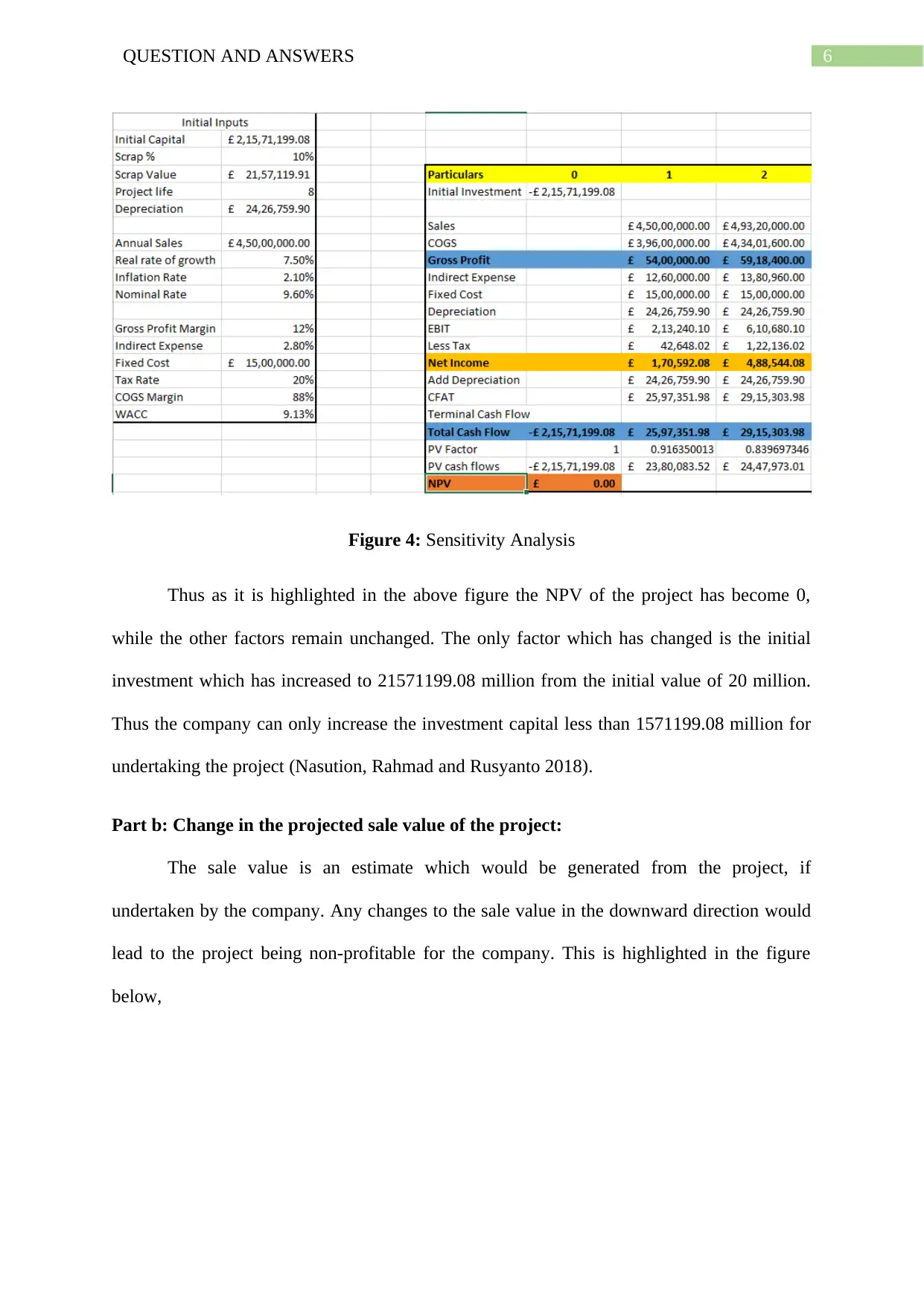
6QUESTION AND ANSWERS
Figure 4: Sensitivity Analysis
Thus as it is highlighted in the above figure the NPV of the project has become 0,
while the other factors remain unchanged. The only factor which has changed is the initial
investment which has increased to 21571199.08 million from the initial value of 20 million.
Thus the company can only increase the investment capital less than 1571199.08 million for
undertaking the project (Nasution, Rahmad and Rusyanto 2018).
Part b: Change in the projected sale value of the project:
The sale value is an estimate which would be generated from the project, if
undertaken by the company. Any changes to the sale value in the downward direction would
lead to the project being non-profitable for the company. This is highlighted in the figure
below,
Figure 4: Sensitivity Analysis
Thus as it is highlighted in the above figure the NPV of the project has become 0,
while the other factors remain unchanged. The only factor which has changed is the initial
investment which has increased to 21571199.08 million from the initial value of 20 million.
Thus the company can only increase the investment capital less than 1571199.08 million for
undertaking the project (Nasution, Rahmad and Rusyanto 2018).
Part b: Change in the projected sale value of the project:
The sale value is an estimate which would be generated from the project, if
undertaken by the company. Any changes to the sale value in the downward direction would
lead to the project being non-profitable for the company. This is highlighted in the figure
below,
Paraphrase This Document
Need a fresh take? Get an instant paraphrase of this document with our AI Paraphraser
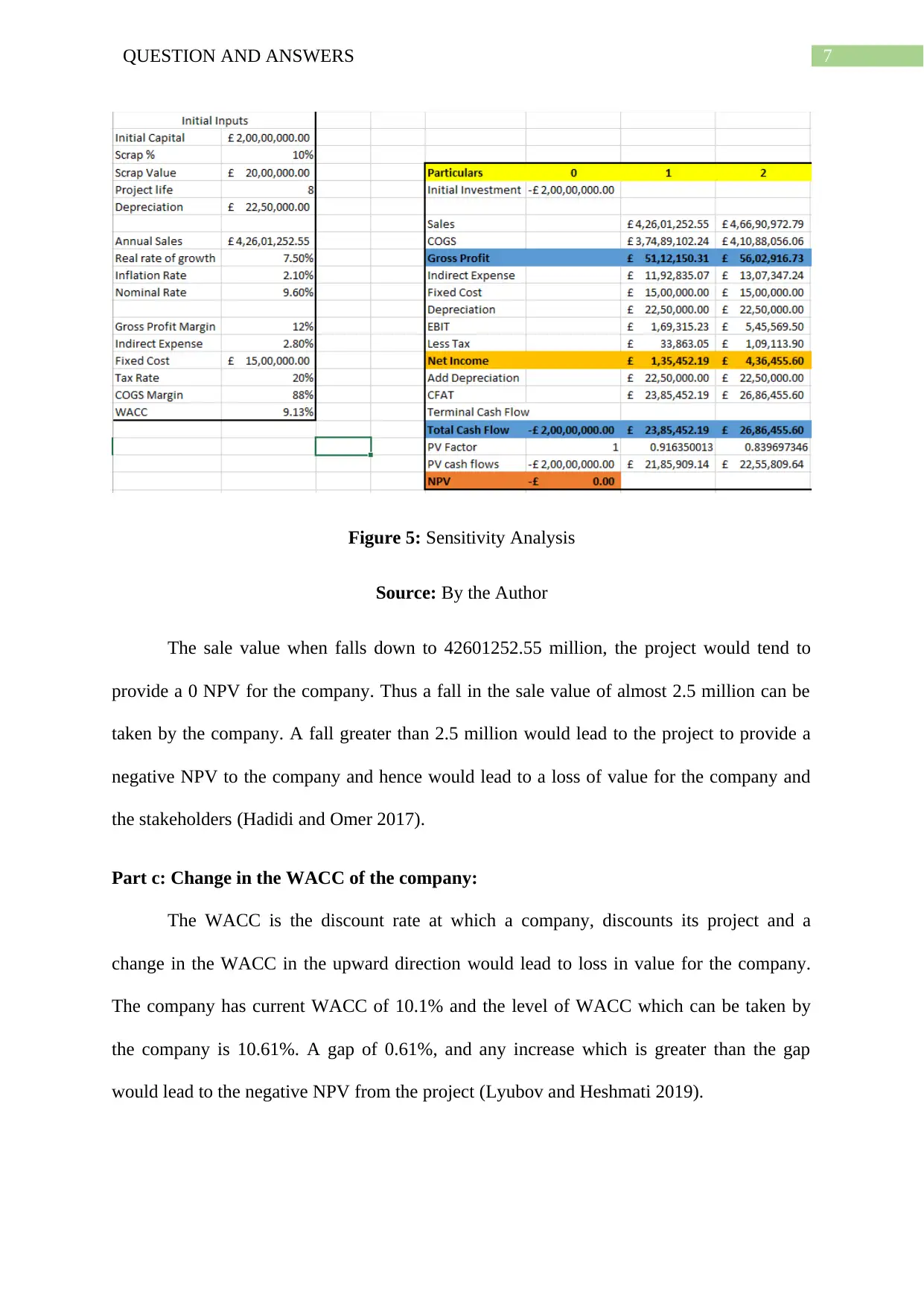
7QUESTION AND ANSWERS
Figure 5: Sensitivity Analysis
Source: By the Author
The sale value when falls down to 42601252.55 million, the project would tend to
provide a 0 NPV for the company. Thus a fall in the sale value of almost 2.5 million can be
taken by the company. A fall greater than 2.5 million would lead to the project to provide a
negative NPV to the company and hence would lead to a loss of value for the company and
the stakeholders (Hadidi and Omer 2017).
Part c: Change in the WACC of the company:
The WACC is the discount rate at which a company, discounts its project and a
change in the WACC in the upward direction would lead to loss in value for the company.
The company has current WACC of 10.1% and the level of WACC which can be taken by
the company is 10.61%. A gap of 0.61%, and any increase which is greater than the gap
would lead to the negative NPV from the project (Lyubov and Heshmati 2019).
Figure 5: Sensitivity Analysis
Source: By the Author
The sale value when falls down to 42601252.55 million, the project would tend to
provide a 0 NPV for the company. Thus a fall in the sale value of almost 2.5 million can be
taken by the company. A fall greater than 2.5 million would lead to the project to provide a
negative NPV to the company and hence would lead to a loss of value for the company and
the stakeholders (Hadidi and Omer 2017).
Part c: Change in the WACC of the company:
The WACC is the discount rate at which a company, discounts its project and a
change in the WACC in the upward direction would lead to loss in value for the company.
The company has current WACC of 10.1% and the level of WACC which can be taken by
the company is 10.61%. A gap of 0.61%, and any increase which is greater than the gap
would lead to the negative NPV from the project (Lyubov and Heshmati 2019).
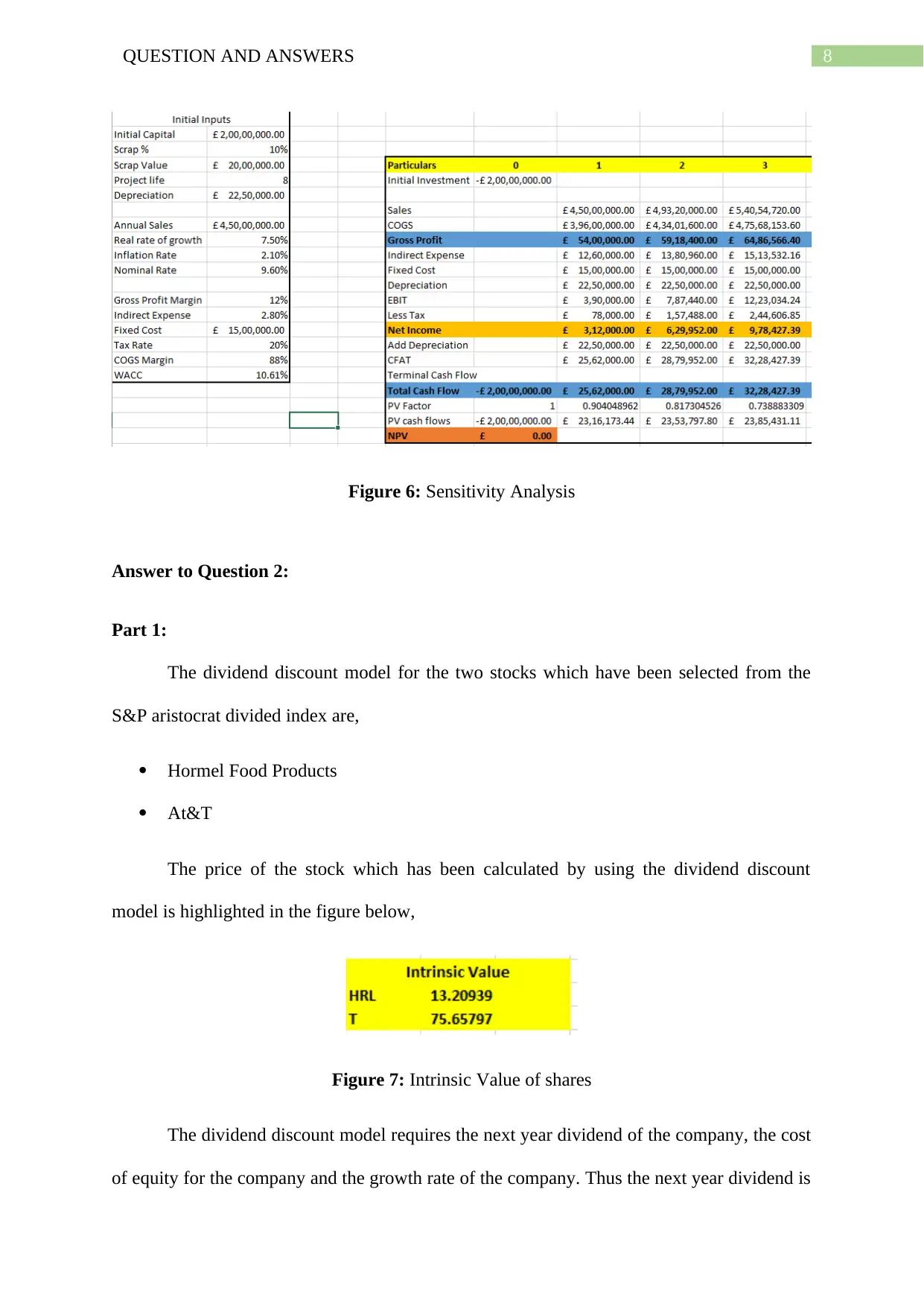
8QUESTION AND ANSWERS
Figure 6: Sensitivity Analysis
Answer to Question 2:
Part 1:
The dividend discount model for the two stocks which have been selected from the
S&P aristocrat divided index are,
Hormel Food Products
At&T
The price of the stock which has been calculated by using the dividend discount
model is highlighted in the figure below,
Figure 7: Intrinsic Value of shares
The dividend discount model requires the next year dividend of the company, the cost
of equity for the company and the growth rate of the company. Thus the next year dividend is
Figure 6: Sensitivity Analysis
Answer to Question 2:
Part 1:
The dividend discount model for the two stocks which have been selected from the
S&P aristocrat divided index are,
Hormel Food Products
At&T
The price of the stock which has been calculated by using the dividend discount
model is highlighted in the figure below,
Figure 7: Intrinsic Value of shares
The dividend discount model requires the next year dividend of the company, the cost
of equity for the company and the growth rate of the company. Thus the next year dividend is
⊘ This is a preview!⊘
Do you want full access?
Subscribe today to unlock all pages.
Trusted by 1+ million students worldwide
9QUESTION AND ANSWERS
divided by the difference of the cost of equity and the growth rate of the company
(finance.yahoo.com/quote/HRL 2020).
Thus the shares of the company Hormel Food products intrinsic value should be $
13.20 and the intrinsic value of the shares of the company At&T should be at $75.65
(finance.yahoo.com/quote/AT&T 2020).
Part 2:
The various assumptions which has been used in the valuation of the shares of the
company are provided in the bullets below,
Beta of the companies is calculated by using the slope function in excel for the past 5
years daily return from both the stock. The benchmark is taken as the S&P 500
Aristocrat Dividend index. Thus the analysis period of the investments is 5 years
which is used to calculate the Beta of the stock.
The market rate of return is taken as 11%, which is the return of the Aristocrat index
for the past 5 years. This is considered as the market rate of return and taken for the
valuation of the company.
The risk free rate which is considered for the country of US is 1.15% which is the 5
year treasury yield.
The above estimates are used as an input in the CAPM to derive the cost of equity for
both the companies. Thus the cost of equity is the minimum return which needs to be
generated by the company for the shareholders.
The growth rate for the company is taken as the CAGR from yahoo finance for both
the stocks and assumed to be constant for the future life of the company.
divided by the difference of the cost of equity and the growth rate of the company
(finance.yahoo.com/quote/HRL 2020).
Thus the shares of the company Hormel Food products intrinsic value should be $
13.20 and the intrinsic value of the shares of the company At&T should be at $75.65
(finance.yahoo.com/quote/AT&T 2020).
Part 2:
The various assumptions which has been used in the valuation of the shares of the
company are provided in the bullets below,
Beta of the companies is calculated by using the slope function in excel for the past 5
years daily return from both the stock. The benchmark is taken as the S&P 500
Aristocrat Dividend index. Thus the analysis period of the investments is 5 years
which is used to calculate the Beta of the stock.
The market rate of return is taken as 11%, which is the return of the Aristocrat index
for the past 5 years. This is considered as the market rate of return and taken for the
valuation of the company.
The risk free rate which is considered for the country of US is 1.15% which is the 5
year treasury yield.
The above estimates are used as an input in the CAPM to derive the cost of equity for
both the companies. Thus the cost of equity is the minimum return which needs to be
generated by the company for the shareholders.
The growth rate for the company is taken as the CAGR from yahoo finance for both
the stocks and assumed to be constant for the future life of the company.
Paraphrase This Document
Need a fresh take? Get an instant paraphrase of this document with our AI Paraphraser
10QUESTION AND ANSWERS
The dividends for the both the companies is paid quarterly, hence the annual dividend
is calculated by summing all the dividends received in a year. This fact however,
ignores the time value of money (Tsoy and Heshmati 2017).
Part 3:
Thus the intrinsic value for both the stocks is calculated, which highlights the should
be price for the companies. This price is based on the above assumptions and the intrinsic
value is subject to change if any of the assumptions above are changed. The current price for
the company Hormel Food Products is $41.68, while the intrinsic value for the stock
calculated using the dividend discount model is $13.20. Thus the shares of the company are
overvalued and are expected to fall in the future. Hence the stock of the company should be
sold by the investors as the price would fall down towards the intrinsic value due to mean
reversion property.
The stock of the company At&T is currently trading at the market at a price of $35.16,
while the intrinsic value of the stock is $75.65. Thus the stock is expected to appreciate in the
future and the recommendation advice is to buy the stock. This is due to the mean reversion
property of shares the price of the stock would increase or decrease.
The mean reversion property states that every shares have a mean price at which the
stock should trade. However, due to the market forces the stock become overvalued or
undervalued. Thus, due to this property share price will fall towards the mean if they are
overvalued or rise towards mean if they are undervalued. This would happen when due to
certain events which act as catalyst the market revises their belief for a particular stock and
can be any event in the future (Rodrigues 2020).
The dividends for the both the companies is paid quarterly, hence the annual dividend
is calculated by summing all the dividends received in a year. This fact however,
ignores the time value of money (Tsoy and Heshmati 2017).
Part 3:
Thus the intrinsic value for both the stocks is calculated, which highlights the should
be price for the companies. This price is based on the above assumptions and the intrinsic
value is subject to change if any of the assumptions above are changed. The current price for
the company Hormel Food Products is $41.68, while the intrinsic value for the stock
calculated using the dividend discount model is $13.20. Thus the shares of the company are
overvalued and are expected to fall in the future. Hence the stock of the company should be
sold by the investors as the price would fall down towards the intrinsic value due to mean
reversion property.
The stock of the company At&T is currently trading at the market at a price of $35.16,
while the intrinsic value of the stock is $75.65. Thus the stock is expected to appreciate in the
future and the recommendation advice is to buy the stock. This is due to the mean reversion
property of shares the price of the stock would increase or decrease.
The mean reversion property states that every shares have a mean price at which the
stock should trade. However, due to the market forces the stock become overvalued or
undervalued. Thus, due to this property share price will fall towards the mean if they are
overvalued or rise towards mean if they are undervalued. This would happen when due to
certain events which act as catalyst the market revises their belief for a particular stock and
can be any event in the future (Rodrigues 2020).
11QUESTION AND ANSWERS
Answer to Question 3:
The dividend policy is an integral part for the company as it emphasizes the return
earning capability of a company. It provides a return to the investors or the shareholders of
the company who have invested in the company to earn returns. Thus various theories in
regards to the dividend policy of the company are discussed and this part seeks to highlight
the importance of each theory in dividend policy (Heaton 2020).
As per the MM irrelevance theory, which highlights the company dividend policy is
irrelevant for the investors. It states that a gain which is incurred to the investors by the
receipt of dividend will be reduced when the stock price of the company falls. Thus the gain
is nullified for the investors, and the investment decision is not made by the investors by
analysing the dividend policy of the company. This however, is based on a series of
assumptions which are not applicable in the real world (Sim and Wright 2017).
The Pecking order theory, states that the value of a firm is dependent on the mode of
financing which is taken by the company. This however, focuses on the cost of capital of the
company but also is impacted by the dividend policy of the company. A company which does
not pay dividend and reinvests the proceeds in projects gives no signal to the investors about
the future prospects of the company. Thus, it can be considered as one of the best methods of
financing which can be undertaken by the company. However, if the company has poor
fundamentals and does not pay dividend to the investors, the value of the company can
reduce significantly. This is because if the company invests the retained earnings which
generate lower return for the investors, while an investor can invest the same proceeds in
other investments and generate higher return. Thus, the investors would prefer the company
to pay dividends in such scenario as the value of the investments for the investments is
reducing (Hatemi and El-Khatib 2018).
Answer to Question 3:
The dividend policy is an integral part for the company as it emphasizes the return
earning capability of a company. It provides a return to the investors or the shareholders of
the company who have invested in the company to earn returns. Thus various theories in
regards to the dividend policy of the company are discussed and this part seeks to highlight
the importance of each theory in dividend policy (Heaton 2020).
As per the MM irrelevance theory, which highlights the company dividend policy is
irrelevant for the investors. It states that a gain which is incurred to the investors by the
receipt of dividend will be reduced when the stock price of the company falls. Thus the gain
is nullified for the investors, and the investment decision is not made by the investors by
analysing the dividend policy of the company. This however, is based on a series of
assumptions which are not applicable in the real world (Sim and Wright 2017).
The Pecking order theory, states that the value of a firm is dependent on the mode of
financing which is taken by the company. This however, focuses on the cost of capital of the
company but also is impacted by the dividend policy of the company. A company which does
not pay dividend and reinvests the proceeds in projects gives no signal to the investors about
the future prospects of the company. Thus, it can be considered as one of the best methods of
financing which can be undertaken by the company. However, if the company has poor
fundamentals and does not pay dividend to the investors, the value of the company can
reduce significantly. This is because if the company invests the retained earnings which
generate lower return for the investors, while an investor can invest the same proceeds in
other investments and generate higher return. Thus, the investors would prefer the company
to pay dividends in such scenario as the value of the investments for the investments is
reducing (Hatemi and El-Khatib 2018).
⊘ This is a preview!⊘
Do you want full access?
Subscribe today to unlock all pages.
Trusted by 1+ million students worldwide

1 out of 16


Related Documents


Your All-in-One AI-Powered Toolkit for Academic Success.
+13062052269
info@desklib.com
Available 24*7 on WhatsApp / Email
![[object Object]](/_next/static/media/star-bottom.7253800d.svg)
Unlock your academic potential
Copyright © 2020–2026 A2Z Services. All Rights Reserved. Developed and managed by ZUCOL.