Capital Structure and Valuation Project - Accommodate PLC Finance

Verified

Added on  2022/09/11

|11
|1607
|14
Project
AI Summary
This project analyzes Accommodate PLC's financial decisions regarding a potential acquisition. It begins with a capital structure analysis, exploring the use of WACC and risk-adjusted WACC to evaluate the project's feasibility. The project calculates NPV to determine whether the investment should be accepted. It also delves into dividend policy, comparing residual dividend policy with constant growth, and discusses the benefits and limitations of each. The project further examines valuation methods, including net asset valuation, price-to-earnings ratio, and free cash flow valuation. Finally, it investigates option pricing using the Black-Scholes model and compares call and put options, along with the binomial option pricing model.

Document Page
Running head: QUESTION AND ANSWER
Question and Answer
Name of the Student:
Name of the University:
Author Note:
tabler-icon-diamond-filled.svg

Paraphrase This Document

Need a fresh take? Get an instant paraphrase of this document with our AI Paraphraser
Document Page
1QUESTION AND ANSWER
Table of Contents
Answer to Question 1:................................................................................................................2
Part a:.....................................................................................................................................2
Part b:.....................................................................................................................................2
Part c:.....................................................................................................................................3
Answer to Question 2:................................................................................................................4
Part a:.....................................................................................................................................4
Part b:.....................................................................................................................................4
Part c:.....................................................................................................................................5
Part i:..................................................................................................................................5
Part ii:.................................................................................................................................5
Part iii:................................................................................................................................5
Part iv:................................................................................................................................6
Part d:.....................................................................................................................................6
Answer to Question 3:................................................................................................................7
Answer to Question 4:................................................................................................................8
Part a:.....................................................................................................................................8
Part b:.....................................................................................................................................9
Part c:.....................................................................................................................................9
Part i:..................................................................................................................................9
Part ii:.................................................................................................................................9
Document Page
2QUESTION AND ANSWER
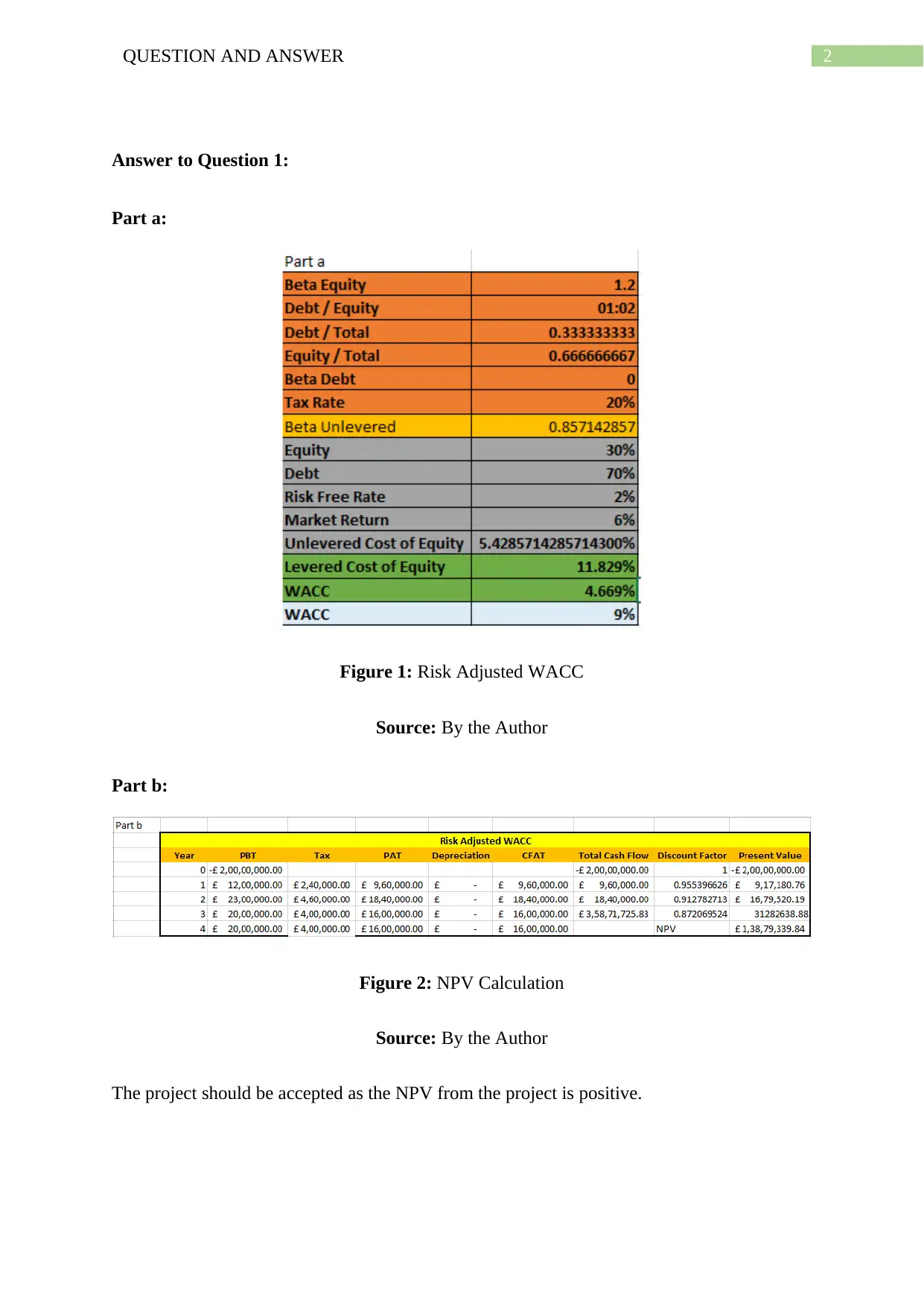
Answer to Question 1:
Part a:
Figure 1: Risk Adjusted WACC
Source: By the Author
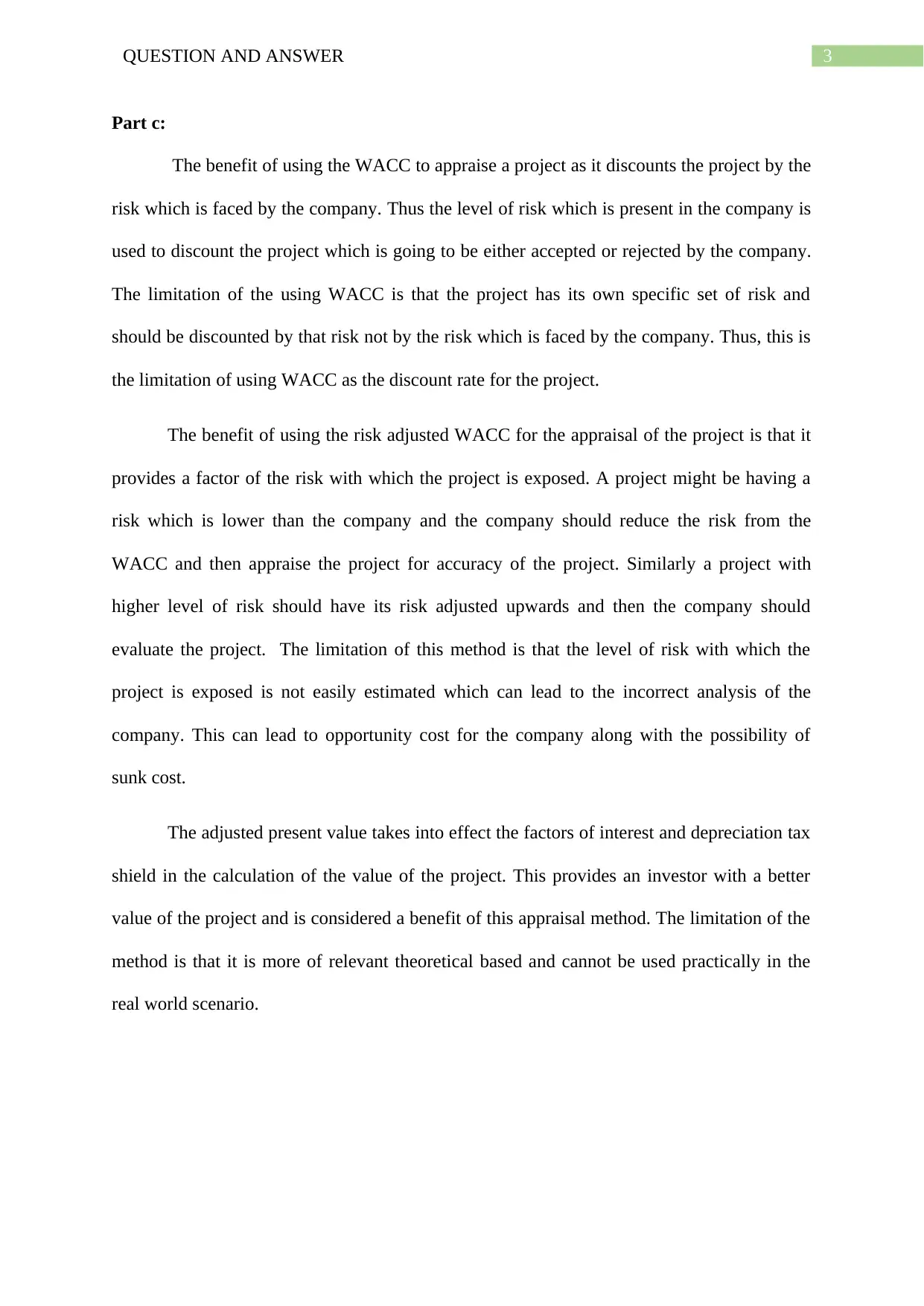
Part b:
Figure 2: NPV Calculation
Source: By the Author
The project should be accepted as the NPV from the project is positive.
Document Page
3QUESTION AND ANSWER
Part c:
The benefit of using the WACC to appraise a project as it discounts the project by the
risk which is faced by the company. Thus the level of risk which is present in the company is
used to discount the project which is going to be either accepted or rejected by the company.
The limitation of the using WACC is that the project has its own specific set of risk and
should be discounted by that risk not by the risk which is faced by the company. Thus, this is
the limitation of using WACC as the discount rate for the project.
The benefit of using the risk adjusted WACC for the appraisal of the project is that it
provides a factor of the risk with which the project is exposed. A project might be having a
risk which is lower than the company and the company should reduce the risk from the
WACC and then appraise the project for accuracy of the project. Similarly a project with
higher level of risk should have its risk adjusted upwards and then the company should
evaluate the project. The limitation of this method is that the level of risk with which the
project is exposed is not easily estimated which can lead to the incorrect analysis of the
company. This can lead to opportunity cost for the company along with the possibility of
sunk cost.
The adjusted present value takes into effect the factors of interest and depreciation tax
shield in the calculation of the value of the project. This provides an investor with a better
value of the project and is considered a benefit of this appraisal method. The limitation of the
method is that it is more of relevant theoretical based and cannot be used practically in the
real world scenario.
tabler-icon-diamond-filled.svg

Paraphrase This Document

Need a fresh take? Get an instant paraphrase of this document with our AI Paraphraser
Document Page
4QUESTION AND ANSWER
Answer to Question 2:
Part a:
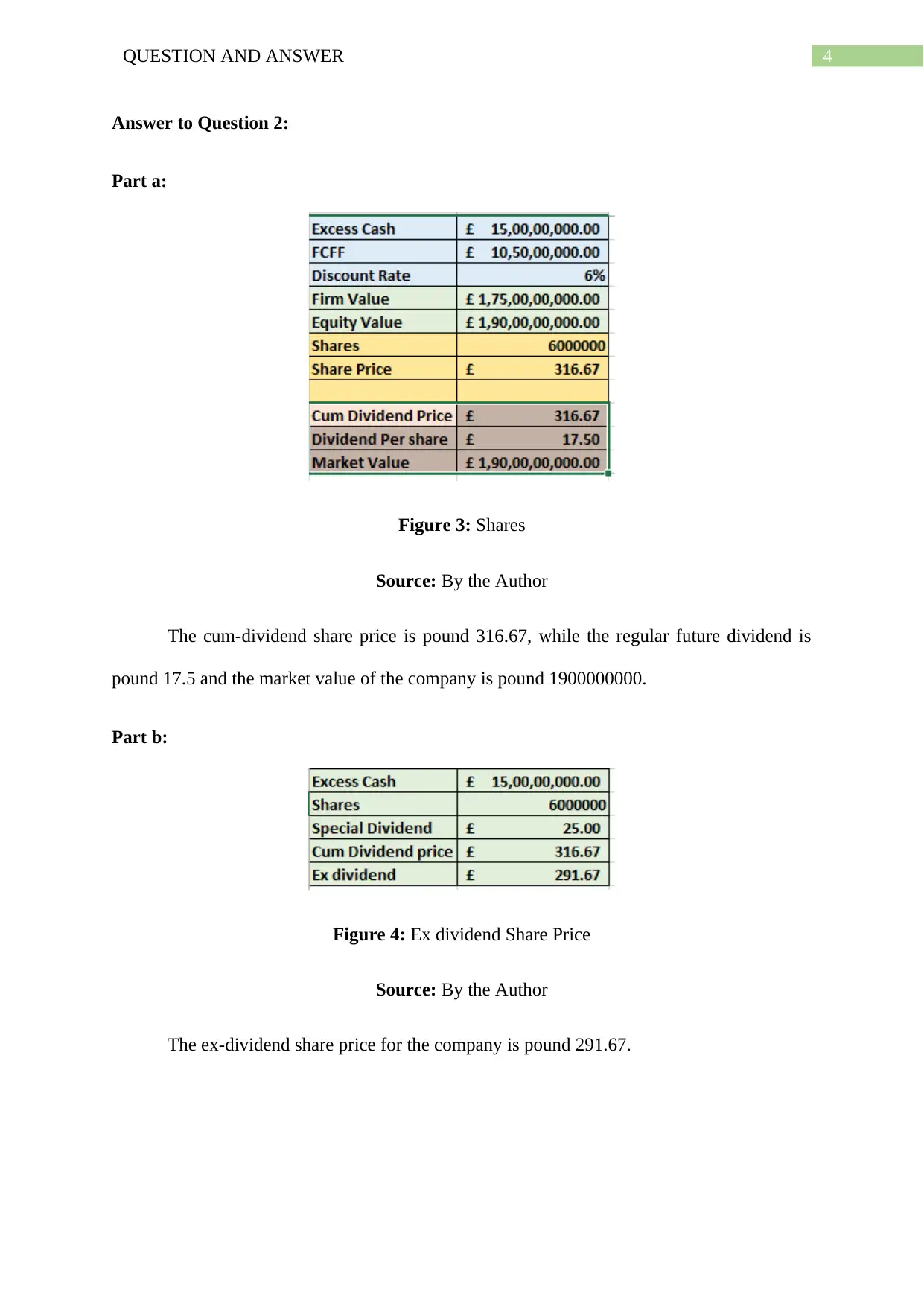
Figure 3: Shares
Source: By the Author
The cum-dividend share price is pound 316.67, while the regular future dividend is
pound 17.5 and the market value of the company is pound 1900000000.
Part b:
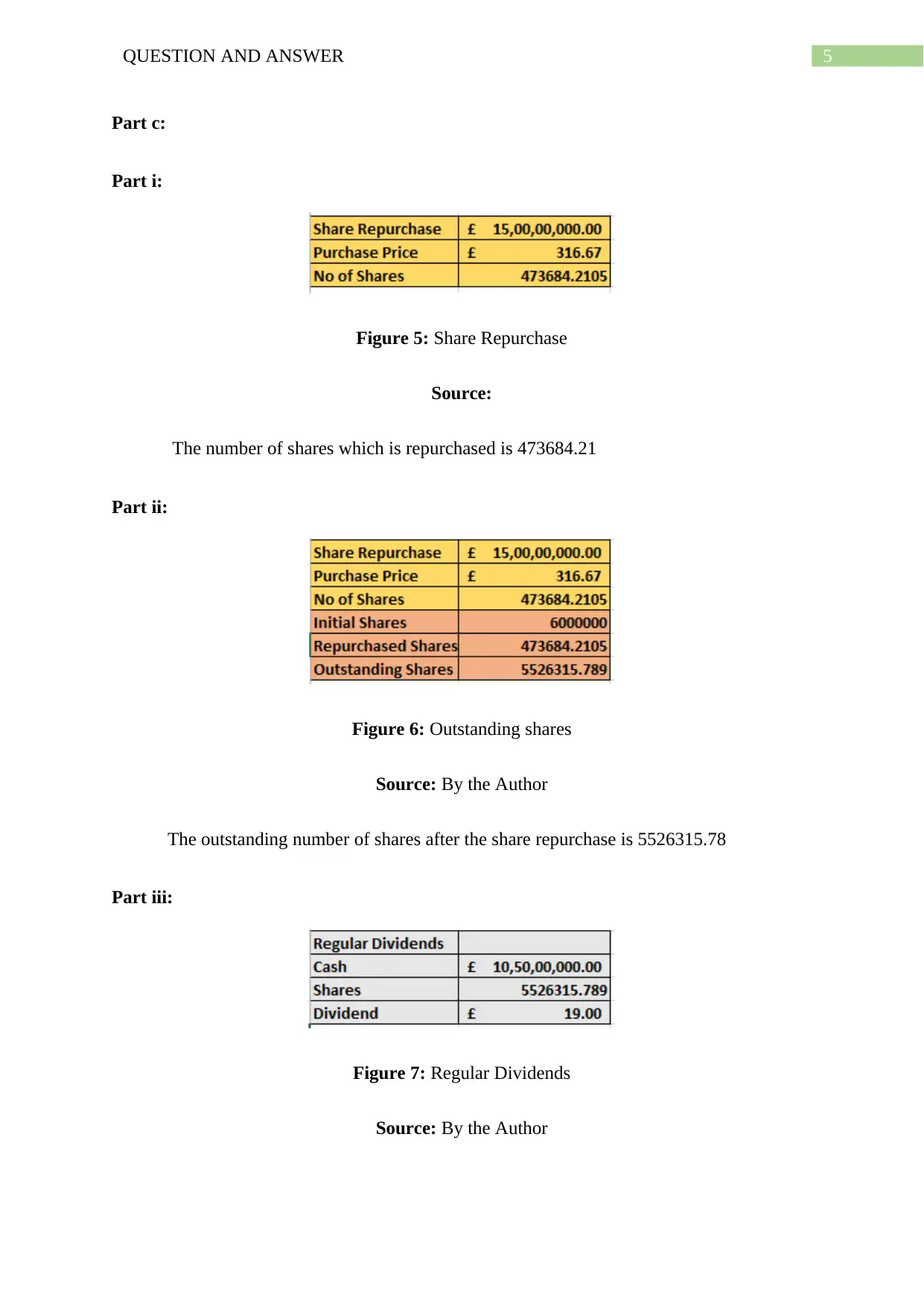
Figure 4: Ex dividend Share Price
Source: By the Author
The ex-dividend share price for the company is pound 291.67.
Document Page
5QUESTION AND ANSWER
Part c:
Part i:
Figure 5: Share Repurchase
Source:
The number of shares which is repurchased is 473684.21
Part ii:
Figure 6: Outstanding shares
Source: By the Author
The outstanding number of shares after the share repurchase is 5526315.78
Part iii:
Figure 7: Regular Dividends
Source: By the Author
Document Page
6QUESTION AND ANSWER
Thus, after the share repurchase the regular dividend to the shareholders increased and
became 19 pounds per share.
Part iv:
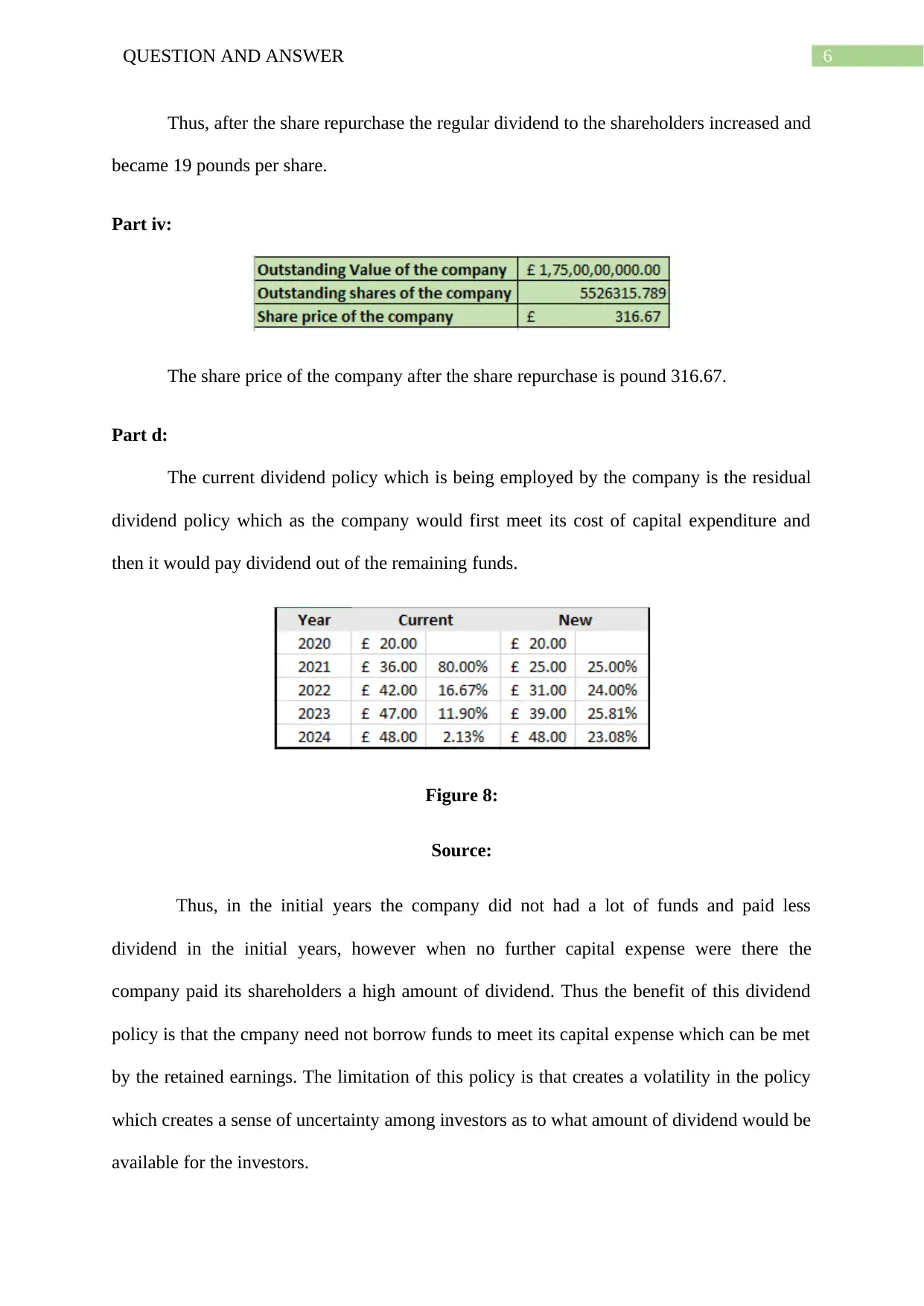
The share price of the company after the share repurchase is pound 316.67.
Part d:
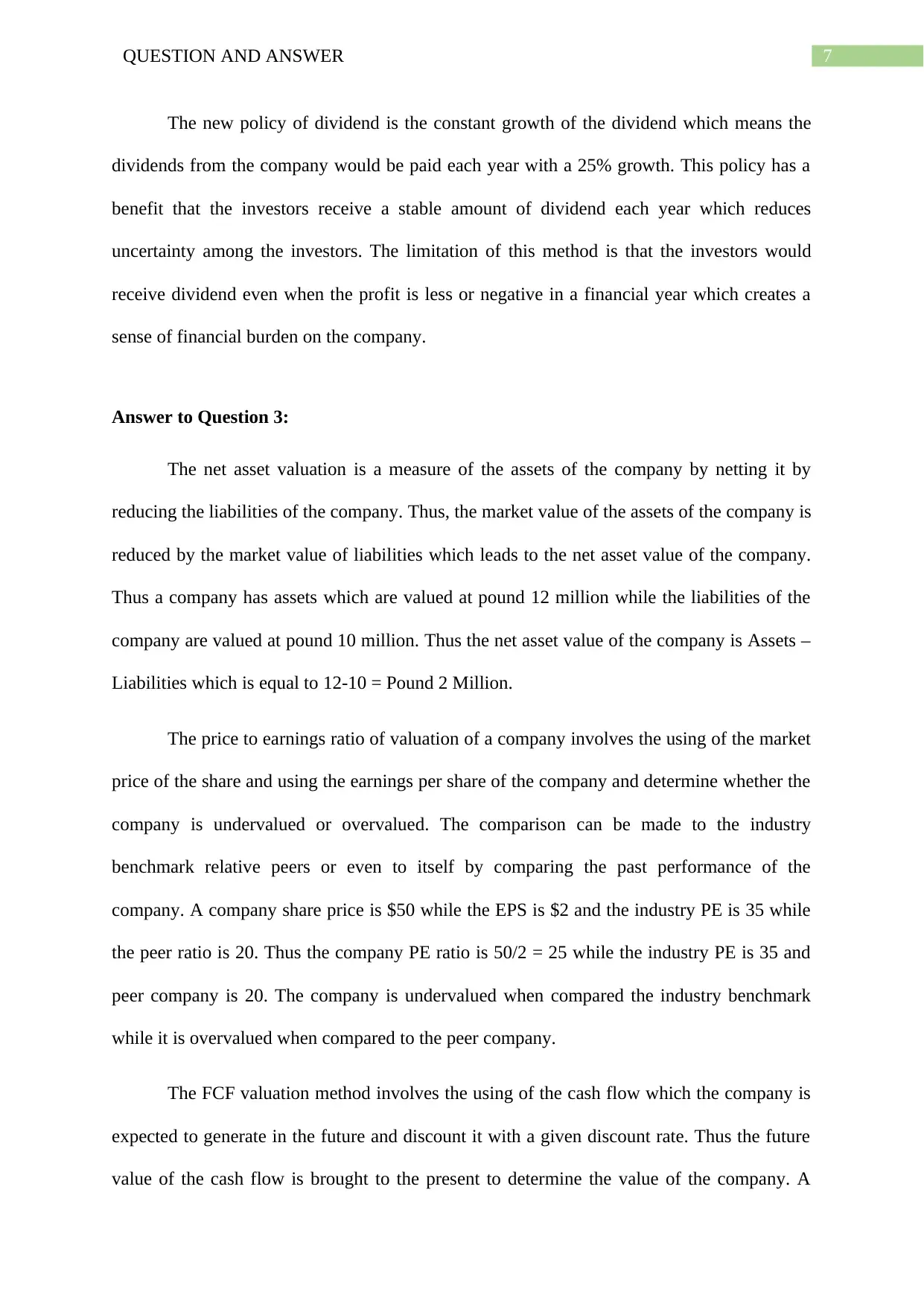
The current dividend policy which is being employed by the company is the residual
dividend policy which as the company would first meet its cost of capital expenditure and
then it would pay dividend out of the remaining funds.
Figure 8:
Source:
Thus, in the initial years the company did not had a lot of funds and paid less
dividend in the initial years, however when no further capital expense were there the
company paid its shareholders a high amount of dividend. Thus the benefit of this dividend
policy is that the cmpany need not borrow funds to meet its capital expense which can be met
by the retained earnings. The limitation of this policy is that creates a volatility in the policy
which creates a sense of uncertainty among investors as to what amount of dividend would be
available for the investors.
tabler-icon-diamond-filled.svg

Paraphrase This Document

Need a fresh take? Get an instant paraphrase of this document with our AI Paraphraser
Document Page
7QUESTION AND ANSWER
The new policy of dividend is the constant growth of the dividend which means the
dividends from the company would be paid each year with a 25% growth. This policy has a
benefit that the investors receive a stable amount of dividend each year which reduces
uncertainty among the investors. The limitation of this method is that the investors would
receive dividend even when the profit is less or negative in a financial year which creates a
sense of financial burden on the company.
Answer to Question 3:
The net asset valuation is a measure of the assets of the company by netting it by
reducing the liabilities of the company. Thus, the market value of the assets of the company is
reduced by the market value of liabilities which leads to the net asset value of the company.
Thus a company has assets which are valued at pound 12 million while the liabilities of the
company are valued at pound 10 million. Thus the net asset value of the company is Assets –
Liabilities which is equal to 12-10 = Pound 2 Million.
The price to earnings ratio of valuation of a company involves the using of the market
price of the share and using the earnings per share of the company and determine whether the
company is undervalued or overvalued. The comparison can be made to the industry
benchmark relative peers or even to itself by comparing the past performance of the
company. A company share price is $50 while the EPS is $2 and the industry PE is 35 while
the peer ratio is 20. Thus the company PE ratio is 50/2 = 25 while the industry PE is 35 and
peer company is 20. The company is undervalued when compared the industry benchmark
while it is overvalued when compared to the peer company.
The FCF valuation method involves the using of the cash flow which the company is
expected to generate in the future and discount it with a given discount rate. Thus the future
value of the cash flow is brought to the present to determine the value of the company. A
Document Page
8QUESTION AND ANSWER
company is expected to have FCF of $100, the discount rate is 5% while the growth rate is
2%. The value of the firm is 100/(5-2) = $3333.33. The company has $2000 of debt which
needs to be reduced and $300 cash which needs to be added, the value of the company equity
is $(3333.33-2000+300) = $1633.33.
Answer to Question 4:
Part a:
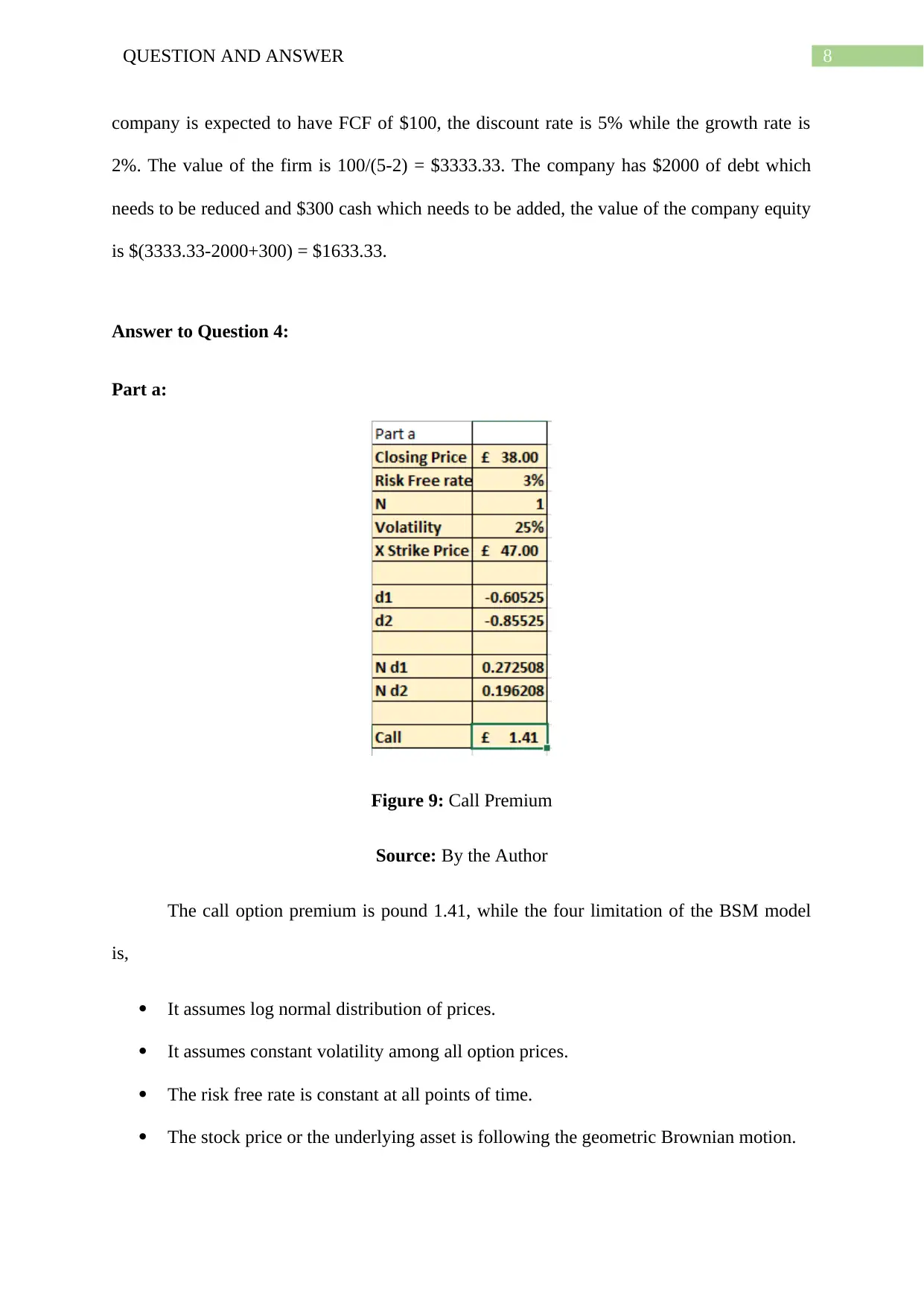
Figure 9: Call Premium
Source: By the Author
The call option premium is pound 1.41, while the four limitation of the BSM model
is,
It assumes log normal distribution of prices.
It assumes constant volatility among all option prices.
The risk free rate is constant at all points of time.
The stock price or the underlying asset is following the geometric Brownian motion.
Document Page
9QUESTION AND ANSWER
Part b:
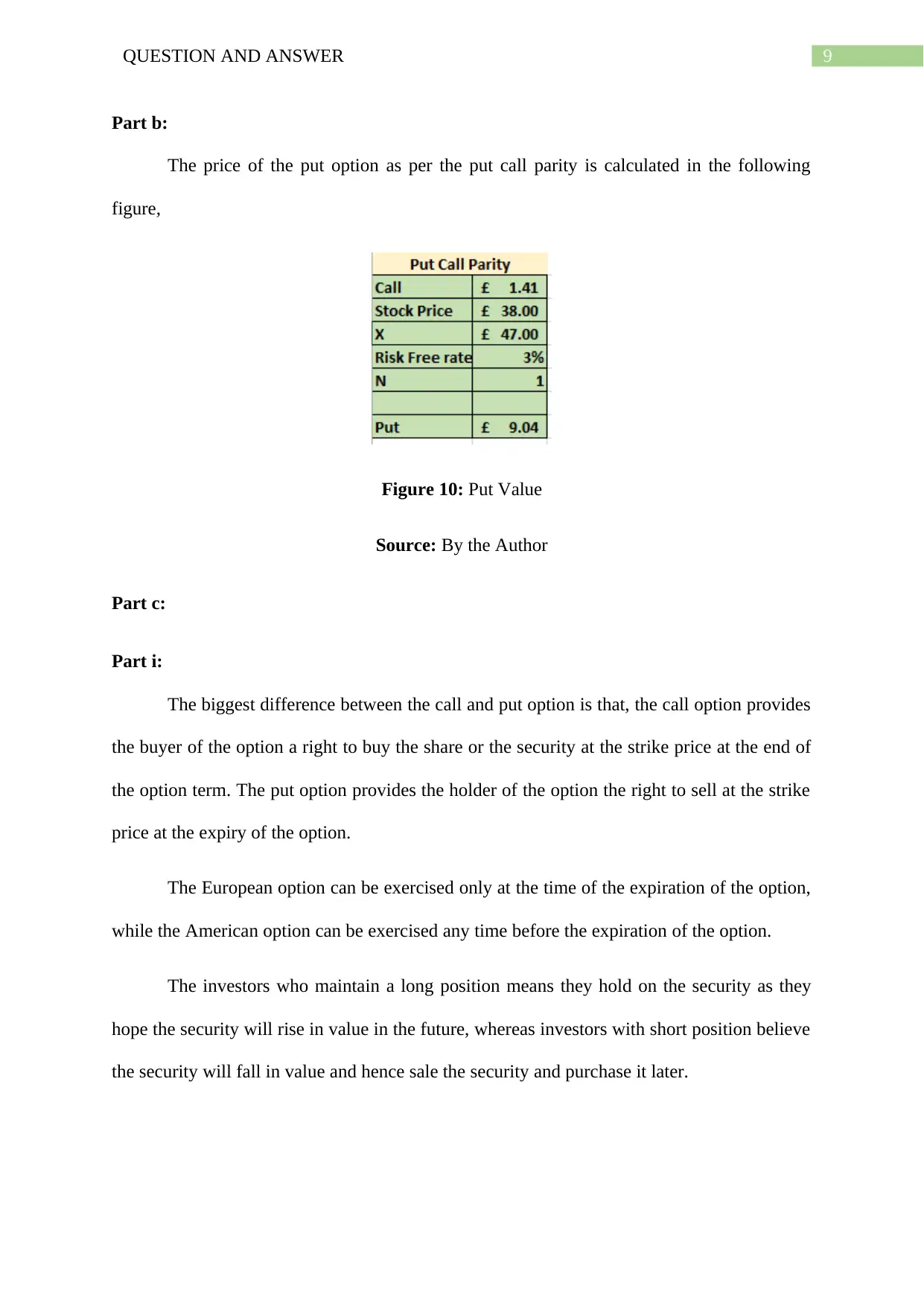
The price of the put option as per the put call parity is calculated in the following
figure,
Figure 10: Put Value
Source: By the Author
Part c:
Part i:
The biggest difference between the call and put option is that, the call option provides
the buyer of the option a right to buy the share or the security at the strike price at the end of
the option term. The put option provides the holder of the option the right to sell at the strike
price at the expiry of the option.
The European option can be exercised only at the time of the expiration of the option,
while the American option can be exercised any time before the expiration of the option.
The investors who maintain a long position means they hold on the security as they
hope the security will rise in value in the future, whereas investors with short position believe
the security will fall in value and hence sale the security and purchase it later.
tabler-icon-diamond-filled.svg

Paraphrase This Document

Need a fresh take? Get an instant paraphrase of this document with our AI Paraphraser
Document Page
10QUESTION AND ANSWER
Part ii:
The method of pricing the premium of the option can also be done using the binomial
option pricing model. This model provides the value of the option using a method which is
called boot strapping or backward induction. The option is priced to the present by carrying
its value to the future and providing the probability by which the option would move up or
down. This is another method which can be used to calculate the premium of the option.
chevron_up_icon
1 out of 11
circle_padding
hide_on_mobile
zoom_out_icon
[object Object]