Managerial Finance Report: Analyzing Capital Structure and Firm Value

Verified

Added on  2022/09/12

|6
|692
|15
Report
AI Summary
This report analyzes the capital structure of a firm, focusing on the impact of debt and equity financing on firm value. It examines the perspectives of three students on the optimal capital structure, considering the role of debt in the capital structure and its implications for shareholders and profitability. The report highlights the importance of managing debt levels to maintain a healthy balance between risk and return, considering the impact of financial leverage, and the potential for a tax shield from interest payments. It references key concepts from the provided assignment brief, including the Modigliani and Miller propositions, the benefits and costs of debt financing, and the trade-off theory of capital structure. The report also includes a discussion on how an increase in debt might affect a company's relationship with its investors and the importance of balancing debt and equity for maximizing returns.

Document Page
1
Response to Hevelie, Kiahni and Chris
tabler-icon-diamond-filled.svg

Paraphrase This Document

Need a fresh take? Get an instant paraphrase of this document with our AI Paraphraser
Document Page
2
Table of Contents
Student 1.....................................................................................................................................3
Student 2.....................................................................................................................................3
Student 3.....................................................................................................................................3
References..................................................................................................................................5
Document Page
3
Student 1
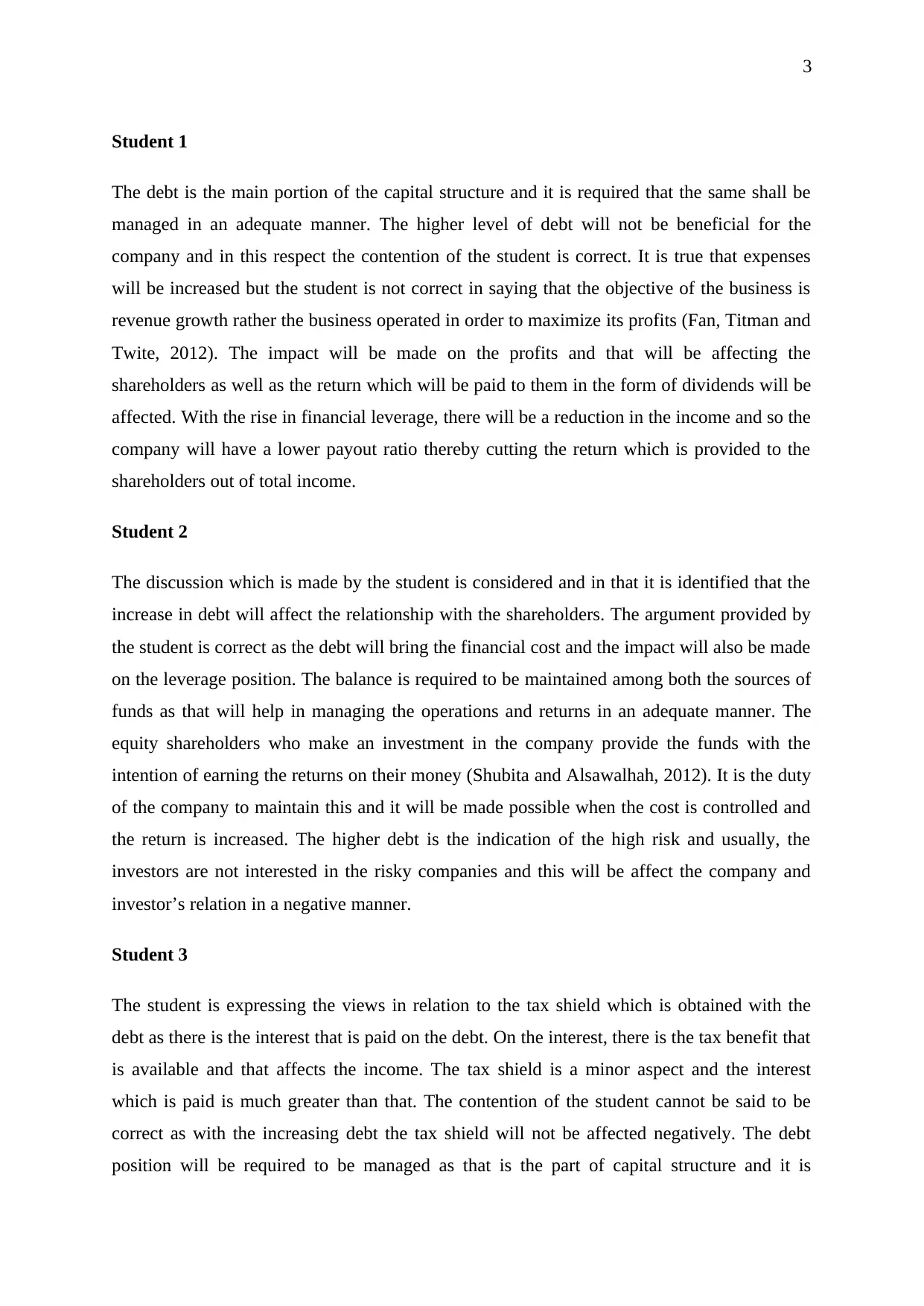
The debt is the main portion of the capital structure and it is required that the same shall be
managed in an adequate manner. The higher level of debt will not be beneficial for the
company and in this respect the contention of the student is correct. It is true that expenses
will be increased but the student is not correct in saying that the objective of the business is
revenue growth rather the business operated in order to maximize its profits (Fan, Titman and
Twite, 2012). The impact will be made on the profits and that will be affecting the
shareholders as well as the return which will be paid to them in the form of dividends will be
affected. With the rise in financial leverage, there will be a reduction in the income and so the
company will have a lower payout ratio thereby cutting the return which is provided to the
shareholders out of total income.
Student 2
The discussion which is made by the student is considered and in that it is identified that the
increase in debt will affect the relationship with the shareholders. The argument provided by
the student is correct as the debt will bring the financial cost and the impact will also be made
on the leverage position. The balance is required to be maintained among both the sources of
funds as that will help in managing the operations and returns in an adequate manner. The
equity shareholders who make an investment in the company provide the funds with the
intention of earning the returns on their money (Shubita and Alsawalhah, 2012). It is the duty
of the company to maintain this and it will be made possible when the cost is controlled and
the return is increased. The higher debt is the indication of the high risk and usually, the
investors are not interested in the risky companies and this will be affect the company and
investor’s relation in a negative manner.
Student 3
The student is expressing the views in relation to the tax shield which is obtained with the
debt as there is the interest that is paid on the debt. On the interest, there is the tax benefit that
is available and that affects the income. The tax shield is a minor aspect and the interest
which is paid is much greater than that. The contention of the student cannot be said to be
correct as with the increasing debt the tax shield will not be affected negatively. The debt
position will be required to be managed as that is the part of capital structure and it is
Document Page
4
necessary that proper balance shall be maintained among them (Sundaresan, Wang and Yang,
2015). The rising debt is adverse for the business as that will lead to negative relations with
the investors. The tax shield is one aspect of the debt funding but the main element is the
interest that will be required to be paid on a regular basis. That will have to be managed and
for that equity and debt shall be maintained in balanced amounts.
tabler-icon-diamond-filled.svg

Paraphrase This Document

Need a fresh take? Get an instant paraphrase of this document with our AI Paraphraser
Document Page
5
References
Fan, J.P., Titman, S. and Twite, G. (2012) An international comparison of capital structure
and debt maturity choices. Journal of Financial and quantitative Analysis, 47(1), pp.23-56.
Shubita, M.F. and Alsawalhah, J.M. (2012) The relationship between capital structure and
profitability. International Journal of Business and Social Science, 3(16), pp.104-112.
Sundaresan, S., Wang, N. and Yang, J. (2015) Dynamic investment, capital structure, and
debt overhang. The Review of Corporate Finance Studies, 4(1), pp.1-42.
Document Page
6
chevron_up_icon
1 out of 6
circle_padding
hide_on_mobile
zoom_out_icon
[object Object]