Analyzing Environment and Economy: A Project on Carbon Cycle
VerifiedAdded on 2023/01/16
|14
|3939
|1
Project
AI Summary
This project delves into the complex interplay between the environment and the economy, with a specific focus on the carbon cycle. It begins with an introduction to the carbon cycle, highlighting the role of carbon dioxide (CO2) and the potential impacts of climate change. The project then explores the motivations behind addressing environmental issues, emphasizing the need for better economic models to assess the effects of CO2 and other greenhouse gases. The project summary covers the project's structure, which includes an analysis of fossil fuel usage, technological advancements, and the challenges of global cooperation. The project also examines the limitations of current models and proposes improvements to address issues like feedback effects, capital accumulation, and technical progress. The project then outlines the project's summary which explores the challenges of managing fossil fuel resources and the importance of considering environmental costs. The project concludes by presenting a framework to calculate costs incurred in environmental challenges.

Running Head: Environment Economy
environment Economy
environment Economy

Paraphrase This Document
Need a fresh take? Get an instant paraphrase of this document with our AI Paraphraser

Environment Economy 1
Table of Contents
Introduction......................................................................................................................................2
Motivation........................................................................................................................................3
Project Summary.............................................................................................................................5
Project Details..................................................................................................................................6
Implementation and Issues and Challenges.....................................................................................7
Outcome...........................................................................................................................................8
Timeline...........................................................................................................................................9
Conclusion.......................................................................................................................................9
References......................................................................................................................................11
Table of Contents
Introduction......................................................................................................................................2
Motivation........................................................................................................................................3
Project Summary.............................................................................................................................5
Project Details..................................................................................................................................6
Implementation and Issues and Challenges.....................................................................................7
Outcome...........................................................................................................................................8
Timeline...........................................................................................................................................9
Conclusion.......................................................................................................................................9
References......................................................................................................................................11
Environment Economy 2
Introduction
The development of carbon from sources to definite air is known as the carbon cycle. The
biggest store of carbon is in carbonate silt, for example, limestone and chalk. Other critical
however less steady stores incorporate petroleum products, living and dead plants and creatures,
carbonates and bicarbonates broke down in the sea. Immense amounts of carbon, as carbon
dioxide (CO2), move from the biosphere and seas to the environment and back every year. It is
generally trusted that before the mechanical unrest these streams were firmly adjusted and the air
CO2 level was moderately steady. In later occasions, however, a few changes in the carbon cycle
may have happened. While it isn't debated that the expansion of CO2 will affect warming and
climatic change, vulnerability about fossil vitality use, land use change, the carbon cycle, and
other climatic unsettling influences all make the forecast of things to come climate unsure.
Carbon dioxide in the environment influences the radiation equalization of the earth and
expanding CO2 focuses are relied upon to cause a hotter climate (Dixon et al, 2013).
Carbon dioxide is moderately straightforward to vitality as daylight, however, reflects or traps a
substantial bit of this vitality when emanated from the earth as warmth. A vital improvement in
climate look into is the distinguishing proof of other follow or ozone-depleting substances
(GHG) with this equivalent warmth catching property. The forecast of future temperature is
additionally muddled by different elements. Noteworthy criticism impacts are relied upon to go
with any immediate impacts of CO2 heat catching. Warming may change cloud, snow, and ice
spread and modifies the world's "albedo" or brilliance. Thusly, the reflection and ingestion of
vitality may increment or decline (Wu et al, 2010).
Another significant concern is that hotter earth would result in progressively fast and rough
variances in climate designs resulting in mounting harms and related conceivable issues
incorporate changes in the scope of yield bugs, more prominent medical issues from the spread
of ailments related with tropical climates, and disturbance of world fisheries. The worry about
worldwide climate change because of the development of over the top groupings of ozone-
depleting substances is an important worry in an environmental arrangement. The convergence
of ozone-harming substances in the climate is stock contamination, it can take several years prior
to they lose their properties or vanish. Following climate projections and updates by the
Intergovernmental Panel on Climate Change (IPCC), the normal patterns in overall vitality use
Introduction
The development of carbon from sources to definite air is known as the carbon cycle. The
biggest store of carbon is in carbonate silt, for example, limestone and chalk. Other critical
however less steady stores incorporate petroleum products, living and dead plants and creatures,
carbonates and bicarbonates broke down in the sea. Immense amounts of carbon, as carbon
dioxide (CO2), move from the biosphere and seas to the environment and back every year. It is
generally trusted that before the mechanical unrest these streams were firmly adjusted and the air
CO2 level was moderately steady. In later occasions, however, a few changes in the carbon cycle
may have happened. While it isn't debated that the expansion of CO2 will affect warming and
climatic change, vulnerability about fossil vitality use, land use change, the carbon cycle, and
other climatic unsettling influences all make the forecast of things to come climate unsure.
Carbon dioxide in the environment influences the radiation equalization of the earth and
expanding CO2 focuses are relied upon to cause a hotter climate (Dixon et al, 2013).
Carbon dioxide is moderately straightforward to vitality as daylight, however, reflects or traps a
substantial bit of this vitality when emanated from the earth as warmth. A vital improvement in
climate look into is the distinguishing proof of other follow or ozone-depleting substances
(GHG) with this equivalent warmth catching property. The forecast of future temperature is
additionally muddled by different elements. Noteworthy criticism impacts are relied upon to go
with any immediate impacts of CO2 heat catching. Warming may change cloud, snow, and ice
spread and modifies the world's "albedo" or brilliance. Thusly, the reflection and ingestion of
vitality may increment or decline (Wu et al, 2010).
Another significant concern is that hotter earth would result in progressively fast and rough
variances in climate designs resulting in mounting harms and related conceivable issues
incorporate changes in the scope of yield bugs, more prominent medical issues from the spread
of ailments related with tropical climates, and disturbance of world fisheries. The worry about
worldwide climate change because of the development of over the top groupings of ozone-
depleting substances is an important worry in an environmental arrangement. The convergence
of ozone-harming substances in the climate is stock contamination, it can take several years prior
to they lose their properties or vanish. Following climate projections and updates by the
Intergovernmental Panel on Climate Change (IPCC), the normal patterns in overall vitality use
⊘ This is a preview!⊘
Do you want full access?
Subscribe today to unlock all pages.

Trusted by 1+ million students worldwide
Environment Economy 3
are with the end goal that these could create critical climate changes. The time allotment and the
greatness of harms are still exceedingly questionable. From an economic perspective, there are
some fascinating viewpoints with the general issue. Ozone harming substances are consistently
blended stock toxins and the issue is on an overall scale (Altman, Larsen & Buchanan 2018).
The focal point of the first part is to address and dissect some particular and binding together
issues at the interface of vitality use and environmental administration from a worldwide
viewpoint. These issues will be assaulted on different occasions all through the project.
Utilization development, as these examinations contended, would so contaminate the
environment as to undermine human wellbeing and the life-supporting properties of the
biosphere on which human presence depends.
(I) General Synthetic or radiation tainting of the environment (perilous and atomic squanders)
(ii) General disintegration of characteristic environments (air and water contamination, soil
disintegration)
(iii) Changes in the worldwide climate. (CO2 outflow and follow gases, ozone consumption).
The structure of the project is as follows:
The first part is Introduction which provides a basic understanding of the project and also states
the problem which will be tackled in this project.
Motivation
The primary motivation for this project is to add to better financial arrangement investigation
through enhancements in models concentrating the monetary effects of carbon dioxide (CO2) and
other ozone-depleting substances and to demonstrate manners by which financial instruments
can viably be put to use to mitigate such issues. This methodology contrasts in somewhere
around one noteworthy regard from regular investigations of the climatic change issue. We
center around the examination, control and streamlining of displaying frames as opposed to the
accumulation and investigation of information. All the more solidly, we look for ideal non-
renewable energy source use, research and innovation approaches as opposed to forecasting of
things to come. Most investigations of the issue exogenously determine specialized
advancements and petroleum product control approaches and afterwards anticipates future
are with the end goal that these could create critical climate changes. The time allotment and the
greatness of harms are still exceedingly questionable. From an economic perspective, there are
some fascinating viewpoints with the general issue. Ozone harming substances are consistently
blended stock toxins and the issue is on an overall scale (Altman, Larsen & Buchanan 2018).
The focal point of the first part is to address and dissect some particular and binding together
issues at the interface of vitality use and environmental administration from a worldwide
viewpoint. These issues will be assaulted on different occasions all through the project.
Utilization development, as these examinations contended, would so contaminate the
environment as to undermine human wellbeing and the life-supporting properties of the
biosphere on which human presence depends.
(I) General Synthetic or radiation tainting of the environment (perilous and atomic squanders)
(ii) General disintegration of characteristic environments (air and water contamination, soil
disintegration)
(iii) Changes in the worldwide climate. (CO2 outflow and follow gases, ozone consumption).
The structure of the project is as follows:
The first part is Introduction which provides a basic understanding of the project and also states
the problem which will be tackled in this project.
Motivation
The primary motivation for this project is to add to better financial arrangement investigation
through enhancements in models concentrating the monetary effects of carbon dioxide (CO2) and
other ozone-depleting substances and to demonstrate manners by which financial instruments
can viably be put to use to mitigate such issues. This methodology contrasts in somewhere
around one noteworthy regard from regular investigations of the climatic change issue. We
center around the examination, control and streamlining of displaying frames as opposed to the
accumulation and investigation of information. All the more solidly, we look for ideal non-
renewable energy source use, research and innovation approaches as opposed to forecasting of
things to come. Most investigations of the issue exogenously determine specialized
advancements and petroleum product control approaches and afterwards anticipates future
Paraphrase This Document
Need a fresh take? Get an instant paraphrase of this document with our AI Paraphraser
Environment Economy 4
climatic changes. These expectation models fuse a lot of information and will, in general, be very
unpredictable (Kijima et al, 2010).
Since some present vitality economy-environmental models don't improve and don't regard such
issues as participation, specialized change and vulnerability in an incorporated way, these models
might be too sceptical about the likelihood of controlling the development in barometrical CO2
focuses. The exclusions and the structure of present models place covered up, unbending and
pointless limitations on the economy. We trust that this project dispenses with a portion of these
issues and permit an increasingly strong establishment from which arrangement ends can be
drawn. The worldwide idea of potential CO2 issues makes it hard to keep models basic and
makes issues of vulnerability and global participation vital. The longtime length loans centrality
to the demonstrating of specialized change and furthermore focuses on the need to adjust the
welfare of present and who and what is to come (Savitz et al, 2013).
Doing research in monetary models and applying them to the CO2 issue necessitates that we take
the physical angles and discoveries of this issue as given information sources. We see that
despite the fact that debate and vulnerability encompass practically all the particular expectations
of CO2 impacts, the essential determination that a multiplying of barometrical CGz will cause a
noteworthy temperature rise has stayed consistent. Varieties in the physical parameters, in view
of various sources, can be unhesitatingly taken care of by affectability investigation in the
numerical treatment of our models. A critical later improvement is an accentuation on the extra
temperature increments because of following gases or purported ozone-depleting substances, to
which we will react in our models. Since CO2 sway appraisal would likewise result in a CGz
identical change in GHG outflows our investigation in some cases utilizes the terms reciprocally.
Before we unmistakably recognize the applicable work around there we have some broad
comments on some vitality economy contemplates used to look at CO2 and other related vitality
issues. We distinguish a few confinements in these models which we will address in our models.
We locate that most real investigations of the CO2 issue utilize prescient models which do
exclude criticism impacts. In the models we talk about, the way toward amassing and discarding
physical capital is taken care of by an assortment of impromptu strategies and isn't displayed
expressly. Specialized advancement is frequently considered to happen consistently all through
the economy or is incorporated by anticipating explicitly specialized improvements. Despite the
fact that the treatment of specialized advancement isn't somewhere down in many investigations
climatic changes. These expectation models fuse a lot of information and will, in general, be very
unpredictable (Kijima et al, 2010).
Since some present vitality economy-environmental models don't improve and don't regard such
issues as participation, specialized change and vulnerability in an incorporated way, these models
might be too sceptical about the likelihood of controlling the development in barometrical CO2
focuses. The exclusions and the structure of present models place covered up, unbending and
pointless limitations on the economy. We trust that this project dispenses with a portion of these
issues and permit an increasingly strong establishment from which arrangement ends can be
drawn. The worldwide idea of potential CO2 issues makes it hard to keep models basic and
makes issues of vulnerability and global participation vital. The longtime length loans centrality
to the demonstrating of specialized change and furthermore focuses on the need to adjust the
welfare of present and who and what is to come (Savitz et al, 2013).
Doing research in monetary models and applying them to the CO2 issue necessitates that we take
the physical angles and discoveries of this issue as given information sources. We see that
despite the fact that debate and vulnerability encompass practically all the particular expectations
of CO2 impacts, the essential determination that a multiplying of barometrical CGz will cause a
noteworthy temperature rise has stayed consistent. Varieties in the physical parameters, in view
of various sources, can be unhesitatingly taken care of by affectability investigation in the
numerical treatment of our models. A critical later improvement is an accentuation on the extra
temperature increments because of following gases or purported ozone-depleting substances, to
which we will react in our models. Since CO2 sway appraisal would likewise result in a CGz
identical change in GHG outflows our investigation in some cases utilizes the terms reciprocally.
Before we unmistakably recognize the applicable work around there we have some broad
comments on some vitality economy contemplates used to look at CO2 and other related vitality
issues. We distinguish a few confinements in these models which we will address in our models.
We locate that most real investigations of the CO2 issue utilize prescient models which do
exclude criticism impacts. In the models we talk about, the way toward amassing and discarding
physical capital is taken care of by an assortment of impromptu strategies and isn't displayed
expressly. Specialized advancement is frequently considered to happen consistently all through
the economy or is incorporated by anticipating explicitly specialized improvements. Despite the
fact that the treatment of specialized advancement isn't somewhere down in many investigations
Environment Economy 5
of CO2, the significance of foreseeing specialized advancement is perceived. At last, the
connection between exchange examples and CO2 gathering is only sometimes considered in
present vitality - economy models (Burivalova, Hua, Koh, Garcia & Putz, 2016).
The only remaining century has seen a remarkable time of development, in vitality, economy,
populace, and utilization. Before the finish of the sixties, specifically, uneasiness was mounting
about whether the world was starting to slam into the roof of asset and environmental
imperatives, or whether despite everything it had sufficient energy to finish the progressive
change toward a "consistent state" in which populace and assets were in parity. The "cutoff
points to development" banter finished in a few examinations related with the Club of Rome,
anticipating a calamitous increment in death rates all through the world start in the main many
years of the 21st century, to a great extent because of asset deficiencies. Yet, regardless of
whether assets were not constraining, worldwide contamination would, a couple of years or
decades later, lead to significantly more noteworthy fiasco. The essential proposal was that the
more extended this fiasco was delayed by "mechanical fixes" the more dangerous would be the
last breakdown (Jadhav & Roy, 2013).
Up until this point, no feasible economical control innovations to catch any noteworthy division
of CO2 emanations have been seemingly within easy reach. A prime normal for the C02 issue is
the longtime slacks that may pass between the reason and the distinguishing proof of huge
impacts. Another trademark is the high level of vulnerability that normally goes to forecasts of
future impacts. Such vulnerability is exacerbated by the way that C02 impacts happen at
different complex dimensions (Hasan & Rahman, 2017).
Project Summary
Given the CO2 limitations portrayed in the previous sections of this project will investigate
conceivable world petroleum derivative ways with the guide of a basic carbon cycle demonstrate.
The model will be utilized to test the affectability of the outcomes to varieties in key parameters
that would impact the vitality framework elements. From the monetary perspective of petroleum,
derivative utilize the contention is regularly best in class that showcases powers should (and will)
assume a predominant job in assigning assets, and in this way, no other component ought to
intercede in this "ideal" process. As indicated by this view, the "cost adequacy" process is
of CO2, the significance of foreseeing specialized advancement is perceived. At last, the
connection between exchange examples and CO2 gathering is only sometimes considered in
present vitality - economy models (Burivalova, Hua, Koh, Garcia & Putz, 2016).
The only remaining century has seen a remarkable time of development, in vitality, economy,
populace, and utilization. Before the finish of the sixties, specifically, uneasiness was mounting
about whether the world was starting to slam into the roof of asset and environmental
imperatives, or whether despite everything it had sufficient energy to finish the progressive
change toward a "consistent state" in which populace and assets were in parity. The "cutoff
points to development" banter finished in a few examinations related with the Club of Rome,
anticipating a calamitous increment in death rates all through the world start in the main many
years of the 21st century, to a great extent because of asset deficiencies. Yet, regardless of
whether assets were not constraining, worldwide contamination would, a couple of years or
decades later, lead to significantly more noteworthy fiasco. The essential proposal was that the
more extended this fiasco was delayed by "mechanical fixes" the more dangerous would be the
last breakdown (Jadhav & Roy, 2013).
Up until this point, no feasible economical control innovations to catch any noteworthy division
of CO2 emanations have been seemingly within easy reach. A prime normal for the C02 issue is
the longtime slacks that may pass between the reason and the distinguishing proof of huge
impacts. Another trademark is the high level of vulnerability that normally goes to forecasts of
future impacts. Such vulnerability is exacerbated by the way that C02 impacts happen at
different complex dimensions (Hasan & Rahman, 2017).
Project Summary
Given the CO2 limitations portrayed in the previous sections of this project will investigate
conceivable world petroleum derivative ways with the guide of a basic carbon cycle demonstrate.
The model will be utilized to test the affectability of the outcomes to varieties in key parameters
that would impact the vitality framework elements. From the monetary perspective of petroleum,
derivative utilize the contention is regularly best in class that showcases powers should (and will)
assume a predominant job in assigning assets, and in this way, no other component ought to
intercede in this "ideal" process. As indicated by this view, the "cost adequacy" process is
⊘ This is a preview!⊘
Do you want full access?
Subscribe today to unlock all pages.
Trusted by 1+ million students worldwide
Environment Economy 6
consequently employable; subsequently, there is no explanation behind compelling exogenously
the development of petroleum product use (Pearce & Moran, 2013).
To investigate these thoughts further, note that the asset base for non-renewable energy sources
is in fact extremely huge on the off chance that it incorporates assets that will cost considerably
more than they do now. About portion of the ordinary oil and petroleum gas is recuperated
reasonably. The rest originates from an assortment of sources that are related to higher
generation costs, less fortunate fields that require penetrating more openings, creation from
mainland racks, further bowls and Polar Regions and so on. Every one of these exercises is, in
addition, related to altogether bigger environmental effects. On the off chance that we accept that
tidying up spills, recovering mined-out grounds to valuable purposes, and risky waste
administration are for the most part activities whose cost must be disguised, at that point these
"messy" energizes become considerably progressively costly (Cai, Ma, Li, Li & Peng, 2010).
The standard perception of asset financial experts for example that one never comes up short on
an asset however essentially achieves a point where it is less expensive to utilize a substitute, is
to some degree right on account of petroleum derivatives. Shockingly, not many solid
evaluations of non-renewable energy source assets versus cost bends are accessible
(Vandermeersch, 2017).
After the project has been completed successfully it can not only provide organized remedies for
this issues but also will provide a framework which can be used to calculate the costs incurred in
such environmental challenges (Schaltegger Wagner, 2017).
Project Details
Plans for expanded vitality use yield different situations for expanded C02 fixations with time.
To catch in straightforward terms the idea of the issue we expect:
1. A base practical dimension of CO2 exists, controlled by absolute incorporated interest for
petroleum products included overall future time, before the world has changed over to vitality
sources that don't build after that (primarily sunlight based as well as atomic in different
structures). It has been expected that if less complete petroleum derivatives are utilized amid all
future time, there will be extensive social agitation due to unit request (Vörösmarty et al, 2010).
consequently employable; subsequently, there is no explanation behind compelling exogenously
the development of petroleum product use (Pearce & Moran, 2013).
To investigate these thoughts further, note that the asset base for non-renewable energy sources
is in fact extremely huge on the off chance that it incorporates assets that will cost considerably
more than they do now. About portion of the ordinary oil and petroleum gas is recuperated
reasonably. The rest originates from an assortment of sources that are related to higher
generation costs, less fortunate fields that require penetrating more openings, creation from
mainland racks, further bowls and Polar Regions and so on. Every one of these exercises is, in
addition, related to altogether bigger environmental effects. On the off chance that we accept that
tidying up spills, recovering mined-out grounds to valuable purposes, and risky waste
administration are for the most part activities whose cost must be disguised, at that point these
"messy" energizes become considerably progressively costly (Cai, Ma, Li, Li & Peng, 2010).
The standard perception of asset financial experts for example that one never comes up short on
an asset however essentially achieves a point where it is less expensive to utilize a substitute, is
to some degree right on account of petroleum derivatives. Shockingly, not many solid
evaluations of non-renewable energy source assets versus cost bends are accessible
(Vandermeersch, 2017).
After the project has been completed successfully it can not only provide organized remedies for
this issues but also will provide a framework which can be used to calculate the costs incurred in
such environmental challenges (Schaltegger Wagner, 2017).
Project Details
Plans for expanded vitality use yield different situations for expanded C02 fixations with time.
To catch in straightforward terms the idea of the issue we expect:
1. A base practical dimension of CO2 exists, controlled by absolute incorporated interest for
petroleum products included overall future time, before the world has changed over to vitality
sources that don't build after that (primarily sunlight based as well as atomic in different
structures). It has been expected that if less complete petroleum derivatives are utilized amid all
future time, there will be extensive social agitation due to unit request (Vörösmarty et al, 2010).
Paraphrase This Document
Need a fresh take? Get an instant paraphrase of this document with our AI Paraphraser
Environment Economy 7
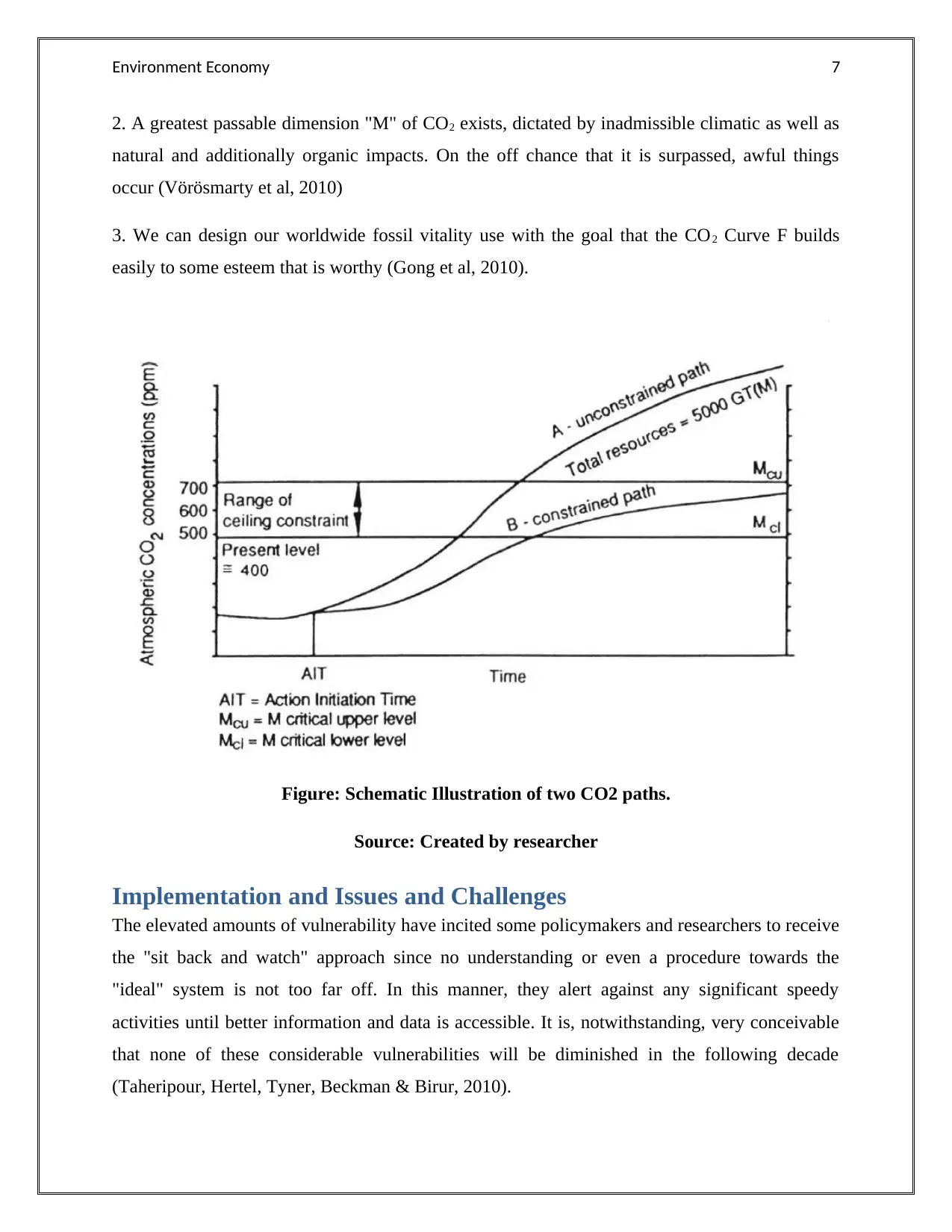
2. A greatest passable dimension "M" of CO2 exists, dictated by inadmissible climatic as well as
natural and additionally organic impacts. On the off chance that it is surpassed, awful things
occur (Vörösmarty et al, 2010)
3. We can design our worldwide fossil vitality use with the goal that the CO2 Curve F builds
easily to some esteem that is worthy (Gong et al, 2010).
Figure: Schematic Illustration of two CO2 paths.
Source: Created by researcher
Implementation and Issues and Challenges
The elevated amounts of vulnerability have incited some policymakers and researchers to receive
the "sit back and watch" approach since no understanding or even a procedure towards the
"ideal" system is not too far off. In this manner, they alert against any significant speedy
activities until better information and data is accessible. It is, notwithstanding, very conceivable
that none of these considerable vulnerabilities will be diminished in the following decade
(Taheripour, Hertel, Tyner, Beckman & Birur, 2010).
2. A greatest passable dimension "M" of CO2 exists, dictated by inadmissible climatic as well as
natural and additionally organic impacts. On the off chance that it is surpassed, awful things
occur (Vörösmarty et al, 2010)
3. We can design our worldwide fossil vitality use with the goal that the CO2 Curve F builds
easily to some esteem that is worthy (Gong et al, 2010).
Figure: Schematic Illustration of two CO2 paths.
Source: Created by researcher
Implementation and Issues and Challenges
The elevated amounts of vulnerability have incited some policymakers and researchers to receive
the "sit back and watch" approach since no understanding or even a procedure towards the
"ideal" system is not too far off. In this manner, they alert against any significant speedy
activities until better information and data is accessible. It is, notwithstanding, very conceivable
that none of these considerable vulnerabilities will be diminished in the following decade
(Taheripour, Hertel, Tyner, Beckman & Birur, 2010).
Environment Economy 8
As such, the traditional suppositions of learning after some time might be unessential in this
issue. It is conceivable that we will confront for all intents and purposes a similar choice in 10
years that we face now, with just marginally increasingly solid data. This is so somewhat in light
of the fact that climate change is tormented with the issue of "indissoluble natures" and
"inadequate sets". These are regions where our insight is commonly so small and the stakes are
so high, yet in addition that we can't hope to find solid solutions either economically or rapidly
on the grounds that an unequivocal trial involves an approach change and, in light of the fact that
recorded involvement with insufficient sets is so gradually enlightening. Unmistakably leaders
must endeavour to live with and suit to the high level of vulnerability penetrating the issue.
Along these lines, policymakers must understand that choices should be made without certain
cost/advantage data and that holding up until the vulnerability is settled will be most likely past
the point where it is possible to settle on a compelling choice (Henri & Journeault, 2010).
Outcome
This project will provide a reasonable arrangement for managing a global temperature boost is
enormously entangled by some crucial logical vulnerability that is probably not going to be
completely settled sooner rather than later. This represents a clumsy strategy predicament: when
dependable answers are approaching, the harm perpetrated on us will have expanded
significantly, if the worry warts turnout to have been correct and we don't pursue their remedies
for extraordinary changes now. Then again, authorizing an exceptional program may force
financial expenses and social disturbances, particularly on more unfortunate areas, that would be
plainly intemperate if the issue ends up being less extreme than numerous presently envision
(Fodha & Zaghdoud, 2010).
Our model permits computation of a 'basic likelihood' that describes the conditions under which
the protection advantages of quick guidelines surpass their expense. This basic likelihood can
work as the standard of evidence required in legal settings. Like the standard of confirmation, it
indicates the level of certainty arrangement producers must have that GHG emanations should be
confined to evade critical unfavourable environmental impacts with the goal for them to pass
judgment on that extra discharge limitations ought to be embraced at present. In the event that
approach producers' apparent likelihood that outflow decreases will be required is more
noteworthy than the basic likelihood, the system of embracing guidelines quickly will force
As such, the traditional suppositions of learning after some time might be unessential in this
issue. It is conceivable that we will confront for all intents and purposes a similar choice in 10
years that we face now, with just marginally increasingly solid data. This is so somewhat in light
of the fact that climate change is tormented with the issue of "indissoluble natures" and
"inadequate sets". These are regions where our insight is commonly so small and the stakes are
so high, yet in addition that we can't hope to find solid solutions either economically or rapidly
on the grounds that an unequivocal trial involves an approach change and, in light of the fact that
recorded involvement with insufficient sets is so gradually enlightening. Unmistakably leaders
must endeavour to live with and suit to the high level of vulnerability penetrating the issue.
Along these lines, policymakers must understand that choices should be made without certain
cost/advantage data and that holding up until the vulnerability is settled will be most likely past
the point where it is possible to settle on a compelling choice (Henri & Journeault, 2010).
Outcome
This project will provide a reasonable arrangement for managing a global temperature boost is
enormously entangled by some crucial logical vulnerability that is probably not going to be
completely settled sooner rather than later. This represents a clumsy strategy predicament: when
dependable answers are approaching, the harm perpetrated on us will have expanded
significantly, if the worry warts turnout to have been correct and we don't pursue their remedies
for extraordinary changes now. Then again, authorizing an exceptional program may force
financial expenses and social disturbances, particularly on more unfortunate areas, that would be
plainly intemperate if the issue ends up being less extreme than numerous presently envision
(Fodha & Zaghdoud, 2010).
Our model permits computation of a 'basic likelihood' that describes the conditions under which
the protection advantages of quick guidelines surpass their expense. This basic likelihood can
work as the standard of evidence required in legal settings. Like the standard of confirmation, it
indicates the level of certainty arrangement producers must have that GHG emanations should be
confined to evade critical unfavourable environmental impacts with the goal for them to pass
judgment on that extra discharge limitations ought to be embraced at present. In the event that
approach producers' apparent likelihood that outflow decreases will be required is more
noteworthy than the basic likelihood, the system of embracing guidelines quickly will force
⊘ This is a preview!⊘
Do you want full access?
Subscribe today to unlock all pages.
Trusted by 1+ million students worldwide
Environment Economy 9
lower expected asset costs; of the likelihood is lower, sitting tight for improved comprehension
of the probability and results of GHG gathering before acting will be savvy (Pearce et al, 2013).
Timeline
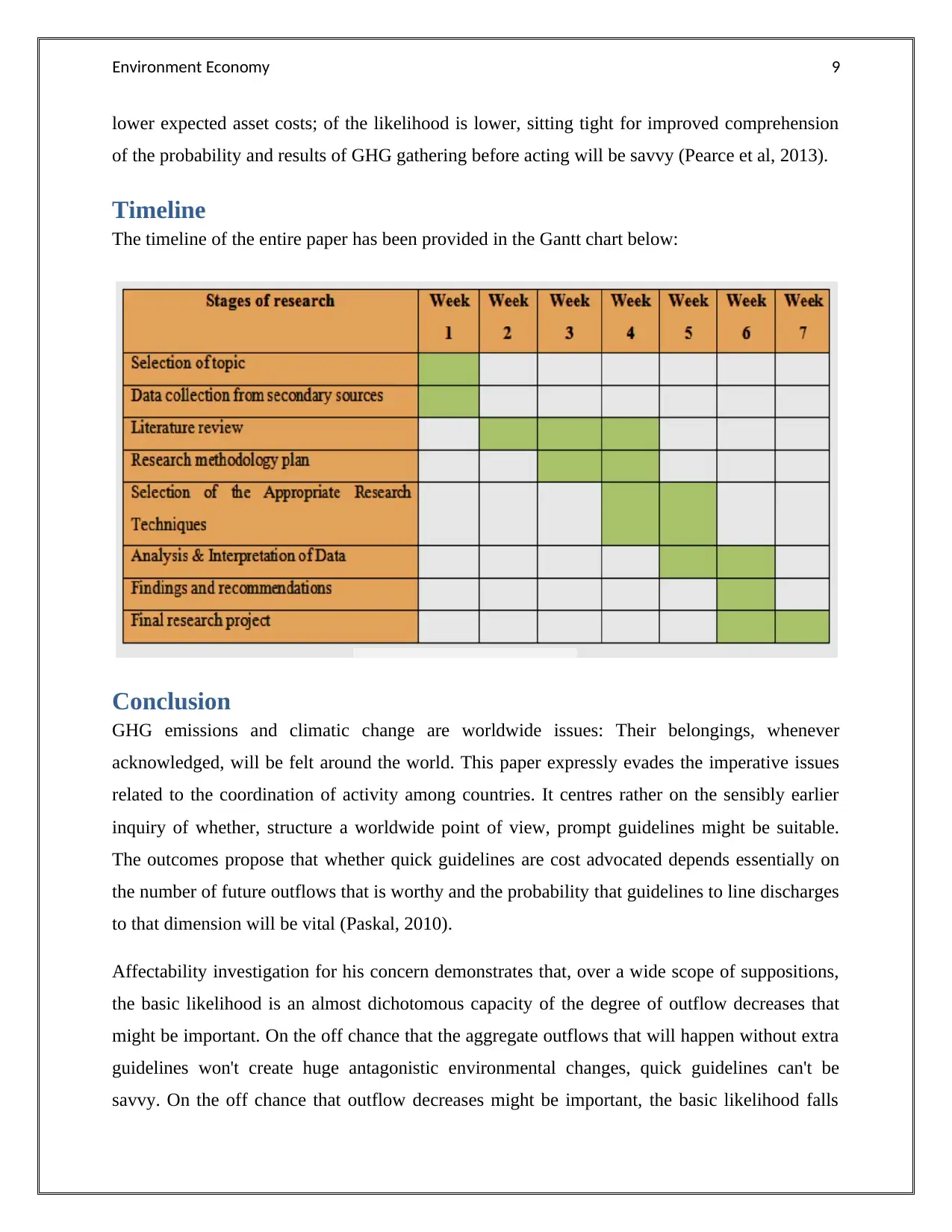
The timeline of the entire paper has been provided in the Gantt chart below:
Conclusion
GHG emissions and climatic change are worldwide issues: Their belongings, whenever
acknowledged, will be felt around the world. This paper expressly evades the imperative issues
related to the coordination of activity among countries. It centres rather on the sensibly earlier
inquiry of whether, structure a worldwide point of view, prompt guidelines might be suitable.
The outcomes propose that whether quick guidelines are cost advocated depends essentially on
the number of future outflows that is worthy and the probability that guidelines to line discharges
to that dimension will be vital (Paskal, 2010).
Affectability investigation for his concern demonstrates that, over a wide scope of suppositions,
the basic likelihood is an almost dichotomous capacity of the degree of outflow decreases that
might be important. On the off chance that the aggregate outflows that will happen without extra
guidelines won't create huge antagonistic environmental changes, quick guidelines can't be
savvy. On the off chance that outflow decreases might be important, the basic likelihood falls
lower expected asset costs; of the likelihood is lower, sitting tight for improved comprehension
of the probability and results of GHG gathering before acting will be savvy (Pearce et al, 2013).
Timeline
The timeline of the entire paper has been provided in the Gantt chart below:
Conclusion
GHG emissions and climatic change are worldwide issues: Their belongings, whenever
acknowledged, will be felt around the world. This paper expressly evades the imperative issues
related to the coordination of activity among countries. It centres rather on the sensibly earlier
inquiry of whether, structure a worldwide point of view, prompt guidelines might be suitable.
The outcomes propose that whether quick guidelines are cost advocated depends essentially on
the number of future outflows that is worthy and the probability that guidelines to line discharges
to that dimension will be vital (Paskal, 2010).
Affectability investigation for his concern demonstrates that, over a wide scope of suppositions,
the basic likelihood is an almost dichotomous capacity of the degree of outflow decreases that
might be important. On the off chance that the aggregate outflows that will happen without extra
guidelines won't create huge antagonistic environmental changes, quick guidelines can't be
savvy. On the off chance that outflow decreases might be important, the basic likelihood falls
Paraphrase This Document
Need a fresh take? Get an instant paraphrase of this document with our AI Paraphraser

Environment Economy 10
between about 0.3 and 0.5 over the area of combined discharge limits for which it very well may
be determined (Kolstad, 2011).
between about 0.3 and 0.5 over the area of combined discharge limits for which it very well may
be determined (Kolstad, 2011).
Environment Economy 11
References
Altman, J., Larsen, L., & Buchanan, G. J. (2018). The environmental significance of the
Indigenous estate: natural resource management as economic development in remote
Australia.
Burivalova, Z., Hua, F., Koh, L. P., Garcia, C., & Putz, F. (2017). A critical comparison of
conventional, certified, and community management of tropical forests for timber in
terms of environmental, economic, and social variables. Conservation Letters, 10(1), 4-
14.
Cai, J., Ma, X., Li, Q., Li, L., & Peng, H. (2010). A multi-objective chaotic ant swarm
optimization for environmental/economic dispatch. International Journal of Electrical
Power & Energy Systems, 32(5), 337-344.
Dixon, J. A., Carpenter, R. A., Fallon, L. A., Sherman, P. B., &Manipomoke, S.
(2013). Economic Analysis of the Environmental Impacts of Development Projects.
Routledge.
Fodha, M., &Zaghdoud, O. (2010). Economic growth and pollutant emissions in Tunisia: an
empirical analysis of the environmental Kuznets curve. Energy Policy, 38(2), 1150-1156.
Gong, D. W., Zhang, Y., & Qi, C. L. (2010). Environmental/economic power dispatch using a
hybrid multi-objective optimization algorithm. International Journal of Electrical Power
& Energy Systems, 32(6), 607-614.
Hasan, M. M., & Rahman, M. M. (2017). Performance and emission characteristics of the
biodiesel-diesel blend and environmental and economic impacts of biodiesel production:
A review. Renewable and Sustainable Energy Reviews, 74, 938-948.
Henri, J. F., &Journeault, M. (2010). Eco-control: The influence of management control systems
on environmental and economic performance. Accounting, Organizations and
Society, 35(1), 63-80.
References
Altman, J., Larsen, L., & Buchanan, G. J. (2018). The environmental significance of the
Indigenous estate: natural resource management as economic development in remote
Australia.
Burivalova, Z., Hua, F., Koh, L. P., Garcia, C., & Putz, F. (2017). A critical comparison of
conventional, certified, and community management of tropical forests for timber in
terms of environmental, economic, and social variables. Conservation Letters, 10(1), 4-
14.
Cai, J., Ma, X., Li, Q., Li, L., & Peng, H. (2010). A multi-objective chaotic ant swarm
optimization for environmental/economic dispatch. International Journal of Electrical
Power & Energy Systems, 32(5), 337-344.
Dixon, J. A., Carpenter, R. A., Fallon, L. A., Sherman, P. B., &Manipomoke, S.
(2013). Economic Analysis of the Environmental Impacts of Development Projects.
Routledge.
Fodha, M., &Zaghdoud, O. (2010). Economic growth and pollutant emissions in Tunisia: an
empirical analysis of the environmental Kuznets curve. Energy Policy, 38(2), 1150-1156.
Gong, D. W., Zhang, Y., & Qi, C. L. (2010). Environmental/economic power dispatch using a
hybrid multi-objective optimization algorithm. International Journal of Electrical Power
& Energy Systems, 32(6), 607-614.
Hasan, M. M., & Rahman, M. M. (2017). Performance and emission characteristics of the
biodiesel-diesel blend and environmental and economic impacts of biodiesel production:
A review. Renewable and Sustainable Energy Reviews, 74, 938-948.
Henri, J. F., &Journeault, M. (2010). Eco-control: The influence of management control systems
on environmental and economic performance. Accounting, Organizations and
Society, 35(1), 63-80.
⊘ This is a preview!⊘
Do you want full access?
Subscribe today to unlock all pages.
Trusted by 1+ million students worldwide

1 out of 14


Related Documents


Your All-in-One AI-Powered Toolkit for Academic Success.
+13062052269
info@desklib.com
Available 24*7 on WhatsApp / Email
![[object Object]](/_next/static/media/star-bottom.7253800d.svg)
Unlock your academic potential
Copyright © 2020–2026 A2Z Services. All Rights Reserved. Developed and managed by ZUCOL.