Carbon Emission Comparison: Stakeholder Theory in Canada & Germany

Verified

Added on  2023/06/06

|24
|5033
|217
Report
AI Summary
This research project investigates and compares carbon emission intensity between Canada and Germany, examining the association between carbon emission intensity, country, and a company's direct responsibility for climate change. Data was collected from 166 firms in both countries and analyzed using SPSS. The report presents descriptive statistics showing average intensity and percentage changes in carbon emissions, along with inferential analyses including Chi-Square tests revealing a significant association between country and the level of responsibility for climate change. Correlation tests showed no significant relationship between intensity and percentage change. A t-test indicated no significant difference in average emissions intensity between Canadian and German companies. The study also explores the prevalence of emission reduction initiatives and risk management procedures related to climate change within the sampled companies, while also acknowledging the limitations and suggesting directions for further research.
Document Page
Stakeholder Theory in Canada and Germany Companies
Name
Course
Instructor
Date
1
tabler-icon-diamond-filled.svg

Paraphrase This Document

Need a fresh take? Get an instant paraphrase of this document with our AI Paraphraser
Document Page
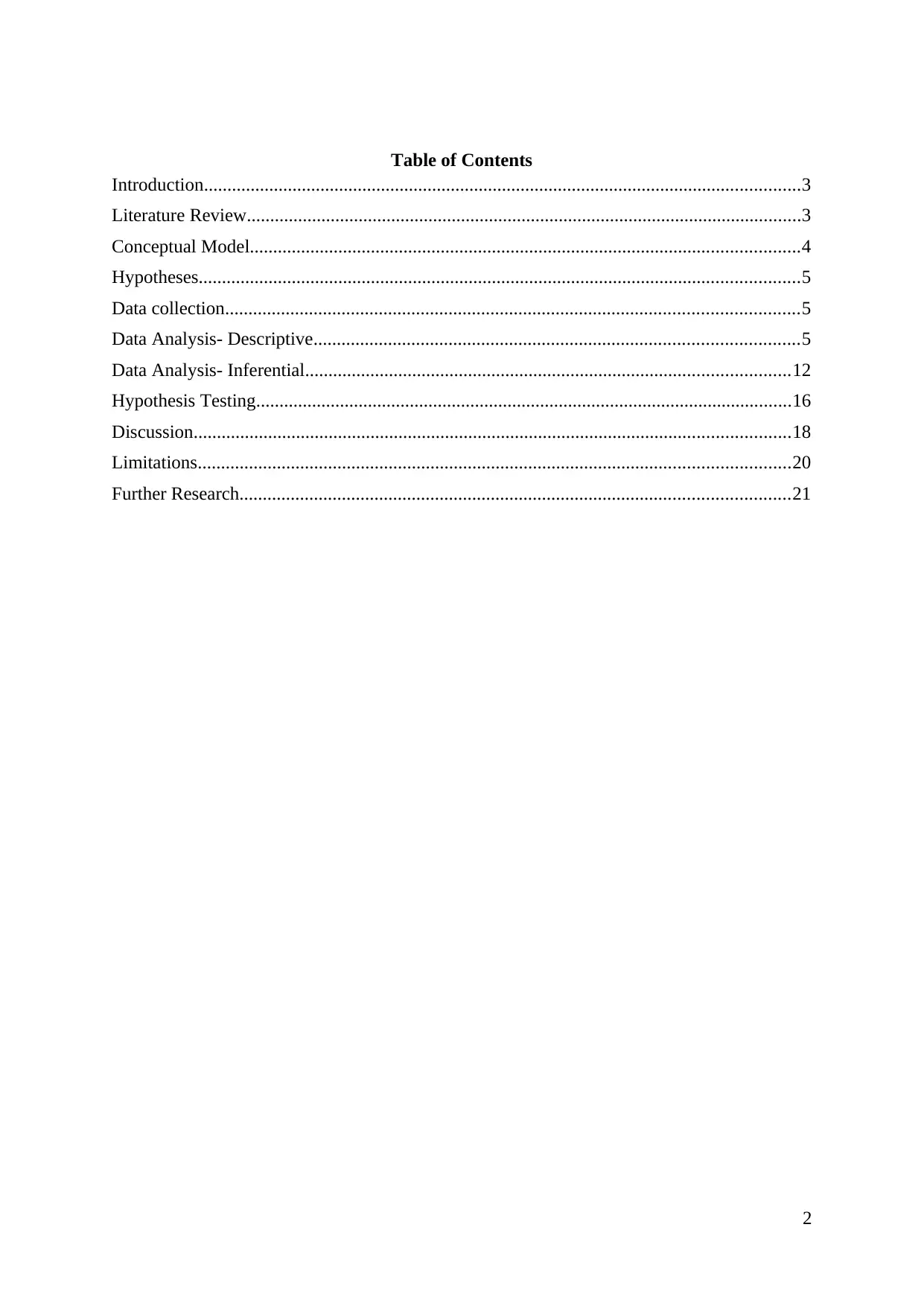
Table of Contents
Introduction................................................................................................................................3
Literature Review.......................................................................................................................3
Conceptual Model......................................................................................................................4
Hypotheses.................................................................................................................................5
Data collection...........................................................................................................................5
Data Analysis- Descriptive........................................................................................................5
Data Analysis- Inferential........................................................................................................12
Hypothesis Testing...................................................................................................................16
Discussion................................................................................................................................18
Limitations...............................................................................................................................20
Further Research......................................................................................................................21
2
Document Page
Introduction
Carbon emission continues to be a subject of global discussion attracting both governments
and businesses. Carbon emission results in great amounts of pollution that disrupt the climatic
conditions of the earth making it difficult for people to live comfortably. Human activities
such as deforestation, burning fossil fuels, farming practices, refrigeration and manufacturing
process produce substances greenhouses gases that deplete the ozone-layer (Chunbo & Stern,
2008).
It is important that governments and organization work together to deliberately reduce the
intensity of carbon emission in their respective countries to decrease the depletion of the
ozone-layer which cause the effects of global warming (Smith, 2009). Therefore, this
research project aims to identify and compare the intensity of carbon emission for two
countries: Canada and Germany. The project also sought to investigate if significant
difference exists between the average intensity emissions for companies that offer incentives
towards the management of emissions and those that do not.
Literature Review
The theme of environmental change is presently attracting enthusiastic conversations among
organization financial specialists, policymakers, and scholastics. The discussions revolve
around the issue of ozone-layer depletion caused by emission of carbon gases from the
burning of non-renewable fossil fuels and its adverse environmental effects on the earth. The
conversations have to the establishment of initiatives by public and private entities the world
over to try and minimise the intensity of carbon emission (Bonner, Hastie, & Sprinkle, 2000).
At the same time, partnerships between companies and their employees are giving the much
needed motivation to their staff to drive the agenda of reducing the intensity of carbon
emission from company activities (Bansal & Roth, 2000).
3
Document Page
Research indicates that companies are using different motivation techniques including
monetary and nonmonetary incentives to reduce the intensity if carbon emission from their
activities. Hypotheses have focused on the impact of monetary motivation on individual
performance, contending that fiscal motivations are utilized to adjust the key goals along with
those of the agents. The ideal agreement is to share the responsibility of reducing carbon
emission between the company and its representatives through motivational incentives.
Accordingly, it is reported that monetary incentives and money related motivations diminish
the challenges associated with the collaborations between companies and their employees in
working towards reduce carbon emission (Aguilera, Rupp, Williams, & Ganapathi, 2007).
Some of these challenges include reduced productivity. However, there is need to establish
the relationship between the carbon emission intensity, the highest level of direct
responsibility for climate change in the company, and the country.
Conceptual Model
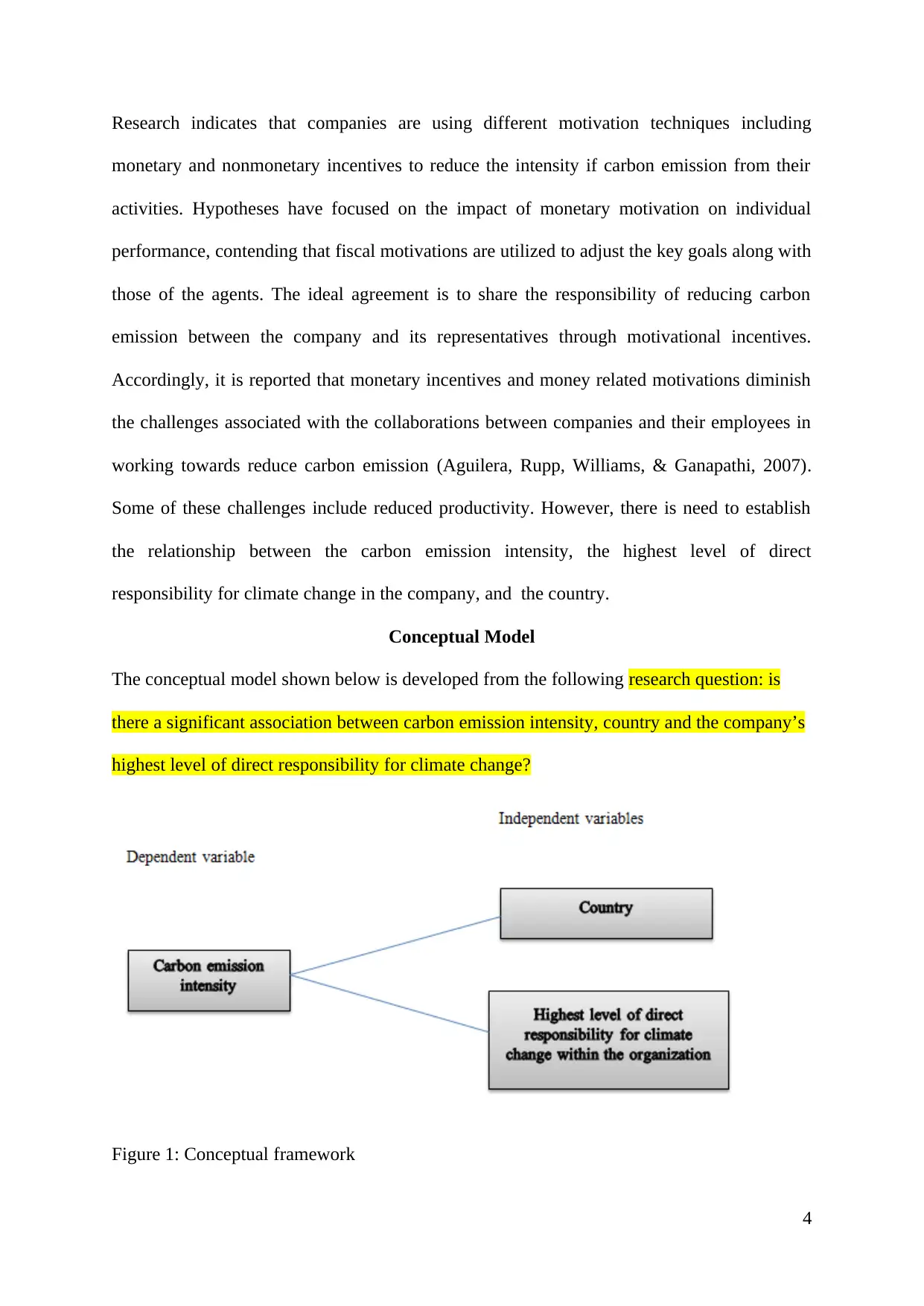
The conceptual model shown below is developed from the following research question: is
there a significant association between carbon emission intensity, country and the company’s
highest level of direct responsibility for climate change?
Figure 1: Conceptual framework
4
tabler-icon-diamond-filled.svg

Paraphrase This Document

Need a fresh take? Get an instant paraphrase of this document with our AI Paraphraser
Document Page
Hypotheses
The following hypotheses were tested for this research project;
H1: There is significant association between country and the company’s highest level
of direct responsibility for climate change.
H0: There’s no significant correlation between intensity and percentage change in
intensity for the various countries.
H0: There is no significant difference in intensity for the two countries (Canada and
Germany).
Data collection
Data for this research project was collected from Canada and Germany firms. Random
selection was used to select a sample size of 166 firms from Canada and Germany. Data was
cleaned and processes in the Statistical Package for Social Sciences (SPSS). Only useful
variables were included in the dataset, the non-useful variables were deleted from the dataset.
Missing data were coded as -999 and 999. A separate data file (excel file) is provided
together with this report.
Data Analysis- Descriptive
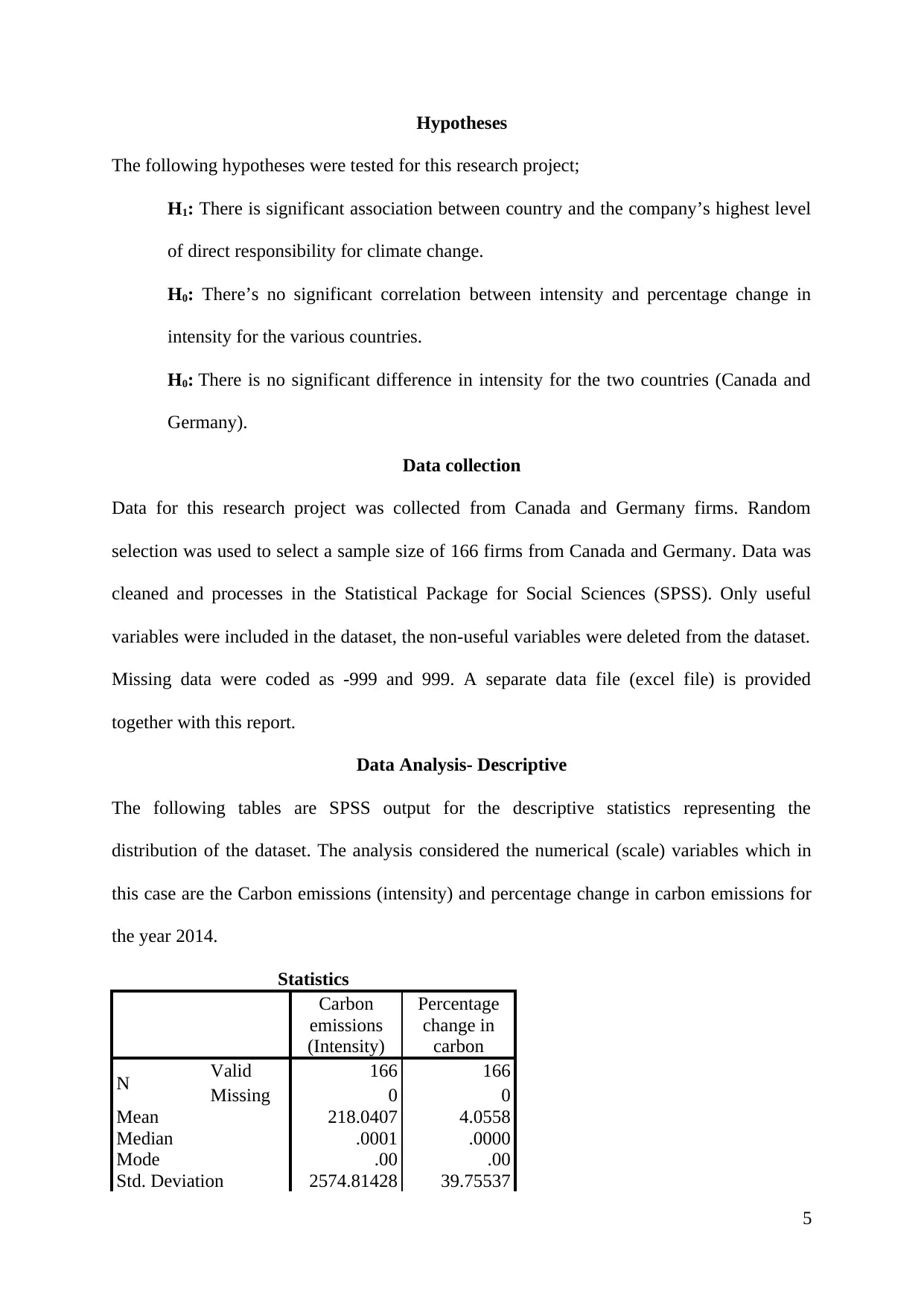
The following tables are SPSS output for the descriptive statistics representing the
distribution of the dataset. The analysis considered the numerical (scale) variables which in
this case are the Carbon emissions (intensity) and percentage change in carbon emissions for
the year 2014.
Statistics
Carbon
emissions
(Intensity)
Percentage
change in
carbon
N Valid 166 166
Missing 0 0
Mean 218.0407 4.0558
Median .0001 .0000
Mode .00 .00
Std. Deviation 2574.81428 39.75537
5
Document Page
Variance 6629668.573 1580.489
Skewness 12.833 6.094
Std. Error of
Skewness
.188 .188
Kurtosis 165.093 54.602
Std. Error of Kurtosis .375 .375
Range 33148.00 486.24
Minimum .00 -99.24
Maximum 33148.00 387.00
Percentiles
25 .0000 -4.8500
50 .0001 .0000
75 .0011 4.9250
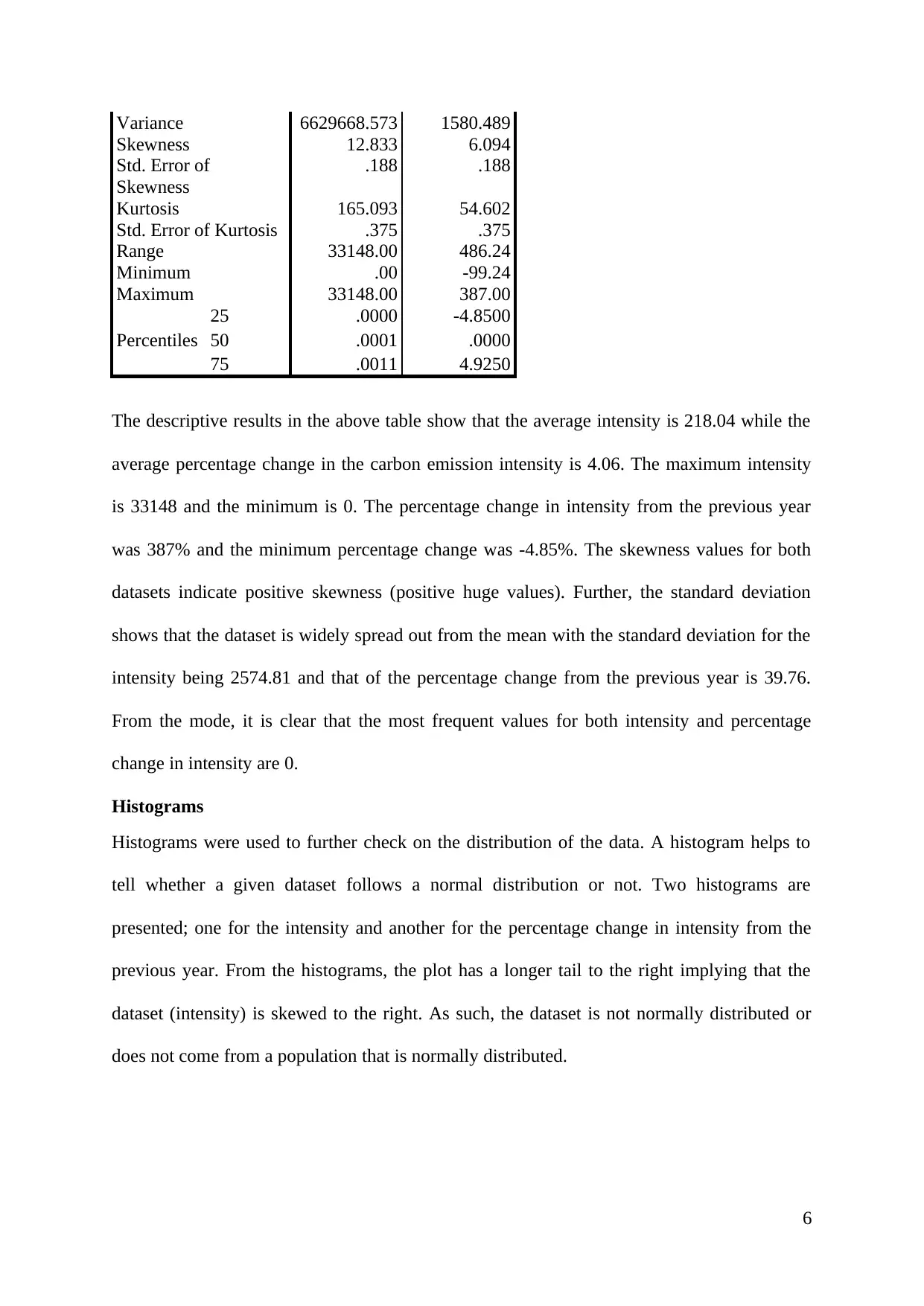
The descriptive results in the above table show that the average intensity is 218.04 while the
average percentage change in the carbon emission intensity is 4.06. The maximum intensity
is 33148 and the minimum is 0. The percentage change in intensity from the previous year
was 387% and the minimum percentage change was -4.85%. The skewness values for both
datasets indicate positive skewness (positive huge values). Further, the standard deviation
shows that the dataset is widely spread out from the mean with the standard deviation for the
intensity being 2574.81 and that of the percentage change from the previous year is 39.76.
From the mode, it is clear that the most frequent values for both intensity and percentage
change in intensity are 0.
Histograms
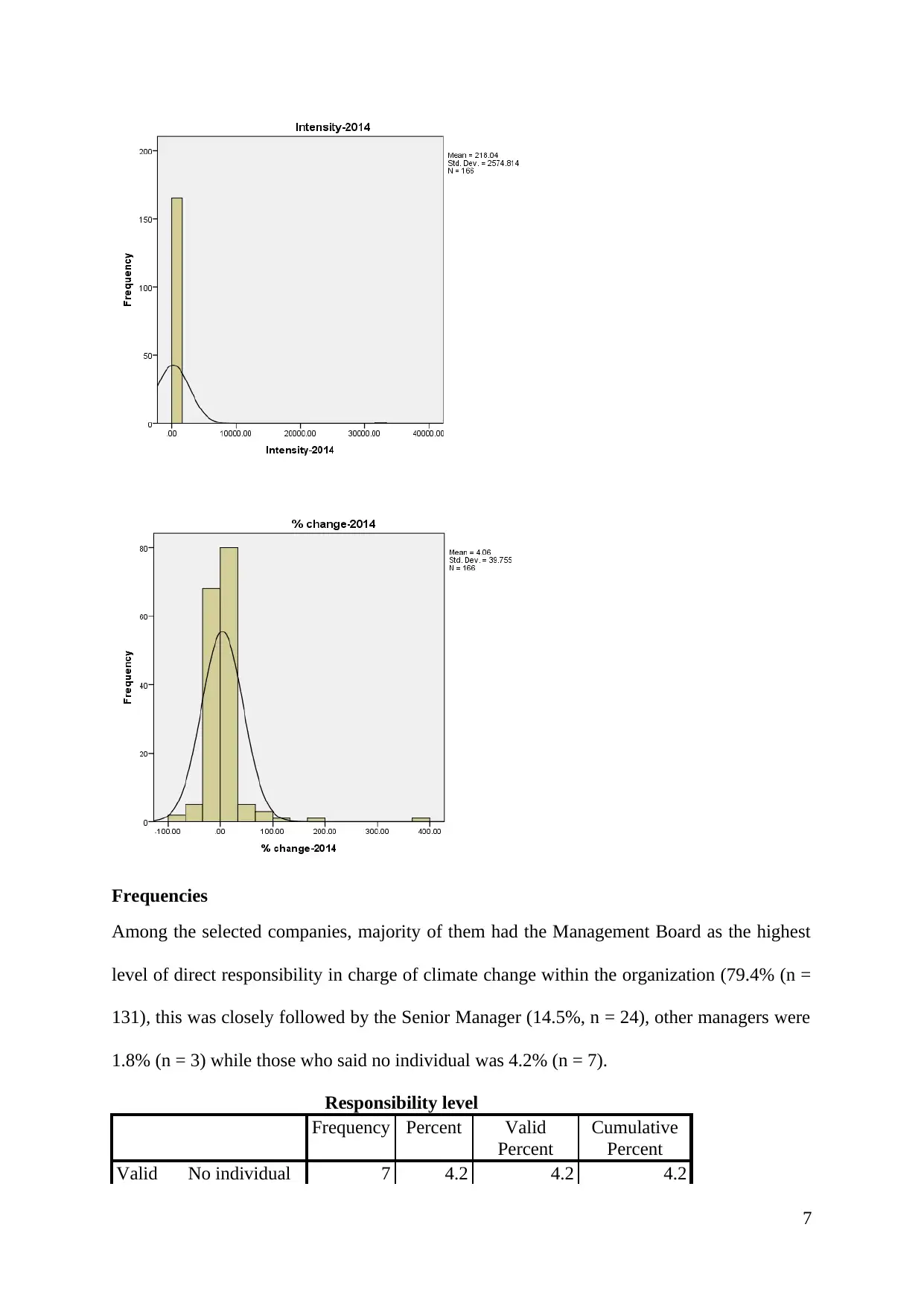
Histograms were used to further check on the distribution of the data. A histogram helps to
tell whether a given dataset follows a normal distribution or not. Two histograms are
presented; one for the intensity and another for the percentage change in intensity from the
previous year. From the histograms, the plot has a longer tail to the right implying that the
dataset (intensity) is skewed to the right. As such, the dataset is not normally distributed or
does not come from a population that is normally distributed.
6
Document Page
Frequencies
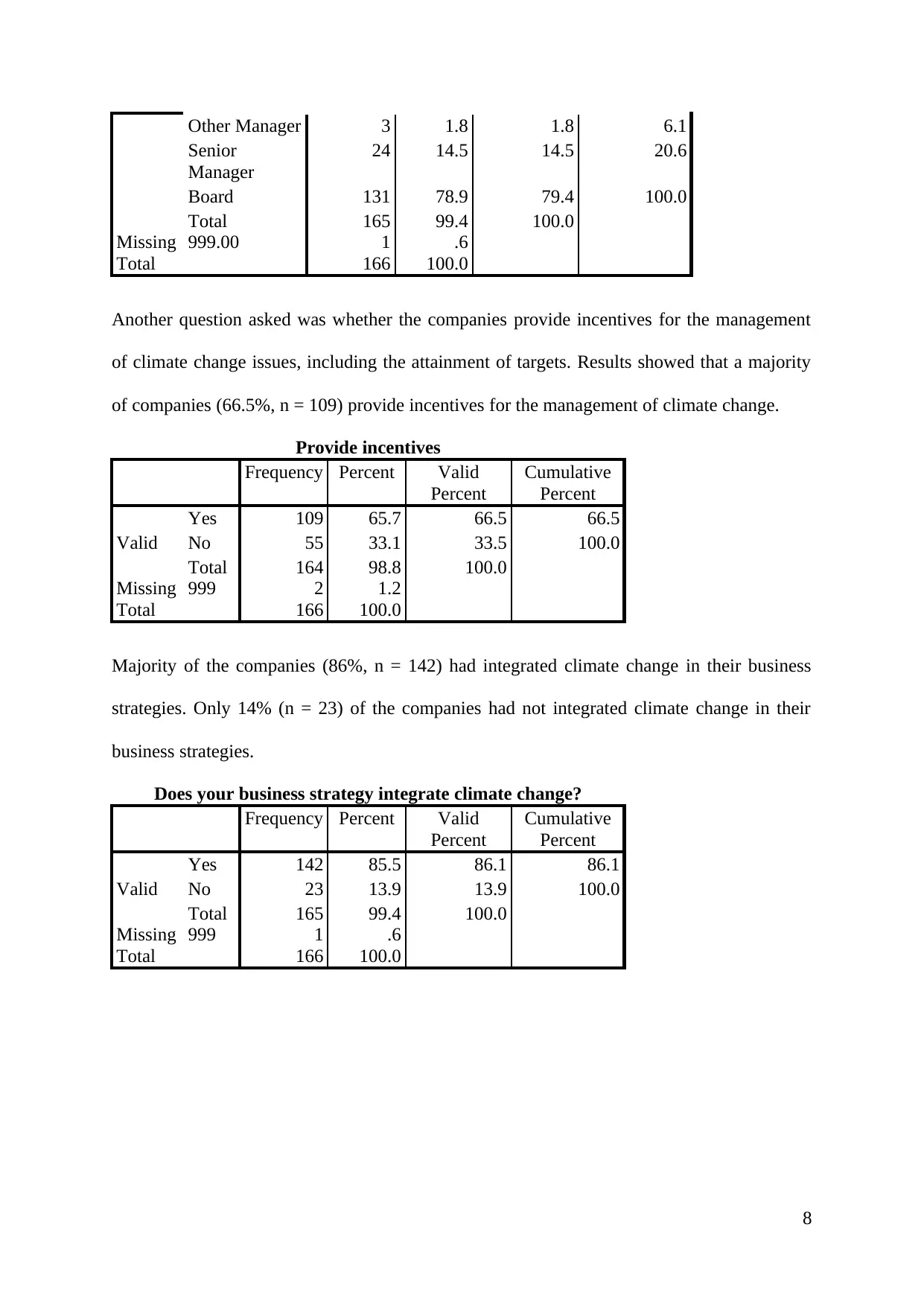
Among the selected companies, majority of them had the Management Board as the highest
level of direct responsibility in charge of climate change within the organization (79.4% (n =
131), this was closely followed by the Senior Manager (14.5%, n = 24), other managers were
1.8% (n = 3) while those who said no individual was 4.2% (n = 7).
Responsibility level
Frequency Percent Valid
Percent
Cumulative
Percent
Valid No individual 7 4.2 4.2 4.2
7
tabler-icon-diamond-filled.svg

Paraphrase This Document

Need a fresh take? Get an instant paraphrase of this document with our AI Paraphraser
Document Page
Other Manager 3 1.8 1.8 6.1
Senior
Manager
24 14.5 14.5 20.6
Board 131 78.9 79.4 100.0
Total 165 99.4 100.0
Missing 999.00 1 .6
Total 166 100.0
Another question asked was whether the companies provide incentives for the management
of climate change issues, including the attainment of targets. Results showed that a majority
of companies (66.5%, n = 109) provide incentives for the management of climate change.
Provide incentives
Frequency Percent Valid
Percent
Cumulative
Percent
Valid
Yes 109 65.7 66.5 66.5
No 55 33.1 33.5 100.0
Total 164 98.8 100.0
Missing 999 2 1.2
Total 166 100.0
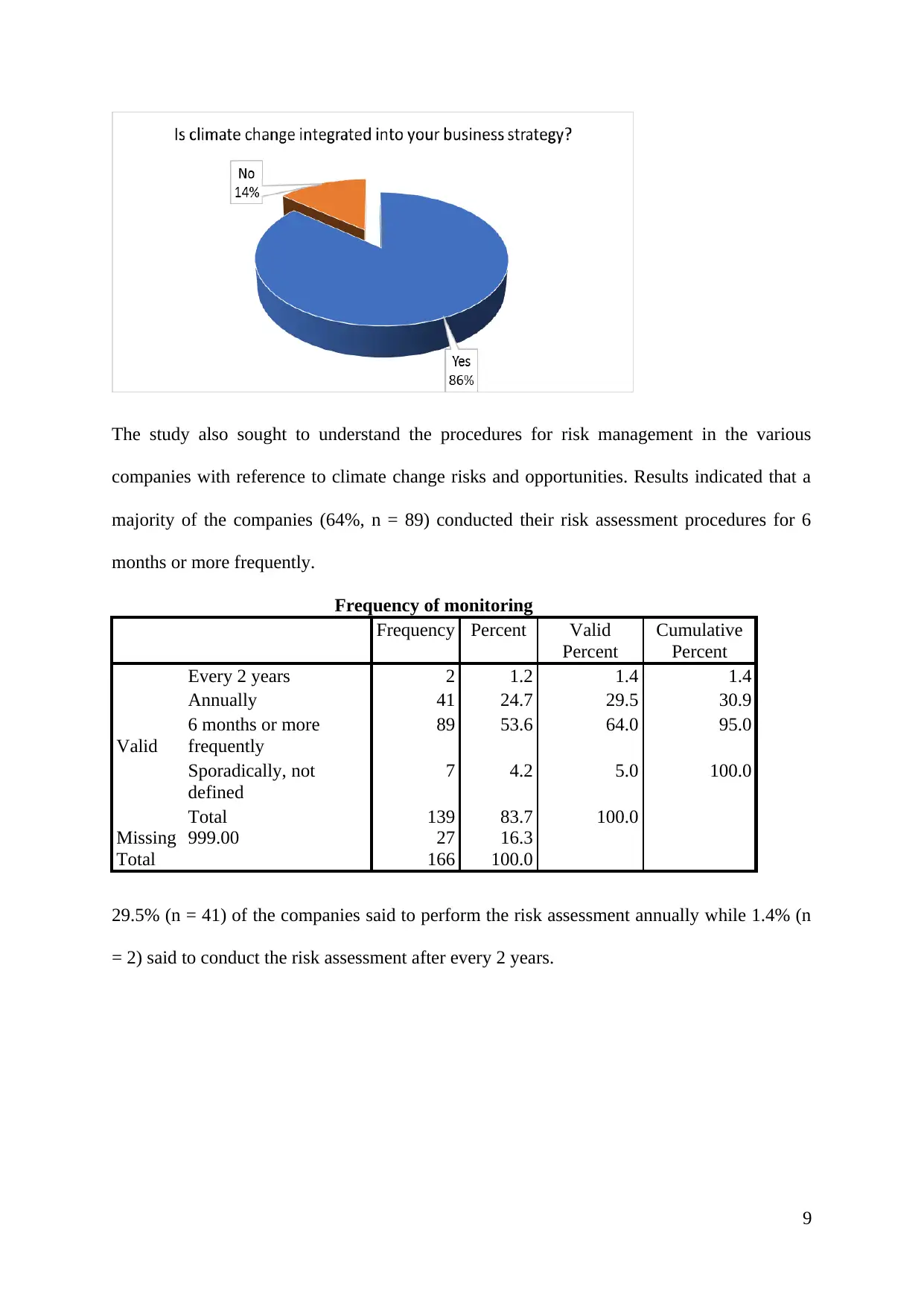
Majority of the companies (86%, n = 142) had integrated climate change in their business
strategies. Only 14% (n = 23) of the companies had not integrated climate change in their
business strategies.
Does your business strategy integrate climate change?
Frequency Percent Valid
Percent
Cumulative
Percent
Valid
Yes 142 85.5 86.1 86.1
No 23 13.9 13.9 100.0
Total 165 99.4 100.0
Missing 999 1 .6
Total 166 100.0
8
Document Page
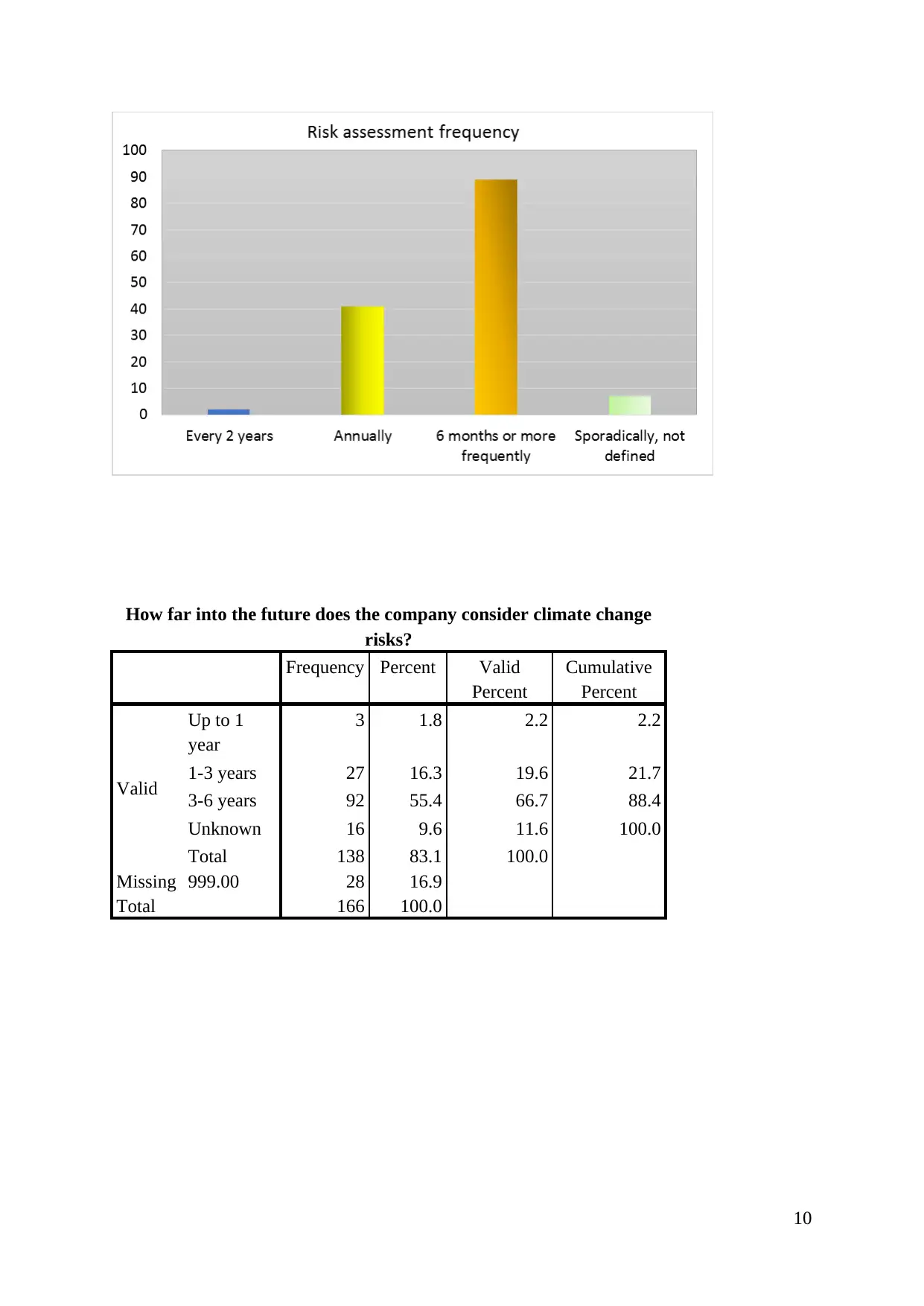
The study also sought to understand the procedures for risk management in the various
companies with reference to climate change risks and opportunities. Results indicated that a
majority of the companies (64%, n = 89) conducted their risk assessment procedures for 6
months or more frequently.
Frequency of monitoring
Frequency Percent Valid
Percent
Cumulative
Percent
Valid
Every 2 years 2 1.2 1.4 1.4
Annually 41 24.7 29.5 30.9
6 months or more
frequently
89 53.6 64.0 95.0
Sporadically, not
defined
7 4.2 5.0 100.0
Total 139 83.7 100.0
Missing 999.00 27 16.3
Total 166 100.0
29.5% (n = 41) of the companies said to perform the risk assessment annually while 1.4% (n
= 2) said to conduct the risk assessment after every 2 years.
9
Document Page
How far into the future does the company consider climate change
risks?
Frequency Percent Valid
Percent
Cumulative
Percent
Valid
Up to 1
year
3 1.8 2.2 2.2
1-3 years 27 16.3 19.6 21.7
3-6 years 92 55.4 66.7 88.4
Unknown 16 9.6 11.6 100.0
Total 138 83.1 100.0
Missing 999.00 28 16.9
Total 166 100.0
10
tabler-icon-diamond-filled.svg

Paraphrase This Document

Need a fresh take? Get an instant paraphrase of this document with our AI Paraphraser
Document Page
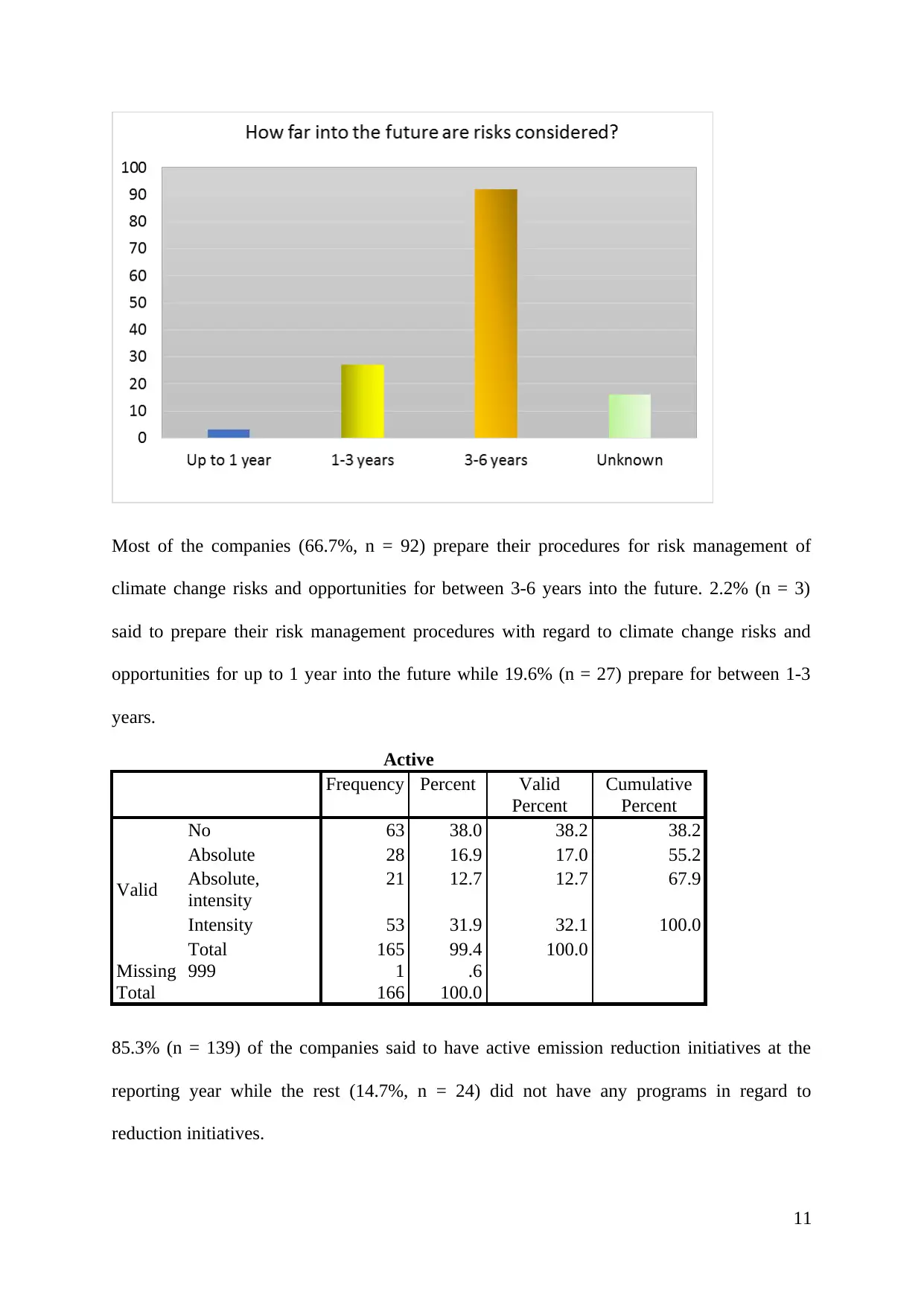
Most of the companies (66.7%, n = 92) prepare their procedures for risk management of
climate change risks and opportunities for between 3-6 years into the future. 2.2% (n = 3)
said to prepare their risk management procedures with regard to climate change risks and
opportunities for up to 1 year into the future while 19.6% (n = 27) prepare for between 1-3
years.
Active
Frequency Percent Valid
Percent
Cumulative
Percent
Valid
No 63 38.0 38.2 38.2
Absolute 28 16.9 17.0 55.2
Absolute,
intensity
21 12.7 12.7 67.9
Intensity 53 31.9 32.1 100.0
Total 165 99.4 100.0
Missing 999 1 .6
Total 166 100.0
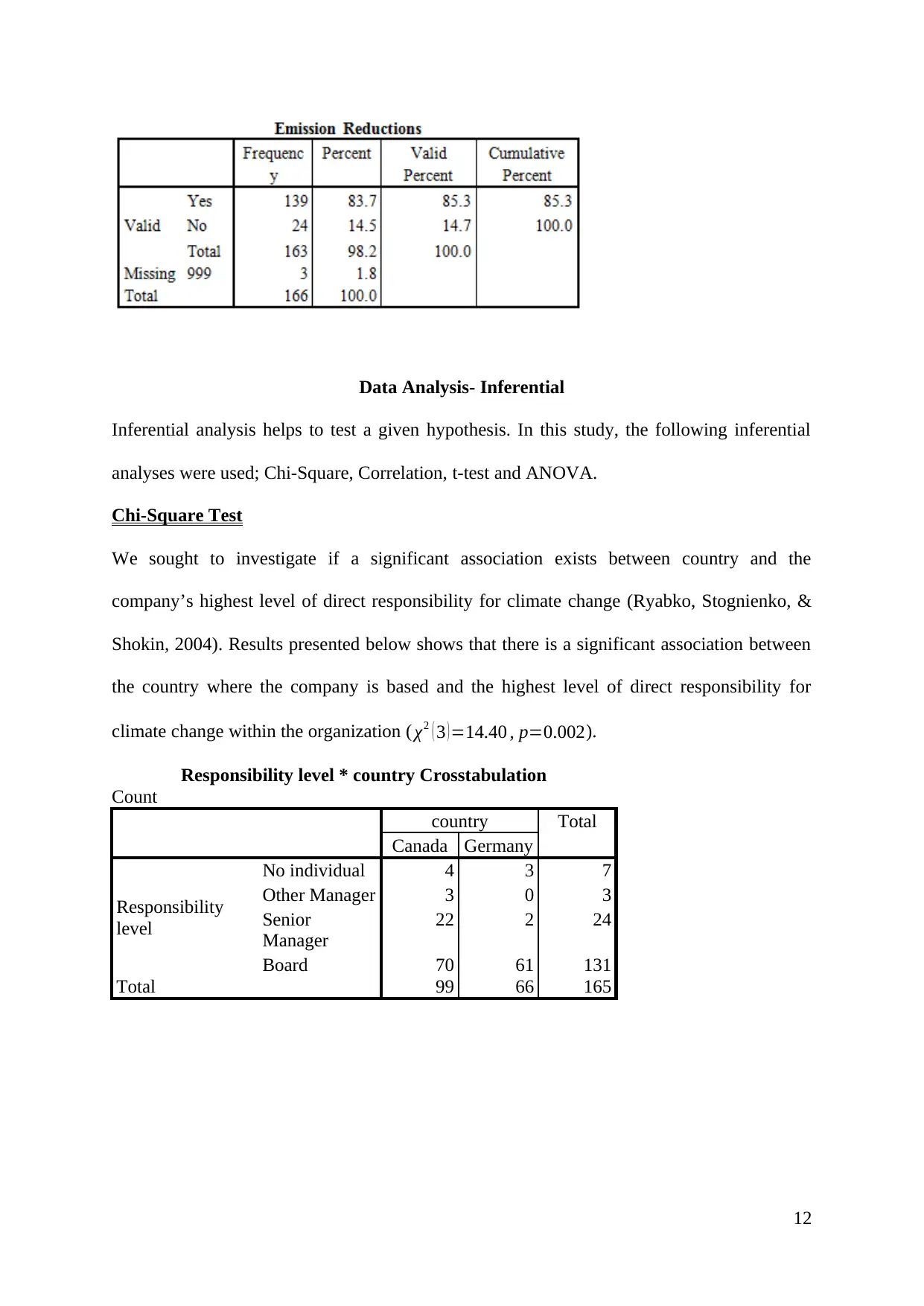
85.3% (n = 139) of the companies said to have active emission reduction initiatives at the
reporting year while the rest (14.7%, n = 24) did not have any programs in regard to
reduction initiatives.
11
Document Page
Data Analysis- Inferential
Inferential analysis helps to test a given hypothesis. In this study, the following inferential
analyses were used; Chi-Square, Correlation, t-test and ANOVA.
Chi-Square Test
We sought to investigate if a significant association exists between country and the
company’s highest level of direct responsibility for climate change (Ryabko, Stognienko, &
Shokin, 2004). Results presented below shows that there is a significant association between
the country where the company is based and the highest level of direct responsibility for
climate change within the organization ( χ2 ( 3 )=14.40 , p=0.002).
Responsibility level * country Crosstabulation
Count
country Total
Canada Germany
Responsibility
level
No individual 4 3 7
Other Manager 3 0 3
Senior
Manager
22 2 24
Board 70 61 131
Total 99 66 165
12
chevron_up_icon
1 out of 24
circle_padding
hide_on_mobile
zoom_out_icon
[object Object]