Economics Essay: Analyzing Carbon Emissions Reduction and Saving Lives
VerifiedAdded on 2023/06/14
|6
|1253
|160
Essay
AI Summary
This essay provides a commentary on an article discussing the potential for carbon emission reductions to save lives globally. It delves into the economic terminology of externalities, specifically negative externalities arising from production processes. The analysis applies the theory of negative externalities, highlighting the discrepancy between private marginal costs and social marginal costs. The essay further explores government intervention policies like pollution taxes and quotas to internalize these externalities. Ultimately, it argues that government intervention compelling production houses to internalize negative externalities can reduce pollution levels and improve public health, showcasing how internalizing social costs can lead to better environmental outcomes and increased overall utility.
Page 1 of 6
ECONOMICS ASSIGNMENT
INTERNAL ASSESSMENT
Commentary details
Title of the article: New study finds reducing carbon emissions could save hundreds of
millions of lives
Source of the article: The Chronicle http://www.dukechronicle.com/article/2018/03/new-
study-finds-reducing-carbon-emissions-could-save-hundreds-of-millions-of-lives
The date of the article: 22/03/18
The word count of the commentary: 750
The date the commentary was written: 11/04/18
The section of the syllabus the commentary relates: Microeconomics
ECONOMICS ASSIGNMENT
INTERNAL ASSESSMENT
Commentary details
Title of the article: New study finds reducing carbon emissions could save hundreds of
millions of lives
Source of the article: The Chronicle http://www.dukechronicle.com/article/2018/03/new-
study-finds-reducing-carbon-emissions-could-save-hundreds-of-millions-of-lives
The date of the article: 22/03/18
The word count of the commentary: 750
The date the commentary was written: 11/04/18
The section of the syllabus the commentary relates: Microeconomics
Paraphrase This Document
Need a fresh take? Get an instant paraphrase of this document with our AI Paraphraser

Page 2 of 6
Table of contents
Introduction................................................................................................................................3
Terminology...............................................................................................................................3
Application.................................................................................................................................3
Analysis......................................................................................................................................4
Evaluation..................................................................................................................................5
Conclusion..................................................................................................................................5
Reference....................................................................................................................................6
Table of contents
Introduction................................................................................................................................3
Terminology...............................................................................................................................3
Application.................................................................................................................................3
Analysis......................................................................................................................................4
Evaluation..................................................................................................................................5
Conclusion..................................................................................................................................5
Reference....................................................................................................................................6

Page 3 of 6
Introduction
The chosen article talks about how the reduction in carbon emission in different
countries can save lives all across the world. According to the article, the lack of proper
policies of the government to deal with the carbon emission results in loss of human lives.
The aim of this paper is to present commentary based on the chosen article. The commentary
includes the application, analysis and the evaluation of the theories that link to the problem
stated in the article.
Terminology
The article uses the economic terminology of externality which is referred to as the
external economic impact of an activity which is generally not taken into account by
economic entity (Möhlmeier, Rusinowska & Tanimura, 2016). Based on the type of impact it
has on the humans and the environment, externality can be classified into two categories of
positive and negative externality. While in positive externality, the economic activity benefits
the environment and the humans unknowingly, the negative externality creates a problem for
the environment and the human, cost of which are ignored by the economic agent carrying
out the activity (Ballentine, 2018). The problem presented in the chosen article is regarding
the negative externality of production processes that give rise to carbon emissions.
The production units, apart from the private marginal cost (PMC), also need to take
into account the Social Marginal cost (SMC) that the environment and the human as a whole
incur due to the production. For example, if a production unit is dumping the waste on the
river which is used by the neighbouring village for drinking purpose, the increased
production will also increase the health hazard and the medical bills of the villagers as well.
Application
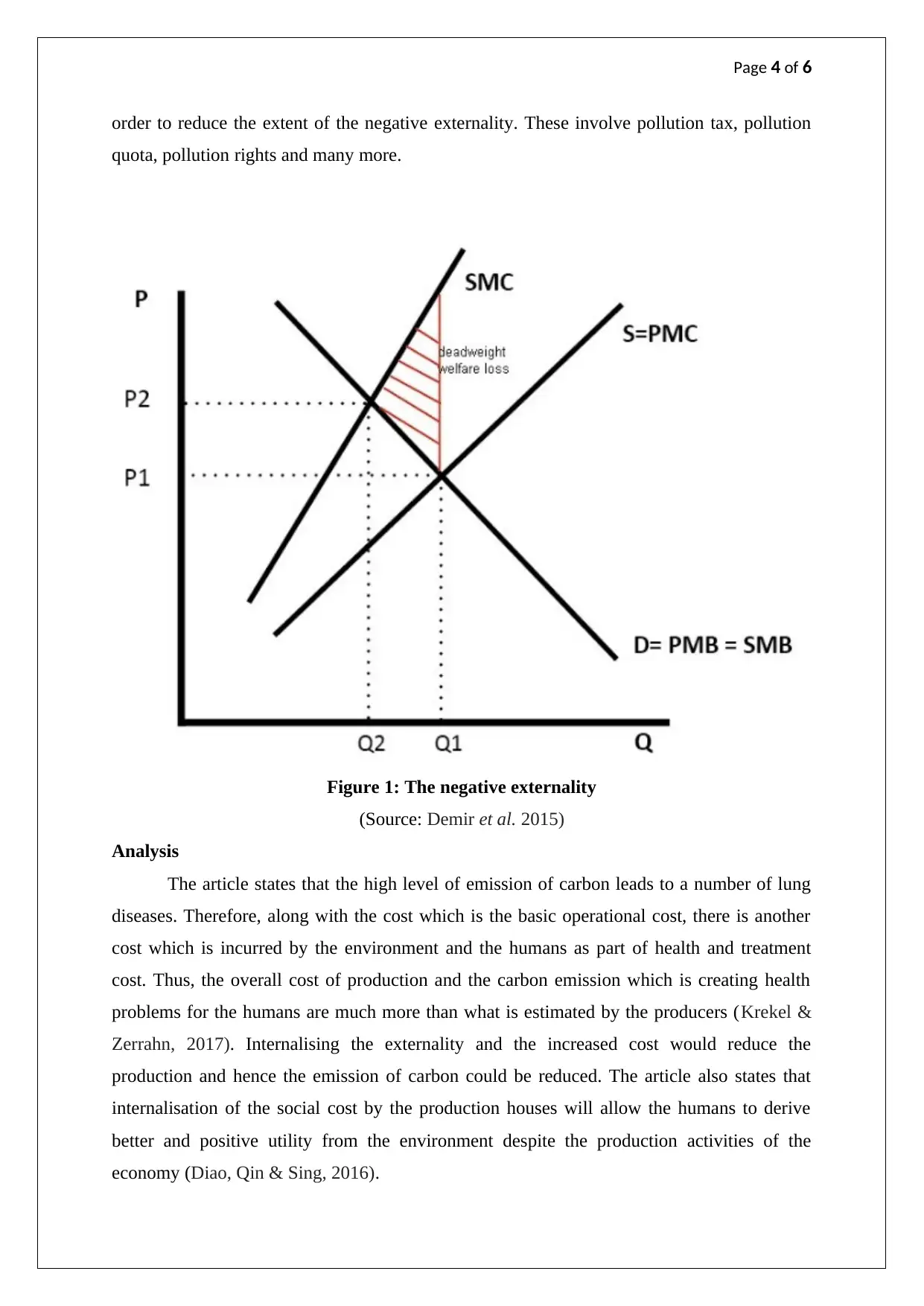
According to the theory of negative economic externality, production houses only
emphasise on the private costs and ignore the social cost of production. As the figure 1
shows, the production houses produce at the point where the private marginal cost equates
with the social marginal benefits. However, if the production houses would have considered
the social marginal cost as a whole, the overall production would have been low and the price
would have been high (Wood & Sullivan, 2015). This market equilibrium where SMC
intersects with SMB is where the market considers and take into account the cost incurred by
the environment and the humans as part of environmental degradation and the medial bills.
According to the theory, the government can intervene in this case with many policies in
Introduction
The chosen article talks about how the reduction in carbon emission in different
countries can save lives all across the world. According to the article, the lack of proper
policies of the government to deal with the carbon emission results in loss of human lives.
The aim of this paper is to present commentary based on the chosen article. The commentary
includes the application, analysis and the evaluation of the theories that link to the problem
stated in the article.
Terminology
The article uses the economic terminology of externality which is referred to as the
external economic impact of an activity which is generally not taken into account by
economic entity (Möhlmeier, Rusinowska & Tanimura, 2016). Based on the type of impact it
has on the humans and the environment, externality can be classified into two categories of
positive and negative externality. While in positive externality, the economic activity benefits
the environment and the humans unknowingly, the negative externality creates a problem for
the environment and the human, cost of which are ignored by the economic agent carrying
out the activity (Ballentine, 2018). The problem presented in the chosen article is regarding
the negative externality of production processes that give rise to carbon emissions.
The production units, apart from the private marginal cost (PMC), also need to take
into account the Social Marginal cost (SMC) that the environment and the human as a whole
incur due to the production. For example, if a production unit is dumping the waste on the
river which is used by the neighbouring village for drinking purpose, the increased
production will also increase the health hazard and the medical bills of the villagers as well.
Application
According to the theory of negative economic externality, production houses only
emphasise on the private costs and ignore the social cost of production. As the figure 1
shows, the production houses produce at the point where the private marginal cost equates
with the social marginal benefits. However, if the production houses would have considered
the social marginal cost as a whole, the overall production would have been low and the price
would have been high (Wood & Sullivan, 2015). This market equilibrium where SMC
intersects with SMB is where the market considers and take into account the cost incurred by
the environment and the humans as part of environmental degradation and the medial bills.
According to the theory, the government can intervene in this case with many policies in
⊘ This is a preview!⊘
Do you want full access?
Subscribe today to unlock all pages.

Trusted by 1+ million students worldwide

Page 4 of 6
order to reduce the extent of the negative externality. These involve pollution tax, pollution
quota, pollution rights and many more.
Figure 1: The negative externality
(Source: Demir et al. 2015)
Analysis
The article states that the high level of emission of carbon leads to a number of lung
diseases. Therefore, along with the cost which is the basic operational cost, there is another
cost which is incurred by the environment and the humans as part of health and treatment
cost. Thus, the overall cost of production and the carbon emission which is creating health
problems for the humans are much more than what is estimated by the producers (Krekel &
Zerrahn, 2017). Internalising the externality and the increased cost would reduce the
production and hence the emission of carbon could be reduced. The article also states that
internalisation of the social cost by the production houses will allow the humans to derive
better and positive utility from the environment despite the production activities of the
economy (Diao, Qin & Sing, 2016).
order to reduce the extent of the negative externality. These involve pollution tax, pollution
quota, pollution rights and many more.
Figure 1: The negative externality
(Source: Demir et al. 2015)
Analysis
The article states that the high level of emission of carbon leads to a number of lung
diseases. Therefore, along with the cost which is the basic operational cost, there is another
cost which is incurred by the environment and the humans as part of health and treatment
cost. Thus, the overall cost of production and the carbon emission which is creating health
problems for the humans are much more than what is estimated by the producers (Krekel &
Zerrahn, 2017). Internalising the externality and the increased cost would reduce the
production and hence the emission of carbon could be reduced. The article also states that
internalisation of the social cost by the production houses will allow the humans to derive
better and positive utility from the environment despite the production activities of the
economy (Diao, Qin & Sing, 2016).
Paraphrase This Document
Need a fresh take? Get an instant paraphrase of this document with our AI Paraphraser

Page 5 of 6
Evaluation
Therefore, it is a concern for the government that the production units are considering
their private costs while setting the prices of the products. However, the damage it’s creating
on the environment and the lives of people are being ignored (Scotti et al. 2014). The lower
cost corresponding to avoidance of social cost creates higher demand in the market thereby
increasing the pollution even more. Thus, as recommended in the article, the governments
need to have an environmental policy so that each of the production units has their limited
quota to pollute the environment so that the overall level of pollution does not reach an
alarming stage and the negative externality is internalised by the production houses.
Conclusion
Thus, the paper furnishes that the human death resulting from the increased carbon
emission can be reduced if the invention is made by the government which can compel the
production houses to internalise the negative externality. This will increase the cost of
production and the resulting high prices will automatically reduce the pollution level in the
environment.
Evaluation
Therefore, it is a concern for the government that the production units are considering
their private costs while setting the prices of the products. However, the damage it’s creating
on the environment and the lives of people are being ignored (Scotti et al. 2014). The lower
cost corresponding to avoidance of social cost creates higher demand in the market thereby
increasing the pollution even more. Thus, as recommended in the article, the governments
need to have an environmental policy so that each of the production units has their limited
quota to pollute the environment so that the overall level of pollution does not reach an
alarming stage and the negative externality is internalised by the production houses.
Conclusion
Thus, the paper furnishes that the human death resulting from the increased carbon
emission can be reduced if the invention is made by the government which can compel the
production houses to internalise the negative externality. This will increase the cost of
production and the resulting high prices will automatically reduce the pollution level in the
environment.

Page 6 of 6
Reference
Ballentine, C. (2018). A new study finds reducing carbon emissions could save hundreds of
millions of lives. The Chronicle. Retrieved from
http://www.dukechronicle.com/article/2018/03/new-study-finds-reducing-carbon-
emissions-could-save-hundreds-of-millions-of-lives
Demir, E., Huang, Y., Scholts, S., & Van Woensel, T. (2015). A selected review on the
negative externalities of the freight transportation: Modeling and
pricing. Transportation research part E: Logistics and transportation review, 77, 95-
114.
Diao, M., Qin, Y., & Sing, T. F. (2016). Negative externalities of rail noise and housing
values: Evidence from the cessation of railway operations in Singapore. Real Estate
Economics, 44(4), 878-917.
Krekel, C., & Zerrahn, A. (2017). Does the presence of wind turbines have negative
externalities for people in their surroundings? Evidence from well-being data. Journal
of Environmental Economics and Management, 82, 221-238.
Möhlmeier, P., Rusinowska, A., & Tanimura, E. (2016). A Degree‐Distance‐Based
Connections Model with Negative and Positive Externalities. Journal of Public
Economic Theory, 18(2), 168-192.
Scotti, D., Dresner, M., Martini, G., & Yu, C. (2014). Incorporating negative externalities
into productivity assessments of US airports. Transportation Research Part A: Policy
and Practice, 62, 39-53.
Wood, R. M., & Sullivan, C. (2015). Doing harm by doing good? The negative externalities
of humanitarian aid provision during civil conflict. The Journal of Politics, 77(3),
736-748.
Reference
Ballentine, C. (2018). A new study finds reducing carbon emissions could save hundreds of
millions of lives. The Chronicle. Retrieved from
http://www.dukechronicle.com/article/2018/03/new-study-finds-reducing-carbon-
emissions-could-save-hundreds-of-millions-of-lives
Demir, E., Huang, Y., Scholts, S., & Van Woensel, T. (2015). A selected review on the
negative externalities of the freight transportation: Modeling and
pricing. Transportation research part E: Logistics and transportation review, 77, 95-
114.
Diao, M., Qin, Y., & Sing, T. F. (2016). Negative externalities of rail noise and housing
values: Evidence from the cessation of railway operations in Singapore. Real Estate
Economics, 44(4), 878-917.
Krekel, C., & Zerrahn, A. (2017). Does the presence of wind turbines have negative
externalities for people in their surroundings? Evidence from well-being data. Journal
of Environmental Economics and Management, 82, 221-238.
Möhlmeier, P., Rusinowska, A., & Tanimura, E. (2016). A Degree‐Distance‐Based
Connections Model with Negative and Positive Externalities. Journal of Public
Economic Theory, 18(2), 168-192.
Scotti, D., Dresner, M., Martini, G., & Yu, C. (2014). Incorporating negative externalities
into productivity assessments of US airports. Transportation Research Part A: Policy
and Practice, 62, 39-53.
Wood, R. M., & Sullivan, C. (2015). Doing harm by doing good? The negative externalities
of humanitarian aid provision during civil conflict. The Journal of Politics, 77(3),
736-748.
⊘ This is a preview!⊘
Do you want full access?
Subscribe today to unlock all pages.

Trusted by 1+ million students worldwide
1 out of 6
Related Documents
Your All-in-One AI-Powered Toolkit for Academic Success.
+13062052269
info@desklib.com
Available 24*7 on WhatsApp / Email
Unlock your academic potential
Copyright © 2020–2025 A2Z Services. All Rights Reserved. Developed and managed by ZUCOL.

![[Year] ABC Company: Market Failure and Environment in Economic Context](/_next/image/?url=https%3A%2F%2Fdesklib.com%2Fmedia%2Fimages%2F658e5453c376427285461096c079d2b6.jpg&w=256&q=75)