Cardiovascular Attacks: Case Study Analysis Report - University
VerifiedAdded on 2022/11/03
|13
|2582
|243
Case Study
AI Summary
This case study examines cardiovascular attacks, specifically focusing on a 74-year-old patient, Mr. Sam Kwon, who suffered a stroke. The study begins by defining cerebrovascular accidents (CVAs) and their prevalence, differentiating between ischemic and hemorrhagic strokes. It explores the incidence of CVAs in Australia and the USA, highlighting demographic and socio-economic factors. Mr. Kwon's case is analyzed, detailing his medical history (hypertension, diabetes, smoking) and presenting his symptoms (right-sided hemi-paralysis, aphasia, facial drooping). The analysis identifies key risk factors like hypertension, diabetes, age, and smoking, and assesses neurological, sensory, and motor skills. The assignment then differentiates between ischemic and hemorrhagic strokes based on Mr. Kwon's symptoms, concluding he suffered a hemorrhagic stroke. Finally, it outlines nursing and inter-professional interventions for managing such cases, emphasizing the importance of monitoring vital signs and implementing collaborative care strategies.
Running Head: CARDIOVASCULAR ATTACKS
Cardio-vascular Attacks
Author Name
University Name
Author note
Cardio-vascular Attacks
Author Name
University Name
Author note

Paraphrase This Document
Need a fresh take? Get an instant paraphrase of this document with our AI Paraphraser
1CARDIOVASCULAR ATTACKS
Prevalence of CVA
Cerebrovascular accident (CVA) is a medical term referring to stroke, which occurs when the
blood flow inside a blood vessel suffers from a blockage, or if the blood vessel ruptures. The
individual suffering from a stroke can exhibit various symptoms from sudden headaches, nausea
to loss of balance and sensory or motor skills. The CVA can be mainly of two types- Ischemic
and haemorrhagic stroke, both of which result in the occurrence of hypoxia in the brain cells,
leading to their death. Cardiovascular diseases have been ranked as the second leading cause of
death under the Global Burden of Disease list. Demographically speaking, the average age range
of the incidence of stroke is from 55 to 80 years, even though many cases show that stroke can
occur at any age.
In Australia
According to the surveys held, there were about 1.1 million hospitalisations in each of the recent
years, due to the incidence of CVAs. In the years 2015-2016, several indigenous Australians
were hospitalised, with the death rate becoming twice that of the non-indigenous population of
Australia. Adults belonging to the age range of 18 to 95 were found to be prone to
cardiovascular attacks, mainly due to their lifestyle choices, as reported by the Australian Bureau
of Statistics (ABS) during the National Health Survey (Benjamin et al., 2018). The reasons on
which the prevalence of the attacks depend can be based on gender, socio-economic status,
cultural status, and more. The surveys successfully highlighted the following observations:
The incidence of CVA is higher in lower socio-ecoomic groups than in higher socio-
economic groups.
Prevalence of CVA
Cerebrovascular accident (CVA) is a medical term referring to stroke, which occurs when the
blood flow inside a blood vessel suffers from a blockage, or if the blood vessel ruptures. The
individual suffering from a stroke can exhibit various symptoms from sudden headaches, nausea
to loss of balance and sensory or motor skills. The CVA can be mainly of two types- Ischemic
and haemorrhagic stroke, both of which result in the occurrence of hypoxia in the brain cells,
leading to their death. Cardiovascular diseases have been ranked as the second leading cause of
death under the Global Burden of Disease list. Demographically speaking, the average age range
of the incidence of stroke is from 55 to 80 years, even though many cases show that stroke can
occur at any age.
In Australia
According to the surveys held, there were about 1.1 million hospitalisations in each of the recent
years, due to the incidence of CVAs. In the years 2015-2016, several indigenous Australians
were hospitalised, with the death rate becoming twice that of the non-indigenous population of
Australia. Adults belonging to the age range of 18 to 95 were found to be prone to
cardiovascular attacks, mainly due to their lifestyle choices, as reported by the Australian Bureau
of Statistics (ABS) during the National Health Survey (Benjamin et al., 2018). The reasons on
which the prevalence of the attacks depend can be based on gender, socio-economic status,
cultural status, and more. The surveys successfully highlighted the following observations:
The incidence of CVA is higher in lower socio-ecoomic groups than in higher socio-
economic groups.
2CARDIOVASCULAR ATTACKS
The incidence was recorded to be around 67% for people belonging to the age range of
65 and over, especially for those belonging to the age range of 85 and over, who had 3
times that of the age range of 65 to 74.
Prevalence of stroke was found to be approximately similar to that of men and women.
However, in some areas, the incidence of stroke seemed to be more in men than women.
The biggest observation made was that like the older age group, the young adults having
unhealthy lifestyles and abusing addictive substances, were the main targets of these
cardiovascular attacks.
However, due to the active participation of the healthcare professionals and introduction of new
interventions and efficient emergency services, there has been a significant reduction in the
incidence or occurrence of these attacks.
The incidence was recorded to be around 67% for people belonging to the age range of
65 and over, especially for those belonging to the age range of 85 and over, who had 3
times that of the age range of 65 to 74.
Prevalence of stroke was found to be approximately similar to that of men and women.
However, in some areas, the incidence of stroke seemed to be more in men than women.
The biggest observation made was that like the older age group, the young adults having
unhealthy lifestyles and abusing addictive substances, were the main targets of these
cardiovascular attacks.
However, due to the active participation of the healthcare professionals and introduction of new
interventions and efficient emergency services, there has been a significant reduction in the
incidence or occurrence of these attacks.
⊘ This is a preview!⊘
Do you want full access?
Subscribe today to unlock all pages.

Trusted by 1+ million students worldwide
3CARDIOVASCULAR ATTACKS
In USA
Surveys have showed that USA is one of the countries most affected by the incidence of CVA,
especially due to their fight with increased cases of obesity around the country. It has been seen
that each year in the US, stroke has killed more than 795,000 Americans. Out of the many CVA
cases, about 87% of them were due to Ischemic strokes (Cdc.gov, 2019). The reasons on which
the prevalence of the attacks depends can be based on gender, socio-economic status, cultural
status, race and more. The surveys effectively highlighted the following observations:
Different races have been seen to have different rates of incidence of strokes, like the
coloured Americans have been seen to be more inclined to suffer from strokes than white
Americans.
Age is one of the biggest factors for CVAs. Even though a stroke can happen to an
individual belonging to any age group, the stroke risk in more in individuals aged 65 or
above.
Increased substance abuse among the youth and the increased prevalence of other health
issues like obesity has been one of the biggest contributors of CVA incidence.
To reduce the incidence of these CVA cases, the US government spends about $34 billion each
year on healthcare services, medications and for various new healthcare initiatives. The
government has taken initiatives to promote healthy lifestyle and incorporate healthy diet plans
to help reduce the occurrence cardiovascular diseases.
In USA
Surveys have showed that USA is one of the countries most affected by the incidence of CVA,
especially due to their fight with increased cases of obesity around the country. It has been seen
that each year in the US, stroke has killed more than 795,000 Americans. Out of the many CVA
cases, about 87% of them were due to Ischemic strokes (Cdc.gov, 2019). The reasons on which
the prevalence of the attacks depends can be based on gender, socio-economic status, cultural
status, race and more. The surveys effectively highlighted the following observations:
Different races have been seen to have different rates of incidence of strokes, like the
coloured Americans have been seen to be more inclined to suffer from strokes than white
Americans.
Age is one of the biggest factors for CVAs. Even though a stroke can happen to an
individual belonging to any age group, the stroke risk in more in individuals aged 65 or
above.
Increased substance abuse among the youth and the increased prevalence of other health
issues like obesity has been one of the biggest contributors of CVA incidence.
To reduce the incidence of these CVA cases, the US government spends about $34 billion each
year on healthcare services, medications and for various new healthcare initiatives. The
government has taken initiatives to promote healthy lifestyle and incorporate healthy diet plans
to help reduce the occurrence cardiovascular diseases.
Paraphrase This Document
Need a fresh take? Get an instant paraphrase of this document with our AI Paraphraser
4CARDIOVASCULAR ATTACKS
Case Study Analysis
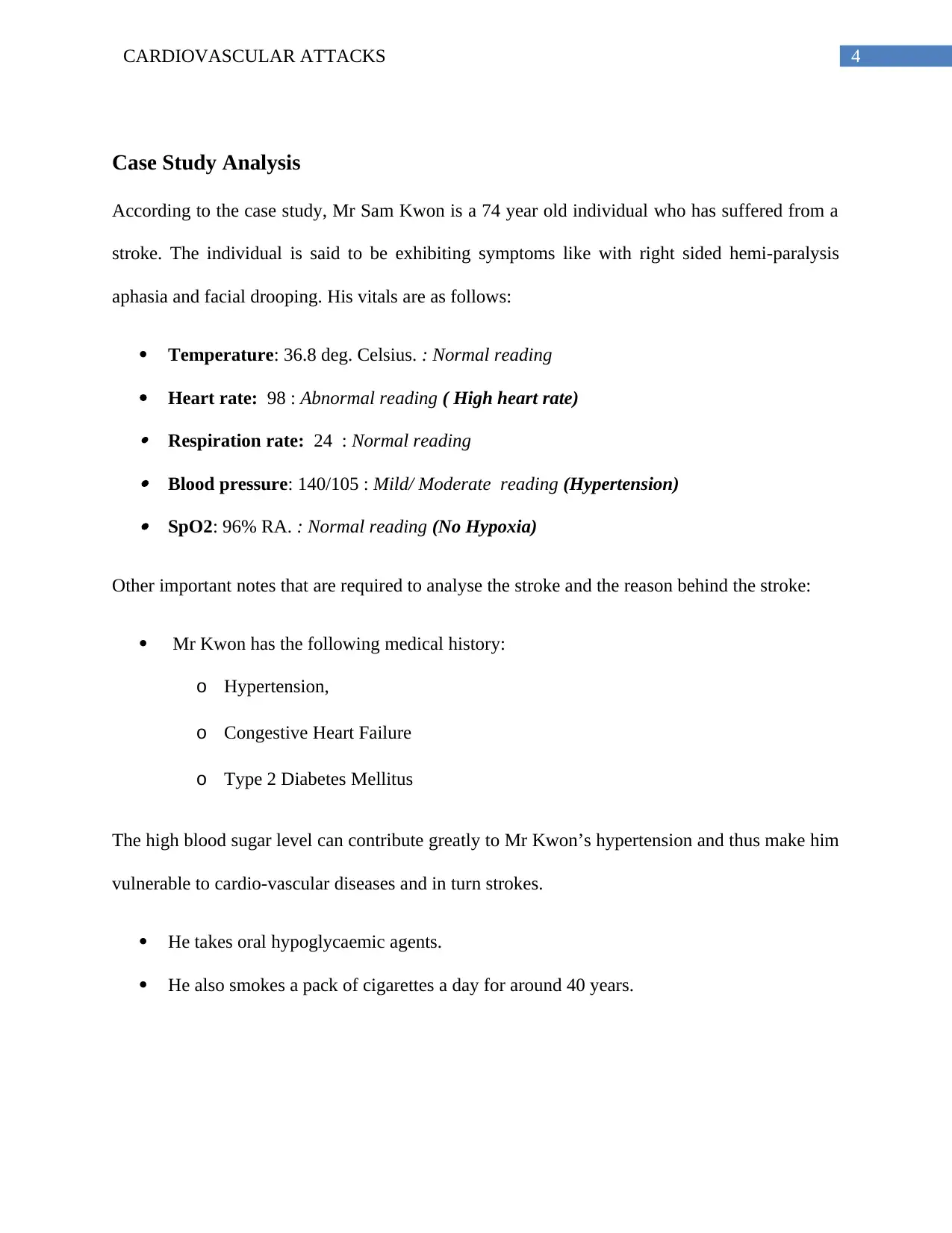
According to the case study, Mr Sam Kwon is a 74 year old individual who has suffered from a
stroke. The individual is said to be exhibiting symptoms like with right sided hemi-paralysis
aphasia and facial drooping. His vitals are as follows:
Temperature: 36.8 deg. Celsius. : Normal reading
Heart rate: 98 : Abnormal reading ( High heart rate) Respiration rate: 24 : Normal reading Blood pressure: 140/105 : Mild/ Moderate reading (Hypertension) SpO2: 96% RA. : Normal reading (No Hypoxia)
Other important notes that are required to analyse the stroke and the reason behind the stroke:
Mr Kwon has the following medical history:
o Hypertension,
o Congestive Heart Failure
o Type 2 Diabetes Mellitus
The high blood sugar level can contribute greatly to Mr Kwon’s hypertension and thus make him
vulnerable to cardio-vascular diseases and in turn strokes.
He takes oral hypoglycaemic agents.
He also smokes a pack of cigarettes a day for around 40 years.
Case Study Analysis
According to the case study, Mr Sam Kwon is a 74 year old individual who has suffered from a
stroke. The individual is said to be exhibiting symptoms like with right sided hemi-paralysis
aphasia and facial drooping. His vitals are as follows:
Temperature: 36.8 deg. Celsius. : Normal reading
Heart rate: 98 : Abnormal reading ( High heart rate) Respiration rate: 24 : Normal reading Blood pressure: 140/105 : Mild/ Moderate reading (Hypertension) SpO2: 96% RA. : Normal reading (No Hypoxia)
Other important notes that are required to analyse the stroke and the reason behind the stroke:
Mr Kwon has the following medical history:
o Hypertension,
o Congestive Heart Failure
o Type 2 Diabetes Mellitus
The high blood sugar level can contribute greatly to Mr Kwon’s hypertension and thus make him
vulnerable to cardio-vascular diseases and in turn strokes.
He takes oral hypoglycaemic agents.
He also smokes a pack of cigarettes a day for around 40 years.
5CARDIOVASCULAR ATTACKS
Risk factors
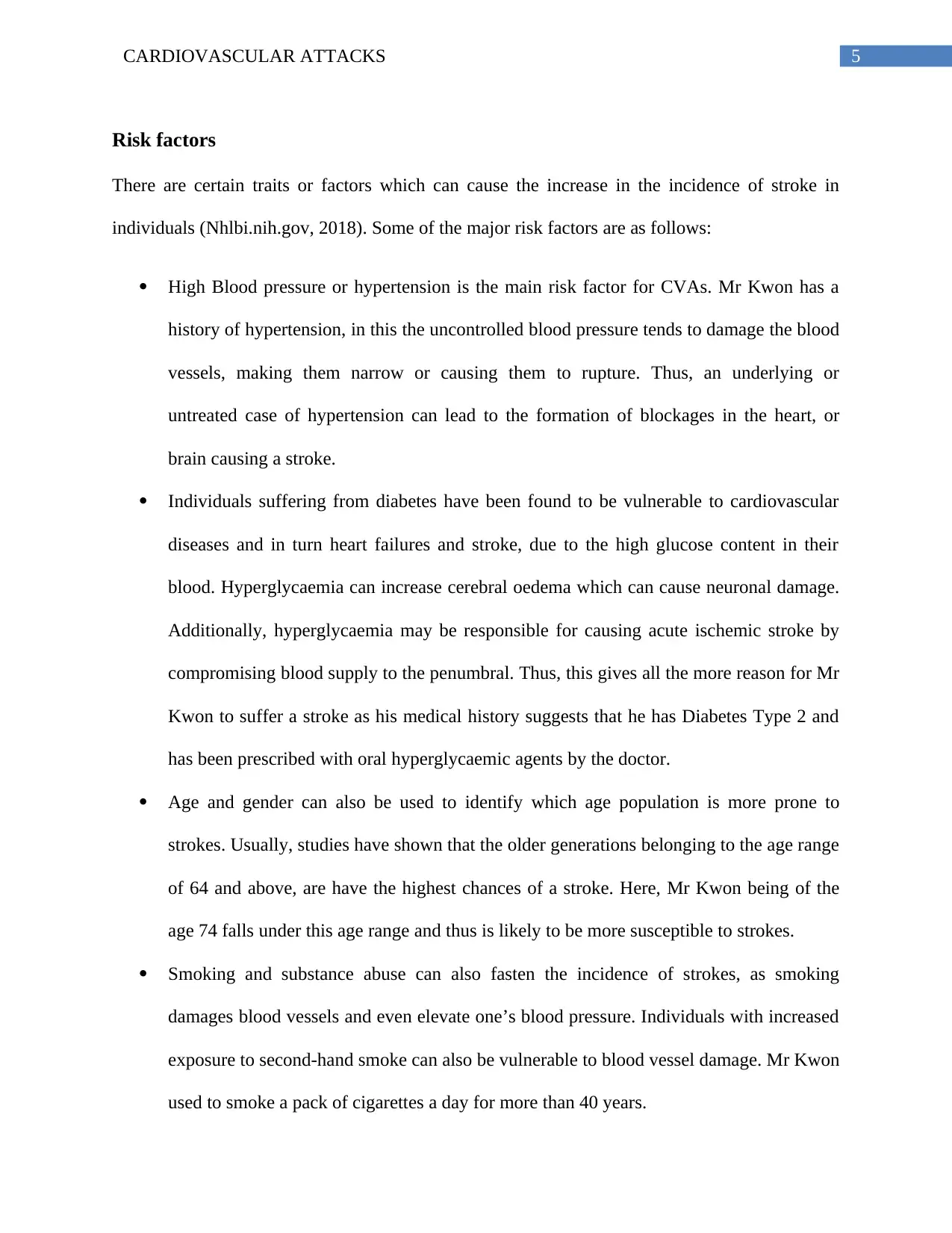
There are certain traits or factors which can cause the increase in the incidence of stroke in
individuals (Nhlbi.nih.gov, 2018). Some of the major risk factors are as follows:
High Blood pressure or hypertension is the main risk factor for CVAs. Mr Kwon has a
history of hypertension, in this the uncontrolled blood pressure tends to damage the blood
vessels, making them narrow or causing them to rupture. Thus, an underlying or
untreated case of hypertension can lead to the formation of blockages in the heart, or
brain causing a stroke.
Individuals suffering from diabetes have been found to be vulnerable to cardiovascular
diseases and in turn heart failures and stroke, due to the high glucose content in their
blood. Hyperglycaemia can increase cerebral oedema which can cause neuronal damage.
Additionally, hyperglycaemia may be responsible for causing acute ischemic stroke by
compromising blood supply to the penumbral. Thus, this gives all the more reason for Mr
Kwon to suffer a stroke as his medical history suggests that he has Diabetes Type 2 and
has been prescribed with oral hyperglycaemic agents by the doctor.
Age and gender can also be used to identify which age population is more prone to
strokes. Usually, studies have shown that the older generations belonging to the age range
of 64 and above, are have the highest chances of a stroke. Here, Mr Kwon being of the
age 74 falls under this age range and thus is likely to be more susceptible to strokes.
Smoking and substance abuse can also fasten the incidence of strokes, as smoking
damages blood vessels and even elevate one’s blood pressure. Individuals with increased
exposure to second-hand smoke can also be vulnerable to blood vessel damage. Mr Kwon
used to smoke a pack of cigarettes a day for more than 40 years.
Risk factors
There are certain traits or factors which can cause the increase in the incidence of stroke in
individuals (Nhlbi.nih.gov, 2018). Some of the major risk factors are as follows:
High Blood pressure or hypertension is the main risk factor for CVAs. Mr Kwon has a
history of hypertension, in this the uncontrolled blood pressure tends to damage the blood
vessels, making them narrow or causing them to rupture. Thus, an underlying or
untreated case of hypertension can lead to the formation of blockages in the heart, or
brain causing a stroke.
Individuals suffering from diabetes have been found to be vulnerable to cardiovascular
diseases and in turn heart failures and stroke, due to the high glucose content in their
blood. Hyperglycaemia can increase cerebral oedema which can cause neuronal damage.
Additionally, hyperglycaemia may be responsible for causing acute ischemic stroke by
compromising blood supply to the penumbral. Thus, this gives all the more reason for Mr
Kwon to suffer a stroke as his medical history suggests that he has Diabetes Type 2 and
has been prescribed with oral hyperglycaemic agents by the doctor.
Age and gender can also be used to identify which age population is more prone to
strokes. Usually, studies have shown that the older generations belonging to the age range
of 64 and above, are have the highest chances of a stroke. Here, Mr Kwon being of the
age 74 falls under this age range and thus is likely to be more susceptible to strokes.
Smoking and substance abuse can also fasten the incidence of strokes, as smoking
damages blood vessels and even elevate one’s blood pressure. Individuals with increased
exposure to second-hand smoke can also be vulnerable to blood vessel damage. Mr Kwon
used to smoke a pack of cigarettes a day for more than 40 years.
⊘ This is a preview!⊘
Do you want full access?
Subscribe today to unlock all pages.
Trusted by 1+ million students worldwide
6CARDIOVASCULAR ATTACKS
Individuals having family or personal history of stroke have a higher chance of
contracting heart diseases and are greatly prone to congestive heart failures and strokes.
According to the case study, Mr Kwon has suffered from a congestive heart failure in the
past, thus making him further susceptible to a stroke (Nhlbi.nih.gov, 2018).
Neurological, Sensory and Motor Assessment
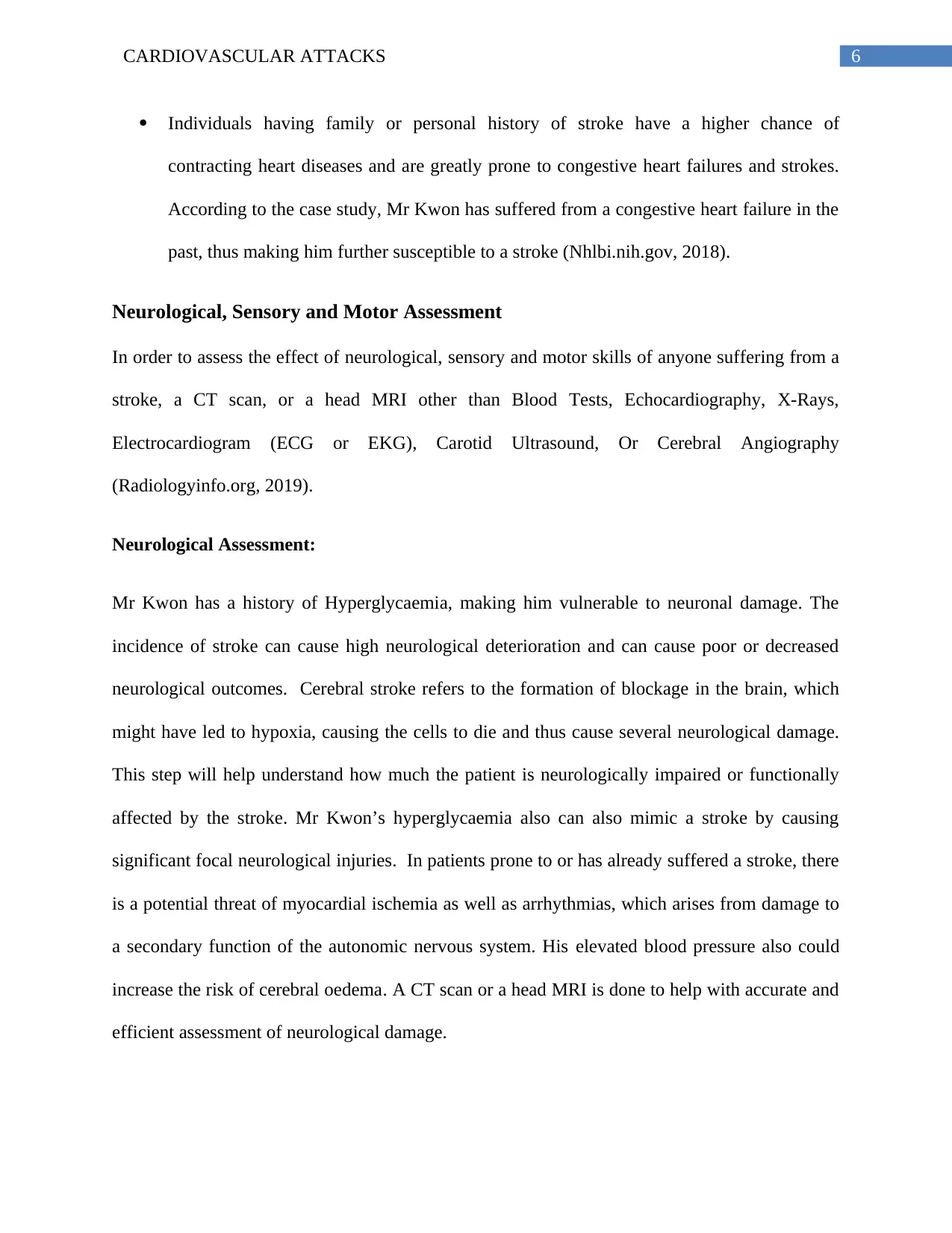
In order to assess the effect of neurological, sensory and motor skills of anyone suffering from a
stroke, a CT scan, or a head MRI other than Blood Tests, Echocardiography, X-Rays,
Electrocardiogram (ECG or EKG), Carotid Ultrasound, Or Cerebral Angiography
(Radiologyinfo.org, 2019).
Neurological Assessment:
Mr Kwon has a history of Hyperglycaemia, making him vulnerable to neuronal damage. The
incidence of stroke can cause high neurological deterioration and can cause poor or decreased
neurological outcomes. Cerebral stroke refers to the formation of blockage in the brain, which
might have led to hypoxia, causing the cells to die and thus cause several neurological damage.
This step will help understand how much the patient is neurologically impaired or functionally
affected by the stroke. Mr Kwon’s hyperglycaemia also can also mimic a stroke by causing
significant focal neurological injuries. In patients prone to or has already suffered a stroke, there
is a potential threat of myocardial ischemia as well as arrhythmias, which arises from damage to
a secondary function of the autonomic nervous system. His elevated blood pressure also could
increase the risk of cerebral oedema. A CT scan or a head MRI is done to help with accurate and
efficient assessment of neurological damage.
Individuals having family or personal history of stroke have a higher chance of
contracting heart diseases and are greatly prone to congestive heart failures and strokes.
According to the case study, Mr Kwon has suffered from a congestive heart failure in the
past, thus making him further susceptible to a stroke (Nhlbi.nih.gov, 2018).
Neurological, Sensory and Motor Assessment
In order to assess the effect of neurological, sensory and motor skills of anyone suffering from a
stroke, a CT scan, or a head MRI other than Blood Tests, Echocardiography, X-Rays,
Electrocardiogram (ECG or EKG), Carotid Ultrasound, Or Cerebral Angiography
(Radiologyinfo.org, 2019).
Neurological Assessment:
Mr Kwon has a history of Hyperglycaemia, making him vulnerable to neuronal damage. The
incidence of stroke can cause high neurological deterioration and can cause poor or decreased
neurological outcomes. Cerebral stroke refers to the formation of blockage in the brain, which
might have led to hypoxia, causing the cells to die and thus cause several neurological damage.
This step will help understand how much the patient is neurologically impaired or functionally
affected by the stroke. Mr Kwon’s hyperglycaemia also can also mimic a stroke by causing
significant focal neurological injuries. In patients prone to or has already suffered a stroke, there
is a potential threat of myocardial ischemia as well as arrhythmias, which arises from damage to
a secondary function of the autonomic nervous system. His elevated blood pressure also could
increase the risk of cerebral oedema. A CT scan or a head MRI is done to help with accurate and
efficient assessment of neurological damage.
Paraphrase This Document
Need a fresh take? Get an instant paraphrase of this document with our AI Paraphraser
7CARDIOVASCULAR ATTACKS
Sensory Assessment:
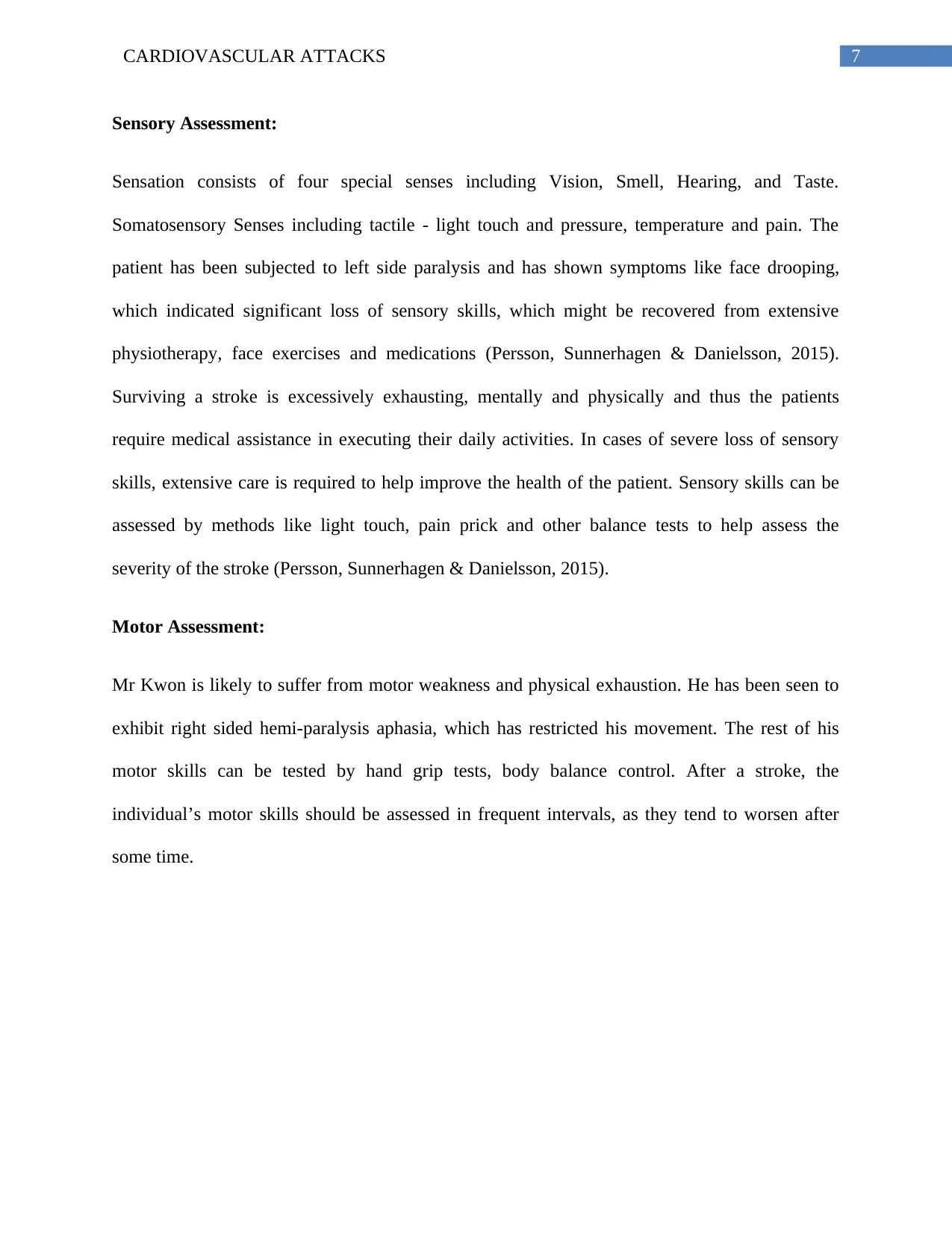
Sensation consists of four special senses including Vision, Smell, Hearing, and Taste.
Somatosensory Senses including tactile - light touch and pressure, temperature and pain. The
patient has been subjected to left side paralysis and has shown symptoms like face drooping,
which indicated significant loss of sensory skills, which might be recovered from extensive
physiotherapy, face exercises and medications (Persson, Sunnerhagen & Danielsson, 2015).
Surviving a stroke is excessively exhausting, mentally and physically and thus the patients
require medical assistance in executing their daily activities. In cases of severe loss of sensory
skills, extensive care is required to help improve the health of the patient. Sensory skills can be
assessed by methods like light touch, pain prick and other balance tests to help assess the
severity of the stroke (Persson, Sunnerhagen & Danielsson, 2015).
Motor Assessment:
Mr Kwon is likely to suffer from motor weakness and physical exhaustion. He has been seen to
exhibit right sided hemi-paralysis aphasia, which has restricted his movement. The rest of his
motor skills can be tested by hand grip tests, body balance control. After a stroke, the
individual’s motor skills should be assessed in frequent intervals, as they tend to worsen after
some time.
Sensory Assessment:
Sensation consists of four special senses including Vision, Smell, Hearing, and Taste.
Somatosensory Senses including tactile - light touch and pressure, temperature and pain. The
patient has been subjected to left side paralysis and has shown symptoms like face drooping,
which indicated significant loss of sensory skills, which might be recovered from extensive
physiotherapy, face exercises and medications (Persson, Sunnerhagen & Danielsson, 2015).
Surviving a stroke is excessively exhausting, mentally and physically and thus the patients
require medical assistance in executing their daily activities. In cases of severe loss of sensory
skills, extensive care is required to help improve the health of the patient. Sensory skills can be
assessed by methods like light touch, pain prick and other balance tests to help assess the
severity of the stroke (Persson, Sunnerhagen & Danielsson, 2015).
Motor Assessment:
Mr Kwon is likely to suffer from motor weakness and physical exhaustion. He has been seen to
exhibit right sided hemi-paralysis aphasia, which has restricted his movement. The rest of his
motor skills can be tested by hand grip tests, body balance control. After a stroke, the
individual’s motor skills should be assessed in frequent intervals, as they tend to worsen after
some time.
8CARDIOVASCULAR ATTACKS
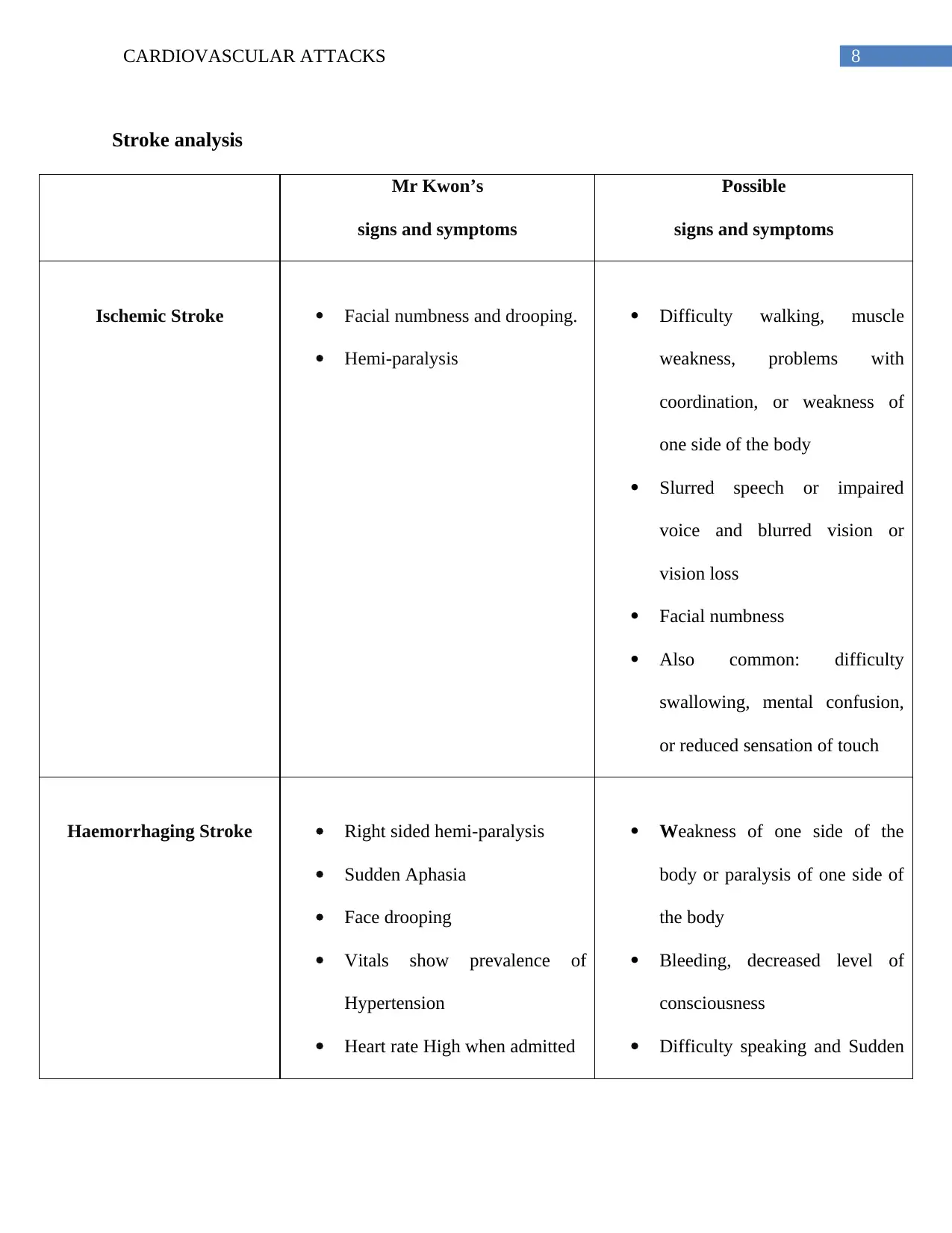
Stroke analysis
Mr Kwon’s
signs and symptoms
Possible
signs and symptoms
Ischemic Stroke Facial numbness and drooping.
Hemi-paralysis
Difficulty walking, muscle
weakness, problems with
coordination, or weakness of
one side of the body
Slurred speech or impaired
voice and blurred vision or
vision loss
Facial numbness
Also common: difficulty
swallowing, mental confusion,
or reduced sensation of touch
Haemorrhaging Stroke Right sided hemi-paralysis
Sudden Aphasia
Face drooping
Vitals show prevalence of
Hypertension
Heart rate High when admitted
Weakness of one side of the
body or paralysis of one side of
the body
Bleeding, decreased level of
consciousness
Difficulty speaking and Sudden
Stroke analysis
Mr Kwon’s
signs and symptoms
Possible
signs and symptoms
Ischemic Stroke Facial numbness and drooping.
Hemi-paralysis
Difficulty walking, muscle
weakness, problems with
coordination, or weakness of
one side of the body
Slurred speech or impaired
voice and blurred vision or
vision loss
Facial numbness
Also common: difficulty
swallowing, mental confusion,
or reduced sensation of touch
Haemorrhaging Stroke Right sided hemi-paralysis
Sudden Aphasia
Face drooping
Vitals show prevalence of
Hypertension
Heart rate High when admitted
Weakness of one side of the
body or paralysis of one side of
the body
Bleeding, decreased level of
consciousness
Difficulty speaking and Sudden
⊘ This is a preview!⊘
Do you want full access?
Subscribe today to unlock all pages.
Trusted by 1+ million students worldwide
9CARDIOVASCULAR ATTACKS
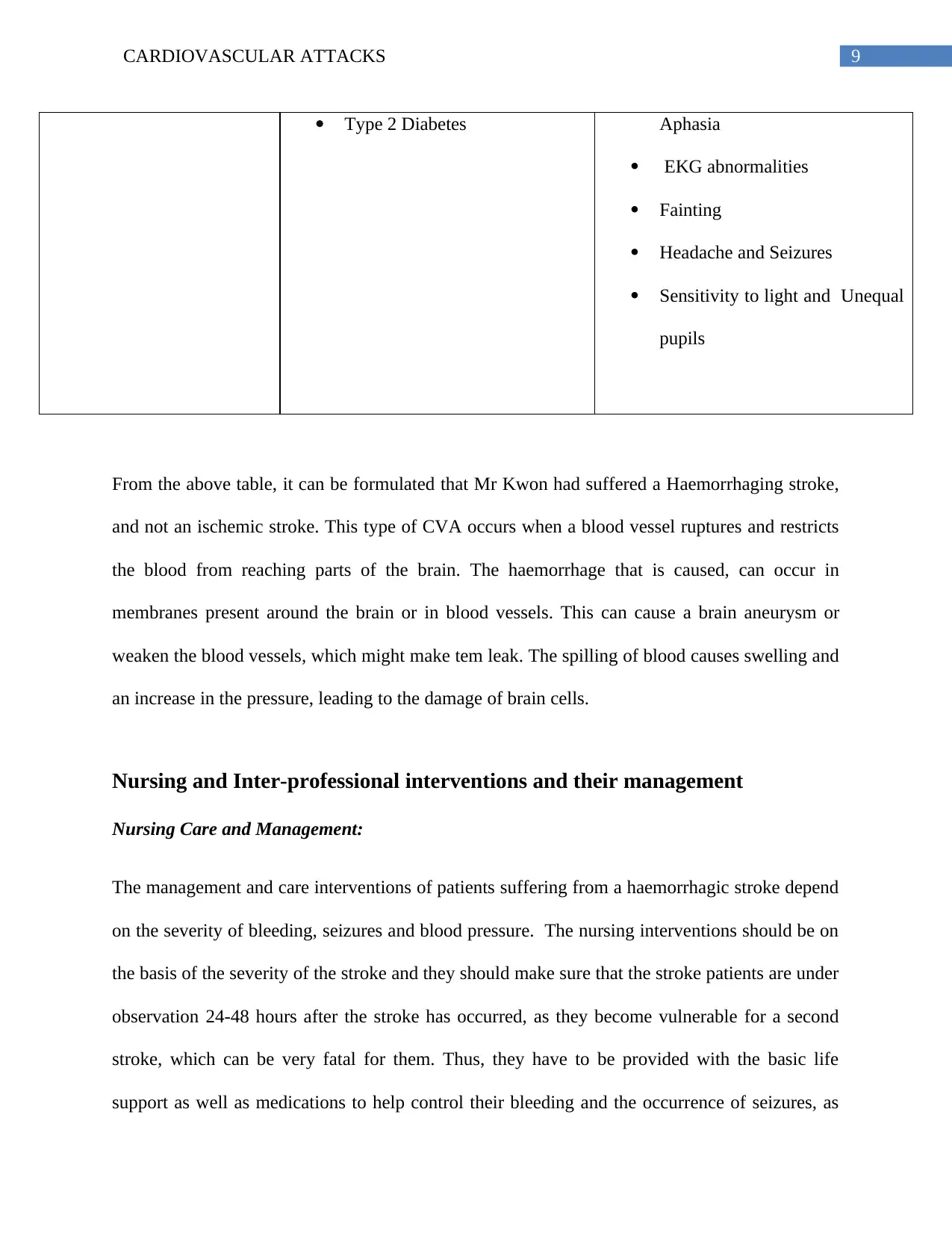
Type 2 Diabetes Aphasia
EKG abnormalities
Fainting
Headache and Seizures
Sensitivity to light and Unequal
pupils
From the above table, it can be formulated that Mr Kwon had suffered a Haemorrhaging stroke,
and not an ischemic stroke. This type of CVA occurs when a blood vessel ruptures and restricts
the blood from reaching parts of the brain. The haemorrhage that is caused, can occur in
membranes present around the brain or in blood vessels. This can cause a brain aneurysm or
weaken the blood vessels, which might make tem leak. The spilling of blood causes swelling and
an increase in the pressure, leading to the damage of brain cells.
Nursing and Inter-professional interventions and their management
Nursing Care and Management:
The management and care interventions of patients suffering from a haemorrhagic stroke depend
on the severity of bleeding, seizures and blood pressure. The nursing interventions should be on
the basis of the severity of the stroke and they should make sure that the stroke patients are under
observation 24-48 hours after the stroke has occurred, as they become vulnerable for a second
stroke, which can be very fatal for them. Thus, they have to be provided with the basic life
support as well as medications to help control their bleeding and the occurrence of seizures, as
Type 2 Diabetes Aphasia
EKG abnormalities
Fainting
Headache and Seizures
Sensitivity to light and Unequal
pupils
From the above table, it can be formulated that Mr Kwon had suffered a Haemorrhaging stroke,
and not an ischemic stroke. This type of CVA occurs when a blood vessel ruptures and restricts
the blood from reaching parts of the brain. The haemorrhage that is caused, can occur in
membranes present around the brain or in blood vessels. This can cause a brain aneurysm or
weaken the blood vessels, which might make tem leak. The spilling of blood causes swelling and
an increase in the pressure, leading to the damage of brain cells.
Nursing and Inter-professional interventions and their management
Nursing Care and Management:
The management and care interventions of patients suffering from a haemorrhagic stroke depend
on the severity of bleeding, seizures and blood pressure. The nursing interventions should be on
the basis of the severity of the stroke and they should make sure that the stroke patients are under
observation 24-48 hours after the stroke has occurred, as they become vulnerable for a second
stroke, which can be very fatal for them. Thus, they have to be provided with the basic life
support as well as medications to help control their bleeding and the occurrence of seizures, as
Paraphrase This Document
Need a fresh take? Get an instant paraphrase of this document with our AI Paraphraser
10CARDIOVASCULAR ATTACKS
well as hypertension. Thus, they are often prescribed Anticonvulsants, Antihypertensive agents
and osmotic diuretics. The management of vital signs is one of the most important interventions
which can help in the immediate relief of the patient. Another important intervention that nurses
can implement is to raise awareness about the common risk factors of stroke.
Inter-professional interventions and Management:
Some main types of Inter-professional interventions include collaborative teams each
specialising on pulmonary, cardio-vascular, and neurological care. It is crucial to effectively
work in teams to help provide relief to the patient, by effectively implementing different
interventions to reduce hypertension, and provide extensive neurological care to the patients
(Santschi et al., 2017).
Thus to manage these interventions and provide immediate assistance, they are to work
collaboratively and efficiently. More funding for organising awareness programs discussing
about stroke, for building better rehabilitation facilities for stroke patients, for organising
exercise equipment to help them gain their physical skills and help control weight in obese stroke
patients.
well as hypertension. Thus, they are often prescribed Anticonvulsants, Antihypertensive agents
and osmotic diuretics. The management of vital signs is one of the most important interventions
which can help in the immediate relief of the patient. Another important intervention that nurses
can implement is to raise awareness about the common risk factors of stroke.
Inter-professional interventions and Management:
Some main types of Inter-professional interventions include collaborative teams each
specialising on pulmonary, cardio-vascular, and neurological care. It is crucial to effectively
work in teams to help provide relief to the patient, by effectively implementing different
interventions to reduce hypertension, and provide extensive neurological care to the patients
(Santschi et al., 2017).
Thus to manage these interventions and provide immediate assistance, they are to work
collaboratively and efficiently. More funding for organising awareness programs discussing
about stroke, for building better rehabilitation facilities for stroke patients, for organising
exercise equipment to help them gain their physical skills and help control weight in obese stroke
patients.
11CARDIOVASCULAR ATTACKS
References
AIHW. (2018). Cardiovascular disease snapshot, How many Australians have cardiovascular
disease? - Australian Institute of Health and Welfare. Australian Institute of Health and
Welfare. Retrieved from:
https://www.aihw.gov.au/reports/heart-stroke-vascular-disease/cardiovascular-health-
compendium/contents/how-many-australians-have-cardiovascular-disease
Benjamin, E., Virani, S., Callaway, C., Chamberlain, A., Chang, A., Cheng, S., & Chiuve, S. et al.
(2018). Heart Disease and Stroke Statistics—2018 Update: A Report From the American
Heart Association. Circulation, 137(12). doi:10.1161/cir.0000000000000558
Cdc.gov. (2019). Stroke Facts | cdc.gov. Cdc.gov. Retrieved from:
https://www.cdc.gov/stroke/facts.htm
Nhlbi.nih.gov. (2018). Stroke | National Heart, Lung, and Blood Institute (NHLBI). Nhlbi.nih.gov.
Retrieved from: https://www.nhlbi.nih.gov/health-topics/stroke
Persson, H., Sunnerhagen, K., & Danielsson, A. (2015). Motor function in ischemic and hemorrhagic
stroke during the first year. Physiotherapy, 101, e1199-e1200.
doi:10.1016/j.physio.2015.03.2126
Radiologyinfo.org. (2019). Stroke - Diagnosis, Evaluation and Treatment. Radiologyinfo.org.
Retrieved from: https://www.radiologyinfo.org/en/info.cfm?pg=stroke
Santschi, V., Wuerzner, G., Chiolero, A., Burnand, B., Schaller, P., Cloutier, L., & Paradis, G. et al.
(2017). Team-based care for improving hypertension management among outpatients (TBC-
References
AIHW. (2018). Cardiovascular disease snapshot, How many Australians have cardiovascular
disease? - Australian Institute of Health and Welfare. Australian Institute of Health and
Welfare. Retrieved from:
https://www.aihw.gov.au/reports/heart-stroke-vascular-disease/cardiovascular-health-
compendium/contents/how-many-australians-have-cardiovascular-disease
Benjamin, E., Virani, S., Callaway, C., Chamberlain, A., Chang, A., Cheng, S., & Chiuve, S. et al.
(2018). Heart Disease and Stroke Statistics—2018 Update: A Report From the American
Heart Association. Circulation, 137(12). doi:10.1161/cir.0000000000000558
Cdc.gov. (2019). Stroke Facts | cdc.gov. Cdc.gov. Retrieved from:
https://www.cdc.gov/stroke/facts.htm
Nhlbi.nih.gov. (2018). Stroke | National Heart, Lung, and Blood Institute (NHLBI). Nhlbi.nih.gov.
Retrieved from: https://www.nhlbi.nih.gov/health-topics/stroke
Persson, H., Sunnerhagen, K., & Danielsson, A. (2015). Motor function in ischemic and hemorrhagic
stroke during the first year. Physiotherapy, 101, e1199-e1200.
doi:10.1016/j.physio.2015.03.2126
Radiologyinfo.org. (2019). Stroke - Diagnosis, Evaluation and Treatment. Radiologyinfo.org.
Retrieved from: https://www.radiologyinfo.org/en/info.cfm?pg=stroke
Santschi, V., Wuerzner, G., Chiolero, A., Burnand, B., Schaller, P., Cloutier, L., & Paradis, G. et al.
(2017). Team-based care for improving hypertension management among outpatients (TBC-
⊘ This is a preview!⊘
Do you want full access?
Subscribe today to unlock all pages.
Trusted by 1+ million students worldwide

1 out of 13


Related Documents


Your All-in-One AI-Powered Toolkit for Academic Success.
+13062052269
info@desklib.com
Available 24*7 on WhatsApp / Email
![[object Object]](/_next/static/media/star-bottom.7253800d.svg)
Unlock your academic potential
Copyright © 2020–2026 A2Z Services. All Rights Reserved. Developed and managed by ZUCOL.