CNA 540: Cardiovascular Nursing ECG Summary and Analysis Report

Verified

Added on  2023/02/01

|7
|971
|33
Report
AI Summary
This report presents a summary of two ECG analyses. The first ECG reveals a regular rhythm with 75 beats per minute, indicating a right bundle branch block (RBBB), characterized by an increased QRS duration. The second ECG shows a ventricle rate of 40 beats per minute and an atrial rate of 70 beats per minute, indicative of a second-degree heart block, specifically Mobitz type 1, potentially progressing to complete heart block. The analysis includes discussions on the interpretation of ECG findings, such as the presence of RSR wave in V1, the significance of QRS complex and P wave, and the importance of considering old ECG reports. The report also highlights the nursing implications, including the need for continuous cardiac monitoring, assessment of symptoms, and collaboration with doctors for treatment plans. Additionally, the report references relevant literature to support the interpretations and conclusions drawn from the ECG analyses, including discussions on left axis deviation and the need for atropine in certain cases.
Document Page
ECG SUMMARY
1
tabler-icon-diamond-filled.svg

Paraphrase This Document

Need a fresh take? Get an instant paraphrase of this document with our AI Paraphraser
Document Page
Table of Contents
Summary of ECG 1.........................................................................................................................3
Summary of ECG 2.........................................................................................................................3
Reference list...................................................................................................................................5
Appendices......................................................................................................................................6
2
Document Page
Summary of ECG 1
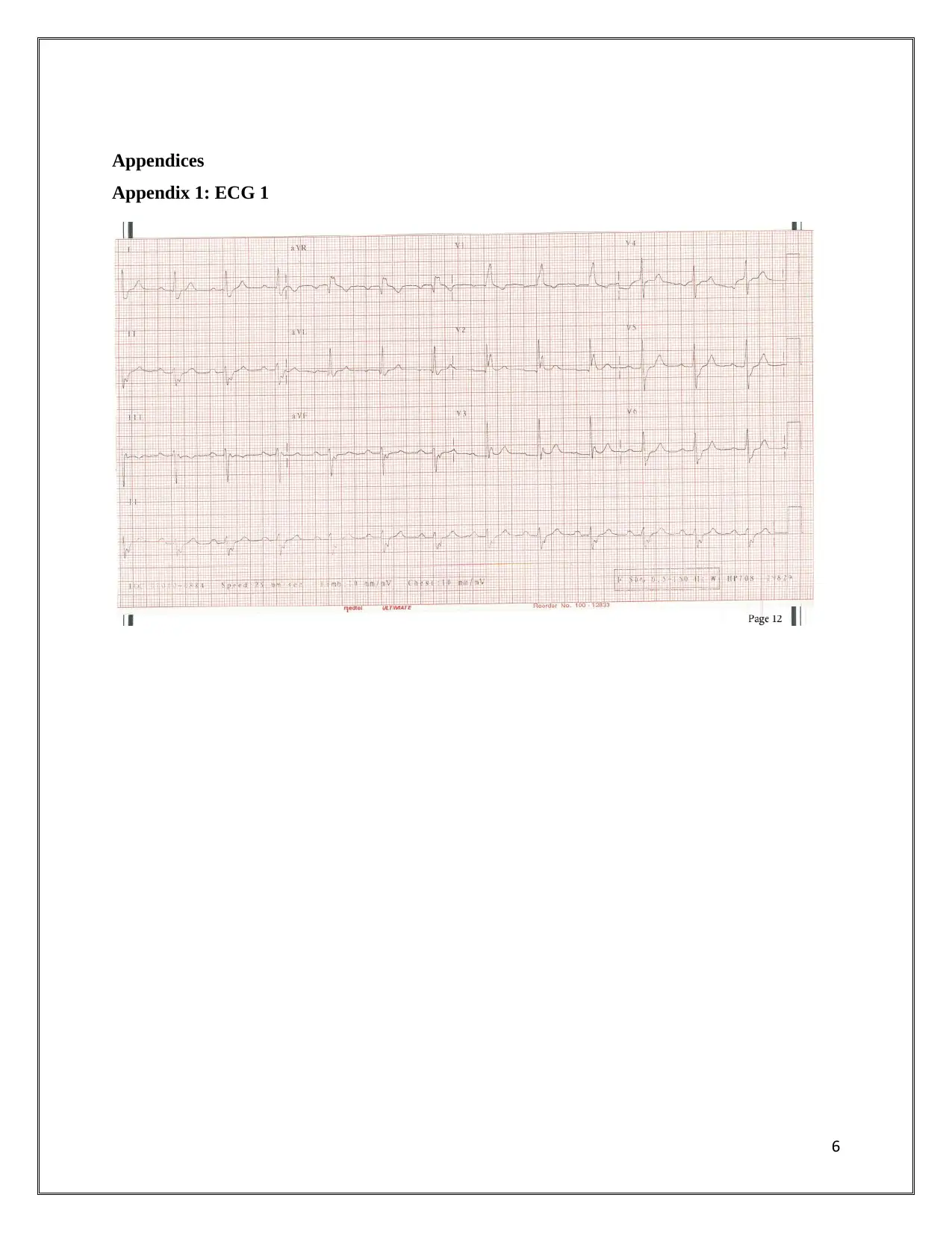
In case of First ECG, I have found 75 beats per minutes and regular rhythm. I have learned that
QRS complex and P wave are measured in order to evaluate condition of heart rate. I understand
by this course that presence of RSR wave within V1 indicates duration of QRS and the right
ventricle have been increased. I think, it can be stated that underlying congenital diseases,
hypertrophy of right ventricles and normal variants are the cause of depolarization in the left
side. I have learned that this kind of interpretation of ECG report states that the person has
medical issue regarding right bundle brunch block (RBBB). As suggested by Regueiro et al.
(2016), QRS duration must be increased by 100 ms and it needs to be prolonged within the S
wave. [Referred to Appendix 1]
These courses have made me understand that invasive management is required in case of
presence of block in artery like this case. Several processes are there those can be used in
management of RBBB. From the discussion, I have understood that rate of ventricle and artery
needs to be measured as well as evaluated separately. It may be difficult for me to maintain
normal electric flow within heart of patient (Heldeweg et al. 2016). On another hand, the group
discussion has made me realize that I need to evaluate whether the issue of blocking is chronic or
acute. Management of RBBB includes comparing. I have understood that old ECG reports are
useful resources that can help me to evaluate new reports of ECG. From this course, I have
learned that I need to refer this kind of patient to the department of cardiac outpatient.
Summary of ECG 2
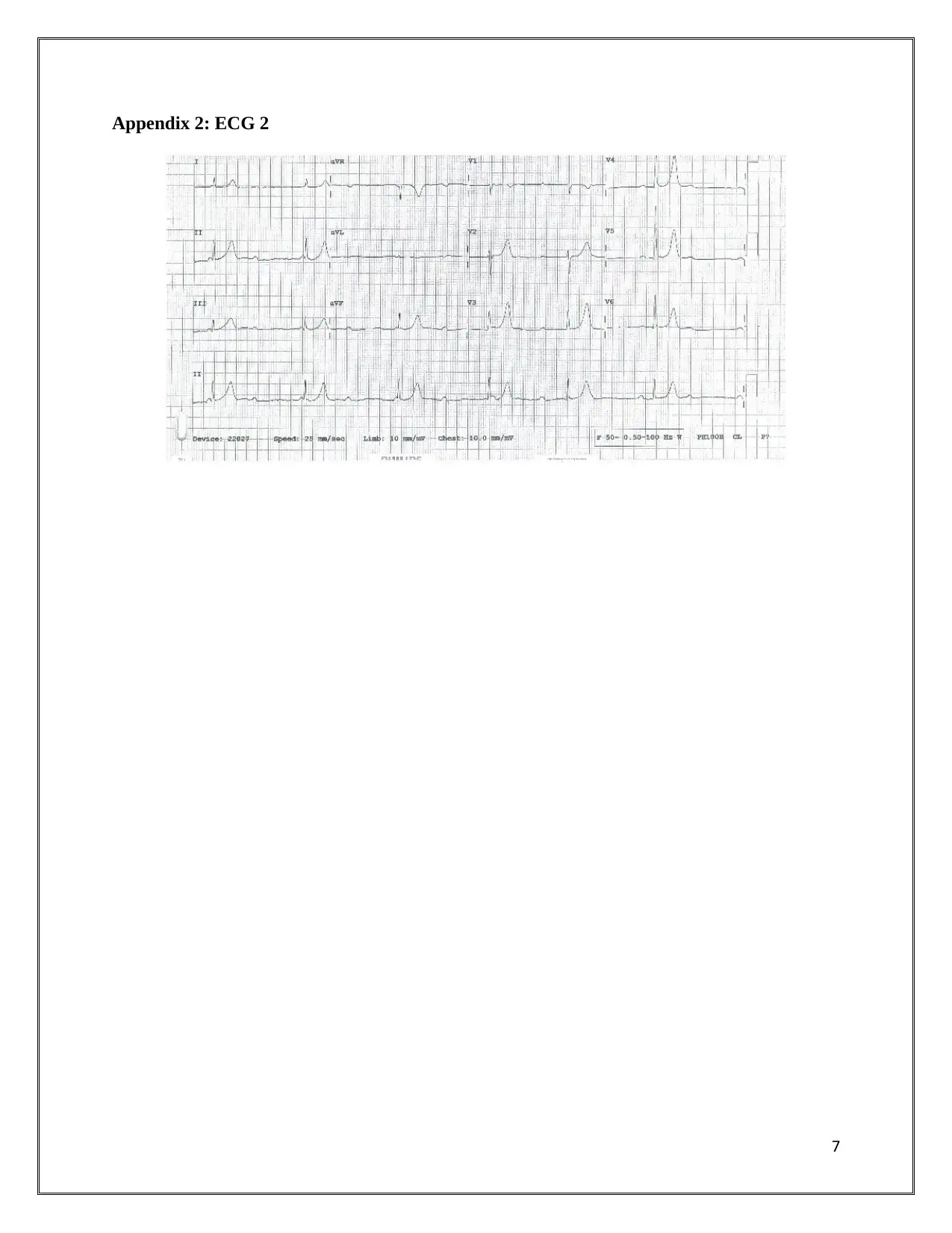
In this case, ventricle and article rates have been measured separately. I have found that
Ventricle rate is 40 beats per minutes and artery rate is 70 beats/ minute. I have learned that
Consideration of R wave and intervals of r wave helps to understand regular rhythm. P wave has
been spotted to QRS complex. Missing heart beat is observed with normal QRS. Abnormality of
this ECG is indicating that this person has a 2nd degree heart block, which is also known as type 1
Mobiltz. This course has helped me to understand that these abnormalities of heart rate refer to
the diseases caused type 1 Mobiltz. [Referred to Appendix 2]
3
Document Page
I have understood that it is a clear case of complete heart block. I have learned that if the patient
is not symptomatic, it is important for me to refer this patient to the department of cardiology
outpatient. Patient with type 1 Mobilz often suffers from dizziness and syncope (Sánchez et al.
2018). I have learned that nurses are required to diagnose symptoms with care. I have understood
that this being a nurse, it is my responsibility to compare ECG report with old reports to identify
potential issues. This kind of case must be escalated with Doctors as we are nurses and we are
not able to make treatment plan for RBBB. As per my learning from this course, patients with
myocardial ischemia need to intake atropine. It is important to check whether identified issue is
acute or chronic (Toggweiler et al. 2016). I have learned that this kind of disorder in heart can
damage the structure of AV node or not. I am feeling enriched with knowledge regarding
management of heart blockage and this aspect will help me to perform better.
4
tabler-icon-diamond-filled.svg

Paraphrase This Document

Need a fresh take? Get an instant paraphrase of this document with our AI Paraphraser
Document Page
Reference list
Heldeweg, M.L.A., Liu, N., Koh, Z.X., Fook-Chong, S., Lye, W.K., Harms, M. and Ong,
M.E.H., 2016. A novel cardiovascular risk stratification model incorporating ECG and heart rate
variability for patients presenting to the emergency department with chest pain. Critical
Care, 20(1), p.179.
Regueiro, A., Abdul-Jawad Altisent, O., Del Trigo, M., Campelo-Parada, F., Puri, R., Urena, M.,
Philippon, F. and Rodés-Cabau, J., 2016. Impact of new-onset left bundle branch block and
periprocedural permanent pacemaker implantation on clinical outcomes in patients undergoing
transcatheter aortic valve replacement: a systematic review and meta-analysis. Circulation:
Cardiovascular Interventions, 9(5), p.e003635.
Sánchez, C., D’Ambrosio, G., Maffessanti, F., Caiani, E.G., Prinzen, F.W., Krause, R.,
Auricchio, A. and Potse, M., 2018. Sensitivity analysis of ventricular activation and
electrocardiogram in tailored models of heart-failure patients. Medical & biological engineering
& computing, 56(3), pp.491-504.
Toggweiler, S., Stortecky, S., Holy, E., Zuk, K., Cuculi, F., Nietlispach, F., Sabti, Z., Suciu, R.,
Maier, W., Jamshidi, P. and Maisano, F., 2016. The electrocardiogram after transcatheter aortic
valve replacement determines the risk for post-procedural high-degree AV block and the need
for telemetry monitoring. JACC: Cardiovascular Interventions, 9(12), pp.1269-1276.
5
Document Page
Appendices
Appendix 1: ECG 1
6
Document Page
Appendix 2: ECG 2
7
chevron_up_icon
1 out of 7
circle_padding
hide_on_mobile
zoom_out_icon
[object Object]