Analysis of Care Coordination Role in Patient Care Delivery Report
VerifiedAdded on 2020/10/22
|11
|3610
|113
Report
AI Summary
This report delves into the critical role of care coordination in the delivery of patient care, analyzing its impact on improving health outcomes and meeting patient requirements. It compares and contrasts patient care experiences and needs in community versus institutional settings, highlighting the importance of shared decision-making, cost-effectiveness, and the effectiveness and safety of care in both environments. The report also examines the significance of referral and data sharing within inter-professional teams, emphasizing the need for effective communication and coordinated efforts to provide optimal patient care. Furthermore, it underscores the importance of regular team meetings for reviewing client cases, planning care, and facilitating improvements in patient health. Finally, the report addresses relevant facilitators and barriers to effective care coordination, providing a comprehensive overview of the topic.
Rehabilitation and Community Care

Paraphrase This Document
Need a fresh take? Get an instant paraphrase of this document with our AI Paraphraser
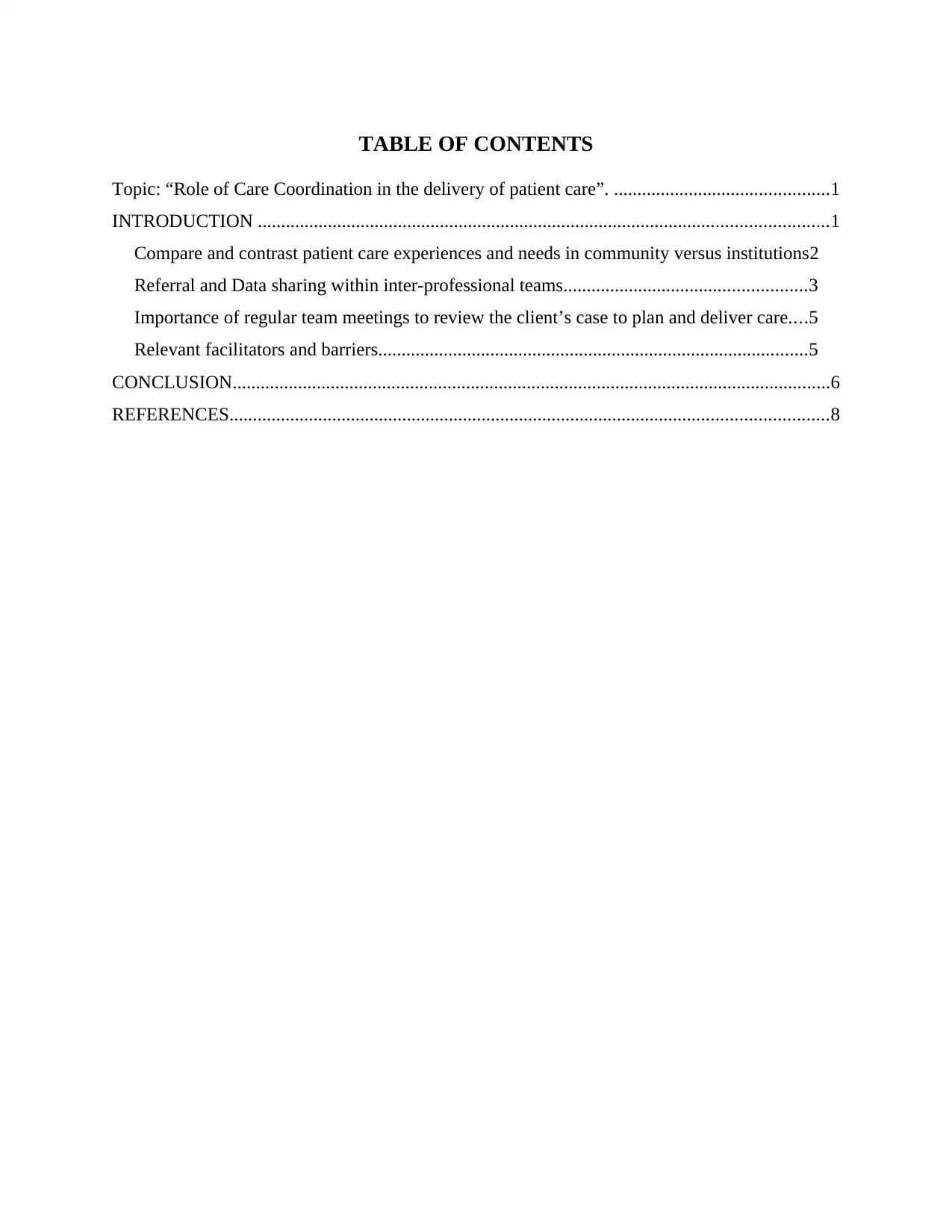
TABLE OF CONTENTS
Topic: “Role of Care Coordination in the delivery of patient care”. ..............................................1
INTRODUCTION ..........................................................................................................................1
Compare and contrast patient care experiences and needs in community versus institutions2
Referral and Data sharing within inter-professional teams....................................................3
Importance of regular team meetings to review the client’s case to plan and deliver care....5
Relevant facilitators and barriers............................................................................................5
CONCLUSION................................................................................................................................6
REFERENCES................................................................................................................................8
Topic: “Role of Care Coordination in the delivery of patient care”. ..............................................1
INTRODUCTION ..........................................................................................................................1
Compare and contrast patient care experiences and needs in community versus institutions2
Referral and Data sharing within inter-professional teams....................................................3
Importance of regular team meetings to review the client’s case to plan and deliver care....5
Relevant facilitators and barriers............................................................................................5
CONCLUSION................................................................................................................................6
REFERENCES................................................................................................................................8
INTRODUCTION
According to Smith, Bates and Bodenheimer (2013), Care coordination refers to a
process of synchronising the delivery of health care to patients from multiple service providers
and medical professionals. The main goal of coordinated care is to enhance and improve health
outcomes. This would help in ensuring that care from service providers should not delivered in
seclusion. Therefore, it is important to manage coordination in care for individuals who are
suffering from chronic disease to enhance delivery of patient care. Care Coordination has been
selected as the most preferred topic for this study as it is a highly intensive driver for delivery of
service making it the point of difference among health and care systems in existing scenario.
This report is going to make critical discussion about role of care coordination in delivery of
patient care. The report will analyse how care coordination would impact on improving health
outcomes and meet requirement of patients.
The key terms used for this purpose are based on research questions and help in acquiring
faster, concise and simplified results based on the main topic of the study. To search regarding
the related topic, sources such as Medline and PubMed have been utilized. These sources provide
a vast data pool for citations, phrases and keywords. Through conducting a search using phrase
“Care Coordination”, PubMed gave back 14563 results along with references and citations. In
addition to this, topic related keyword searches such as “Patient care in society versus
institutions” received 67 results mainly in anti-biotic exposure, cancer treatments and
Myomectomy.
As there was immense amount of data present, the main strategy employed to choose
supportive articles was to customize range, text availability and article types to 2011 to 2018,
Abstract and Review respectively (Standards and Guidelines for Correctional Health Care
Facilities. 2019). This helped in downsizing the search results to 3 from 67 and 1166 from
14563. Since this academic paper is concerned with reviewing existing literature, literary works
such as articles, journals and academic papers of scholars which helped in gathering and
summarising viable information with regard to study topic.
Compare and contrast patient care experiences and needs in community versus institutions
Care coordination is important for providing proper treatment to patients and for
managing healthy and safe care environment. This is essential because positive patient
3
According to Smith, Bates and Bodenheimer (2013), Care coordination refers to a
process of synchronising the delivery of health care to patients from multiple service providers
and medical professionals. The main goal of coordinated care is to enhance and improve health
outcomes. This would help in ensuring that care from service providers should not delivered in
seclusion. Therefore, it is important to manage coordination in care for individuals who are
suffering from chronic disease to enhance delivery of patient care. Care Coordination has been
selected as the most preferred topic for this study as it is a highly intensive driver for delivery of
service making it the point of difference among health and care systems in existing scenario.
This report is going to make critical discussion about role of care coordination in delivery of
patient care. The report will analyse how care coordination would impact on improving health
outcomes and meet requirement of patients.
The key terms used for this purpose are based on research questions and help in acquiring
faster, concise and simplified results based on the main topic of the study. To search regarding
the related topic, sources such as Medline and PubMed have been utilized. These sources provide
a vast data pool for citations, phrases and keywords. Through conducting a search using phrase
“Care Coordination”, PubMed gave back 14563 results along with references and citations. In
addition to this, topic related keyword searches such as “Patient care in society versus
institutions” received 67 results mainly in anti-biotic exposure, cancer treatments and
Myomectomy.
As there was immense amount of data present, the main strategy employed to choose
supportive articles was to customize range, text availability and article types to 2011 to 2018,
Abstract and Review respectively (Standards and Guidelines for Correctional Health Care
Facilities. 2019). This helped in downsizing the search results to 3 from 67 and 1166 from
14563. Since this academic paper is concerned with reviewing existing literature, literary works
such as articles, journals and academic papers of scholars which helped in gathering and
summarising viable information with regard to study topic.
Compare and contrast patient care experiences and needs in community versus institutions
Care coordination is important for providing proper treatment to patients and for
managing healthy and safe care environment. This is essential because positive patient
3
⊘ This is a preview!⊘
Do you want full access?
Subscribe today to unlock all pages.

Trusted by 1+ million students worldwide
experiences are associated with better health results or outcomes. The patient care experience is
the important section in order to measure service quality. According to Wade (2015), the
community care help people in managing high cost medical services which includes personal
care, mobility support, health, housekeeping assistance and required care. Conversely, as
explained by Wysocki and et.al. (2012), institutional care is dependent upon service providers
who manage all things of their patients.
As per the view of Richard (2019) care coordination is the function which aid them in
ensuring about patient's needs and preferences for health services and also share information
among people, functions and sites which are meet in given time period (Hirshon and et.al. 2013).
This is the comparison among institutions and society patients care experiences and its
requirement are described as under:
Shared Decision-making
As per Légaré and et.al. (2014), shared decision-making in healthcare refers to the patient-
centred care based on a treatment plan that is approved by both healthcare provider and the
receiver. It helps in execution of customised work to the patients by investigating each factor of
the manageable alternate to treating them directing to actions between the professional and the
patient. Community-based services is provisional to people of all ages at their comfort of home.
These services include home support, nursing, physiotherapy and other rehabilitation services.
As per the Ball and Miller (2015), community-based health care focuses on patient experience is
lower as these models are less transferable and need more adaptability since not much can be
changed at home unlike in the case of an institutional based healthcare model which are highly
adaptable based on easy availability of equipment’s and specialized carers on call.
Cost effectiveness
The community-based healthcare experience can be analysed on the basis of cost incurred
against attribute of care delivered to the patient (Standards: A framework for quality. 2019).
Since healthcare treatments are premium priced based on their advancements and equipment’s
used, it is highly probable that users incur huge expenditures while opting for such treatment
options. Thus, in the words of Bardsley and et.al. (2013), providing a high-quality based
experience at affordable prices to its users makes all the difference. Thus, cost, experience
derived from the treatment and quality of care are directly dependent on each other. This results
in creation of a more stressful environment for the family of the patient as well as the patient
4
the important section in order to measure service quality. According to Wade (2015), the
community care help people in managing high cost medical services which includes personal
care, mobility support, health, housekeeping assistance and required care. Conversely, as
explained by Wysocki and et.al. (2012), institutional care is dependent upon service providers
who manage all things of their patients.
As per the view of Richard (2019) care coordination is the function which aid them in
ensuring about patient's needs and preferences for health services and also share information
among people, functions and sites which are meet in given time period (Hirshon and et.al. 2013).
This is the comparison among institutions and society patients care experiences and its
requirement are described as under:
Shared Decision-making
As per Légaré and et.al. (2014), shared decision-making in healthcare refers to the patient-
centred care based on a treatment plan that is approved by both healthcare provider and the
receiver. It helps in execution of customised work to the patients by investigating each factor of
the manageable alternate to treating them directing to actions between the professional and the
patient. Community-based services is provisional to people of all ages at their comfort of home.
These services include home support, nursing, physiotherapy and other rehabilitation services.
As per the Ball and Miller (2015), community-based health care focuses on patient experience is
lower as these models are less transferable and need more adaptability since not much can be
changed at home unlike in the case of an institutional based healthcare model which are highly
adaptable based on easy availability of equipment’s and specialized carers on call.
Cost effectiveness
The community-based healthcare experience can be analysed on the basis of cost incurred
against attribute of care delivered to the patient (Standards: A framework for quality. 2019).
Since healthcare treatments are premium priced based on their advancements and equipment’s
used, it is highly probable that users incur huge expenditures while opting for such treatment
options. Thus, in the words of Bardsley and et.al. (2013), providing a high-quality based
experience at affordable prices to its users makes all the difference. Thus, cost, experience
derived from the treatment and quality of care are directly dependent on each other. This results
in creation of a more stressful environment for the family of the patient as well as the patient
4
Paraphrase This Document
Need a fresh take? Get an instant paraphrase of this document with our AI Paraphraser
itself. Community based care is more expensive as compared to its institutional counterparts as
they require appointment of staff to the patient including its daily expenses and maintenance fee
of equipment’s used for patient care.
Effectiveness and Safety of Care
According to Rennke and et.al. (2013), effectiveness and safety of care relates to the extent
of which the healthcare provider was able to meet the expectations of the patient while delivering
his/her services. It is an important measure to consider while analysing differences between
community-based and institutional based healthcare services. These can be identified on the
basis of needs and patient experiences.
Based on the patient experiences it is seen that service seekers find community-based
care more appealing as they are able to be treated in an environment which induces happiness
among them since the place of services provided to them is none other than their homes. This
keeps them near to their family and friends and helps the patients to recover faster as compared
to an institution.
On the other hand, the requirement and needs of a patient are very common when it
comes to a gives attention. Every patient expects high quality of service from their carers. In this
case, Institutions seem to provide better fulfil the needs of patients as they have more than one
specialist looking after them. This is also due to the better control over line of authority in the
institutions that thrust upon the deliverers of healthcare service to conduct their duties
responsibly and justifiably without having any laid-back behaviour towards their patients.
Referral and Data sharing within inter-professional teams
The referral management system is a powerful and unique method which is used by
health providers to keep lead or analyse their patients’ referrals throughout the care continuum
(Supper and et.al., 2015). The main purpose of this is to make proper improvement and
streamline in communication among primary care doctors, specialists and any other health
providers which involved in caring patients.
As mentioned by Reeves and et.al. (2013), sharing data and information is an essential
factor of developing successful team coordination. Care providers are responsible for
maintaining and managing coordination among them which help in delivering necessary services
to the patients. Hence, it is required for a care provider to focus on coordination among team
members which help them in giving proper care and make improvement in health issues.
5
they require appointment of staff to the patient including its daily expenses and maintenance fee
of equipment’s used for patient care.
Effectiveness and Safety of Care
According to Rennke and et.al. (2013), effectiveness and safety of care relates to the extent
of which the healthcare provider was able to meet the expectations of the patient while delivering
his/her services. It is an important measure to consider while analysing differences between
community-based and institutional based healthcare services. These can be identified on the
basis of needs and patient experiences.
Based on the patient experiences it is seen that service seekers find community-based
care more appealing as they are able to be treated in an environment which induces happiness
among them since the place of services provided to them is none other than their homes. This
keeps them near to their family and friends and helps the patients to recover faster as compared
to an institution.
On the other hand, the requirement and needs of a patient are very common when it
comes to a gives attention. Every patient expects high quality of service from their carers. In this
case, Institutions seem to provide better fulfil the needs of patients as they have more than one
specialist looking after them. This is also due to the better control over line of authority in the
institutions that thrust upon the deliverers of healthcare service to conduct their duties
responsibly and justifiably without having any laid-back behaviour towards their patients.
Referral and Data sharing within inter-professional teams
The referral management system is a powerful and unique method which is used by
health providers to keep lead or analyse their patients’ referrals throughout the care continuum
(Supper and et.al., 2015). The main purpose of this is to make proper improvement and
streamline in communication among primary care doctors, specialists and any other health
providers which involved in caring patients.
As mentioned by Reeves and et.al. (2013), sharing data and information is an essential
factor of developing successful team coordination. Care providers are responsible for
maintaining and managing coordination among them which help in delivering necessary services
to the patients. Hence, it is required for a care provider to focus on coordination among team
members which help them in giving proper care and make improvement in health issues.
5
Communication is core element of care coordination in hospital where service provider needs to
make coordination with inter professional team for maintaining and managing patient’s health.
While delivering proper care, they also needed to focus on making and processing
powerful relation with them. According to Bookey‐Bassett and et.al. (2017), this will assist them
in reaching with desired goals and targets effectively. When care providers maintain their
patients records, this data sharing helps in forming a strong communicational base for all the
team members for the patient related to his/her health issues that can be used for analyse their
actual situations. This will help in future references of the patient in case of emergency thus
providing ready information regarding the patient. If they have proper coordination, they can
easily share data elated patient’s health records which are important for care providers for
delivering accurate care.
As mentioned by Chumbler and et. al. (2015), referral management and data sharing
within inter-professional teams is very important as they help in mainlining records regarding
patient history, experience of both providers as well the receiver of services and help in
understanding the prerequisite needs of the patient in future as well as in current scenario. Thus,
it is that activity which assist ensuring about patients’ needs and preferences for health facilities
and information sharing across different people, functions and sites which met in given time
period. Patients and their household experience the common requirement and necessity which
are provided by aid suppliers. According to Slater and et.al. (2012), maintenance of such
procedures is important in the company so as to develop and build coordination among group
members through which they can provide proper care and other important facilities to their
patients.
The current health care system is complex and complicated with regard to communication.
When patients require care so they may communicate with any number of specialists, physicians’
medical assistants and trained professionals if health care providers do not coordinate with each
other so this will dangerous for patients as well as their families. If care providers develop
coordination among team members so they can deliver proper treatment to the patients which
reduces their stress, issues related to health. Referral and data sharing with inter professional
team is helpful in analysing need and requirements of patients which supports positive health
outcome.
6
make coordination with inter professional team for maintaining and managing patient’s health.
While delivering proper care, they also needed to focus on making and processing
powerful relation with them. According to Bookey‐Bassett and et.al. (2017), this will assist them
in reaching with desired goals and targets effectively. When care providers maintain their
patients records, this data sharing helps in forming a strong communicational base for all the
team members for the patient related to his/her health issues that can be used for analyse their
actual situations. This will help in future references of the patient in case of emergency thus
providing ready information regarding the patient. If they have proper coordination, they can
easily share data elated patient’s health records which are important for care providers for
delivering accurate care.
As mentioned by Chumbler and et. al. (2015), referral management and data sharing
within inter-professional teams is very important as they help in mainlining records regarding
patient history, experience of both providers as well the receiver of services and help in
understanding the prerequisite needs of the patient in future as well as in current scenario. Thus,
it is that activity which assist ensuring about patients’ needs and preferences for health facilities
and information sharing across different people, functions and sites which met in given time
period. Patients and their household experience the common requirement and necessity which
are provided by aid suppliers. According to Slater and et.al. (2012), maintenance of such
procedures is important in the company so as to develop and build coordination among group
members through which they can provide proper care and other important facilities to their
patients.
The current health care system is complex and complicated with regard to communication.
When patients require care so they may communicate with any number of specialists, physicians’
medical assistants and trained professionals if health care providers do not coordinate with each
other so this will dangerous for patients as well as their families. If care providers develop
coordination among team members so they can deliver proper treatment to the patients which
reduces their stress, issues related to health. Referral and data sharing with inter professional
team is helpful in analysing need and requirements of patients which supports positive health
outcome.
6
⊘ This is a preview!⊘
Do you want full access?
Subscribe today to unlock all pages.
Trusted by 1+ million students worldwide
Importance of regular team meetings to review the client’s case to plan and deliver care
Challis and et. al. (2018) stress on the fact that care providers must conduct daily meeting
which are helpful in analysing and examining current condition of each and every patient who
are admitted in hospital. Regular team meetings are essential for discuss and analyse patients’
case as per this doctors and service providers deliver care to them. For this, they can easy to
measure and analyse wellbeing condition of each patient and determine chances of change. The
main purpose for conducting team meeting is to analyse and examine the patient’s condition and
discuss plan for make improvement in their health. In the hospital, doctors, nurses and other staff
members are take part in regular team meetings for make discussion regarding current health
issue for the patient. In this meeting, all the employees are making conclusion as per the welfare
of the patient who are suffered from major disease. For this, they are providing them foremost
care which accomplish all needs and requirements of patients and deliver effective services or
facilities.
The regular team meeting help care providers to analyse their patients’ case and make
improvement in this daily schedule. This will help them in delivering end goals to their patients
in correct manner. It is required for hospital staff members while attending meeting they need to
review all patients case and discuss about activity taken which assist in make improvement in
their health condition. According to Connolly and et. al. (2015), inter-professional team meetings
should not be too short and long but it assists in gaining knowledge and information about
patients’ current situation. Along with this, there are different complex case which want to be
discussed in this team meeting and senior doctor required to take appropriate suggestions and
advice to their junior doctors. For this, they can easily analyse and examine their patients’
condition. The main benefit of daily team meeting is that all the doctors and care providers
develop effectual care plan which assist in delivering accurate services and facilities to the end
users.
Relevant facilitators and barriers
Care coordination is the function which assure about patients’ needs and preferences
regarding health services and information sharing among people, sites and functions for met
requirements. It involves obtaining care patients need at the time of controlling costs in order to
reduce unneeded and duplicated facilities effectively. Facilitators and Barriers can be
administration, interpersonal and individual related.
7
Challis and et. al. (2018) stress on the fact that care providers must conduct daily meeting
which are helpful in analysing and examining current condition of each and every patient who
are admitted in hospital. Regular team meetings are essential for discuss and analyse patients’
case as per this doctors and service providers deliver care to them. For this, they can easy to
measure and analyse wellbeing condition of each patient and determine chances of change. The
main purpose for conducting team meeting is to analyse and examine the patient’s condition and
discuss plan for make improvement in their health. In the hospital, doctors, nurses and other staff
members are take part in regular team meetings for make discussion regarding current health
issue for the patient. In this meeting, all the employees are making conclusion as per the welfare
of the patient who are suffered from major disease. For this, they are providing them foremost
care which accomplish all needs and requirements of patients and deliver effective services or
facilities.
The regular team meeting help care providers to analyse their patients’ case and make
improvement in this daily schedule. This will help them in delivering end goals to their patients
in correct manner. It is required for hospital staff members while attending meeting they need to
review all patients case and discuss about activity taken which assist in make improvement in
their health condition. According to Connolly and et. al. (2015), inter-professional team meetings
should not be too short and long but it assists in gaining knowledge and information about
patients’ current situation. Along with this, there are different complex case which want to be
discussed in this team meeting and senior doctor required to take appropriate suggestions and
advice to their junior doctors. For this, they can easily analyse and examine their patients’
condition. The main benefit of daily team meeting is that all the doctors and care providers
develop effectual care plan which assist in delivering accurate services and facilities to the end
users.
Relevant facilitators and barriers
Care coordination is the function which assure about patients’ needs and preferences
regarding health services and information sharing among people, sites and functions for met
requirements. It involves obtaining care patients need at the time of controlling costs in order to
reduce unneeded and duplicated facilities effectively. Facilitators and Barriers can be
administration, interpersonal and individual related.
7
Paraphrase This Document
Need a fresh take? Get an instant paraphrase of this document with our AI Paraphraser
Facilitators of care coordination:
It is required for care providers is to focus on patient’s health and safety factors which
help them to meet with accurate outcomes. Connolly and et. al. (2015) state that the main
facilitators to care coordination have been observed to include practicality of technology used to
obtain medical information from databases, easier accessibility to community resources and
other healthcare facilities. For this, service providers can easily treat their patients by using
effective methods and techniques that help in providing self-care for mental health patents as
well as wellness for them. In holistic care, care provider treats the whole person, body, mind and
spirit. Apart from these, collectivity of services provided to two or more groups dealing with
similar issues as well as complete integration of such services into practices were held to play a
larger role in facilitation. The way of caring people for managing their needs and requirements in
proper manner. The main assistant of care skilfulness are that they are precede relationship-based
care in which create and keep powerful and loyal relationship with their patients. This will assist
in building relation among providers as well as patients in proper manner. If they are developed
trust and relationship with their patients so they can easily analyse health issue which are faced
by service users.
Barriers to care coordination:
There are various barriers of care coordination which create problem while serving and
delivering care to their patients. The main obstruction happen due to shortfall of healthcare
suppliers who are render services or facilities to the patients in correct way. Vaughn and et. Al,
(2016) explain that excess amount of cases and ineffectiveness in implementing data
management responsibilities create substantial barriers to care coordination leading to
mismanagement and degrading of care quality. Sometime there are limited access to speciality
services and providers in order to given required care to the people. There are some unskilled
and unqualified staff members who are not able to deliver proper health care facilities to their
patients. Hence, it is important for an organisation to follow all legal policies, rules and
regulations governing care providing facilities so they can perform their duties effectively. The
major barrier occurs due patients lack of trust and inability to take responsibility for self-
management of their health condition. Along with this, different cultural beliefs and
characteristics may influence other patients who are receiving certain treatments.
8
It is required for care providers is to focus on patient’s health and safety factors which
help them to meet with accurate outcomes. Connolly and et. al. (2015) state that the main
facilitators to care coordination have been observed to include practicality of technology used to
obtain medical information from databases, easier accessibility to community resources and
other healthcare facilities. For this, service providers can easily treat their patients by using
effective methods and techniques that help in providing self-care for mental health patents as
well as wellness for them. In holistic care, care provider treats the whole person, body, mind and
spirit. Apart from these, collectivity of services provided to two or more groups dealing with
similar issues as well as complete integration of such services into practices were held to play a
larger role in facilitation. The way of caring people for managing their needs and requirements in
proper manner. The main assistant of care skilfulness are that they are precede relationship-based
care in which create and keep powerful and loyal relationship with their patients. This will assist
in building relation among providers as well as patients in proper manner. If they are developed
trust and relationship with their patients so they can easily analyse health issue which are faced
by service users.
Barriers to care coordination:
There are various barriers of care coordination which create problem while serving and
delivering care to their patients. The main obstruction happen due to shortfall of healthcare
suppliers who are render services or facilities to the patients in correct way. Vaughn and et. Al,
(2016) explain that excess amount of cases and ineffectiveness in implementing data
management responsibilities create substantial barriers to care coordination leading to
mismanagement and degrading of care quality. Sometime there are limited access to speciality
services and providers in order to given required care to the people. There are some unskilled
and unqualified staff members who are not able to deliver proper health care facilities to their
patients. Hence, it is important for an organisation to follow all legal policies, rules and
regulations governing care providing facilities so they can perform their duties effectively. The
major barrier occurs due patients lack of trust and inability to take responsibility for self-
management of their health condition. Along with this, different cultural beliefs and
characteristics may influence other patients who are receiving certain treatments.
8
CONCLUSION
From the above described report, it can be analysed that care coordination is the patient-
centred care that is involved in managing and coordinating patients care actions and functions in
better way through the means of shared decision making, referral systems and data sharing
among inter-professional teams. Hence, care coordination helps in providing proper treatment to
their patients for making them healthy and safe. The primary aim of this is to form correct
improvement and streamline in communication among special care doctors, specialists and any
other health providers which concerned with caring patients. In addition to this, care
coordination is the intended organisation of patient care functions and activities between two or
more participants which consider patients care to provide suitable delivery of health care
services. The main purpose for conducting team meeting is that coordinator examine and
examine their patients’ condition and discuss program for make improvement in their health. It is
required for care providers is to focus on patient’s health and safety factors which help them to
meet with accurate outcomes.
9
From the above described report, it can be analysed that care coordination is the patient-
centred care that is involved in managing and coordinating patients care actions and functions in
better way through the means of shared decision making, referral systems and data sharing
among inter-professional teams. Hence, care coordination helps in providing proper treatment to
their patients for making them healthy and safe. The primary aim of this is to form correct
improvement and streamline in communication among special care doctors, specialists and any
other health providers which concerned with caring patients. In addition to this, care
coordination is the intended organisation of patient care functions and activities between two or
more participants which consider patients care to provide suitable delivery of health care
services. The main purpose for conducting team meeting is that coordinator examine and
examine their patients’ condition and discuss program for make improvement in their health. It is
required for care providers is to focus on patient’s health and safety factors which help them to
meet with accurate outcomes.
9
⊘ This is a preview!⊘
Do you want full access?
Subscribe today to unlock all pages.
Trusted by 1+ million students worldwide
REFERENCES
Books and journals
Ball, J., Balogh, E., & Miller, B. T. (Eds.). (2015). Improving diagnosis in health care. National
Academies Press.
Bardsley, M and et. al. (2013). Evaluating integrated and community-based care. How do we
know what works?
Bookey‐Bassett, S., Markle‐Reid, M., Mckey, C. A., & Akhtar‐Danesh, N. (2017).
Understanding interprofessional collaboration in the context of chronic disease
management for older adults living in communities: a concept analysis. Journal of
advanced nursing. 73(1). 71-84.
Challis, D., & et. al., (2018). Care management in social and primary health care: the Gateshead
Community Care Scheme. Routledge.
Chumbler. & et. al., (2015). A randomized controlled trial on stroke telerehabilitation: the effects
on falls self-efficacy and satisfaction with care. Journal of telemedicine and telecare.
21(3). 139-143.
Connolly, B. & et. al., (2015). Exercise rehabilitation following intensive care unit discharge for
recovery from critical illness. Cochrane Database of Systematic Reviews. (6).
Connolly, B. & et. al., (2015). Exercise rehabilitation following intensive care unit discharge for
recovery from critical illness. Cochrane Database of Systematic Reviews. (6).
Légaré, F., and et.al. (2014). Interventions for improving the adoption of shared decision making
by healthcare professionals. Cochrane database of systematic reviews. (9).
Paquin, K. & et. al., (2015). Effectiveness of commercial video gaming on fine motor control in
chronic stroke within community-level rehabilitation. Disability and rehabilitation.
37(23). 2184-2191.
Reeves, S. & et.al., (2013). Interprofessional education: effects on professional practice and
healthcare outcomes. Cochrane Database of systematic reviews. (3).
Rennke, S. & et. al. (2013). Hospital-initiated transitional care interventions as a patient safety
strategy: a systematic review. Annals of internal medicine. 158(5_Part_2). 433-440.
Slater, H., & et.al., (2012). A policy-into-practice intervention to increase the uptake of
evidence-based management of low back pain in primary care: a prospective cohort
study. PLoS One. 7(5). e38037.
Smith, M., Bates, D. W., & Bodenheimer, T. S. (2013). Pharmacists belong in accountable care
organizations and integrated care teams. Health Affairs. 32(11). 1963-1970.
Hirshon, J. M., and et.al. (2013). Health systems and services: the role of acute care. Bulletin of
the World Health Organization. 91. 386-388.
Supper, I. and et.al. (2015). Interprofessional collaboration in primary health care: a review of
facilitators and barriers perceived by involved actors. Journal of Public Health. 37(4).
716-727.
Vaughn, S. & et. al., (2016). The competency model for professional rehabilitation
nursing. Rehabilitation Nursing. 41(1). 33-44.
Wade, D. (2015). Rehabilitation–a new approach. Overview and part one: the problems.
Wysocki, A. & et.al. (2012). Long-term care for older adults: a review of home and community-
based services versus institutional care.
Online
10
Books and journals
Ball, J., Balogh, E., & Miller, B. T. (Eds.). (2015). Improving diagnosis in health care. National
Academies Press.
Bardsley, M and et. al. (2013). Evaluating integrated and community-based care. How do we
know what works?
Bookey‐Bassett, S., Markle‐Reid, M., Mckey, C. A., & Akhtar‐Danesh, N. (2017).
Understanding interprofessional collaboration in the context of chronic disease
management for older adults living in communities: a concept analysis. Journal of
advanced nursing. 73(1). 71-84.
Challis, D., & et. al., (2018). Care management in social and primary health care: the Gateshead
Community Care Scheme. Routledge.
Chumbler. & et. al., (2015). A randomized controlled trial on stroke telerehabilitation: the effects
on falls self-efficacy and satisfaction with care. Journal of telemedicine and telecare.
21(3). 139-143.
Connolly, B. & et. al., (2015). Exercise rehabilitation following intensive care unit discharge for
recovery from critical illness. Cochrane Database of Systematic Reviews. (6).
Connolly, B. & et. al., (2015). Exercise rehabilitation following intensive care unit discharge for
recovery from critical illness. Cochrane Database of Systematic Reviews. (6).
Légaré, F., and et.al. (2014). Interventions for improving the adoption of shared decision making
by healthcare professionals. Cochrane database of systematic reviews. (9).
Paquin, K. & et. al., (2015). Effectiveness of commercial video gaming on fine motor control in
chronic stroke within community-level rehabilitation. Disability and rehabilitation.
37(23). 2184-2191.
Reeves, S. & et.al., (2013). Interprofessional education: effects on professional practice and
healthcare outcomes. Cochrane Database of systematic reviews. (3).
Rennke, S. & et. al. (2013). Hospital-initiated transitional care interventions as a patient safety
strategy: a systematic review. Annals of internal medicine. 158(5_Part_2). 433-440.
Slater, H., & et.al., (2012). A policy-into-practice intervention to increase the uptake of
evidence-based management of low back pain in primary care: a prospective cohort
study. PLoS One. 7(5). e38037.
Smith, M., Bates, D. W., & Bodenheimer, T. S. (2013). Pharmacists belong in accountable care
organizations and integrated care teams. Health Affairs. 32(11). 1963-1970.
Hirshon, J. M., and et.al. (2013). Health systems and services: the role of acute care. Bulletin of
the World Health Organization. 91. 386-388.
Supper, I. and et.al. (2015). Interprofessional collaboration in primary health care: a review of
facilitators and barriers perceived by involved actors. Journal of Public Health. 37(4).
716-727.
Vaughn, S. & et. al., (2016). The competency model for professional rehabilitation
nursing. Rehabilitation Nursing. 41(1). 33-44.
Wade, D. (2015). Rehabilitation–a new approach. Overview and part one: the problems.
Wysocki, A. & et.al. (2012). Long-term care for older adults: a review of home and community-
based services versus institutional care.
Online
10
Paraphrase This Document
Need a fresh take? Get an instant paraphrase of this document with our AI Paraphraser
Research continues to show that the benefits of community-based services outweigh those of
institutional care. 2019. [Online]. Available through:
<https://www.integrityinc.org/3-major-benefits-of-community-based-services-vs-institutional-
care/>.
Standards: A framework for quality. 2019. [Online]. Available through:
<https://www.ncchc.org/standards>.
Standards and Guidelines for Correctional Health Care Facilities. 2019. [Online]. Available
through: <https://network.aia.org/academyofarchitectureforjustice/blogs/kerry-feeney/
2016/12/16/standards-and-guidelines-for-correctional-health-care-facilities>.
11
institutional care. 2019. [Online]. Available through:
<https://www.integrityinc.org/3-major-benefits-of-community-based-services-vs-institutional-
care/>.
Standards: A framework for quality. 2019. [Online]. Available through:
<https://www.ncchc.org/standards>.
Standards and Guidelines for Correctional Health Care Facilities. 2019. [Online]. Available
through: <https://network.aia.org/academyofarchitectureforjustice/blogs/kerry-feeney/
2016/12/16/standards-and-guidelines-for-correctional-health-care-facilities>.
11

1 out of 11


Related Documents


Your All-in-One AI-Powered Toolkit for Academic Success.
+13062052269
info@desklib.com
Available 24*7 on WhatsApp / Email
![[object Object]](/_next/static/media/star-bottom.7253800d.svg)
Unlock your academic potential
Copyright © 2020–2026 A2Z Services. All Rights Reserved. Developed and managed by ZUCOL.