Care Plan: Assessment, Plan, Implementation, and Bio-Psychosocial
VerifiedAdded on 2023/01/06
|9
|2936
|76
Report
AI Summary
This report details a comprehensive care plan for Mr. Jungala, a 71-year-old man with multiple health concerns including diabetes, unstable angina, and a history of falls. The plan begins with a thorough assessment, including alcohol withdrawal risk, cognitive function, fall risk, functional abilities, and nutritional needs. It then outlines an implementation plan focusing on nursing interventions to reduce fall risk, manage medications, and address cognitive and emotional challenges. The report further incorporates a bio-psychosocial approach, analyzing factors impacting Mr. Jungala's emotional, mental, social, and spiritual health, both positively and negatively. It explores coping mechanisms and social support networks, offering strategies such as cognitive behavioral therapy, aromatherapy, and slow breathing techniques to manage anxiety and stress, ultimately aiming to improve Mr. Jungala's overall well-being.
CARE PLAN

Paraphrase This Document
Need a fresh take? Get an instant paraphrase of this document with our AI Paraphraser
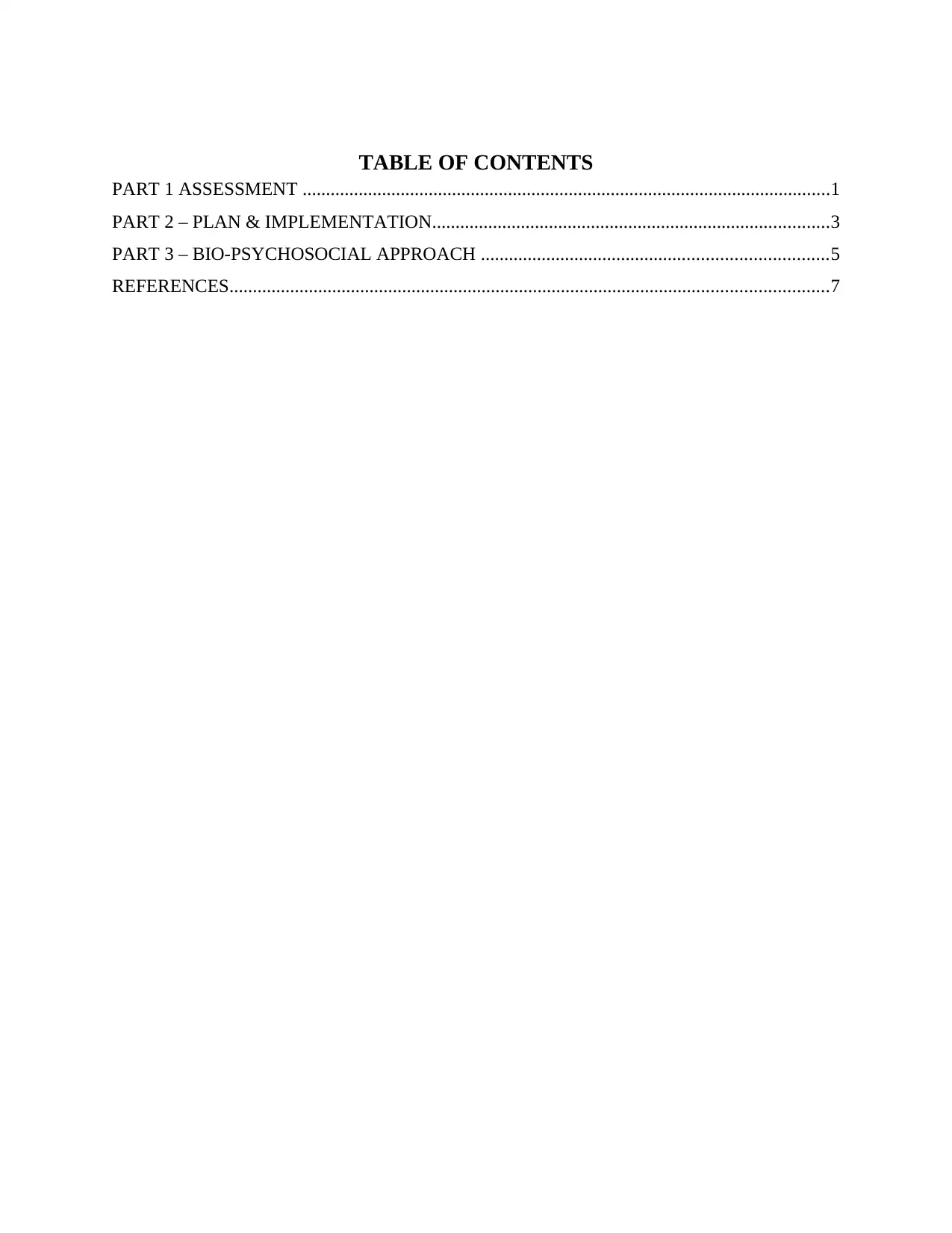
TABLE OF CONTENTS
PART 1 ASSESSMENT .................................................................................................................1
PART 2 – PLAN & IMPLEMENTATION.....................................................................................3
PART 3 – BIO-PSYCHOSOCIAL APPROACH ..........................................................................5
REFERENCES................................................................................................................................7
PART 1 ASSESSMENT .................................................................................................................1
PART 2 – PLAN & IMPLEMENTATION.....................................................................................3
PART 3 – BIO-PSYCHOSOCIAL APPROACH ..........................................................................5
REFERENCES................................................................................................................................7
PART 1 ASSESSMENT
Alcohol withdrawal risk assessment
Alcohol withdrawal risk assessment shows that there could be complication for the
withdrawal of alcohol leading to demand in the healthcare resources and to increase on the
mortality and morbidity. The purpose of alcohol risk assessment is to know about what will be
the risk factor which will faced by Mr. Jungala because of going through these changes. This is
because Withdrawal of alcohol may lead to fear or anxiety causing situational crisis, perceived
threat for death or the threat related to self-concept. People having severe alcohol addiction on
withdrawal may have the feelings of self-disgust, remorse and inadequacy, increased tension,
increased hopelessness. Mr. Jungala needs alcohol withdrawal risk assessments so that it
effectively may help in reduction of the anxiety and fear to manageable level. Professional may
build trusting relationship by frequent contact being non-judgemental and honest. It develops
humanness and helps in decreasing distrust and paranoia (Alcohol withdrawal risk assessment,
2019). Mr Jungala being a diabetic patient may face increased anxiety as also having
hypertension. Withdrawal may increase the anxiety and stress level for falling and for daughter
diagnosed with cancer. Due to this Mr Jungala may face reduction in sleeping hours due to
higher anxiety or feeling of inadequacy. The mortality may increase due to alcohol withdrawal
(Birken, & et.al., (2018). However, as the alcohol consumption is not at regular basis severe
complication may not be seen but the age factor could cause higher level of anxiety.
Cognitive assessment
It evaluates the important areas of the brain functions. It includes concentration, memory,
processing speed, reasoning capabilities and language. Cognitive assessment is critical to
complete the wellness as it sets personalised benchmark of the brain health for comparison in
future. Cognitive assessment allows the neuropsychologist in tracking changes of the brain
health. It could be analysed from the medical history of Mr Jungala that cognitive function shows
no worries however due to hypertension and diabetes it may develop issues related to the
cognitive functions. Diabetes was caused due to hereditary and fall last year affected the renal
functioning. Increase in angina can also cause cognitive function. The stress level will increase
the cognitive risks due to cancer diagnosed in youngest daughter. Also the anxiety level may
affect the brain functioning to take decisions, visionary issues and memory problems. There may
also be difficulty in sensory functions which is working effectively till now. The cognitive risk
1
Alcohol withdrawal risk assessment
Alcohol withdrawal risk assessment shows that there could be complication for the
withdrawal of alcohol leading to demand in the healthcare resources and to increase on the
mortality and morbidity. The purpose of alcohol risk assessment is to know about what will be
the risk factor which will faced by Mr. Jungala because of going through these changes. This is
because Withdrawal of alcohol may lead to fear or anxiety causing situational crisis, perceived
threat for death or the threat related to self-concept. People having severe alcohol addiction on
withdrawal may have the feelings of self-disgust, remorse and inadequacy, increased tension,
increased hopelessness. Mr. Jungala needs alcohol withdrawal risk assessments so that it
effectively may help in reduction of the anxiety and fear to manageable level. Professional may
build trusting relationship by frequent contact being non-judgemental and honest. It develops
humanness and helps in decreasing distrust and paranoia (Alcohol withdrawal risk assessment,
2019). Mr Jungala being a diabetic patient may face increased anxiety as also having
hypertension. Withdrawal may increase the anxiety and stress level for falling and for daughter
diagnosed with cancer. Due to this Mr Jungala may face reduction in sleeping hours due to
higher anxiety or feeling of inadequacy. The mortality may increase due to alcohol withdrawal
(Birken, & et.al., (2018). However, as the alcohol consumption is not at regular basis severe
complication may not be seen but the age factor could cause higher level of anxiety.
Cognitive assessment
It evaluates the important areas of the brain functions. It includes concentration, memory,
processing speed, reasoning capabilities and language. Cognitive assessment is critical to
complete the wellness as it sets personalised benchmark of the brain health for comparison in
future. Cognitive assessment allows the neuropsychologist in tracking changes of the brain
health. It could be analysed from the medical history of Mr Jungala that cognitive function shows
no worries however due to hypertension and diabetes it may develop issues related to the
cognitive functions. Diabetes was caused due to hereditary and fall last year affected the renal
functioning. Increase in angina can also cause cognitive function. The stress level will increase
the cognitive risks due to cancer diagnosed in youngest daughter. Also the anxiety level may
affect the brain functioning to take decisions, visionary issues and memory problems. There may
also be difficulty in sensory functions which is working effectively till now. The cognitive risk
1
⊘ This is a preview!⊘
Do you want full access?
Subscribe today to unlock all pages.

Trusted by 1+ million students worldwide
could be managed as Jungala spends time sitting alone and relaxing. Regular exercise in garden
or green environment and playing mind games may help in giving strength for cognitive
functions and managing the anxiety.
Falls Assessment
Falls are seen commonly in the adults above the age of 65 years. Fall risk assessment is
conducted to know how likely the individual will fall. Fall risk assessment is generally done for
the old age people and the people with severe medical issues. There are various factors that
increases risk to fall in the older adults. Fall risk could cause balance disorders, mobility
problems, impaired vision and the chronic illness (Birken, & et.al., (2019). It could range from
head injuries, mild bruising to the broken bones and even death in some of the cases. In older
adults falls could cause death. Fall risk factors in elderly age are seen due to increasing age,
cognitive impairment, medication use and the sensory deficits. Mr Jungala consumes alcohol and
have hypertension due to which fall risk is there. Medical history shows Jungala had experienced
fall that led to urine infection. Vision is low and anxiety while consuming alcohol may cause fall.
The fall risk high due to old age and vision. Glasses could be changed that allows to have clear
vision and alcohol consumption should also be reduced to minimum. Nervous systems are
working properly but the anxiety or stress level may cause fall.
Functional Assessment
Functional assessment refers to the objective review of the transfer skills, mobility and
the activities of the daily care such as sphincter control, self-care, locomotion and the
communication. It is performed for establishing baseline for predicting the rehabilitation
outcomes and for evaluating the therapeutic intervention and standardising the communication
for the research purposes. The scales vary greatly in respect to number, scoring and type of task
used for determining the performance levels, degree of standardisation and predictive validity.
Mr Jungala is able to perform all the daily functions on own and not having functional disability.
Is having visionary problems such as cataracts due to which cannot drive alone. Taking diabetic
diet that controls the the functioning of body parts. Central nervous system is working properly,
reactive to command and not time. Cannot attempt walking for long and take weights due to pain
in right hip area due to fall. There is decreased movement in the right hip area and tender on the
palpation of the right hip area (Burke, & et.al., (2016). Respiratory systems and urinary organs
2
or green environment and playing mind games may help in giving strength for cognitive
functions and managing the anxiety.
Falls Assessment
Falls are seen commonly in the adults above the age of 65 years. Fall risk assessment is
conducted to know how likely the individual will fall. Fall risk assessment is generally done for
the old age people and the people with severe medical issues. There are various factors that
increases risk to fall in the older adults. Fall risk could cause balance disorders, mobility
problems, impaired vision and the chronic illness (Birken, & et.al., (2019). It could range from
head injuries, mild bruising to the broken bones and even death in some of the cases. In older
adults falls could cause death. Fall risk factors in elderly age are seen due to increasing age,
cognitive impairment, medication use and the sensory deficits. Mr Jungala consumes alcohol and
have hypertension due to which fall risk is there. Medical history shows Jungala had experienced
fall that led to urine infection. Vision is low and anxiety while consuming alcohol may cause fall.
The fall risk high due to old age and vision. Glasses could be changed that allows to have clear
vision and alcohol consumption should also be reduced to minimum. Nervous systems are
working properly but the anxiety or stress level may cause fall.
Functional Assessment
Functional assessment refers to the objective review of the transfer skills, mobility and
the activities of the daily care such as sphincter control, self-care, locomotion and the
communication. It is performed for establishing baseline for predicting the rehabilitation
outcomes and for evaluating the therapeutic intervention and standardising the communication
for the research purposes. The scales vary greatly in respect to number, scoring and type of task
used for determining the performance levels, degree of standardisation and predictive validity.
Mr Jungala is able to perform all the daily functions on own and not having functional disability.
Is having visionary problems such as cataracts due to which cannot drive alone. Taking diabetic
diet that controls the the functioning of body parts. Central nervous system is working properly,
reactive to command and not time. Cannot attempt walking for long and take weights due to pain
in right hip area due to fall. There is decreased movement in the right hip area and tender on the
palpation of the right hip area (Burke, & et.al., (2016). Respiratory systems and urinary organs
2
Paraphrase This Document
Need a fresh take? Get an instant paraphrase of this document with our AI Paraphraser
functioning is normal. CNS disorders may occur due to the stress of daughter leading to
hypertension and anxiety.
Nutritional Assessment
The assessment is deep evaluation of the subjective and objective data related to the food
and nutritional intake, medical history and lifestyle. It is also referred as systematic process
involving collection and the interpretation of information to make decisions on nature and cause
of the health issues related to the nutrition which could affect the individual. It could be
nutritional screening that is brief risk assessment that could be carried by healthcare practitioner
or nutritional assessment by the dietician. Mr Jungala is patient of hypertension, diabetes and
unstable angina. It is essential to have balanced and nutritional diet for the patient. Mr Jungala is
having diabetic diet with proper medication. Consumes beer that could affect the health due to
diabetes. Takes regular doctor check-ups with diabetic doctors and a balanced diabetic diet. Does
not smoke or intakes any other food or substance causing health issues (Geurts, & et.al., (2016).
Diabetic is essential for making insulin for controlling the blood sugar levels and proper and
boosting the immune system. Higher alcohol consumption or junk food can cause severe health
issues to Jungala being a diabetic patient.
PART 2 – PLAN & IMPLEMENTATION
Mr Jungala is 71-year-old man who has suffered from the fall last year and has suffered
renal failure and also got angina last year. The one body system which has been affected is
endocrine system. Mr Jangula's diabetes, retinopathy (low vision) and medications drug
interaction with others that he is taking (metformin) contributing to his fall. This is the reason
that Mr. Jungala is risk of falling The nursing actions will be taken for the age related issues in
which risk of fall is focused which caused the soft tissue injury in the right hip. In the people
above age of 65 risk of fall increases due to various causes such as loss of muscle power,
impaired physical mobility, sensory perceptions or vision. The nursing actions will reduce the
risk of fall for Jungala that can cause severe complications leading to long time hospitality. The
age related issues also include diminished physiologic reserve and renal function. There is risk of
injury due to impaired perceptual/ sensory reception with poor hearing or vision
Risk for Fall
Interventions and rationale:
3
hypertension and anxiety.
Nutritional Assessment
The assessment is deep evaluation of the subjective and objective data related to the food
and nutritional intake, medical history and lifestyle. It is also referred as systematic process
involving collection and the interpretation of information to make decisions on nature and cause
of the health issues related to the nutrition which could affect the individual. It could be
nutritional screening that is brief risk assessment that could be carried by healthcare practitioner
or nutritional assessment by the dietician. Mr Jungala is patient of hypertension, diabetes and
unstable angina. It is essential to have balanced and nutritional diet for the patient. Mr Jungala is
having diabetic diet with proper medication. Consumes beer that could affect the health due to
diabetes. Takes regular doctor check-ups with diabetic doctors and a balanced diabetic diet. Does
not smoke or intakes any other food or substance causing health issues (Geurts, & et.al., (2016).
Diabetic is essential for making insulin for controlling the blood sugar levels and proper and
boosting the immune system. Higher alcohol consumption or junk food can cause severe health
issues to Jungala being a diabetic patient.
PART 2 – PLAN & IMPLEMENTATION
Mr Jungala is 71-year-old man who has suffered from the fall last year and has suffered
renal failure and also got angina last year. The one body system which has been affected is
endocrine system. Mr Jangula's diabetes, retinopathy (low vision) and medications drug
interaction with others that he is taking (metformin) contributing to his fall. This is the reason
that Mr. Jungala is risk of falling The nursing actions will be taken for the age related issues in
which risk of fall is focused which caused the soft tissue injury in the right hip. In the people
above age of 65 risk of fall increases due to various causes such as loss of muscle power,
impaired physical mobility, sensory perceptions or vision. The nursing actions will reduce the
risk of fall for Jungala that can cause severe complications leading to long time hospitality. The
age related issues also include diminished physiologic reserve and renal function. There is risk of
injury due to impaired perceptual/ sensory reception with poor hearing or vision
Risk for Fall
Interventions and rationale:
3
There are different interventions which can be taken in order to reduce down the risk of fall.
In this health care professionals Identifying factors that increases the risk of fall for patients. It
will help to determine the interventions essential for Jungala. Risk factors includes motor
deficits, illness, age, medication and use of mobility aids. Care provider will Assessing place of
living for the factors associated with risk for fall. To make right placement of the furniture of
house or having inadequate lightning as Jungala is having vision problem that increases risk for
fall. They will be Securing wristband identification for warning the healthcare providers for
implementation of fall precaution on patients. Healthcare practitioner needs to recognise the
Jungala with high fall risk to implement the measure for promoting safety and preventing falls
(Hill & et.al., (2020). Carers Placing assistive equipment’s or devices and common use items in
the reach. Providing easy access over assistive devices and the personal care items. Other items
such as telephone, water and bell should be close for avoiding frequent reaching. They need to
Keeping bed of patient at lowest position. Keeping bed close to floor prevents the risk and injury
from fall. Ensuring that the room is properly lit and using bedside lamp or lights that could be
turned on in night. Lighting is very essential for old age people for avoiding obstacles in mobility
and with weak vision. Monitoring level of consciousness and the neurologic status of patient.
Evaluating pre-confusion functional ability and mental status from caregiver. Asking to perform
some mental tasks. It is component of mini mental status inspection which provides baseline to
succeed for evaluating confusion of patient as Jungala is having anxiety. Task will indicate the
brain functioning. Determining cause of acute confusion. It may cause by psychological and
physical conditions and not only due to age factor. Hydration status could be evaluated through
pinching the sternum or the clavicle for turgor (Holahan, & et.al., (2016). Also observing dry
mucous membrane and furrowed tongue of Jungala as CNS history is normal of Jungala.
Assessing apical pulse and informing physician of new episode of the irregular pulse. Checking
for dysrhythmia. Cardiac abnormalities and dysrhythmias could lead to poor brain oxygenation
resulting in confusion. Review existing medications including OTC drugs with pharmacist. Some
high level medications like anti cholinergic agents, drug interaction and digoxin could cause
acute confusion. Having patient to wear hearing aids and glasses. Hearing aids and glasses likely
reduces the sensory confusion.
4
In this health care professionals Identifying factors that increases the risk of fall for patients. It
will help to determine the interventions essential for Jungala. Risk factors includes motor
deficits, illness, age, medication and use of mobility aids. Care provider will Assessing place of
living for the factors associated with risk for fall. To make right placement of the furniture of
house or having inadequate lightning as Jungala is having vision problem that increases risk for
fall. They will be Securing wristband identification for warning the healthcare providers for
implementation of fall precaution on patients. Healthcare practitioner needs to recognise the
Jungala with high fall risk to implement the measure for promoting safety and preventing falls
(Hill & et.al., (2020). Carers Placing assistive equipment’s or devices and common use items in
the reach. Providing easy access over assistive devices and the personal care items. Other items
such as telephone, water and bell should be close for avoiding frequent reaching. They need to
Keeping bed of patient at lowest position. Keeping bed close to floor prevents the risk and injury
from fall. Ensuring that the room is properly lit and using bedside lamp or lights that could be
turned on in night. Lighting is very essential for old age people for avoiding obstacles in mobility
and with weak vision. Monitoring level of consciousness and the neurologic status of patient.
Evaluating pre-confusion functional ability and mental status from caregiver. Asking to perform
some mental tasks. It is component of mini mental status inspection which provides baseline to
succeed for evaluating confusion of patient as Jungala is having anxiety. Task will indicate the
brain functioning. Determining cause of acute confusion. It may cause by psychological and
physical conditions and not only due to age factor. Hydration status could be evaluated through
pinching the sternum or the clavicle for turgor (Holahan, & et.al., (2016). Also observing dry
mucous membrane and furrowed tongue of Jungala as CNS history is normal of Jungala.
Assessing apical pulse and informing physician of new episode of the irregular pulse. Checking
for dysrhythmia. Cardiac abnormalities and dysrhythmias could lead to poor brain oxygenation
resulting in confusion. Review existing medications including OTC drugs with pharmacist. Some
high level medications like anti cholinergic agents, drug interaction and digoxin could cause
acute confusion. Having patient to wear hearing aids and glasses. Hearing aids and glasses likely
reduces the sensory confusion.
4
⊘ This is a preview!⊘
Do you want full access?
Subscribe today to unlock all pages.
Trusted by 1+ million students worldwide
PART 3 – BIO-PSYCHOSOCIAL APPROACH
Factors impacting Mr Jungala's psychosocial health both positively and negatively
Emotional, mental, spiritual and social health are the components of the psychosocial
health. Their interrelationship and balance helps person to lead healthier life (Psychosocial
factors influencing Healthy ageing, 2020). There are also things that could throw people out of
the whack and send them into psychological tailspin if they are not caught at early stage (Souza
Neto, & et.al., (2017). Analysing positive and negative factors helps in managing psychosocial
health.
Positive Factors impacting psychosocial healthcare
Mr Jungala is staying with wife and girls and their kids at home. The tablets are working
and helping to manage angina. Family and friends are always there for support and help. Relaxes
sitting down and does not stress much. The family is full supportive and is having healthy
relation with wife from 51 years. Have strength of spirit for family and country.
Negative Factors impacting psychosocial healthcare
The negative factors include diabetes, unstable angina and diabetes, cannot walk long and
take weight due to the pain in right hip bone from fall. Cannot drive due to weak vision and is
dependent on other for taking for clinical check ups and other works. Stress and anxiety due to
cancer of daughter and fear to fall which caused urine infection and renal failure.
Coping mechanisms and social support networks
Coping mechanism that will be useful and helpful for Mr Jungala
Cognitive behavioural therapy technique can help Jungala in finding new ways by
changing the thought patterns. It reduces the stress level, coping with complex situations,
dealing with griefs and to face common life challenges positively.
Aromatherapy is beneficial therapy that helps in activating receptors and strengthening
brain receptors and in easing the anxiety.
Slow breathing whenever feeling anxious as breath becomes fast and shallow. Slowing
down breathing will reduce the anxiety and stress level.
Social problem solving is method designed to help the patients when facing peer pressure
or decision involving dilemma. Through this process Jungala can thought of having
5
Factors impacting Mr Jungala's psychosocial health both positively and negatively
Emotional, mental, spiritual and social health are the components of the psychosocial
health. Their interrelationship and balance helps person to lead healthier life (Psychosocial
factors influencing Healthy ageing, 2020). There are also things that could throw people out of
the whack and send them into psychological tailspin if they are not caught at early stage (Souza
Neto, & et.al., (2017). Analysing positive and negative factors helps in managing psychosocial
health.
Positive Factors impacting psychosocial healthcare
Mr Jungala is staying with wife and girls and their kids at home. The tablets are working
and helping to manage angina. Family and friends are always there for support and help. Relaxes
sitting down and does not stress much. The family is full supportive and is having healthy
relation with wife from 51 years. Have strength of spirit for family and country.
Negative Factors impacting psychosocial healthcare
The negative factors include diabetes, unstable angina and diabetes, cannot walk long and
take weight due to the pain in right hip bone from fall. Cannot drive due to weak vision and is
dependent on other for taking for clinical check ups and other works. Stress and anxiety due to
cancer of daughter and fear to fall which caused urine infection and renal failure.
Coping mechanisms and social support networks
Coping mechanism that will be useful and helpful for Mr Jungala
Cognitive behavioural therapy technique can help Jungala in finding new ways by
changing the thought patterns. It reduces the stress level, coping with complex situations,
dealing with griefs and to face common life challenges positively.
Aromatherapy is beneficial therapy that helps in activating receptors and strengthening
brain receptors and in easing the anxiety.
Slow breathing whenever feeling anxious as breath becomes fast and shallow. Slowing
down breathing will reduce the anxiety and stress level.
Social problem solving is method designed to help the patients when facing peer pressure
or decision involving dilemma. Through this process Jungala can thought of having
5
Paraphrase This Document
Need a fresh take? Get an instant paraphrase of this document with our AI Paraphraser
problem and reaching over decision (Ways for coping with anxiety, 2020). It increases
mind functioning and to come at possible outcomes
Interdisciplinary team referrals
Mr Jungala could consult interdisciplinary team. It will help in consulting the right
physician and medical practitioner related to the health issues. The team ensures that health
issues are managed using concerned therapies and steps. Diabetologist may be consulted at
timely intervals for checking the diabetes level as they are specialist in diabetes who will help in
managing the sugar level. Dietitian can be consulted for proper diabetic diet which is essential
for proper insulin secretion to maintain the blood sugar level that can sever health complexions.
Jungala is also having vision problem for which eye doctor needs to be consulted for diagnosing
and eye screening (Tuinman, & et.al., (2017). It will reduce the risk of fall or risk of injury due to
reduced vision. Psychologist will help Jungala in managing the stress level and easing anxiety
through various strategies and stress release methods. The anxiety and hypertension will be
managed by the psychotherapy and other mental exercises.
6
mind functioning and to come at possible outcomes
Interdisciplinary team referrals
Mr Jungala could consult interdisciplinary team. It will help in consulting the right
physician and medical practitioner related to the health issues. The team ensures that health
issues are managed using concerned therapies and steps. Diabetologist may be consulted at
timely intervals for checking the diabetes level as they are specialist in diabetes who will help in
managing the sugar level. Dietitian can be consulted for proper diabetic diet which is essential
for proper insulin secretion to maintain the blood sugar level that can sever health complexions.
Jungala is also having vision problem for which eye doctor needs to be consulted for diagnosing
and eye screening (Tuinman, & et.al., (2017). It will reduce the risk of fall or risk of injury due to
reduced vision. Psychologist will help Jungala in managing the stress level and easing anxiety
through various strategies and stress release methods. The anxiety and hypertension will be
managed by the psychotherapy and other mental exercises.
6
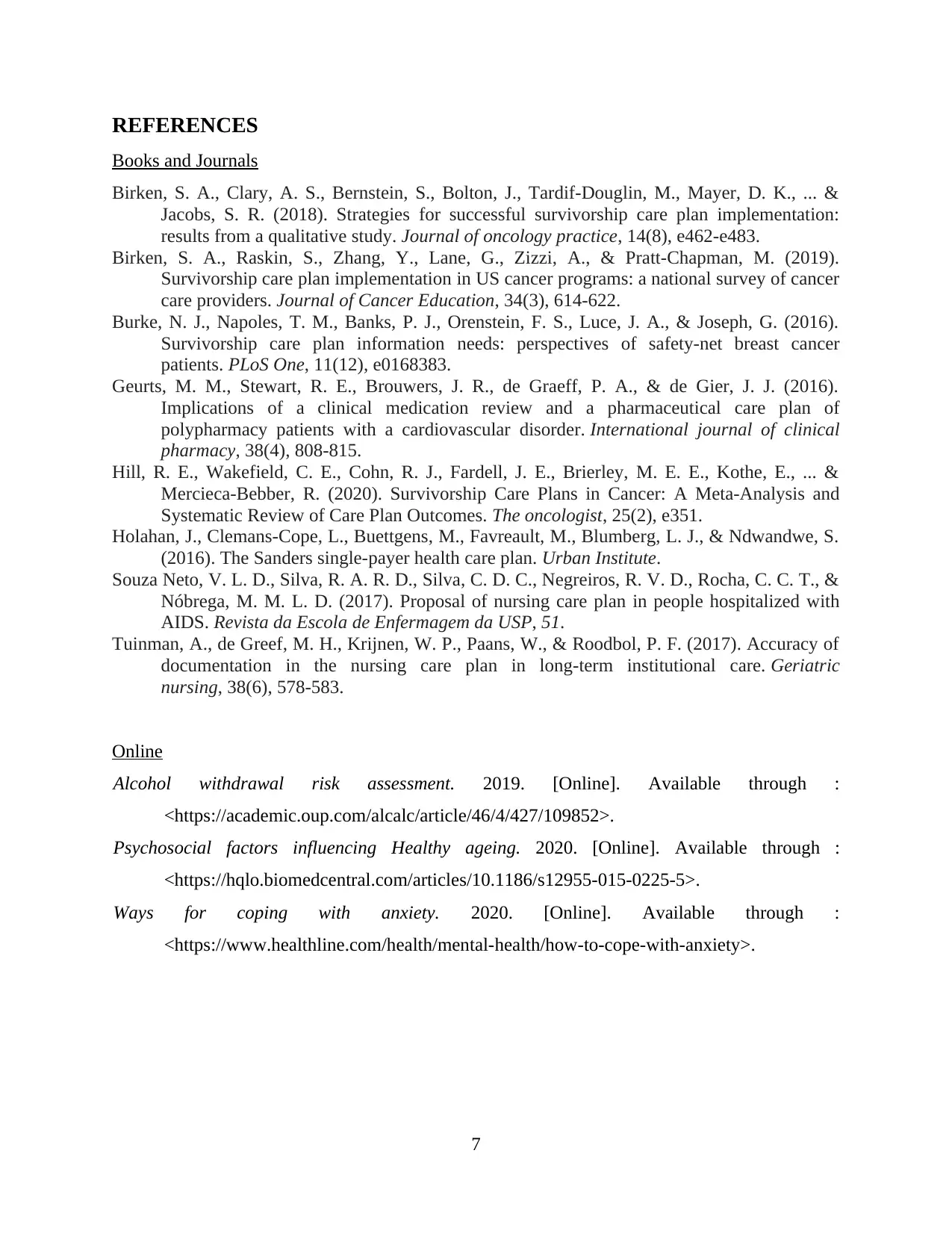
REFERENCES
Books and Journals
Birken, S. A., Clary, A. S., Bernstein, S., Bolton, J., Tardif-Douglin, M., Mayer, D. K., ... &
Jacobs, S. R. (2018). Strategies for successful survivorship care plan implementation:
results from a qualitative study. Journal of oncology practice, 14(8), e462-e483.
Birken, S. A., Raskin, S., Zhang, Y., Lane, G., Zizzi, A., & Pratt-Chapman, M. (2019).
Survivorship care plan implementation in US cancer programs: a national survey of cancer
care providers. Journal of Cancer Education, 34(3), 614-622.
Burke, N. J., Napoles, T. M., Banks, P. J., Orenstein, F. S., Luce, J. A., & Joseph, G. (2016).
Survivorship care plan information needs: perspectives of safety-net breast cancer
patients. PLoS One, 11(12), e0168383.
Geurts, M. M., Stewart, R. E., Brouwers, J. R., de Graeff, P. A., & de Gier, J. J. (2016).
Implications of a clinical medication review and a pharmaceutical care plan of
polypharmacy patients with a cardiovascular disorder. International journal of clinical
pharmacy, 38(4), 808-815.
Hill, R. E., Wakefield, C. E., Cohn, R. J., Fardell, J. E., Brierley, M. E. E., Kothe, E., ... &
Mercieca‐Bebber, R. (2020). Survivorship Care Plans in Cancer: A Meta‐Analysis and
Systematic Review of Care Plan Outcomes. The oncologist, 25(2), e351.
Holahan, J., Clemans-Cope, L., Buettgens, M., Favreault, M., Blumberg, L. J., & Ndwandwe, S.
(2016). The Sanders single-payer health care plan. Urban Institute.
Souza Neto, V. L. D., Silva, R. A. R. D., Silva, C. D. C., Negreiros, R. V. D., Rocha, C. C. T., &
Nóbrega, M. M. L. D. (2017). Proposal of nursing care plan in people hospitalized with
AIDS. Revista da Escola de Enfermagem da USP, 51.
Tuinman, A., de Greef, M. H., Krijnen, W. P., Paans, W., & Roodbol, P. F. (2017). Accuracy of
documentation in the nursing care plan in long-term institutional care. Geriatric
nursing, 38(6), 578-583.
Online
Alcohol withdrawal risk assessment. 2019. [Online]. Available through :
<https://academic.oup.com/alcalc/article/46/4/427/109852>.
Psychosocial factors influencing Healthy ageing. 2020. [Online]. Available through :
<https://hqlo.biomedcentral.com/articles/10.1186/s12955-015-0225-5>.
Ways for coping with anxiety. 2020. [Online]. Available through :
<https://www.healthline.com/health/mental-health/how-to-cope-with-anxiety>.
7
Books and Journals
Birken, S. A., Clary, A. S., Bernstein, S., Bolton, J., Tardif-Douglin, M., Mayer, D. K., ... &
Jacobs, S. R. (2018). Strategies for successful survivorship care plan implementation:
results from a qualitative study. Journal of oncology practice, 14(8), e462-e483.
Birken, S. A., Raskin, S., Zhang, Y., Lane, G., Zizzi, A., & Pratt-Chapman, M. (2019).
Survivorship care plan implementation in US cancer programs: a national survey of cancer
care providers. Journal of Cancer Education, 34(3), 614-622.
Burke, N. J., Napoles, T. M., Banks, P. J., Orenstein, F. S., Luce, J. A., & Joseph, G. (2016).
Survivorship care plan information needs: perspectives of safety-net breast cancer
patients. PLoS One, 11(12), e0168383.
Geurts, M. M., Stewart, R. E., Brouwers, J. R., de Graeff, P. A., & de Gier, J. J. (2016).
Implications of a clinical medication review and a pharmaceutical care plan of
polypharmacy patients with a cardiovascular disorder. International journal of clinical
pharmacy, 38(4), 808-815.
Hill, R. E., Wakefield, C. E., Cohn, R. J., Fardell, J. E., Brierley, M. E. E., Kothe, E., ... &
Mercieca‐Bebber, R. (2020). Survivorship Care Plans in Cancer: A Meta‐Analysis and
Systematic Review of Care Plan Outcomes. The oncologist, 25(2), e351.
Holahan, J., Clemans-Cope, L., Buettgens, M., Favreault, M., Blumberg, L. J., & Ndwandwe, S.
(2016). The Sanders single-payer health care plan. Urban Institute.
Souza Neto, V. L. D., Silva, R. A. R. D., Silva, C. D. C., Negreiros, R. V. D., Rocha, C. C. T., &
Nóbrega, M. M. L. D. (2017). Proposal of nursing care plan in people hospitalized with
AIDS. Revista da Escola de Enfermagem da USP, 51.
Tuinman, A., de Greef, M. H., Krijnen, W. P., Paans, W., & Roodbol, P. F. (2017). Accuracy of
documentation in the nursing care plan in long-term institutional care. Geriatric
nursing, 38(6), 578-583.
Online
Alcohol withdrawal risk assessment. 2019. [Online]. Available through :
<https://academic.oup.com/alcalc/article/46/4/427/109852>.
Psychosocial factors influencing Healthy ageing. 2020. [Online]. Available through :
<https://hqlo.biomedcentral.com/articles/10.1186/s12955-015-0225-5>.
Ways for coping with anxiety. 2020. [Online]. Available through :
<https://www.healthline.com/health/mental-health/how-to-cope-with-anxiety>.
7
⊘ This is a preview!⊘
Do you want full access?
Subscribe today to unlock all pages.
Trusted by 1+ million students worldwide

1 out of 9


Related Documents


Your All-in-One AI-Powered Toolkit for Academic Success.
+13062052269
info@desklib.com
Available 24*7 on WhatsApp / Email
![[object Object]](/_next/static/media/star-bottom.7253800d.svg)
Unlock your academic potential
Copyright © 2020–2026 A2Z Services. All Rights Reserved. Developed and managed by ZUCOL.