Analysis of Two Care Planning Frameworks: A Healthcare Report

Verified

Added on  2020/07/23

|7
|1695
|429
Report
AI Summary
This report provides an in-depth analysis of two care planning frameworks: Logan and Tierney's 12 activities of daily living and the APIE model. The report begins by introducing both frameworks, detailing their core principles and objectives. Logan and Tierney's model focuses on activities of daily living, emphasizing patient independence and holistic care. The APIE model, a problem-solving approach, is used to direct individuals in a systematic approach to solve the problems. The report compares and contrasts the two models, highlighting their similarities and differences in promoting patient health and independence. It explores how healthcare disciplines can utilize these frameworks, providing examples of their application in nursing practices, such as assessing patient needs, setting goals, and implementing interventions. The report also includes examples to illustrate how these frameworks can be applied in real-world scenarios. Furthermore, the report also includes reference to various books and journals to support the analysis.

Document Page
Report
1
tabler-icon-diamond-filled.svg

Paraphrase This Document

Need a fresh take? Get an instant paraphrase of this document with our AI Paraphraser
Document Page
1)
Table of Contents
Report...............................................................................................................................................1
Assessment part 1............................................................................................................................3
2.) Two of the care planning frameworks...............................................................................3
a.) Framework of Logan and Tierney’s 12 activities of daily living..........................................3
b.) Comparing and contrasting the Logan and Tierney’s 12 activities of daily living and
Orem’s self-care model of nursing..............................................................................................4
c.) Health or care disciplines might use Orem’s self-care model of nursing in their practice....5
Reference.........................................................................................................................................6
2
Document Page
Assessment part 1
Two of the care planning frameworks
Two of the care planning frameworks which have been chosen are Logan and Tierney’s
12 activities of daily living and
The Roper Logan Tierney model for nursing is a theory of nursing care-based activities
of daily living. These are basically abbreviated of ADL or ALs. The main purpose of this theory
is to provide intervention to the patient and make them independent (Williams, 2017). With the
use of this model, patient life can have changed and their illness can be measured. This theory
attempts to define what exactly means of living. Therefore, all the activities of living are
categorized in this model. Further, it helps in providing intervention which can support
independence in the area which is tough for the patient to address alone. The goal of using this
intervention and assessment is to promote maximum independence for the patient for their daily
activities (Kaşıkçı, Kılıçand and Şirin, 2015). This support in determining different intervention
that enhance independence and also ongoing support to those who are not enough capable to take
care of themselves.
As per the model, there are five factors which can influence the activities of living. Hence
incorporating all these factors into a theory of nursing lead to make it a holistic model (Williams,
2015). Apart from this sexuality and death of a patient is also considered in daily activities but
they are depended on the setting and situation of an individual.
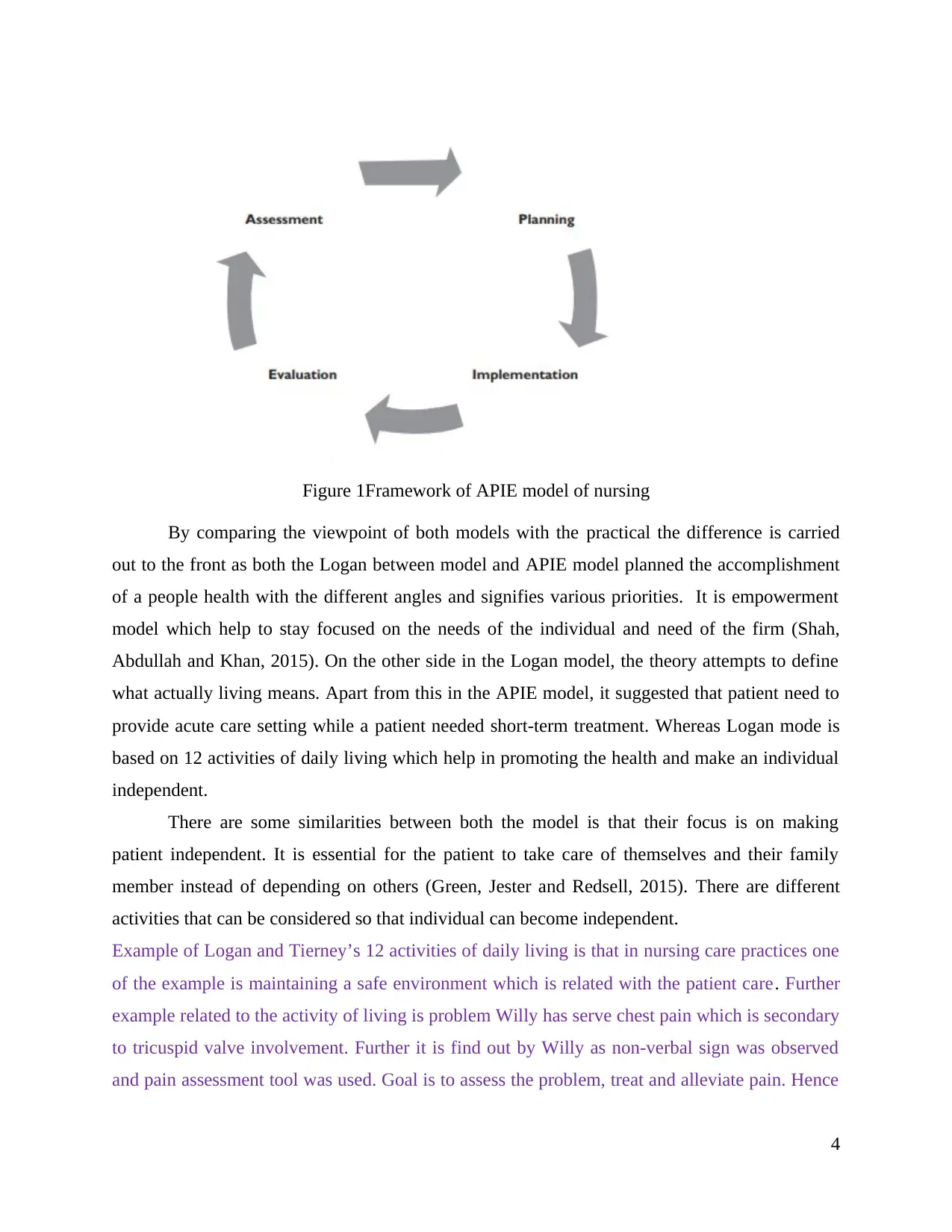
APIE is problem solving approach that is used to direct individuals in a systematic
approach to solve the problems. It is basically used in nursing for providing care and not only
looks illness or diseases but at the service user from the holistic view.
Care planning framework
Assess: Current needs and problem is assess which is presented upon referral and admission
Plan: Planning of goal and outcome for addressing the needs and increasing independent/
recovery
Implement: plan agreed by client and reflect with practice intervention and observation
Evaluate: The entire process with the multidisciplinary team and the client.
The APIE framework is classified into three stages because it is very familiar with the one most
of the people who are involved in health and social care practices.
3
Document Page
Figure 1Framework of APIE model of nursing
By comparing the viewpoint of both models with the practical the difference is carried
out to the front as both the Logan between model and APIE model planned the accomplishment
of a people health with the different angles and signifies various priorities. It is empowerment
model which help to stay focused on the needs of the individual and need of the firm (Shah,
Abdullah and Khan, 2015). On the other side in the Logan model, the theory attempts to define
what actually living means. Apart from this in the APIE model, it suggested that patient need to
provide acute care setting while a patient needed short-term treatment. Whereas Logan mode is
based on 12 activities of daily living which help in promoting the health and make an individual
independent.
There are some similarities between both the model is that their focus is on making
patient independent. It is essential for the patient to take care of themselves and their family
member instead of depending on others (Green, Jester and Redsell, 2015). There are different
activities that can be considered so that individual can become independent.
Example of Logan and Tierney’s 12 activities of daily living is that in nursing care practices one
of the example is maintaining a safe environment which is related with the patient care. Further
example related to the activity of living is problem Willy has serve chest pain which is secondary
to tricuspid valve involvement. Further it is find out by Willy as non-verbal sign was observed
and pain assessment tool was used. Goal is to assess the problem, treat and alleviate pain. Hence
4
tabler-icon-diamond-filled.svg

Paraphrase This Document

Need a fresh take? Get an instant paraphrase of this document with our AI Paraphraser
Document Page
intervention find out is to educate the staff involved in caring for Willy for making sure that
holistic care is delivered.
For example healthcare discipline might use Logan and Tierney’s 12 activities of daily living in
their practices. For example nurses use this model for measuring the patients relative
independence and potential to be independent in the daily living activities. With the help of
this model nurses can identify intervention which help them in increasing their
independence and support which they required. Here example can be considered of activity
of living: maintain a safe environment.
Problem Identification Goal Intervention
Willy is
diagnosed with
hepatitis C and
its level of
compliance with
a healthy
lifestyle is poor.
It can be reason
of lack of
education related
to health
A through
nursing
assessment it is
revealed drug
dependence. As
Willy has joined
drug dependence
clinic but do not
adhere to the
suggested
program.
Therefore, his
knowledge
deficit is noted
and documented
in care plan of
Willy
Goal of nursing
it to educate
Willy and
motivate so that
it can apply the
information
provided to them
related to his
diagnosis.
To acknowledge
nursing staff to
be involve in
caring of Willy
and make sure
that holistic care
is delivered to
him.
Apart from this APIE model also ensure physical requirement of an individual that proven to
be effective with respect to influence health of an individual. There are many text books that
focuses on the assessment stage and with the support of this they can easily identify the needs of
patients. A care plan can be changes if patient is not satisfied with the provided plan. Further,
5
Document Page
this theory signifies that all patients should care themselves which help them to recover faster.
They should holistically perform their own care and their family members (Mohammadpour,
Rahmati Sharghi and Akhond, 2015). Hence this model highly influences all patient’s
independence, but it cannot be applied to those who need full care such as aged and infants. As
they are not enough capable to care themselves or become independent.
The reason behind selecting APIE model of nursing and it is systematic organised
method of planning and providing quality and individualised nursing care. Further it is also a
problem-solving approach which directs the nurses and the client to determine the needs for
providing nursing care such as to plan and implement and evaluating the outcomes. This model
help in providing quality services to patient according to plan which is agreed by them. Through
proper planning chances of getting failed is reduced and patient can easily received effective
services.
6
Document Page
Books and journals
Alligood, M.R., 2017. Nursing Theorists and Their Work-E-Book. Elsevier Health Sciences.
Aydın, G. and Mucuk, S., 2015. The evaluation of daily living activities, pressure sores and risk
factors. Rehabilitation Nursing, 40(2), pp.84-91.
Bal Özkaptan, B. and Kapucu, S., 2016. Home nursing care with the selfcare model improves
selfefficacy of patients with chronic obstructive pulmonary disease. Japan Journal of
Nursing Science, 13(3), pp.365-377.
Green, J., Jester, R., McKinley, R., Pooler, A., Mason, S. and Redsell, S., 2015. A new quality of
life consultation template for patients with venous leg ulceration. Journal of wound care,
24(3), pp.140-148.
Kaşıkçı, M., Kılıç, D., Avşar, G. and Şirin, M., 2015. Prevalence of urinary incontinence in older
Turkish women, risk factors, and effect on activities of daily living. Archives of gerontology
and geriatrics, 61(2), pp.217-223.
Mahmoudzadeh, Z.F., Raiesifar, A. and Ebadi, A., 2016. The Effect of Orem’s Self-Care Model
on Quality of Life in Patients with Migraine: a Randomized Clinical Trial.
Mohammadpour, A., Rahmati Sharghi, N., Khosravan, S., Alami, A. and Akhond, M., 2015. The
effect of a supportive educational intervention developed based on the Orem's selfcare
theory on the selfcare ability of patients with myocardial infarction: a randomised controlled
trial. Journal of clinical nursing, 24(11-12), pp.1686-1692.
Shah, M., Abdullah, A. and Khan, H., 2015. Compare and Contrast of Grand Theories: Orem’s
Self-Care Deficit Theory and Roy’s Adaptation Model. INTERNATIONAL JOURNAL OF
NURSING, 5(1).
Williams, B.C., 2015. The Roper-Logan-Tierney model of nursing: A framework to complement
the nursing process. Nursing2017, 45(3), pp.24-26.
Williams, B.C., 2017. The Roper-Logan-Tierney model of nursing. Nursing2017 Critical Care,
12(1), pp.17-20.
7
chevron_up_icon
1 out of 7
circle_padding
hide_on_mobile
zoom_out_icon
[object Object]